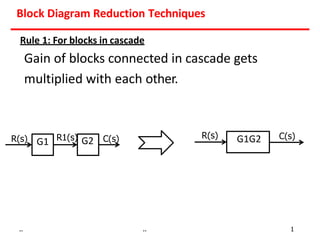
Rule 1: For blocks in cascade
Gain of blocks connected in cascade gets
multiplied with each other.
Block Diagram Reduction Techniques
G1
R(s) R1(s) G2 C(s) G1G2
R(s) C(s)
.. .. 1
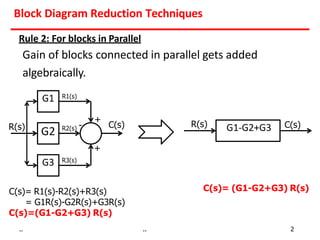
Rule 2: For blocks in Parallel
Gain of blocks connected in parallel gets added
algebraically.
Block Diagram Reduction Techniques
C(s)= (G1-G2+G3) R(s)
G1-G2+G3
R(s) C(s)
G1
G2
R(s) C(s)
G3
R1(s)
R3(s)
+
+
R2(s) -
C(s)= R1(s)-R2(s)+R3(s)
= G1R(s)-G2R(s)+G3R(s)
C(s)=(G1-G2+G3) R(s)
.. .. 2
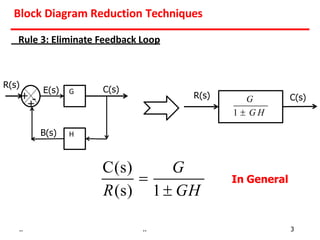
Rule 3: Eliminate Feedback Loop
Block Diagram Reduction Techniques
C(s)
G
H
R(s)
+
+
- R(s) C(s)
G
1  G H
B(s)
E(s)
C(s)
R(s) 1 GH
G
 In General
.. .. 3
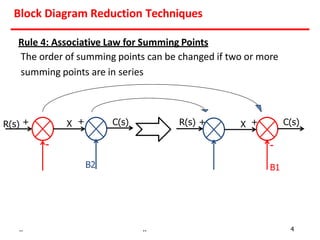
Rule 4: Associative Law for Summing Points
The order of summing points can be changed if two or more
summing points are in series
Block Diagram Reduction Techniques
C(s)
B2
R(s) + X +
-
C(s)
B1
R(s) + X +
-
.. .. 4
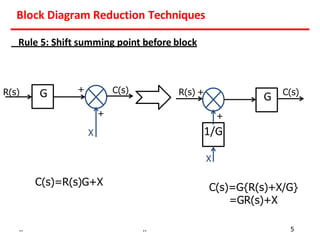
Rule 5: Shift summing point before block
Block Diagram Reduction Techniques
R(s) C(s)
X
+
G
C(s)=R(s)G+X
C(s)=G{R(s)+X/G}
=GR(s)+X
+
C(s)
R(s) +
G
1/G
X
+
.. .. 5
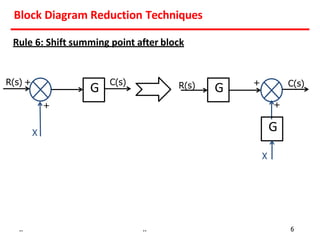
Rule 6: Shift summing point after block
Block Diagram Reduction Techniques
C(s)
R(s) +
G
X
+
R(s) C(s)
X
+
G
G
+
.. .. 6
Block Diagram Reduction Techniques
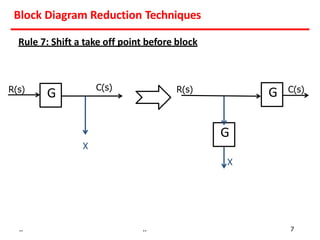
Rule 7: Shift a take off point before block
R(s) C(s)
G
X
R(s) C(s)
X
G
G
.. .. 7
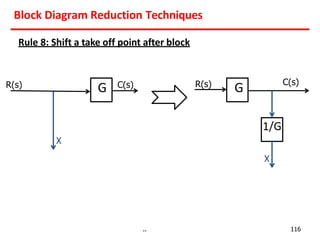
Rule 8: Shift a take off point after block
Block Diagram Reduction Techniques
R(s) C(s)
X
G R(s) C(s)
G
X
1/G
.. 116
Block Diagram Reduction Techniques
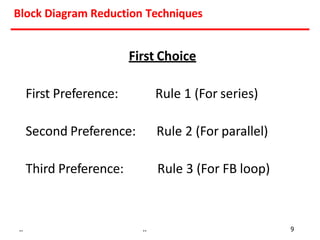
First Choice
First Preference: Rule 1 (For series)
Second Preference: Rule 2 (For parallel)
Third Preference: Rule 3 (For FB loop)
.. .. 9
Block Diagram Reduction Techniques
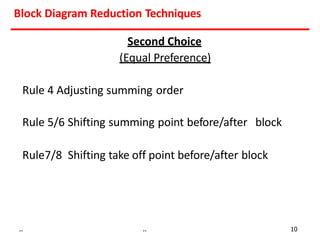
Second Choice
(Equal Preference)
Rule 4 Adjusting summing order
Rule 5/6 Shifting summing point before/after block
Rule7/8 Shifting take off point before/after block
.. .. 10
H1
G2 G3
H2
C(s)
R(s) + + +
+
- -
G1 G4
G5
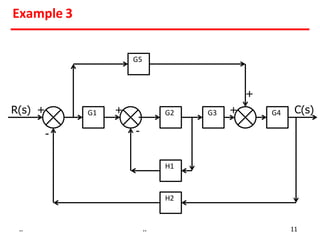
Example 3
.. .. 11
H1
G2 G3
H2
C(s)
R(s) + +
+
-
G1 G4
G5
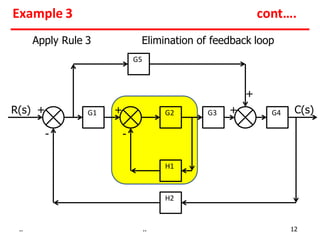
Apply Rule 3 Elimination of feedback loop
Example 3 cont….
+
.. .. 12
-
G3
H2
C(s)
R(s) + +
+
-
G1 G4
G5
Apply Rule 1 Blocks in series
G2
1  G2H1
Example 3 cont….
.. .. 13
H2
C(s)
R(s) + +
+
-
G4
G5
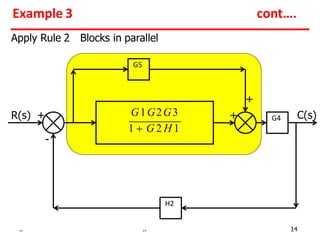
Apply Rule 2 Blocks in parallel
G1G2G3
1  G 2 H 1
Example 3 cont….
.. .. 14
H2
C(s)
R(s) +
-
G4
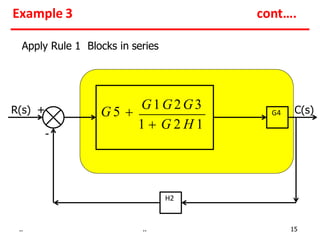
Apply Rule 1 Blocks in series
G 5 
G1G2G3
1  G 2 H 1
Example 3 cont….
.. .. 15
H2
C(s)
R(s) +
-
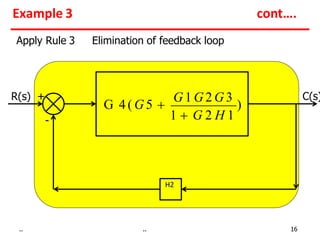
Apply Rule 3 Elimination of feedback loop
G 4(G5 
G1G2G3
)
1  G 2 H 1
Example 3 cont….
.. .. 16
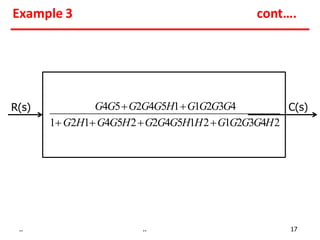
R(s) C(s)
G4G5G2G4G5H1G1G2G3G4
1G2H1G4G5H2G2G4G5H1H2G1G2G3G4H2
Example 3 cont….
.. .. 17
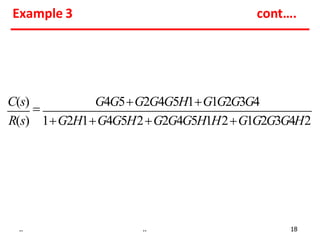
C(s)

G4G5G2G4G5H1G1G2G3G4
R(s) 1G2H1G4G5H2G2G4G5H1H2G1G2G3G4H2
Example 3 cont….
.. .. 18
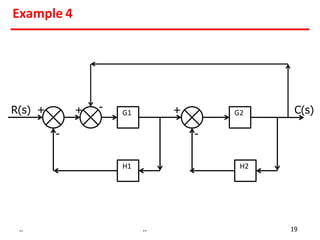
G1
H2
G2
H1
C(s)
R(s) + + -
-
-
+
Example 4
.. .. 19
G1
H2
G2
H1
C(s)
R(s) + +
-
-
+
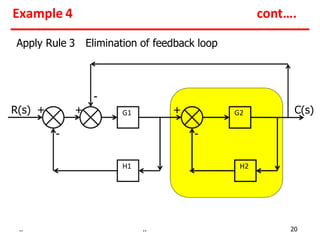
Apply Rule 3 Elimination of feedback loop
Example 4 cont….
-
.. .. 20
G1
H1
C(s)
R(s) + + -
-
G2
1 G2H 2
Example 4 cont….
.. .. 21
G1
H1
C(s)
+ -
-
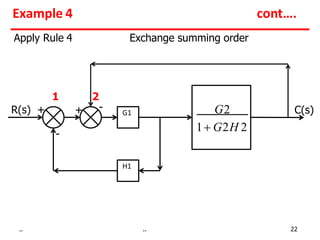
Apply Rule 4 Exchange summing order
G2
1 G2H 2
1
R(s) +
2
Example 4 cont….
.. .. 22
G1
H1
C(s)
+
-
-
Apply Rule 3 Elimination feedback loop
G2
1 G2H 2
1
2
R(s) +
Example 4 cont….
.. .. 23
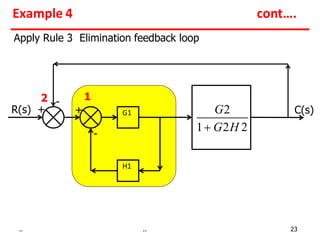
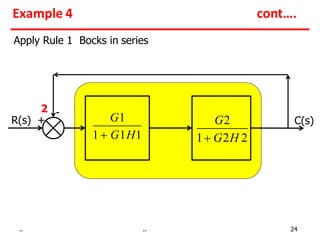
C(s)
-
Apply Rule 1 Bocks in series
G2
1 G2H 2
2
R(s) + G1
1  G1H1
Example 4 cont….
.. .. 24
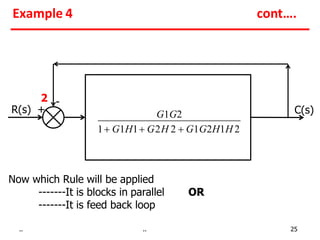
C(s)
-
2
R(s) +
Now which Rule will be applied
-------It is blocks in parallel
-------It is feed back loop
OR
G1G2
1 G1H1 G2H 2  G1G2H1H 2
Example 4 cont….
.. .. 25
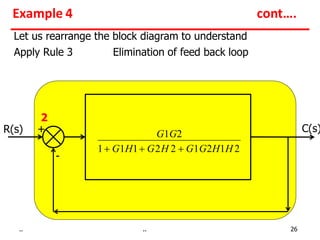
C(s)
-
2
R(s) +
Let us rearrange the block diagram to understand
Apply Rule 3 Elimination of feed back loop
G1G2
1 G1H1 G2H 2  G1G2H1H 2
Example 4 cont….
.. .. 26
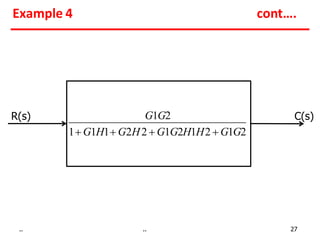
R(s) C(s)
G1G2
1G1H1 G2H2 G1G2H1H2 G1G2
Example 4 cont….
.. .. 27
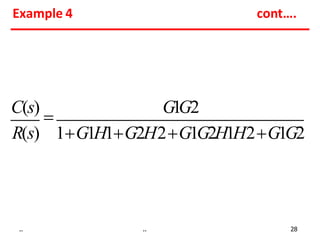
C(s)

G1G2
R(s) 1G1H1G2H2G1G2H1H2G1G2
Example 4 cont….
.. .. 28
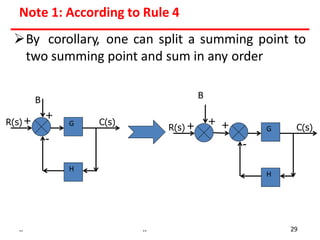
Note 1: According to Rule 4
By corollary, one can split a summing point to
two summing point and sum in any order
G
H
+
-
R(s)+ C(s)
B
G
H
+
-
R(s) C(s)
+ +
B
.. .. 29
G1
H1
C(s)
R(s) + +
-
G2 G3
H2
H3
-
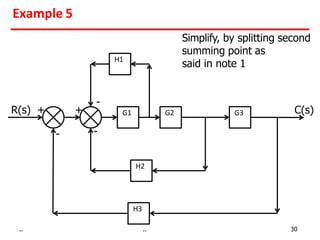
Simplify, by splitting second
summing point as
said in note 1
Example 5
-
.. .. 30
G1
H1
C(s)
+ + -
-
G2 G3
H2
H3
+
-
R(s)
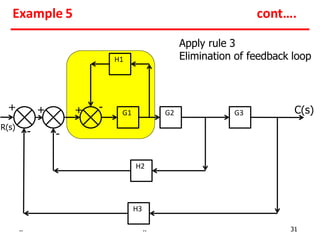
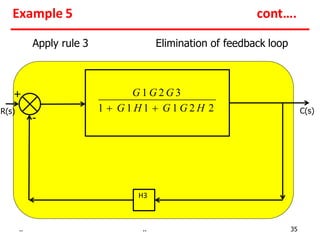
Apply rule 3
Elimination of feedback loop
Example 5 cont….
.. .. 31
C(s)
+
-
G2 G3
H2
H3
+
-
R(s)
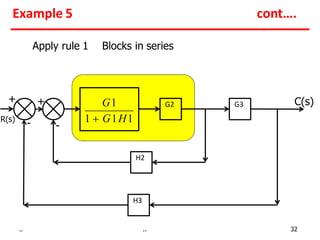
Apply rule 1 Blocks in series
G1
1  G1H1
Example 5 cont….
.. .. 32
C(s)
+
-
G3
H2
H3
+
-
R(s)
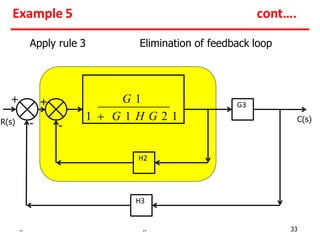
Apply rule 3 Elimination of feedback loop
G 1
1  G 1 H G 2 1
Example 5 cont….
.. .. 33
C(s)
G3
H3
+
-
R(s)
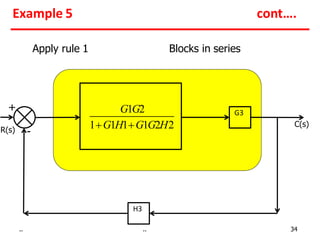
Apply rule 1 Blocks in series
G1G2
1G1H1G1G2H2
Example 5 cont….
.. .. 34
C(s)
H3
+
-
R(s)
Apply rule 3 Elimination of feedback loop
G 1 G 2 G 3
1  G 1 H 1  G 1 G 2 H 2
Example 5 cont….
.. .. 35
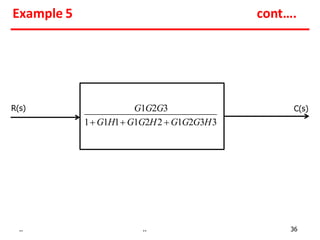
C(s)
R(s) G1G2G3
1 G1H1 G1G2H2  G1G2G3H3
Example 5 cont….
.. .. 36
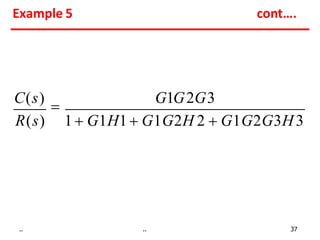
C(s)

G1G2G3
R(s) 1 G1H1 G1G2H 2  G1G2G3H3
Example 5 cont….
.. .. 37
H3
G2
H1
C(s)
R(s) + +
-
-
G1 G3
H2
-
+
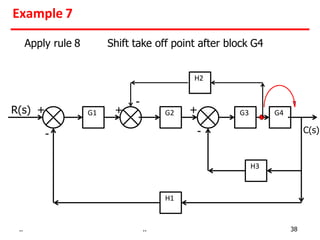
Apply rule 8 Shift take off point after block G4
G4
Example 7
.. .. 38
H3
G2
H1
C(s)
R(s) + +
-
-
G1 G3
H2
-
+
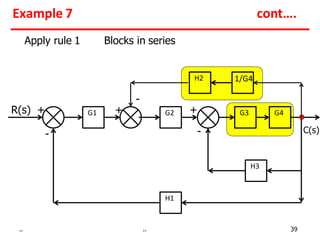
Apply rule 1 Blocks in series
G4
1/G4
Example 7 cont….
.. .. 39
H3
G2
H1
C(s)
R(s) + +
-
-
G1 G3G4
-
+
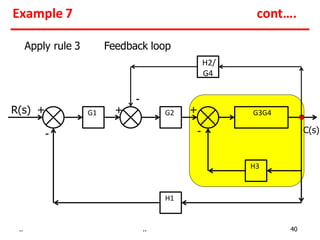
Apply rule 3 Feedback loop
H2/
G4
Example 7 cont….
.. .. 40
G2
H1
C(s)
R(s) + +
-
-
G1
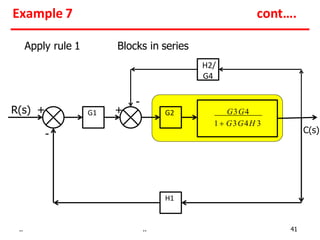
Apply rule 1 Blocks in series
H2/
G4
G3G4
1  G3G4H 3
Example 7 cont….
.. .. 41
H1
C(s)
R(s) + +
-
-
G1
Apply rule 3 Feedback loop
H2/
G4
G 2 G 3 G 4
1  G 3 G 4 H 3
Example 7 cont….
.. .. 42
H1
C(s)
R(s) +
-
G1
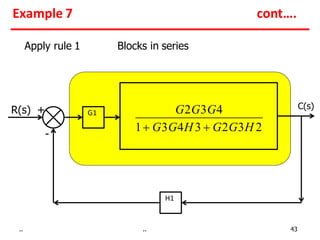
Apply rule 1 Blocks in series
G2G3G4
1 G3G4H 3  G2G3H 2
Example 7 cont….
.. .. 43
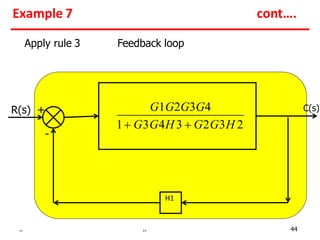
H1
C(s)
R(s) +
-
Apply rule 3 Feedback loop
G1G2G3G4
1 G3G4H 3  G2G3H 2
Example 7 cont….
.. .. 44
R(s) C(s)
G1G2G3G4
1 G3G4H3  G2G3H 2  G1G2G3G4H1
Example 7 cont….
.. .. 45
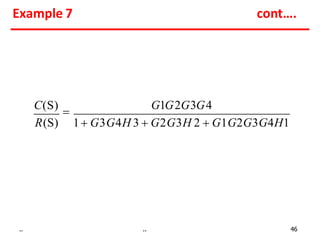
C(S)

G1G2G3G4
R(S) 1 G3G4H 3  G2G3H 2  G1G2G3G4H1
Example 7 cont….
.. .. 46

block diagram reduction with examples