Definition:
“CVA or stroke or brain attack is
sudden loss of neurological function
caused by an interruption of the
blood flow to the brain.” (O’Sullivan,
S. B., 2007)
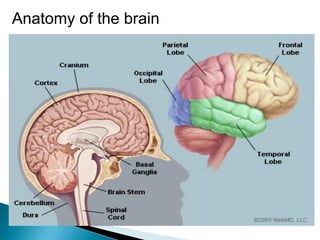
Anatomy of the brain
Function:
The cortex: thinking and voluntary
movements.
The brain stem: breathing and sleep
are controlled here.
The basal ganglia: coordinate
messages between multiple other
brain areas.
The cerebellum: coordination and
balance.
http://www.webmd.com/brain/picture-of-the-brain
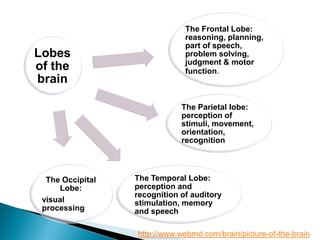
Lobes
of the
brain
The Frontal Lobe:
reasoning, planning,
part of speech,
problem solving,
judgment & motor
function.
The Parietal lobe:
perception of
stimuli, movement,
orientation,
recognition
The Temporal Lobe:
perception and
recognition of auditory
stimulation, memory
and speech
The Occipital
Lobe:
visual
processing
http://www.webmd.com/brain/picture-of-the-brain
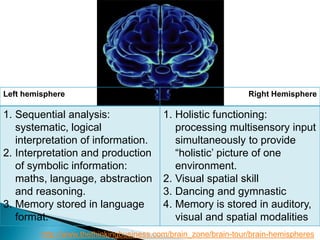
Left hemisphere Right Hemisphere
1. Sequential analysis:
systematic, logical
interpretation of information.
2. Interpretation and production
of symbolic information:
maths, language, abstraction
and reasoning.
3. Memory stored in language
format.
1. Holistic functioning:
processing multisensory input
simultaneously to provide
“holistic’ picture of one
environment.
2. Visual spatial skill
3. Dancing and gymnastic
4. Memory is stored in auditory,
visual and spatial modalities
http://www.thethinkingbusiness.com/brain_zone/brain-tour/brain-hemispheres
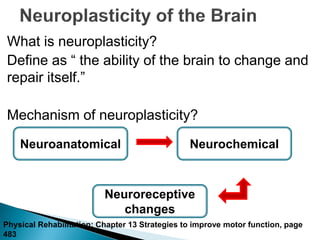
What is neuroplasticity?
Define as “ the ability of the brain to change and
repair itself.”
Mechanism of neuroplasticity?
Neuroanatomical Neurochemical
Neuroreceptive
changes
Physical Rehabilitation: Chapter 13 Strategies to improve motor function, page
483
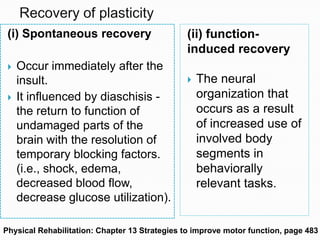
(i) Spontaneous recovery
 Occur immediately after the
insult.
 It influenced by diaschisis -
the return to function of
undamaged parts of the
brain with the resolution of
temporary blocking factors.
(i.e., shock, edema,
decreased blood flow,
decrease glucose utilization).
(ii) function-
induced recovery
 The neural
organization that
occurs as a result
of increased use of
involved body
segments in
behaviorally
relevant tasks.
Physical Rehabilitation: Chapter 13 Strategies to improve motor function, page 483
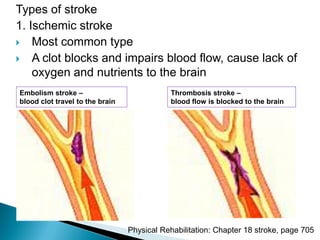
Types of stroke
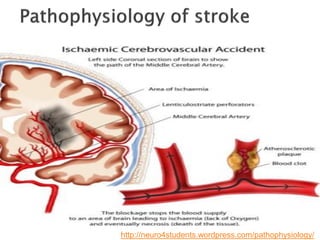
1. Ischemic stroke
 Most common type
 A clot blocks and impairs blood flow, cause lack of
oxygen and nutrients to the brain
Embolism stroke –
blood clot travel to the brain
Thrombosis stroke –
blood flow is blocked to the brain
Physical Rehabilitation: Chapter 18 stroke, page 705
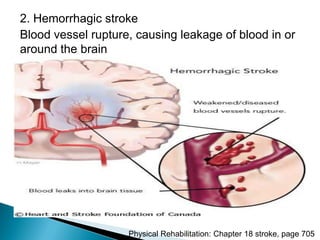
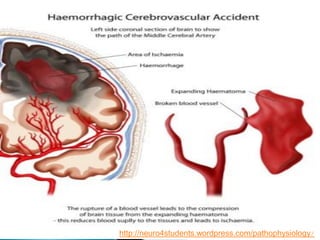
2. Hemorrhagic stroke
Blood vessel rupture, causing leakage of blood in or
around the brain
Physical Rehabilitation: Chapter 18 stroke, page 705
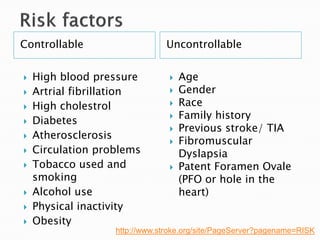
Controllable Uncontrollable
 High blood pressure
 Artrial fibrillation
 High cholestrol
 Diabetes
 Atherosclerosis
 Circulation problems
 Tobacco used and
smoking
 Alcohol use
 Physical inactivity
 Obesity
 Age
 Gender
 Race
 Family history
 Previous stroke/ TIA
 Fibromuscular
Dyslapsia
 Patent Foramen Ovale
(PFO or hole in the
heart)
http://www.stroke.org/site/PageServer?pagename=RISK
http://neuro4students.wordpress.com/pathophysiology/
1. Sudden numbness or weakness of the
face, arm, or leg, especially on one side of
the body.
2. Sudden confusion, trouble speaking or
understanding.
3. Sudden trouble seeing in one or both eyes.
4. Sudden trouble walking. Dizziness, loss of
balance or coordination.
5. Sudden, severe headaches with no known
cause.
Physical Rehabilitation: chapter 18 Stroke, page 707
Hemorrhagic stroke
Drugs and blood transfusion product that
clot the blood.
Surgical blood vessel repair
1. Surgical clipping
2. Coiling (endovascular embolization)
3. Surgical AVM removal
http://www.mayoclinic.com/health/stroke/DS00150/DSECTION=treatments-and-
drugs
Ischemic stroke
Therapy with clot-busting drugs (within 4.5hours)
Example: heparin, warfarin (Coumadin), aspirin, or
clopidogrel (Plavix).
Intravenous injection of tissue plasminogen
activator (TPA) – restore blood flow by dissolving
blood clot.
Emergency procedures
1. Medication delivered directly into the brain.
2. Mechanical clot removal
Other procedures:
1. Carotid endarterectomy
2. Angioplasty and stents
http://www.mayoclinic.com/health/stroke/DS00150/DSECTION=treatments-and-
drugs
Improve balance and walking.
Increase ability to roll/move in bed/sit/stand
Reduce muscle spasms, pain and stiffness
Increase strength
Retrain normal patterns of movement
Increase affected arm and leg function
Increase energy levels
Increase independence and quality of life
Reduce the risk of falls
http://www.manchesterneurophysio.co.uk/stroke/physiotherapy-treatment-cva.html

CVA

  • 2.
    Definition: “CVA or strokeor brain attack is sudden loss of neurological function caused by an interruption of the blood flow to the brain.” (O’Sullivan, S. B., 2007)
  • 3.
  • 4.
    Function: The cortex: thinkingand voluntary movements. The brain stem: breathing and sleep are controlled here. The basal ganglia: coordinate messages between multiple other brain areas. The cerebellum: coordination and balance. http://www.webmd.com/brain/picture-of-the-brain
  • 5.
    Lobes of the brain The FrontalLobe: reasoning, planning, part of speech, problem solving, judgment & motor function. The Parietal lobe: perception of stimuli, movement, orientation, recognition The Temporal Lobe: perception and recognition of auditory stimulation, memory and speech The Occipital Lobe: visual processing http://www.webmd.com/brain/picture-of-the-brain
  • 6.
    Left hemisphere RightHemisphere 1. Sequential analysis: systematic, logical interpretation of information. 2. Interpretation and production of symbolic information: maths, language, abstraction and reasoning. 3. Memory stored in language format. 1. Holistic functioning: processing multisensory input simultaneously to provide “holistic’ picture of one environment. 2. Visual spatial skill 3. Dancing and gymnastic 4. Memory is stored in auditory, visual and spatial modalities http://www.thethinkingbusiness.com/brain_zone/brain-tour/brain-hemispheres
  • 10.
    What is neuroplasticity? Defineas “ the ability of the brain to change and repair itself.” Mechanism of neuroplasticity? Neuroanatomical Neurochemical Neuroreceptive changes Physical Rehabilitation: Chapter 13 Strategies to improve motor function, page 483
  • 11.
    (i) Spontaneous recovery Occur immediately after the insult.  It influenced by diaschisis - the return to function of undamaged parts of the brain with the resolution of temporary blocking factors. (i.e., shock, edema, decreased blood flow, decrease glucose utilization). (ii) function- induced recovery  The neural organization that occurs as a result of increased use of involved body segments in behaviorally relevant tasks. Physical Rehabilitation: Chapter 13 Strategies to improve motor function, page 483
  • 12.
    Types of stroke 1.Ischemic stroke  Most common type  A clot blocks and impairs blood flow, cause lack of oxygen and nutrients to the brain Embolism stroke – blood clot travel to the brain Thrombosis stroke – blood flow is blocked to the brain Physical Rehabilitation: Chapter 18 stroke, page 705
  • 13.
    2. Hemorrhagic stroke Bloodvessel rupture, causing leakage of blood in or around the brain Physical Rehabilitation: Chapter 18 stroke, page 705
  • 14.
    Controllable Uncontrollable  Highblood pressure  Artrial fibrillation  High cholestrol  Diabetes  Atherosclerosis  Circulation problems  Tobacco used and smoking  Alcohol use  Physical inactivity  Obesity  Age  Gender  Race  Family history  Previous stroke/ TIA  Fibromuscular Dyslapsia  Patent Foramen Ovale (PFO or hole in the heart) http://www.stroke.org/site/PageServer?pagename=RISK
  • 15.
  • 16.
  • 17.
    1. Sudden numbnessor weakness of the face, arm, or leg, especially on one side of the body. 2. Sudden confusion, trouble speaking or understanding. 3. Sudden trouble seeing in one or both eyes. 4. Sudden trouble walking. Dizziness, loss of balance or coordination. 5. Sudden, severe headaches with no known cause. Physical Rehabilitation: chapter 18 Stroke, page 707
  • 18.
    Hemorrhagic stroke Drugs andblood transfusion product that clot the blood. Surgical blood vessel repair 1. Surgical clipping 2. Coiling (endovascular embolization) 3. Surgical AVM removal http://www.mayoclinic.com/health/stroke/DS00150/DSECTION=treatments-and- drugs
  • 19.
    Ischemic stroke Therapy withclot-busting drugs (within 4.5hours) Example: heparin, warfarin (Coumadin), aspirin, or clopidogrel (Plavix). Intravenous injection of tissue plasminogen activator (TPA) – restore blood flow by dissolving blood clot. Emergency procedures 1. Medication delivered directly into the brain. 2. Mechanical clot removal Other procedures: 1. Carotid endarterectomy 2. Angioplasty and stents http://www.mayoclinic.com/health/stroke/DS00150/DSECTION=treatments-and- drugs
  • 20.
    Improve balance andwalking. Increase ability to roll/move in bed/sit/stand Reduce muscle spasms, pain and stiffness Increase strength Retrain normal patterns of movement Increase affected arm and leg function Increase energy levels Increase independence and quality of life Reduce the risk of falls http://www.manchesterneurophysio.co.uk/stroke/physiotherapy-treatment-cva.html