An Introduction to
Primary and Secondary Sources
Primary
Sources
What are primary sources?
Original records from the past recorded by
people who were:
Involved in the event
Witnessed the event
Knew the persons involved in the event
They can also be objects (artifacts) or visual
evidence.
They give you an idea about what people
alive at the time saw or thought about the
event.
What are primary sources?
Keep in mind that a primary source reflects
only one point of view and may contain a
person’s bias (prejudice) toward an event.
What are primary sources?
Examples of primary sources:
Books, magazines, newspapers
Printed Publications
Examples of primary sources:
Personal Records
Diaries, journals, records
Examples of primary sources:
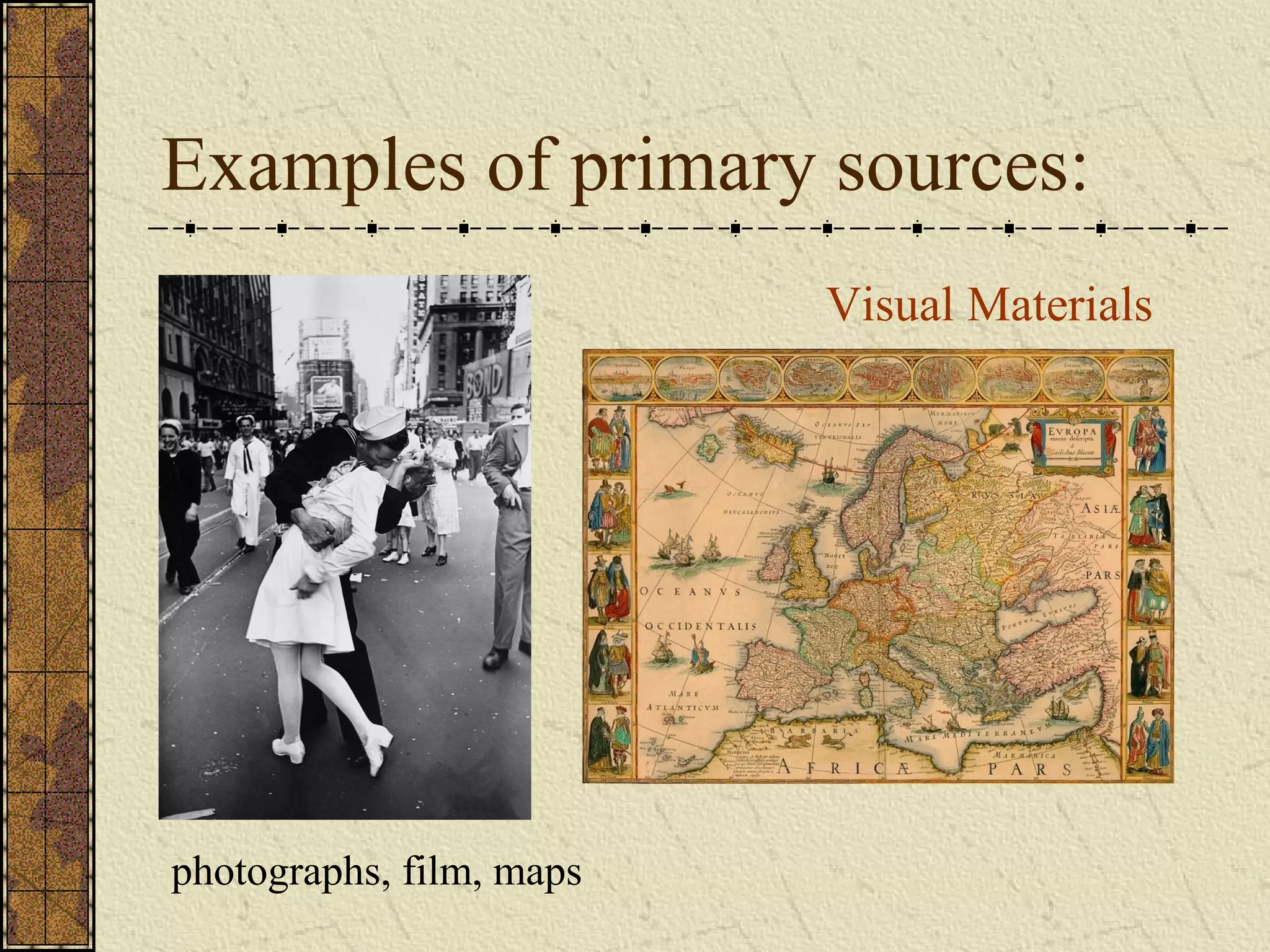
Visual Materials
Paintings, drawings, sculpture
Examples of primary sources:
Visual Materials
photographs, film, maps
Examples of primary sources:
Oral Histories
Chronicles, memoirs, myths, legends passed down by
word of mouth
Click on this button to hear an
example of oral history -------- >
Examples of primary sources:
Songs and Poems
Examples of primary sources:
Artifacts
Tools, ornaments, objects
Secondary Sources
What are secondary sources?
Secondary sources are made at a later time.
They include written information by
historians or others AFTER an event has
taken place.
What are secondary sources?
Although they can be useful and reliable,
they cannot reflect what people who lived at
the time thought or felt about the event.
But they can represent a more fair account
of the event because they can include more
than one point of view, or may include
information that was unavailable at the time
of the event.
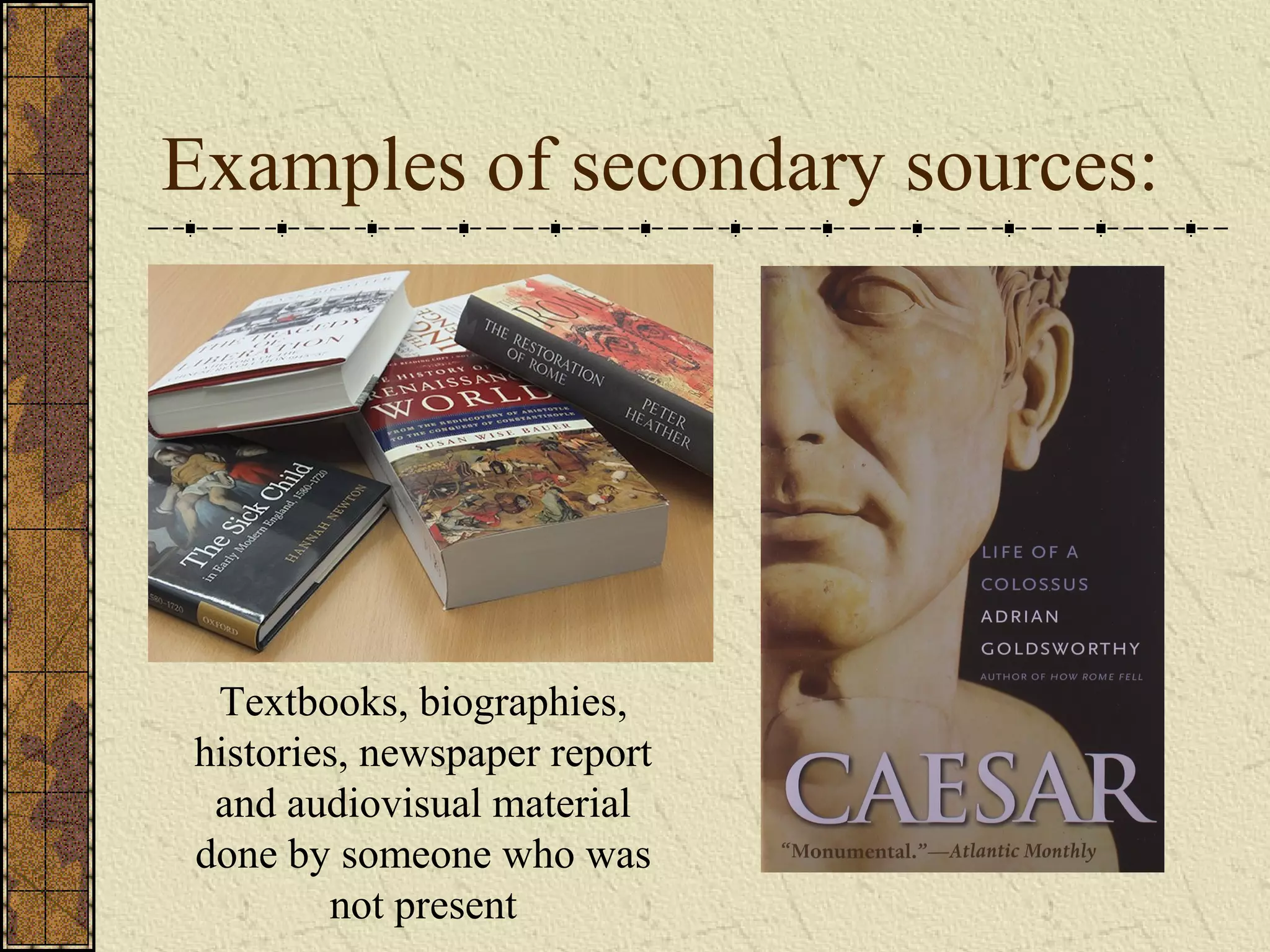
Examples of secondary sources:
Textbooks, biographies,
histories, newspaper report
and audiovisual material
done by someone who was
not present
Examples of secondary sources:
Charts, graphs, or images
created AFTER the time
period.
Name that Source!
The following slides contain examples of
primary and secondary sources. See if you can
classify each example as a primary or secondary
source.
Classify these: primary or
secondary?
Classify these: primary or
secondary?
Classify these: primary or
secondary?
Classify these: primary or
secondary?
The End

Historical sources

  • 1.
    An Introduction to Primaryand Secondary Sources
  • 2.
  • 3.
    What are primarysources? Original records from the past recorded by people who were: Involved in the event Witnessed the event Knew the persons involved in the event
  • 4.
    They can alsobe objects (artifacts) or visual evidence. They give you an idea about what people alive at the time saw or thought about the event. What are primary sources?
  • 5.
    Keep in mindthat a primary source reflects only one point of view and may contain a person’s bias (prejudice) toward an event. What are primary sources?
  • 6.
    Examples of primarysources: Books, magazines, newspapers Printed Publications
  • 7.
    Examples of primarysources: Personal Records Diaries, journals, records
  • 8.
    Examples of primarysources: Visual Materials Paintings, drawings, sculpture
  • 9.
    Examples of primarysources: Visual Materials photographs, film, maps
  • 10.
    Examples of primarysources: Oral Histories Chronicles, memoirs, myths, legends passed down by word of mouth Click on this button to hear an example of oral history -------- >
  • 11.
    Examples of primarysources: Songs and Poems
  • 12.
    Examples of primarysources: Artifacts Tools, ornaments, objects
  • 13.
  • 14.
    What are secondarysources? Secondary sources are made at a later time. They include written information by historians or others AFTER an event has taken place.
  • 15.
    What are secondarysources? Although they can be useful and reliable, they cannot reflect what people who lived at the time thought or felt about the event. But they can represent a more fair account of the event because they can include more than one point of view, or may include information that was unavailable at the time of the event.
  • 16.
    Examples of secondarysources: Textbooks, biographies, histories, newspaper report and audiovisual material done by someone who was not present
  • 17.
    Examples of secondarysources: Charts, graphs, or images created AFTER the time period.
  • 18.
    Name that Source! Thefollowing slides contain examples of primary and secondary sources. See if you can classify each example as a primary or secondary source.
  • 19.
  • 20.
  • 21.
  • 22.
  • 23.