Readings in
Philippine
History
PREPARED & COMPILED BY:
BRO. CARLOS B. DAVID O.P.
“WHO CONTROLS THE PRESENT,
CONTROLS THE PAST,
WHO CONTROLS THE PAST,
CONTROLS THE FUTURE”
- GEORGE ORWELL
What is your own definition of History?
Lesson 1—
Meaning of History
HISTORY
Etymologically, HISTORY (from Greek
word Historia, meaning “Knowledge
acquired by investigation)
HISTORY
On the other side, were the events occurring before
written record are considered prehistoric;
an umbrella term that relates to past events as well as
the memory, discovery, collection, organization,
presentation and interpretation of information about
these events.
Hence, scholars who write about history are called
Historians.
HISTORY
History is a narration of the events which have
happened among mankind, including an account of
the rise and fall of the nations, as well as of other great
changes which have affected the political and social
condition of the human race.
HISTORY
THE WORD ‘HISTORY ‘IS REFFERED
USUALLY FOR ACCOUNTS OF
PHENOMENA,
SPECIALLY OF HUMAN AFFAIRS IN
CHRONOLOGIAL ORDER.
HISTORY
There are theories constructed by
historians in investigating history;
✣ a). Factual History
✣ b). Speculative History
FACTUAL HISTORY
PRESENTS READERS THE PLAIN AND BASIC
INFORMATION, THE EVENTS THAT TOOK PLACE
(WHAT),
THE TIME AND DATE WITH WHICH THE EVENT
HAPPENED (WHEN),
THE PLACE WITH WHICH THE EVENT TOOK PLACE
(WHERE), AND
THE PEOPLE THAT WERE INVOLVED (WHO)
SPECULATIVE HISTORY
- It goes beyond facts because it is concerned
about the reasons for which events happened
(why),
and the way they happened (how).
- It tries to speculate on the cause and effect
of an event – (Cantal, Cardinal et.al.)
HISTORIOGRAPHY?
The practice of historical writing is
called historiography—the traditional
method in doing historical research
that focus on gathering of documents
from different libraries and archives
to form a pool of evidence needed in
making descriptive or analytical
narrative.
Understanding History;
by Louis Gottschalk
“Only a part of what was observed in the past
was remembered by those who observed it;
only a part of what was remembered was
recorded;
only a part of what was recorded has survived;
only a part of what has survived
has come to the historian’s attention.”
Understanding History;
by Louis Gottschalk CONT’D
“Only a part of what is credible has been
grasped, and only a part of what has been
grasped can be expounded or narrated by
the historian.”
LESSON 2
Sources and Historical data
Historical Sources
Sources – an object from the past
or testimony concerning the past
on which historians depend in order
to create their own depiction
of that past. .
Primary and Secondary Sources
✣ What are they?
✣ Advantages and disadvantages of using
Primary or Secondary sources
✣ Categories
Primary sources
✣ Primary sources enable the
researcher to get as close as
possible to what actually
happened during a historical
event or time period.
PRIMARY SOURCES
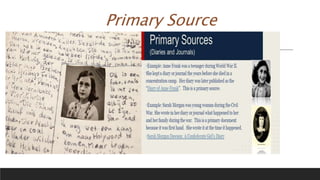
✣ Diaries and journals
⨳ Example: Anne Frank was a teenager during World War II. She
kept a diary or journal the years before she died in a concentration
camp. Her diary was later published as the
“Diary of Anne Frank”. This is a primary source.
⨳ Example: Sarah Morgan was young woman during the Civil War.
She wrote in her diary or journal what happened to her and her
family during the war. This is a primary document because it was
first hand. She wrote it at the time it happened.
⨳ Sarah Morgan Dawson: A Confederate Girl's Diary
Primary Source
Primary Source
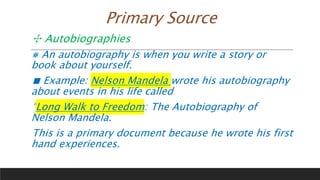
✣ Autobiographies
⨳ An autobiography is when you write a story or
book about yourself.
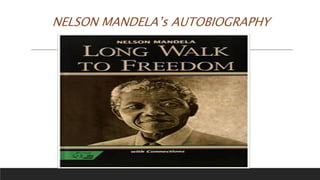
■ Example: Nelson Mandela wrote his autobiography
about events in his life called
“Long Walk to Freedom: The Autobiography of
Nelson Mandela.
This is a primary document because he wrote his first
hand experiences.
NELSON MANDELA’s AUTOBIOGRAPHY
PRIMARY SOURCES
✣ Sound Recordings and interviews are considered primary
resources.
⨳ Example
1: During the Great Depression and World War II, television had not been invented
yet.
The people would often sit around the radio to listen to President Roosevelt’ s war
messages. Those radio addresses are considered “primary sources.”
⨳ Example
2: During the 2008 election Barack Obama, had many interviews that were televised.
Those interviews are considered primary sources.
What is a secondary source?
A secondary source is something
written about a primary source.
SECONDARY SOURCE/s
• Secondary sources are written "after the fact" –
that is, at a later date.
• Usually the author of a secondary source will have
studied the primary sources of an historical period
or event and will then interpret the "evidence" found in
these sources.
• You can think of secondary sources as second-hand
information.
SECONDARY SOURCE
• Think about it like this….
• If I tell you something, I am the primary source.
If you tell someone else what I told you,
you are the secondary source.
• Secondary source materials can be articles in
newspapers, magazines, books or articles found that
evaluate or criticize someone else's original research
Why Use Primary Sources?
ADVANTAGES
✣ Primary sources provide a window into the
past—unfiltered access to the record of artistic,
social, scientific and political thought and
achievement during the specific period under study,
produced by people who lived during that period
✣ these unique, often profoundly personal,
documents and objects can give a very real sense of
what it was like to be alive during a long-past era.
Primary Source: Disadvantages
✣ Primary sources are often incomplete and have little
context.
Students must use prior knowledge and work with
multiple primary sources to find patterns
✣ In analyzing primary sources, students move from
concrete observations and facts to questioning and
making inferences about the materials.
Why Use Secondary Sources?
Advantages
✣ Secondary sources can provide analysis, synthesis,
interpretation, or evaluation of the original information. ✣
Secondary sources are best for uncovering background or
historical information about a topic and broadening your
understanding of a topic by exposing you to others’
perspectives, interpretations, and conclusions
✣ Allows the reader to get expert views of events and often
bring together multiple primary sources relevant to the subject
matter
Secondary Source
DISADVANTAGE
✣ Their reliability and validity are open to question, and
often they do not provide exact information
✣ They do not represent first hand knowledge of a subject
or event
✣ There are countless books, journals, magazine articles
and web pages that attempt to interpret the past and
finding good secondary sources can be an issu
Written Sources of History
• Narrative or Literary
• Diplomatic or Juridical
• Social Documents
Diplomatic Sources
✣ It is these kind of sources that professional historians
once treated as purest, “best” source.
A legal document is usually sealed or authenticated to
provide evidence that a legal transaction has been
completed and can be used as evidence in judicial
proceedings in case of dispute.
Social Documents
✣ These are information pertaining to
economic, social, political or judicial
significance.
✣ They are records kept by bureaucracies.
Examples — such as government reports,
Municipal accounts, property registers and
records of census.
Historical Criticisms
What is Historical Criticism?
In order for a source to be used as
evidence in history, basic matters
about its form and
content must be settled
2 Types of Historical Criticisms
1. External Criticism
2. Internal Criticism
What is External Criticism?
The problem of authenticity
To spot fabricated, forged, faked
documents
To distinguish a hoax or
misrepresentation
Tests of Authenticity
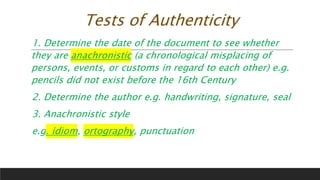
1. Determine the date of the document to see whether
they are anachronistic (a chronological misplacing of
persons, events, or customs in regard to each other) e.g.
pencils did not exist before the 16th Century
2. Determine the author e.g. handwriting, signature, seal
3. Anachronistic style
e.g. idiom, ortography, punctuation
Tests of Authenticity
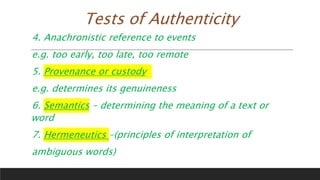
4. Anachronistic reference to events
e.g. too early, too late, too remote
5. Provenance or custody
e.g. determines its genuineness
6. Semantics – determining the meaning of a text or
word
7. Hermeneutics –(principles of interpretation of
ambiguous words)
What is Internal Criticism?
The Problem of Credibility
Relevant particulars in the document – is it
credible?
Verisimilar – as close as what really
happened from a critical
examination of best available sources
Tests of Credibility
1. Identification of the author
e.g. to determine his reliability; mental processes,
personal attitudes
2. Determination of the approximate date
e.g. handwriting, signature, seal
3. Ability to tell the truth
e.g. nearness to the event, competence of witness, degree
of attention…
END OF THE LESSON…..
THAT’S ALL FOLKS!
THANK YOU VERY MUCH!

Week-1-n-2_Lessons-1-and-2-in-Readings-in (1).pptx

  • 1.
    Readings in Philippine History PREPARED &COMPILED BY: BRO. CARLOS B. DAVID O.P.
  • 2.
    “WHO CONTROLS THEPRESENT, CONTROLS THE PAST, WHO CONTROLS THE PAST, CONTROLS THE FUTURE” - GEORGE ORWELL
  • 3.
    What is yourown definition of History? Lesson 1— Meaning of History
  • 4.
    HISTORY Etymologically, HISTORY (fromGreek word Historia, meaning “Knowledge acquired by investigation)
  • 5.
    HISTORY On the otherside, were the events occurring before written record are considered prehistoric; an umbrella term that relates to past events as well as the memory, discovery, collection, organization, presentation and interpretation of information about these events. Hence, scholars who write about history are called Historians.
  • 6.
    HISTORY History is anarration of the events which have happened among mankind, including an account of the rise and fall of the nations, as well as of other great changes which have affected the political and social condition of the human race.
  • 7.
    HISTORY THE WORD ‘HISTORY‘IS REFFERED USUALLY FOR ACCOUNTS OF PHENOMENA, SPECIALLY OF HUMAN AFFAIRS IN CHRONOLOGIAL ORDER.
  • 8.
    HISTORY There are theoriesconstructed by historians in investigating history; ✣ a). Factual History ✣ b). Speculative History
  • 9.
    FACTUAL HISTORY PRESENTS READERSTHE PLAIN AND BASIC INFORMATION, THE EVENTS THAT TOOK PLACE (WHAT), THE TIME AND DATE WITH WHICH THE EVENT HAPPENED (WHEN), THE PLACE WITH WHICH THE EVENT TOOK PLACE (WHERE), AND THE PEOPLE THAT WERE INVOLVED (WHO)
  • 10.
    SPECULATIVE HISTORY - Itgoes beyond facts because it is concerned about the reasons for which events happened (why), and the way they happened (how). - It tries to speculate on the cause and effect of an event – (Cantal, Cardinal et.al.)
  • 11.
    HISTORIOGRAPHY? The practice ofhistorical writing is called historiography—the traditional method in doing historical research that focus on gathering of documents from different libraries and archives to form a pool of evidence needed in making descriptive or analytical narrative.
  • 12.
    Understanding History; by LouisGottschalk “Only a part of what was observed in the past was remembered by those who observed it; only a part of what was remembered was recorded; only a part of what was recorded has survived; only a part of what has survived has come to the historian’s attention.”
  • 13.
    Understanding History; by LouisGottschalk CONT’D “Only a part of what is credible has been grasped, and only a part of what has been grasped can be expounded or narrated by the historian.”
  • 14.
    LESSON 2 Sources andHistorical data
  • 15.
    Historical Sources Sources –an object from the past or testimony concerning the past on which historians depend in order to create their own depiction of that past. .
  • 16.
    Primary and SecondarySources ✣ What are they? ✣ Advantages and disadvantages of using Primary or Secondary sources ✣ Categories
  • 17.
    Primary sources ✣ Primarysources enable the researcher to get as close as possible to what actually happened during a historical event or time period.
  • 18.
    PRIMARY SOURCES ✣ Diariesand journals ⨳ Example: Anne Frank was a teenager during World War II. She kept a diary or journal the years before she died in a concentration camp. Her diary was later published as the “Diary of Anne Frank”. This is a primary source. ⨳ Example: Sarah Morgan was young woman during the Civil War. She wrote in her diary or journal what happened to her and her family during the war. This is a primary document because it was first hand. She wrote it at the time it happened. ⨳ Sarah Morgan Dawson: A Confederate Girl's Diary
  • 19.
  • 20.
    Primary Source ✣ Autobiographies ⨳An autobiography is when you write a story or book about yourself. ■ Example: Nelson Mandela wrote his autobiography about events in his life called “Long Walk to Freedom: The Autobiography of Nelson Mandela. This is a primary document because he wrote his first hand experiences.
  • 21.
  • 22.
    PRIMARY SOURCES ✣ SoundRecordings and interviews are considered primary resources. ⨳ Example 1: During the Great Depression and World War II, television had not been invented yet. The people would often sit around the radio to listen to President Roosevelt’ s war messages. Those radio addresses are considered “primary sources.” ⨳ Example 2: During the 2008 election Barack Obama, had many interviews that were televised. Those interviews are considered primary sources.
  • 23.
    What is asecondary source? A secondary source is something written about a primary source.
  • 24.
    SECONDARY SOURCE/s • Secondarysources are written "after the fact" – that is, at a later date. • Usually the author of a secondary source will have studied the primary sources of an historical period or event and will then interpret the "evidence" found in these sources. • You can think of secondary sources as second-hand information.
  • 25.
    SECONDARY SOURCE • Thinkabout it like this…. • If I tell you something, I am the primary source. If you tell someone else what I told you, you are the secondary source. • Secondary source materials can be articles in newspapers, magazines, books or articles found that evaluate or criticize someone else's original research
  • 26.
    Why Use PrimarySources? ADVANTAGES ✣ Primary sources provide a window into the past—unfiltered access to the record of artistic, social, scientific and political thought and achievement during the specific period under study, produced by people who lived during that period ✣ these unique, often profoundly personal, documents and objects can give a very real sense of what it was like to be alive during a long-past era.
  • 27.
    Primary Source: Disadvantages ✣Primary sources are often incomplete and have little context. Students must use prior knowledge and work with multiple primary sources to find patterns ✣ In analyzing primary sources, students move from concrete observations and facts to questioning and making inferences about the materials.
  • 28.
    Why Use SecondarySources? Advantages ✣ Secondary sources can provide analysis, synthesis, interpretation, or evaluation of the original information. ✣ Secondary sources are best for uncovering background or historical information about a topic and broadening your understanding of a topic by exposing you to others’ perspectives, interpretations, and conclusions ✣ Allows the reader to get expert views of events and often bring together multiple primary sources relevant to the subject matter
  • 29.
    Secondary Source DISADVANTAGE ✣ Theirreliability and validity are open to question, and often they do not provide exact information ✣ They do not represent first hand knowledge of a subject or event ✣ There are countless books, journals, magazine articles and web pages that attempt to interpret the past and finding good secondary sources can be an issu
  • 30.
    Written Sources ofHistory • Narrative or Literary • Diplomatic or Juridical • Social Documents
  • 32.
    Diplomatic Sources ✣ Itis these kind of sources that professional historians once treated as purest, “best” source. A legal document is usually sealed or authenticated to provide evidence that a legal transaction has been completed and can be used as evidence in judicial proceedings in case of dispute.
  • 33.
    Social Documents ✣ Theseare information pertaining to economic, social, political or judicial significance. ✣ They are records kept by bureaucracies. Examples — such as government reports, Municipal accounts, property registers and records of census.
  • 34.
    Historical Criticisms What isHistorical Criticism? In order for a source to be used as evidence in history, basic matters about its form and content must be settled
  • 35.
    2 Types ofHistorical Criticisms 1. External Criticism 2. Internal Criticism
  • 36.
    What is ExternalCriticism? The problem of authenticity To spot fabricated, forged, faked documents To distinguish a hoax or misrepresentation
  • 37.
    Tests of Authenticity 1.Determine the date of the document to see whether they are anachronistic (a chronological misplacing of persons, events, or customs in regard to each other) e.g. pencils did not exist before the 16th Century 2. Determine the author e.g. handwriting, signature, seal 3. Anachronistic style e.g. idiom, ortography, punctuation
  • 38.
    Tests of Authenticity 4.Anachronistic reference to events e.g. too early, too late, too remote 5. Provenance or custody e.g. determines its genuineness 6. Semantics – determining the meaning of a text or word 7. Hermeneutics –(principles of interpretation of ambiguous words)
  • 39.
    What is InternalCriticism? The Problem of Credibility Relevant particulars in the document – is it credible? Verisimilar – as close as what really happened from a critical examination of best available sources
  • 40.
    Tests of Credibility 1.Identification of the author e.g. to determine his reliability; mental processes, personal attitudes 2. Determination of the approximate date e.g. handwriting, signature, seal 3. Ability to tell the truth e.g. nearness to the event, competence of witness, degree of attention…
  • 41.
    END OF THELESSON….. THAT’S ALL FOLKS! THANK YOU VERY MUCH!