WHAT ARE 5S PRINCIPLES?
It’s widely believed that the principles of 5S originated in Japan during Toyota’s rise to prominence in
the 1950s. While it’s true that they took on their alliterative form there, the principles themselves
existed previously and were (more or less) being applied concurrently at Ford under a methodology
labeled CANDO.
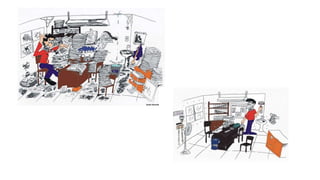
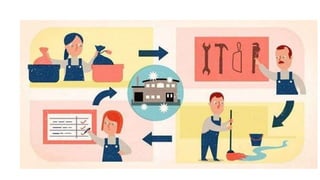
Naming trivialities aside, though, the purpose of 5S is straightforward: 5S principles reduce waste and
increase efficiency. They’re meant to be followed chronologically and cyclically, as each stage of the
practice enables the next and the process as a whole is designed to continually optimize the use of
the workspace.
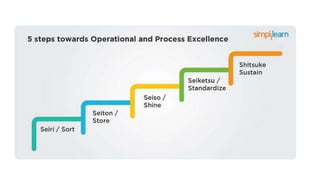
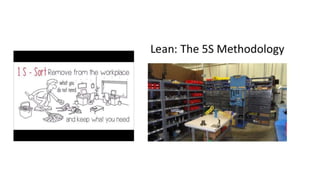
1. SORT
To “sort” means to review all items within a work environment and remove any that are unnecessary.
This is designed to reduce the time spent locating items, to free up more workspace, and to increase
safety by removing obstacles.
Separate required tools, materials, and instructions from those that are not needed. Remove everything
that is not necessary from the work area.
2. SET IN ORDER
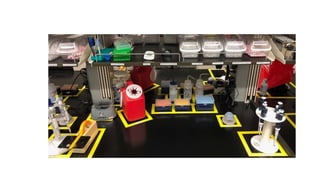
To “set in order” means to put all necessary items in their optimal places. This usually involves labeling
storage areas (often via tape on item containers and holding areas) and arranging workstations in a
way that makes the flow of work most efficient.
3. SHINE
To “shine” means to regularly clean the workspace. This is meant to prevent the deterioration of order and
to continually make the environment safe and suitable for work.
Set new standards for cleanliness. Clean and remove all trash, grease, and dirt. Everything must be
clean, tidy, and neatly put in its appropriate place. Cleanliness provides a safe workplace—and makes
potential problems noticeable, e.g., equipment leaks, loose parts, missing guards, loose paperwork, or
materials.
4. STANDARDIZE
To “standardize” means to order the processes used to maintain the organization of the workplace. This
may mean, for example, organizing cleaning schedules or procedures, or documenting processes and
placements via clear directions and even visual cues (like photos of correctly ordered shelves).
5. SUSTAIN
To “sustain” means to continually ensure that the practices of 5S are being followed. Any issues or
impediments to the consistent application of 5S should be identified and solved.
WHAT ARE THE BENEFITS OF 5S IN A LAB SETTING?
The principles of 5S are most commonly applied in a manufacturing setting. That’s where they were
first standardized, and due to the high throughput of production lines, the benefits of their
application are quick and obvious.
But their value can be applied universally to nearly any work environment – and we’ve found that
they have particular usefulness in a laboratory setting.
Here’s what they provide:
Increased safety. It sounds simple, but it’s important. Labs, when disorganized, can present real
and significant safety risks. The adoption of 5S supports compliances with applicable health and
safety policies. It can reduce potential for exposure to hazardous materials, minimize fire hazards,
and ensure the accessibility of safety equipment. At the most basic levels, clutter can represent a
tripping hazard. 5S improves organization and leads to improved safety.
.
Efficient execution of experiments. When laboratories are disorganized, research happens more
slowly; it takes research teams longer to locate items, they wait for key supplies due to poor
inventory management, and process setup delays the collection of results. 5S improves efficiency
across the board; one study (unspecific to industry) found that most organizations save over $10,000
annually after implementation.
More accurate results. The biggest benefit of applying 5S principles to laboratories, though, is that
it fosters a change of mindset. When people are more rigorous in the management of their
workspace, they are more rigorous in the way they collect and manage data. This minimizes the risk
of failed experiments or invalid findings
HOW DOES 5S IMPLEMENTATION HAPPEN?
With the benefits of 5S in mind, how can you go about implementing it in your own laboratory?
We’ve found that comprehensive training is essential. Stakeholders have to be educated on the
principles of 5S, but just as importantly, they have to enact and maintain the practices
themselves over the long-term. The value of 5S accumulates over time, after all. Organizations
that think of 5S like we think of New Year’s resolutions are setting themselves up for
disappointment. Adopting the 5S methodology should be a durable change of lifestyle in order
to have a positive impact.
That’s why we coach research teams in the practice of 5S (versus only educating them on the
principles). We work with all stakeholders – managers, researchers, and more – and ensure
that each lab has “5S champion” who will own the implementation process. Typically, we find
that training on the first four steps takes about one week, with another two-week period required
to confirm practice of the “sustain” principle.
To help facilitate the 5S methodology, we also offer original technology solutions (online
learning management system, checklists, reporting tools) that streamline its adoption
throughout the organizations.
Overall, the results of 5S training and implementation typically represent a night-and-day
improvement from most laboratories’ prior states; they go from cluttered counters and cabinets
to streamlined spaces with flawless inventory management. Users of a 5S facility are not
nostalgic for the they old ways, but rather take great pride in their work environment.
And, ultimately, they’re able to more efficiently engineer discoveries.
The Action Plan
You can start implementing 5S by providing training to your staff to understand the system. This may be
followed up with one-day sessions with each employee or team to ensure they are on the same page as
far as implementation is concerned.
In the first one-day session, employees should look be ready to meet the first three 5S requirements:
1.Take a picture of the current status of your workplace.
2.Sort to separate anything that is needed and necessary from what is not needed.
3.Organize the things you need so that there is a place for everything and everything has a place. You
should be able to find anything in just a few seconds.
4.Clean the workplace and get rid of things that make it difficult to maintain cleanliness, such as boxes on
the floor that prevent you from being able to clean the entire surface — label them store them in labeled
drawers, instead.
5.Prepare an action plan for the items you aren’t able to deal with that day, but will be able to in the near
future. This could include selling items you no longer use, donating them, recycling, or throwing them
away.
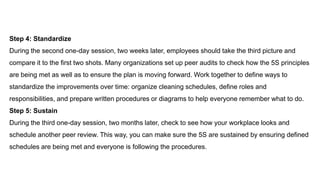
Step 4: Standardize
During the second one-day session, two weeks later, employees should take the third picture and
compare it to the first two shots. Many organizations set up peer audits to check how the 5S principles
are being met as well as to ensure the plan is moving forward. Work together to define ways to
standardize the improvements over time: organize cleaning schedules, define roles and
responsibilities, and prepare written procedures or diagrams to help everyone remember what to do.
Step 5: Sustain
During the third one-day session, two months later, check to see how your workplace looks and
schedule another peer review. This way, you can make sure the 5S are sustained by ensuring defined
schedules are being met and everyone is following the procedures.
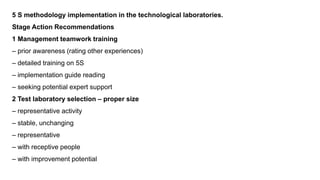
5 S methodology implementation in the technological laboratories.
Stage Action Recommendations
1 Management teamwork training
– prior awareness (rating other experiences)
– detailed training on 5S
– implementation guide reading
– seeking potential expert support
2 Test laboratory selection – proper size
– representative activity
– stable, unchanging
– representative
– with receptive people
– with improvement potential
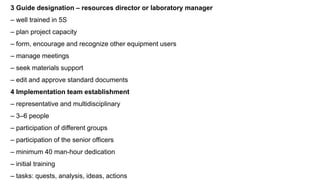
3 Guide designation – resources director or laboratory manager
– well trained in 5S
– plan project capacity
– form, encourage and recognize other equipment users
– manage meetings
– seek materials support
– edit and approve standard documents
4 Implementation team establishment
– representative and multidisciplinary
– 3–6 people
– participation of different groups
– participation of the senior officers
– minimum 40 man-hour dedication
– initial training
– tasks: quests, analysis, ideas, actions
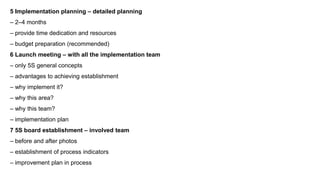
5 Implementation planning – detailed planning
– 2–4 months
– provide time dedication and resources
– budget preparation (recommended)
6 Launch meeting – with all the implementation team
– only 5S general concepts
– advantages to achieving establishment
– why implement it?
– why this area?
– why this team?
– implementation plan
7 5S board establishment – involved team
– before and after photos
– establishment of process indicators
– improvement plan in process
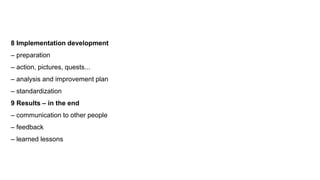
8 Implementation development
– preparation
– action, pictures, quests...
– analysis and improvement plan
– standardization
9 Results – in the end
– communication to other people
– feedback
– learned lessons
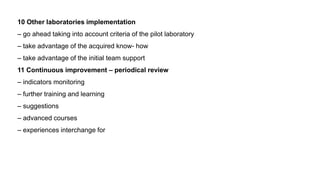
10 Other laboratories implementation
– go ahead taking into account criteria of the pilot laboratory
– take advantage of the acquired know- how
– take advantage of the initial team support
11 Continuous improvement – periodical review
– indicators monitoring
– further training and learning
– suggestions
– advanced courses
– experiences interchange for
Lean Manufacturing is a way of thinking about productive systems with a focus on reducing
the unnecessary — that is, eliminating wasted materials, effort, and time. This approach helps
to improve overall productivity, quality, and profits. 5S fits naturally here, because it works
toward a streamlined, organized, and clean workplace.

5 S Laboratory.pptx

  • 3.
    WHAT ARE 5SPRINCIPLES? It’s widely believed that the principles of 5S originated in Japan during Toyota’s rise to prominence in the 1950s. While it’s true that they took on their alliterative form there, the principles themselves existed previously and were (more or less) being applied concurrently at Ford under a methodology labeled CANDO. Naming trivialities aside, though, the purpose of 5S is straightforward: 5S principles reduce waste and increase efficiency. They’re meant to be followed chronologically and cyclically, as each stage of the practice enables the next and the process as a whole is designed to continually optimize the use of the workspace.
  • 6.
    1. SORT To “sort”means to review all items within a work environment and remove any that are unnecessary. This is designed to reduce the time spent locating items, to free up more workspace, and to increase safety by removing obstacles. Separate required tools, materials, and instructions from those that are not needed. Remove everything that is not necessary from the work area. 2. SET IN ORDER To “set in order” means to put all necessary items in their optimal places. This usually involves labeling storage areas (often via tape on item containers and holding areas) and arranging workstations in a way that makes the flow of work most efficient.
  • 9.
    3. SHINE To “shine”means to regularly clean the workspace. This is meant to prevent the deterioration of order and to continually make the environment safe and suitable for work. Set new standards for cleanliness. Clean and remove all trash, grease, and dirt. Everything must be clean, tidy, and neatly put in its appropriate place. Cleanliness provides a safe workplace—and makes potential problems noticeable, e.g., equipment leaks, loose parts, missing guards, loose paperwork, or materials. 4. STANDARDIZE To “standardize” means to order the processes used to maintain the organization of the workplace. This may mean, for example, organizing cleaning schedules or procedures, or documenting processes and placements via clear directions and even visual cues (like photos of correctly ordered shelves). 5. SUSTAIN To “sustain” means to continually ensure that the practices of 5S are being followed. Any issues or impediments to the consistent application of 5S should be identified and solved.
  • 10.
    WHAT ARE THEBENEFITS OF 5S IN A LAB SETTING? The principles of 5S are most commonly applied in a manufacturing setting. That’s where they were first standardized, and due to the high throughput of production lines, the benefits of their application are quick and obvious. But their value can be applied universally to nearly any work environment – and we’ve found that they have particular usefulness in a laboratory setting. Here’s what they provide: Increased safety. It sounds simple, but it’s important. Labs, when disorganized, can present real and significant safety risks. The adoption of 5S supports compliances with applicable health and safety policies. It can reduce potential for exposure to hazardous materials, minimize fire hazards, and ensure the accessibility of safety equipment. At the most basic levels, clutter can represent a tripping hazard. 5S improves organization and leads to improved safety. .
  • 11.
    Efficient execution ofexperiments. When laboratories are disorganized, research happens more slowly; it takes research teams longer to locate items, they wait for key supplies due to poor inventory management, and process setup delays the collection of results. 5S improves efficiency across the board; one study (unspecific to industry) found that most organizations save over $10,000 annually after implementation. More accurate results. The biggest benefit of applying 5S principles to laboratories, though, is that it fosters a change of mindset. When people are more rigorous in the management of their workspace, they are more rigorous in the way they collect and manage data. This minimizes the risk of failed experiments or invalid findings
  • 12.
    HOW DOES 5SIMPLEMENTATION HAPPEN? With the benefits of 5S in mind, how can you go about implementing it in your own laboratory? We’ve found that comprehensive training is essential. Stakeholders have to be educated on the principles of 5S, but just as importantly, they have to enact and maintain the practices themselves over the long-term. The value of 5S accumulates over time, after all. Organizations that think of 5S like we think of New Year’s resolutions are setting themselves up for disappointment. Adopting the 5S methodology should be a durable change of lifestyle in order to have a positive impact. That’s why we coach research teams in the practice of 5S (versus only educating them on the principles). We work with all stakeholders – managers, researchers, and more – and ensure that each lab has “5S champion” who will own the implementation process. Typically, we find that training on the first four steps takes about one week, with another two-week period required to confirm practice of the “sustain” principle. To help facilitate the 5S methodology, we also offer original technology solutions (online learning management system, checklists, reporting tools) that streamline its adoption throughout the organizations. Overall, the results of 5S training and implementation typically represent a night-and-day improvement from most laboratories’ prior states; they go from cluttered counters and cabinets to streamlined spaces with flawless inventory management. Users of a 5S facility are not nostalgic for the they old ways, but rather take great pride in their work environment. And, ultimately, they’re able to more efficiently engineer discoveries.
  • 13.
    The Action Plan Youcan start implementing 5S by providing training to your staff to understand the system. This may be followed up with one-day sessions with each employee or team to ensure they are on the same page as far as implementation is concerned. In the first one-day session, employees should look be ready to meet the first three 5S requirements: 1.Take a picture of the current status of your workplace. 2.Sort to separate anything that is needed and necessary from what is not needed. 3.Organize the things you need so that there is a place for everything and everything has a place. You should be able to find anything in just a few seconds. 4.Clean the workplace and get rid of things that make it difficult to maintain cleanliness, such as boxes on the floor that prevent you from being able to clean the entire surface — label them store them in labeled drawers, instead. 5.Prepare an action plan for the items you aren’t able to deal with that day, but will be able to in the near future. This could include selling items you no longer use, donating them, recycling, or throwing them away.
  • 14.
    Step 4: Standardize Duringthe second one-day session, two weeks later, employees should take the third picture and compare it to the first two shots. Many organizations set up peer audits to check how the 5S principles are being met as well as to ensure the plan is moving forward. Work together to define ways to standardize the improvements over time: organize cleaning schedules, define roles and responsibilities, and prepare written procedures or diagrams to help everyone remember what to do. Step 5: Sustain During the third one-day session, two months later, check to see how your workplace looks and schedule another peer review. This way, you can make sure the 5S are sustained by ensuring defined schedules are being met and everyone is following the procedures.
  • 16.
    5 S methodologyimplementation in the technological laboratories. Stage Action Recommendations 1 Management teamwork training – prior awareness (rating other experiences) – detailed training on 5S – implementation guide reading – seeking potential expert support 2 Test laboratory selection – proper size – representative activity – stable, unchanging – representative – with receptive people – with improvement potential
  • 17.
    3 Guide designation– resources director or laboratory manager – well trained in 5S – plan project capacity – form, encourage and recognize other equipment users – manage meetings – seek materials support – edit and approve standard documents 4 Implementation team establishment – representative and multidisciplinary – 3–6 people – participation of different groups – participation of the senior officers – minimum 40 man-hour dedication – initial training – tasks: quests, analysis, ideas, actions
  • 18.
    5 Implementation planning– detailed planning – 2–4 months – provide time dedication and resources – budget preparation (recommended) 6 Launch meeting – with all the implementation team – only 5S general concepts – advantages to achieving establishment – why implement it? – why this area? – why this team? – implementation plan 7 5S board establishment – involved team – before and after photos – establishment of process indicators – improvement plan in process
  • 19.
    8 Implementation development –preparation – action, pictures, quests... – analysis and improvement plan – standardization 9 Results – in the end – communication to other people – feedback – learned lessons
  • 20.
    10 Other laboratoriesimplementation – go ahead taking into account criteria of the pilot laboratory – take advantage of the acquired know- how – take advantage of the initial team support 11 Continuous improvement – periodical review – indicators monitoring – further training and learning – suggestions – advanced courses – experiences interchange for
  • 21.
    Lean Manufacturing isa way of thinking about productive systems with a focus on reducing the unnecessary — that is, eliminating wasted materials, effort, and time. This approach helps to improve overall productivity, quality, and profits. 5S fits naturally here, because it works toward a streamlined, organized, and clean workplace.