How “Open Educational Practices” Support
Student-Centered Course Design and
Accessibility
April 11, 2018, 11:00 am PST
Welcome to
Agenda
• Introductions
• CCCOER Overview
• Leveraging Open Educational Resources for
Accessibility with Tara Buñag
• OER your classes personalized? How Open
Educational Practices support Universal Design with
Suzanne Wakim
• Q & A
Image on title page: pixabay.com
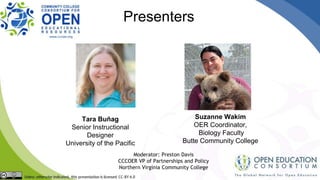
Moderator: Preston Davis
CCCOER VP of Partnerships and Policy
Northern Virginia Community College
Presenters
Suzanne Wakim
OER Coordinator,
Biology Faculty
Butte Community College
Tara Buñag
Senior Instructional
Designer
University of the Pacific
• Expand awareness & access to high-
quality OER
• Support faculty choice & development
• Improve student success
CCCOER Mission
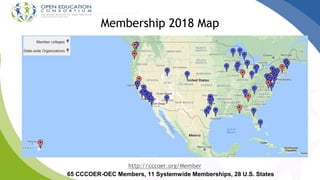
Membership 2018 Map
http://cccoer.org/Member
65 CCCOER-OEC Members, 11 Systemwide Memberships, 28 U.S. States
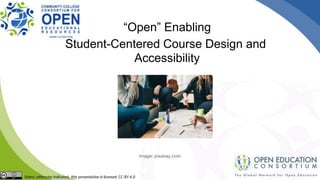
“Open” Enabling
Student-Centered Course Design and
Accessibility
Image: pixabay.com
Leveraging Open Educational
Resources for Accessibility
Tara Buñag
Senior Instructional
Designer
Tara Buñag
Sr. Instructional Designer
University of the Pacific, Center for Teaching and Learning
Open Educational Practice for
Accessibility
CTL and University of the Pacific logo are all rights reserved.
The rest of the presentation is licensed as CC-BY.
• The Challenge
• Accessibility Issues
• Approach
• Failure to Success
Overview
• Graduate level, required Educational Statistics
course
• Independent study format, hybrid modality
• Student who is blind
• <2 months before the semester
• Problem with existing textbook
The Challenge
• Needs
• To meet the same objectives to the same level as
other students
• Equivalent, easily modified materials to support
learning
• Immediate access to content
• A non-visual equivalent for essential visuals
• Hybrid Course
• In-person only once per month
Accessibility
Issues
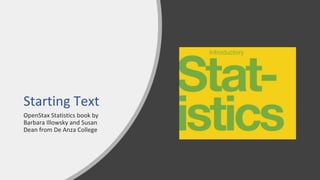
OpenStax Statistics book by
Barbara Illowsky and Susan
Dean from De Anza College
Starting Text
Textbook Features
Challenges
• Low level for class
• Not education specific
• Missing some topics
• No use of SPSS
• No data files
• Highly visual
Benefits
• Available in multiple formats
• Aligns to low level objectives
• Includes many examples
• Good accessibility to start
• Creative Commons license
• Additional materials exist
• Modification of materials
• Multiple digital formats
• Incorporating media
• Identifying critical visuals
• Modification across the senses
• Testing
• NVDA
• Hands-on
Before the
class
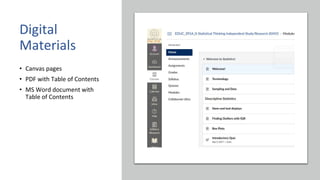
• Canvas pages
• PDF with Table of Contents
• MS Word document with
Table of Contents
Digital
Materials
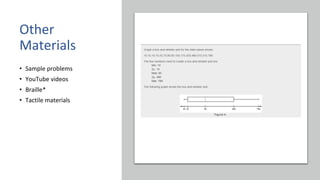
• Sample problems
• YouTube videos
• Braille*
• Tactile materials
Other
Materials
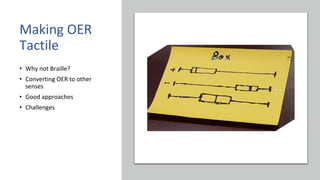
• Why not Braille?
• Converting OER to other
senses
• Good approaches
• Challenges
Making OER
Tactile
One Sample T-test scenario
The following scenario is based on a real scenario,
but may deviate from real values.
A group training guide dogs for individuals who
are blind is worried about the working life of their
collies. Typically, the dogs they train average 80
months of working life. They gather a random
sample of 18 collies to compare to the rest of the
dogs.
The group runs a one-sample t-test in SPSS. The
next questions are based on this scenario.
Including
relevant, real
world
scenarios
• At start
• Technically “fully” accessible
• Had too many choices
• Not enough real data
• Changes
• Made actually accessible
• Streamlined options
• Included more relevant, open data sets and
external websites
From Failure
to Success
• From Universal Design to Human-Centered
Design
• Flexibility and adaptability
• Failure will occur
• Embrace it
• Ease of including student research interests
• Students adding to the OER
Lessons
Learned
Questions?
Contact information:
Tara Buñag
tbunag@pacific.edu
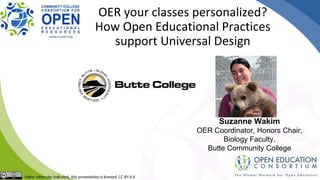
Suzanne Wakim
OER Coordinator, Honors Chair,
Biology Faculty,
Butte Community College
OER your classes personalized?
How Open Educational Practices
support Universal Design
Universal Design & Equity in Learning
Provide multiple means of representation: give learners
various ways of acquiring information and knowledge (text,
video, audio)
Provide multiple means of action and expression: provide
learners alternatives for demonstrating what they know
(essay, diagram, table, outline)
Provide multiple means of engagement: tap into learners'
interests, challenge them appropriately, and motivate them
to learn. (authentic, intrinsic/extrinsic motivation)
Adapted from ACCESSIBILITY AND OPEN EDUCATIONAL RESOURCES by UDL on Campus Creative Commons Attribution-ShareAlike 4.0 International License
And Universal Design for Learning by Wikipedia Creative Commons Attribution-ShareAlike 4.0 International License
And Lecture Hall By Xbxg32000 [CC BY-SA 3.0 (http://creativecommons.org/licenses/by-sa/3.0)], via Wikimedia Commons
There is no
“ average / typical ”
student
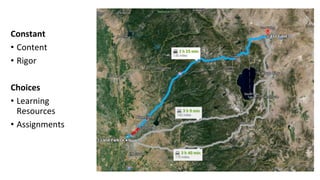
Constant
• Content
• Rigor
Choices
• Learning
Resources
• Assignments
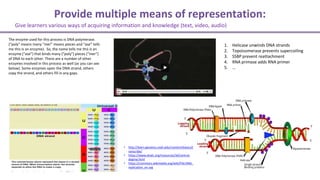
1. Helicase unwinds DNA strands
2. Topoisomerase prevents supercoiling
3. SSBP prevent reattachment
4. RNA primase adds RNA primer
5. …
The enzyme used for this process is DNA polymerase.
(“poly” means many “mer” means pieces and “ase” tells
me this is an enzyme). So, the name tells me this is an
enzyme (“ase”) that binds many (“poly”) pieces (“mer”)
of DNA to each other. There are a number of other
enzymes involved in this process as well (as you can see
below). Some enzymes open the DNA strand, others
copy the strand, and others fill in any gaps.
• http://learn.genetics.utah.edu/content/basics/t
ranscribe/
• https://www.dnalc.org/resources/3d/central-
dogma.html
• https://commons.wikimedia.org/wiki/File:DNA_
replication_en.svg
Give learners various ways of acquiring information and knowledge (text, video, audio)
Provide multiple means of representation:
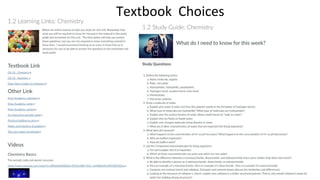
Textbook Choices
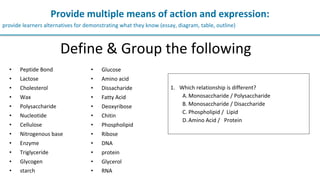
provide learners alternatives for demonstrating what they know (essay, diagram, table, outline)
Provide multiple means of action and expression:
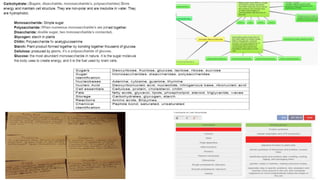
• Peptide Bond
• Lactose
• Cholesterol
• Wax
• Polysaccharide
• Nucleotide
• Cellulose
• Nitrogenous base
• Enzyme
• Triglyceride
• Glycogen
• starch
• Glucose
• Amino acid
• Dissacharide
• Fatty Acid
• Deoxyribose
• Chitin
• Phospholipid
• Ribose
• DNA
• protein
• Glycerol
• RNA
1. Which relationship is different?
A. Monosaccharide / Polysaccharide
B. Monosaccharide / Disaccharide
C. Phospholipid / Lipid
D.Amino Acid / Protein
Define & Group the following
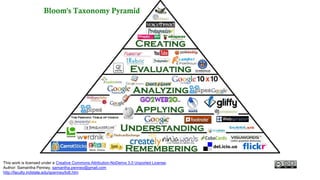
This work is licensed under a Creative Commons Attribution-NoDerivs 3.0 Unported License.
Author: Samantha Penney, samantha.penney@gmail.com
http://faculty.indstate.edu/spenney/bdt.htm
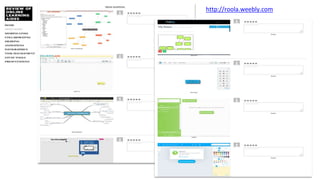
http://roola.weebly.com
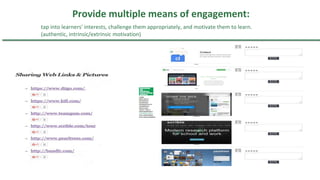
tap into learners' interests, challenge them appropriately, and motivate them to learn.
(authentic, intrinsic/extrinsic motivation)
Provide multiple means of engagement:
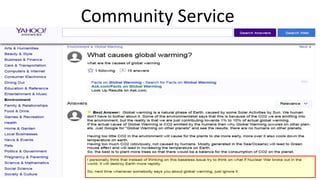
Community Service
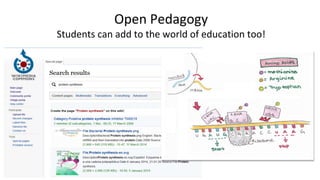
Open Pedagogy
Students can add to the world of education too!
Universal Design & Equity in Learning
Provide multiple means of representation: give learners
various ways of acquiring information and knowledge (text,
video, audio)
Provide multiple means of action and expression: provide
learners alternatives for demonstrating what they know
(essay, diagram, table, outline)
Provide multiple means of engagement: tap into learners'
interests, challenge them appropriately, and motivate them
to learn. (authentic, intrinsic/extrinsic motivation)
Adapted from ACCESSIBILITY AND OPEN EDUCATIONAL RESOURCES by UDL on Campus Creative Commons Attribution-ShareAlike 4.0 International License
And Universal Design for Learning by Wikipedia Creative Commons Attribution-ShareAlike 4.0 International License
And Lecture Hall By Xbxg32000 [CC BY-SA 3.0 (http://creativecommons.org/licenses/by-sa/3.0)], via Wikimedia Commons
There is no
“ average / typical ”
student
Stay in the Loop
• Upcoming Conferences
– OpenEd 2018, October 10-12
– See our website under “Get-Involved”
• Stay in touch thru Community Email
-- https://www.cccoer.org/community-email/
Image: pixabay.com
http://cccoer.org
May 9th Webinar
The Importance of Student Collaboration in OER
Projects
Speakers:
• Brian Weston, Director - Distance and Accelerated Learning,
College of the Canyons and student
• TBA
Registration available here:
https://www.cccoer.org/2018/01/23/cccoer-spring-2018-webinars/
Questions?
Contact Info:
Preston Davis - wdavis@nvcc.edu
Tara Buñag - tbunag@pacific.edu
Suzanne Wakim - wakimsu@butte.edu
@unatdaly -- unatdaly@oeconsortium.org
Thank you!

How Open Education Practices Support Student Centered Design & Accessibility

  • 1.
    How “Open EducationalPractices” Support Student-Centered Course Design and Accessibility April 11, 2018, 11:00 am PST Welcome to
  • 2.
    Agenda • Introductions • CCCOEROverview • Leveraging Open Educational Resources for Accessibility with Tara Buñag • OER your classes personalized? How Open Educational Practices support Universal Design with Suzanne Wakim • Q & A Image on title page: pixabay.com
  • 3.
    Moderator: Preston Davis CCCOERVP of Partnerships and Policy Northern Virginia Community College Presenters Suzanne Wakim OER Coordinator, Biology Faculty Butte Community College Tara Buñag Senior Instructional Designer University of the Pacific
  • 4.
    • Expand awareness& access to high- quality OER • Support faculty choice & development • Improve student success CCCOER Mission
  • 5.
    Membership 2018 Map http://cccoer.org/Member 65CCCOER-OEC Members, 11 Systemwide Memberships, 28 U.S. States
  • 6.
    “Open” Enabling Student-Centered CourseDesign and Accessibility Image: pixabay.com
  • 7.
    Leveraging Open Educational Resourcesfor Accessibility Tara Buñag Senior Instructional Designer
  • 8.
    Tara Buñag Sr. InstructionalDesigner University of the Pacific, Center for Teaching and Learning Open Educational Practice for Accessibility CTL and University of the Pacific logo are all rights reserved. The rest of the presentation is licensed as CC-BY.
  • 9.
    • The Challenge •Accessibility Issues • Approach • Failure to Success Overview
  • 10.
    • Graduate level,required Educational Statistics course • Independent study format, hybrid modality • Student who is blind • <2 months before the semester • Problem with existing textbook The Challenge
  • 11.
    • Needs • Tomeet the same objectives to the same level as other students • Equivalent, easily modified materials to support learning • Immediate access to content • A non-visual equivalent for essential visuals • Hybrid Course • In-person only once per month Accessibility Issues
  • 12.
    OpenStax Statistics bookby Barbara Illowsky and Susan Dean from De Anza College Starting Text
  • 13.
    Textbook Features Challenges • Lowlevel for class • Not education specific • Missing some topics • No use of SPSS • No data files • Highly visual Benefits • Available in multiple formats • Aligns to low level objectives • Includes many examples • Good accessibility to start • Creative Commons license • Additional materials exist
  • 14.
    • Modification ofmaterials • Multiple digital formats • Incorporating media • Identifying critical visuals • Modification across the senses • Testing • NVDA • Hands-on Before the class
  • 15.
    • Canvas pages •PDF with Table of Contents • MS Word document with Table of Contents Digital Materials
  • 16.
    • Sample problems •YouTube videos • Braille* • Tactile materials Other Materials
  • 17.
    • Why notBraille? • Converting OER to other senses • Good approaches • Challenges Making OER Tactile
  • 18.
    One Sample T-testscenario The following scenario is based on a real scenario, but may deviate from real values. A group training guide dogs for individuals who are blind is worried about the working life of their collies. Typically, the dogs they train average 80 months of working life. They gather a random sample of 18 collies to compare to the rest of the dogs. The group runs a one-sample t-test in SPSS. The next questions are based on this scenario. Including relevant, real world scenarios
  • 19.
    • At start •Technically “fully” accessible • Had too many choices • Not enough real data • Changes • Made actually accessible • Streamlined options • Included more relevant, open data sets and external websites From Failure to Success
  • 20.
    • From UniversalDesign to Human-Centered Design • Flexibility and adaptability • Failure will occur • Embrace it • Ease of including student research interests • Students adding to the OER Lessons Learned
  • 21.
  • 22.
    Suzanne Wakim OER Coordinator,Honors Chair, Biology Faculty, Butte Community College OER your classes personalized? How Open Educational Practices support Universal Design
  • 23.
    Universal Design &Equity in Learning Provide multiple means of representation: give learners various ways of acquiring information and knowledge (text, video, audio) Provide multiple means of action and expression: provide learners alternatives for demonstrating what they know (essay, diagram, table, outline) Provide multiple means of engagement: tap into learners' interests, challenge them appropriately, and motivate them to learn. (authentic, intrinsic/extrinsic motivation) Adapted from ACCESSIBILITY AND OPEN EDUCATIONAL RESOURCES by UDL on Campus Creative Commons Attribution-ShareAlike 4.0 International License And Universal Design for Learning by Wikipedia Creative Commons Attribution-ShareAlike 4.0 International License And Lecture Hall By Xbxg32000 [CC BY-SA 3.0 (http://creativecommons.org/licenses/by-sa/3.0)], via Wikimedia Commons There is no “ average / typical ” student
  • 24.
    Constant • Content • Rigor Choices •Learning Resources • Assignments
  • 25.
    1. Helicase unwindsDNA strands 2. Topoisomerase prevents supercoiling 3. SSBP prevent reattachment 4. RNA primase adds RNA primer 5. … The enzyme used for this process is DNA polymerase. (“poly” means many “mer” means pieces and “ase” tells me this is an enzyme). So, the name tells me this is an enzyme (“ase”) that binds many (“poly”) pieces (“mer”) of DNA to each other. There are a number of other enzymes involved in this process as well (as you can see below). Some enzymes open the DNA strand, others copy the strand, and others fill in any gaps. • http://learn.genetics.utah.edu/content/basics/t ranscribe/ • https://www.dnalc.org/resources/3d/central- dogma.html • https://commons.wikimedia.org/wiki/File:DNA_ replication_en.svg Give learners various ways of acquiring information and knowledge (text, video, audio) Provide multiple means of representation:
  • 26.
  • 27.
    provide learners alternativesfor demonstrating what they know (essay, diagram, table, outline) Provide multiple means of action and expression: • Peptide Bond • Lactose • Cholesterol • Wax • Polysaccharide • Nucleotide • Cellulose • Nitrogenous base • Enzyme • Triglyceride • Glycogen • starch • Glucose • Amino acid • Dissacharide • Fatty Acid • Deoxyribose • Chitin • Phospholipid • Ribose • DNA • protein • Glycerol • RNA 1. Which relationship is different? A. Monosaccharide / Polysaccharide B. Monosaccharide / Disaccharide C. Phospholipid / Lipid D.Amino Acid / Protein Define & Group the following
  • 29.
    This work islicensed under a Creative Commons Attribution-NoDerivs 3.0 Unported License. Author: Samantha Penney, samantha.penney@gmail.com http://faculty.indstate.edu/spenney/bdt.htm
  • 30.
  • 31.
    tap into learners'interests, challenge them appropriately, and motivate them to learn. (authentic, intrinsic/extrinsic motivation) Provide multiple means of engagement:
  • 32.
  • 33.
    Open Pedagogy Students canadd to the world of education too!
  • 34.
    Universal Design &Equity in Learning Provide multiple means of representation: give learners various ways of acquiring information and knowledge (text, video, audio) Provide multiple means of action and expression: provide learners alternatives for demonstrating what they know (essay, diagram, table, outline) Provide multiple means of engagement: tap into learners' interests, challenge them appropriately, and motivate them to learn. (authentic, intrinsic/extrinsic motivation) Adapted from ACCESSIBILITY AND OPEN EDUCATIONAL RESOURCES by UDL on Campus Creative Commons Attribution-ShareAlike 4.0 International License And Universal Design for Learning by Wikipedia Creative Commons Attribution-ShareAlike 4.0 International License And Lecture Hall By Xbxg32000 [CC BY-SA 3.0 (http://creativecommons.org/licenses/by-sa/3.0)], via Wikimedia Commons There is no “ average / typical ” student
  • 35.
    Stay in theLoop • Upcoming Conferences – OpenEd 2018, October 10-12 – See our website under “Get-Involved” • Stay in touch thru Community Email -- https://www.cccoer.org/community-email/ Image: pixabay.com http://cccoer.org
  • 36.
    May 9th Webinar TheImportance of Student Collaboration in OER Projects Speakers: • Brian Weston, Director - Distance and Accelerated Learning, College of the Canyons and student • TBA Registration available here: https://www.cccoer.org/2018/01/23/cccoer-spring-2018-webinars/
  • 37.
    Questions? Contact Info: Preston Davis- wdavis@nvcc.edu Tara Buñag - tbunag@pacific.edu Suzanne Wakim - wakimsu@butte.edu @unatdaly -- unatdaly@oeconsortium.org Thank you!