MORSE CODE
(-- --- •-• ••• • -•-• --- -•• •)
MEMBERS
 Vaishali Upadhyay
 Vikas Prasad
 Tanish Garg
 Anurag Aggarwal
 Tushar Swami
OUTLINE
 What is Morse Code?
 History
 Invention
 International Morse Code
 Transmitting Morse Code
 Tap Code (a new replacement)
 Advantages and Disadvantages
 Uses – then and now…
ACKNOWLEDGEMENT
We would like to express our special thanks of gratitude to our teacher
Dr. Chhavi Bhatnagar who gave us the golden opportunity to present this wonderful
presentation on the topic ( MORSE CODE ), which also helped us in doing a lot of
Research and we came to know about new things. We are really thankful to her.
WHAT IS MORSE CODE???
INTRODUCTION
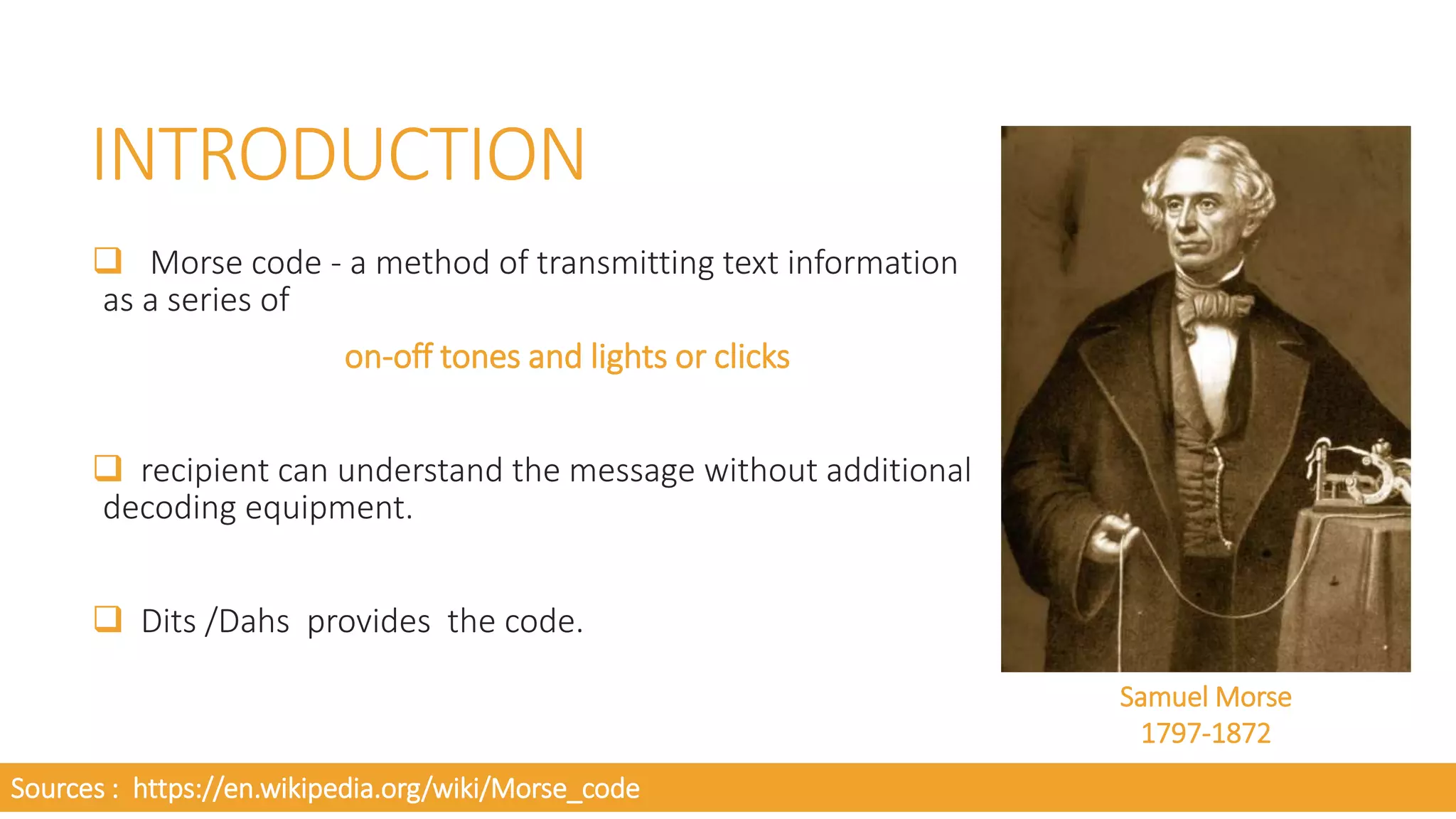
 Morse code - a method of transmitting text information
as a series of
on-off tones and lights or clicks
 recipient can understand the message without additional
decoding equipment.
 Dits /Dahs provides the code.
Samuel Morse
1797-1872
Sources : https://en.wikipedia.org/wiki/Morse_code
INTRODUCTION
 Dits refers to dots and dahs refer to dash.
 slow but reliable means of transmitting and
receiving text through condition involving
noise fading or interference.
 simple binary code (key up/ key down)allows for
an extremely narrow bandwidth
maximum speed to transmit and
receive information is 20-30 WPM.
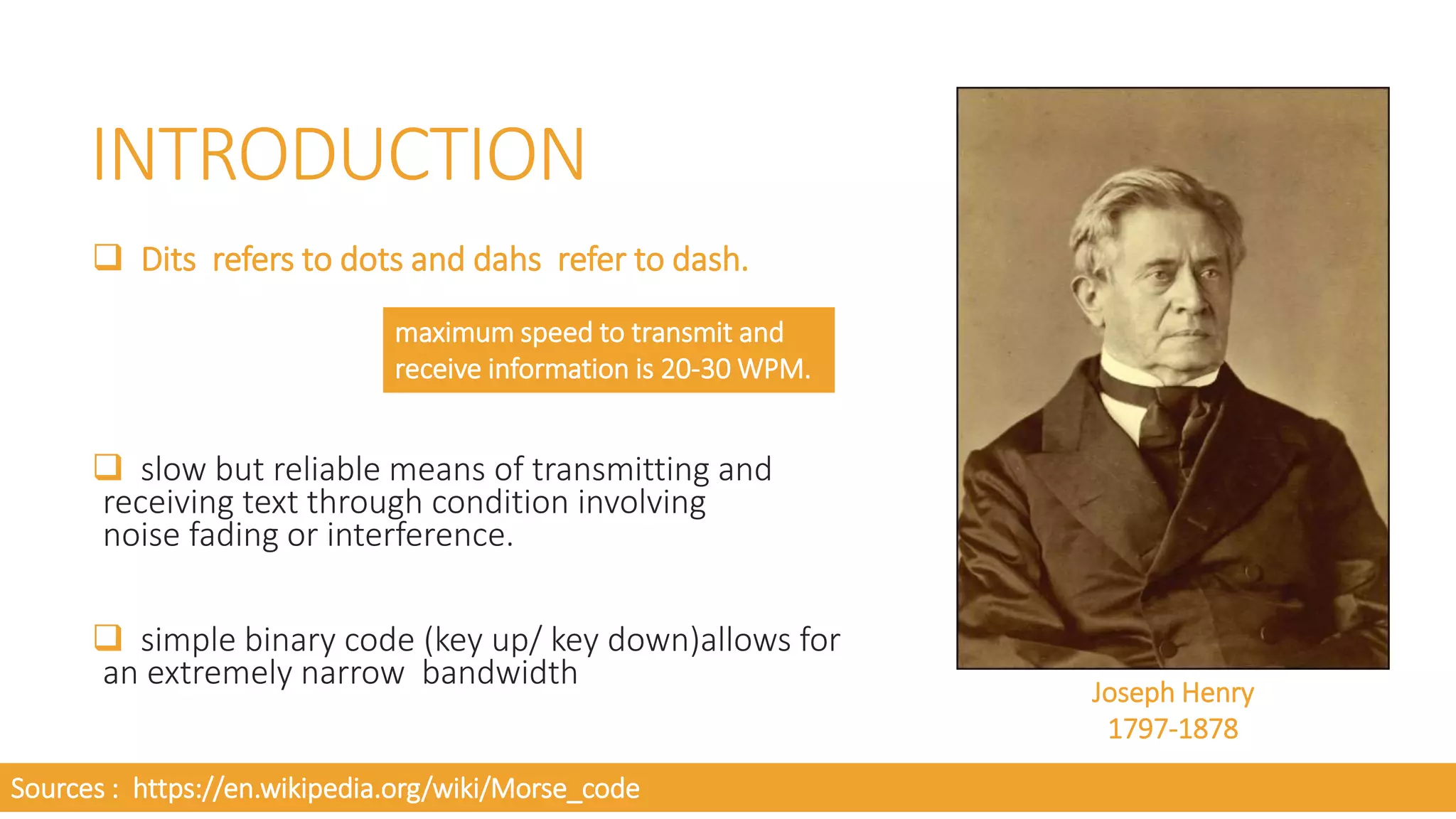
Joseph Henry
1797-1878
Sources : https://en.wikipedia.org/wiki/Morse_code
HISTORY
 Samuel Morse got idea of inventing a secret code language in
1800s when he worked with an electrical telegraph
system.
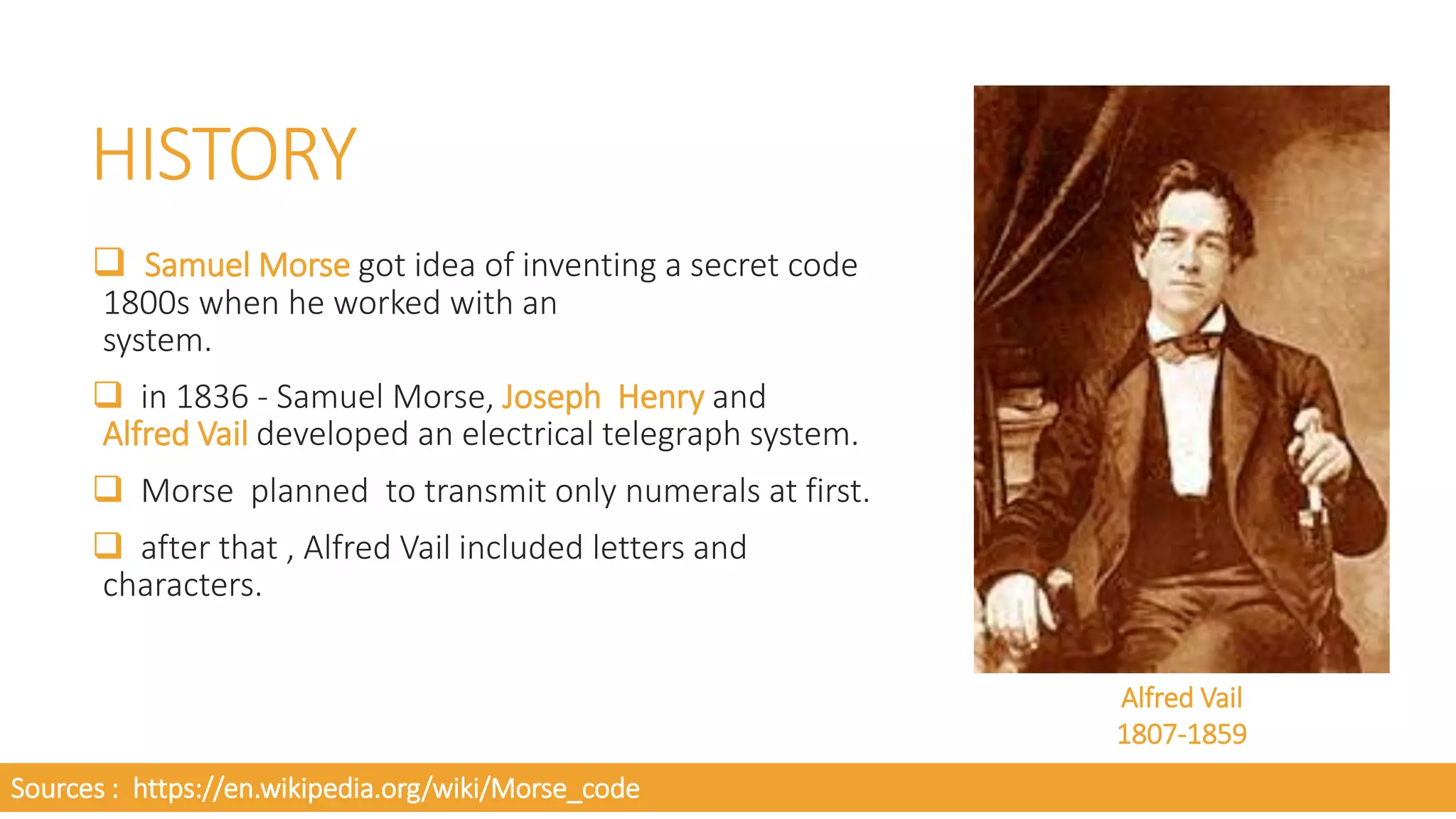
 in 1836 - Samuel Morse, Joseph Henry and
Alfred Vail developed an electrical telegraph system.
 Morse planned to transmit only numerals at first.
 after that , Alfred Vail included letters and special
characters.
Alfred Vail
1807-1859
Sources : https://en.wikipedia.org/wiki/Morse_code
HOW MORSE CODE EVOLVED???
 once, Samuel Morse went to a printers shop and counted the amount of printer
type the alphabet.
 he then interpreted these counts as approximations of the relative frequency of
each letter in typical English text.
 he organized the Morse code so that the shortest
symbols were associated with the most frequent character.
Sources : https://en.wikipedia.org/wiki/Morse_code
http://www.codeproject.com/Tips/565652/Introduction-to-Morse-Code
‘E’ is the most commonly
used letter so its Morse code
is just a single dot.
The letter ‘I’ has two dots.
The letter ‘T’ has a single
dash.
International Morse Codes
MORSE CODE TRANSMISSION
Morse code can be transmitted(sent) through a number of ways
Electrical Telegraph Wire
Light
Sound
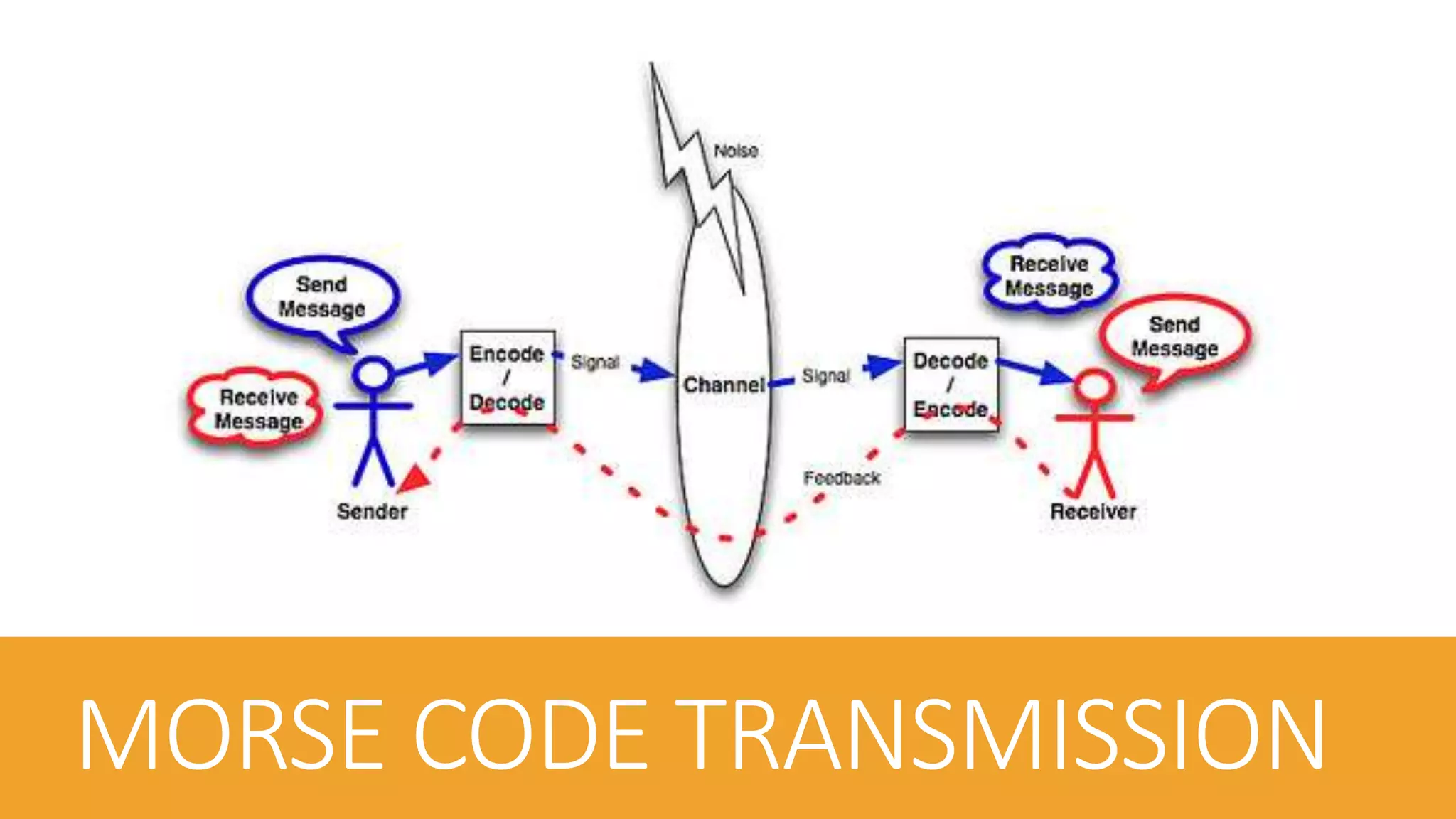
The transmission has
mainly three sections:
a transmitter, a receiver
and channel.
TIMING
Generally speaking, morse code consists of five elements
1. a dot (one unit)
2. a dash (three units)
3. an inter-element gap (one unit)
4. a gap between letters (three units)
5. the gap between words (7 units)
'MESSAGE TO'
Sources : http://cryptomuseum.com/radio/morse/
https://www.mtechnologies.com/ameco/keys.htm
Transmission through Electrical
telegraph wire
The transmitting operator used a Morse key (switch) to turn the electric
current on and off in the rhythm of the morse codes.
Sources : http://cryptomuseum.com/radio/morse/
http://www.vk5sw.com/Beginner's%20Morse%20Code.htm
 These electric signals are transmitted through telegraph wires.
 At the receiving end, the electric current engaged an electro-
magnet, that would 'click' in the rhythm of the morse signals.
 The operator present at the receiving station recognize the 'clicks'
of the electro-magnet and decodes the message.
Sources : http://cryptomuseum.com/radio/morse/
MESSAGE TRANSMISSION THROUGH
LIGHT OR SOUND
Via Light
 procedure same as transmitting signal normally.
 long flash – dash
 short flash – dot
For demonstration let us try transmitting message “SOS”
Sources : https://en.wikipedia.org/wiki/Signal_lamp
Via Audio
 message transmitted in form of beeps.
 just need to focus on your length of beeps.
 long beep – dash
 short beep – dot
Morse Code was used in light and audio format mostly by US NAVY and Submarines
to communicate with each other.
Still, some of them employ such methods to send secret messages.
Sources : http://blinking-light-training.software.informer.com/
TAP CODE
TAP CODE
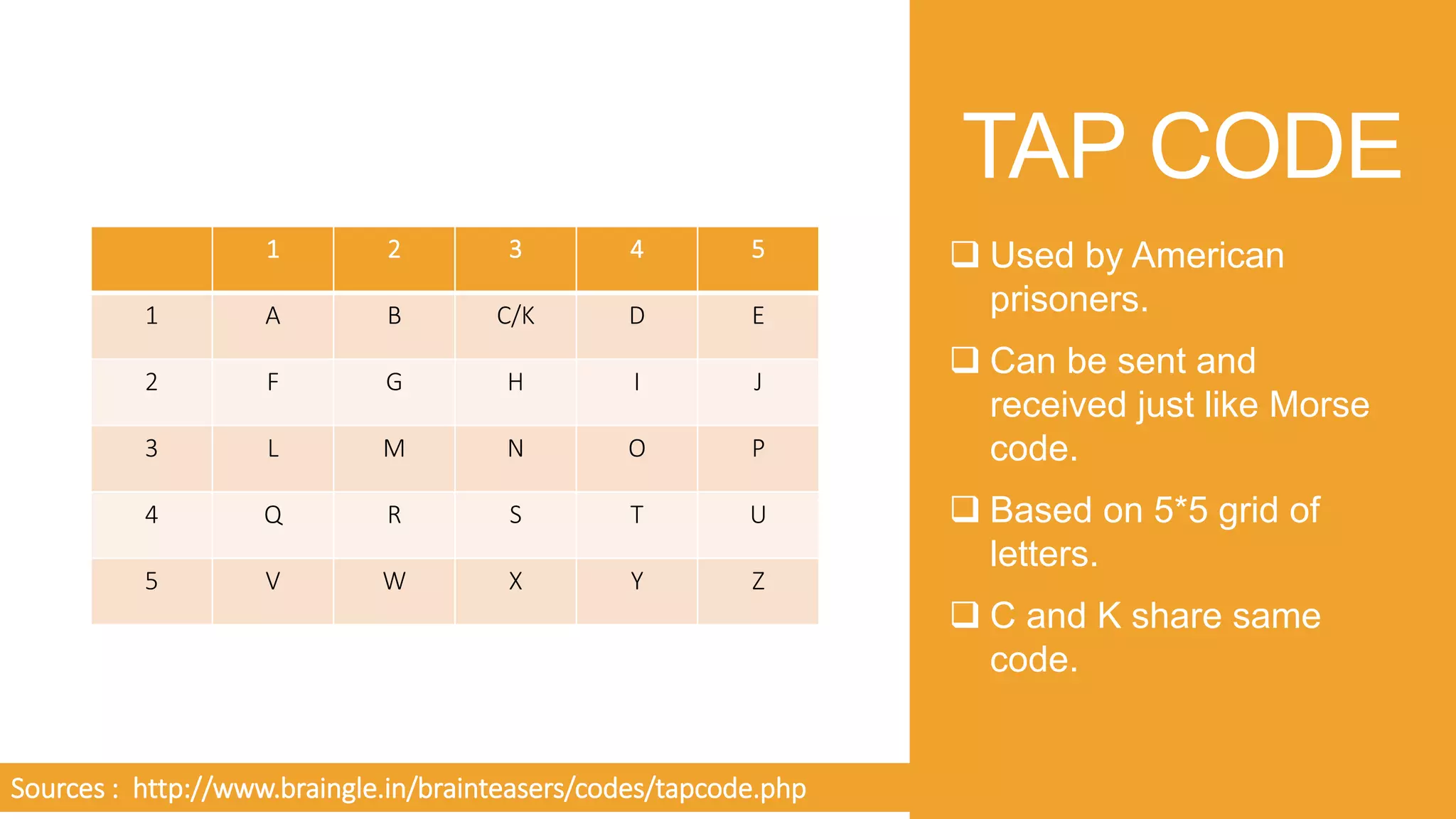
1 2 3 4 5
1 A B C/K D E
2 F G H I J
3 L M N O P
4 Q R S T U
5 V W X Y Z
 Used by American
prisoners.
 Can be sent and
received just like Morse
code.
 Based on 5*5 grid of
letters.
 C and K share same
code.
Sources : http://www.braingle.in/brainteasers/codes/tapcode.php
TAP CODE
1 2 3 4 5
1 A B C/K D E
2 F G H I J
3 L M N O P
4 Q R S T U
5 V W X Y Z
E = ●─●●●●●
M= ●●●─●●
T= ●●●●─●●●●
Sources : http://metalgear.wikia.com/wiki/Tap_code
Now, Tap code have started being more popular
than Morse Code because of its simplicity.
CHANGES MADE IN MORSE CODE
AMERICAN & CONTINENTAL MORSE CODE
 with use, some characters in codes we changed by various users in various
countries.
 in 1848, Germany eliminated the long spaces and long dashes. The new standard
also changed the code for the numerical characters.
 modified version of the Morse code was accepted in 1865 throughout Europe.
 became known as Continental Morse.
 later, it became known as International Morse. The original version of Morse code
became known as American Morse.
Sources : http://jhbunnell.com/morsecode.shtml
http://www.vk5sw.com/Beginner's%20Morse%20Code.htm
THE DIFFERENCE BETWEEN THE MORSE AND THE CONTINENTAL CODES
Morse Continental Morse Continental
C . . . C _ . _ . 1 . _ _ . 1 . _ _ _ _
F . _ . F . . _ . 2 . . _ . . 2 . . _ _ _
J _ . _ . J . _ _ _ 3 . . . _ . 3 . . . _ _
L ___[long dash] L . _ . . 5 _ _ _ 5 . . . . .
O . . O _ _ _ 6 . . . . . . 6 _ . . . .
P . . . . . P . _ _ . 7 _ _ . . 7 _ _ . . .
Q . . _ . Q _ _ . _ 8 _ . . . . 8 _ _ _ . .
R . . . R . _ . 9 _ . . _ 9 _ _ _ _ .
X . _ . . X _ . . _ 0 _______ 0 _ _ _ _ _
Y . . . . Y _ . _ _
Z . . . . Z _ _ . .
Sources : http://jhbunnell.com/morsecode.shtml
http://www.vk5sw.com/Beginner's%20Morse%20Code.htm
ADVANTAGES AND DISADVANTAGES
OF MORSE CODE
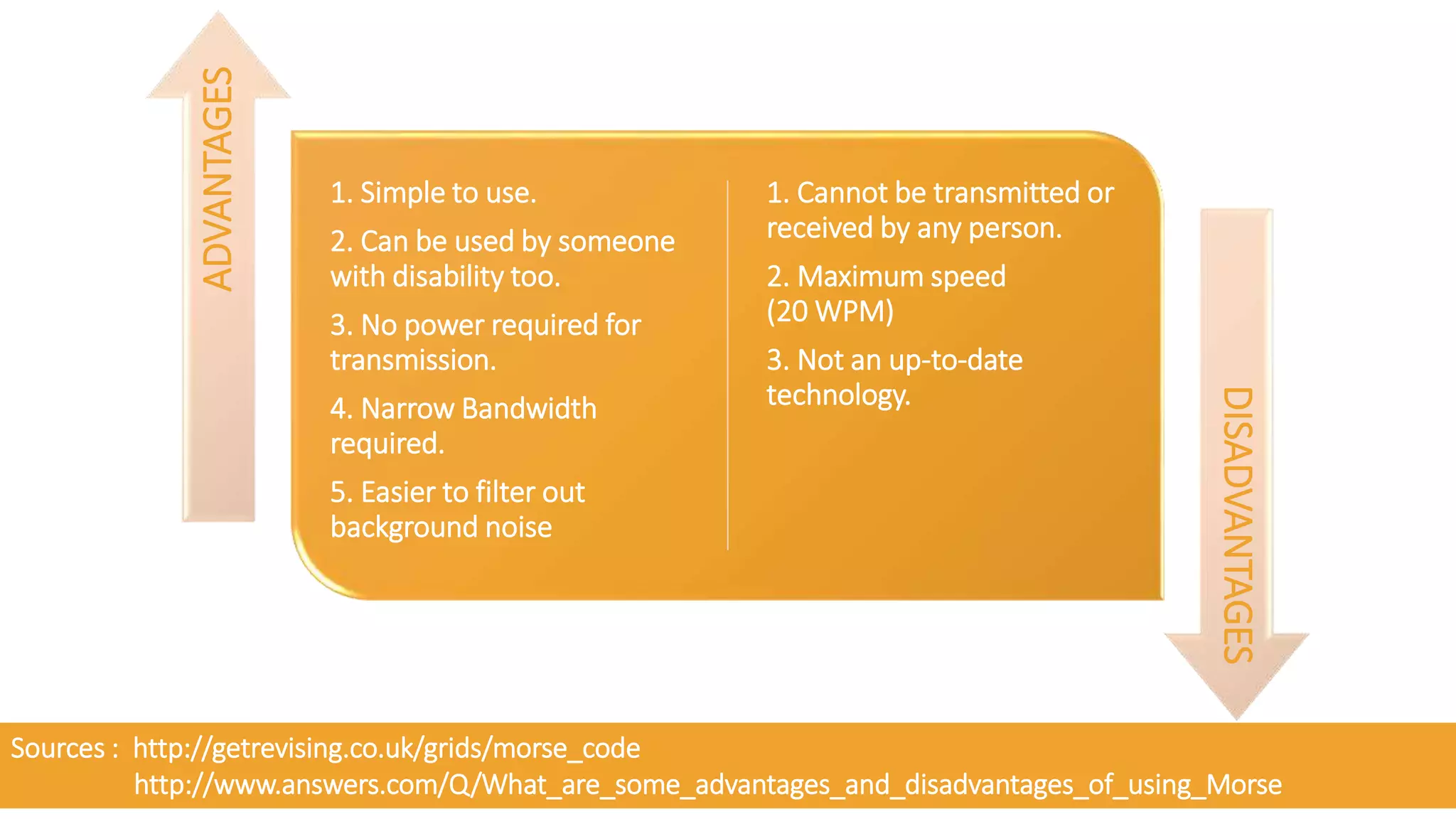
1. Simple to use.
2. Can be used by someone
with disability too.
3. No power required for
transmission.
4. Narrow Bandwidth
required.
5. Easier to filter out
background noise
1. Cannot be transmitted or
received by any person.
2. Maximum speed
(20 WPM)
3. Not an up-to-date
technology.
ADVANTAGES
DISADVANTAGES
Sources : http://getrevising.co.uk/grids/morse_code
http://www.answers.com/Q/What_are_some_advantages_and_disadvantages_of_using_Morse
MORSE CODE APPLICATIONS
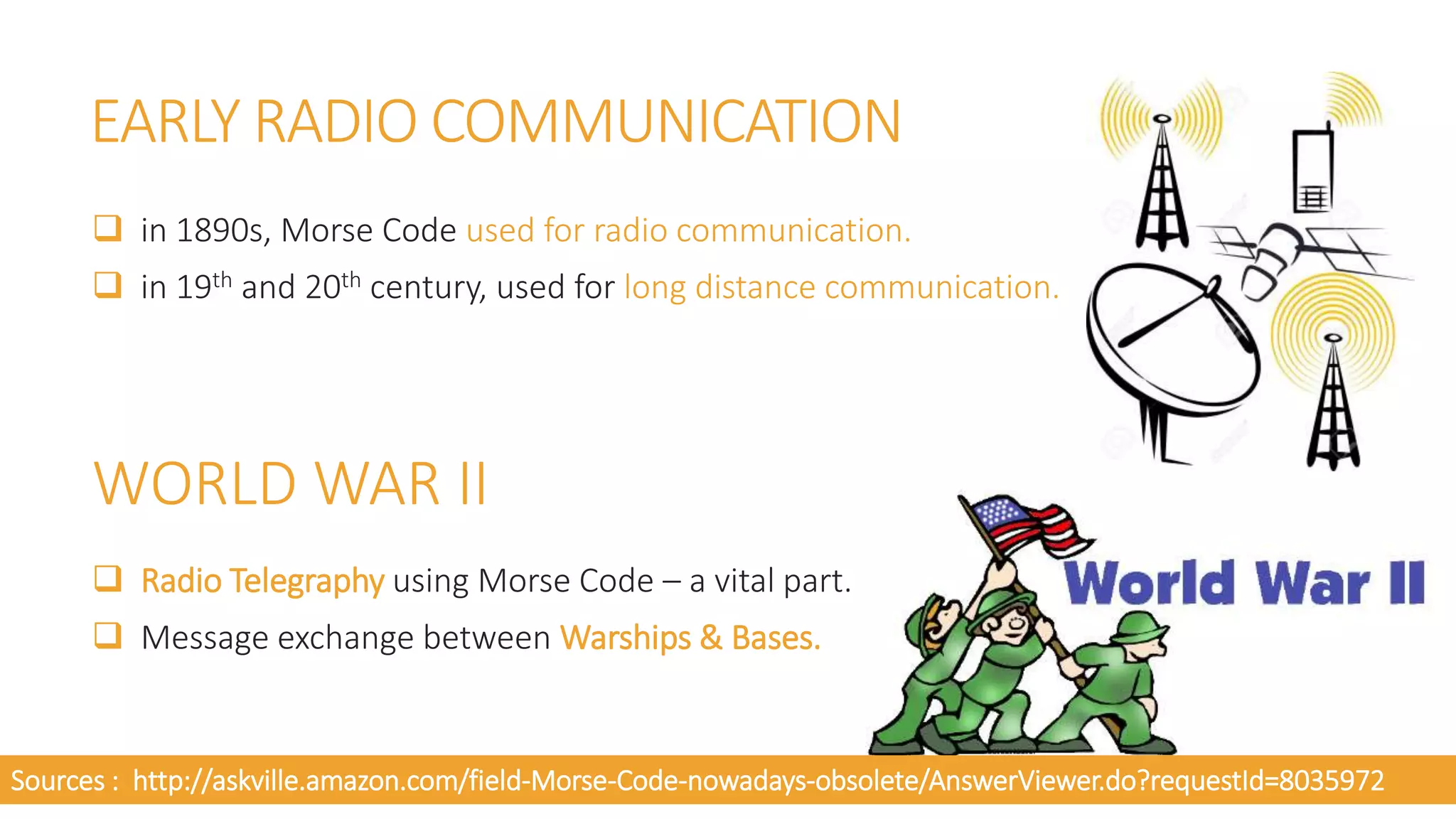
EARLY RADIO COMMUNICATION
 in 1890s, Morse Code used for radio communication.
 in 19th and 20th century, used for long distance communication.
WORLD WAR II
 Radio Telegraphy using Morse Code – a vital part.
 Message exchange between Warships & Bases.
Sources : http://askville.amazon.com/field-Morse-Code-nowadays-obsolete/AnswerViewer.do?requestId=8035972
HAM RADIO
 also called “Amateur Radio”.
 uses radio frequency spectra for non-commercial exchange of messages.
 originated in 19th century.
 but got advanced in late 20th century (one we use today).
 the term "amateur“ - describes duly personal use.
- without pecuniary interest.
- different from commercial broadcasting or for public safety.
Sources : http://electronics.howstuffworks.com/ham-radio2.htm
 operates on a variety of frequencies.
 non-hams can "listen in" via their own receivers or radio scanners.
 operate from just above the AM broadcast band to the microwave region, in the
gigahertz range.
 right now, 89 amateur radio stations allotted in US
approximately 675,000 amateur
radio operators in the US, and
more than 2.5 million around
the world.
Sources : http://electronics.howstuffworks.com/ham-radio8.htm
WHAT TO DO, IF YOU WANT TO BE ONE
STEP ONE : buy a short-wave receiver capable of receiving
single sideband (SSB).
STEP TWO : talk to ARRL, they’ll
grant you a “license”.
STEP THREE : you will hear local ham operators using repeaters
in the frequency range of 144 to 148 MHz.
Sources : http://www.hamradio-friedrichshafen.de/ham-en/information/facts.php
MORSE CODE TRANSLATOR (ANDROID APP)

MORSE-IT (iOS APP)
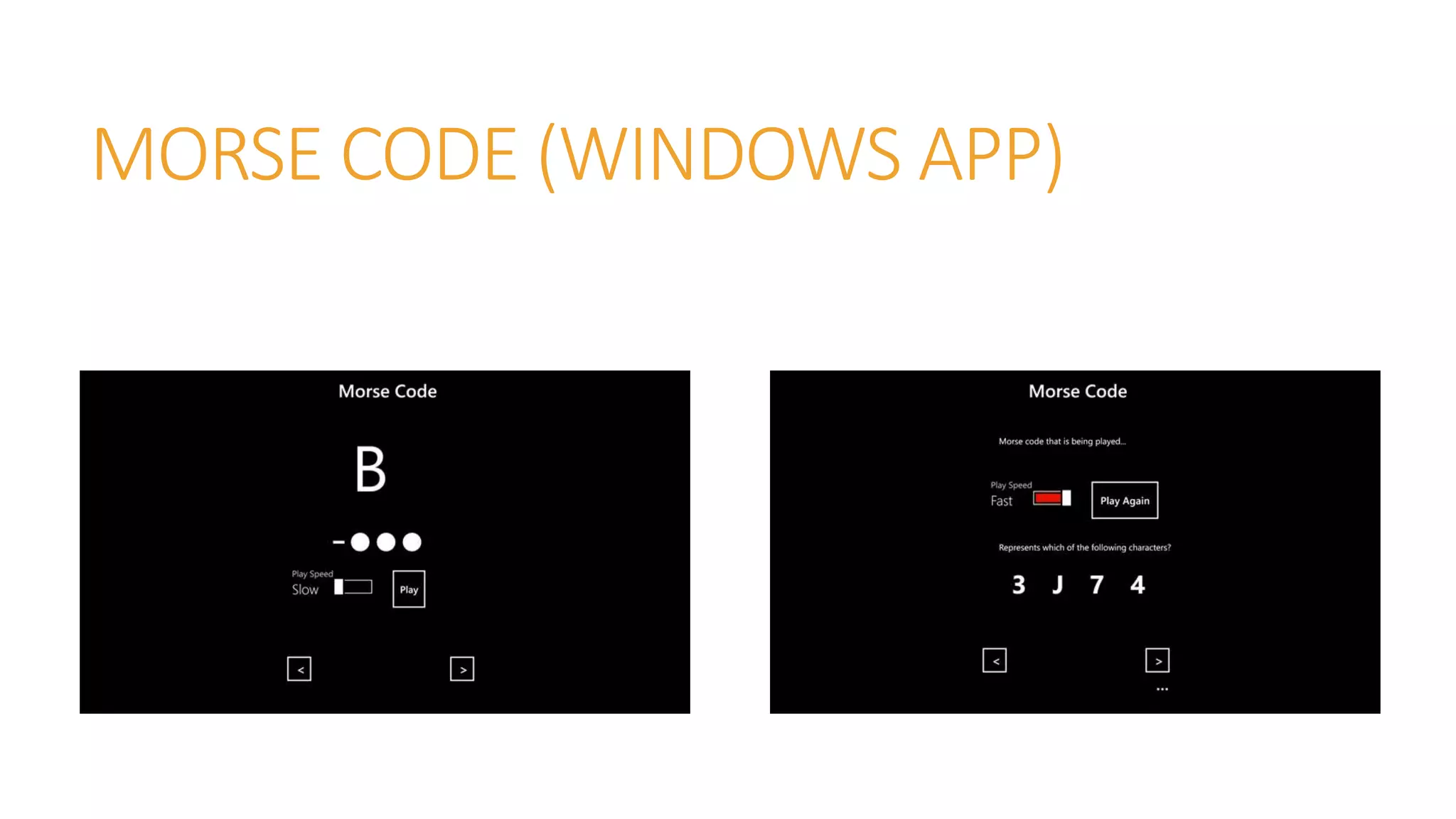
MORSE CODE (WINDOWS APP)
- .... .- -. -.- / -.-- --- ..-
Morse code (-- --- .-. ... . -.-. --- -.. .)

Morse code (-- --- .-. ... . -.-. --- -.. .)

  • 2.
    MORSE CODE (-- ---•-• ••• • -•-• --- -•• •)
  • 3.
    MEMBERS  Vaishali Upadhyay Vikas Prasad  Tanish Garg  Anurag Aggarwal  Tushar Swami
  • 4.
    OUTLINE  What isMorse Code?  History  Invention  International Morse Code  Transmitting Morse Code  Tap Code (a new replacement)  Advantages and Disadvantages  Uses – then and now…
  • 5.
    ACKNOWLEDGEMENT We would liketo express our special thanks of gratitude to our teacher Dr. Chhavi Bhatnagar who gave us the golden opportunity to present this wonderful presentation on the topic ( MORSE CODE ), which also helped us in doing a lot of Research and we came to know about new things. We are really thankful to her.
  • 6.
  • 7.
    INTRODUCTION  Morse code- a method of transmitting text information as a series of on-off tones and lights or clicks  recipient can understand the message without additional decoding equipment.  Dits /Dahs provides the code. Samuel Morse 1797-1872 Sources : https://en.wikipedia.org/wiki/Morse_code
  • 8.
    INTRODUCTION  Dits refersto dots and dahs refer to dash.  slow but reliable means of transmitting and receiving text through condition involving noise fading or interference.  simple binary code (key up/ key down)allows for an extremely narrow bandwidth maximum speed to transmit and receive information is 20-30 WPM. Joseph Henry 1797-1878 Sources : https://en.wikipedia.org/wiki/Morse_code
  • 9.
    HISTORY  Samuel Morsegot idea of inventing a secret code language in 1800s when he worked with an electrical telegraph system.  in 1836 - Samuel Morse, Joseph Henry and Alfred Vail developed an electrical telegraph system.  Morse planned to transmit only numerals at first.  after that , Alfred Vail included letters and special characters. Alfred Vail 1807-1859 Sources : https://en.wikipedia.org/wiki/Morse_code
  • 10.
    HOW MORSE CODEEVOLVED???  once, Samuel Morse went to a printers shop and counted the amount of printer type the alphabet.  he then interpreted these counts as approximations of the relative frequency of each letter in typical English text.  he organized the Morse code so that the shortest symbols were associated with the most frequent character. Sources : https://en.wikipedia.org/wiki/Morse_code http://www.codeproject.com/Tips/565652/Introduction-to-Morse-Code
  • 11.
    ‘E’ is themost commonly used letter so its Morse code is just a single dot. The letter ‘I’ has two dots. The letter ‘T’ has a single dash. International Morse Codes
  • 12.
  • 13.
    Morse code canbe transmitted(sent) through a number of ways Electrical Telegraph Wire Light Sound The transmission has mainly three sections: a transmitter, a receiver and channel.
  • 14.
    TIMING Generally speaking, morsecode consists of five elements 1. a dot (one unit) 2. a dash (three units) 3. an inter-element gap (one unit) 4. a gap between letters (three units) 5. the gap between words (7 units) 'MESSAGE TO' Sources : http://cryptomuseum.com/radio/morse/ https://www.mtechnologies.com/ameco/keys.htm
  • 15.
    Transmission through Electrical telegraphwire The transmitting operator used a Morse key (switch) to turn the electric current on and off in the rhythm of the morse codes. Sources : http://cryptomuseum.com/radio/morse/ http://www.vk5sw.com/Beginner's%20Morse%20Code.htm
  • 16.
     These electricsignals are transmitted through telegraph wires.  At the receiving end, the electric current engaged an electro- magnet, that would 'click' in the rhythm of the morse signals.  The operator present at the receiving station recognize the 'clicks' of the electro-magnet and decodes the message. Sources : http://cryptomuseum.com/radio/morse/
  • 17.
    MESSAGE TRANSMISSION THROUGH LIGHTOR SOUND Via Light  procedure same as transmitting signal normally.  long flash – dash  short flash – dot For demonstration let us try transmitting message “SOS” Sources : https://en.wikipedia.org/wiki/Signal_lamp
  • 18.
    Via Audio  messagetransmitted in form of beeps.  just need to focus on your length of beeps.  long beep – dash  short beep – dot Morse Code was used in light and audio format mostly by US NAVY and Submarines to communicate with each other. Still, some of them employ such methods to send secret messages. Sources : http://blinking-light-training.software.informer.com/
  • 19.
  • 20.
    TAP CODE 1 23 4 5 1 A B C/K D E 2 F G H I J 3 L M N O P 4 Q R S T U 5 V W X Y Z  Used by American prisoners.  Can be sent and received just like Morse code.  Based on 5*5 grid of letters.  C and K share same code. Sources : http://www.braingle.in/brainteasers/codes/tapcode.php
  • 21.
    TAP CODE 1 23 4 5 1 A B C/K D E 2 F G H I J 3 L M N O P 4 Q R S T U 5 V W X Y Z E = ●─●●●●● M= ●●●─●● T= ●●●●─●●●● Sources : http://metalgear.wikia.com/wiki/Tap_code Now, Tap code have started being more popular than Morse Code because of its simplicity.
  • 22.
    CHANGES MADE INMORSE CODE
  • 23.
    AMERICAN & CONTINENTALMORSE CODE  with use, some characters in codes we changed by various users in various countries.  in 1848, Germany eliminated the long spaces and long dashes. The new standard also changed the code for the numerical characters.  modified version of the Morse code was accepted in 1865 throughout Europe.  became known as Continental Morse.  later, it became known as International Morse. The original version of Morse code became known as American Morse. Sources : http://jhbunnell.com/morsecode.shtml http://www.vk5sw.com/Beginner's%20Morse%20Code.htm
  • 24.
    THE DIFFERENCE BETWEENTHE MORSE AND THE CONTINENTAL CODES Morse Continental Morse Continental C . . . C _ . _ . 1 . _ _ . 1 . _ _ _ _ F . _ . F . . _ . 2 . . _ . . 2 . . _ _ _ J _ . _ . J . _ _ _ 3 . . . _ . 3 . . . _ _ L ___[long dash] L . _ . . 5 _ _ _ 5 . . . . . O . . O _ _ _ 6 . . . . . . 6 _ . . . . P . . . . . P . _ _ . 7 _ _ . . 7 _ _ . . . Q . . _ . Q _ _ . _ 8 _ . . . . 8 _ _ _ . . R . . . R . _ . 9 _ . . _ 9 _ _ _ _ . X . _ . . X _ . . _ 0 _______ 0 _ _ _ _ _ Y . . . . Y _ . _ _ Z . . . . Z _ _ . . Sources : http://jhbunnell.com/morsecode.shtml http://www.vk5sw.com/Beginner's%20Morse%20Code.htm
  • 25.
  • 26.
    1. Simple touse. 2. Can be used by someone with disability too. 3. No power required for transmission. 4. Narrow Bandwidth required. 5. Easier to filter out background noise 1. Cannot be transmitted or received by any person. 2. Maximum speed (20 WPM) 3. Not an up-to-date technology. ADVANTAGES DISADVANTAGES Sources : http://getrevising.co.uk/grids/morse_code http://www.answers.com/Q/What_are_some_advantages_and_disadvantages_of_using_Morse
  • 27.
  • 28.
    EARLY RADIO COMMUNICATION in 1890s, Morse Code used for radio communication.  in 19th and 20th century, used for long distance communication. WORLD WAR II  Radio Telegraphy using Morse Code – a vital part.  Message exchange between Warships & Bases. Sources : http://askville.amazon.com/field-Morse-Code-nowadays-obsolete/AnswerViewer.do?requestId=8035972
  • 29.
    HAM RADIO  alsocalled “Amateur Radio”.  uses radio frequency spectra for non-commercial exchange of messages.  originated in 19th century.  but got advanced in late 20th century (one we use today).  the term "amateur“ - describes duly personal use. - without pecuniary interest. - different from commercial broadcasting or for public safety. Sources : http://electronics.howstuffworks.com/ham-radio2.htm
  • 30.
     operates ona variety of frequencies.  non-hams can "listen in" via their own receivers or radio scanners.  operate from just above the AM broadcast band to the microwave region, in the gigahertz range.  right now, 89 amateur radio stations allotted in US approximately 675,000 amateur radio operators in the US, and more than 2.5 million around the world. Sources : http://electronics.howstuffworks.com/ham-radio8.htm
  • 31.
    WHAT TO DO,IF YOU WANT TO BE ONE STEP ONE : buy a short-wave receiver capable of receiving single sideband (SSB). STEP TWO : talk to ARRL, they’ll grant you a “license”. STEP THREE : you will hear local ham operators using repeaters in the frequency range of 144 to 148 MHz. Sources : http://www.hamradio-friedrichshafen.de/ham-en/information/facts.php
  • 32.
    MORSE CODE TRANSLATOR(ANDROID APP) 
  • 33.
  • 34.
  • 35.
    - .... .--. -.- / -.-- --- ..-