WAYS TO
BUILD YOUR
VOCABULARY
IN A FOREIGN LANGUAGE
10
Image © Chris-Håvard Berge | Flickr
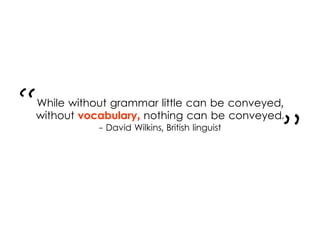
While without grammar little can be conveyed,
without vocabulary, nothing can be conveyed.
- David Wilkins, British linguist
“
”
There is a long held assumption that
grammar is more important than
vocabulary when learning a new language.
But linguistic research has demonstrated that
vocabulary is actually more fundamental
than grammar.
(Barcroft, 2004; Lewis, 2002; Wilkins, 1972)
Author Keith Folse knew the perfect Japanese
structure to ask: “Excuse me, where is the ____?”
Author Keith Folse knew the perfect Japanese
structure to ask: “Excuse me, where is the ____?”
What he didn’t know was the word for flour.
Image © David Pacey | Flickr
Author Keith Folse knew the perfect Japanese
structure to ask: “Excuse me, where is the ____?”
What he didn’t know was the word for flour.
Image © David Pacey | Flickr
After consulting a Japanese friend for the
translation, what he actually ended up
with was the word for flower.
Image © Swaminathan | Flickr
Sometimes, one word can make
all the difference.
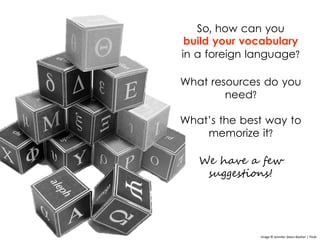
So, how can you
build your vocabulary
in a foreign language?
What resources do you
need?
What’s the best way to
memorize it?
We have a few
suggestions!
Image © Jennifer Steen Booher | Flickr
Use Language-Learning Software
1
Language-learning
software can be a
very effective
vocabulary builder,
especially for
beginners!
Image © Jeff Geerling | Flickr
Image © phip_s | Flickr
Put down the index cards.
Most software programs come
with hundreds of common
words and phrases, so you
can spend less time making
flashcards and spend more
time actually learning.
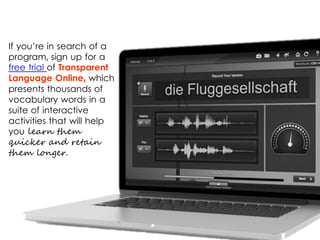
If you’re in search of a
program, sign up for a
free trial of Transparent
Language Online, which
presents thousands of
vocabulary words in a
suite of interactive
activities that will help
you learn them
quicker and retain
them longer.
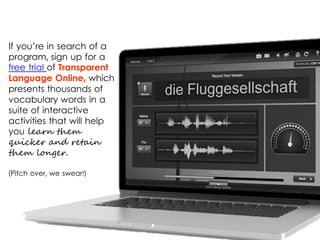
If you’re in search of a
program, sign up for a
free trial of Transparent
Language Online, which
presents thousands of
vocabulary words in a
suite of interactive
activities that will help
you learn them
quicker and retain
them longer.
(Pitch over, we swear!)
Study Cognates & False Cognates
2
Chances are, you already know dozens (if not
hundreds or more!) of words in your new
language, but you just don’t realize it.
Chances are, you already know dozens (if not
hundreds or more!) of words in your new
language, but you just don’t realize it.
HOW?
Chances are, you already know dozens (if not
hundreds or more!) of words in your new
language, but you just don’t realize it.
HOW?
They’re called cognates.
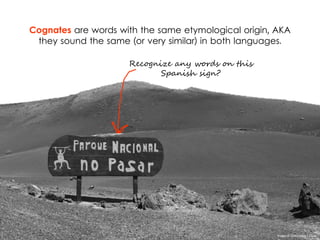
Cognates are words with the same etymological origin, AKA
they sound the same (or very similar) in both languages.
Image © Doblonaut | Flickr
Cognates are words with the same etymological origin, AKA
they sound the same (or very similar) in both languages.
Recognize any words on this
Spanish sign?
Image © Doblonaut | Flickr
Take time to memorize the cognates in the
language you’re learning. A Google search for
“[language]-English cognates” should lead you
in the right direction.
Beware, though! You should also search for
and memorize false cognates, or words
that sound the same but actually have
very different meanings.
Beware, though! You should also search for
and memorize false cognates, or words
that sound the same but actually have
very different meanings.
In Spanish, for example, embarazada
does not mean embarrassed… it
means pregnant! Now that mix up
could be embarrassing!
Image © clappstar | flickr
Study Synonym Pairs
3
Cognates are extremely easy to memorize. But if
you’re beyond the beginner level, you probably
know most of them. What’s next?
Cognates are extremely easy to memorize. But if
you’re beyond the beginner level, you probably
know most of them. What’s next?
Synonyms and antonyms!
Learning synonyms may seem like
duplicated effort. If you know the word for
“funny,” you should be all set, right?
Image © Don LaVange | Flickr
Learning synonyms may seem like
duplicated effort. If you know the word for
“funny,” you should be all set, right?
Image © Don LaVange | Flickr
But what if someone tells
you: That was…
hilarious
amusing
entertaining
silly
hysterical
?
When you learn a new word, use a thesaurus to
discover its synonyms. This practice will increase
your understanding of the word and add variety
to your vocabulary.
Image © mrd00dman | Flickr
Study Prefixes & Suffixes
4
Another trick to significantly expand your
vocabulary is to study common prefixes and
suffixes in the target language.
For example, if you know the Spanish prefix “con” (with) and
the verb “vivir” (to live), deciphering the new verb “convivir” (to
live together) becomes a lot easier.
Image © Brent and Amanda I | Flickr
Each prefix and suffix you learn opens the
door to hundreds of new words, yielding a
huge return on your investment in your
vocabulary.
Read, Read, & Read Some More
5
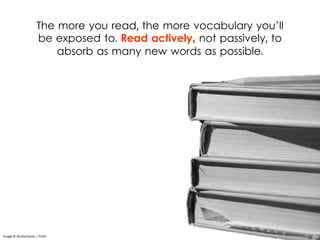
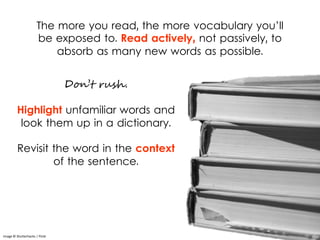
The more you read, the more vocabulary you’ll
be exposed to. Read actively, not passively, to
absorb as many new words as possible.
Image © Shutterhacks | Flickr
The more you read, the more vocabulary you’ll
be exposed to. Read actively, not passively, to
absorb as many new words as possible.
Image © Shutterhacks | Flickr
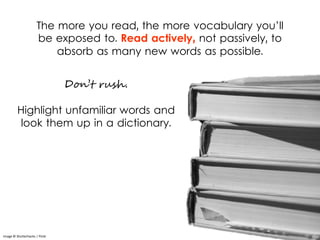
Don’t rush.
The more you read, the more vocabulary you’ll
be exposed to. Read actively, not passively, to
absorb as many new words as possible.
Image © Shutterhacks | Flickr
Don’t rush.
Highlight unfamiliar words and
look them up in a dictionary.
The more you read, the more vocabulary you’ll
be exposed to. Read actively, not passively, to
absorb as many new words as possible.
Image © Shutterhacks | Flickr
Don’t rush.
Highlight unfamiliar words and
look them up in a dictionary.
Revisit the word in the context
of the sentence.
Read a variety of materials, from short stories and
novels to newspapers and blogs, to acquire vocabulary
at varying levels of difficulty and a wide range of topics.
Image © Ol.v!er[H2vPk] | Flickr
Separate your leisurely reading from your
active, vocabulary-building reading.
Image © Chad Kainz | Flickr
Separate your leisurely reading from your
active, vocabulary-building reading.
When reading to boost your vocab,
limit yourself. Stick to just a few pages of
a novel, one news story, one magazine
article, etc. and really take your time.
Image © Chad Kainz | Flickr
Keep a Journal in the
Target Language6
Keeping a journal in your target language is the
perfect way to find words you didn’t even know
that you didn’t know. (What a mouthful!)
Image © Walt Stoneburner | Flickr
Take a few minutes to
write about your day.
Want to mention
something you did or
experienced, but don’t
know how? That’s
probably a word you’ll
want to know in the
future, so look it up!
Image © Refracted Moments | Flickr
Image © photosteve101 | Flickr
Highlight the new words in each entry. At the end of
the week, flip through your old entries and review
these new words to keep them fresh in your memory.
Investigate Word Origins7
If you struggle less with finding new vocabulary
and more with just remembering it, try your
hand at a little etymology!
Image © Trish Hartmann | Flickr
It may help to associate a new vocabulary word
with its origins.
Image © William Warby | Flickr
For example, the English word
“hippopotamus” is derived from
the Greek words “ippos” (horse)
and “potamas” (river).
It may help to associate a new vocabulary word
with its origins.
Image © William Warby | Flickr
For example, the English word
“hippopotamus” is derived from
the Greek words “ippos” (horse)
and “potamas” (river).
Associating “hippopotamus”
with “river horse” gives you a
strong visual, and may help
you recall the word more
easily.
Looking up the origins or literal meanings
of words and expressions will paint a
mental picture that you can look back
on, rather than just relying on rote
memorization.
Follow Native Speakers
on Twitter8
Looking for slang, idioms, informal
expressions, abbreviations, and all of that
juicy stuff you’ll never find in a
dictionary?
Looking for slang, idioms, informal
expressions, abbreviations, and all of that
juicy stuff you’ll never find in a
dictionary?
Check Twitter!
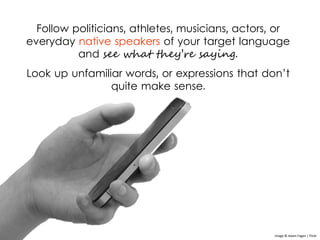
Follow politicians, athletes, musicians, actors, or
everyday native speakers of your target language
and see what they’re saying.
Look up unfamiliar words, or expressions that don’t
quite make sense.
Image © Adam Fagen | Flickr
For example, the
Portuguese
expression “Escrevo
o que eu tô te
falando.” literally
means “Write down
what I’m telling
you.”
That’s a little
strange, right? If you
look it up, you’ll find
that it’s actually
used to say “Mark
my words.”
Watching and interacting with
native speakers on an informal
platform like Twitter will give your
vocabulary a much-needed boost
in the colloquial department.
Learn a “Word of the Day”9
Use a word-a-day calendar or
online Word of the Day service to
learn one new word each day!
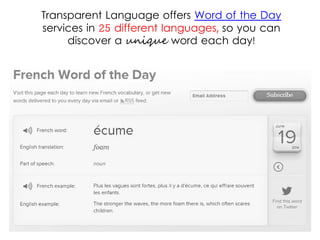
Transparent Language offers Word of the Day
services in 25 different languages, so you can
discover a unique word each day!
Listen to Music10
Similar to how exploring word origins helps you
build vocabulary by providing strong mental
images, listening to music gives you something
memorable to associate with a new word.
Have you ever noticed your brain’s seemingly
endless capacity for song lyrics? Think of how many
songs you have memorized in there!
Image © Roadsidepictures | Flickr
Search YouTube, Pandora, Spotify, last.fm, etc.
for music you enjoy in your target language
and look up the lyrics.
Image © eldeeem | Flickr
Pick one song at a time, and look up all of
the unfamiliar vocabulary in the lyrics. With
enough listens, those new words and phrases
will be engrained in your mind, just like
your favorite songs in your native language.
Vocabulary building should be a goal
for language learners of all levels.
The greater your vocabulary in a language,
the better you will understand others and
express yourself.
Use these tips to get started, and never
stop acquiring new vocabulary!
Ready to build your vocabulary?
Sign up for a free trial of Transparent Language Online and learn
thousands of new vocabulary words and phrases in 100+ languages!
TRY IT FREE

10 Ways to Build Your Vocabulary in a Foreign Language

  • 1.
    WAYS TO BUILD YOUR VOCABULARY INA FOREIGN LANGUAGE 10 Image © Chris-Håvard Berge | Flickr
  • 2.
    While without grammarlittle can be conveyed, without vocabulary, nothing can be conveyed. - David Wilkins, British linguist “ ”
  • 3.
    There is along held assumption that grammar is more important than vocabulary when learning a new language.
  • 4.
    But linguistic researchhas demonstrated that vocabulary is actually more fundamental than grammar. (Barcroft, 2004; Lewis, 2002; Wilkins, 1972)
  • 5.
    Author Keith Folseknew the perfect Japanese structure to ask: “Excuse me, where is the ____?”
  • 6.
    Author Keith Folseknew the perfect Japanese structure to ask: “Excuse me, where is the ____?” What he didn’t know was the word for flour. Image © David Pacey | Flickr
  • 7.
    Author Keith Folseknew the perfect Japanese structure to ask: “Excuse me, where is the ____?” What he didn’t know was the word for flour. Image © David Pacey | Flickr After consulting a Japanese friend for the translation, what he actually ended up with was the word for flower. Image © Swaminathan | Flickr
  • 8.
    Sometimes, one wordcan make all the difference.
  • 9.
    So, how canyou build your vocabulary in a foreign language? What resources do you need? What’s the best way to memorize it? We have a few suggestions! Image © Jennifer Steen Booher | Flickr
  • 10.
  • 11.
    Language-learning software can bea very effective vocabulary builder, especially for beginners! Image © Jeff Geerling | Flickr
  • 12.
    Image © phip_s| Flickr Put down the index cards. Most software programs come with hundreds of common words and phrases, so you can spend less time making flashcards and spend more time actually learning.
  • 13.
    If you’re insearch of a program, sign up for a free trial of Transparent Language Online, which presents thousands of vocabulary words in a suite of interactive activities that will help you learn them quicker and retain them longer.
  • 14.
    If you’re insearch of a program, sign up for a free trial of Transparent Language Online, which presents thousands of vocabulary words in a suite of interactive activities that will help you learn them quicker and retain them longer. (Pitch over, we swear!)
  • 15.
    Study Cognates &False Cognates 2
  • 16.
    Chances are, youalready know dozens (if not hundreds or more!) of words in your new language, but you just don’t realize it.
  • 17.
    Chances are, youalready know dozens (if not hundreds or more!) of words in your new language, but you just don’t realize it. HOW?
  • 18.
    Chances are, youalready know dozens (if not hundreds or more!) of words in your new language, but you just don’t realize it. HOW? They’re called cognates.
  • 19.
    Cognates are wordswith the same etymological origin, AKA they sound the same (or very similar) in both languages. Image © Doblonaut | Flickr
  • 20.
    Cognates are wordswith the same etymological origin, AKA they sound the same (or very similar) in both languages. Recognize any words on this Spanish sign? Image © Doblonaut | Flickr
  • 21.
    Take time tomemorize the cognates in the language you’re learning. A Google search for “[language]-English cognates” should lead you in the right direction.
  • 22.
    Beware, though! Youshould also search for and memorize false cognates, or words that sound the same but actually have very different meanings.
  • 23.
    Beware, though! Youshould also search for and memorize false cognates, or words that sound the same but actually have very different meanings. In Spanish, for example, embarazada does not mean embarrassed… it means pregnant! Now that mix up could be embarrassing! Image © clappstar | flickr
  • 24.
  • 25.
    Cognates are extremelyeasy to memorize. But if you’re beyond the beginner level, you probably know most of them. What’s next?
  • 26.
    Cognates are extremelyeasy to memorize. But if you’re beyond the beginner level, you probably know most of them. What’s next? Synonyms and antonyms!
  • 27.
    Learning synonyms mayseem like duplicated effort. If you know the word for “funny,” you should be all set, right? Image © Don LaVange | Flickr
  • 28.
    Learning synonyms mayseem like duplicated effort. If you know the word for “funny,” you should be all set, right? Image © Don LaVange | Flickr But what if someone tells you: That was… hilarious amusing entertaining silly hysterical ?
  • 29.
    When you learna new word, use a thesaurus to discover its synonyms. This practice will increase your understanding of the word and add variety to your vocabulary. Image © mrd00dman | Flickr
  • 30.
    Study Prefixes &Suffixes 4
  • 31.
    Another trick tosignificantly expand your vocabulary is to study common prefixes and suffixes in the target language.
  • 32.
    For example, ifyou know the Spanish prefix “con” (with) and the verb “vivir” (to live), deciphering the new verb “convivir” (to live together) becomes a lot easier. Image © Brent and Amanda I | Flickr
  • 33.
    Each prefix andsuffix you learn opens the door to hundreds of new words, yielding a huge return on your investment in your vocabulary.
  • 34.
    Read, Read, &Read Some More 5
  • 35.
    The more youread, the more vocabulary you’ll be exposed to. Read actively, not passively, to absorb as many new words as possible. Image © Shutterhacks | Flickr
  • 36.
    The more youread, the more vocabulary you’ll be exposed to. Read actively, not passively, to absorb as many new words as possible. Image © Shutterhacks | Flickr Don’t rush.
  • 37.
    The more youread, the more vocabulary you’ll be exposed to. Read actively, not passively, to absorb as many new words as possible. Image © Shutterhacks | Flickr Don’t rush. Highlight unfamiliar words and look them up in a dictionary.
  • 38.
    The more youread, the more vocabulary you’ll be exposed to. Read actively, not passively, to absorb as many new words as possible. Image © Shutterhacks | Flickr Don’t rush. Highlight unfamiliar words and look them up in a dictionary. Revisit the word in the context of the sentence.
  • 39.
    Read a varietyof materials, from short stories and novels to newspapers and blogs, to acquire vocabulary at varying levels of difficulty and a wide range of topics. Image © Ol.v!er[H2vPk] | Flickr
  • 40.
    Separate your leisurelyreading from your active, vocabulary-building reading. Image © Chad Kainz | Flickr
  • 41.
    Separate your leisurelyreading from your active, vocabulary-building reading. When reading to boost your vocab, limit yourself. Stick to just a few pages of a novel, one news story, one magazine article, etc. and really take your time. Image © Chad Kainz | Flickr
  • 42.
    Keep a Journalin the Target Language6
  • 43.
    Keeping a journalin your target language is the perfect way to find words you didn’t even know that you didn’t know. (What a mouthful!) Image © Walt Stoneburner | Flickr
  • 44.
    Take a fewminutes to write about your day. Want to mention something you did or experienced, but don’t know how? That’s probably a word you’ll want to know in the future, so look it up! Image © Refracted Moments | Flickr
  • 45.
    Image © photosteve101| Flickr Highlight the new words in each entry. At the end of the week, flip through your old entries and review these new words to keep them fresh in your memory.
  • 46.
  • 47.
    If you struggleless with finding new vocabulary and more with just remembering it, try your hand at a little etymology! Image © Trish Hartmann | Flickr
  • 48.
    It may helpto associate a new vocabulary word with its origins. Image © William Warby | Flickr For example, the English word “hippopotamus” is derived from the Greek words “ippos” (horse) and “potamas” (river).
  • 49.
    It may helpto associate a new vocabulary word with its origins. Image © William Warby | Flickr For example, the English word “hippopotamus” is derived from the Greek words “ippos” (horse) and “potamas” (river). Associating “hippopotamus” with “river horse” gives you a strong visual, and may help you recall the word more easily.
  • 50.
    Looking up theorigins or literal meanings of words and expressions will paint a mental picture that you can look back on, rather than just relying on rote memorization.
  • 51.
  • 52.
    Looking for slang,idioms, informal expressions, abbreviations, and all of that juicy stuff you’ll never find in a dictionary?
  • 53.
    Looking for slang,idioms, informal expressions, abbreviations, and all of that juicy stuff you’ll never find in a dictionary? Check Twitter!
  • 54.
    Follow politicians, athletes,musicians, actors, or everyday native speakers of your target language and see what they’re saying. Look up unfamiliar words, or expressions that don’t quite make sense. Image © Adam Fagen | Flickr
  • 55.
    For example, the Portuguese expression“Escrevo o que eu tô te falando.” literally means “Write down what I’m telling you.” That’s a little strange, right? If you look it up, you’ll find that it’s actually used to say “Mark my words.”
  • 56.
    Watching and interactingwith native speakers on an informal platform like Twitter will give your vocabulary a much-needed boost in the colloquial department.
  • 57.
    Learn a “Wordof the Day”9
  • 58.
    Use a word-a-daycalendar or online Word of the Day service to learn one new word each day!
  • 59.
    Transparent Language offersWord of the Day services in 25 different languages, so you can discover a unique word each day!
  • 60.
  • 61.
    Similar to howexploring word origins helps you build vocabulary by providing strong mental images, listening to music gives you something memorable to associate with a new word.
  • 62.
    Have you evernoticed your brain’s seemingly endless capacity for song lyrics? Think of how many songs you have memorized in there! Image © Roadsidepictures | Flickr
  • 63.
    Search YouTube, Pandora,Spotify, last.fm, etc. for music you enjoy in your target language and look up the lyrics. Image © eldeeem | Flickr
  • 64.
    Pick one songat a time, and look up all of the unfamiliar vocabulary in the lyrics. With enough listens, those new words and phrases will be engrained in your mind, just like your favorite songs in your native language.
  • 65.
    Vocabulary building shouldbe a goal for language learners of all levels. The greater your vocabulary in a language, the better you will understand others and express yourself. Use these tips to get started, and never stop acquiring new vocabulary!
  • 66.
    Ready to buildyour vocabulary? Sign up for a free trial of Transparent Language Online and learn thousands of new vocabulary words and phrases in 100+ languages! TRY IT FREE