Introduction to Temperature
Measurement and
Calibration
© 2019 Fluke Corporation
Today’s Webinar
Introduction to Temperature Measurement
and Calibration
December 18, 2019
Temperature is one of the most commonly measured physical parameters. Yet there
are many ways to measure it. With so many options for measuring temperature,
you’re likely to have questions on this topic. How do I measure temperature? How
much accuracy is needed? What temperature range is required? What types of
devices best measure temperature? Does my instrument require calibration?
Attend this free web seminar to learn the basics that you need to know about
measuring temperature, calibration, and maintaining standards.
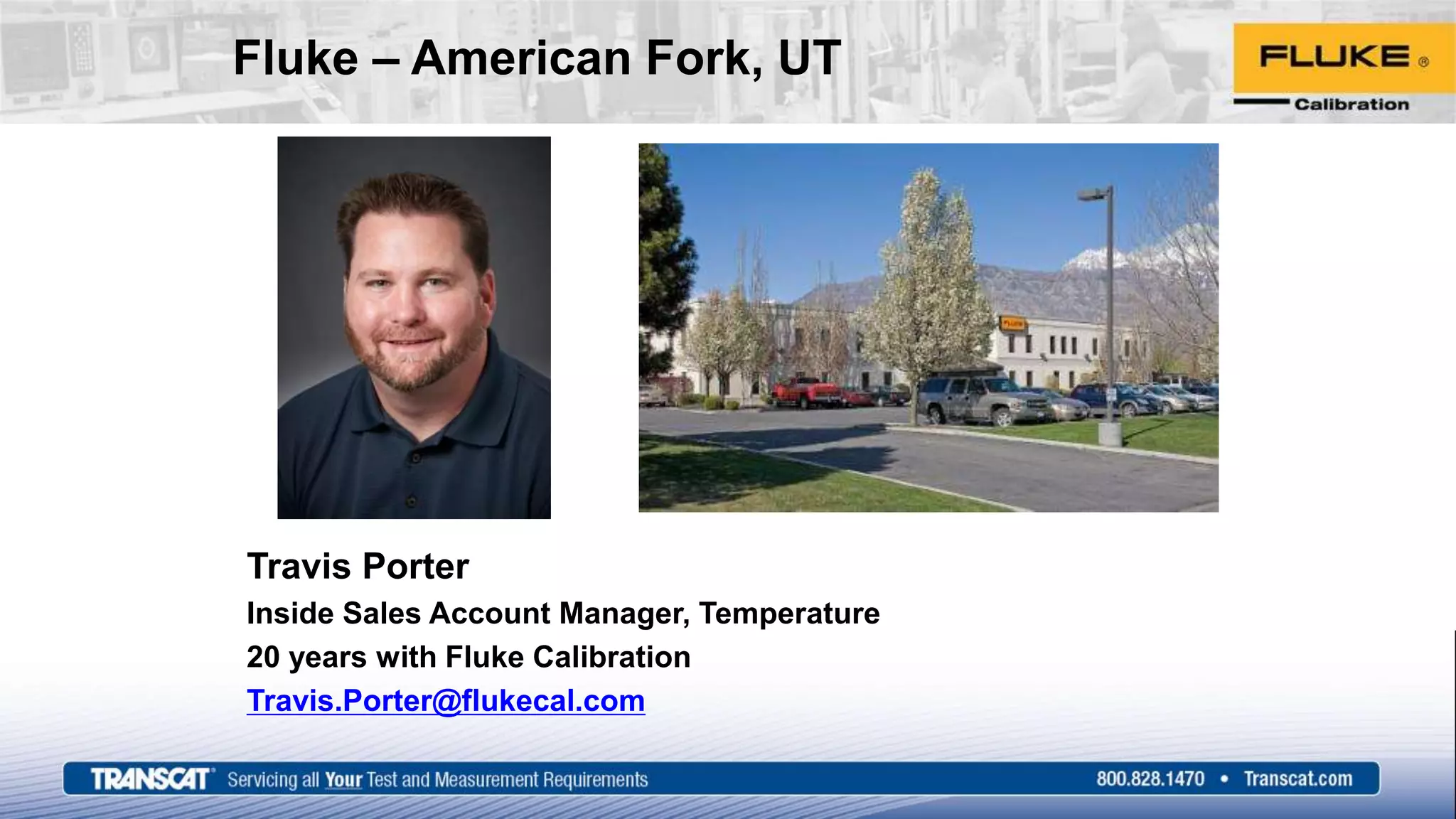
Fluke – American Fork, UT
Travis Porter
Inside Sales Account Manager, Temperature
20 years with Fluke Calibration
Travis.Porter@flukecal.com
Agenda
Introduction to Temperature Measurement
and Calibration
• Calibration methods
• How do I chose the equipment needed?
• Proper placement of sensors in a heat source
• Is my reference thermometer in tolerance?
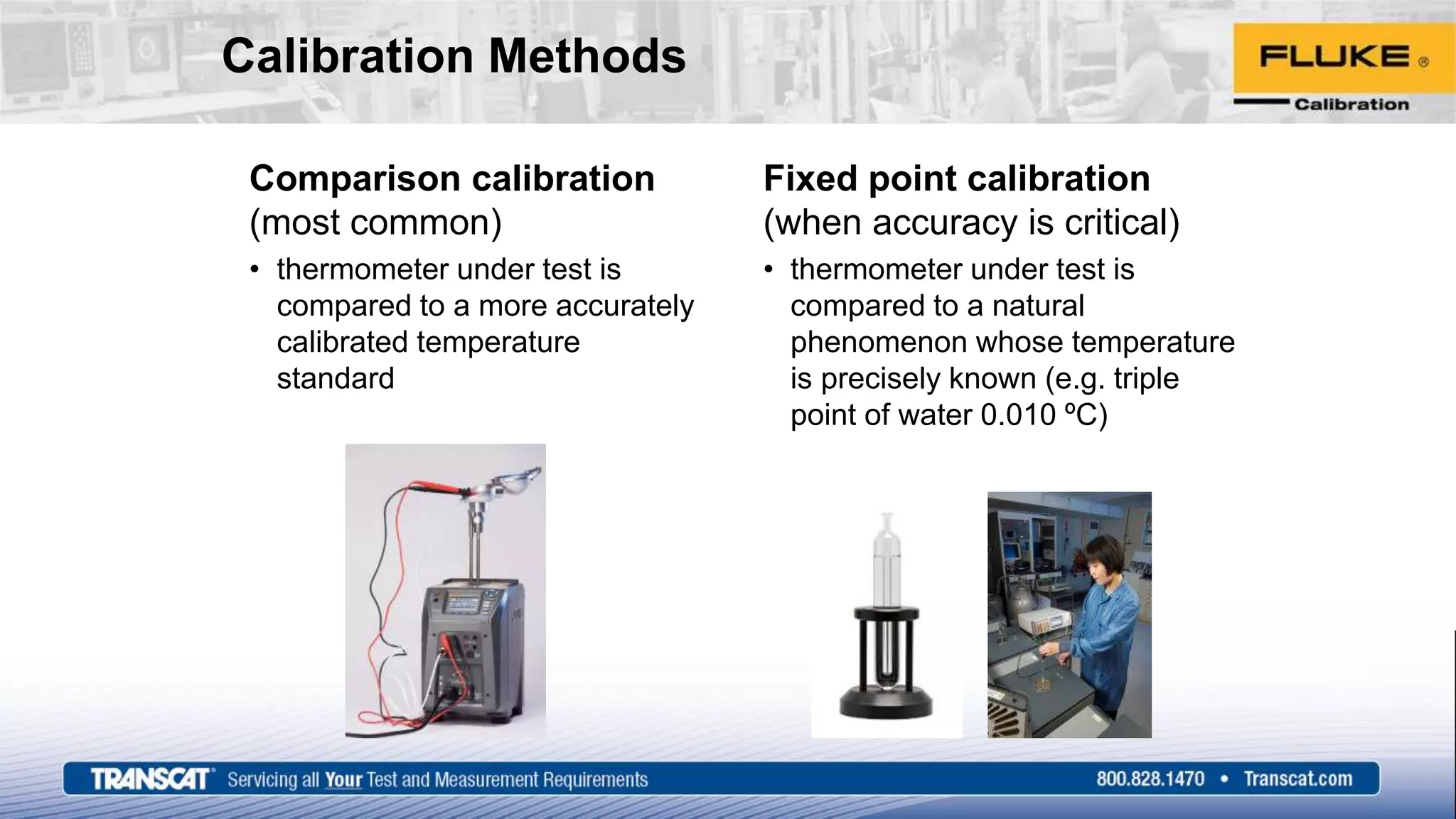
Comparison calibration
(most common)
• thermometer under test is
compared to a more accurately
calibrated temperature
standard
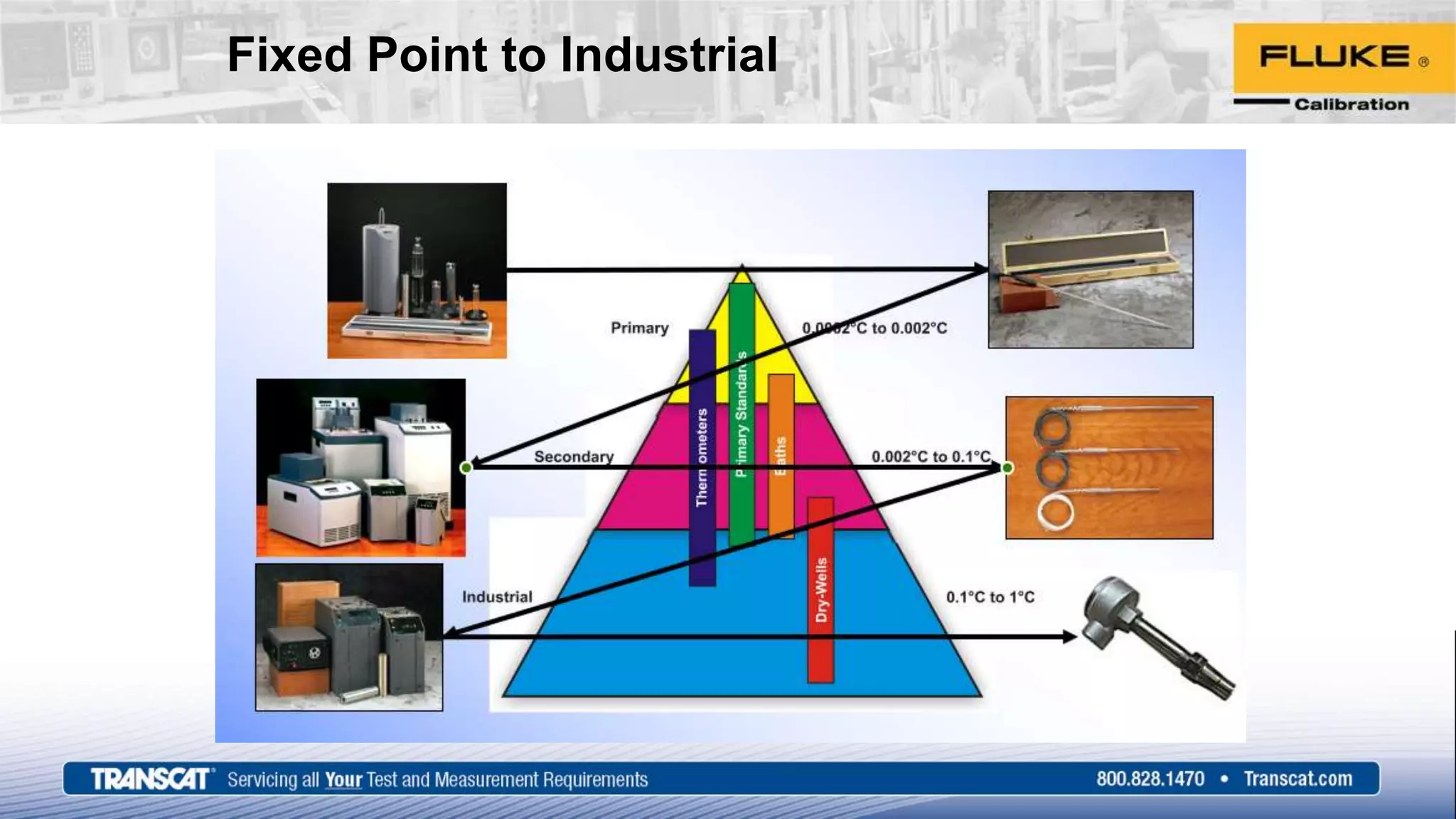
Calibration Methods
Fixed point calibration
(when accuracy is critical)
• thermometer under test is
compared to a natural
phenomenon whose temperature
is precisely known (e.g. triple
point of water 0.010 ºC)
Fixed Point to Industrial
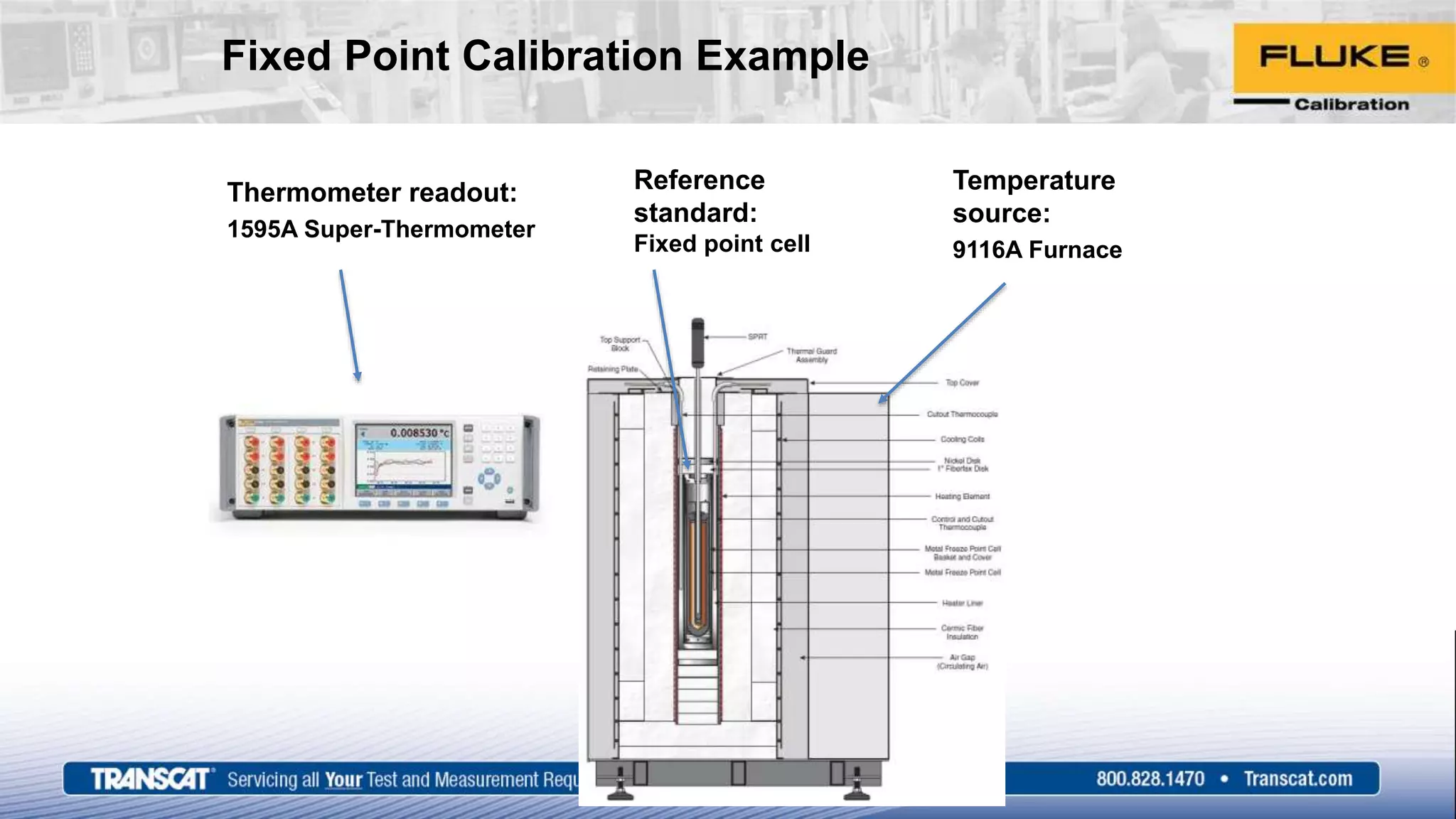
Fixed Point Calibration Example
Reference
standard:
Fixed point cell
Thermometer readout:
1595A Super-Thermometer
Temperature
source:
9116A Furnace
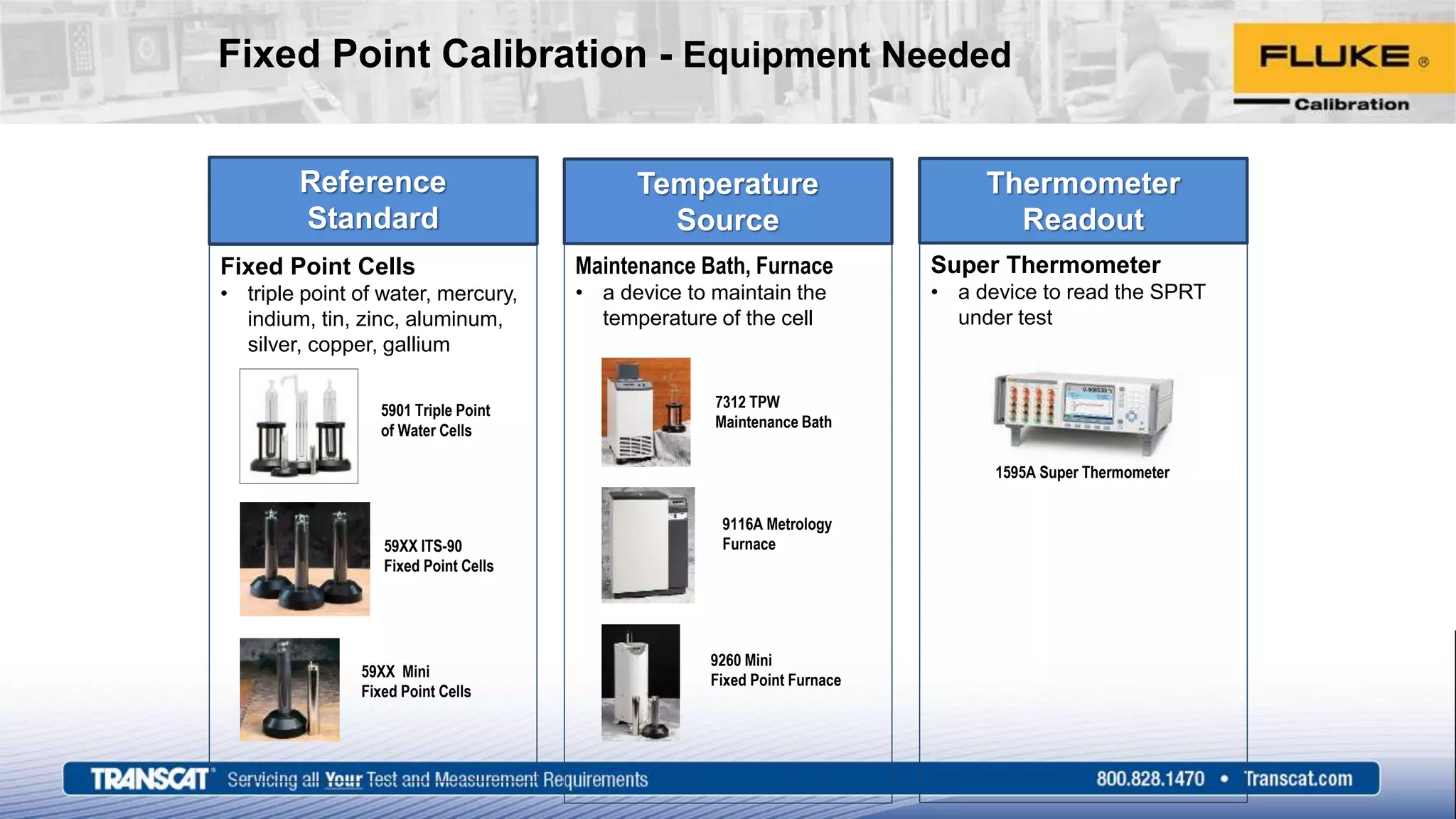
Fixed Point Calibration - Equipment Needed
Temperature
Source
Maintenance Bath, Furnace
• a device to maintain the
temperature of the cell
Thermometer
Readout
Super Thermometer
• a device to read the SPRT
under test
Reference
Standard
Fixed Point Cells
• triple point of water, mercury,
indium, tin, zinc, aluminum,
silver, copper, gallium
5901 Triple Point
of Water Cells
59XX ITS-90
Fixed Point Cells
59XX Mini
Fixed Point Cells
7312 TPW
Maintenance Bath
9116A Metrology
Furnace
9260 Mini
Fixed Point Furnace
1595A Super Thermometer
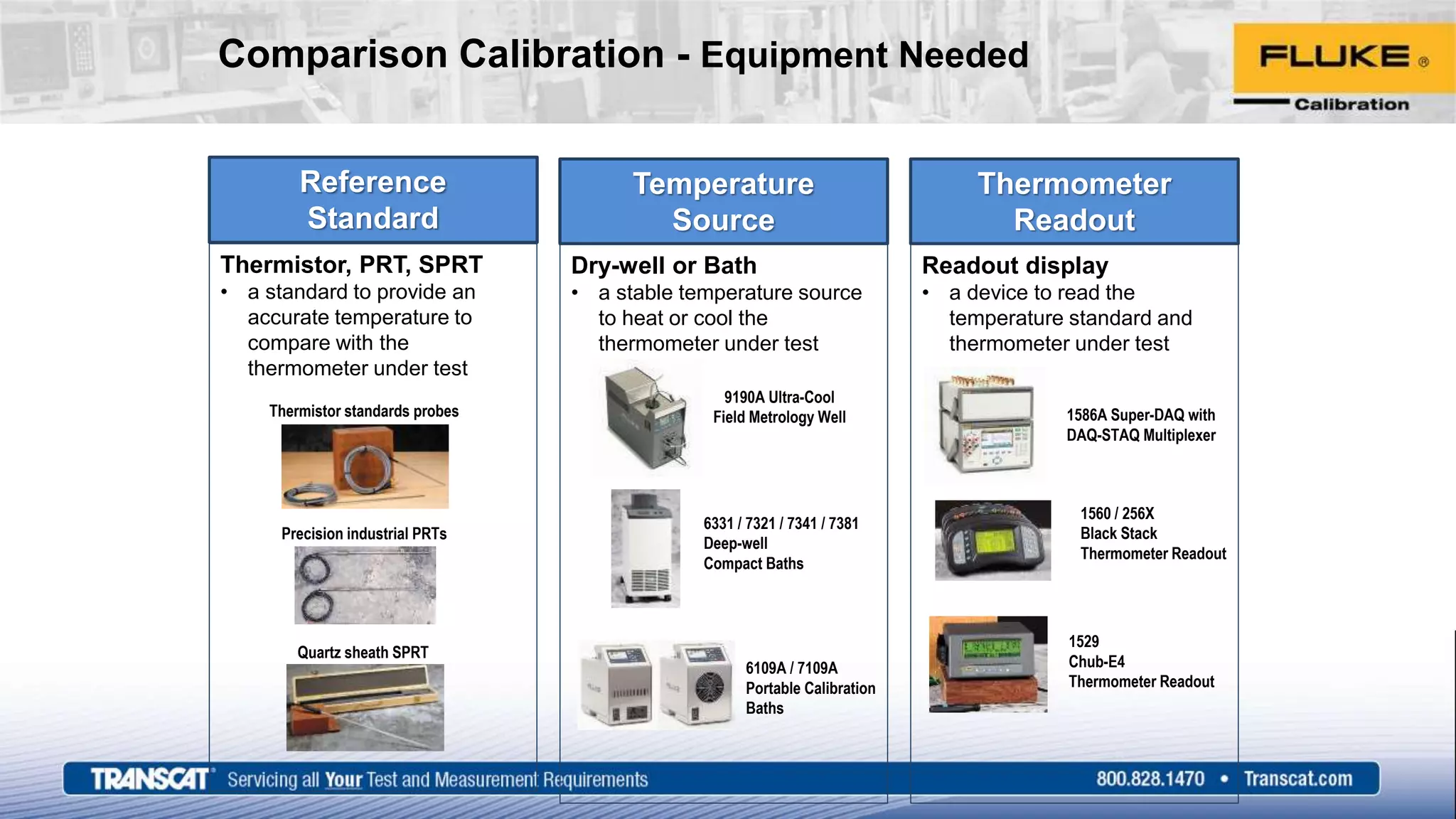
Comparison Calibration - Equipment Needed
Temperature
Source
Dry-well or Bath
• a stable temperature source
to heat or cool the
thermometer under test
Reference
Standard
Thermistor, PRT, SPRT
• a standard to provide an
accurate temperature to
compare with the
thermometer under test
Thermometer
Readout
Readout display
• a device to read the
temperature standard and
thermometer under test
Thermistor standards probes
Precision industrial PRTs
Quartz sheath SPRT
9190A Ultra-Cool
Field Metrology Well
6331 / 7321 / 7341 / 7381
Deep-well
Compact Baths
6109A / 7109A
Portable Calibration
Baths
1586A Super-DAQ with
DAQ-STAQ Multiplexer
1529
Chub-E4
Thermometer Readout
1560 / 256X
Black Stack
Thermometer Readout
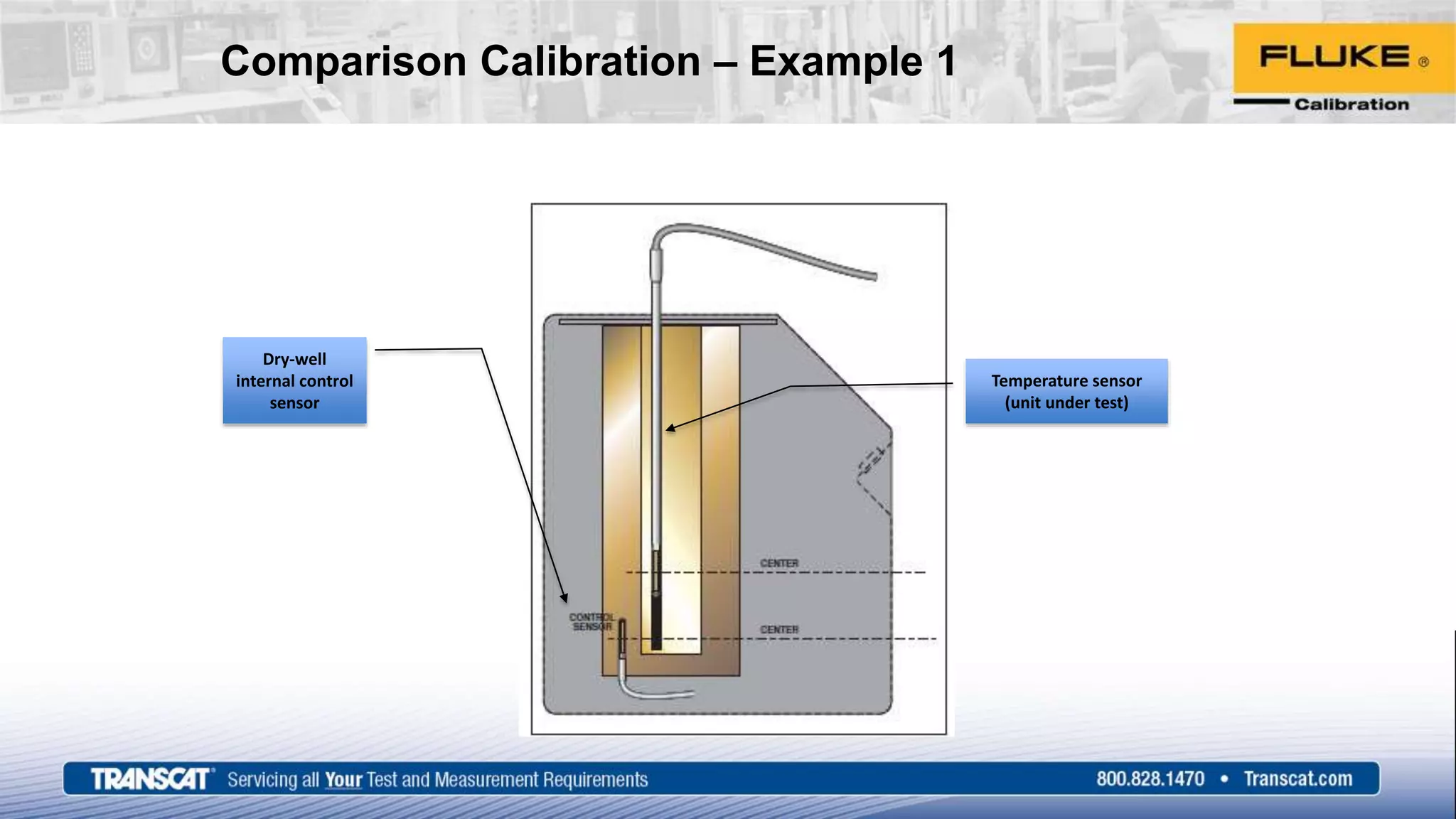
Comparison Calibration – Example 1
Temperature sensor
(unit under test)
Dry-well
internal control
sensor
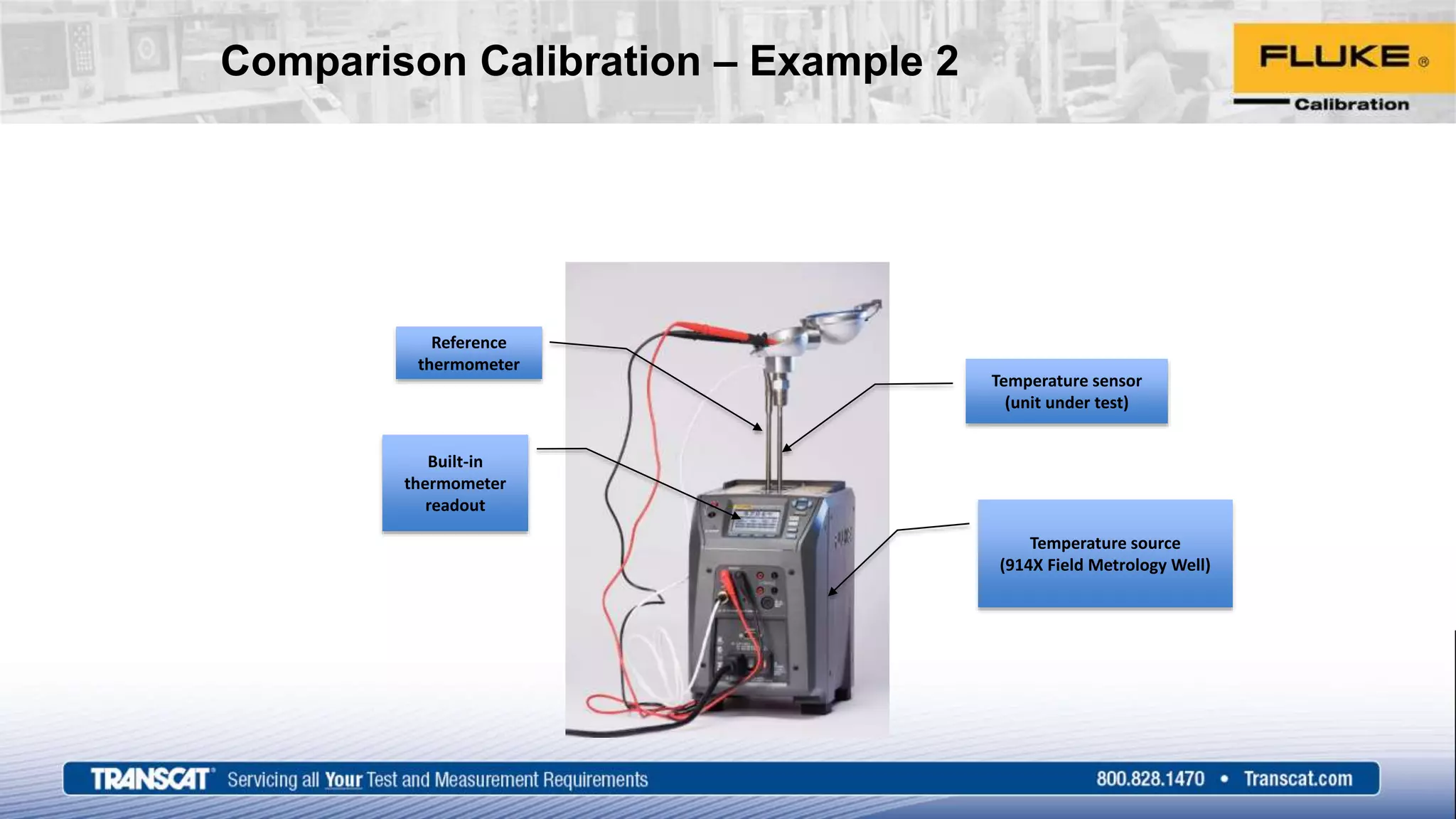
Comparison Calibration – Example 2
Temperature sensor
(unit under test)
Reference
thermometer
Built-in
thermometer
readout
Temperature source
(914X Field Metrology Well)
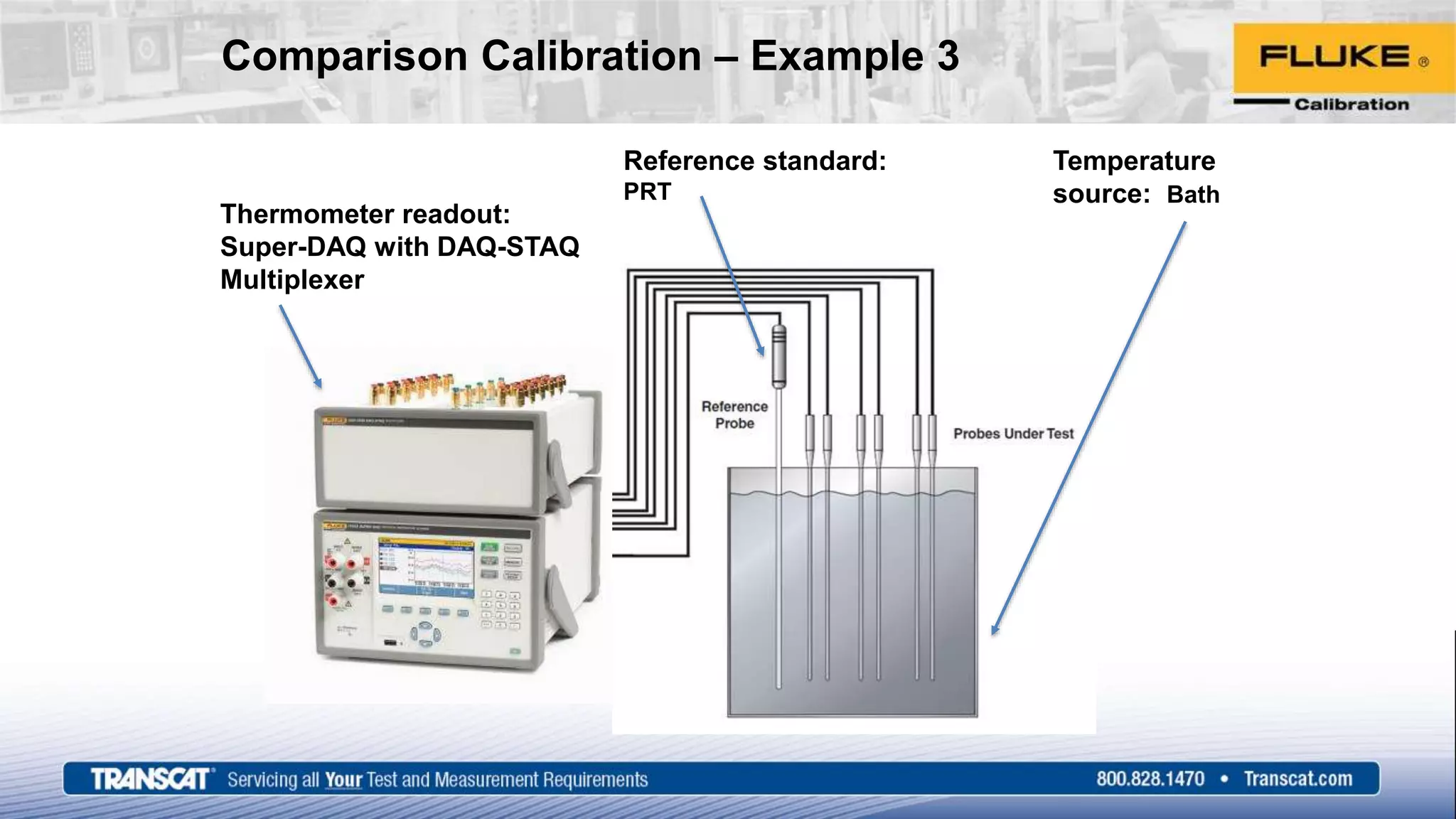
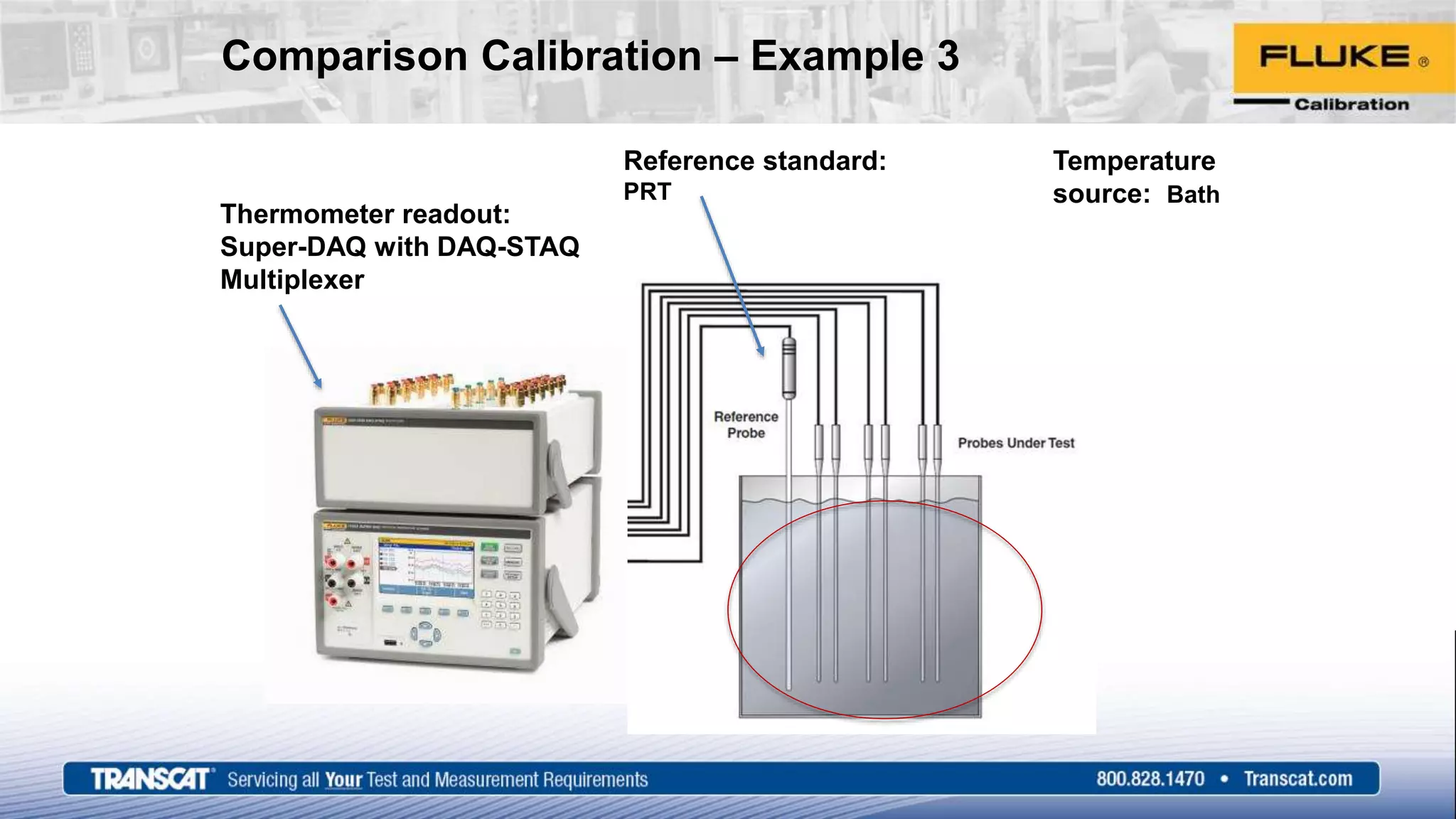
Comparison Calibration – Example 3
Reference standard:
PRT
Thermometer readout:
Super-DAQ with DAQ-STAQ
Multiplexer
Temperature
source: Bath
Choosing Equipment
Things to consider in choosing
temperature calibration equipment:
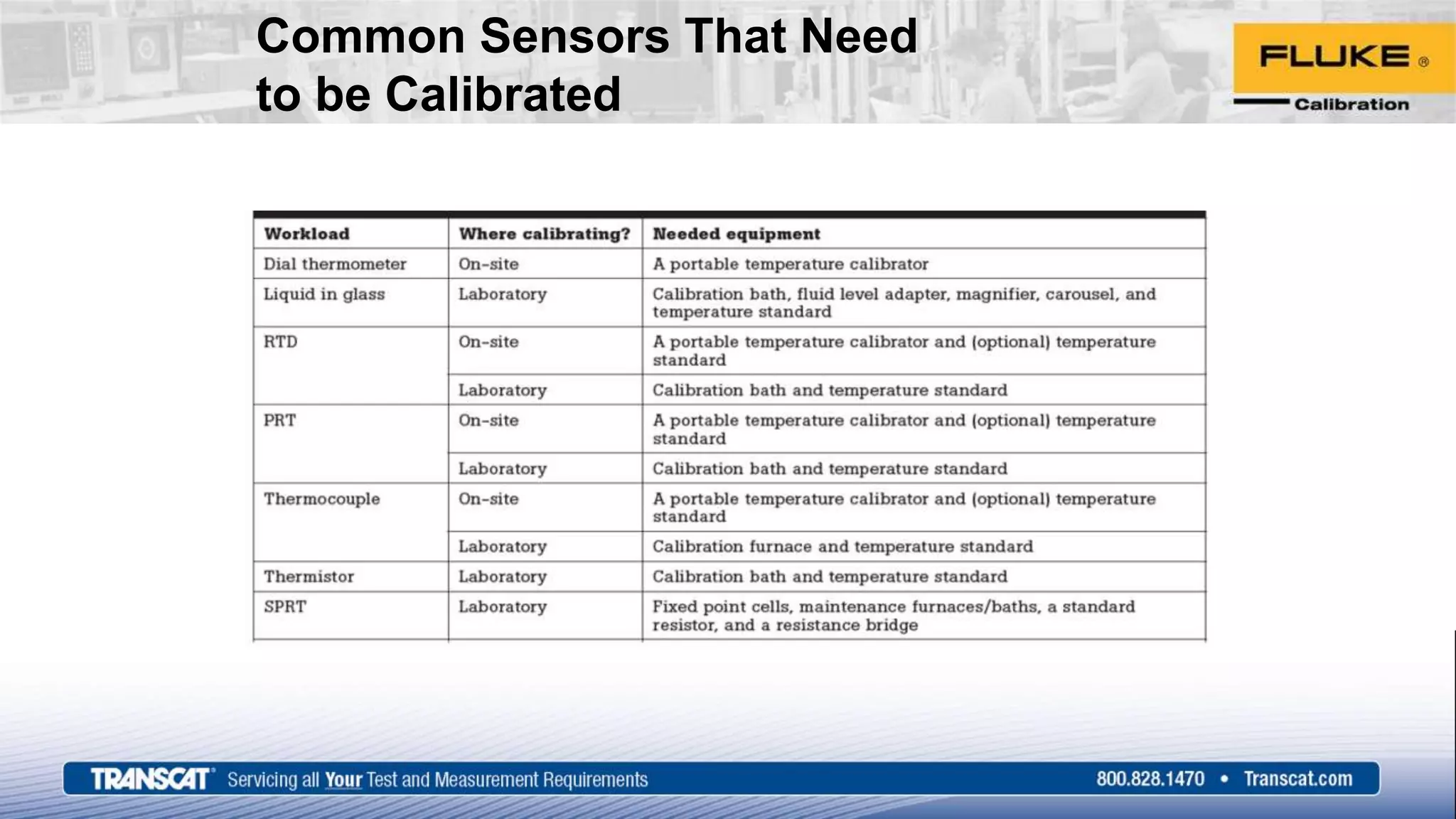
• What type of sensor am I calibrating?
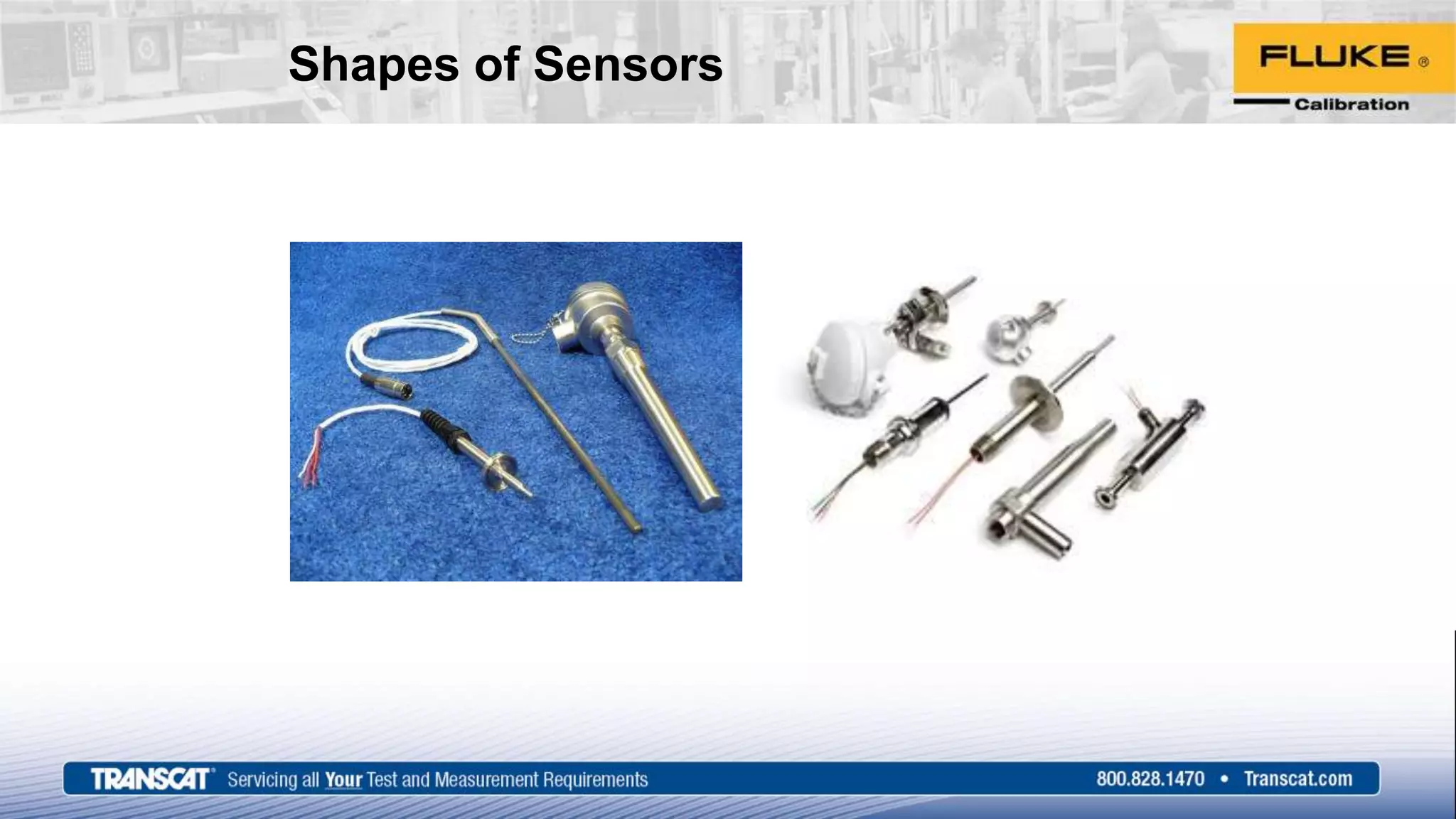
• What is the shape of the sensor?
• How much accuracy is needed?
• What is my temperature range?
Common Sensors That Need
to be Calibrated
Shapes of Sensors
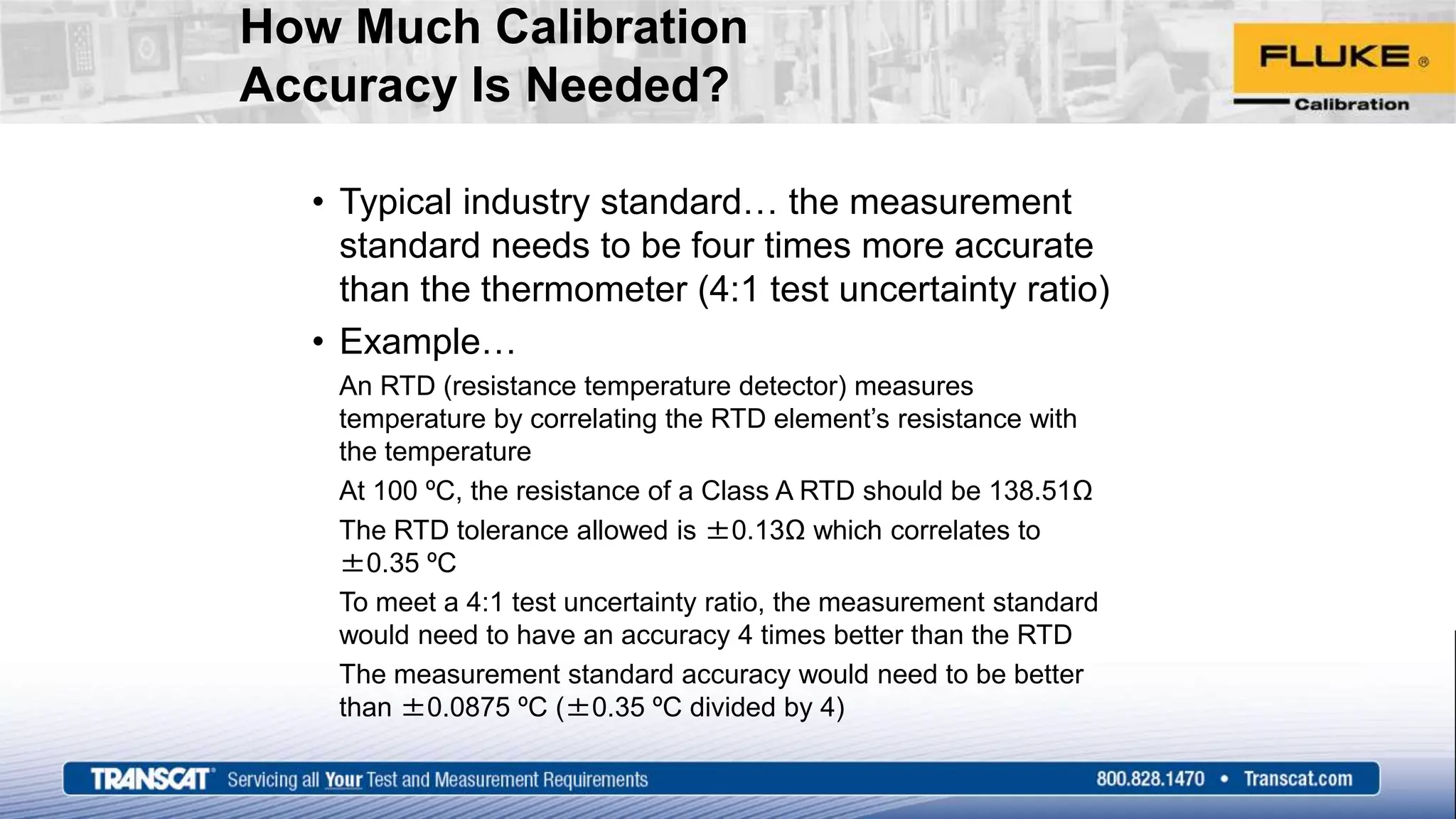
How Much Calibration
Accuracy Is Needed?
• Typical industry standard… the measurement
standard needs to be four times more accurate
than the thermometer (4:1 test uncertainty ratio)
• Example…
An RTD (resistance temperature detector) measures
temperature by correlating the RTD element’s resistance with
the temperature
At 100 ºC, the resistance of a Class A RTD should be 138.51Ω
The RTD tolerance allowed is ±0.13Ω which correlates to
±0.35 ºC
To meet a 4:1 test uncertainty ratio, the measurement standard
would need to have an accuracy 4 times better than the RTD
The measurement standard accuracy would need to be better
than ±0.0875 ºC (±0.35 ºC divided by 4)
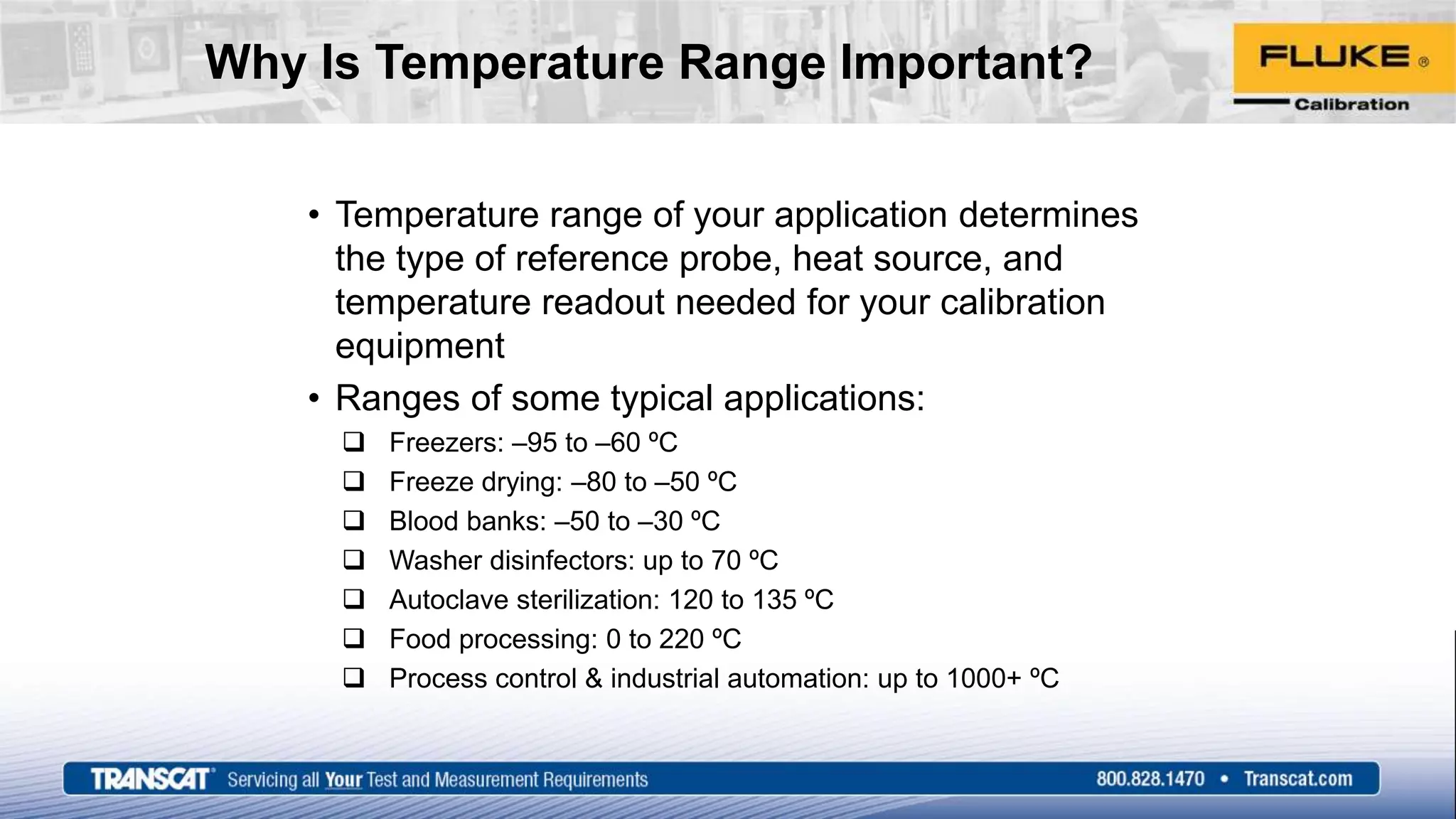
Why Is Temperature Range Important?
• Temperature range of your application determines
the type of reference probe, heat source, and
temperature readout needed for your calibration
equipment
• Ranges of some typical applications:
 Freezers: –95 to –60 ºC
 Freeze drying: –80 to –50 ºC
 Blood banks: –50 to –30 ºC
 Washer disinfectors: up to 70 ºC
 Autoclave sterilization: 120 to 135 ºC
 Food processing: 0 to 220 ºC
 Process control & industrial automation: up to 1000+ ºC
Choosing Sensors for My Range
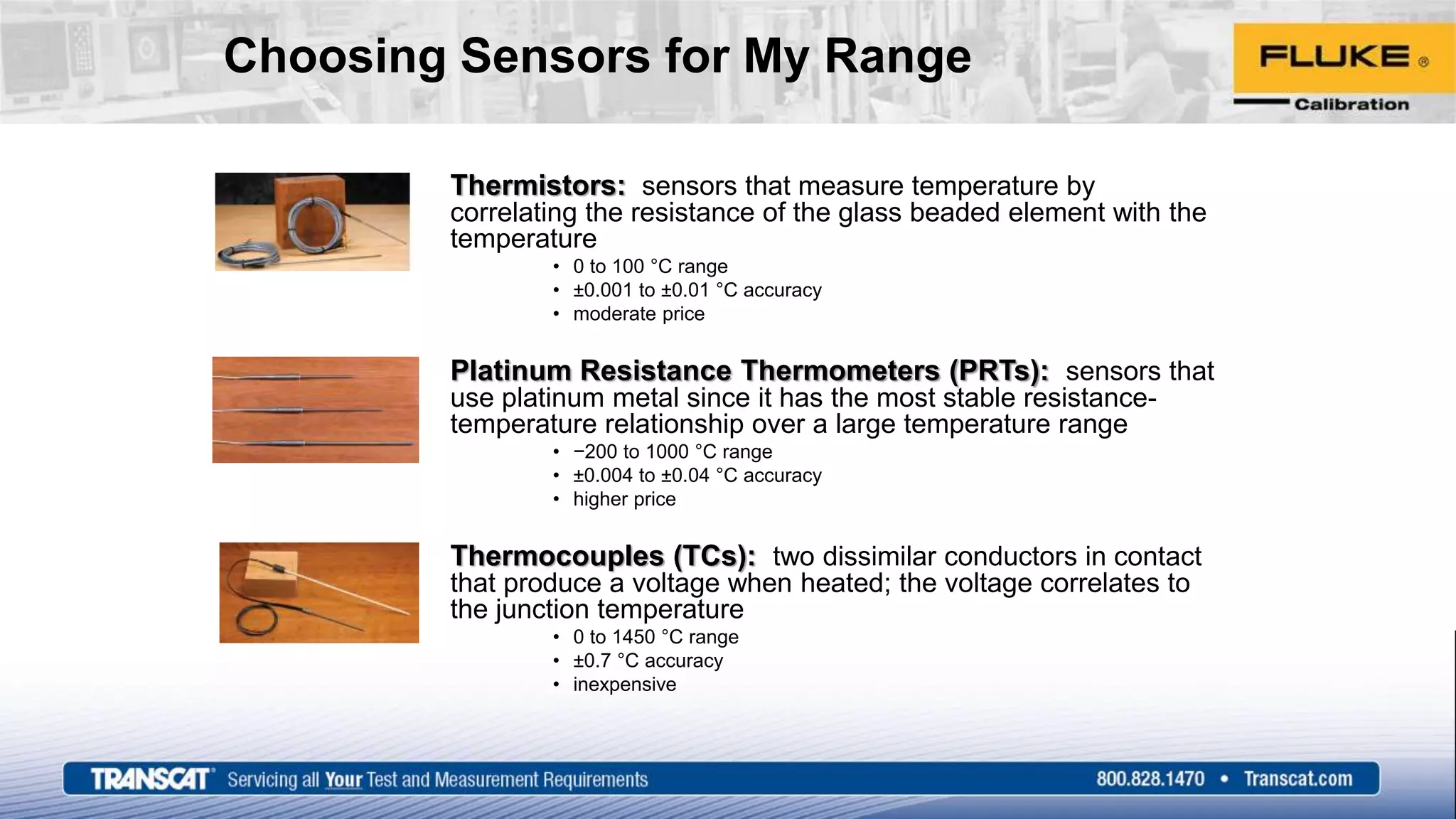
Thermistors: sensors that measure temperature by
correlating the resistance of the glass beaded element with the
temperature
• 0 to 100 °C range
• ±0.001 to ±0.01 °C accuracy
• moderate price
Platinum Resistance Thermometers (PRTs): sensors that
use platinum metal since it has the most stable resistance-
temperature relationship over a large temperature range
• −200 to 1000 °C range
• ±0.004 to ±0.04 °C accuracy
• higher price
Thermocouples (TCs): two dissimilar conductors in contact
that produce a voltage when heated; the voltage correlates to
the junction temperature
• 0 to 1450 °C range
• ±0.7 °C accuracy
• inexpensive
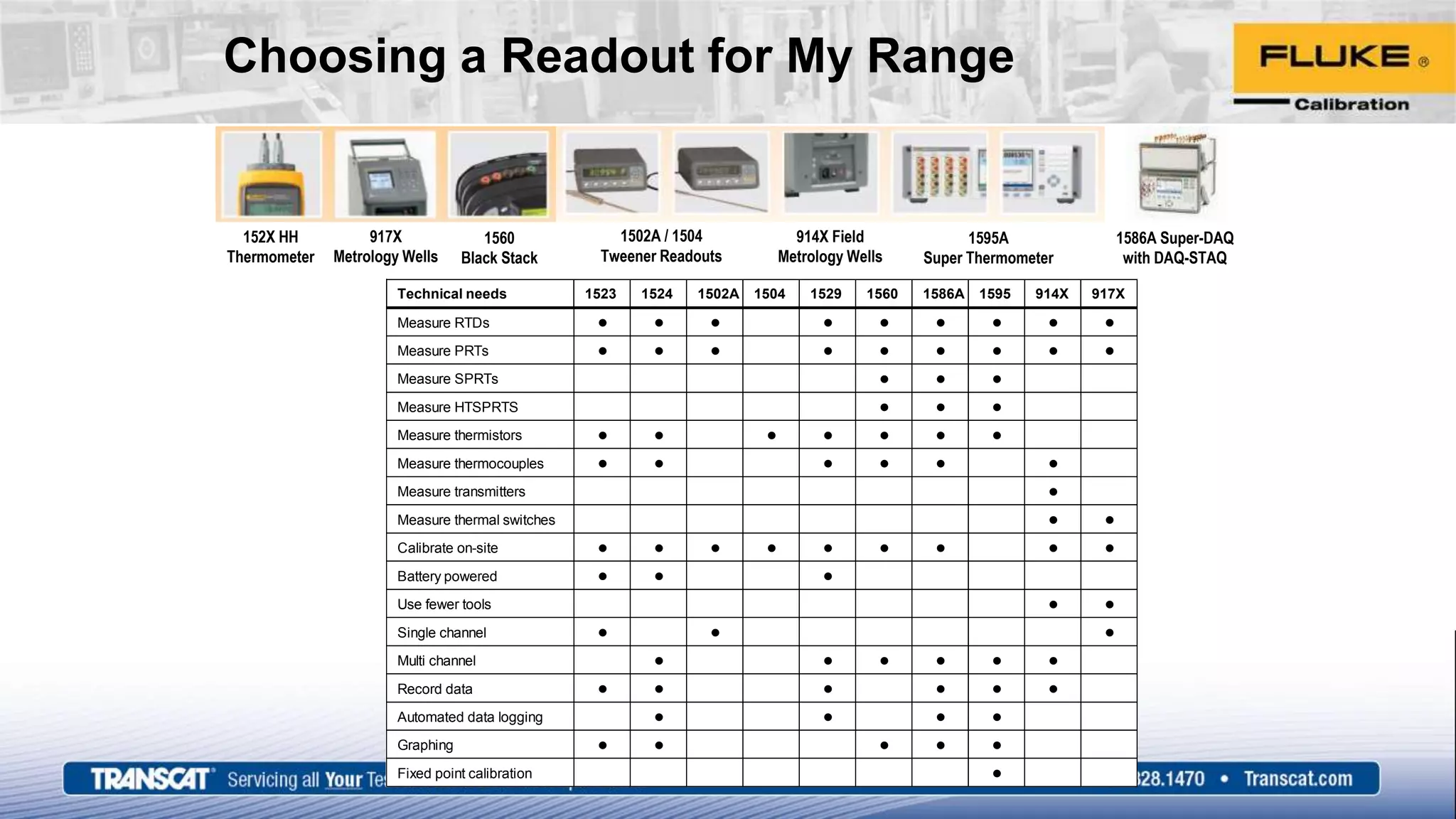
Choosing a Readout for My Range
152X HH
Thermometer
917X
Metrology Wells
914X Field
Metrology Wells
1595A
Super Thermometer
1560
Black Stack
1502A / 1504
Tweener Readouts
Technical needs 1523 1524 1502A 1504 1529 1560 1586A 1595 914X 917X
Measure RTDs • • • • • • • • •
Measure PRTs • • • • • • • • •
Measure SPRTs • • •
Measure HTSPRTS • • •
Measure thermistors • • • • • • •
Measure thermocouples • • • • • •
Measure transmitters •
Measure thermal switches • •
Calibrate on-site • • • • • • • • •
Battery powered • • •
Use fewer tools • •
Single channel • • •
Multi channel • • • • • •
Record data • • • • • •
Automated data logging • • • •
Graphing • • • • •
Fixed point calibration •
1586A Super-DAQ
with DAQ-STAQ
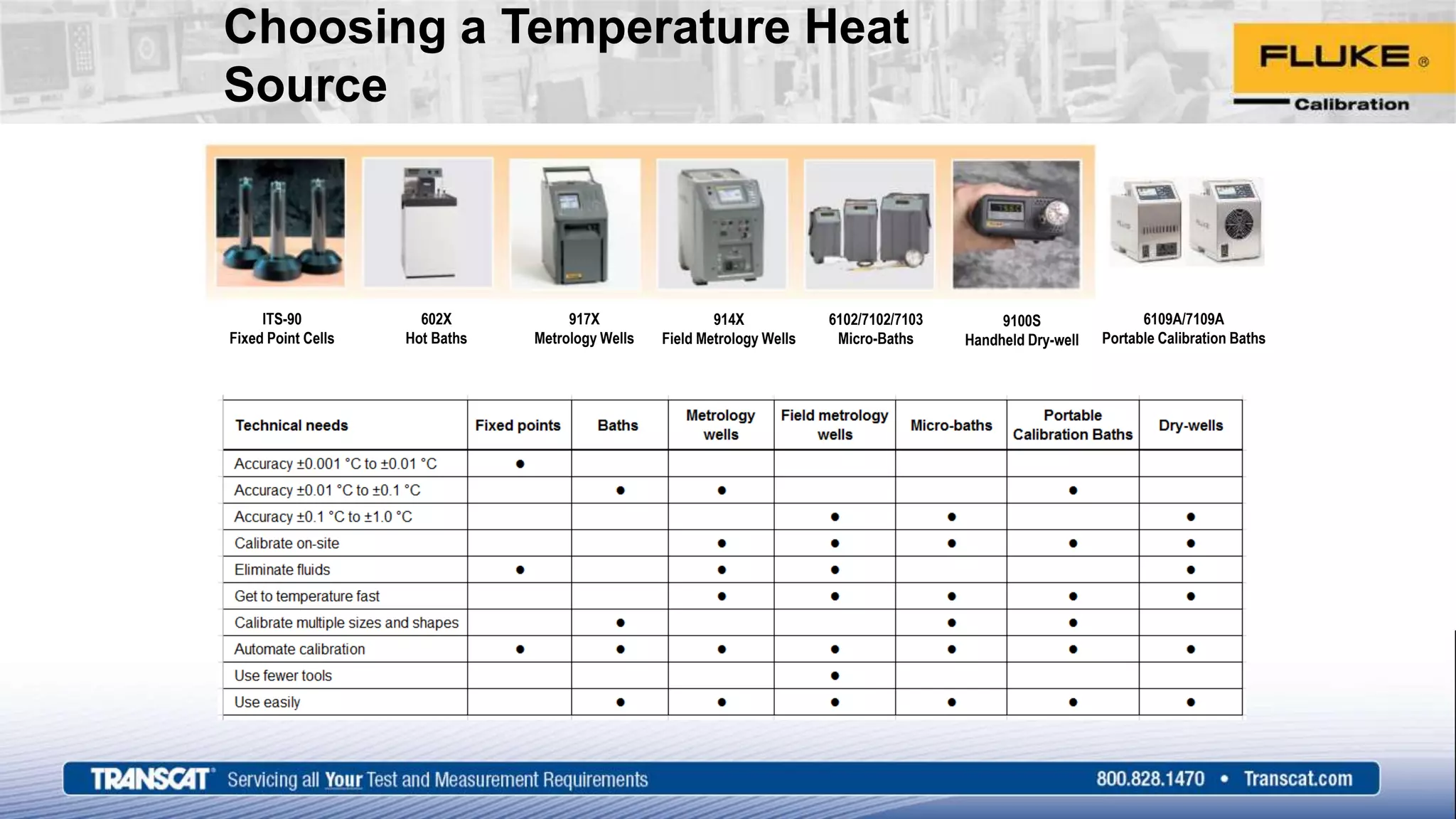
Choosing a Temperature Heat
Source
ITS-90
Fixed Point Cells
602X
Hot Baths
917X
Metrology Wells
914X
Field Metrology Wells
6102/7102/7103
Micro-Baths
9100S
Handheld Dry-well
6109A/7109A
Portable Calibration Baths
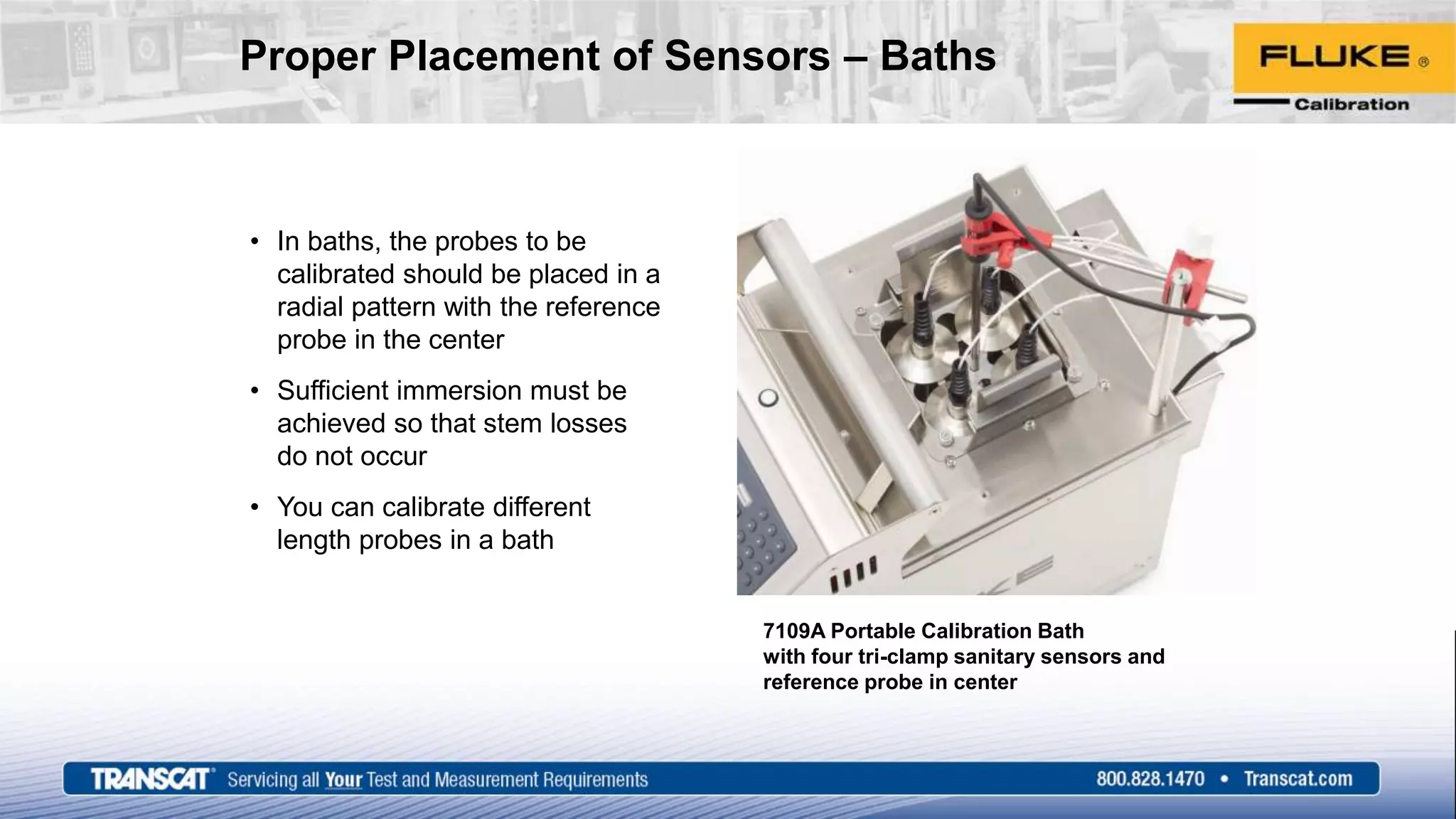
Proper Placement of Sensors – Baths
• In baths, the probes to be
calibrated should be placed in a
radial pattern with the reference
probe in the center
• Sufficient immersion must be
achieved so that stem losses
do not occur
• You can calibrate different
length probes in a bath
7109A Portable Calibration Bath
with four tri-clamp sanitary sensors and
reference probe in center
Comparison Calibration – Example 3
Reference standard:
PRT
Thermometer readout:
Super-DAQ with DAQ-STAQ
Multiplexer
Temperature
source: Bath
Proper Placement of Sensors – Dry-Wells
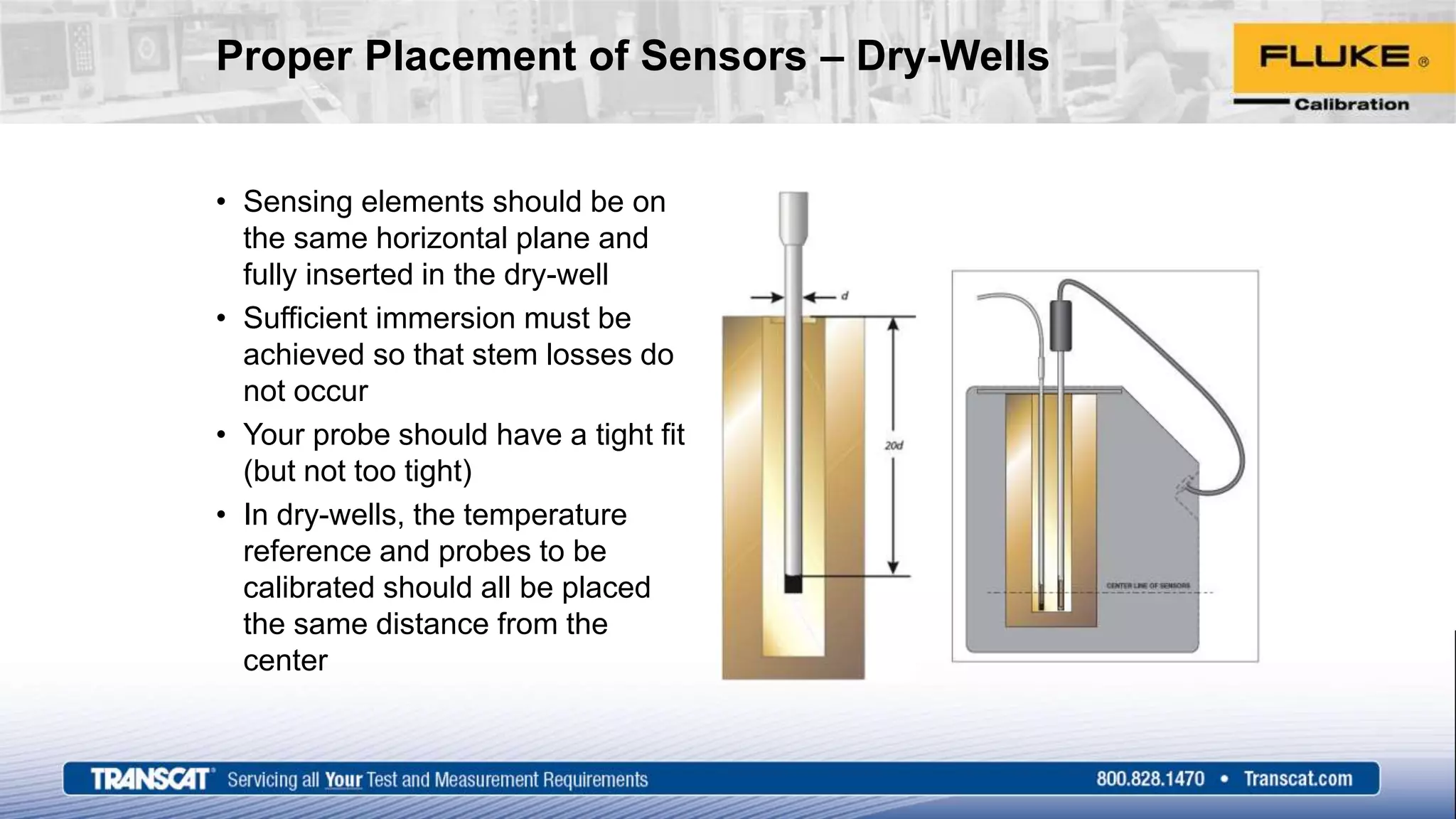
• Sensing elements should be on
the same horizontal plane and
fully inserted in the dry-well
• Sufficient immersion must be
achieved so that stem losses do
not occur
• Your probe should have a tight fit
(but not too tight)
• In dry-wells, the temperature
reference and probes to be
calibrated should all be placed
the same distance from the
center
Maintain Your Standards
• A calibration report doesn’t mean a probe is in tolerance
• Thermometers can drift over time through normal usage
and accidental bumps
• What about in shipping??? Yes!
• Thermometers need to be corrected by calibration at
regular intervals
• If thermometers are repeatedly out of tolerance, shorten
the calibration interval or replace them
• Keep good records
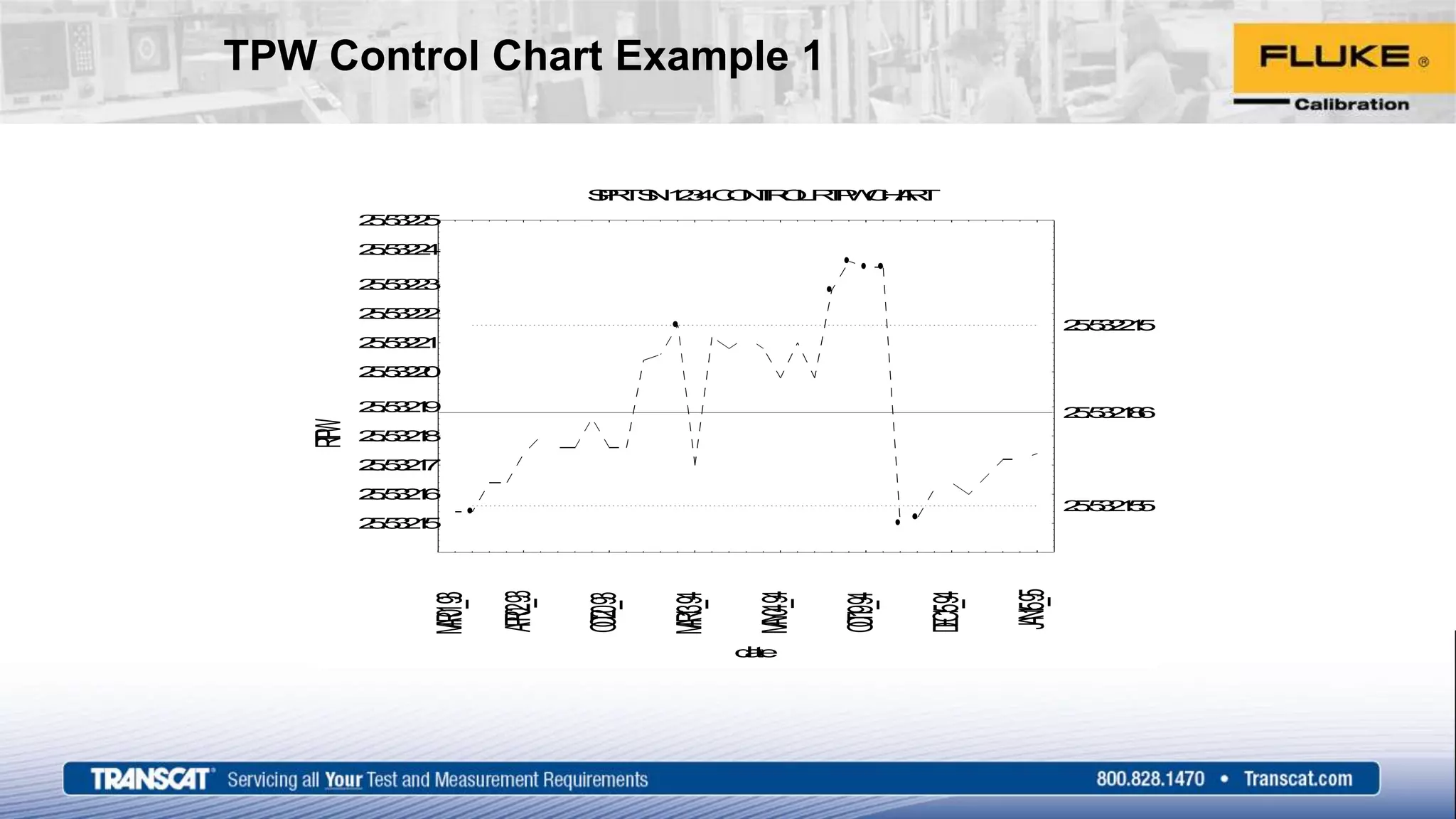
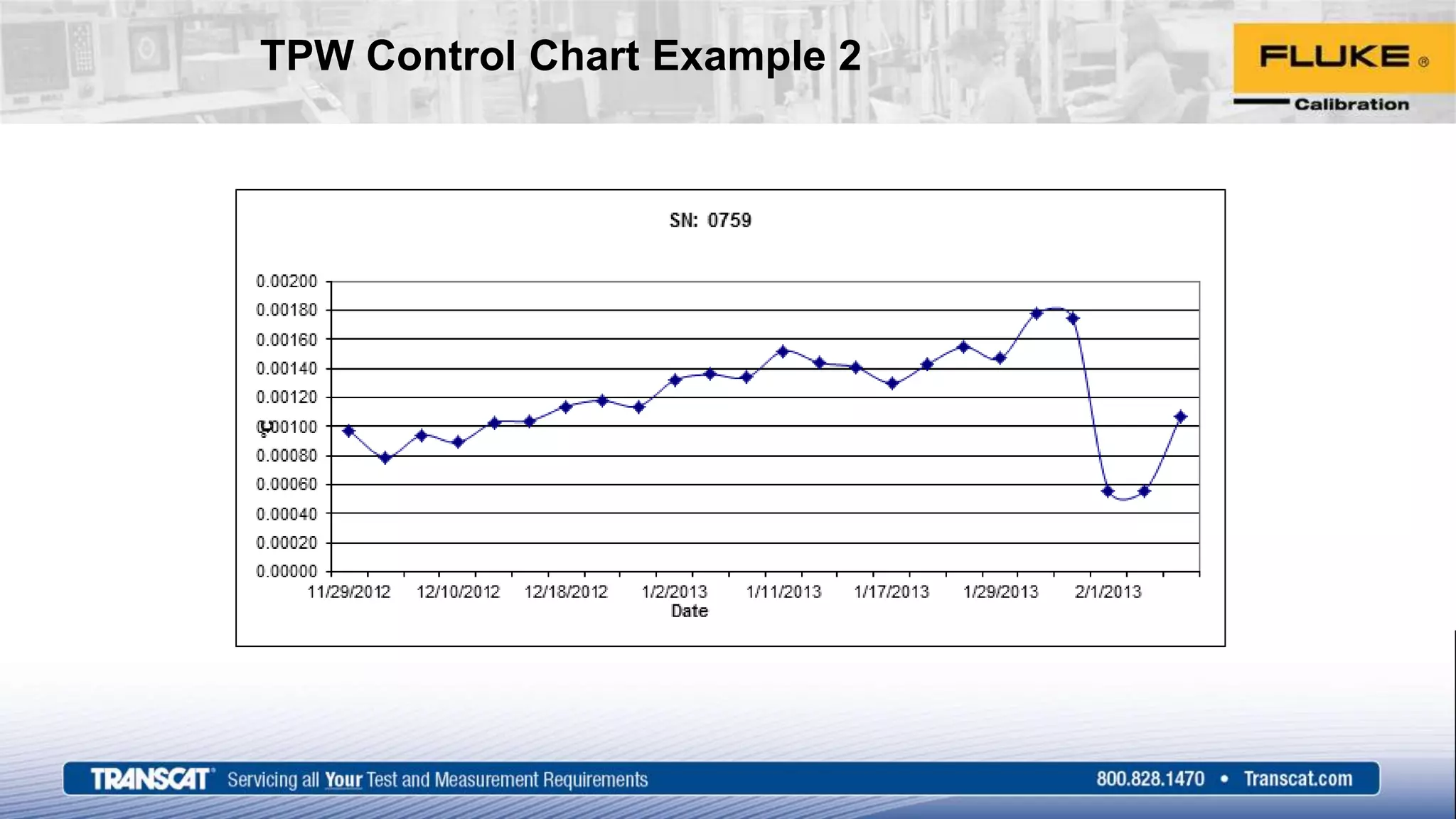
• Monitor certified thermometers between calibrations
using an ice bath, or triple point of water cell (use a
control chart)
TPW Control Chart Example 1
SPRTSN1234CONTROLRTPWCHART
date
RTPW
25.532155
25.532186
25.532215
25.53215
25.53216
25.53217
25.53218
25.53219
25.53220
25.53221
25.53222
25.53223
25.53224
25.53225
MAR01_93
APR02_93
OCT20_93
MAR13_94
MAY04_94
OCT19_94
DEC15_94
JAN15_95
TPW Control Chart Example 2
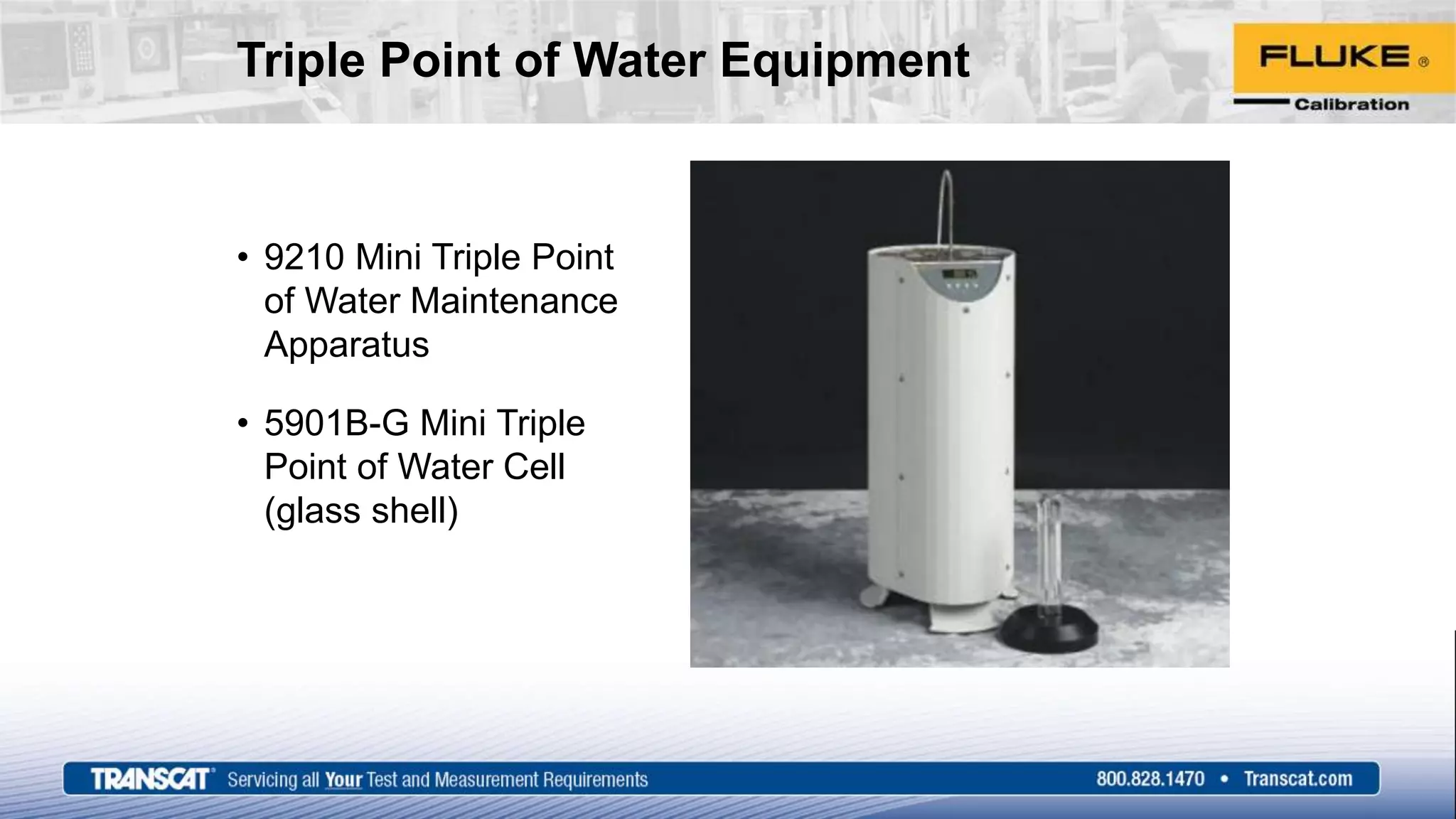
Triple Point of Water Equipment
• 9210 Mini Triple Point
of Water Maintenance
Apparatus
• 5901B-G Mini Triple
Point of Water Cell
(glass shell)
Understand Your User
• Can the user handle a PRT correctly?
• Is the user trained?
• Will the user properly monitor the probe?
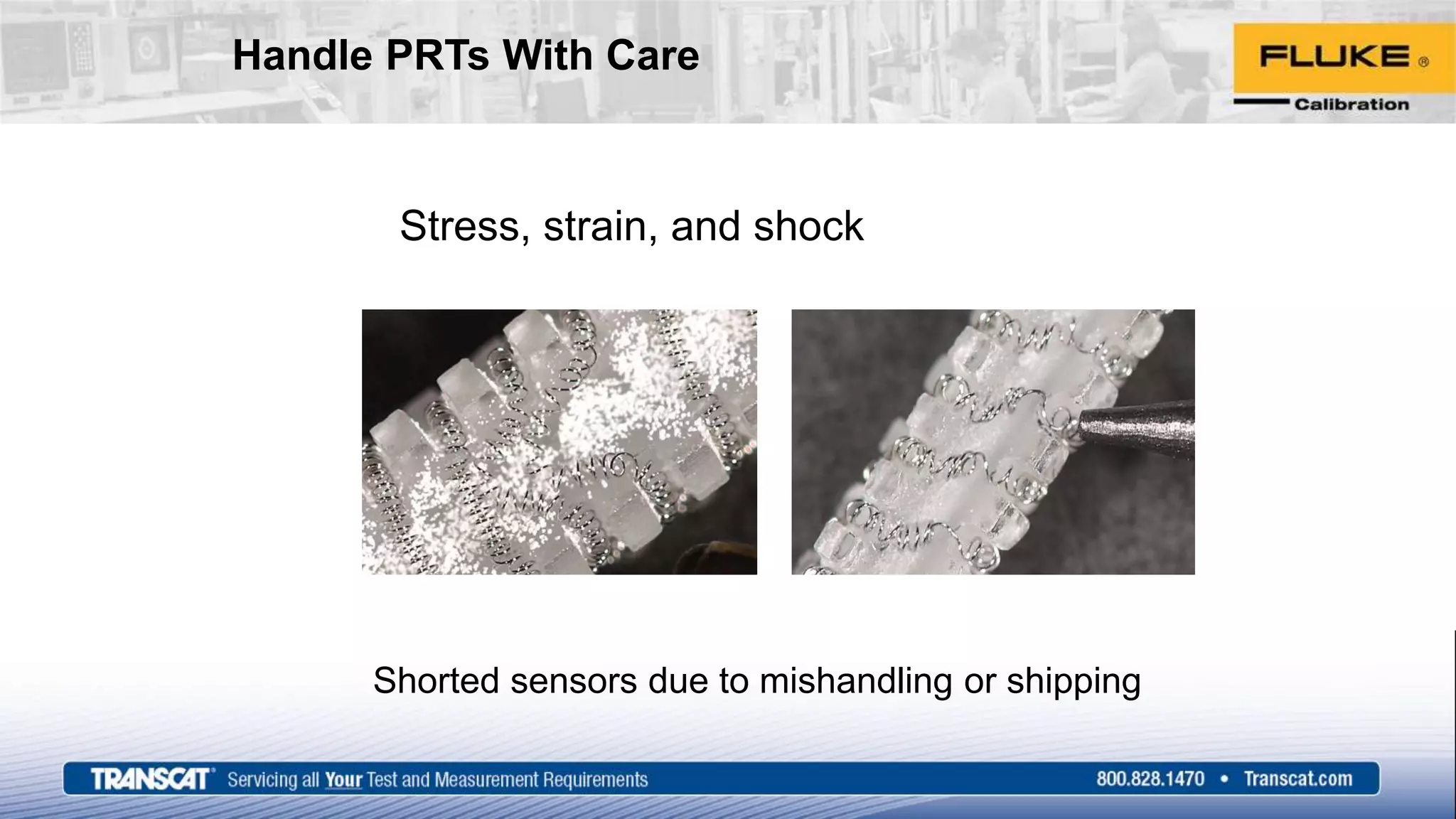
Handle PRTs With Care
Stress, strain, and shock
Shorted sensors due to mishandling or shipping
Train Your User
Questions
?
Questions or Comments?
Email Nicole VanWert-Quinzi nvanwert@Transcat.com
Transcat: 800-828-1470
www.Transcat.com
For related product information, go to:
www.transcat.com/brand/fluke-store

Introduction to Temperature Measurement and Calibration Presented by Fluke Calibration

  • 1.
    Introduction to Temperature Measurementand Calibration © 2019 Fluke Corporation
  • 2.
    Today’s Webinar Introduction toTemperature Measurement and Calibration December 18, 2019 Temperature is one of the most commonly measured physical parameters. Yet there are many ways to measure it. With so many options for measuring temperature, you’re likely to have questions on this topic. How do I measure temperature? How much accuracy is needed? What temperature range is required? What types of devices best measure temperature? Does my instrument require calibration? Attend this free web seminar to learn the basics that you need to know about measuring temperature, calibration, and maintaining standards.
  • 3.
    Fluke – AmericanFork, UT Travis Porter Inside Sales Account Manager, Temperature 20 years with Fluke Calibration Travis.Porter@flukecal.com
  • 4.
    Agenda Introduction to TemperatureMeasurement and Calibration • Calibration methods • How do I chose the equipment needed? • Proper placement of sensors in a heat source • Is my reference thermometer in tolerance?
  • 5.
    Comparison calibration (most common) •thermometer under test is compared to a more accurately calibrated temperature standard Calibration Methods Fixed point calibration (when accuracy is critical) • thermometer under test is compared to a natural phenomenon whose temperature is precisely known (e.g. triple point of water 0.010 ºC)
  • 6.
    Fixed Point toIndustrial
  • 7.
    Fixed Point CalibrationExample Reference standard: Fixed point cell Thermometer readout: 1595A Super-Thermometer Temperature source: 9116A Furnace
  • 8.
    Fixed Point Calibration- Equipment Needed Temperature Source Maintenance Bath, Furnace • a device to maintain the temperature of the cell Thermometer Readout Super Thermometer • a device to read the SPRT under test Reference Standard Fixed Point Cells • triple point of water, mercury, indium, tin, zinc, aluminum, silver, copper, gallium 5901 Triple Point of Water Cells 59XX ITS-90 Fixed Point Cells 59XX Mini Fixed Point Cells 7312 TPW Maintenance Bath 9116A Metrology Furnace 9260 Mini Fixed Point Furnace 1595A Super Thermometer
  • 9.
    Comparison Calibration -Equipment Needed Temperature Source Dry-well or Bath • a stable temperature source to heat or cool the thermometer under test Reference Standard Thermistor, PRT, SPRT • a standard to provide an accurate temperature to compare with the thermometer under test Thermometer Readout Readout display • a device to read the temperature standard and thermometer under test Thermistor standards probes Precision industrial PRTs Quartz sheath SPRT 9190A Ultra-Cool Field Metrology Well 6331 / 7321 / 7341 / 7381 Deep-well Compact Baths 6109A / 7109A Portable Calibration Baths 1586A Super-DAQ with DAQ-STAQ Multiplexer 1529 Chub-E4 Thermometer Readout 1560 / 256X Black Stack Thermometer Readout
  • 10.
    Comparison Calibration –Example 1 Temperature sensor (unit under test) Dry-well internal control sensor
  • 11.
    Comparison Calibration –Example 2 Temperature sensor (unit under test) Reference thermometer Built-in thermometer readout Temperature source (914X Field Metrology Well)
  • 12.
    Comparison Calibration –Example 3 Reference standard: PRT Thermometer readout: Super-DAQ with DAQ-STAQ Multiplexer Temperature source: Bath
  • 13.
    Choosing Equipment Things toconsider in choosing temperature calibration equipment: • What type of sensor am I calibrating? • What is the shape of the sensor? • How much accuracy is needed? • What is my temperature range?
  • 14.
    Common Sensors ThatNeed to be Calibrated
  • 15.
  • 16.
    How Much Calibration AccuracyIs Needed? • Typical industry standard… the measurement standard needs to be four times more accurate than the thermometer (4:1 test uncertainty ratio) • Example… An RTD (resistance temperature detector) measures temperature by correlating the RTD element’s resistance with the temperature At 100 ºC, the resistance of a Class A RTD should be 138.51Ω The RTD tolerance allowed is ±0.13Ω which correlates to ±0.35 ºC To meet a 4:1 test uncertainty ratio, the measurement standard would need to have an accuracy 4 times better than the RTD The measurement standard accuracy would need to be better than ±0.0875 ºC (±0.35 ºC divided by 4)
  • 17.
    Why Is TemperatureRange Important? • Temperature range of your application determines the type of reference probe, heat source, and temperature readout needed for your calibration equipment • Ranges of some typical applications:  Freezers: –95 to –60 ºC  Freeze drying: –80 to –50 ºC  Blood banks: –50 to –30 ºC  Washer disinfectors: up to 70 ºC  Autoclave sterilization: 120 to 135 ºC  Food processing: 0 to 220 ºC  Process control & industrial automation: up to 1000+ ºC
  • 18.
    Choosing Sensors forMy Range Thermistors: sensors that measure temperature by correlating the resistance of the glass beaded element with the temperature • 0 to 100 °C range • ±0.001 to ±0.01 °C accuracy • moderate price Platinum Resistance Thermometers (PRTs): sensors that use platinum metal since it has the most stable resistance- temperature relationship over a large temperature range • −200 to 1000 °C range • ±0.004 to ±0.04 °C accuracy • higher price Thermocouples (TCs): two dissimilar conductors in contact that produce a voltage when heated; the voltage correlates to the junction temperature • 0 to 1450 °C range • ±0.7 °C accuracy • inexpensive
  • 19.
    Choosing a Readoutfor My Range 152X HH Thermometer 917X Metrology Wells 914X Field Metrology Wells 1595A Super Thermometer 1560 Black Stack 1502A / 1504 Tweener Readouts Technical needs 1523 1524 1502A 1504 1529 1560 1586A 1595 914X 917X Measure RTDs • • • • • • • • • Measure PRTs • • • • • • • • • Measure SPRTs • • • Measure HTSPRTS • • • Measure thermistors • • • • • • • Measure thermocouples • • • • • • Measure transmitters • Measure thermal switches • • Calibrate on-site • • • • • • • • • Battery powered • • • Use fewer tools • • Single channel • • • Multi channel • • • • • • Record data • • • • • • Automated data logging • • • • Graphing • • • • • Fixed point calibration • 1586A Super-DAQ with DAQ-STAQ
  • 20.
    Choosing a TemperatureHeat Source ITS-90 Fixed Point Cells 602X Hot Baths 917X Metrology Wells 914X Field Metrology Wells 6102/7102/7103 Micro-Baths 9100S Handheld Dry-well 6109A/7109A Portable Calibration Baths
  • 21.
    Proper Placement ofSensors – Baths • In baths, the probes to be calibrated should be placed in a radial pattern with the reference probe in the center • Sufficient immersion must be achieved so that stem losses do not occur • You can calibrate different length probes in a bath 7109A Portable Calibration Bath with four tri-clamp sanitary sensors and reference probe in center
  • 22.
    Comparison Calibration –Example 3 Reference standard: PRT Thermometer readout: Super-DAQ with DAQ-STAQ Multiplexer Temperature source: Bath
  • 23.
    Proper Placement ofSensors – Dry-Wells • Sensing elements should be on the same horizontal plane and fully inserted in the dry-well • Sufficient immersion must be achieved so that stem losses do not occur • Your probe should have a tight fit (but not too tight) • In dry-wells, the temperature reference and probes to be calibrated should all be placed the same distance from the center
  • 24.
    Maintain Your Standards •A calibration report doesn’t mean a probe is in tolerance • Thermometers can drift over time through normal usage and accidental bumps • What about in shipping??? Yes! • Thermometers need to be corrected by calibration at regular intervals • If thermometers are repeatedly out of tolerance, shorten the calibration interval or replace them • Keep good records • Monitor certified thermometers between calibrations using an ice bath, or triple point of water cell (use a control chart)
  • 25.
    TPW Control ChartExample 1 SPRTSN1234CONTROLRTPWCHART date RTPW 25.532155 25.532186 25.532215 25.53215 25.53216 25.53217 25.53218 25.53219 25.53220 25.53221 25.53222 25.53223 25.53224 25.53225 MAR01_93 APR02_93 OCT20_93 MAR13_94 MAY04_94 OCT19_94 DEC15_94 JAN15_95
  • 26.
  • 27.
    Triple Point ofWater Equipment • 9210 Mini Triple Point of Water Maintenance Apparatus • 5901B-G Mini Triple Point of Water Cell (glass shell)
  • 28.
    Understand Your User •Can the user handle a PRT correctly? • Is the user trained? • Will the user properly monitor the probe?
  • 29.
    Handle PRTs WithCare Stress, strain, and shock Shorted sensors due to mishandling or shipping
  • 30.
  • 31.
  • 32.
    Questions or Comments? EmailNicole VanWert-Quinzi nvanwert@Transcat.com Transcat: 800-828-1470 www.Transcat.com For related product information, go to: www.transcat.com/brand/fluke-store