AP Chemistry - Core Concept Cheat Sheet

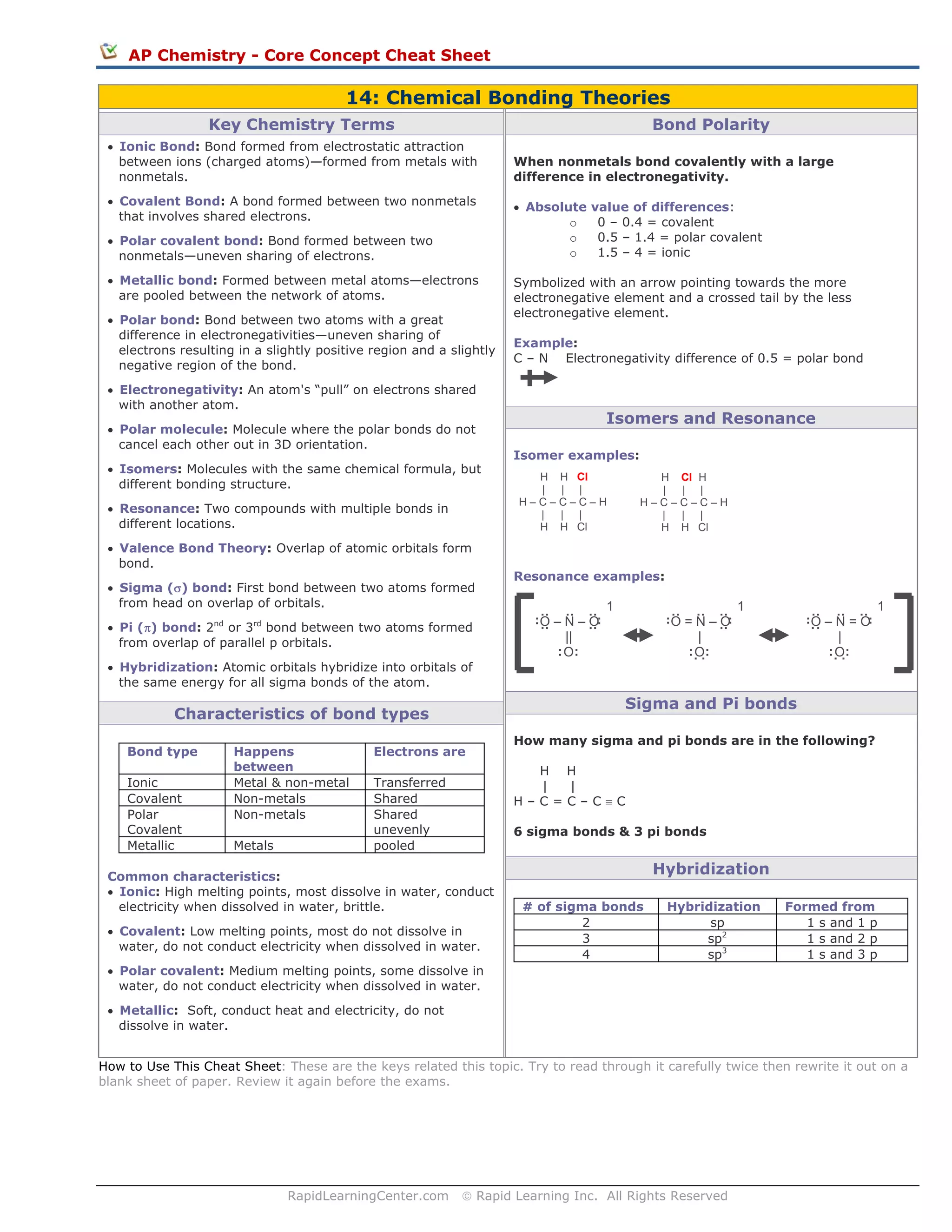
14: Chemical Bonding Theories
Key Chemistry Terms

Bond Polarity

• Ionic Bond: Bond formed from electrostatic attraction
between ions (charged atoms)—formed from metals with
nonmetals.
• Covalent Bond: A bond formed between two nonmetals
that involves shared electrons.
• Polar covalent bond: Bond formed between two
nonmetals—uneven sharing of electrons.
• Metallic bond: Formed between metal atoms—electrons
are pooled between the network of atoms.
• Polar bond: Bond between two atoms with a great
difference in electronegativities—uneven sharing of
electrons resulting in a slightly positive region and a slightly
negative region of the bond.
• Electronegativity: An atom's “pull” on electrons shared
with another atom.
• Polar molecule: Molecule where the polar bonds do not
cancel each other out in 3D orientation.
• Isomers: Molecules with the same chemical formula, but
different bonding structure.
• Resonance: Two compounds with multiple bonds in
different locations.
• Valence Bond Theory: Overlap of atomic orbitals form
bond.
• Sigma (σ) bond: First bond between two atoms formed
from head on overlap of orbitals.
• Pi (π) bond: 2nd or 3rd bond between two atoms formed
from overlap of parallel p orbitals.
• Hybridization: Atomic orbitals hybridize into orbitals of
the same energy for all sigma bonds of the atom.

Ionic
Covalent
Polar
Covalent
Metallic

Happens
between
Metal & non-metal
Non-metals
Non-metals
Metals

• Absolute
o
o
o

value of differences:
0 – 0.4 = covalent
0.5 – 1.4 = polar covalent
1.5 – 4 = ionic

Symbolized with an arrow pointing towards the more
electronegative element and a crossed tail by the less
electronegative element.
Example:
C – N Electronegativity difference of 0.5 = polar bond

Isomers and Resonance
Isomer examples:
H H Cl
|
| |
H–C–C–C–H
|
| |
H H Cl

H Cl H
|
| |
H–C–C–C–H
|
| |
H H Cl

Resonance examples:

1
. . ..
. O – N – .. .
. ..
O
.. .
||
. O.
. .

1
.. ..
. O = N – ...
.
O
...
|
. O.
. . ..

1
. . ..
. O – N = .. .
.. .
O.
|
. O.
. . ..

Sigma and Pi bonds

Characteristics of bond types
Bond type

When nonmetals bond covalently with a large
difference in electronegativity.

Electrons are

How many sigma and pi bonds are in the following?
H H
|
|
H–C=C–C≡C

Transferred
Shared
Shared
unevenly
pooled

6 sigma bonds & 3 pi bonds

Common characteristics:
• Ionic: High melting points, most dissolve in water, conduct
electricity when dissolved in water, brittle.
• Covalent: Low melting points, most do not dissolve in
water, do not conduct electricity when dissolved in water.

Hybridization
# of sigma bonds
2
3
4

Hybridization
sp
sp2
sp3

Formed from
1 s and 1 p
1 s and 2 p
1 s and 3 p

• Polar covalent: Medium melting points, some dissolve in
water, do not conduct electricity when dissolved in water.
• Metallic: Soft, conduct heat and electricity, do not
dissolve in water.
How to Use This Cheat Sheet: These are the keys related this topic. Try to read through it carefully twice then rewrite it out on a
blank sheet of paper. Review it again before the exams.

RapidLearningCenter.com

© Rapid Learning Inc. All Rights Reserved

Chemical bondingtheories cheat sheet

  • 1.
    AP Chemistry -Core Concept Cheat Sheet 14: Chemical Bonding Theories Key Chemistry Terms Bond Polarity • Ionic Bond: Bond formed from electrostatic attraction between ions (charged atoms)—formed from metals with nonmetals. • Covalent Bond: A bond formed between two nonmetals that involves shared electrons. • Polar covalent bond: Bond formed between two nonmetals—uneven sharing of electrons. • Metallic bond: Formed between metal atoms—electrons are pooled between the network of atoms. • Polar bond: Bond between two atoms with a great difference in electronegativities—uneven sharing of electrons resulting in a slightly positive region and a slightly negative region of the bond. • Electronegativity: An atom's “pull” on electrons shared with another atom. • Polar molecule: Molecule where the polar bonds do not cancel each other out in 3D orientation. • Isomers: Molecules with the same chemical formula, but different bonding structure. • Resonance: Two compounds with multiple bonds in different locations. • Valence Bond Theory: Overlap of atomic orbitals form bond. • Sigma (σ) bond: First bond between two atoms formed from head on overlap of orbitals. • Pi (π) bond: 2nd or 3rd bond between two atoms formed from overlap of parallel p orbitals. • Hybridization: Atomic orbitals hybridize into orbitals of the same energy for all sigma bonds of the atom. Ionic Covalent Polar Covalent Metallic Happens between Metal & non-metal Non-metals Non-metals Metals • Absolute o o o value of differences: 0 – 0.4 = covalent 0.5 – 1.4 = polar covalent 1.5 – 4 = ionic Symbolized with an arrow pointing towards the more electronegative element and a crossed tail by the less electronegative element. Example: C – N Electronegativity difference of 0.5 = polar bond Isomers and Resonance Isomer examples: H H Cl | | | H–C–C–C–H | | | H H Cl H Cl H | | | H–C–C–C–H | | | H H Cl Resonance examples: 1 . . .. . O – N – .. . . .. O .. . || . O. . . 1 .. .. . O = N – ... . O ... | . O. . . .. 1 . . .. . O – N = .. . .. . O. | . O. . . .. Sigma and Pi bonds Characteristics of bond types Bond type When nonmetals bond covalently with a large difference in electronegativity. Electrons are How many sigma and pi bonds are in the following? H H | | H–C=C–C≡C Transferred Shared Shared unevenly pooled 6 sigma bonds & 3 pi bonds Common characteristics: • Ionic: High melting points, most dissolve in water, conduct electricity when dissolved in water, brittle. • Covalent: Low melting points, most do not dissolve in water, do not conduct electricity when dissolved in water. Hybridization # of sigma bonds 2 3 4 Hybridization sp sp2 sp3 Formed from 1 s and 1 p 1 s and 2 p 1 s and 3 p • Polar covalent: Medium melting points, some dissolve in water, do not conduct electricity when dissolved in water. • Metallic: Soft, conduct heat and electricity, do not dissolve in water. How to Use This Cheat Sheet: These are the keys related this topic. Try to read through it carefully twice then rewrite it out on a blank sheet of paper. Review it again before the exams. RapidLearningCenter.com © Rapid Learning Inc. All Rights Reserved