Vaginal swabs
 Result mainly from cervical secretion in
response to hormonal levels during the
menstrual cycle there is increased mucous
production from the cervix at the time of
ovulation .
 Physiological discharge usually white
 Physiological discharge increase during
pregnancy and oral contraceptive users.
CAUSES OF PHYSIOLOGICAL
VAGINAL DISCHARGE
Causes of pathological vaginal
discharge
1. Candidal infection
2. Bacterial vaginosis
3. Trichomonas
4. N. gonorrhea
5. Chlamydia
6. Cervical ectropin
7. Endometrial cancer
8. Cervical cancer
9. Vaginal cancer
10. Foreign body, IUD, vaginal ring
 Vulvar itching
 White cheesy vaginal discharge that
adheres to vaginal wall
 Superficial dyspareunia and dysuria.
 Vulval oedema, vulval excoriation,
redness and erythema.
 Normal vaginal pH.
The main sign and symptoms
PRE-PROCEDURE:
 Consultation (medical history, explain
procedure & counsel)
 Gain consent & offer a chaperone.
 Prepare: Empty bladder, provide privacy,
dorsal position, position light, attend
hand hygiene & apply gloves / eye
protection
PROCEDURE
 Inspect the labia, external meatus &
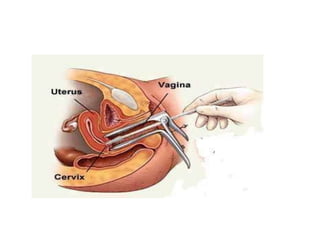
vulva; Insert speculum
 High Vaginal Swab(HVS): Swab, make
smear on glass slide & place in charcoal
medium.
 Endo Cervical Swab(ECS): Pap smear
first (if required), then clean mucous
from cervix & take ECS PCR swab &
place in tube. If pus/ inflammation of
cervix, take ECS for culture, smear on
glass slide & place in charcoal medium
Low Vaginal Swab & Rectal swab(LVS):
May be self-obtained by the woman if
asymptomatic.
 LVS: Insert swab 1-2 cm into vagina & place
into transport tube (use charcoal medium
tube for culture & a separate thin plastic/
wire shaft swab if PCR).
 Rectal: Around/inside rectum just past
external sphincter & place into charcoal
tube.
POST PROCEDURE
 Provide privacy for redressing.
 Offer tissues as required.
 Document: Procedure, consent, persons
attending examination (e.g. chaperone,
family), swab details (swab site, date,
time, patient details- but sticker or hand
write on glass slides)
 Send specimens to pathology
Thank you for attention

Vaginal swabs.pptx

  • 1.
  • 2.
     Result mainlyfrom cervical secretion in response to hormonal levels during the menstrual cycle there is increased mucous production from the cervix at the time of ovulation .  Physiological discharge usually white  Physiological discharge increase during pregnancy and oral contraceptive users. CAUSES OF PHYSIOLOGICAL VAGINAL DISCHARGE
  • 3.
    Causes of pathologicalvaginal discharge 1. Candidal infection 2. Bacterial vaginosis 3. Trichomonas 4. N. gonorrhea 5. Chlamydia 6. Cervical ectropin 7. Endometrial cancer 8. Cervical cancer 9. Vaginal cancer 10. Foreign body, IUD, vaginal ring
  • 4.
     Vulvar itching White cheesy vaginal discharge that adheres to vaginal wall  Superficial dyspareunia and dysuria.  Vulval oedema, vulval excoriation, redness and erythema.  Normal vaginal pH. The main sign and symptoms
  • 5.
    PRE-PROCEDURE:  Consultation (medicalhistory, explain procedure & counsel)  Gain consent & offer a chaperone.  Prepare: Empty bladder, provide privacy, dorsal position, position light, attend hand hygiene & apply gloves / eye protection
  • 6.
    PROCEDURE  Inspect thelabia, external meatus & vulva; Insert speculum  High Vaginal Swab(HVS): Swab, make smear on glass slide & place in charcoal medium.  Endo Cervical Swab(ECS): Pap smear first (if required), then clean mucous from cervix & take ECS PCR swab & place in tube. If pus/ inflammation of cervix, take ECS for culture, smear on glass slide & place in charcoal medium
  • 7.
    Low Vaginal Swab& Rectal swab(LVS): May be self-obtained by the woman if asymptomatic.  LVS: Insert swab 1-2 cm into vagina & place into transport tube (use charcoal medium tube for culture & a separate thin plastic/ wire shaft swab if PCR).  Rectal: Around/inside rectum just past external sphincter & place into charcoal tube.
  • 9.
    POST PROCEDURE  Provideprivacy for redressing.  Offer tissues as required.  Document: Procedure, consent, persons attending examination (e.g. chaperone, family), swab details (swab site, date, time, patient details- but sticker or hand write on glass slides)  Send specimens to pathology
  • 10.
    Thank you forattention