Derivation and Ambiguity
1
Course Name: Compiler Design
Course Code: CSE331
Level:3, Term:3
Department of Computer Science and Engineering
Daffodil International University
Derivation
A derivation is basically a sequence of production rules, in order to get the
input string. During parsing, we take two decisions for some sentential form
of input:
• Deciding the non-terminal which is to be replaced.
• Deciding the production rule, by which, the non-terminal will be replaced.
• To decide which non-terminal to be replaced with production rule, we can
have two options.
2
Derivation Types
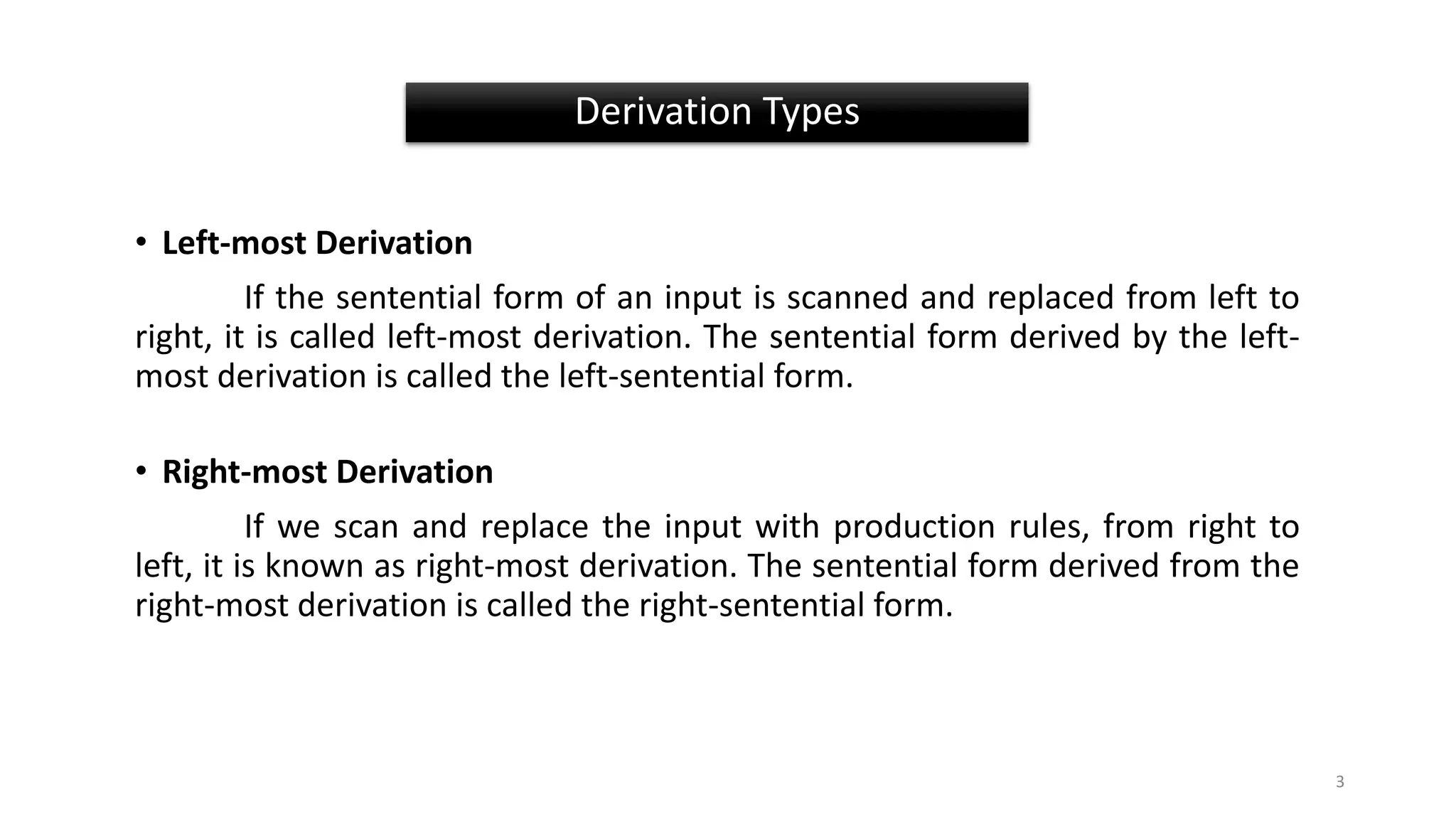
• Left-most Derivation
If the sentential form of an input is scanned and replaced from left to
right, it is called left-most derivation. The sentential form derived by the left-
most derivation is called the left-sentential form.
• Right-most Derivation
If we scan and replace the input with production rules, from right to
left, it is known as right-most derivation. The sentential form derived from the
right-most derivation is called the right-sentential form.
3
4
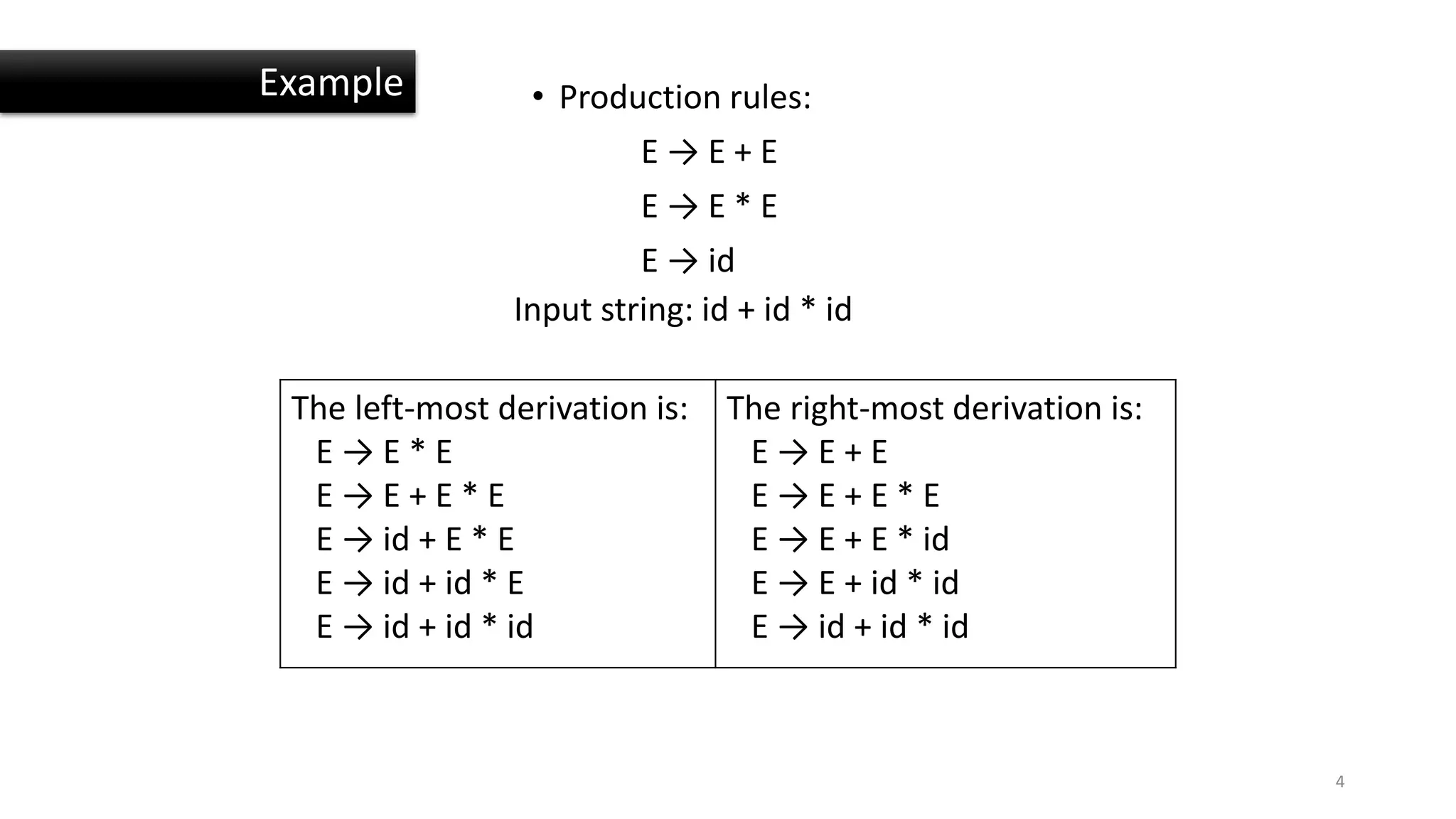
• Production rules:
E → E + E
E → E * E
E → id
The left-most derivation is:
E → E * E
E → E + E * E
E → id + E * E
E → id + id * E
E → id + id * id
The right-most derivation is:
E → E + E
E → E + E * E
E → E + E * id
E → E + id * id
E → id + id * id
Input string: id + id * id
Example
Parse Tree
• A parse tree is a graphical depiction of a derivation.
• It is convenient to see how strings are derived from the start symbol.
• The start symbol of the derivation becomes the root of the parse tree.
5
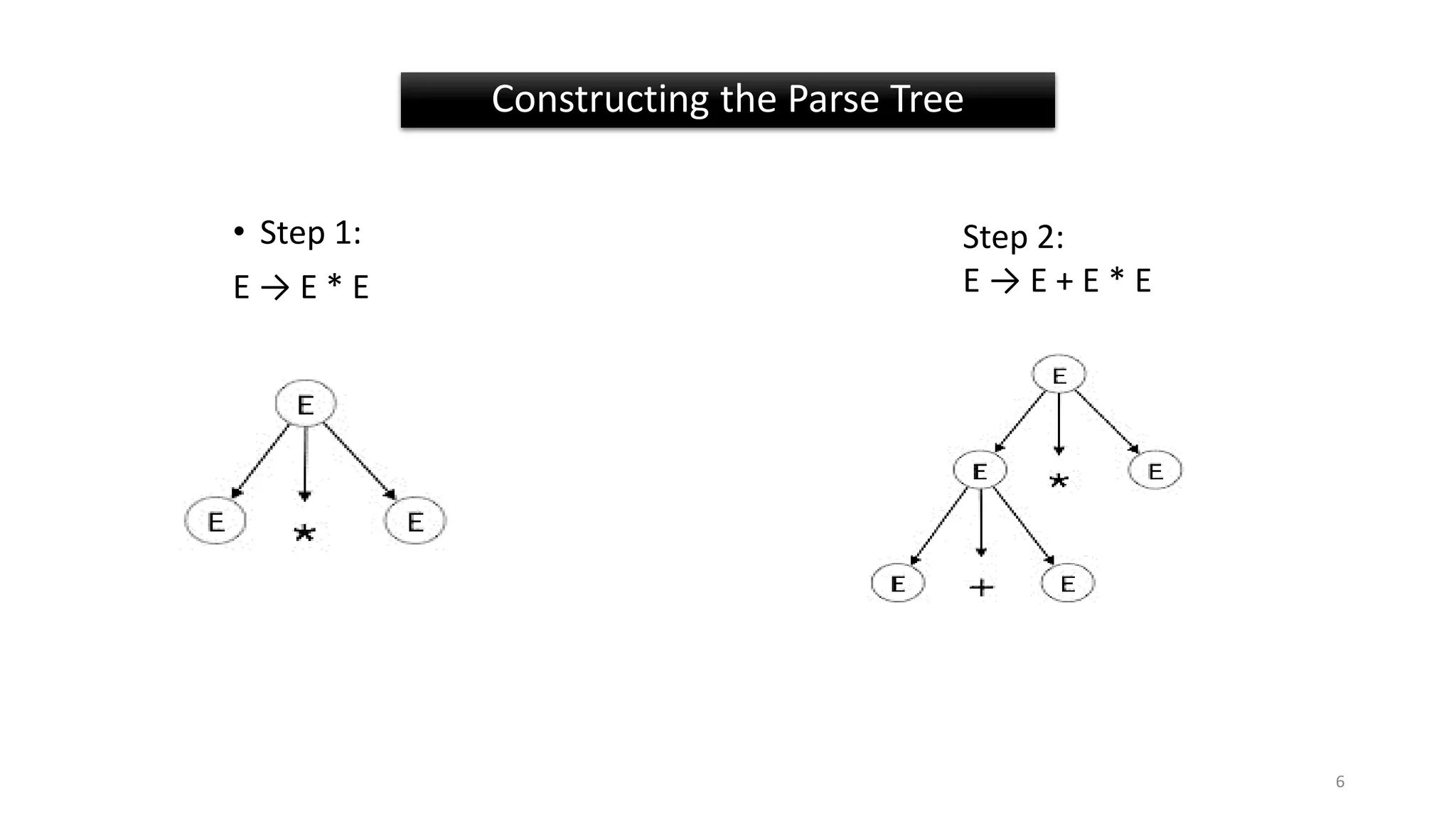
Constructing the Parse Tree
6
• Step 1:
E → E * E
Step 2:
E → E + E * E
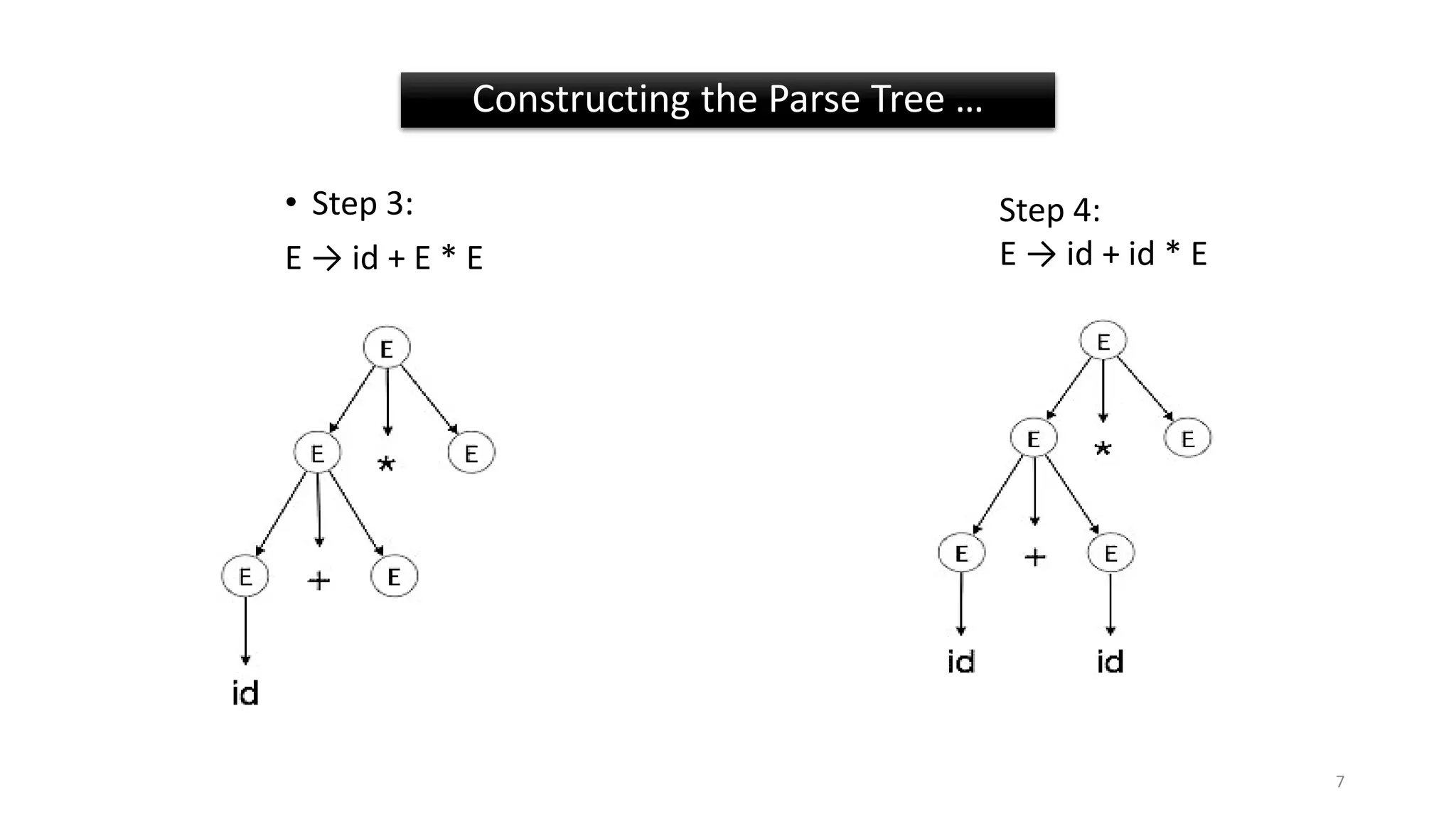
• Step 3:
E → id + E * E
Constructing the Parse Tree …
Step 4:
E → id + id * E
7
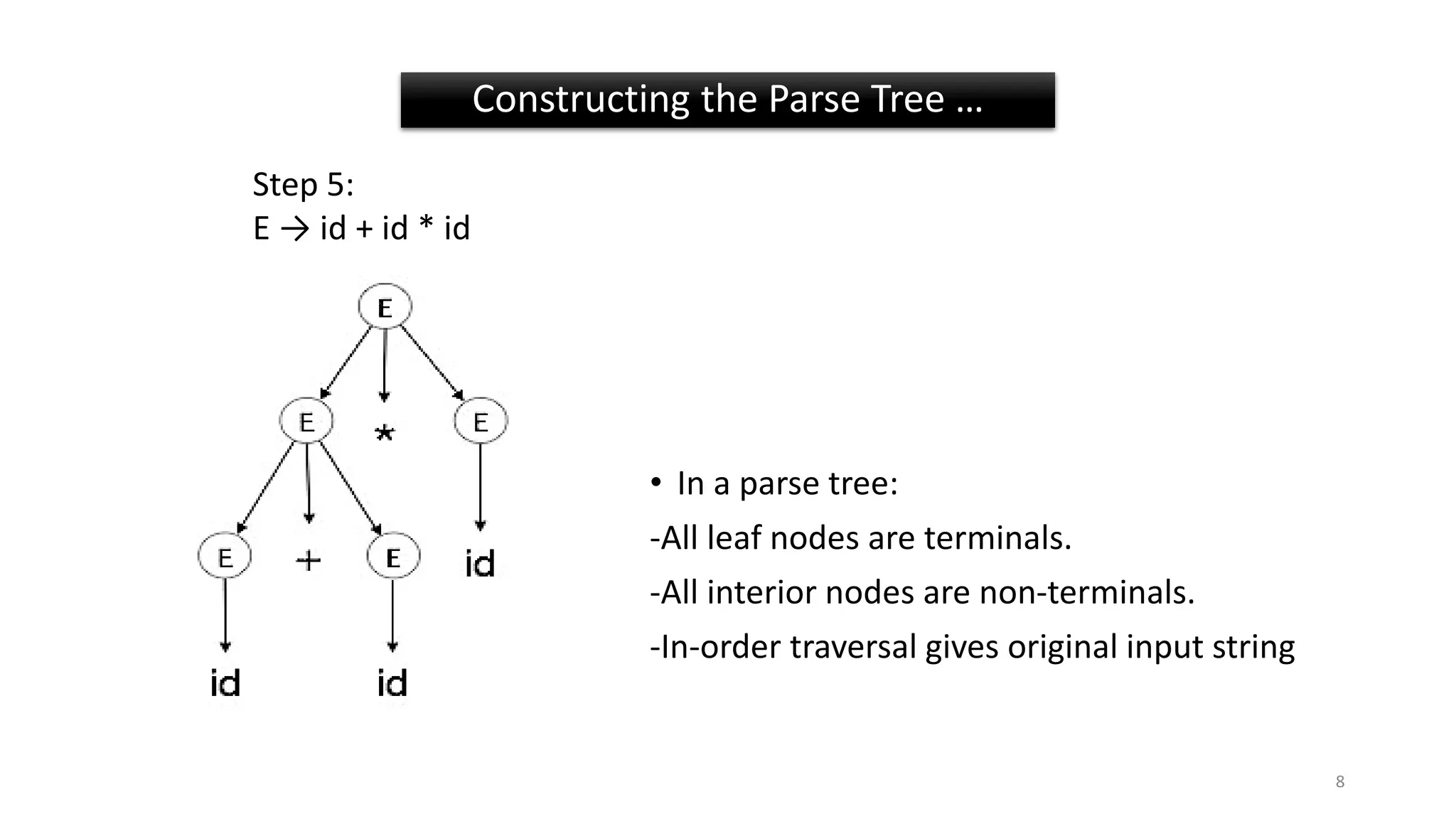
• In a parse tree:
-All leaf nodes are terminals.
-All interior nodes are non-terminals.
-In-order traversal gives original input string
Step 5:
E → id + id * id
Constructing the Parse Tree …
8
Ambiguity
• A grammar G is said to be ambiguous if it has more than one parse tree (left or right
derivation) for at least one string.
Example: E → E + E
E → E – E
E → id
For the string id + id – id, the above grammar generates two parse trees:
9
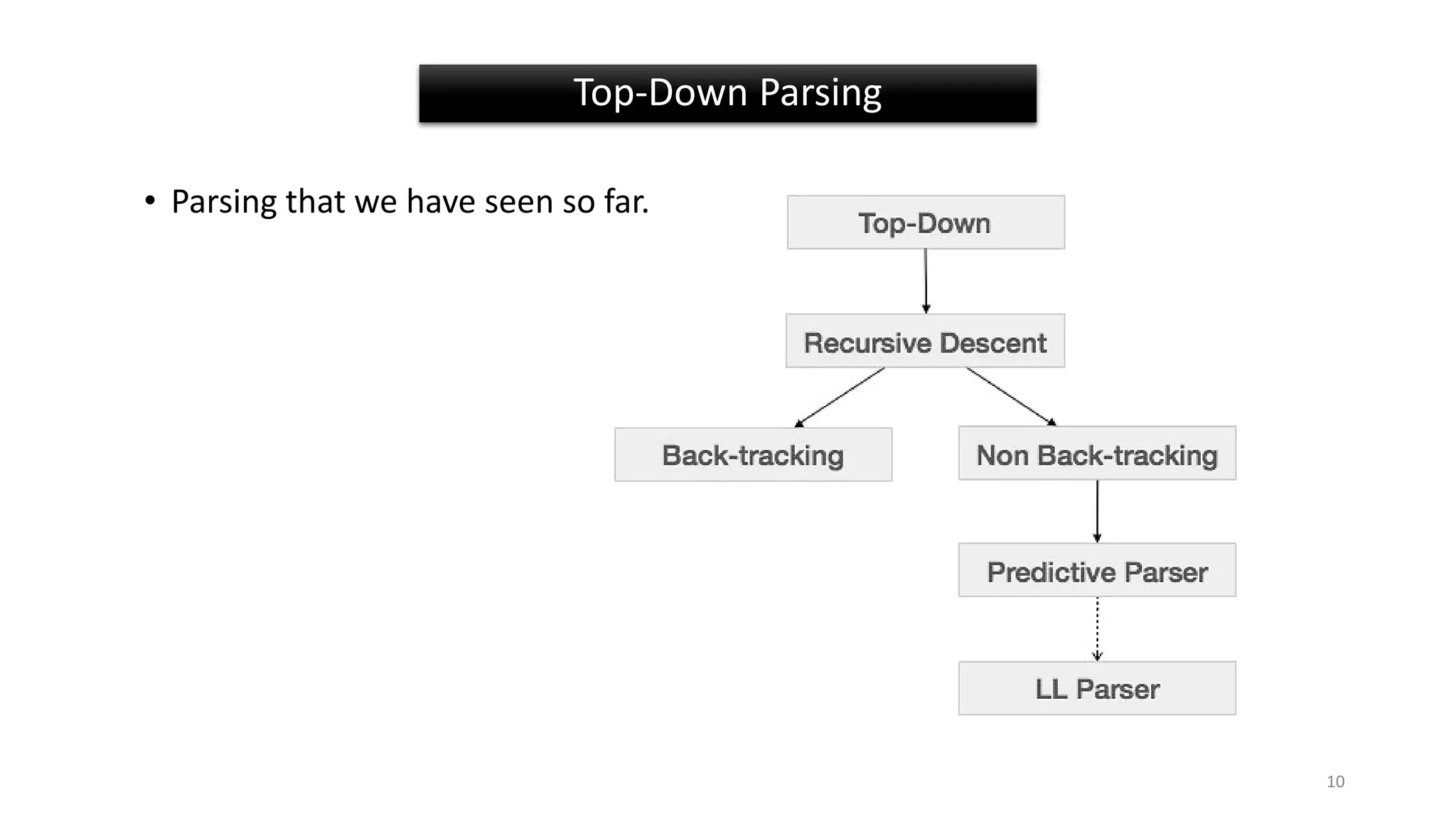
• Parsing that we have seen so far.
Top-Down Parsing
10
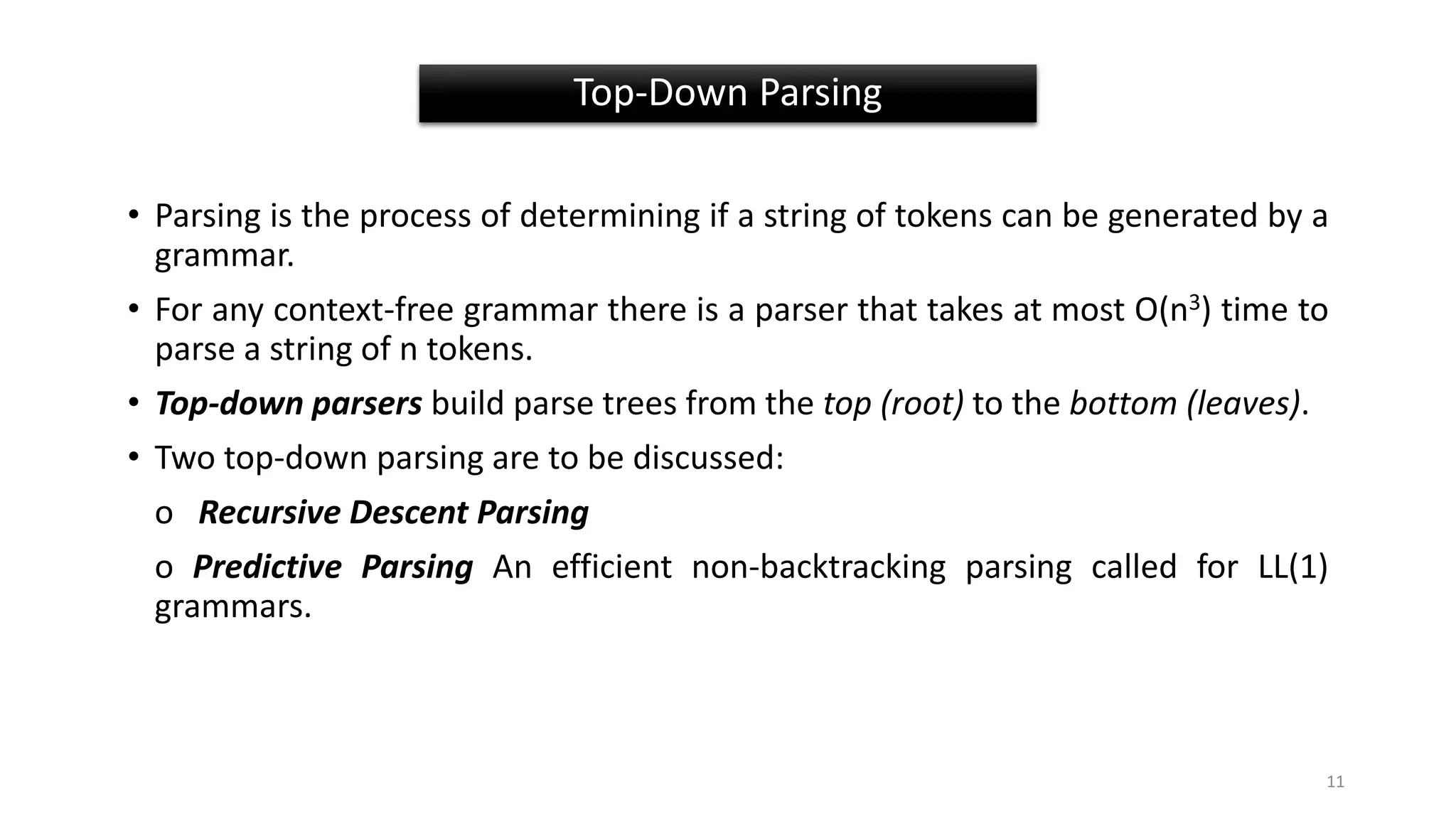
• Parsing is the process of determining if a string of tokens can be generated by a
grammar.
• For any context-free grammar there is a parser that takes at most Ο(n3) time to
parse a string of n tokens.
• Top-down parsers build parse trees from the top (root) to the bottom (leaves).
• Two top-down parsing are to be discussed:
o Recursive Descent Parsing
o Predictive Parsing An efficient non-backtracking parsing called for LL(1)
grammars.
Top-Down Parsing
11
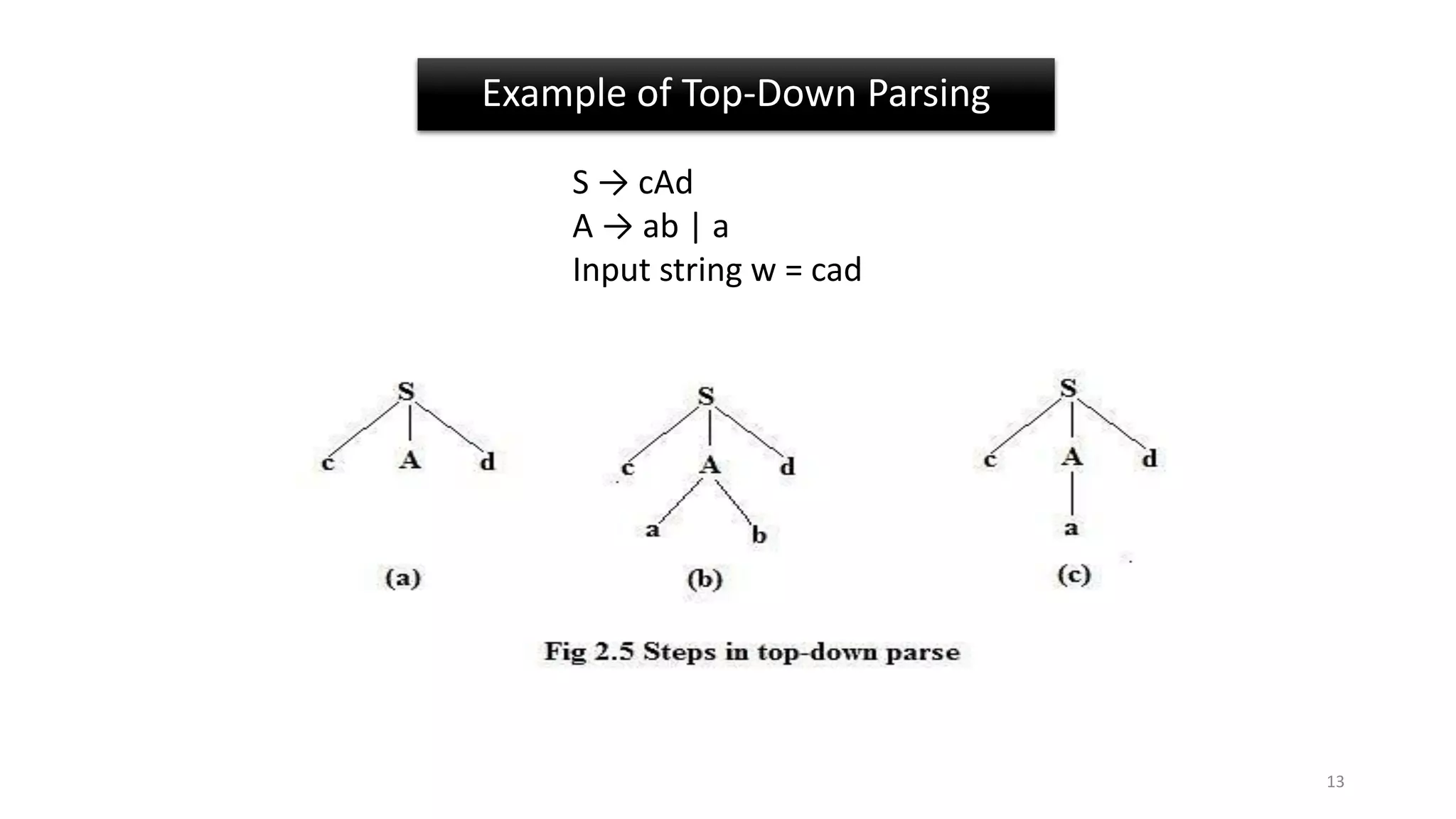
Consider the grammar
S → cAd
A → ab | a
Input string w = cad
To construct a parse tree for this string using top-down approach,
initially create a tree consisting of a single node labeled S.
Example of Top-Down Parsing
12
Example of Top-Down Parsing
S → cAd
A → ab | a
Input string w = cad
13
Procedure of Top-down Parsing
• An input pointer points to c, the first symbol of w.
• Then use the first production for S to expand the tree and obtain the tree.
• The leftmost leaf, labeled c, matches the first symbol of w.
• Next input pointer to a, the second symbol of w.
• Consider the next leaf, labeled A.
• Expand A using the first alternative for A to obtain the tree.
14
• Now have a match for the second input symbol. Then advance to the next
input pointer d, the third input symbol and compare d against the next leaf,
labeled b. Since b does not match d, report failure and go back to A to see
whether there is another alternative. (Backtracking takes place).
• If there is another alternative for A, substitute and compare the input symbol
with leaf.
• Repeat the step for all the alternatives of A to find a match using backtracking.
If match found, then the string is accepted by the grammar. Else report failure.
• A left-recursive grammar can cause a recursive-descent parser, even one with
backtracking, to go into an infinite loop.
• As discussed above, an easy way to implement a recursive descent parsing with
backtracking is to create a procedure for each non-terminals.
Procedure of Top-down Parsing
15
Transition Diagram for Predictive Parsers
16
Example: Build the parse tree for the arithmetic expression 4 + 2 * 3 using the expression grammar:
E → E + T | E - T | T
T → T * F | F
F → a | ( E )
where a represents an operand of some type, be it a number or variable. The trees are grouped by height.
17
E → E + T | E - T | T
T → T * F | F
F → a | ( E )
18
Grammer:
E → E+E | a
E ⇒ E+Ě
⇒ Ě+E+E
⇒ a+Ě+E
⇒ a+a+Ě
⇒ a+a+a
19
Derivation:
Example: Build the parse tree for the arithmetic expression “a+a+a” using the
expression grammar:
E → E+E | a
20
Consider again, the grammar specifying only addition in expression:
E → E+E | a
E ⇒ Ě+E
⇒ Ě+E+E
⇒ a+Ě+E
⇒ a+a+Ě
⇒ a+a+a
E ⇒ E+Ě
⇒ E+E+Ě
⇒ E+Ě+a
⇒ Ě+a+a
⇒ a+a+a
AMBIGUOUS
21
Left Most Derivation(LMD):
Right Most Derivation(LMD):
The grammar is: S ⇾ S S | (S) | ε
Consider the string "()()"
S ⇒ Š S
⇒ ( S ̌) S
⇒ ( ) Š
⇒ ( ) ( S ̌)
⇒ ( ) ( )
S ⇒ S Š
⇒ S ̌( S )
⇒ ( S ) ( Š )
⇒ ( Š ) ( )
⇒ ( ) ( )
NOT AMBIGUOUS
22
UNAMBIGUOUS
The grammar is: S ⇾ S S | (S) | ε
Consider the string "(())()"
S ⇒ ŠS
⇒ (Š)S
⇒ ((Š))S
⇒ (())Š
⇒ (())(Š)
⇒ (())()
S ⇒ ŠS
⇒ SŠS
⇒ S(Š)S
⇒ S((Š))S
⇒ S(())Š
⇒ S(())(Š)
⇒ Š(())()
⇒ (())()
AMBIGUOUS
23
24
THANK YOU

3b. LMD & RMD.pdf

  • 1.
    Derivation and Ambiguity 1 CourseName: Compiler Design Course Code: CSE331 Level:3, Term:3 Department of Computer Science and Engineering Daffodil International University
  • 2.
    Derivation A derivation isbasically a sequence of production rules, in order to get the input string. During parsing, we take two decisions for some sentential form of input: • Deciding the non-terminal which is to be replaced. • Deciding the production rule, by which, the non-terminal will be replaced. • To decide which non-terminal to be replaced with production rule, we can have two options. 2
  • 3.
    Derivation Types • Left-mostDerivation If the sentential form of an input is scanned and replaced from left to right, it is called left-most derivation. The sentential form derived by the left- most derivation is called the left-sentential form. • Right-most Derivation If we scan and replace the input with production rules, from right to left, it is known as right-most derivation. The sentential form derived from the right-most derivation is called the right-sentential form. 3
  • 4.
    4 • Production rules: E→ E + E E → E * E E → id The left-most derivation is: E → E * E E → E + E * E E → id + E * E E → id + id * E E → id + id * id The right-most derivation is: E → E + E E → E + E * E E → E + E * id E → E + id * id E → id + id * id Input string: id + id * id Example
  • 5.
    Parse Tree • Aparse tree is a graphical depiction of a derivation. • It is convenient to see how strings are derived from the start symbol. • The start symbol of the derivation becomes the root of the parse tree. 5
  • 6.
    Constructing the ParseTree 6 • Step 1: E → E * E Step 2: E → E + E * E
  • 7.
    • Step 3: E→ id + E * E Constructing the Parse Tree … Step 4: E → id + id * E 7
  • 8.
    • In aparse tree: -All leaf nodes are terminals. -All interior nodes are non-terminals. -In-order traversal gives original input string Step 5: E → id + id * id Constructing the Parse Tree … 8
  • 9.
    Ambiguity • A grammarG is said to be ambiguous if it has more than one parse tree (left or right derivation) for at least one string. Example: E → E + E E → E – E E → id For the string id + id – id, the above grammar generates two parse trees: 9
  • 10.
    • Parsing thatwe have seen so far. Top-Down Parsing 10
  • 11.
    • Parsing isthe process of determining if a string of tokens can be generated by a grammar. • For any context-free grammar there is a parser that takes at most Ο(n3) time to parse a string of n tokens. • Top-down parsers build parse trees from the top (root) to the bottom (leaves). • Two top-down parsing are to be discussed: o Recursive Descent Parsing o Predictive Parsing An efficient non-backtracking parsing called for LL(1) grammars. Top-Down Parsing 11
  • 12.
    Consider the grammar S→ cAd A → ab | a Input string w = cad To construct a parse tree for this string using top-down approach, initially create a tree consisting of a single node labeled S. Example of Top-Down Parsing 12
  • 13.
    Example of Top-DownParsing S → cAd A → ab | a Input string w = cad 13
  • 14.
    Procedure of Top-downParsing • An input pointer points to c, the first symbol of w. • Then use the first production for S to expand the tree and obtain the tree. • The leftmost leaf, labeled c, matches the first symbol of w. • Next input pointer to a, the second symbol of w. • Consider the next leaf, labeled A. • Expand A using the first alternative for A to obtain the tree. 14
  • 15.
    • Now havea match for the second input symbol. Then advance to the next input pointer d, the third input symbol and compare d against the next leaf, labeled b. Since b does not match d, report failure and go back to A to see whether there is another alternative. (Backtracking takes place). • If there is another alternative for A, substitute and compare the input symbol with leaf. • Repeat the step for all the alternatives of A to find a match using backtracking. If match found, then the string is accepted by the grammar. Else report failure. • A left-recursive grammar can cause a recursive-descent parser, even one with backtracking, to go into an infinite loop. • As discussed above, an easy way to implement a recursive descent parsing with backtracking is to create a procedure for each non-terminals. Procedure of Top-down Parsing 15
  • 16.
    Transition Diagram forPredictive Parsers 16
  • 17.
    Example: Build theparse tree for the arithmetic expression 4 + 2 * 3 using the expression grammar: E → E + T | E - T | T T → T * F | F F → a | ( E ) where a represents an operand of some type, be it a number or variable. The trees are grouped by height. 17
  • 18.
    E → E+ T | E - T | T T → T * F | F F → a | ( E ) 18
  • 19.
    Grammer: E → E+E| a E ⇒ E+Ě ⇒ Ě+E+E ⇒ a+Ě+E ⇒ a+a+Ě ⇒ a+a+a 19 Derivation:
  • 20.
    Example: Build theparse tree for the arithmetic expression “a+a+a” using the expression grammar: E → E+E | a 20
  • 21.
    Consider again, thegrammar specifying only addition in expression: E → E+E | a E ⇒ Ě+E ⇒ Ě+E+E ⇒ a+Ě+E ⇒ a+a+Ě ⇒ a+a+a E ⇒ E+Ě ⇒ E+E+Ě ⇒ E+Ě+a ⇒ Ě+a+a ⇒ a+a+a AMBIGUOUS 21 Left Most Derivation(LMD): Right Most Derivation(LMD):
  • 22.
    The grammar is:S ⇾ S S | (S) | ε Consider the string "()()" S ⇒ Š S ⇒ ( S ̌) S ⇒ ( ) Š ⇒ ( ) ( S ̌) ⇒ ( ) ( ) S ⇒ S Š ⇒ S ̌( S ) ⇒ ( S ) ( Š ) ⇒ ( Š ) ( ) ⇒ ( ) ( ) NOT AMBIGUOUS 22 UNAMBIGUOUS
  • 23.
    The grammar is:S ⇾ S S | (S) | ε Consider the string "(())()" S ⇒ ŠS ⇒ (Š)S ⇒ ((Š))S ⇒ (())Š ⇒ (())(Š) ⇒ (())() S ⇒ ŠS ⇒ SŠS ⇒ S(Š)S ⇒ S((Š))S ⇒ S(())Š ⇒ S(())(Š) ⇒ Š(())() ⇒ (())() AMBIGUOUS 23
  • 24.