

1
By: Syed Mazedur Rahman
ID: 16103386
Program: BCSE
Faculty: Lulu Al Marzan
Department: CAAS
2
CONTENTS
• What is nuclear power
• How a nuclear power plant works
• Advantages of using nuclear power source
• Disadvantages of using nuclear energy
• NUKES
3
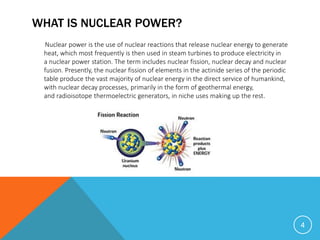
WHAT IS NUCLEAR POWER?
Nuclear power is the use of nuclear reactions that release nuclear energy to generate
heat, which most frequently is then used in steam turbines to produce electricity in
a nuclear power station. The term includes nuclear fission, nuclear decay and nuclear
fusion. Presently, the nuclear fission of elements in the actinide series of the periodic
table produce the vast majority of nuclear energy in the direct service of humankind,
with nuclear decay processes, primarily in the form of geothermal energy,
and radioisotope thermoelectric generators, in niche uses making up the rest.
4
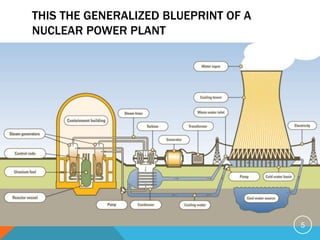
THIS THE GENERALIZED BLUEPRINT OF A
NUCLEAR POWER PLANT
5
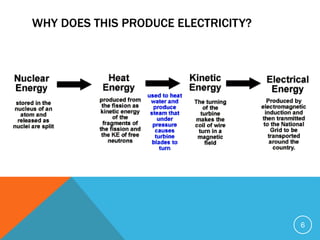
WHY DOES THIS PRODUCE ELECTRICITY?
6
ADVANTAGES OF NUCLEAR POWER
The generation of electricity through nuclear energy reduces the amount of energy
generated from fossil fuels (coal and oil). Less use of fossil fuels means lowering
greenhouse gas emissions (CO2 and others).
Currently, fossil fuels are consumed faster than they are produced, so in the next future
these resources may be reduced or the price may increase becoming inaccessible for
most of the population.
7
ADVANTAGES OF NUCLEAR POWER
Another advantage is the required amount of fuel: less fuel offers more energy. It
represents a significant save on raw materials but also in transport, handling and
extraction of nuclear fuel. The cost of nuclear fuel (overall uranium) is 20% of the cost of
energy generated.
Central termoeléctrica de carbón de Iowa (EEUU) The production of electric energy is
continuous. A nuclear power plant is generating electricity for almost 90% of annual time.
It reduces the price volatility of other fuels such as petrol.
8
ADVANTAGES OF NUCLEAR POWER
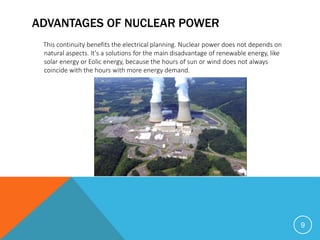
This continuity benefits the electrical planning. Nuclear power does not depends on
natural aspects. It's a solutions for the main disadvantage of renewable energy, like
solar energy or Eolic energy, because the hours of sun or wind does not always
coincide with the hours with more energy demand.
9
DISADVANTAGES OF NUCLEAR POWER
We've previously discussed the advantage of using nuclear energy to reduce fossil
fuel consumption. Organizations often use this argument in favor of nuclear energy
but it's a partial truth. Much of the consumption of fossil fuels is due to road
transport, used in heat engines (cars, trucks, etc.). Savings in fossil fuel for power
generation is fairly low.
10
DISADVANTAGES OF NUCLEAR POWER
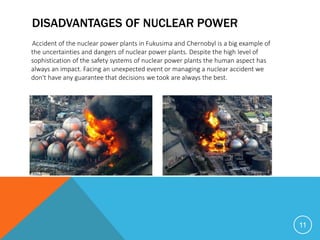
Accident of the nuclear power plants in Fukusima and Chernobyl is a big example of
the uncertainties and dangers of nuclear power plants. Despite the high level of
sophistication of the safety systems of nuclear power plants the human aspect has
always an impact. Facing an unexpected event or managing a nuclear accident we
don't have any guarantee that decisions we took are always the best.
11
DISADVANTAGES OF NUCLEAR POWER
The Chernobyl nuclear accident is, by far, the worst nuclear accident in the history.
Different wrong decisions during the management of the nuclear plant caused a big
nuclear explosion.
Referring to the Fukushima nuclear accident, the operations done by the staff were highly
questionable. Fukushima nuclear accident is the second worst accident in the history.
One of the main disadvantages is the difficulty in the management of nuclear waste. It
takes many years to eliminate its radioactivity and risks.
12
DISADVANTAGES OF NUCLEAR POWER
The constructed nuclear reactors have an expiration date. Then, they've to be dismantled,
so that main countries producing nuclear energy could maintain a regular number of
operating reactors. They've to built about 80 new nuclear reactors during the next ten
years.
Nuclear plants have a limited life. The investment for the construction of a nuclear plant is
very high and must be recovered as soon as possible, so it raises the cost of electricity
generated. In other words, the energy generated is cheap compared to the cost of fuel,
but the recovery of its construction is much more expensive.
13
DISADVANTAGES OF NUCLEAR POWER
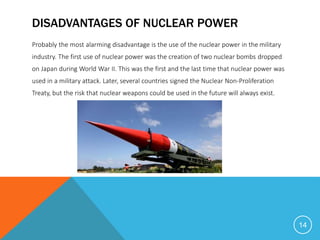
Probably the most alarming disadvantage is the use of the nuclear power in the military
industry. The first use of nuclear power was the creation of two nuclear bombs dropped
on Japan during World War II. This was the first and the last time that nuclear power was
used in a military attack. Later, several countries signed the Nuclear Non-Proliferation
Treaty, but the risk that nuclear weapons could be used in the future will always exist.
14
DISADVANTAGES OF NUCLEAR POWER
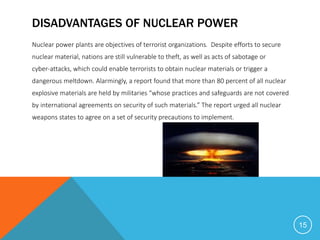
Nuclear power plants are objectives of terrorist organizations. Despite efforts to secure
nuclear material, nations are still vulnerable to theft, as well as acts of sabotage or
cyber-attacks, which could enable terrorists to obtain nuclear materials or trigger a
dangerous meltdown. Alarmingly, a report found that more than 80 percent of all nuclear
explosive materials are held by militaries “whose practices and safeguards are not covered
by international agreements on security of such materials.” The report urged all nuclear
weapons states to agree on a set of security precautions to implement.
15
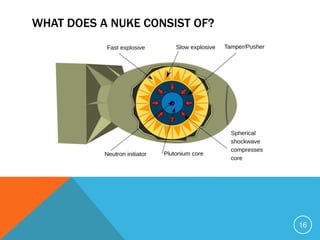
WHAT DOES A NUKE CONSIST OF?
16
DISADVANTAGES OF NUCLEAR POWER
Nuclear power plants generate external dependence. Not many countries have uranium
mines and not all the countries have nuclear technology, so they have to hire both things
overseas.
Current nuclear reactors work by fission nuclear reactions. These chain reactions is
generated in case control systems fail, generating continuous reactions causing a
radioactive explosion that would be virtually impossible to contain.
17
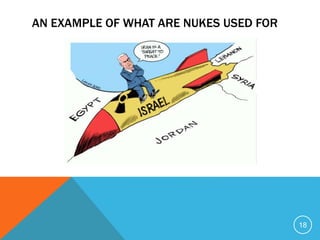
AN EXAMPLE OF WHAT ARE NUKES USED FOR
18
LASTLY…
Currently the generation of electricity in nuclear reactors is done by nuclear fission
reactions. For the moment, nuclear fusion is not valid to generate electric power. Once
developed, if nuclear fusion is really practicable, it will provide great advantages over
nuclear fission:
• Virtually inexhaustible sources of fuel.
• No accidents in the reactor due to the chain reactions that occur in fissions.
• The waste generated will be much less radioactive.
19
Thank you
20

Nuclear power plants

  • 1.
  • 2.
    By: Syed MazedurRahman ID: 16103386 Program: BCSE Faculty: Lulu Al Marzan Department: CAAS 2
  • 3.
    CONTENTS • What isnuclear power • How a nuclear power plant works • Advantages of using nuclear power source • Disadvantages of using nuclear energy • NUKES 3
  • 4.
    WHAT IS NUCLEARPOWER? Nuclear power is the use of nuclear reactions that release nuclear energy to generate heat, which most frequently is then used in steam turbines to produce electricity in a nuclear power station. The term includes nuclear fission, nuclear decay and nuclear fusion. Presently, the nuclear fission of elements in the actinide series of the periodic table produce the vast majority of nuclear energy in the direct service of humankind, with nuclear decay processes, primarily in the form of geothermal energy, and radioisotope thermoelectric generators, in niche uses making up the rest. 4
  • 5.
    THIS THE GENERALIZEDBLUEPRINT OF A NUCLEAR POWER PLANT 5
  • 6.
    WHY DOES THISPRODUCE ELECTRICITY? 6
  • 7.
    ADVANTAGES OF NUCLEARPOWER The generation of electricity through nuclear energy reduces the amount of energy generated from fossil fuels (coal and oil). Less use of fossil fuels means lowering greenhouse gas emissions (CO2 and others). Currently, fossil fuels are consumed faster than they are produced, so in the next future these resources may be reduced or the price may increase becoming inaccessible for most of the population. 7
  • 8.
    ADVANTAGES OF NUCLEARPOWER Another advantage is the required amount of fuel: less fuel offers more energy. It represents a significant save on raw materials but also in transport, handling and extraction of nuclear fuel. The cost of nuclear fuel (overall uranium) is 20% of the cost of energy generated. Central termoeléctrica de carbón de Iowa (EEUU) The production of electric energy is continuous. A nuclear power plant is generating electricity for almost 90% of annual time. It reduces the price volatility of other fuels such as petrol. 8
  • 9.
    ADVANTAGES OF NUCLEARPOWER This continuity benefits the electrical planning. Nuclear power does not depends on natural aspects. It's a solutions for the main disadvantage of renewable energy, like solar energy or Eolic energy, because the hours of sun or wind does not always coincide with the hours with more energy demand. 9
  • 10.
    DISADVANTAGES OF NUCLEARPOWER We've previously discussed the advantage of using nuclear energy to reduce fossil fuel consumption. Organizations often use this argument in favor of nuclear energy but it's a partial truth. Much of the consumption of fossil fuels is due to road transport, used in heat engines (cars, trucks, etc.). Savings in fossil fuel for power generation is fairly low. 10
  • 11.
    DISADVANTAGES OF NUCLEARPOWER Accident of the nuclear power plants in Fukusima and Chernobyl is a big example of the uncertainties and dangers of nuclear power plants. Despite the high level of sophistication of the safety systems of nuclear power plants the human aspect has always an impact. Facing an unexpected event or managing a nuclear accident we don't have any guarantee that decisions we took are always the best. 11
  • 12.
    DISADVANTAGES OF NUCLEARPOWER The Chernobyl nuclear accident is, by far, the worst nuclear accident in the history. Different wrong decisions during the management of the nuclear plant caused a big nuclear explosion. Referring to the Fukushima nuclear accident, the operations done by the staff were highly questionable. Fukushima nuclear accident is the second worst accident in the history. One of the main disadvantages is the difficulty in the management of nuclear waste. It takes many years to eliminate its radioactivity and risks. 12
  • 13.
    DISADVANTAGES OF NUCLEARPOWER The constructed nuclear reactors have an expiration date. Then, they've to be dismantled, so that main countries producing nuclear energy could maintain a regular number of operating reactors. They've to built about 80 new nuclear reactors during the next ten years. Nuclear plants have a limited life. The investment for the construction of a nuclear plant is very high and must be recovered as soon as possible, so it raises the cost of electricity generated. In other words, the energy generated is cheap compared to the cost of fuel, but the recovery of its construction is much more expensive. 13
  • 14.
    DISADVANTAGES OF NUCLEARPOWER Probably the most alarming disadvantage is the use of the nuclear power in the military industry. The first use of nuclear power was the creation of two nuclear bombs dropped on Japan during World War II. This was the first and the last time that nuclear power was used in a military attack. Later, several countries signed the Nuclear Non-Proliferation Treaty, but the risk that nuclear weapons could be used in the future will always exist. 14
  • 15.
    DISADVANTAGES OF NUCLEARPOWER Nuclear power plants are objectives of terrorist organizations. Despite efforts to secure nuclear material, nations are still vulnerable to theft, as well as acts of sabotage or cyber-attacks, which could enable terrorists to obtain nuclear materials or trigger a dangerous meltdown. Alarmingly, a report found that more than 80 percent of all nuclear explosive materials are held by militaries “whose practices and safeguards are not covered by international agreements on security of such materials.” The report urged all nuclear weapons states to agree on a set of security precautions to implement. 15
  • 16.
    WHAT DOES ANUKE CONSIST OF? 16
  • 17.
    DISADVANTAGES OF NUCLEARPOWER Nuclear power plants generate external dependence. Not many countries have uranium mines and not all the countries have nuclear technology, so they have to hire both things overseas. Current nuclear reactors work by fission nuclear reactions. These chain reactions is generated in case control systems fail, generating continuous reactions causing a radioactive explosion that would be virtually impossible to contain. 17
  • 18.
    AN EXAMPLE OFWHAT ARE NUKES USED FOR 18
  • 19.
    LASTLY… Currently the generationof electricity in nuclear reactors is done by nuclear fission reactions. For the moment, nuclear fusion is not valid to generate electric power. Once developed, if nuclear fusion is really practicable, it will provide great advantages over nuclear fission: • Virtually inexhaustible sources of fuel. • No accidents in the reactor due to the chain reactions that occur in fissions. • The waste generated will be much less radioactive. 19
  • 20.