MANAGEMENT OF LITHIUM
TOXICITY
PRESENTED BY,
SUBARNA NEOGI
M.SC NURSING 1ST YEAR
C.O.N., JIPMER
HISTORY:
• In 1800s, lithia water first introduced as MANIA & GOUT
treatment.
• But after having a higher concentration it is found to be
associated with tremors and weakness.
• First “lithium toxicity” is described in 1898
Invention of lithium:
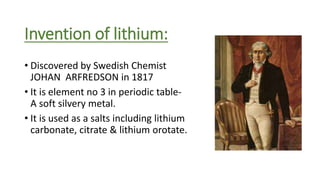
• Discovered by Swedish Chemist
JOHAN ARFREDSON in 1817
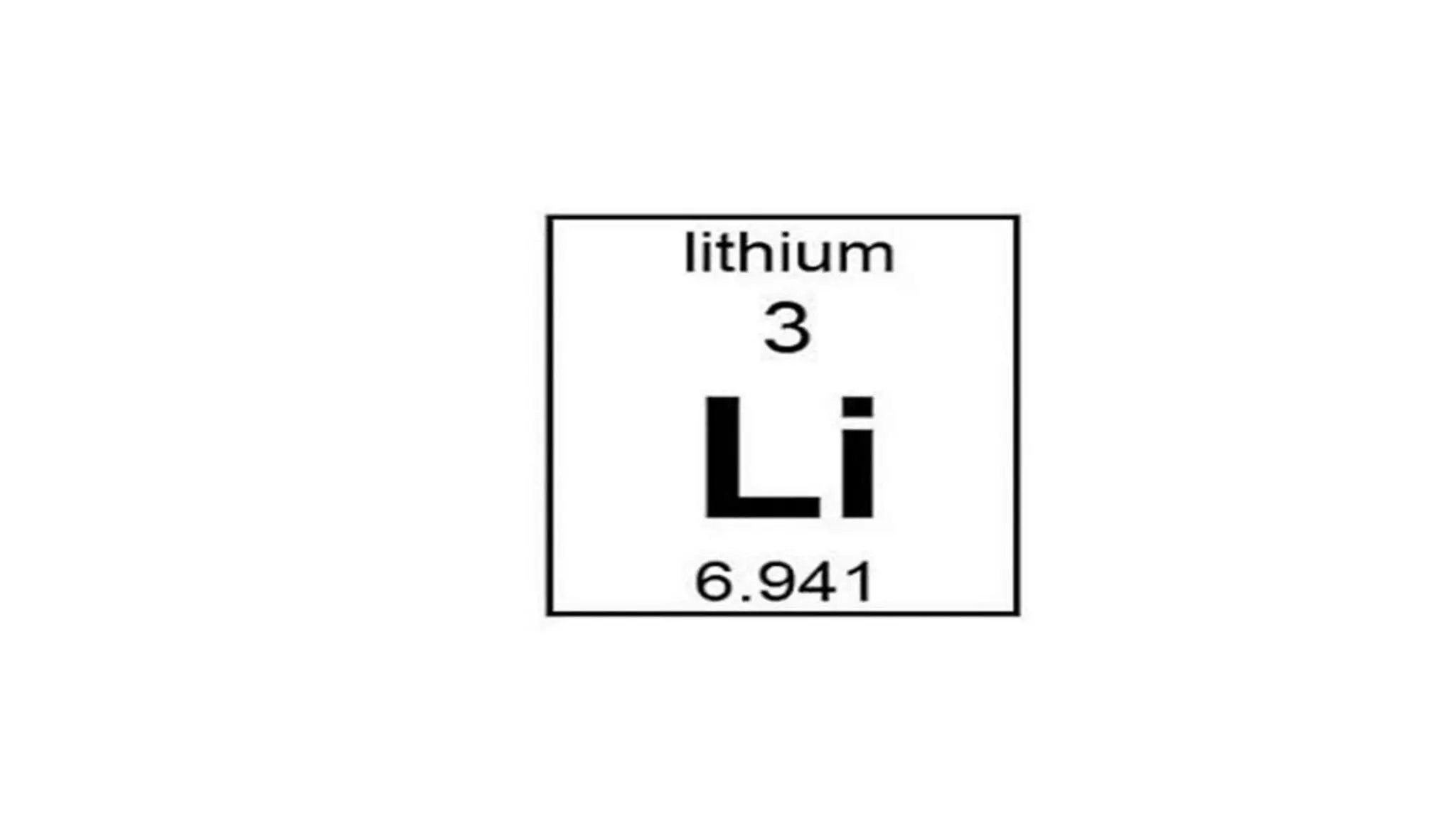
• It is element no 3 in periodic table-
A soft silvery metal.
• It is used as a salts including lithium
carbonate, citrate & lithium orotate.
ORIGIN OF LITHIUM:
• Name originated from “LITHOS” means stone.
• It was discovered from a mineral.
• Use of lithium salt came from spring and spas of North Italy.
People used to drink water for soothing effect.
• Use of lithium salts in Mania 1st by an Australian doctor in
1949.
ETIOLOGY OF LITHIUM TOXICITY:
PHARMACODYNAMICS:
• Producing brain inositol depletion, leading to reduced responsiveness
to alpha-adrenergic stimulation.
• Reducing neuronal responsiveness to neurotransmitters due to
inhibitory effect on adenylate cyclase & G protein.
• Stimulating serotonin release from hippocampus.
• Being a cation, it also effects in ion transport and cell membrane
potential.
TYPES OF LITHIUM TOXICITY:
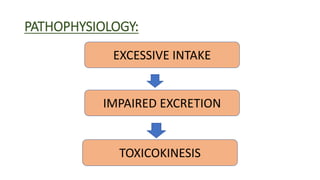
PATHOPHYSIOLOGY:
EXCESSIVE INTAKE
IMPAIRED EXCRETION
TOXICOKINESIS
TOXICOKINESIS:
• Its absorption is rapid.
• It is neither metabolised nor protein bound,
• Serum lithium level reflects only the extracellular lithium
concentration
• It accumulates mostly in liver, bone, muscles, thyroid gland affecting
the brain & kidney.
• Volume depletion can leads to elevate lithium level in blood.
• Half life is 12- 27 hours, it can be up to 48 hours.
• It can cross placenta and can excreted through breast milk
• Renal clearance is usually 10-40ml/min.
SIGN & SYMPTOMS:
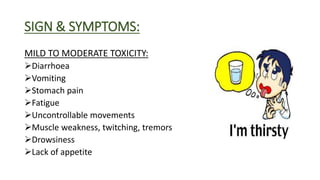
MILD TO MODERATE TOXICITY:
Diarrhoea
Vomiting
Stomach pain
Fatigue
Uncontrollable movements
Muscle weakness, twitching, tremors
Drowsiness
Lack of appetite
CONTED……
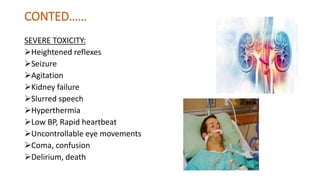
SEVERE TOXICITY:
Heightened reflexes
Seizure
Agitation
Kidney failure
Slurred speech
Hyperthermia
Low BP, Rapid heartbeat
Uncontrollable eye movements
Coma, confusion
Delirium, death
DIAGNOSIS:
• An ECG
• A blood chemistry test-
To determine the metabolism and
electrolyte level
• Blood & urine test-
To determine serum lithium level
• A blood test to assess kidney
function
MANAGEMENT OF LITHIUM TOXICITY:
IN MODERATE TOXICITY:
Stomach pumping
Whole bowel irrigation
IV fluids administration
Haemodialysis
Medication
Vital sign monitoring
Not to follow home remedies like activated
charcoal, which does not even bind with
lithium
CONTD……
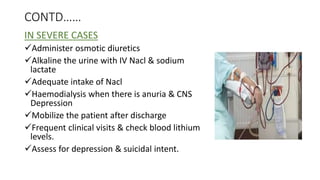
IN SEVERE CASES
Administer osmotic diuretics
Alkaline the urine with IV Nacl & sodium
lactate
Adequate intake of Nacl
Haemodialysis when there is anuria & CNS
Depression
Mobilize the patient after discharge
Frequent clinical visits & check blood lithium
levels.
Assess for depression & suicidal intent.
TREATMENT:
DECONTAMI
NATION
ELIMINATION
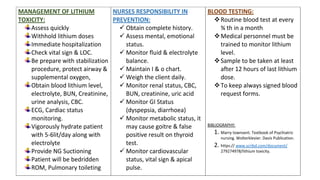
MANAGEMENT OF LITHIUM
TOXICITY:
Assess quickly
Withhold lithium doses
Immediate hospitalization
Check vital sign & LOC.
Be prepare with stabilization
procedure, protect airway &
supplemental oxygen,
Obtain blood lithium level,
electrolyte, BUN, Creatinine,
urine analysis, CBC.
ECG, Cardiac status
monitoring.
Vigorously hydrate patient
with 5-6lit/day along with
electrolyte
Provide NG Suctioning
Patient will be bedridden
ROM, Pulmonary toileting
NURSES RESPONSIBILITY IN
PREVENTION:
 Obtain complete history.
 Assess mental, emotional
status.
 Monitor fluid & electrolyte
balance.
 Maintain I & o chart.
 Weigh the client daily.
 Monitor renal status, CBC,
BUN, creatinine, uric acid
 Monitor GI Status
(dyspepsia, diarrhoea)
 Monitor metabolic status, it
may cause goitre & false
positive result on thyroid
test.
 Monitor cardiovascular
status, vital sign & apical
pulse.
BLOOD TESTING:
Routine blood test at every
¾ th in a month
Medical personnel must be
trained to monitor lithium
level.
Sample to be taken at least
after 12 hours of last lithium
dose.
To keep always signed blood
request forms.
BIBLIOGRAPHY:
1. Marry townsent. Textbook of Psychiatric
nursing. Wolterklevier. Davis Publication.
2. https:// www.scribd.com/document/
279274978/lithium toxicity.
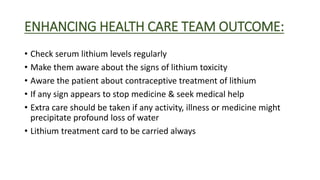
ENHANCING HEALTH CARE TEAM OUTCOME:
• Check serum lithium levels regularly
• Make them aware about the signs of lithium toxicity
• Aware the patient about contraceptive treatment of lithium
• If any sign appears to stop medicine & seek medical help
• Extra care should be taken if any activity, illness or medicine might
precipitate profound loss of water
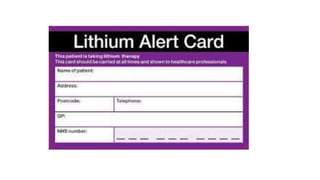
• Lithium treatment card to be carried always
Lithium toxicity & management

Lithium toxicity & management

  • 2.
    MANAGEMENT OF LITHIUM TOXICITY PRESENTEDBY, SUBARNA NEOGI M.SC NURSING 1ST YEAR C.O.N., JIPMER
  • 3.
    HISTORY: • In 1800s,lithia water first introduced as MANIA & GOUT treatment. • But after having a higher concentration it is found to be associated with tremors and weakness. • First “lithium toxicity” is described in 1898
  • 4.
    Invention of lithium: •Discovered by Swedish Chemist JOHAN ARFREDSON in 1817 • It is element no 3 in periodic table- A soft silvery metal. • It is used as a salts including lithium carbonate, citrate & lithium orotate.
  • 5.
    ORIGIN OF LITHIUM: •Name originated from “LITHOS” means stone. • It was discovered from a mineral. • Use of lithium salt came from spring and spas of North Italy. People used to drink water for soothing effect. • Use of lithium salts in Mania 1st by an Australian doctor in 1949.
  • 6.
  • 7.
    PHARMACODYNAMICS: • Producing braininositol depletion, leading to reduced responsiveness to alpha-adrenergic stimulation. • Reducing neuronal responsiveness to neurotransmitters due to inhibitory effect on adenylate cyclase & G protein. • Stimulating serotonin release from hippocampus. • Being a cation, it also effects in ion transport and cell membrane potential.
  • 8.
  • 9.
  • 10.
    TOXICOKINESIS: • Its absorptionis rapid. • It is neither metabolised nor protein bound, • Serum lithium level reflects only the extracellular lithium concentration • It accumulates mostly in liver, bone, muscles, thyroid gland affecting the brain & kidney. • Volume depletion can leads to elevate lithium level in blood. • Half life is 12- 27 hours, it can be up to 48 hours. • It can cross placenta and can excreted through breast milk • Renal clearance is usually 10-40ml/min.
  • 12.
    SIGN & SYMPTOMS: MILDTO MODERATE TOXICITY: Diarrhoea Vomiting Stomach pain Fatigue Uncontrollable movements Muscle weakness, twitching, tremors Drowsiness Lack of appetite
  • 13.
    CONTED…… SEVERE TOXICITY: Heightened reflexes Seizure Agitation Kidneyfailure Slurred speech Hyperthermia Low BP, Rapid heartbeat Uncontrollable eye movements Coma, confusion Delirium, death
  • 14.
    DIAGNOSIS: • An ECG •A blood chemistry test- To determine the metabolism and electrolyte level • Blood & urine test- To determine serum lithium level • A blood test to assess kidney function
  • 15.
    MANAGEMENT OF LITHIUMTOXICITY: IN MODERATE TOXICITY: Stomach pumping Whole bowel irrigation IV fluids administration Haemodialysis Medication Vital sign monitoring Not to follow home remedies like activated charcoal, which does not even bind with lithium
  • 16.
    CONTD…… IN SEVERE CASES Administerosmotic diuretics Alkaline the urine with IV Nacl & sodium lactate Adequate intake of Nacl Haemodialysis when there is anuria & CNS Depression Mobilize the patient after discharge Frequent clinical visits & check blood lithium levels. Assess for depression & suicidal intent.
  • 17.
  • 18.
    MANAGEMENT OF LITHIUM TOXICITY: Assessquickly Withhold lithium doses Immediate hospitalization Check vital sign & LOC. Be prepare with stabilization procedure, protect airway & supplemental oxygen, Obtain blood lithium level, electrolyte, BUN, Creatinine, urine analysis, CBC. ECG, Cardiac status monitoring. Vigorously hydrate patient with 5-6lit/day along with electrolyte Provide NG Suctioning Patient will be bedridden ROM, Pulmonary toileting NURSES RESPONSIBILITY IN PREVENTION:  Obtain complete history.  Assess mental, emotional status.  Monitor fluid & electrolyte balance.  Maintain I & o chart.  Weigh the client daily.  Monitor renal status, CBC, BUN, creatinine, uric acid  Monitor GI Status (dyspepsia, diarrhoea)  Monitor metabolic status, it may cause goitre & false positive result on thyroid test.  Monitor cardiovascular status, vital sign & apical pulse. BLOOD TESTING: Routine blood test at every ¾ th in a month Medical personnel must be trained to monitor lithium level. Sample to be taken at least after 12 hours of last lithium dose. To keep always signed blood request forms. BIBLIOGRAPHY: 1. Marry townsent. Textbook of Psychiatric nursing. Wolterklevier. Davis Publication. 2. https:// www.scribd.com/document/ 279274978/lithium toxicity.
  • 19.
    ENHANCING HEALTH CARETEAM OUTCOME: • Check serum lithium levels regularly • Make them aware about the signs of lithium toxicity • Aware the patient about contraceptive treatment of lithium • If any sign appears to stop medicine & seek medical help • Extra care should be taken if any activity, illness or medicine might precipitate profound loss of water • Lithium treatment card to be carried always