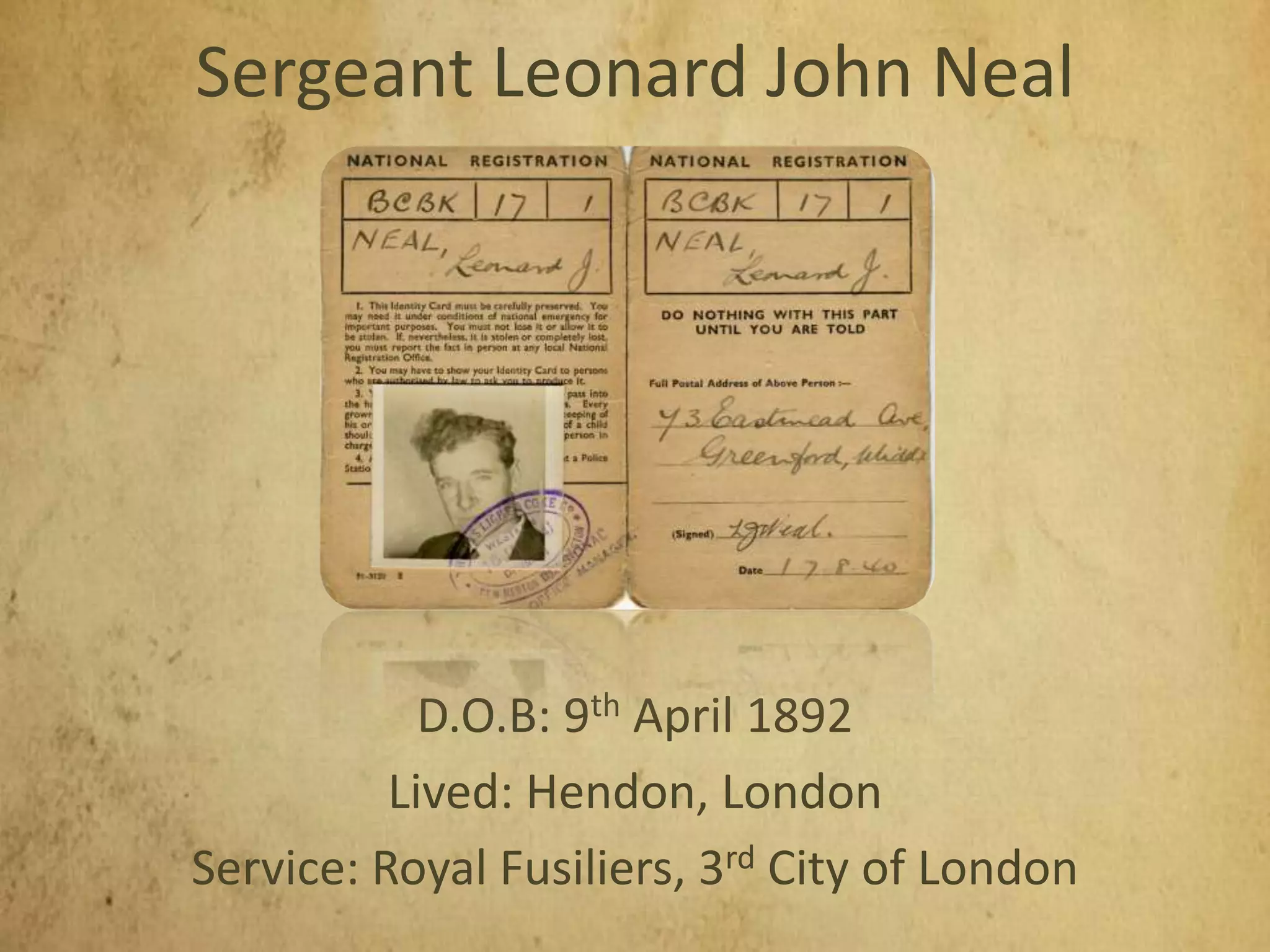
Sergeant Leonard John Neal
D.O.B: 9th April 1892
Lived: Hendon, London
Service: Royal Fusiliers, 3rd City of London
Early Life & Enlistment
• Leonard John Neal was born
to Robert and Sarah Neal,
with four brothers and two
sisters, being the second
oldest of his siblings .
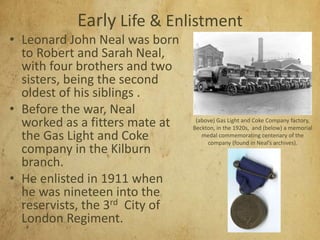
• Before the war, Neal
worked as a fitters mate at
the Gas Light and Coke
company in the Kilburn
branch.
• He enlisted in 1911 when
he was nineteen into the
reservists, the 3rd City of
London Regiment.
(above) Gas Light and Coke Company factory,
Beckton, in the 1920s, and (below) a memorial
medal commemorating centenary of the
company (found in Neal’s archives).
3rd City of London Regiment
• In 1915, the regiment landed at Marseilles on January
6th, being initially destined for a station in Malta.
• On the 11th March, the leader of the battalion,
Lieutenant C.W. Crichton, led a charge on a German
position in the face of heavy machine-gun fire and
were successful, even at the cost of Lieutenant
Crichton sustaining two fatal bullet wounds.
• One Indian army officer from the Gharwal Brigade
remarked;
“It was the finest charge I have ever seen.”
• They were then ordered to the front line for the
beginning of the Somme offensive, where they led a
feint attack across no mans land. This concluded with
the loss of 2 officers and 23 other rank soldiers.
• During the rest of 1915 and throughout 1916 they
were stationed in France continuing to work with the
Indian colonial troops, participating in few major
battles and being involved in some skirmishes,
resulting in limited casualties.
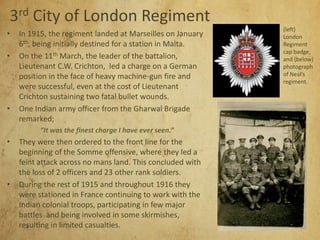
(left)
London
Regiment
cap badge,
and (below)
photograph
of Neal’s
regiment.
The Battle of Langemark
• The Battle of Langemark began on
the 12th August 1917 and lasted to
the 26th as part of the Third Battle of
Ypres.
• The Third Battle of Ypres was an
English-led attack headed by Captain
Douglas Haig. The offensive aimed to
destroy German submarine bases on
the north coast of Belgium.
• The attack from the battalions’ point
of view was seen as a disaster due to
the high number of casualties.
• One officer and 26 other ranks were
killed. 3 officers and 53 other ranks
were missing. The missing included
Leonard.
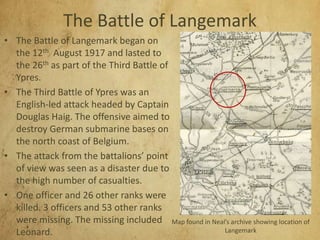
Map found in Neal’s archive showing location of
Langemark
Capture
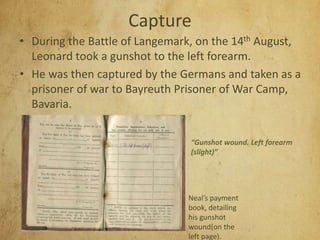
• During the Battle of Langemark, on the 14th August,
Leonard took a gunshot to the left forearm.
• He was then captured by the Germans and taken as a
prisoner of war to Bayreuth Prisoner of War Camp,
Bavaria.
Neal’s payment
book, detailing
his gunshot
wound(on the
left page).
“Gunshot wound. Left forearm
(slight)”
Life in a Prisoner of War Camp
• From the start of WW1 the German
authorities found themselves with
an unexpected influx of prisoners.
• By 1917 conditions of all German
camps had greatly improved. The
camps were no longer such harsh
places.
• One thing that was always in short
supply was food due to the
devastating British naval blockade of
the country. Because of this, they
were mainly fed soup and put on
starvation rations.
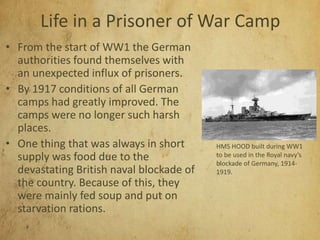
HMS HOOD built during WW1
to be used in the Royal navy’s
blockade of Germany, 1914-
1919.
Leonard’s Life in the Camps
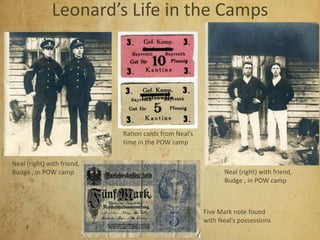
Neal (right) with friend,
Budge , in POW camp Neal (right) with friend,
Budge , in POW camp
Ration cards from Neal’s
time in the POW camp
Five Mark note found
with Neal’s possessions
Release from Bayreuth
• During his time in the camp,
Leonard planned a detailed and
daring escape;
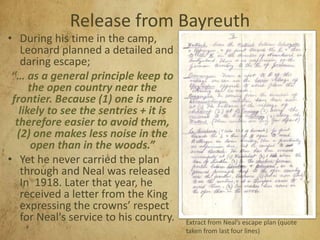
“… as a general principle keep to
the open country near the
frontier. Because (1) one is more
likely to see the sentries + it is
therefore easier to avoid them,
(2) one makes less noise in the
open than in the woods.”
• Yet he never carried the plan
through and Neal was released
In 1918. Later that year, he
received a letter from the King
expressing the crowns’ respect
for Neal's service to his country. Extract from Neal’s escape plan (quote
taken from last four lines)
Leonard’s Post-War Life
• Leonard returned to England and
began working again for the Gas
Light and Coke Company.
• He married Hilda Miriam Vezey in
June 1919, whom he had remained
in contact with throughout the War.
• He went on to live a long life, dying
in Ealing in 1977.
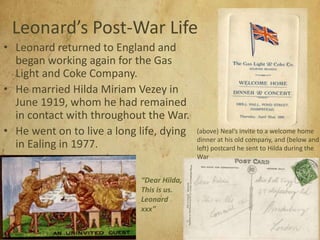
(above) Neal’s invite to a welcome home
dinner at his old company, and (below and
left) postcard he sent to Hilda during the
War
“Dear Hilda,
This is us.
Leonard
xxx”
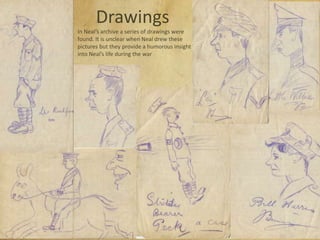
Drawings
In Neal’s archive a series of drawings were
found. It is unclear when Neal drew these
pictures but they provide a humorous insight
into Neal’s life during the war

One Man's War: Sergeant Leonard John Neal

  • 1.
    Sergeant Leonard JohnNeal D.O.B: 9th April 1892 Lived: Hendon, London Service: Royal Fusiliers, 3rd City of London
  • 2.
    Early Life &Enlistment • Leonard John Neal was born to Robert and Sarah Neal, with four brothers and two sisters, being the second oldest of his siblings . • Before the war, Neal worked as a fitters mate at the Gas Light and Coke company in the Kilburn branch. • He enlisted in 1911 when he was nineteen into the reservists, the 3rd City of London Regiment. (above) Gas Light and Coke Company factory, Beckton, in the 1920s, and (below) a memorial medal commemorating centenary of the company (found in Neal’s archives).
  • 3.
    3rd City ofLondon Regiment • In 1915, the regiment landed at Marseilles on January 6th, being initially destined for a station in Malta. • On the 11th March, the leader of the battalion, Lieutenant C.W. Crichton, led a charge on a German position in the face of heavy machine-gun fire and were successful, even at the cost of Lieutenant Crichton sustaining two fatal bullet wounds. • One Indian army officer from the Gharwal Brigade remarked; “It was the finest charge I have ever seen.” • They were then ordered to the front line for the beginning of the Somme offensive, where they led a feint attack across no mans land. This concluded with the loss of 2 officers and 23 other rank soldiers. • During the rest of 1915 and throughout 1916 they were stationed in France continuing to work with the Indian colonial troops, participating in few major battles and being involved in some skirmishes, resulting in limited casualties. (left) London Regiment cap badge, and (below) photograph of Neal’s regiment.
  • 4.
    The Battle ofLangemark • The Battle of Langemark began on the 12th August 1917 and lasted to the 26th as part of the Third Battle of Ypres. • The Third Battle of Ypres was an English-led attack headed by Captain Douglas Haig. The offensive aimed to destroy German submarine bases on the north coast of Belgium. • The attack from the battalions’ point of view was seen as a disaster due to the high number of casualties. • One officer and 26 other ranks were killed. 3 officers and 53 other ranks were missing. The missing included Leonard. Map found in Neal’s archive showing location of Langemark
  • 5.
    Capture • During theBattle of Langemark, on the 14th August, Leonard took a gunshot to the left forearm. • He was then captured by the Germans and taken as a prisoner of war to Bayreuth Prisoner of War Camp, Bavaria. Neal’s payment book, detailing his gunshot wound(on the left page). “Gunshot wound. Left forearm (slight)”
  • 6.
    Life in aPrisoner of War Camp • From the start of WW1 the German authorities found themselves with an unexpected influx of prisoners. • By 1917 conditions of all German camps had greatly improved. The camps were no longer such harsh places. • One thing that was always in short supply was food due to the devastating British naval blockade of the country. Because of this, they were mainly fed soup and put on starvation rations. HMS HOOD built during WW1 to be used in the Royal navy’s blockade of Germany, 1914- 1919.
  • 7.
    Leonard’s Life inthe Camps Neal (right) with friend, Budge , in POW camp Neal (right) with friend, Budge , in POW camp Ration cards from Neal’s time in the POW camp Five Mark note found with Neal’s possessions
  • 8.
    Release from Bayreuth •During his time in the camp, Leonard planned a detailed and daring escape; “… as a general principle keep to the open country near the frontier. Because (1) one is more likely to see the sentries + it is therefore easier to avoid them, (2) one makes less noise in the open than in the woods.” • Yet he never carried the plan through and Neal was released In 1918. Later that year, he received a letter from the King expressing the crowns’ respect for Neal's service to his country. Extract from Neal’s escape plan (quote taken from last four lines)
  • 9.
    Leonard’s Post-War Life •Leonard returned to England and began working again for the Gas Light and Coke Company. • He married Hilda Miriam Vezey in June 1919, whom he had remained in contact with throughout the War. • He went on to live a long life, dying in Ealing in 1977. (above) Neal’s invite to a welcome home dinner at his old company, and (below and left) postcard he sent to Hilda during the War “Dear Hilda, This is us. Leonard xxx”
  • 10.
    Drawings In Neal’s archivea series of drawings were found. It is unclear when Neal drew these pictures but they provide a humorous insight into Neal’s life during the war