POST-WAR EXPERIENCES
“I’ve heard about my pension
Been helped to find a job.
I’m told to train and use my brain
And ‘ware the unskilled mob.”
George Fulkes, “L’Envoi”
Published in “The Pavilion ‘Blues’”, a magazine for patients at Brighton’s Pavilion Hospital for Limbless Men, November 1917
The government’s approach to caring for long-term disabled soldiers was seen as a
compromise between state responsibility and individual liberty.
While employment opportunities and wages were relatively high in the last years
of the war, it was feared that the return of able-bodied troops would put disabled
soldiers at risk of unemployment. There was no obligation on disabled soldiers to
undertake training, or on employers to offer employment on the same terms as
able-bodied workers.
The limits to state support made public charitable organisations more important.
The Ex-Servicemen’s Welfare Society, founded in 1919, aimed to relieve distress,
provide employment, and help ensure medical treatment. In 1927, the Society
took out a patent for “Thermega”, a highly profitable company manufacturing
electric blankets, staffed entirely by disabled soldiers. The Disabled Society (1920)
similarly aimed to provide employment. In 1922 it established the Poppy Factory
to manufacture poppies for the new annual Poppy Appeal. By 1932 a new
expanded factory provide employment for 350 disabled soldiers and housing for
their families.
Despite help from charitable organisations 90% of amputees failed to find
employment. Many soldiers struggled to adapt to civilian life after the trauma of
war. Mental health provision was limited, and many turned to over-the-counter
‘nerve tonics’ and sleeping drugs. There was a stark difference between the heroic
portrayal and expected reintegration of wounded soldiers and the reality of
unemployment and long-term health problems which led to increasing
disillusionment.
Do they matter? - those dreams in the pit?
You can drink and forget and be glad,
And people won't say that you’re mad;
For they know that you've fought for your country,
And no one will worry a bit.
Siegfried Sassoon, ‘Does it Matter?’ (1918)
Private Pierre Oliver (left) and Sergeant Jean Nicolai
(centre) of the French Army, both winners of the
French Military Medal and War Cross, blinded in the
war, taking lessons in Braille. St. Dunstan's Hostel,
Regent's Park, 14 September 1917.
1. © IWM (Q 53979) | 2. © Grace's Guide to British Industrial History | 3. © IWM (Q 90017)
1.
2.
Wreath making at the poppy factory. Richmond has been the site of
poppy manufacturing since 1925.
3.
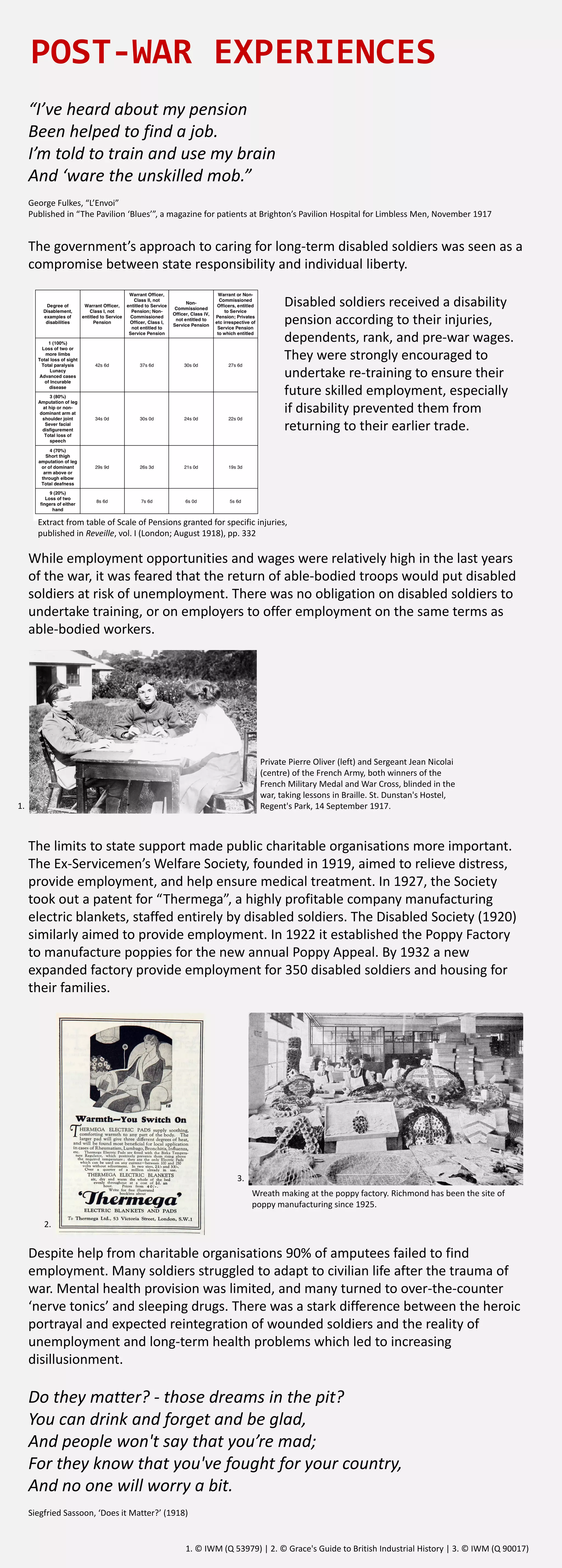
Extract from table of Scale of Pensions granted for specific injuries,
published in Reveille, vol. I (London; August 1918), pp. 332
Disabled soldiers received a disability
pension according to their injuries,
dependents, rank, and pre-war wages.
They were strongly encouraged to
undertake re-training to ensure their
future skilled employment, especially
if disability prevented them from
returning to their earlier trade.

Bombs, Bullets & Bandages - Final Panel

  • 1.
    POST-WAR EXPERIENCES “I’ve heardabout my pension Been helped to find a job. I’m told to train and use my brain And ‘ware the unskilled mob.” George Fulkes, “L’Envoi” Published in “The Pavilion ‘Blues’”, a magazine for patients at Brighton’s Pavilion Hospital for Limbless Men, November 1917 The government’s approach to caring for long-term disabled soldiers was seen as a compromise between state responsibility and individual liberty. While employment opportunities and wages were relatively high in the last years of the war, it was feared that the return of able-bodied troops would put disabled soldiers at risk of unemployment. There was no obligation on disabled soldiers to undertake training, or on employers to offer employment on the same terms as able-bodied workers. The limits to state support made public charitable organisations more important. The Ex-Servicemen’s Welfare Society, founded in 1919, aimed to relieve distress, provide employment, and help ensure medical treatment. In 1927, the Society took out a patent for “Thermega”, a highly profitable company manufacturing electric blankets, staffed entirely by disabled soldiers. The Disabled Society (1920) similarly aimed to provide employment. In 1922 it established the Poppy Factory to manufacture poppies for the new annual Poppy Appeal. By 1932 a new expanded factory provide employment for 350 disabled soldiers and housing for their families. Despite help from charitable organisations 90% of amputees failed to find employment. Many soldiers struggled to adapt to civilian life after the trauma of war. Mental health provision was limited, and many turned to over-the-counter ‘nerve tonics’ and sleeping drugs. There was a stark difference between the heroic portrayal and expected reintegration of wounded soldiers and the reality of unemployment and long-term health problems which led to increasing disillusionment. Do they matter? - those dreams in the pit? You can drink and forget and be glad, And people won't say that you’re mad; For they know that you've fought for your country, And no one will worry a bit. Siegfried Sassoon, ‘Does it Matter?’ (1918) Private Pierre Oliver (left) and Sergeant Jean Nicolai (centre) of the French Army, both winners of the French Military Medal and War Cross, blinded in the war, taking lessons in Braille. St. Dunstan's Hostel, Regent's Park, 14 September 1917. 1. © IWM (Q 53979) | 2. © Grace's Guide to British Industrial History | 3. © IWM (Q 90017) 1. 2. Wreath making at the poppy factory. Richmond has been the site of poppy manufacturing since 1925. 3. Extract from table of Scale of Pensions granted for specific injuries, published in Reveille, vol. I (London; August 1918), pp. 332 Disabled soldiers received a disability pension according to their injuries, dependents, rank, and pre-war wages. They were strongly encouraged to undertake re-training to ensure their future skilled employment, especially if disability prevented them from returning to their earlier trade.