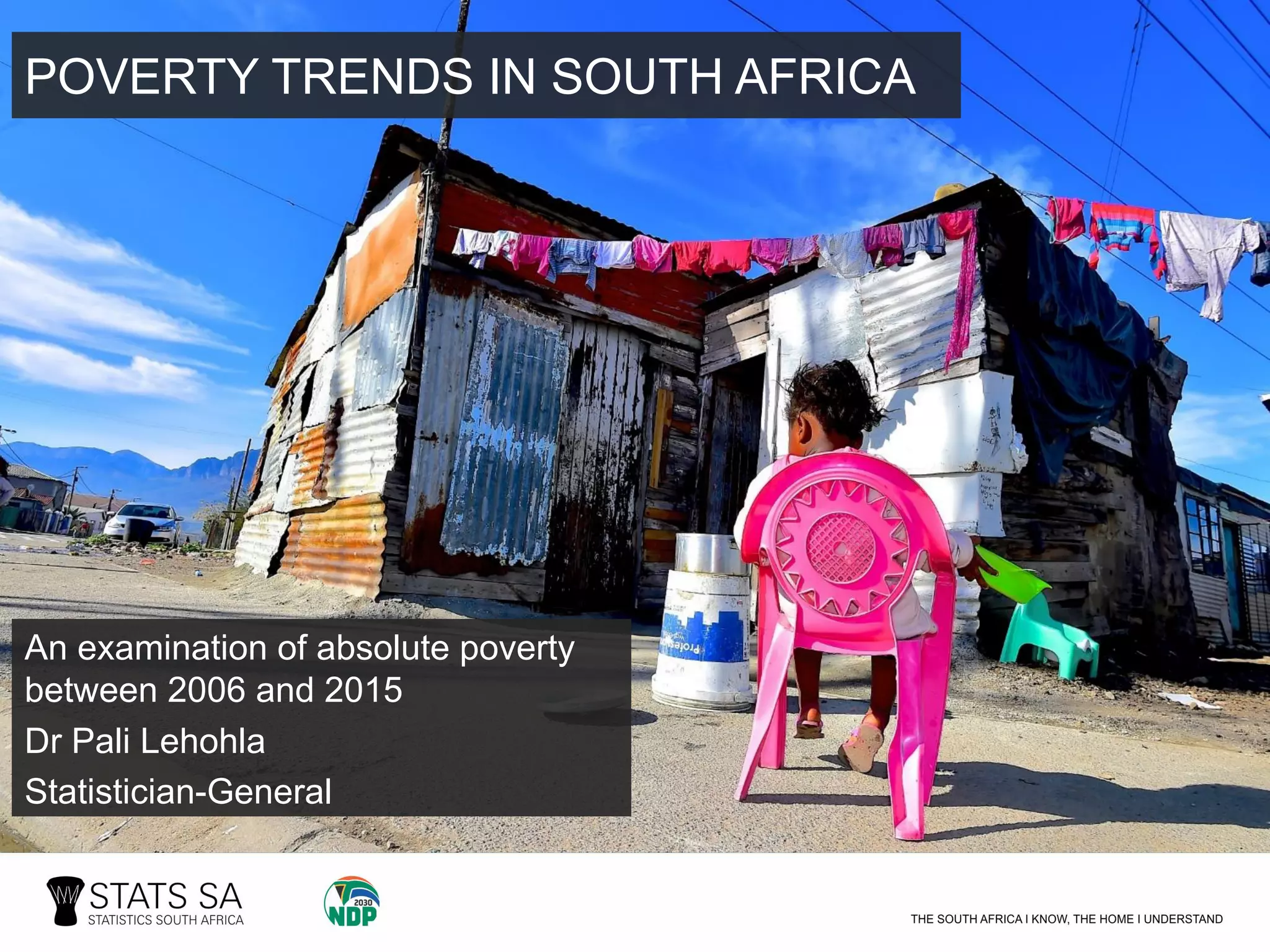
POVERTY TRENDS IN SOUTH AFRICA
An examination of absolute poverty
between 2006 and 2015
Dr Pali Lehohla
Statistician-General
Significant	strides	have	been	made	by	
Government	towards	poverty	and	inequality	
reduction
• In	2001	wide	dispersion	of	Poverty	with	Msinga	having	a	poverty	Headcount	
of	around	60%
• Between	2001	and	2011	poverty	generally	declines	for	all	municipalities
• However	between	2011	and	2016		poverty	trends	diverge	between	
municipalities
Multidimensional	Poverty	by	Municipalities	2001-2016
Msinga	
Headcount	
59,8%
Msinga	
Headcount	
24,5%
Intsika Yethu
Headcount	
27,7%
Msinga	
Headcount	
37,2%
71%
70%
58%
55%
54%
54%
52%
50%
44%
41%
11%
10%
21%
25%
22%
26%
26%
32%
36%
32%
0,0 10,0 20,0 30,0 40,0 50,0 60,0 70,0 80,0 90,0 100,0
WC
GP
RSA
FS
MP
KZN
NW
NC
EC
LP
Salaries Remittances Pensions Grants Other	sources None
Considerable	provincial	variations	are	notable.	Western	Cape	(71,0%)	and	Gauteng	(70,0%)	were	the	only	two	
provinces	in	which	more	than	two-thirds	of	households	reported	salaries	as	their	main	sources	of	income.	
Percentage	distribution	of	main	source	of	income	by	province,	2016
Source:	GHS	2016
63,9%
77,2%
71,9%
88,1%
94,5% 92,2%
0,0
10,0
20,0
30,0
40,0
50,0
60,0
70,0
80,0
90,0
100,0
Male Female Total
Percentage
All	older	persons Older	poor	persons
Nationally,	71,9%	of	all	older	persons	in	South	Africa	are	covered	by	an	old-age	grant,	whereas	the	
coverage	rate	amongst	older	poor	persons	(as	defined	by	the	UBPL)	was	notably	higher	at	92,2%.
Proportion	of	older	persons	(60+)	receiving	old	age	grants	by	sex	in	2015
Government	interventions	towards	poverty	and	inequality	reduction
About 3.6 million households are registered as indigent
households of which;
62,8%
receive free
electricity
67,8%
receive free
piped water
57,6%
receive free
sanitation services
57,6%
receive free refuse
removal services
To date more than 17 million social grants are
issued on monthly basis to people who qualify
the means test
About 4.3 million RDP houses and
subsidies have been delivered since 1994
About 76.2% of pupils in South Africa are
benefiting from school feeding schemes
More than 20 000 schools are declared as
no fee schools
Source: NFCM Source: NFCM
Source: SASSA and Department of Human Settlements Source: Department of Basic Education
Source: Gross domestic product (GDP), Q4 2016
Current	state	vs	NDP	target:	Economic	growth
22,3 million
(down by 150 000 q-q)
Labour force
16,1 million
(down by 113 000 q-q)
Employed
6,2 million
(down by 37 000 q-q)
Unemployed
14,9 million
(up by 306 000 q-q)
Not economically active*
*Of which 2,4 million
were discouraged work
seekers
( up by 83 000 q-q)
37,2 million
(up by 157 000 q-q)
people of working age in
South Africa
(15 – 64 year olds)
ILO hierarchy – Employed first then
unemployed and the remainder is NEA
(including discouraged job-seekers).
3 mutually exclusive groups. Cannot be in two
groups at the same time
NDP target 2030
Employment:
24 million
The	labour	market	Q2:2017
4,4m
6,2m
0,0
1,0
2,0
3,0
4,0
5,0
6,0
7,0
Q1 Q2 Q3 Q4 Q1 Q2 Q3 Q4 Q1 Q2 Q3 Q4 Q1 Q2 Q3 Q4 Q1 Q2 Q3 Q4 Q1 Q2 Q3 Q4 Q1 Q2 Q3 Q4 Q1 Q2 Q3 Q4 Q1 Q2 Q3 Q4 Q1 Q2
2008 2009 2010 2011 2012 2013 2014 2015 2016 2017
Million
Number of unemployed
57,0%
67,2%
10,0
30,0
50,0
70,0
90,0
Q1 Q2 Q3 Q4 Q1 Q2 Q3 Q4 Q1 Q2 Q3 Q4 Q1 Q2 Q3 Q4 Q1 Q2 Q3 Q4 Q1 Q2 Q3 Q4 Q1 Q2 Q3 Q4 Q1 Q2 Q3 Q4 Q1 Q2 Q3 Q4 Q1 Q2
2008 2009 2010 2011 2012 2013 2014 2015 2016 2017
Long term unemployment
Labour	Market	Dashboard
Source: QLFS Q2 2017
Increasing	number	of	unemployed	persons	were	
witnessed	during	2008	to	2015
Reducing the proportion of persons living below
the lower-bound poverty line
Reduce	income	inequality
Increase	the	share	of	income	going	to	the	
bottom	40	per	cent	of	households
Reduce	poverty-induced	hunger
Seeks	to	tackle	poverty	
and	inequality
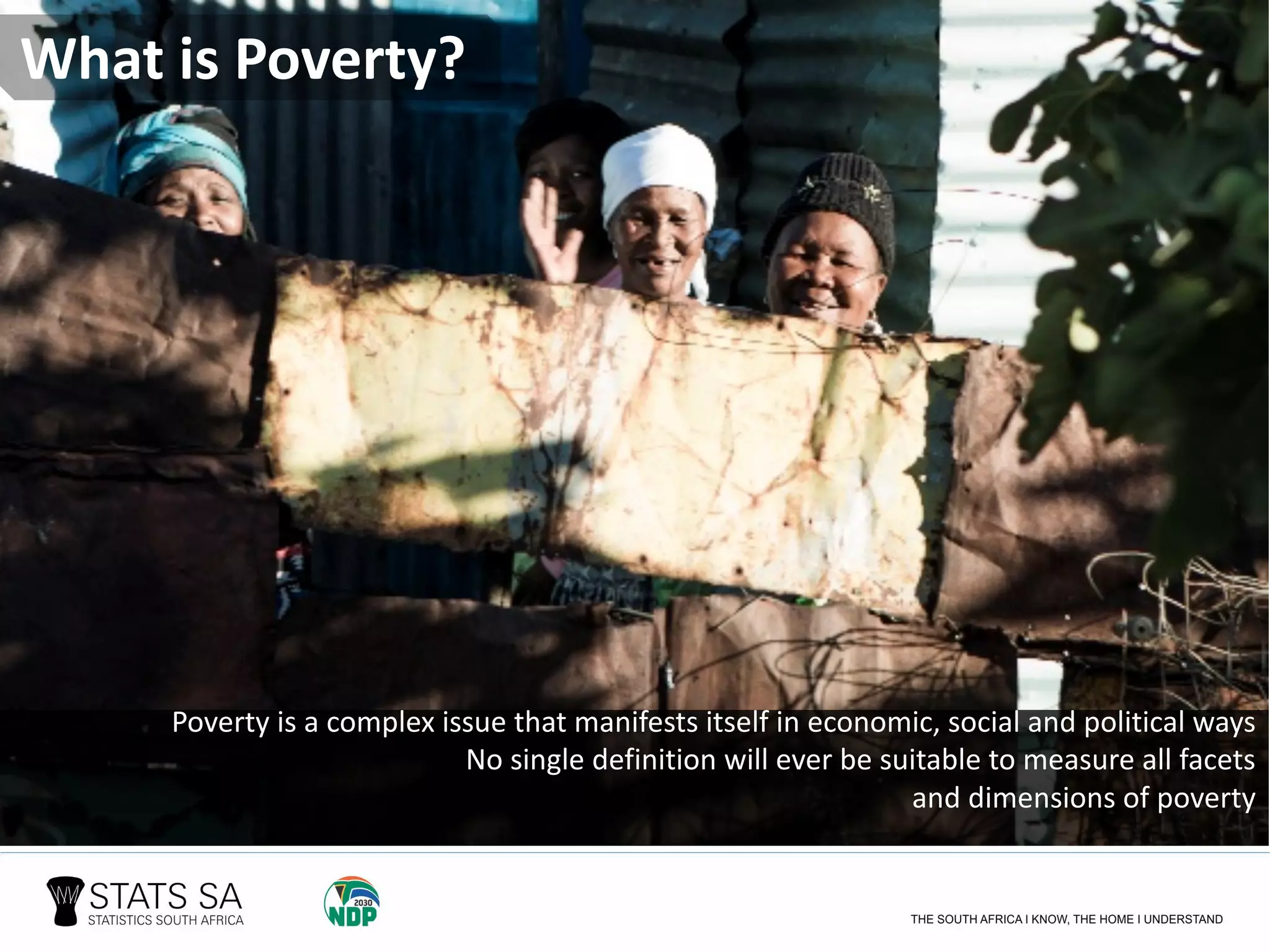
Poverty	is	a	complex	issue	that	manifests	itself	in	economic,	social	and	political	ways
No	single	definition	will	ever	be	suitable	to	measure	all	facets	
and	dimensions	of	poverty
What	is	Poverty?
Stats	SA	applies	and	measures	
various	definitions	of	poverty
Subjective	poverty	(self-perceived)
Money-metric	(lack	of	
income/expenditure)
Multidimensional	poverty	(lack	of	basic	
services,	education,	etc.)
Inequality	(Gini	coefficient,	share	
of	expenditure,	etc.)
Used	In	
This	
Release
Future		Releases
Pilot	of	Poverty	Lines
First	developed	as	pilot	lines	
in	2008	using	the	IES	2000	as	
its	primary	input
2008
2012
3	National	Poverty	Lines
In	2012,	Stats	SA	published	
the	country’s	official	three	
national	poverty	lines	
2014
1st	PTR
In	2014, Stats	SA	published	
the	first	Poverty	Trends	
Report
2015
Stats	SA	published	rebased	poverty	
lines	in	2015	using	the	latest	
consumption	and	spending	patterns	
measured	in	the	IES	2010/11
Rebased	Poverty	Lines
1 2 3 4 5
2nd PTR
2017
In	2017, Stats	SA	published	
the	second	Poverty	Trends	
Report
Stats	SA	adopted	the	cost-of-basic-needs	approach	for	the	development	of	the	lines	which	links	
welfare	to	the	consumption	of	goods	and	services
How	the	poverty	lines	were	developed
Threshold	of	absolute	
deprivation.	The	amount	of	
money	required	to	purchase	
the	minimum	required	daily	
energy	intake
Food	Poverty	Line
R441
Austere	threshold	below	
which	one	has	to	choose	
between	food	and	important	
non-food	items
Lower-Bound	Poverty	Line
R647
Upper-Bound	Poverty	Line
R992
Threshold	of	relative	
deprivation	below	which	
people	cannot	afford	the	
minimum	desired	lifestyle	
by	most	South	Africans
*	Based	on	2015	prices
531
758
1 138
0
200
400
600
800
1000
1200
2006 2007 2008 2009 2010 2011 2012 2013 2014 2015 (April) 2016 (April) 2017 (April)
Poverty	lines	at	current	2017	prices
Non	Poor -
45,5%
Poor -
55,5%
Over	30,4	million South	
Africans	were	living	in	poverty	
in	2015
Upper		Bound	Poverty	Line
Poverty	headcounts	based	on	the	UBPL
Upper-Bound	Poverty	Line Lower-Bound	Poverty	Line
Non	Poor -
45,5%
Poor -
55,5%
Non	Poor
- 60,0%
Poor -
40,0%
Non	Poor -
74,8%
Poor -
25,2%
Food	Poverty	Line
Poverty	headcounts	in	2015
In	2015,	more	than	a	quarter	of	the	
population	were	living	below	the	food	poverty	
line
28,4%
33,5%
21,4%
25,2%
51,0%
47,6%
36,4%
40,0%
66,6%
62,1%
53,2%
55,5%
0,0
10,0
20,0
30,0
40,0
50,0
60,0
70,0
2006 2009 2011 2015
Percentage	
Approximately	13,8	million	South	Africans	were	living	below	the	FPL	
in	2015,	down	from	a	peak	of	16,7	million	in	2009.
Poverty	headcounts	based	on	the	FPL,	LBPL	and	UBPL
7,4 7,2 8,6 8,5
10,7
7,0 7,7 8,1
13,4
16,7 11,0 13,8
15,8 18,9 24,0
24,4
0
10
20
30
40
50
60
2006 2009 2011 2015
Millions
UBPL	Poor LBPL	Poor FPL	Poor Non-Poor
In	PovertyNon	Poor
The	number	of	poor	persons	in	South	Africa	(in	millions)	(2006- 2015)
77,5%
70,3%
57,3%
55,2%
53,6%
55,0%
64,7%
0 10 20 30 40 50 60 70 80
0-17
18-24
25-34
35-44
45-54
55-64
65+
Poverty	in	
2006
Children
Elderly
Change	in	poverty	between	2006	and	2015
0 10 20 30 40 50 60 70 80
0-17
18-24
25-34
35-44
45-54
55-64
65+ - 20,7%	Points
-10,7	%
Points
-11,7%	Points
-11,4%	
Points
- 10,2	%
Points
-10,2	%
Points
- 6,3%
Points
Poverty	in	
2015
Children
Elderly
Change	in	poverty	between	2006	and	2015
Circumstances	vary	between	provinces,	between	rural	and	
urban,	by	population	group
and	by	gender
25,0
35,0
45,0
55,0
65,0
75,0
85,0
2006
2009
2011
2015
2006
2009
2011
2015
2006
2009
2011
2015
2006
2009
2011
2015
2006
2009
2011
2015
2006
2009
2011
2015
2006
2009
2011
2015
2006
2009
2011
2015
2006
2009
2011
2015
LP
EC
KZN
MP
NC
NW
FS
WC
GP
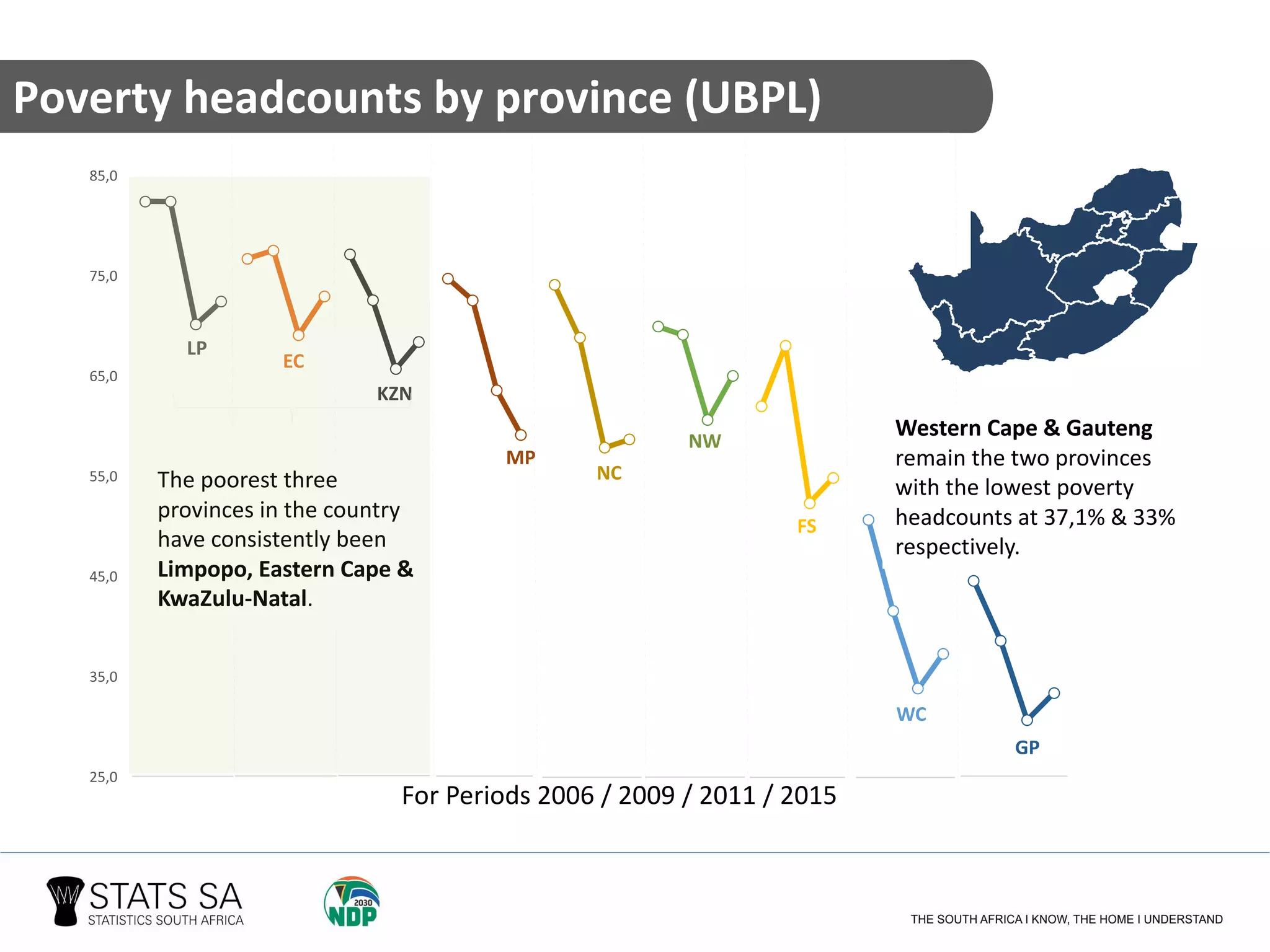
The	poorest	three	
provinces	in	the	country	
have	consistently	been	
Limpopo,	Eastern	Cape	&	
KwaZulu-Natal.
Western	Cape	&	Gauteng	
remain	the	two	provinces	
with	the	lowest	poverty	
headcounts	at	37,1%	&	33%	
respectively.	
For	Periods	2006	/	2009	/	2011	/	2015
Poverty	headcounts	by	province	(UBPL)
52,0 46,8
38,8
40,6
87,6 88,0
77,0
81,3
0,0
10,0
20,0
30,0
40,0
50,0
60,0
70,0
80,0
90,0
100,0
2006 2009 2011 2015
Percentage
Rural
Urban
In	urban	areas,	the	poverty	headcount	had	declined	notably	from	52,0%	in	2006	to	
40,6%	in	2015.
Poor	people	living	in	rural	areas	were	not	only	further	away	from	the	poverty	
line	on	average,	but	the	poorest	of	the	poor	in	those	areas	are	significantly	
worse	off	than	their	poor	counterparts	living	in	urban	areas.
Difference	in	poverty	levels	
between	Rural	and	Urban
Poverty	headcounts	by	settlement	type	(UBPL)
64,1%
60,1%
51,4%
53,7%
68,9%
63,9%
54,9%
57,2%
0,0
10,0
20,0
30,0
40,0
50,0
60,0
70,0
80,0
2006 2009 2011 2015
Percentage
Females remain more disadvantaged than males consistently recording a
higher headcount, gap and severity measures at each point in time;
however, the difference between the sexes is narrowing.
Poverty	headcounts	by	sex	(UBPL)
43,3
40,1
31,7
33,0
65,8
57,6
47,8
50,0
0,0
10,0
20,0
30,0
40,0
50,0
60,0
70,0
2006 2009 2011 2015
Percentage
Male Female
In	2015,	the	incidence	of	poverty	for	male-headed	households	increased		to	33%		(a	1,3%	point	increase	
from	2011)	compared	to	50%	for	female-headed	households	(a	2,2%	point	change	from	2011)
Notable	drop	in	poverty	in	male-
headed	households	between	
2009	and	2011
Poverty	measures	of	households	by	sex	of	household	head	(UBPL)
76,8%
72,6%
62,4% 64,2%
56,1%
45,5%
37,1%
41,3%
20,9%
14,4%
6,5%
5,9%
1,4%
1,9%
0,9% 1,0%
0,0
10,0
20,0
30,0
40,0
50,0
60,0
70,0
80,0
90,0
2006 2009 2011 2015
Percentage
Poverty	headcounts	by	population	group	(UBPL)
White
In	2015,	nearly	3	out	of	5	black	Africans	were	poor
The	Indian/Asian	population	group	
was	the	only	group
where	the	proportion	of	poor	
consistently	decreased	between
2006	and	2015
86,4
79,2
%
0,0
10,0
20,0
30,0
40,0
50,0
60,0
70,0
80,0
90,0
100,0
80,7
72,6
76,1
69,2
64,8
57,8
9,4 8,4%
40,0
35,6
For	Periods	2006	/	2009	/	2011	/	2015
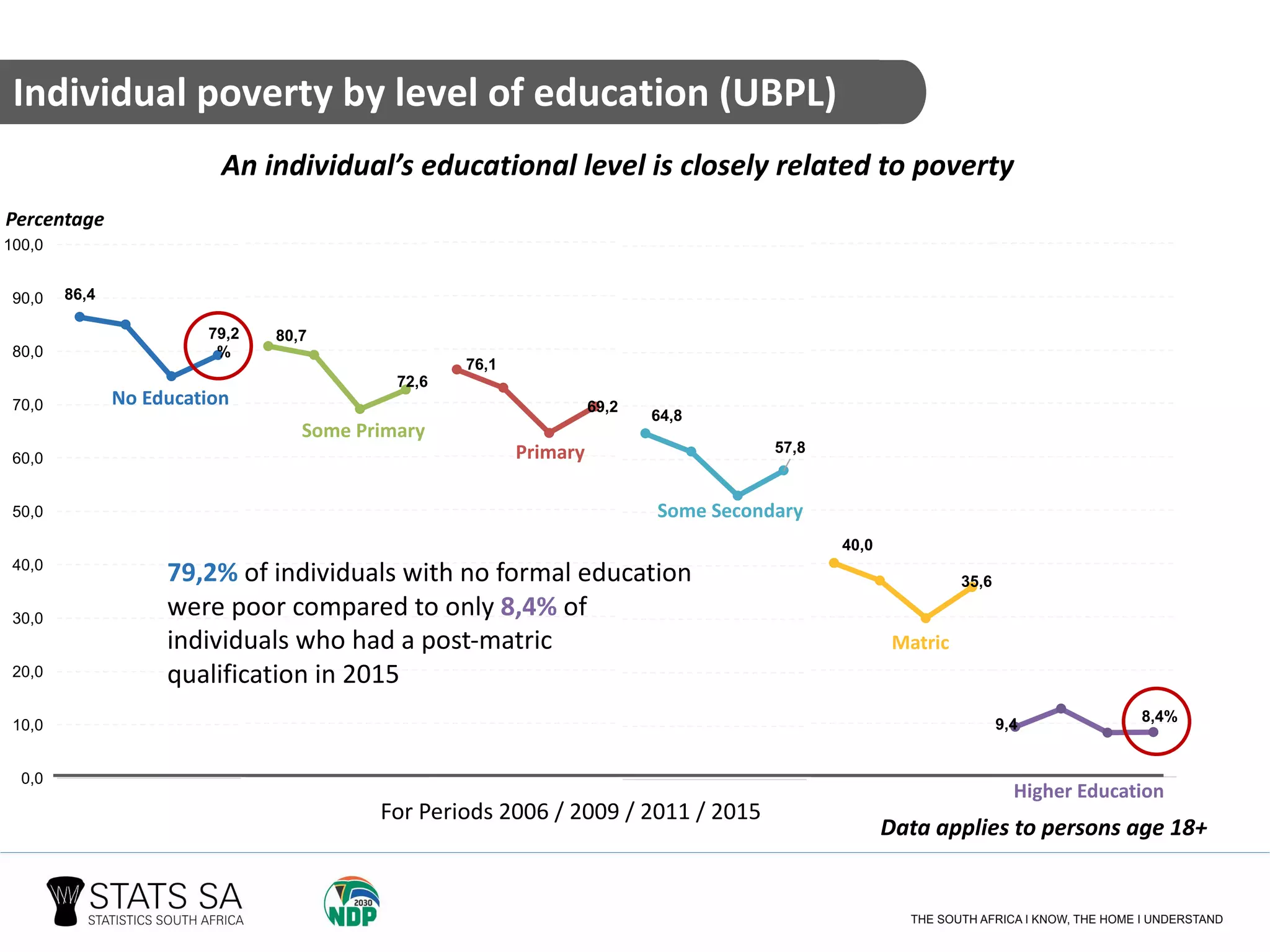
An	individual’s	educational	level	is	closely	related	to	poverty
No	Education
Some	Primary
Primary
Some	Secondary
Matric
Higher	Education
79,2%	of	individuals	with	no	formal	education	
were	poor	compared	to	only	8,4%	of	
individuals	who	had	a	post-matric	
qualification	in	2015
Percentage
Individual	poverty	by	level	of	education	(UBPL)
Data	applies	to	persons	age	18+
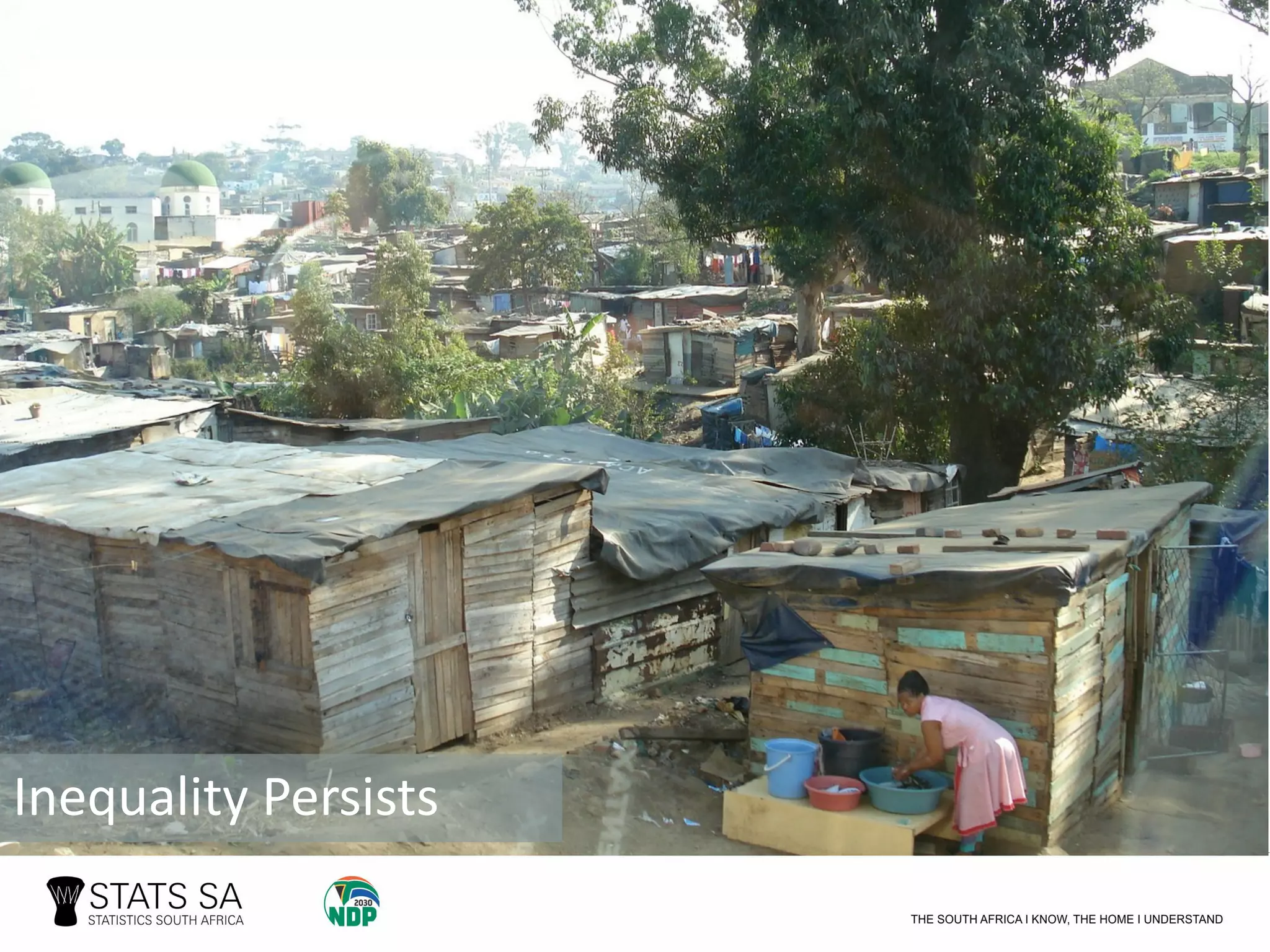
Inequality	Persists
0,72
0,69 0,69
0,68
0,50
0,55
0,60
0,65
0,70
0,75
0,80
2006 2009 2011 2015
Gini	coefficient
Gini	coefficients	(income)	saw	a	very	minimal	decline	over	the	10	year	period
Gini	based	on	income	per	capita	(2006,	2009,	2011	&	2015)
The	Gini	coefficient	is	based	on	
income	per	capita	including	
salaries,	wages	and	grants
0,72
0,70
0,69
0,68
0,64
0,66
0,65 0,65
0,60
0,57
0,59 0,58
0,56
0,53
0,50
0,560,56
0,47
0,45
0,51
0,30
0,35
0,40
0,45
0,50
0,55
0,60
0,65
0,70
0,75
0,80
2006 2009 2011 2015
Gini	Coefficient
The	population	group	with	the	highest	
level	of	inequality	are	black	Africans
Black	Africans	had	the	highest	level	of	income	inequality
Both	whites	and	Indian/Asians	saw	their	Gini	
coefficients	increase,	with	the	white	population	
rising	to	0,51	and	Indian/Asians	returning	to	their	
2006	level	of	0,56
Gini	Coefficient	(Income	per	capita)	by	population	group	(2006,	2009,	2011	&	
2015)
350 937
195 336
124 445
67 828
White-headed households (R350 937) spent five times more
than black African-headed households (R67 828) and three
times more than the national average
Black	
African
Coloured
Indian
White
444 446
271 621
172 765
92 983
0 50000 100000 150000 200000 250000 300000 350000 400000 450000
Average	Expenditure Average	Income
Indians/Asian headed households
(R195 336) spent almost three times
more than black headed households
Average	annual	household	consumption	expenditure	and	income	by	
population	group	of	household	head
30,0%
22,0%
12,5%
9,8%
25,7%
10,5%
34,0%
16,8%
15,4%
23,3%
0,0
5,0
10,0
15,0
20,0
25,0
30,0
35,0
40,0
Food Housing Transport Miscellaneous Other
Poor Non-Poor
Poor	households	spent	the	largest	
proportion	(30,0%)	of	their	total	
expenditure	on	food	compared	to	
just	10,5%	in	non-poor	households.	
The	biggest	proportion	of	household	
expenditure	for	non-poor	households	
went	towards	housing	and	utilities	
(34,0%)
Average	annual	household	consumption	expenditure	for	poor	and	non-poor	
households,	2015
Dietary	intake	of	the	non-poor	and	poor
Poor	Households Non-Poor	Households
Reducing the proportion of persons living below
the lower-bound poverty line
Reduce	income	inequality
Increase	the	share	of	income	going	to	the	
bottom	40	per	cent	of	households
Reduce	poverty-induced	hunger
Seeks	to	tackle	poverty	
and	inequality
Revisiting	the	NDP
39,0 40
00
5
10
15
20
25
30
35
40
45
2008 2013 2018 2023 2028 2033
40,0
Reducing	the	proportion	of	persons	living	below	the	lower-bound	poverty	
line	from	39	per	cent	(in	2009)	to	zero	by	2030
Reduce	poverty-induced	hunger	to	0%	by	2030
21,4
25,2
00
5
10
15
20
25
30
2008 2013 2018 2023 2028 2033
Baseline	(2009) Most	Recent	Figure	(2015)
Target
Baseline	(2011)
Most	Recent	Figure	(2015)
Target
%
%
0,7
0,68
0,6
0,58
0,6
0,62
0,64
0,66
0,68
0,7
0,72
2008 2013 2018 2023 2028 2033
Reduce	income	inequality	from	0,7	in	2010	to	0,6	by	2030
Baseline	(2010)
Most	Recent	Figure	(2015)
Target
6
8,3
10
0
2
4
6
8
10
12
2008 2013 2018 2023 2028 2033
The	share	of	income	going	to	the	bottom	40	per	cent	of	
households	should	rise	from	6	per	cent	to	10	per	cent
Baseline	(2010)
Most	Recent	Figure	(2015)
Target
%
Household	size:	2,4
Household	income:	R199	267
Ownership	of	dwelling:	60,1%
Piped	water	inside/on	site:	
86,7%
Electricity:	91,4%
Household	size:	4,6
Household	income:	R46	624
Ownership	of	dwelling:	78,2%
Piped	water	inside/on	site:	
59%
Electricity:	80,5%
Poor	Households Non-poor	Households
Household	Expenditure	R31	669
Flush	toilet:	39,3%
Flush	toilet: 80,8%
Non-poor	households	had	better	access	to	services	compared	to	poor	households
Profile	of	Poor	and	Non-poor	households
Household	Expenditure	R151	097
Thank you
www.statssa.gov.zawww
@StatsSA
StatsSA
www.slideshare.net/statssa

Poverty on the rise in South Africa - Poverty trends in South Africa: An examination of absolute poverty between 2006 and 2015