Navigating the IRB
Additional
Support
Statistics Solutions is a full-service dissertation consulting company
providing graduate students timely, editorial support for their
dissertations and scholarly projects
For information about our services, receive a complementary 30-min
consultation available Mon-Fri 9-5 ET:
https://app.hubspot.com/meetings/jeanine/dissertation-consultation
info@StatisticsSolutions.com
Phone: 877-437-8622
Overview
History and ethical principles
What is an IRB?
Privacy and confidentiality
Informed consent
Assessing risk
Review categories
Questions
Need help with your dissertation? Call 727-442-4290
The Belmont
Report
The National Commission for the Protection of Human Subjects of
Biomedical and Behavioral Research
Created in response to past unethical research
• Nazi experiments in concentration camps
• Tuskegee Syphilis Study in the USA
Developed a framework for understanding research guidelines
Identified three ethical principles:
• Respect for persons
• Beneficence
• Justice
Need help with your dissertation? Call 727-442-4290
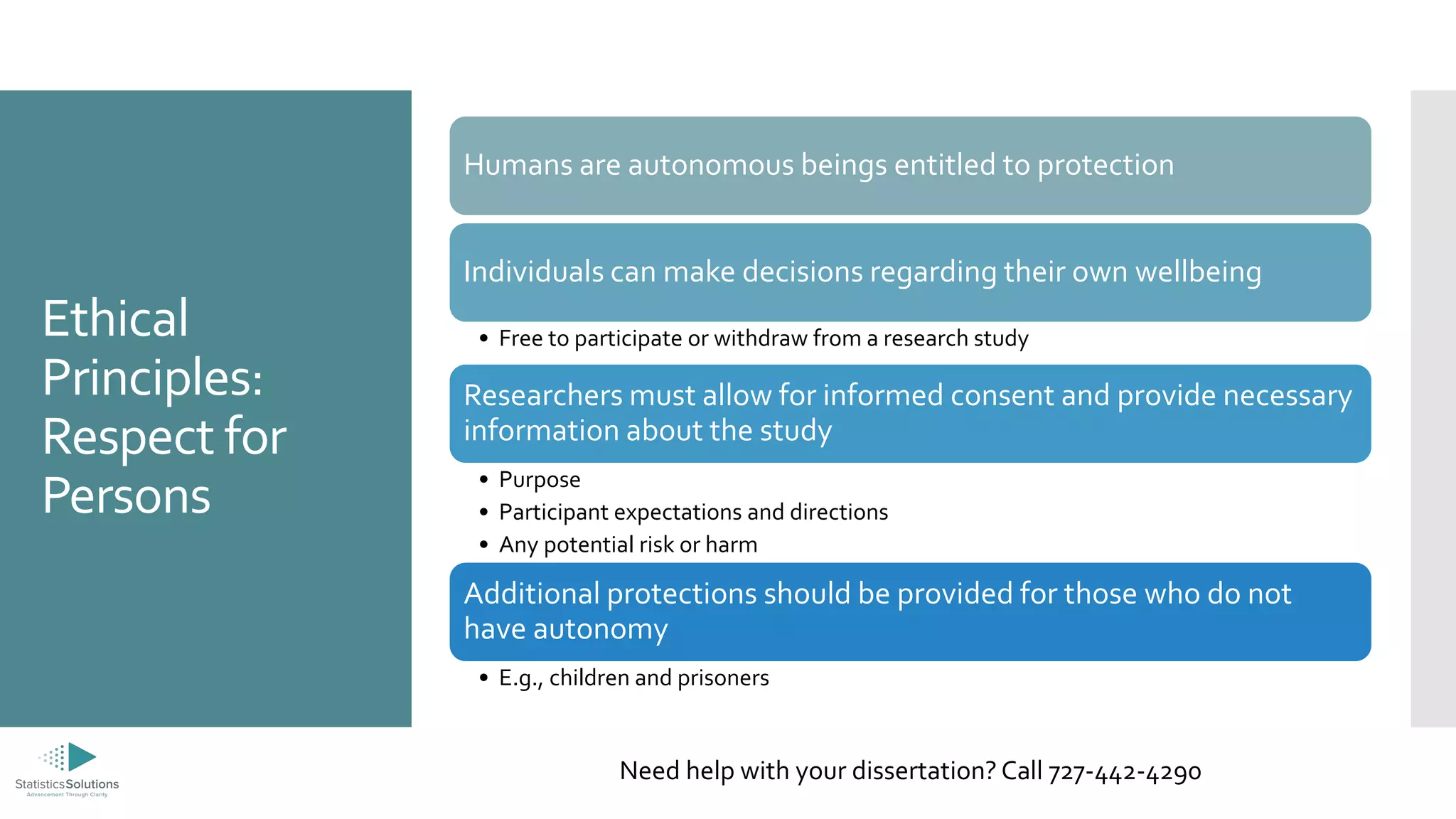
Ethical
Principles:
Respect for
Persons
Humans are autonomous beings entitled to protection
Individuals can make decisions regarding their own wellbeing
• Free to participate or withdraw from a research study
Researchers must allow for informed consent and provide necessary
information about the study
• Purpose
• Participant expectations and directions
• Any potential risk or harm
Additional protections should be provided for those who do not
have autonomy
• E.g., children and prisoners
Need help with your dissertation? Call 727-442-4290
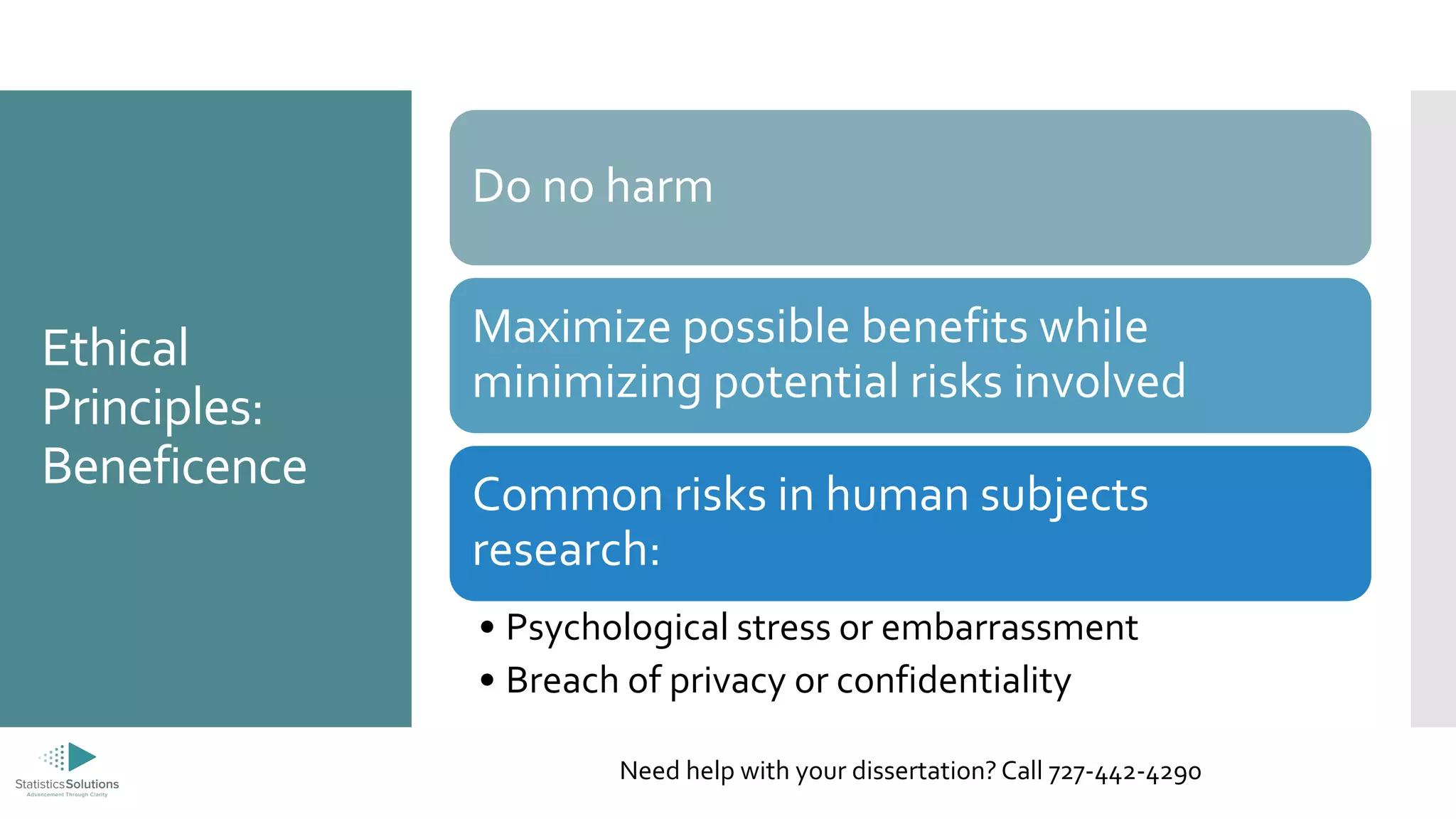
Ethical
Principles:
Beneficence
Do no harm
Maximize possible benefits while
minimizing potential risks involved
Common risks in human subjects
research:
• Psychological stress or embarrassment
• Breach of privacy or confidentiality
Need help with your dissertation? Call 727-442-4290
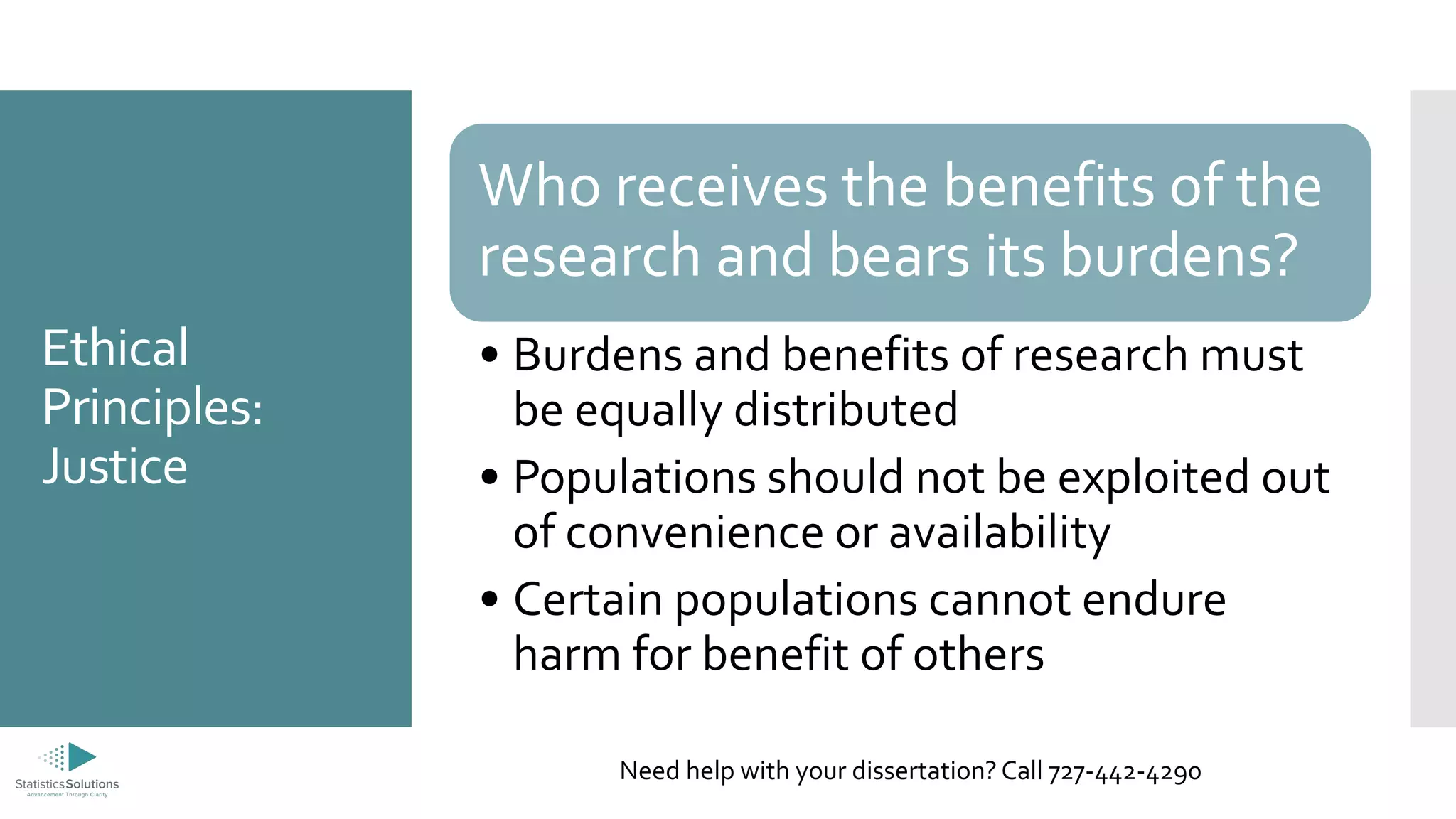
Ethical
Principles:
Justice
Who receives the benefits of the
research and bears its burdens?
• Burdens and benefits of research must
be equally distributed
• Populations should not be exploited out
of convenience or availability
• Certain populations cannot endure
harm for benefit of others
Need help with your dissertation? Call 727-442-4290
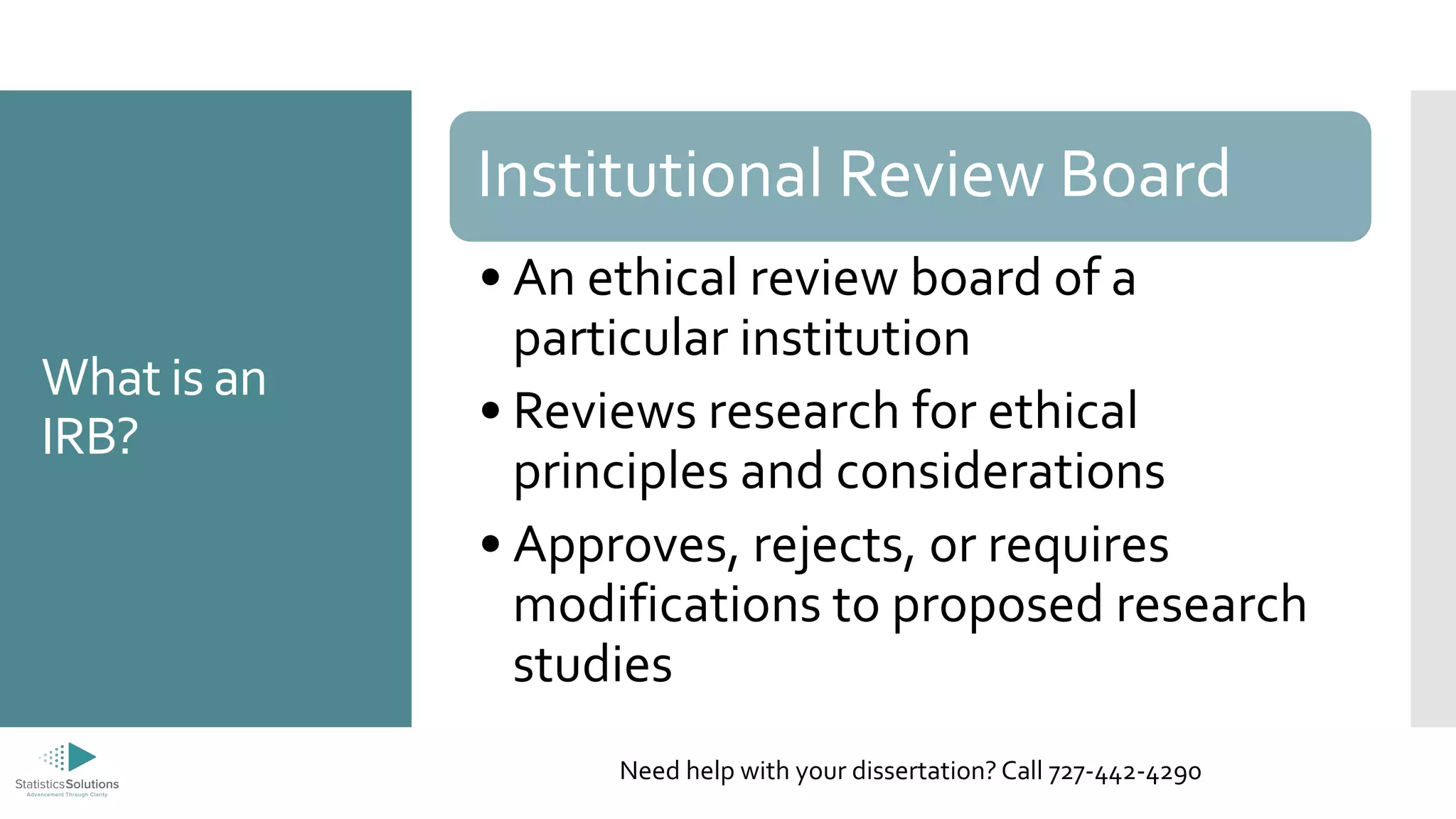
What is an
IRB?
Institutional Review Board
• An ethical review board of a
particular institution
• Reviews research for ethical
principles and considerations
• Approves, rejects, or requires
modifications to proposed research
studies
Need help with your dissertation? Call 727-442-4290
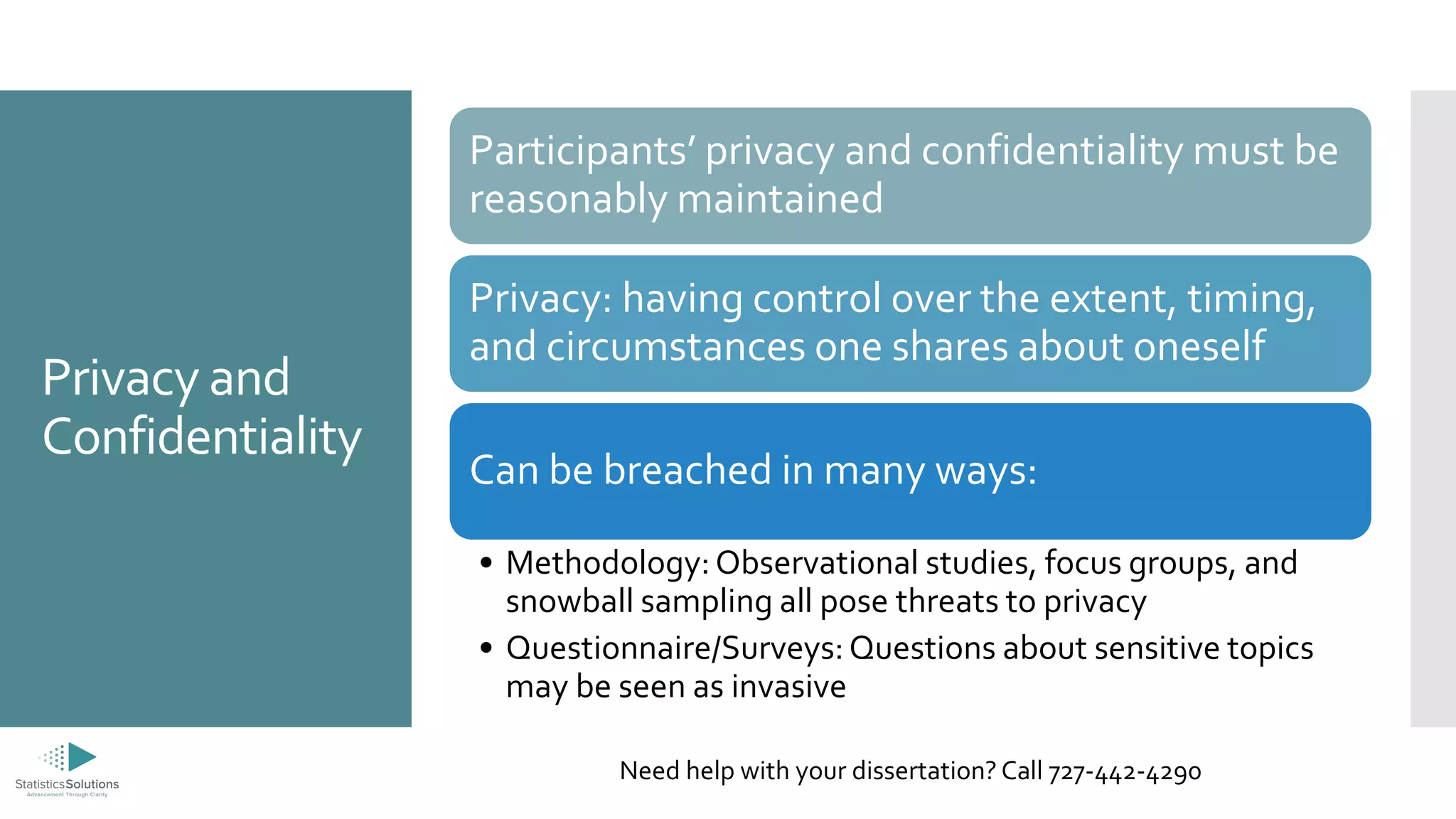
Privacy and
Confidentiality
Participants’ privacy and confidentiality must be
reasonably maintained
Privacy: having control over the extent, timing,
and circumstances one shares about oneself
Can be breached in many ways:
• Methodology:Observational studies, focus groups, and
snowball sampling all pose threats to privacy
• Questionnaire/Surveys:Questions about sensitive topics
may be seen as invasive
Need help with your dissertation? Call 727-442-4290
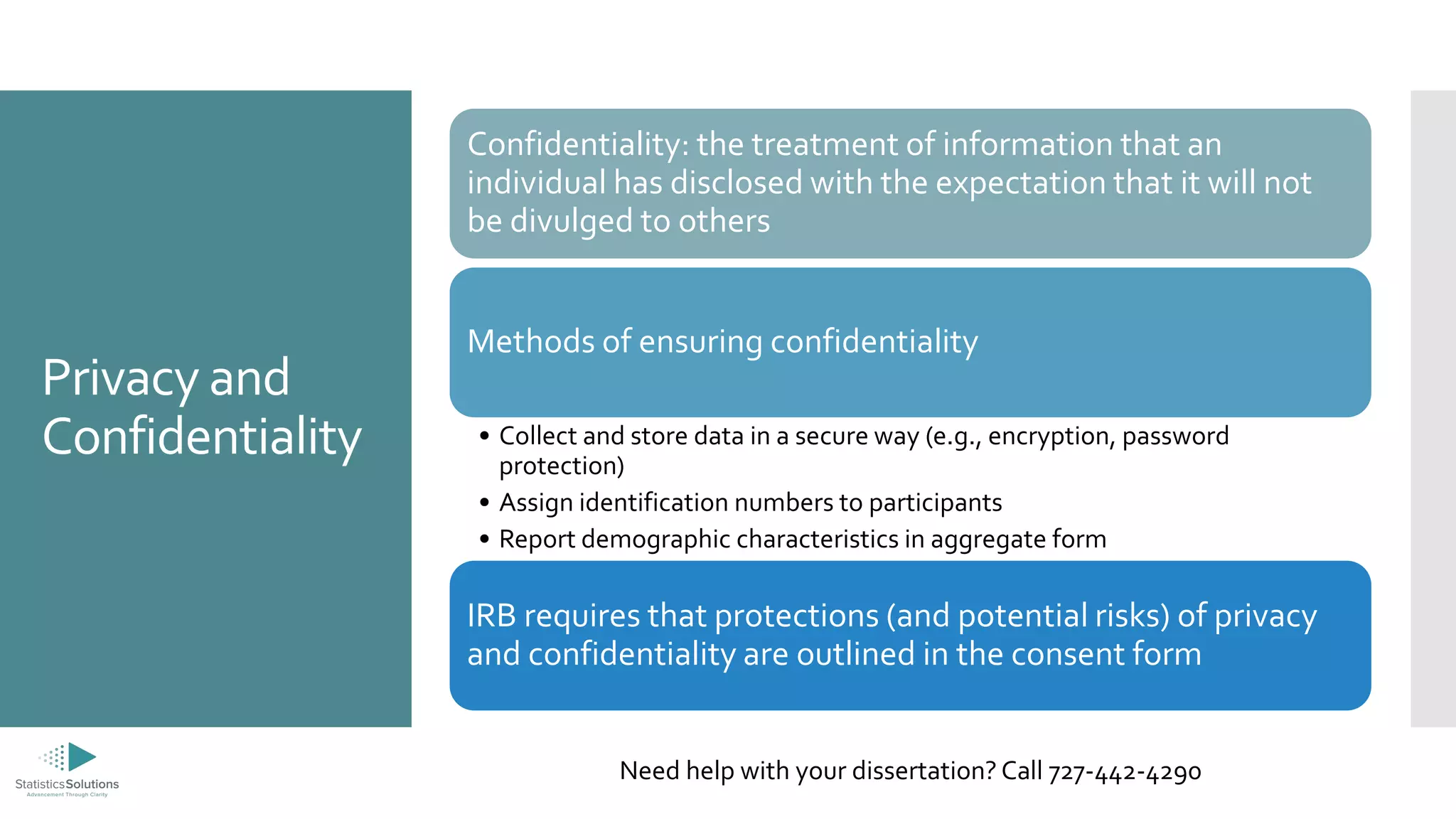
Privacy and
Confidentiality
Confidentiality: the treatment of information that an
individual has disclosed with the expectation that it will not
be divulged to others
Methods of ensuring confidentiality
• Collect and store data in a secure way (e.g., encryption, password
protection)
• Assign identification numbers to participants
• Report demographic characteristics in aggregate form
IRB requires that protections (and potential risks) of privacy
and confidentiality are outlined in the consent form
Need help with your dissertation? Call 727-442-4290
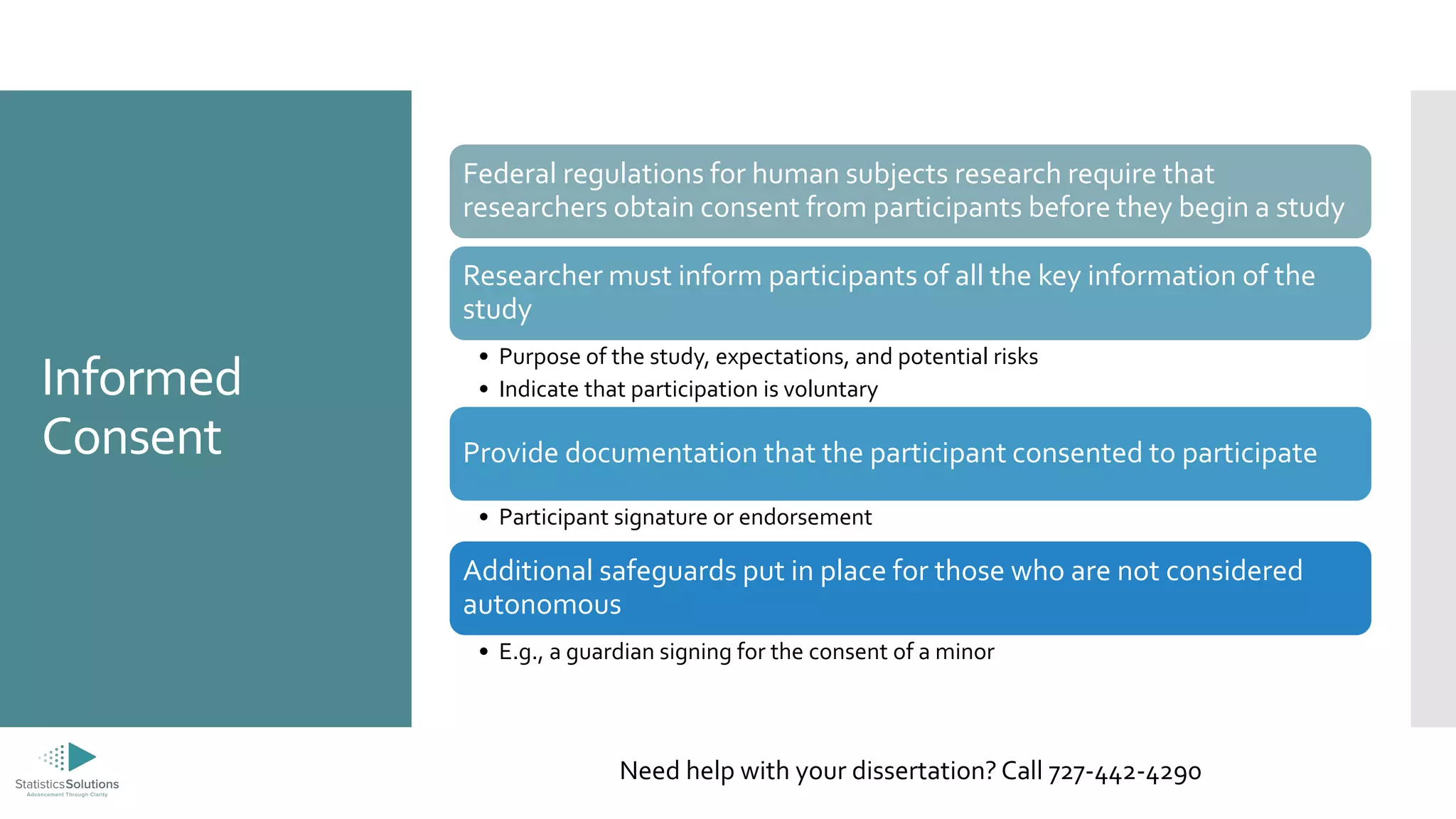
Informed
Consent
Federal regulations for human subjects research require that
researchers obtain consent from participants before they begin a study
Researcher must inform participants of all the key information of the
study
• Purpose of the study, expectations, and potential risks
• Indicate that participation is voluntary
Provide documentation that the participant consented to participate
• Participant signature or endorsement
Additional safeguards put in place for those who are not considered
autonomous
• E.g., a guardian signing for the consent of a minor
Need help with your dissertation? Call 727-442-4290
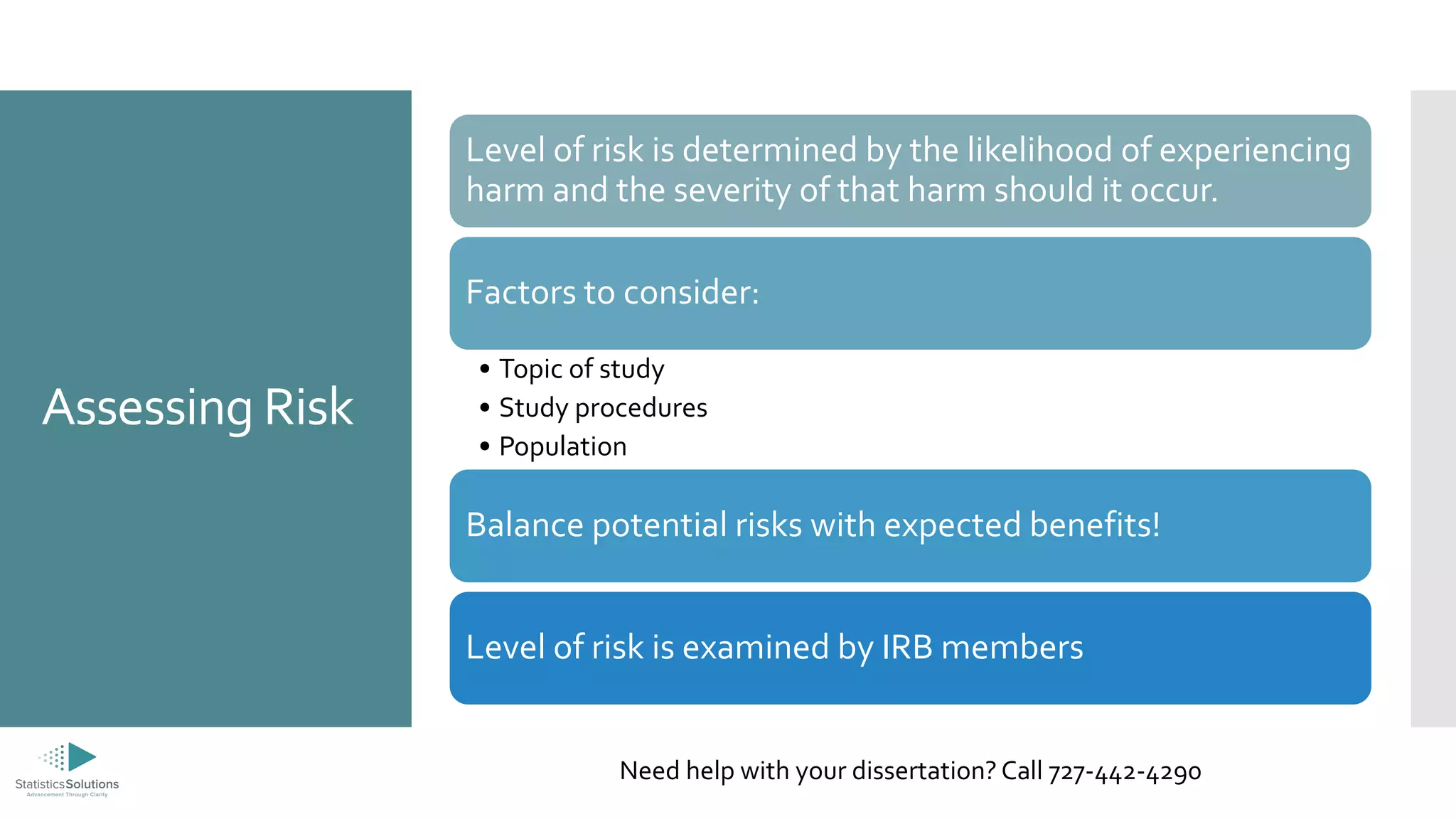
Assessing Risk
Level of risk is determined by the likelihood of experiencing
harm and the severity of that harm should it occur.
Factors to consider:
• Topic of study
• Study procedures
• Population
Balance potential risks with expected benefits!
Level of risk is examined by IRB members
Need help with your dissertation? Call 727-442-4290
Review
Categories
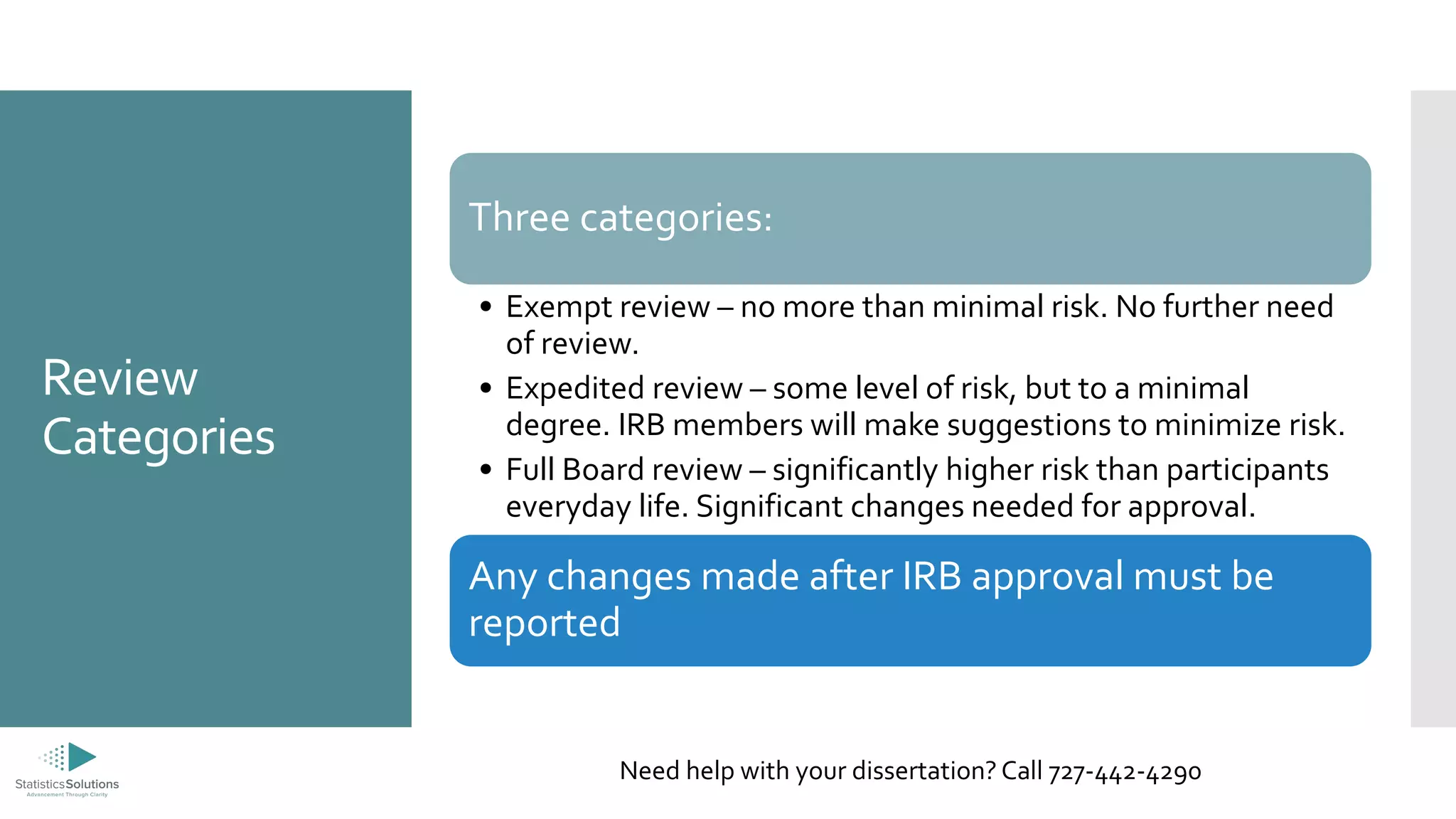
Three categories:
• Exempt review – no more than minimal risk. No further need
of review.
• Expedited review – some level of risk, but to a minimal
degree. IRB members will make suggestions to minimize risk.
• Full Board review – significantly higher risk than participants
everyday life. Significant changes needed for approval.
Any changes made after IRB approval must be
reported
Need help with your dissertation? Call 727-442-4290
IRB
Application
Checklist
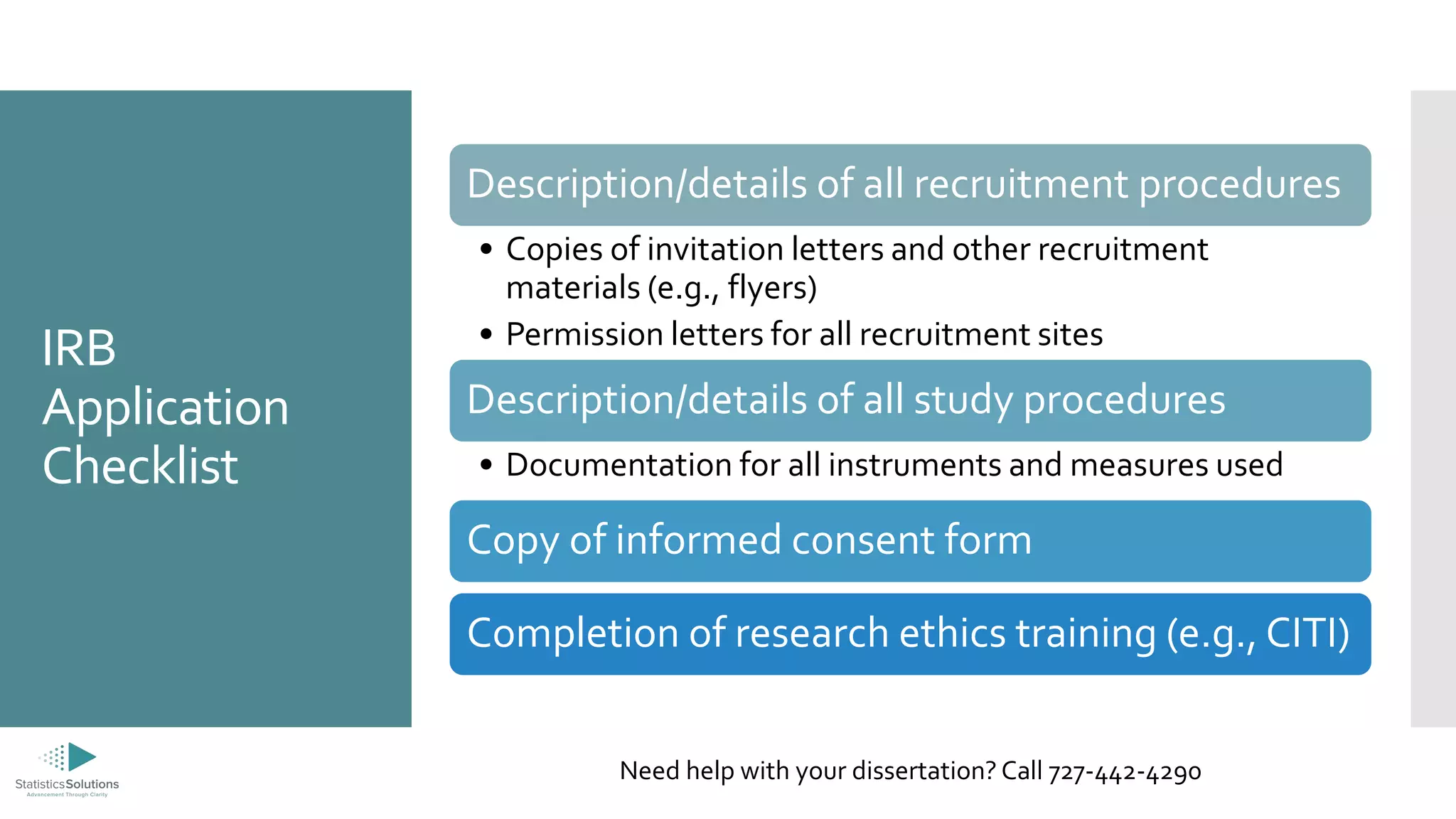
Description/details of all recruitment procedures
• Copies of invitation letters and other recruitment
materials (e.g., flyers)
• Permission letters for all recruitment sites
Description/details of all study procedures
• Documentation for all instruments and measures used
Copy of informed consent form
Completion of research ethics training (e.g., CITI)
Need help with your dissertation? Call 727-442-4290
Additional
Support
Statistics Solutions is a full-service dissertation consulting company
providing graduate students timely, editorial support for their
dissertations and scholarly projects
For information about our services, receive a complementary 30-min
consultation available Mon-Fri 9-5 ET:
https://app.hubspot.com/meetings/jeanine/dissertation-consultation
info@StatisticsSolutions.com
Phone: 877-437-8622

Navigating the IRB

  • 1.
  • 2.
    Additional Support Statistics Solutions isa full-service dissertation consulting company providing graduate students timely, editorial support for their dissertations and scholarly projects For information about our services, receive a complementary 30-min consultation available Mon-Fri 9-5 ET: https://app.hubspot.com/meetings/jeanine/dissertation-consultation info@StatisticsSolutions.com Phone: 877-437-8622
  • 3.
    Overview History and ethicalprinciples What is an IRB? Privacy and confidentiality Informed consent Assessing risk Review categories Questions Need help with your dissertation? Call 727-442-4290
  • 4.
    The Belmont Report The NationalCommission for the Protection of Human Subjects of Biomedical and Behavioral Research Created in response to past unethical research • Nazi experiments in concentration camps • Tuskegee Syphilis Study in the USA Developed a framework for understanding research guidelines Identified three ethical principles: • Respect for persons • Beneficence • Justice Need help with your dissertation? Call 727-442-4290
  • 5.
    Ethical Principles: Respect for Persons Humans areautonomous beings entitled to protection Individuals can make decisions regarding their own wellbeing • Free to participate or withdraw from a research study Researchers must allow for informed consent and provide necessary information about the study • Purpose • Participant expectations and directions • Any potential risk or harm Additional protections should be provided for those who do not have autonomy • E.g., children and prisoners Need help with your dissertation? Call 727-442-4290
  • 6.
    Ethical Principles: Beneficence Do no harm Maximizepossible benefits while minimizing potential risks involved Common risks in human subjects research: • Psychological stress or embarrassment • Breach of privacy or confidentiality Need help with your dissertation? Call 727-442-4290
  • 7.
    Ethical Principles: Justice Who receives thebenefits of the research and bears its burdens? • Burdens and benefits of research must be equally distributed • Populations should not be exploited out of convenience or availability • Certain populations cannot endure harm for benefit of others Need help with your dissertation? Call 727-442-4290
  • 8.
    What is an IRB? InstitutionalReview Board • An ethical review board of a particular institution • Reviews research for ethical principles and considerations • Approves, rejects, or requires modifications to proposed research studies Need help with your dissertation? Call 727-442-4290
  • 9.
    Privacy and Confidentiality Participants’ privacyand confidentiality must be reasonably maintained Privacy: having control over the extent, timing, and circumstances one shares about oneself Can be breached in many ways: • Methodology:Observational studies, focus groups, and snowball sampling all pose threats to privacy • Questionnaire/Surveys:Questions about sensitive topics may be seen as invasive Need help with your dissertation? Call 727-442-4290
  • 10.
    Privacy and Confidentiality Confidentiality: thetreatment of information that an individual has disclosed with the expectation that it will not be divulged to others Methods of ensuring confidentiality • Collect and store data in a secure way (e.g., encryption, password protection) • Assign identification numbers to participants • Report demographic characteristics in aggregate form IRB requires that protections (and potential risks) of privacy and confidentiality are outlined in the consent form Need help with your dissertation? Call 727-442-4290
  • 11.
    Informed Consent Federal regulations forhuman subjects research require that researchers obtain consent from participants before they begin a study Researcher must inform participants of all the key information of the study • Purpose of the study, expectations, and potential risks • Indicate that participation is voluntary Provide documentation that the participant consented to participate • Participant signature or endorsement Additional safeguards put in place for those who are not considered autonomous • E.g., a guardian signing for the consent of a minor Need help with your dissertation? Call 727-442-4290
  • 12.
    Assessing Risk Level ofrisk is determined by the likelihood of experiencing harm and the severity of that harm should it occur. Factors to consider: • Topic of study • Study procedures • Population Balance potential risks with expected benefits! Level of risk is examined by IRB members Need help with your dissertation? Call 727-442-4290
  • 13.
    Review Categories Three categories: • Exemptreview – no more than minimal risk. No further need of review. • Expedited review – some level of risk, but to a minimal degree. IRB members will make suggestions to minimize risk. • Full Board review – significantly higher risk than participants everyday life. Significant changes needed for approval. Any changes made after IRB approval must be reported Need help with your dissertation? Call 727-442-4290
  • 14.
    IRB Application Checklist Description/details of allrecruitment procedures • Copies of invitation letters and other recruitment materials (e.g., flyers) • Permission letters for all recruitment sites Description/details of all study procedures • Documentation for all instruments and measures used Copy of informed consent form Completion of research ethics training (e.g., CITI) Need help with your dissertation? Call 727-442-4290
  • 15.
    Additional Support Statistics Solutions isa full-service dissertation consulting company providing graduate students timely, editorial support for their dissertations and scholarly projects For information about our services, receive a complementary 30-min consultation available Mon-Fri 9-5 ET: https://app.hubspot.com/meetings/jeanine/dissertation-consultation info@StatisticsSolutions.com Phone: 877-437-8622

Editor's Notes

  • #5 The Belmont report is the foundational document for the current human subjects testing protections and protocols in the United States. Published in 1979, as a response to the many unethical research practices on fellow humans in the US and worldwide. Most notable examples of this are the Nazi experiments on those in concentration camps, and the US governments syphilis experiments on members of the African American community. Formal ethics review procedures were not mandated in the US prior to the Belmont Report. the Belmont report lays out three key ethical principles to follow when conducting human subjects research: respect for persons, beneficence, and justice.
  • #6 Respect for persons states that human participants are autonomous beings who are free to choose to participate or withdraw from a research study. In order to be able to make that choice, researchers must provide participants with all the necessary information of the study, such as the purpose of the study, what the individual is expected to do, and the potential risks of harm that may occur due to the study. Additionally, respect for persons argues that those who do not have autonomy, such as children or prison inmates, must be protected.
  • #7 Beneficence refers to the idea of harm reduction. Researchers should do their best to maximize possible benefits of the research, while minimizing the potential risks involved. This means that the potential harm must be reasonable in comparison to the expected benefits of the information learned.
  • #8 the principle of justice argues that the burden of research must be equally distributed, and certain populations should not endure the harm for others to benefit from. Researchers are discouraged from conducting research on convenient populations, such as students in their own classroom or prison inmates.
  • #10 When reviewing a research design, IRB committee members consider many different rules. One common rule in reviewing is that the privacy and confidentiality of the participants must be reasonably maintained. This means that researchers have an obligation to give the participant control over what and how much information they share (privacy), as well as protecting the information that participants do disclose (confidentiality). Privacy, or having control over the extent timing and circumstances one shares about themselves, can be breached in many ways. One way is through different research methods, such as observational studies, focus groups, and snowball sampling. Observational studies pose a threat to privacy if private information is gathered without the subject’s knowledge or consent, while focus groups cannot ensure privacy or confidentiality since participants may talk about what was discussed after the study ends. Additionally, privacy invasions occur if the participant finds the study questions to be invasive. Questions about sensitive topics such as abuse, medication, or sexual behavior may serve to make the participant uncomfortable and studies that include these types of questions should include a warning in the consent form.
  • #11 Confidentiality on the other hand is defined as the treatment of information that an individual has disclosed with the expectation that it will not be divulged to others. One simple way of protecting confidentiality is to deidentify participants information- or assign numbers to participants to make sure that personal information cannot be traced back to the participant. Additionally, how the data and information will be protected should be outlined in clear writing in the consent form.
  • #12 Firstly, that researchers have an obligation to inform participants of all the key information of the study so that they can make an informed decision on whether to participate. This means that participants should be reasonably informed on the studies purpose and procedures, the potential harm and expected benefits, how privacy and confidentiality will be maintained, and any incentives that they will receive for taking part in the research. Additionally, researchers should provide a statement indicating that the study is voluntary, and the contact information of the head researcher for any questions. This information should be presented in a clear and simple manner, so that anyone not familiar with the study can understand what they are consenting to, and participants should be given ample time to read the document and decide. Secondly, researchers should provide documentation that the participant consented to the study procedures and requirements, this is usually obtained in the form of a consent document signed by each participant. For participants who would not be considered autonomous, such as children, additional safeguards should be set in place to ensure that they are able to consent to the best of their ability. This can include tests to determine mental competency, and/or requiring consent from a legal guardian or caretaker.
  • #13 The level of risk of a research study can be determined by assessing the likelihood of experiencing harm along with the severity of that harm should it occur. A researcher should consider the situation and time frame of the research, as many sensitive topics can cause harm if asked in areas in which it is taboo or illegal. Additionally, the subject population itself should be accounted for as well, such as vulnerable or underserved populations who are at a higher risk. Therefore, the goal of a study should be to balance the potential risks with the expected benefits of the information learned. Meaning, if there are little benefits to using an abused population, the risk of retraumatizing them in your study may be too high of a risk. However, if a researcher plans to deceive their participants to learn a new truth of human behavior, the level of that risk may be acceptable for the benefit of the new information. The level of risk for each study is examined by an IRB committee and its members will determine if a studies risk of harm is acceptable and will make suggestions on how to change the level of harm when necessary. Additionally safeguards such as removing participant identifiers from the data or obtaining consent and confidentiality forms, may be suggested.
  • #14 Once an IRB has reviewed the contents of a research study, they will process an experiment under three categories: exempt review, expedited review, and a convened review. Research reviewed as exempt are categorized as studies that involve no more than a minimal level of risk, and therefore do not need further review from the committee. An expedited review often involves some level of risk, but this risk is to a minimal degree. In this case, a few IRB members will review the study procedures and make suggestions to minimize the risk. Finally, a convened review involves research that poses a significantly higher risk than what would occur in participants’ day to day lives. In this case, the researcher may have to make significant changes to obtain approval to run the study. Additionally, an IRB requires than any changes made to a study after it has been approved must be reported back to the committee for another review of risk.