
Ethical Review Process
                 by the IRB
_________________________________
   Presented By-MANISH KUMAR SHARMA
        D.PHARMA,B.PHARMA, PGDCR
   DEPARTMENT OF CLINICAL RESEARCH
   SHARDA UNIVERSITY, GREATER NOIDA,UP
IRB Function

The purpose of an IRB is to
Review research and to Ensure
the rights and welfare of human
subjects involved in research
are adequately protected.
Why Do Human Research Subjects
Need Protection?

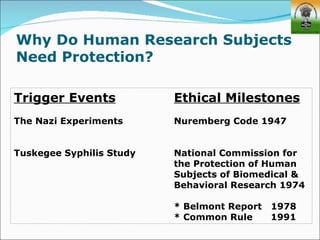
Trigger Events            Ethical Milestones
The Nazi Experiments      Nuremberg Code 1947


Tuskegee Syphilis Study   National Commission for
                          the Protection of Human
                          Subjects of Biomedical &
                          Behavioral Research 1974

                          * Belmont Report   1978
                          * Common Rule      1991
The Basic Principles of the
     Belmont Report

     1. Respect for Persons

     3. Beneficence

     5. Justice
Regulatory Requirements for IRB
              Approval
 Risks to subjects are minimized


 Risks are reasonable in relation to anticipated benefits – if any


 Selection of subjects is equitable


 Informed consent will be sought and appropriately documented


 When appropriate, the research plan makes adequate provision for
  monitoring the data collected to ensure the safety of subjects
Regulatory Requirements for IRB
Approval
 When appropriate, there are adequate provisions to protect the
  privacy of subjects and to maintain the confidentiality of data

 When some or all of the subjects are likely to be vulnerable to
  coercion or undue influence, such as children, prisoners, pregnant
  women, mentally disabled persons, or economically or educationally
  disadvantaged persons, additional safeguards have been included to
  protect the rights and welfare of these subjects.
IRB Review of Research
  All research projects are categorized into one of three categories for
  the IRB review process. Each category is different in the level of
  scrutiny and submission procedures. The IRB is responsible for
  making the final decision of which category a research project falls
  under.

     Full
     Expedited
     Exempt
     Research Not Involving Human Subjects
Full Review
 One or more Committee member(s) are assigned to review the
  complete protocol or amendment, consent form, Investigational
  Drug/Device Brochure and any other protocol materials.
 These Primary & Secondary Reviewers summarize the protocol or
  amendment to the Full Committee at a convened meeting and
  answer questions during the discussion.
 All other committee members are provided with summary
  information, for example the Protocol Cover Form and informed
  consent document. This stresses the importance of the accuracy
  and details provided in these documents, since the majority of voting
  members only see these 2 documents!
Expedited Review
 Protocols, amendments, or continuing reviews that
  meet specific federal criteria qualify for an expedited
  review.
 The complete protocol, consent form, and any other
  protocol materials receive review and approval by a
  Committee Chair.
 Expedited does not mean “fast” it is a regulatory term
  used for research that must meet specific criteria
Some Common
Expedited Review Categories
 Continuing Review when: the research is permanently
  closed to the enrollment of new subjects; (ii) all subjects
  have completed all research-related interventions; and (iii)
  the research remains active only for long-term follow-up
  of subjects; or
 (b) where no subjects have been enrolled and no
  additional risks have been identified; where the remaining
  research activities are limited to data analysis.
Some Common
Expedited Review Categories
 And when the IRB has determined and documented at a
 convened meeting that the research involves no greater
 than minimal risk and no additional risks have been
 identified.
Exempt from IRB Review
 Committee review is not required for certain categories
 of research activities that involve little or no risk to
 human subjects.

 To determine if your research qualifies for exemption
  from formal committee review, complete the “Protocol
  Exemption Review and Determination Checklist.”
 Only the IRB can make the determination of
  Exempt, this cannot be determined by researchers!
What about pilot studies?
 Whether or not a pilot study requires IRB approval
  depends on the nature of the data collected in the pilot

 For example, we have a study of drug use among high
  school students in Kenya

   If the pilot study involves testing the research instruments on high
    school students, asking them questions about drug use – then this
    DOES require IRB approval

   If the pilot involves asking students to give views on the the
    questionnaire design/ content then this DOES NOT require IRB
    approval
IRB Review and Determination of “Research
      Not Involving Human Subjects”
 There is some research that involves coded private information or
  specimens that do not involve human subjects.
 When conducting research using data or specimens, the level of
  review by the IRB depends primarily on one factor: whether the
  data or specimens are identifiable to the principal investigator or
  key personnel.
 Determinations of whether research involving coded private
  information or biological specimens is considered to be
  “human subjects research” must be made by the IRB, not the
  investigator.
The IRB submission packet must
include
The protocol and any amendments, informed consent,
and the investigator brochure. The Investigator’s
Undertaking; CVs (curriculum vitae) can verify the
investigators' qualifications. All advertising materials also
require approval. Payments to subjects require approval
and may be a source of contention between the investigator
and IRB.
Types of Review
 Initial
 Continuing Review
 Amendments
 Safety Information or Unanticipated Problems to
  Subjects or Others
 Noncompliance
While Review the IRB checks…

•   Risks are Minimized (Consistent with a sound research design and does
    not unnecessarily expose subjects to risk)
•   Risks are Reasonable in Relation to Benefits
•   Selection of Subjects is Equitable
•   Informed Consent will be Sought for Each Prospective Subject
•   Informed Consent will Be Documented
•   Research Plan Adequately Provides for Monitoring the Data Collected to
    Ensure Safety of the Subjects
•   Research Plan Adequately Protects the Privacy of Subjects and
    Maintains Confidentiality
•   When some or all of the subjects are likely to be vulnerable to coercion or
    undue influence, additional safeguards need to be included in the protocol
    to protect the rights and welfare of these subjects.
The IRB has the authority to:

   oApprove
   oRequire modifications prior to


    approval
   oDisapprove all research activities
    including proposed changes in
   oTable
    previously approved human
    subject research.
How the IRB System Works
   Primary and Secondary Reviewers
     Assignments made 1 week ahead of meeting


   Discussion by Full Committee
     Reviewers lead discussion
     Everyone contributes


   Committee Vote
     Approve
     Conditional Approval
     Deferral
     Disapprove
Determining an Action
 Approval – the criteria for approval are met.
 Conditional approval – IRB stipulates specific revisions requiring
  simple concurrence by the investigator, then the IRB Chair or another
  IRB member designated by the Chair subsequently approve the
  revised research protocol on behalf of the IRB.
 Deferral - substantive clarifications or modifications required that are
  directly relevant to the criteria for approval.
 Disapproval – major ethical or scientific issues – PI can respond to
  the IRB or start over.
Review Strategy
 Review application
   Look for special issues such as kids, radiation, emergency use issues, new
    drugs/devices, genetics, storing samples for future use


 Read protocol summary
   Look for site specific issues; can we logistically perform the study here?


 Read detailed protocol
   Look also at any study specific tools, letters, ads, extras
Review Strategy
 Prepare your comments
   Written and submitted are wonderful
   Emailed is even better


 Editing the consent form
   Edit right on the document
   Use legible handwriting
   Submit marked up document
Background and Specific Aims
 Should contain a convincing summary of previous
 work and rationale for the study

 References should be included


 There should be clear aims and endpoints
Subject Selection and
Enrollment
 How are subjects identified?
   Ads, charts, RPDR, referrals, PI’s own clinic, support groups, public
    records.
 How, when and by whom are subjects for
 contacted about study?
   In person? Should be by someone who has reason to know confidential
    medical information.
   Letters? Letters should be co-signed by the MD know to the patient-
    subject.
   No cold calls
Subject Selection and Enrollment
 Inclusion/Exclusion Criteria

   Should be a concisive list
   Should include appropriate laboratory parameters
   Should include appropriate medical exclusions
   Should not/rarely exclude non English speakers


 Who obtains consent? Who gives consent?
Study Procedures
 Should include sufficient detail to ascertain what
 subjects will actually experience while in study

   Time commitment.
   Setting or site where study procedures occur.
   Any “routine” agents to be used – such as sedation.
   Consent form with detail in lay terms.
Biostatistics
 A formal sample size is generally necessary.
 Why does the PI need this many subjects?
 Are there enough subjects to answer the study
  question?
 How are the data to be analyzed?
 Just because the PI says it is a pilot study doesn’t
  mean they don’t need statistics.
Risks and Discomforts
 Should be listed clearly, quantitatively and in order of
  seriousness.
    Should include risks of withdrawal from current medications.
    Non medical risks? Social, legal, financial or psychological risks?
    Is loss of confidentiality a legitimate risk or concern?
    What about loss of privacy?
    Is there a complete list of adverse events in the drug or device
     brochure?
    Any foreseeable but maybe still theoretical risks – for example
     tumorigenesis?
Benefits
 Compensation is not a benefit


 If there are benefits to the individual subjects these should
  be discussed first, then any potential benefits to future
  society

 A common error we see is the “overstatement” of benefits.
Example of good benefit statement: There will be no direct
  health benefits to you as a result of your participation in
  this study.
Safety Monitoring
 How are the data to be monitored and by whom?
   All studies involving more than minimal risk require a data and
      safety monitoring plan.
     Not all studies require a DSMB but if one is necessary who does it
      involve? Is it independent? Should it be?
     Are there objective criteria for withdrawal of subjects when safety
      is in question?
     Are there stopping rules?
     Is there a plan for reporting to the IRB?
Common Review Issues
    PI has failed to provide information about
       reasonable clinical context or apparent withholding
       of standard of care.
      Failure to minimize risk.
      Inadequate information about collaborating sites,
       especially when international sites are involved.
      Poor preparation of materials – cutting and pasting
       errors.
      Poor writing skills, no proof reading.
Lets do it together

   CASE STUDIES
Scenario 1

Karen goes to work for the Population Council in
 Nairobi, Kenya on a research project.
The project was conceived and designed by the PC,
 the PI is a member of the PC staff, who is not IRB
 Staff.
Karen will be designing research instruments,
 implementing the survey and managing the
 project. While in the field, Karen decides she
 wants to bring the data back to the US to use for
 her thesis.
 .
Analysis
 Karen does NOT need IRB approval for her survey.
    Responsibility for IRB approval lies with the PI, so the PC
    should be seeking it’s own IRB approval. Karen will need to be
    added to their existing IRB approval as study staff

        To use the data for her thesis, Karen needs to apply for IRB
    approval for secondary data analysis & DE identify the data
    before bringing it back to the US. She can only apply for
    approval for secondary data analysis once the data collection is
    complete, and cannot bring the data to the US until she has IRB
    approval
Scenario 2
Jack goes to Vietnam to work for WHO.
They want him to conduct an evaluation of their
  immunization program, to identify effective delivery
  strategies. The results of his work will be used to
  improve WHO programs in Vietnam.
He does not intends to use the data he collects for his
  thesis or any other publication
Analysis
 Jack does NOT need IRB approval. An
 internal evaluation, in which the data/
 results are not intended to be published or
 generalized is not considered research, and
 is thus exempt from IRB review
Scenario 3
Jasmine travels to West Bengal to study infant feeding practices
  among refugees. Although she submits all her IRB documents
  in advance, she does not hear from the IRB before her project
  is due to start. Frustrated, Jasmine decides to go ahead and
  collect the data, and to apply for retrospective approval once
  she returns
Analysis
 Data collection cannot begin without IRB approval. The
  instruments can be designed & sampling can begin – but
  you cannot start collecting data from human subjects
  without IRB approval. Jasmine cannot apply for
  retrospective approval or for permission for secondary
  data analysis. The data cannot be used for any research
  purposes.

Ethical review process, mk sharma

  • 1.
    Ethical Review Process by the IRB _________________________________ Presented By-MANISH KUMAR SHARMA D.PHARMA,B.PHARMA, PGDCR DEPARTMENT OF CLINICAL RESEARCH SHARDA UNIVERSITY, GREATER NOIDA,UP
  • 2.
    IRB Function The purposeof an IRB is to Review research and to Ensure the rights and welfare of human subjects involved in research are adequately protected.
  • 3.
    Why Do HumanResearch Subjects Need Protection? Trigger Events Ethical Milestones The Nazi Experiments Nuremberg Code 1947 Tuskegee Syphilis Study National Commission for the Protection of Human Subjects of Biomedical & Behavioral Research 1974 * Belmont Report 1978 * Common Rule 1991
  • 4.
    The Basic Principlesof the Belmont Report 1. Respect for Persons 3. Beneficence 5. Justice
  • 5.
    Regulatory Requirements forIRB Approval  Risks to subjects are minimized  Risks are reasonable in relation to anticipated benefits – if any  Selection of subjects is equitable  Informed consent will be sought and appropriately documented  When appropriate, the research plan makes adequate provision for monitoring the data collected to ensure the safety of subjects
  • 6.
    Regulatory Requirements forIRB Approval  When appropriate, there are adequate provisions to protect the privacy of subjects and to maintain the confidentiality of data  When some or all of the subjects are likely to be vulnerable to coercion or undue influence, such as children, prisoners, pregnant women, mentally disabled persons, or economically or educationally disadvantaged persons, additional safeguards have been included to protect the rights and welfare of these subjects.
  • 7.
    IRB Review ofResearch All research projects are categorized into one of three categories for the IRB review process. Each category is different in the level of scrutiny and submission procedures. The IRB is responsible for making the final decision of which category a research project falls under.  Full  Expedited  Exempt  Research Not Involving Human Subjects
  • 8.
    Full Review  Oneor more Committee member(s) are assigned to review the complete protocol or amendment, consent form, Investigational Drug/Device Brochure and any other protocol materials.  These Primary & Secondary Reviewers summarize the protocol or amendment to the Full Committee at a convened meeting and answer questions during the discussion.  All other committee members are provided with summary information, for example the Protocol Cover Form and informed consent document. This stresses the importance of the accuracy and details provided in these documents, since the majority of voting members only see these 2 documents!
  • 9.
    Expedited Review  Protocols,amendments, or continuing reviews that meet specific federal criteria qualify for an expedited review.  The complete protocol, consent form, and any other protocol materials receive review and approval by a Committee Chair.  Expedited does not mean “fast” it is a regulatory term used for research that must meet specific criteria
  • 10.
    Some Common Expedited ReviewCategories  Continuing Review when: the research is permanently closed to the enrollment of new subjects; (ii) all subjects have completed all research-related interventions; and (iii) the research remains active only for long-term follow-up of subjects; or  (b) where no subjects have been enrolled and no additional risks have been identified; where the remaining research activities are limited to data analysis.
  • 11.
    Some Common Expedited ReviewCategories  And when the IRB has determined and documented at a convened meeting that the research involves no greater than minimal risk and no additional risks have been identified.
  • 12.
    Exempt from IRBReview  Committee review is not required for certain categories of research activities that involve little or no risk to human subjects.  To determine if your research qualifies for exemption from formal committee review, complete the “Protocol Exemption Review and Determination Checklist.”  Only the IRB can make the determination of Exempt, this cannot be determined by researchers!
  • 13.
    What about pilotstudies?  Whether or not a pilot study requires IRB approval depends on the nature of the data collected in the pilot  For example, we have a study of drug use among high school students in Kenya  If the pilot study involves testing the research instruments on high school students, asking them questions about drug use – then this DOES require IRB approval  If the pilot involves asking students to give views on the the questionnaire design/ content then this DOES NOT require IRB approval
  • 14.
    IRB Review andDetermination of “Research Not Involving Human Subjects”  There is some research that involves coded private information or specimens that do not involve human subjects.  When conducting research using data or specimens, the level of review by the IRB depends primarily on one factor: whether the data or specimens are identifiable to the principal investigator or key personnel.  Determinations of whether research involving coded private information or biological specimens is considered to be “human subjects research” must be made by the IRB, not the investigator.
  • 15.
    The IRB submissionpacket must include The protocol and any amendments, informed consent, and the investigator brochure. The Investigator’s Undertaking; CVs (curriculum vitae) can verify the investigators' qualifications. All advertising materials also require approval. Payments to subjects require approval and may be a source of contention between the investigator and IRB.
  • 16.
    Types of Review Initial  Continuing Review  Amendments  Safety Information or Unanticipated Problems to Subjects or Others  Noncompliance
  • 17.
    While Review theIRB checks… • Risks are Minimized (Consistent with a sound research design and does not unnecessarily expose subjects to risk) • Risks are Reasonable in Relation to Benefits • Selection of Subjects is Equitable • Informed Consent will be Sought for Each Prospective Subject • Informed Consent will Be Documented • Research Plan Adequately Provides for Monitoring the Data Collected to Ensure Safety of the Subjects • Research Plan Adequately Protects the Privacy of Subjects and Maintains Confidentiality • When some or all of the subjects are likely to be vulnerable to coercion or undue influence, additional safeguards need to be included in the protocol to protect the rights and welfare of these subjects.
  • 18.
    The IRB hasthe authority to: oApprove oRequire modifications prior to approval oDisapprove all research activities including proposed changes in oTable previously approved human subject research.
  • 19.
    How the IRBSystem Works  Primary and Secondary Reviewers  Assignments made 1 week ahead of meeting  Discussion by Full Committee  Reviewers lead discussion  Everyone contributes  Committee Vote  Approve  Conditional Approval  Deferral  Disapprove
  • 20.
    Determining an Action Approval – the criteria for approval are met.  Conditional approval – IRB stipulates specific revisions requiring simple concurrence by the investigator, then the IRB Chair or another IRB member designated by the Chair subsequently approve the revised research protocol on behalf of the IRB.  Deferral - substantive clarifications or modifications required that are directly relevant to the criteria for approval.  Disapproval – major ethical or scientific issues – PI can respond to the IRB or start over.
  • 21.
    Review Strategy  Reviewapplication  Look for special issues such as kids, radiation, emergency use issues, new drugs/devices, genetics, storing samples for future use  Read protocol summary  Look for site specific issues; can we logistically perform the study here?  Read detailed protocol  Look also at any study specific tools, letters, ads, extras
  • 22.
    Review Strategy  Prepareyour comments  Written and submitted are wonderful  Emailed is even better  Editing the consent form  Edit right on the document  Use legible handwriting  Submit marked up document
  • 23.
    Background and SpecificAims  Should contain a convincing summary of previous work and rationale for the study  References should be included  There should be clear aims and endpoints
  • 24.
    Subject Selection and Enrollment How are subjects identified?  Ads, charts, RPDR, referrals, PI’s own clinic, support groups, public records.  How, when and by whom are subjects for contacted about study?  In person? Should be by someone who has reason to know confidential medical information.  Letters? Letters should be co-signed by the MD know to the patient- subject.  No cold calls
  • 25.
    Subject Selection andEnrollment  Inclusion/Exclusion Criteria  Should be a concisive list  Should include appropriate laboratory parameters  Should include appropriate medical exclusions  Should not/rarely exclude non English speakers  Who obtains consent? Who gives consent?
  • 26.
    Study Procedures  Shouldinclude sufficient detail to ascertain what subjects will actually experience while in study  Time commitment.  Setting or site where study procedures occur.  Any “routine” agents to be used – such as sedation.  Consent form with detail in lay terms.
  • 27.
    Biostatistics  A formalsample size is generally necessary.  Why does the PI need this many subjects?  Are there enough subjects to answer the study question?  How are the data to be analyzed?  Just because the PI says it is a pilot study doesn’t mean they don’t need statistics.
  • 28.
    Risks and Discomforts Should be listed clearly, quantitatively and in order of seriousness.  Should include risks of withdrawal from current medications.  Non medical risks? Social, legal, financial or psychological risks?  Is loss of confidentiality a legitimate risk or concern?  What about loss of privacy?  Is there a complete list of adverse events in the drug or device brochure?  Any foreseeable but maybe still theoretical risks – for example tumorigenesis?
  • 29.
    Benefits  Compensation isnot a benefit  If there are benefits to the individual subjects these should be discussed first, then any potential benefits to future society  A common error we see is the “overstatement” of benefits. Example of good benefit statement: There will be no direct health benefits to you as a result of your participation in this study.
  • 30.
    Safety Monitoring  Howare the data to be monitored and by whom?  All studies involving more than minimal risk require a data and safety monitoring plan.  Not all studies require a DSMB but if one is necessary who does it involve? Is it independent? Should it be?  Are there objective criteria for withdrawal of subjects when safety is in question?  Are there stopping rules?  Is there a plan for reporting to the IRB?
  • 31.
    Common Review Issues  PI has failed to provide information about reasonable clinical context or apparent withholding of standard of care.  Failure to minimize risk.  Inadequate information about collaborating sites, especially when international sites are involved.  Poor preparation of materials – cutting and pasting errors.  Poor writing skills, no proof reading.
  • 32.
    Lets do ittogether CASE STUDIES
  • 33.
    Scenario 1 Karen goesto work for the Population Council in Nairobi, Kenya on a research project. The project was conceived and designed by the PC, the PI is a member of the PC staff, who is not IRB Staff. Karen will be designing research instruments, implementing the survey and managing the project. While in the field, Karen decides she wants to bring the data back to the US to use for her thesis. .
  • 34.
    Analysis  Karen doesNOT need IRB approval for her survey. Responsibility for IRB approval lies with the PI, so the PC should be seeking it’s own IRB approval. Karen will need to be added to their existing IRB approval as study staff  To use the data for her thesis, Karen needs to apply for IRB approval for secondary data analysis & DE identify the data before bringing it back to the US. She can only apply for approval for secondary data analysis once the data collection is complete, and cannot bring the data to the US until she has IRB approval
  • 35.
    Scenario 2 Jack goesto Vietnam to work for WHO. They want him to conduct an evaluation of their immunization program, to identify effective delivery strategies. The results of his work will be used to improve WHO programs in Vietnam. He does not intends to use the data he collects for his thesis or any other publication
  • 36.
    Analysis  Jack doesNOT need IRB approval. An internal evaluation, in which the data/ results are not intended to be published or generalized is not considered research, and is thus exempt from IRB review
  • 37.
    Scenario 3 Jasmine travelsto West Bengal to study infant feeding practices among refugees. Although she submits all her IRB documents in advance, she does not hear from the IRB before her project is due to start. Frustrated, Jasmine decides to go ahead and collect the data, and to apply for retrospective approval once she returns
  • 38.
    Analysis  Data collectioncannot begin without IRB approval. The instruments can be designed & sampling can begin – but you cannot start collecting data from human subjects without IRB approval. Jasmine cannot apply for retrospective approval or for permission for secondary data analysis. The data cannot be used for any research purposes.

Editor's Notes

  • #2 __________________________________________________________________________________________________________________________________________________________________________________________________________________________________________________________________________________________________________________________________________________________________________________________________________________________________
  • #3 __________________________________________________________________________________________________________________________________________________________________________________________________________________________________________________________________________________________________________________________________________________________________________________________________________________________________
  • #4 Mostly Nazi Experiments
  • #5 __________________________________________________________________________________________________________________________________________________________________________________________________________________________________________________________________________________________________________________________________________________________________________________________________________________________________
  • #19 __________________________________________________________________________________________________________________________________________________________________________________________________________________________________________________________________________________________________________________________________________________________________________________________________________________________________