Introduction to the
Bristol Community College
Institutional Review Board (IRB)
Angelina O’Brien, M.A., C.A.G.S., L.M.H.C.
Director, Institutional Research, Planning & Assessment
Administrator, Institutional Review Board
September 17, 2015
What is an IRB?
• An IRB functions like an ethics committee
▫ Focuses on what is right and wrong, what is desirable and
undesirable
• Ensures that the College is meeting the objectives of protecting
people’s privacy, health and safety, and people’s ability to
participate voluntarily in human subject research and meeting the
federal regulations
• The review and approval of activities by the IRB are meant to assist
the researchers by having a review that will objectively analyze the
potential risk involved to research participants, as well as ways to
minimize that risk
Many Unethical Studies
• 1962: The Thalidomide Experiment
• 1964: Willowbrook Hepatitis Studies
• 1932-1972: Tuskegee Syphilis Study
Thalidomide – drug sold from 1957-1961 to treat unpleasant symptoms associated with
pregnancy. It was not standard practice to inform patients of investigational nature of drugs.
This drug caused severe growth problems. Public outrage led to amendment to Food, Drug,
and Cosmetic Act that required investigators to obtain informed consent from potential
subjects before administering investigational medications. Drug is still in use today for
treating leprosy, multiple myeloma, lymphoma, and other cancers.
Willowbrook Hepatitis Studies – 1956-1971. Series of studies done to understand issues
related to transmission of hepatitis virus in children with mental illness at a state school. Dr.
was trying to develop a vaccine against hepatitis. Study design involved intentionally infecting
healthy children with hepatitis. Parents were told their children could not enroll unless they
agreed to participate in this project.
Tuskegee, Alabama – 1932-1972 U. S. Public Health Service funded study to evaluate
natural history of untreated syphilis in human beings. At that time there was not an effective
treatment for syphilis. Subject population was vulnerable – 399 indigent, uneducated,
sharecroppers in Macon County who had syphilis. Subjects did not know about their
condition or the research that was being conducted. Subjects thought they were getting
free treatment, but were getting free spinal taps and did not know that the government was
observing course of their illness. Wives contracted syphilis and babies were born with
congenital syphilis. Penicillin was invented in 1940 and became the standard treatment
but was not given to these subjects. This study led to the creation of the Belmont Report, the
Office for Human Research Protections and Institutional Review Boards.
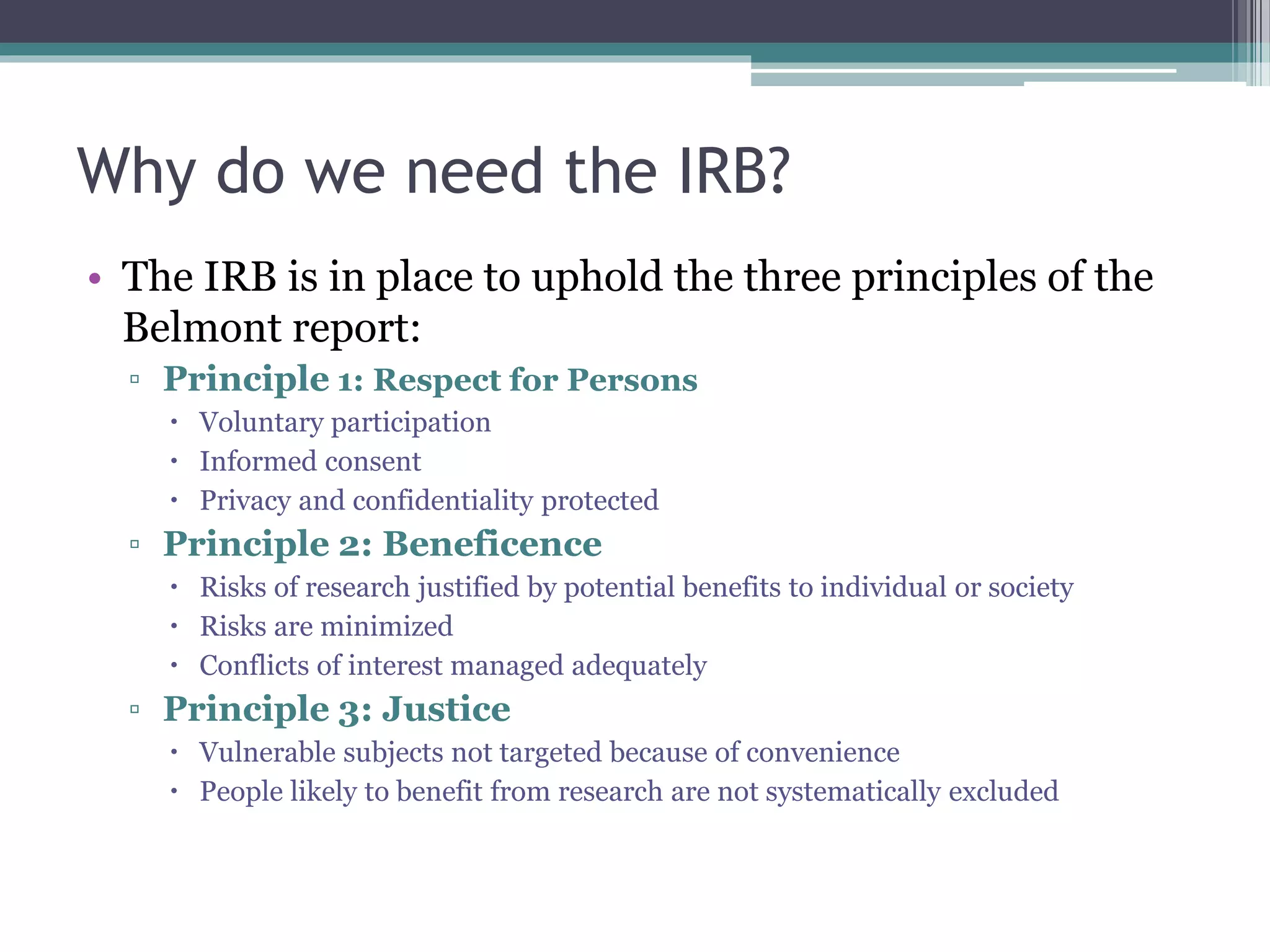
Why do we need the IRB?
• The IRB is in place to uphold the three principles of the
Belmont report:
▫ Principle 1: Respect for Persons
 Voluntary participation
 Informed consent
 Privacy and confidentiality protected
▫ Principle 2: Beneficence
 Risks of research justified by potential benefits to individual or society
 Risks are minimized
 Conflicts of interest managed adequately
▫ Principle 3: Justice
 Vulnerable subjects not targeted because of convenience
 People likely to benefit from research are not systematically excluded
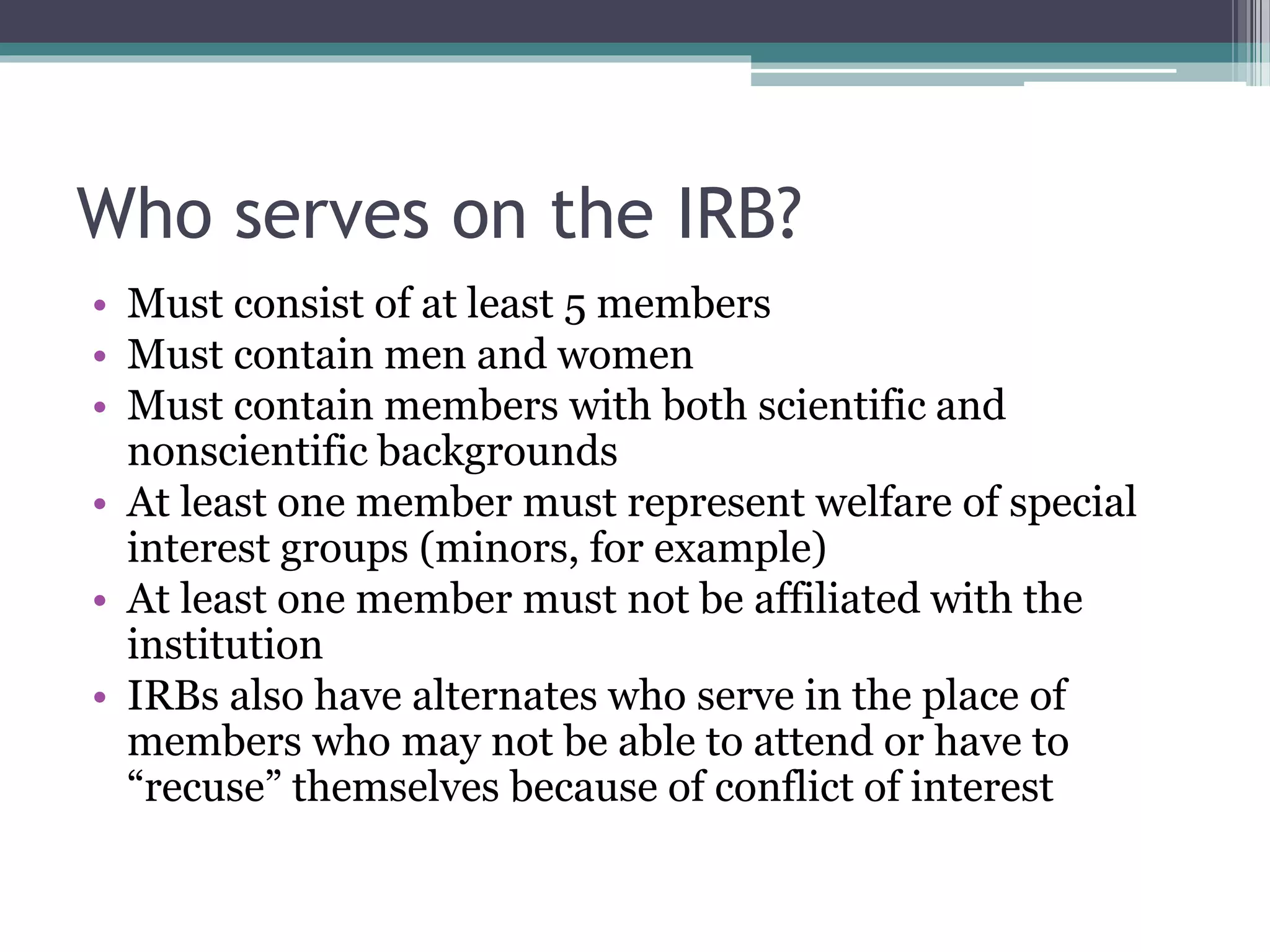
Who serves on the IRB?
• Must consist of at least 5 members
• Must contain men and women
• Must contain members with both scientific and
nonscientific backgrounds
• At least one member must represent welfare of special
interest groups (minors, for example)
• At least one member must not be affiliated with the
institution
• IRBs also have alternates who serve in the place of
members who may not be able to attend or have to
“recuse” themselves because of conflict of interest
What does the IRB do?
• Meets regularly and reviews research requests
that come before them
• Engages in training to learn more about the
process
• Makes decisions about how research can/cannot
proceed
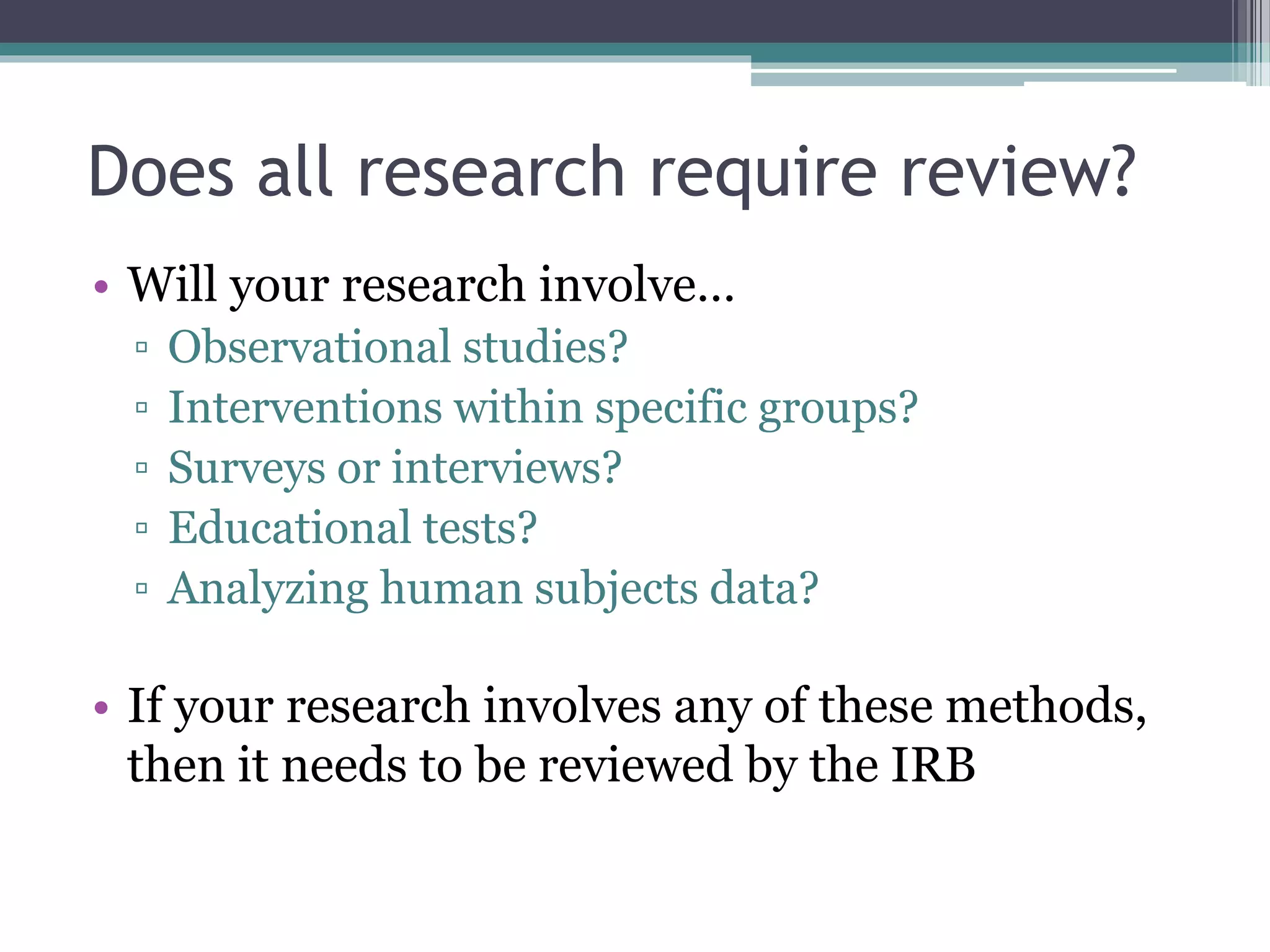
Does all research require review?
• Will your research involve…
▫ Observational studies?
▫ Interventions within specific groups?
▫ Surveys or interviews?
▫ Educational tests?
▫ Analyzing human subjects data?
• If your research involves any of these methods,
then it needs to be reviewed by the IRB
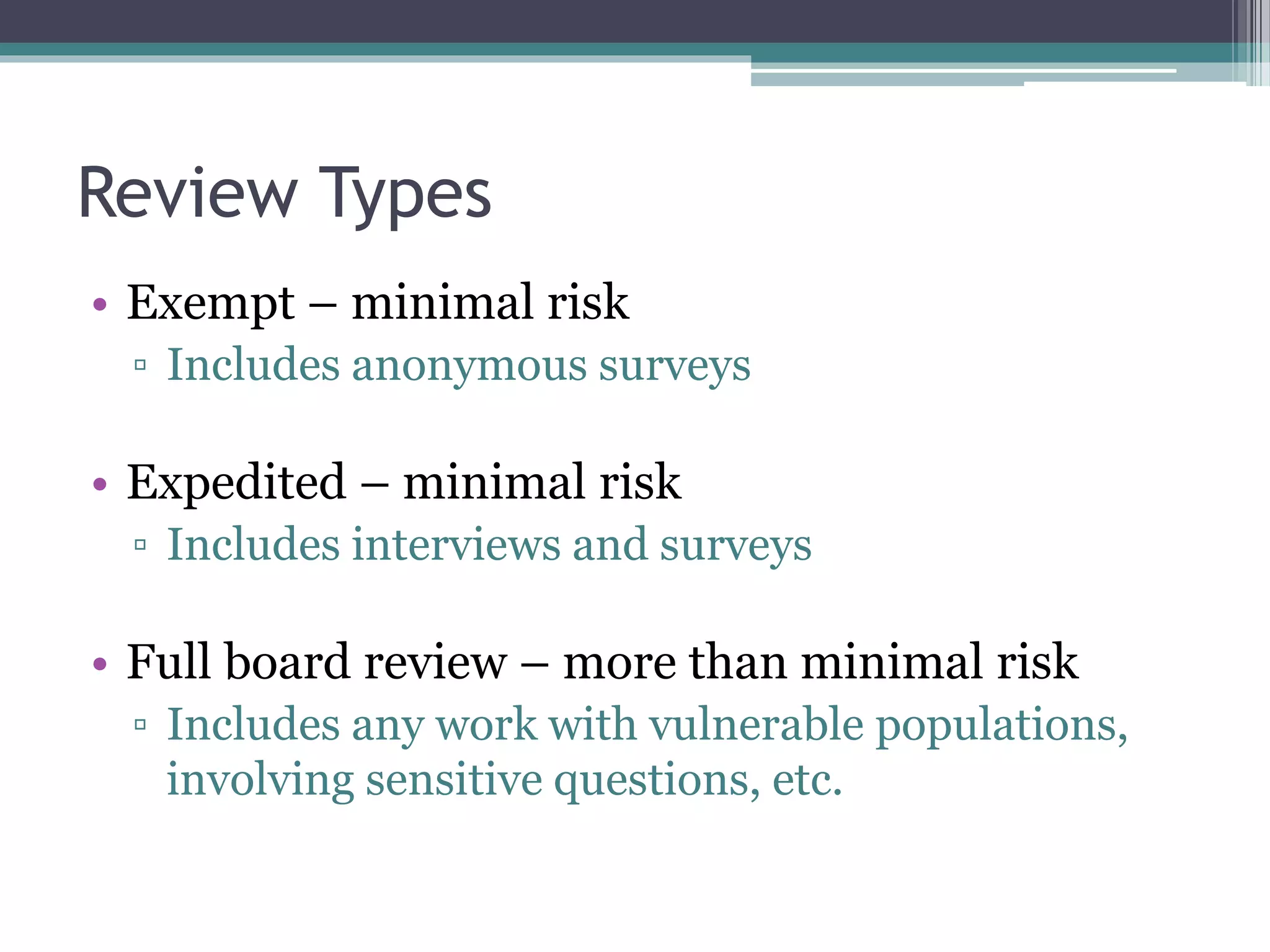
Review Types
• Exempt – minimal risk
▫ Includes anonymous surveys
• Expedited – minimal risk
▫ Includes interviews and surveys
• Full board review – more than minimal risk
▫ Includes any work with vulnerable populations,
involving sensitive questions, etc.
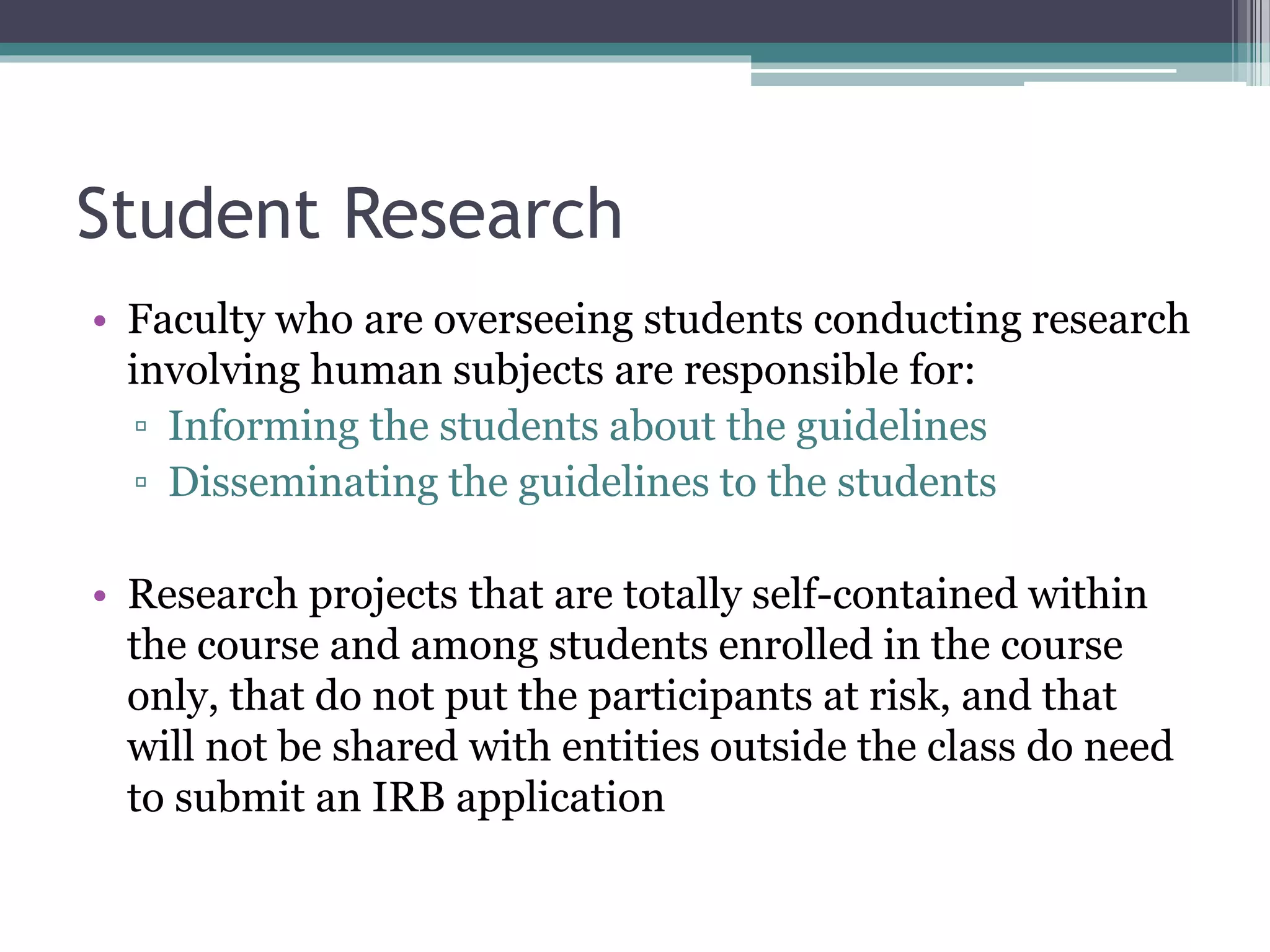
Student Research
• Faculty who are overseeing students conducting research
involving human subjects are responsible for:
▫ Informing the students about the guidelines
▫ Disseminating the guidelines to the students
• Research projects that are totally self-contained within
the course and among students enrolled in the course
only, that do not put the participants at risk, and that
will not be shared with entities outside the class do need
to submit an IRB application
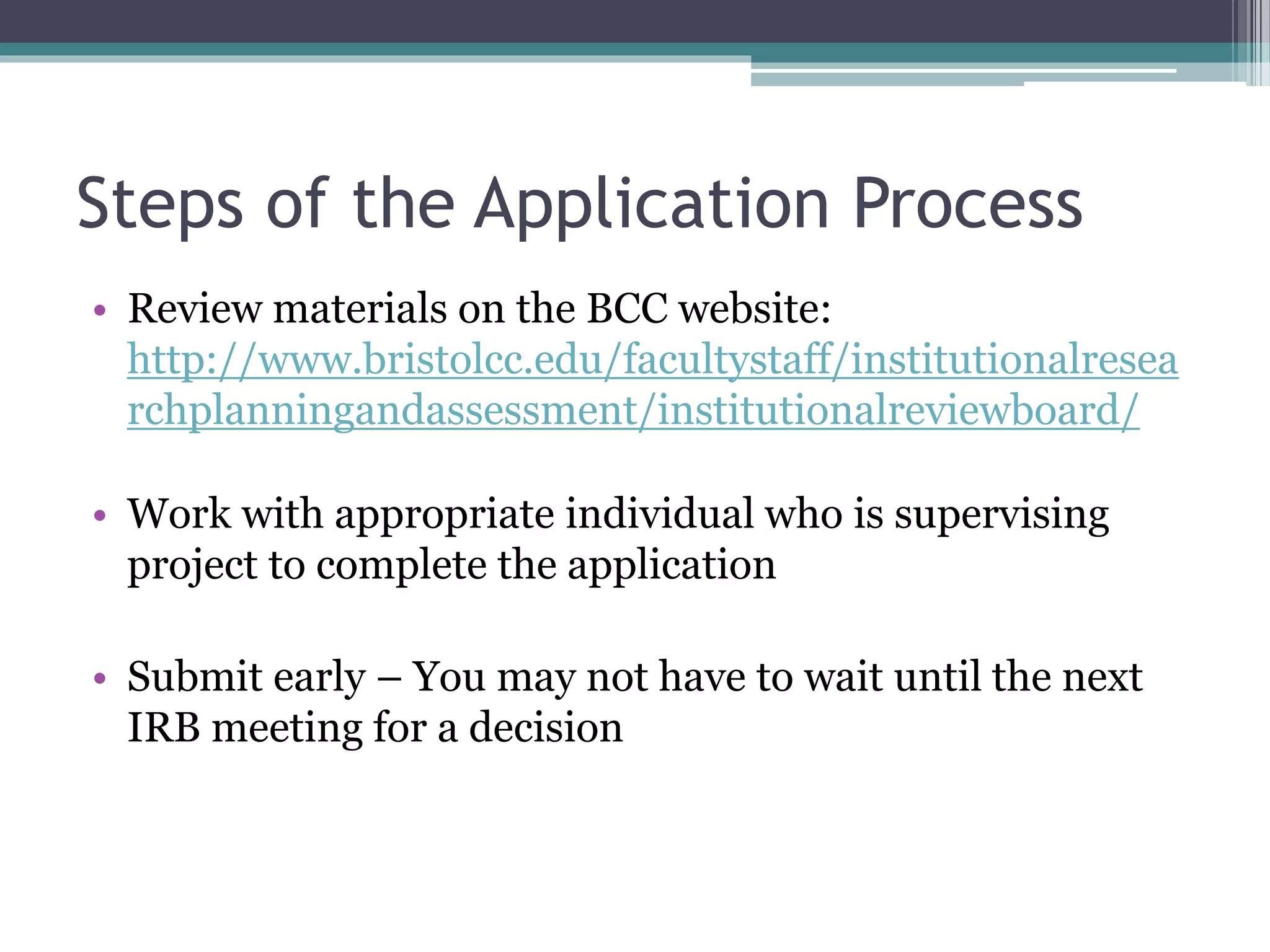
Steps of the Application Process
• Review materials on the BCC website:
http://www.bristolcc.edu/facultystaff/institutionalresea
rchplanningandassessment/institutionalreviewboard/
• Work with appropriate individual who is supervising
project to complete the application
• Submit early – You may not have to wait until the next
IRB meeting for a decision
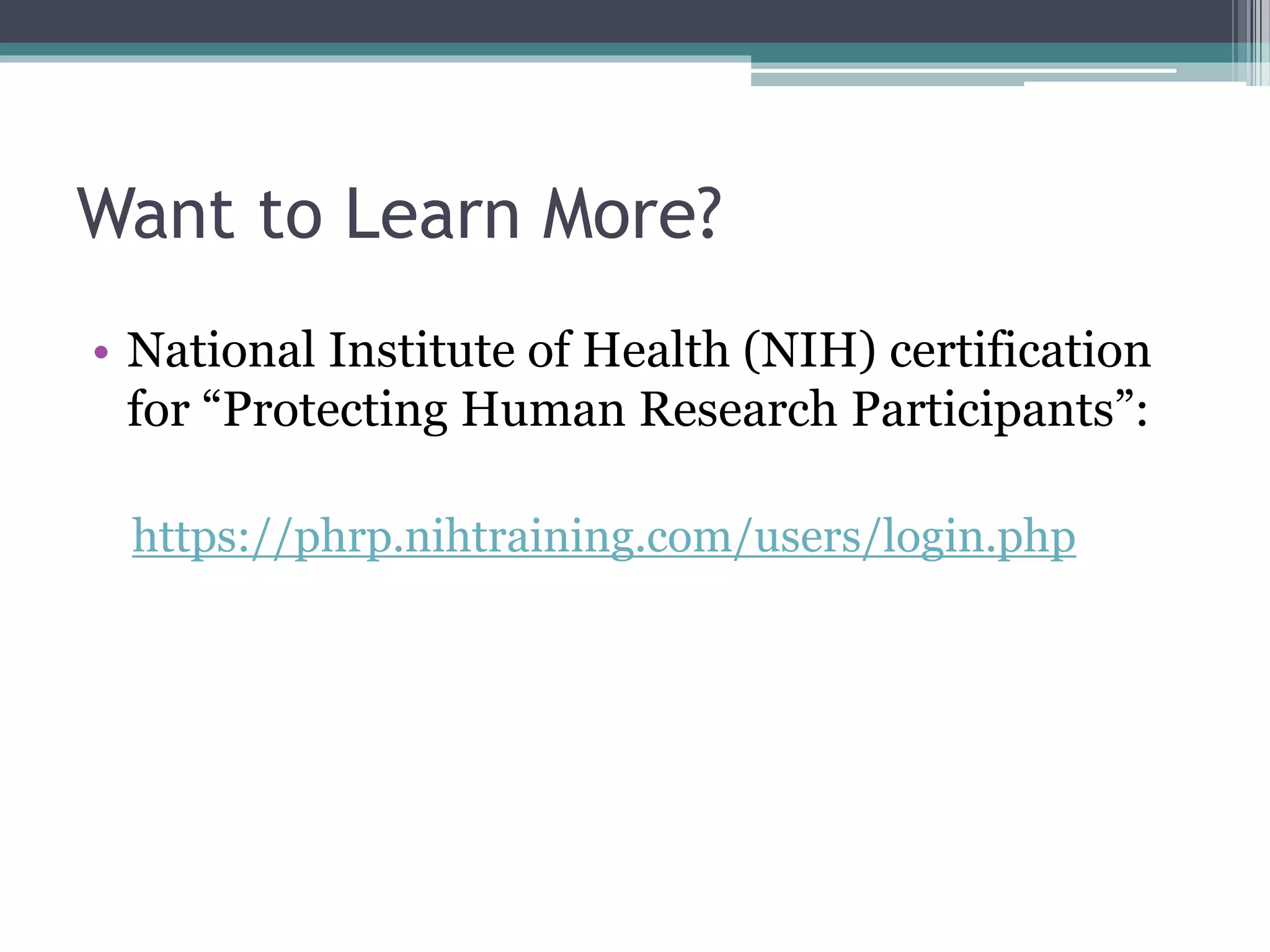
Want to Learn More?
• National Institute of Health (NIH) certification
for “Protecting Human Research Participants”:
https://phrp.nihtraining.com/users/login.php
References
• Amdur, R.J. and Bankert, E.A. (2007). Institutional
review board: Member handbook. Sudbury, MA: Jones
and Bartlett Publishers.
• Bankert, E.A. and Amdur, R.J. (2006). Institutional
review board: Management and function. Sudbury, MA:
Jones and Bartlett Publishers.
• Stanford University: Research with Human Subjects:
Research Compliance Office
• U.S. Department of Health & Human Services
• Health Information Privacy. (n.d.) Retrieved February
6, 2010, from http://www.hhs.gov/ocr/privacy.
Contact Information
Dr. Rhonda Gabovitch, IRB Chair
Vice President of Institutional Research, Planning, and Assessment
Phone: 508-678-2811 x 2835
Rhonda.Gabovitch@Bristolcc.edu
Angelina O’Brien, M.A., C.A.G.S, L.M.H.C.
Director, Institutional Research, Planning & Assessment
Administrator, Institutional Review Board
Phone: 508-678-2811 x 2019
Angelina.O’brien@Bristolcc.edu

Irb student presentation 9 16-15

  • 1.
    Introduction to the BristolCommunity College Institutional Review Board (IRB) Angelina O’Brien, M.A., C.A.G.S., L.M.H.C. Director, Institutional Research, Planning & Assessment Administrator, Institutional Review Board September 17, 2015
  • 2.
    What is anIRB? • An IRB functions like an ethics committee ▫ Focuses on what is right and wrong, what is desirable and undesirable • Ensures that the College is meeting the objectives of protecting people’s privacy, health and safety, and people’s ability to participate voluntarily in human subject research and meeting the federal regulations • The review and approval of activities by the IRB are meant to assist the researchers by having a review that will objectively analyze the potential risk involved to research participants, as well as ways to minimize that risk
  • 3.
    Many Unethical Studies •1962: The Thalidomide Experiment • 1964: Willowbrook Hepatitis Studies • 1932-1972: Tuskegee Syphilis Study
  • 4.
    Thalidomide – drugsold from 1957-1961 to treat unpleasant symptoms associated with pregnancy. It was not standard practice to inform patients of investigational nature of drugs. This drug caused severe growth problems. Public outrage led to amendment to Food, Drug, and Cosmetic Act that required investigators to obtain informed consent from potential subjects before administering investigational medications. Drug is still in use today for treating leprosy, multiple myeloma, lymphoma, and other cancers. Willowbrook Hepatitis Studies – 1956-1971. Series of studies done to understand issues related to transmission of hepatitis virus in children with mental illness at a state school. Dr. was trying to develop a vaccine against hepatitis. Study design involved intentionally infecting healthy children with hepatitis. Parents were told their children could not enroll unless they agreed to participate in this project. Tuskegee, Alabama – 1932-1972 U. S. Public Health Service funded study to evaluate natural history of untreated syphilis in human beings. At that time there was not an effective treatment for syphilis. Subject population was vulnerable – 399 indigent, uneducated, sharecroppers in Macon County who had syphilis. Subjects did not know about their condition or the research that was being conducted. Subjects thought they were getting free treatment, but were getting free spinal taps and did not know that the government was observing course of their illness. Wives contracted syphilis and babies were born with congenital syphilis. Penicillin was invented in 1940 and became the standard treatment but was not given to these subjects. This study led to the creation of the Belmont Report, the Office for Human Research Protections and Institutional Review Boards.
  • 5.
    Why do weneed the IRB? • The IRB is in place to uphold the three principles of the Belmont report: ▫ Principle 1: Respect for Persons  Voluntary participation  Informed consent  Privacy and confidentiality protected ▫ Principle 2: Beneficence  Risks of research justified by potential benefits to individual or society  Risks are minimized  Conflicts of interest managed adequately ▫ Principle 3: Justice  Vulnerable subjects not targeted because of convenience  People likely to benefit from research are not systematically excluded
  • 6.
    Who serves onthe IRB? • Must consist of at least 5 members • Must contain men and women • Must contain members with both scientific and nonscientific backgrounds • At least one member must represent welfare of special interest groups (minors, for example) • At least one member must not be affiliated with the institution • IRBs also have alternates who serve in the place of members who may not be able to attend or have to “recuse” themselves because of conflict of interest
  • 7.
    What does theIRB do? • Meets regularly and reviews research requests that come before them • Engages in training to learn more about the process • Makes decisions about how research can/cannot proceed
  • 8.
    Does all researchrequire review? • Will your research involve… ▫ Observational studies? ▫ Interventions within specific groups? ▫ Surveys or interviews? ▫ Educational tests? ▫ Analyzing human subjects data? • If your research involves any of these methods, then it needs to be reviewed by the IRB
  • 9.
    Review Types • Exempt– minimal risk ▫ Includes anonymous surveys • Expedited – minimal risk ▫ Includes interviews and surveys • Full board review – more than minimal risk ▫ Includes any work with vulnerable populations, involving sensitive questions, etc.
  • 10.
    Student Research • Facultywho are overseeing students conducting research involving human subjects are responsible for: ▫ Informing the students about the guidelines ▫ Disseminating the guidelines to the students • Research projects that are totally self-contained within the course and among students enrolled in the course only, that do not put the participants at risk, and that will not be shared with entities outside the class do need to submit an IRB application
  • 11.
    Steps of theApplication Process • Review materials on the BCC website: http://www.bristolcc.edu/facultystaff/institutionalresea rchplanningandassessment/institutionalreviewboard/ • Work with appropriate individual who is supervising project to complete the application • Submit early – You may not have to wait until the next IRB meeting for a decision
  • 12.
    Want to LearnMore? • National Institute of Health (NIH) certification for “Protecting Human Research Participants”: https://phrp.nihtraining.com/users/login.php
  • 13.
    References • Amdur, R.J.and Bankert, E.A. (2007). Institutional review board: Member handbook. Sudbury, MA: Jones and Bartlett Publishers. • Bankert, E.A. and Amdur, R.J. (2006). Institutional review board: Management and function. Sudbury, MA: Jones and Bartlett Publishers. • Stanford University: Research with Human Subjects: Research Compliance Office • U.S. Department of Health & Human Services • Health Information Privacy. (n.d.) Retrieved February 6, 2010, from http://www.hhs.gov/ocr/privacy.
  • 14.
    Contact Information Dr. RhondaGabovitch, IRB Chair Vice President of Institutional Research, Planning, and Assessment Phone: 508-678-2811 x 2835 Rhonda.Gabovitch@Bristolcc.edu Angelina O’Brien, M.A., C.A.G.S, L.M.H.C. Director, Institutional Research, Planning & Assessment Administrator, Institutional Review Board Phone: 508-678-2811 x 2019 Angelina.O’brien@Bristolcc.edu