Writing ProgramWriting Program
IRB ComplianceIRB Compliance
Information for faculty about student-conducted
research involving human participants
April 2015
IntroductionIntroduction
The Institutional Review Board (IRB) at the
University of Denver (DU) is responsible for
protecting the rights and safety of individuals
participating in research projects that
involve human participants.
The following PowerPoint is divided into
three sections:
◦ Writing Program IRB Compliance
◦ IRB oversight: what’s covered/what’s not
◦ Resources for faculty
WRIT IRBWRIT IRB
COMPLIANCECOMPLIANCE
WRIT IRB ComplianceWRIT IRB Compliance
 The IRB approved the Writing Program’s proposal that
student-conducted research projects in WRIT classes
involving human subjects be classified Exempt.
 This exempt approval means that as long as student-
conducted research abides by certain guidelines the
following applies:
◦ Students conducting fieldwork research observations,
interviews, and surveys in WRIT courses do not have to get
separate IRB approval to conduct that research.
◦ You, as instructor, do not have to complete an IRB application
nor have your students complete a Class Project Form for each
class project involving fieldwork research.
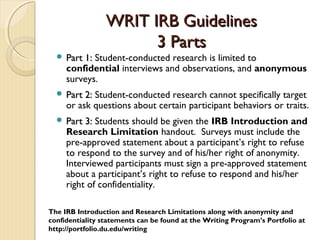
WRIT IRB GuidelinesWRIT IRB Guidelines
3 Parts3 Parts
 Part 1:Part 1: Student-conducted research is limited to
confidential interviews and observations, and anonymous
surveys.
 Part 2:Part 2: Student-conducted research cannot specifically target
or ask questions about certain participant behaviors or traits.
 Part 3:Part 3: Students should be given the IRB Introduction and
Research Limitation handout. Surveys must include the
pre-approved statement about a participant’s right to refuse
to respond to the survey and of his/her right of anonymity.
Interviewed participants must sign a pre-approved statement
about a participant’s right to refuse to respond and his/her
right of confidentiality.
The IRB Introduction and Research Limitations along with anonymity and
confidentiality statements can be found at the Writing Program’s Portfolio at
http://portfolio.du.edu/writing
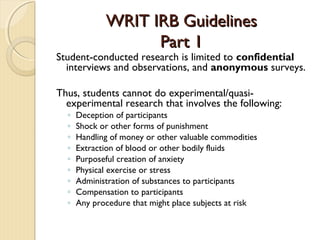
WRIT IRB GuidelinesWRIT IRB Guidelines
Part 1Part 1
Student-conducted research is limited to confidential
interviews and observations, and anonymous surveys.
Thus, students cannot do experimental/quasi-
experimental research that involves the following:
◦ Deception of participants
◦ Shock or other forms of punishment
◦ Handling of money or other valuable commodities
◦ Extraction of blood or other bodily fluids
◦ Purposeful creation of anxiety
◦ Physical exercise or stress
◦ Administration of substances to participants
◦ Compensation to participants
◦ Any procedure that might place subjects at risk
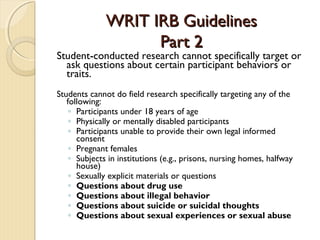
WRIT IRB GuidelinesWRIT IRB Guidelines
Part 2Part 2
Student-conducted research cannot specifically target or
ask questions about certain participant behaviors or
traits.
Students cannot do field research specifically targeting any of the
following:
◦ Participants under 18 years of age
◦ Physically or mentally disabled participants
◦ Participants unable to provide their own legal informed
consent
◦ Pregnant females
◦ Subjects in institutions (e.g., prisons, nursing homes, halfway
house)
◦ Sexually explicit materials or questions
◦ Questions about drug use
◦ Questions about illegal behavior
◦ Questions about suicide or suicidal thoughts
◦ Questions about sexual experiences or sexual abuse
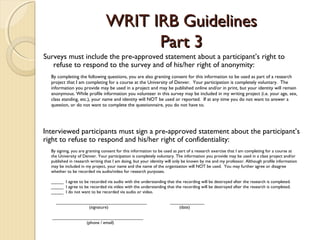
WRIT IRB GuidelinesWRIT IRB Guidelines
Part 3Part 3
Surveys must include the pre-approved statement about a participant’s right to
refuse to respond to the survey and of his/her right of anonymity:
By completing the following questions, you are also granting consent for this information to be used as part of a research
project that I am completing for a course at the University of Denver. Your participation is completely voluntary. The
information you provide may be used in a project and may be published online and/or in print, but your identity will remain
anonymous. While profile information you volunteer in this survey may be included in my writing project (i.e. your age, sex,
class standing, etc.), your name and identity will NOT be used or reported. If at any time you do not want to answer a
question, or do not want to complete the questionnaire, you do not have to.
By signing, you are granting consent for this information to be used as part of a research exercise that I am completing for a course at
the University of Denver. Your participation is completely voluntary. The information you provide may be used in a class project and/or
published in research writing that I am doing, but your identity will only be known by me and my professor. Although profile information
may be included in my project, your name and the name of the organization will NOT be used. You may further agree or disagree
whether to be recorded via audio/video for research purposes.
 
_____ I agree to be recorded via audio with the understanding that the recording will be destroyed after the research is completed.
_____ I agree to be recorded via video with the understanding that the recording will be destroyed after the research is completed.
_____ I do not want to be recorded via audio or video.
 
_____________________________________ ______________
(signature) (date)
 
_____________________________________
(phone / email)
Interviewed participants must sign a pre-approved statement about the participant’s
right to refuse to respond and his/her right of confidentiality:
IRB OVERSIGHT:IRB OVERSIGHT:
WHATWHAT’S COVERED’S COVERED
DefinitionsDefinitions
Research is defined as “a systematic
investigation, including development, testing,
and evaluation, designed to develop or
contribute to generalizable knowledge” (
45CFR46.102(d))
A human subject is defined as "a living
individual about whom an investigator
conducting research obtains (1) data
through intervention or interaction with the
individual, or (2) identifiable private
information." (45CFR46.102(f))
WhatWhat “research” means for“research” means for
WRIT student-conducted researchWRIT student-conducted research
Research leading to “generalizable knowledge”
DU IRB defines this as follows:
Investigations designed to develop or contribute to generalizable knowledge are those
designed to:
 draw general conclusions,
 test or generate a hypothesis,
 inform policy, or generalize findings beyond a single individual or an internal
program,
 offer benefits that extend beyond immediate population - to society, other
researchers, scholars, or practitioners in field contribute to a theoretical framework
or body of knowledge,
 or lead to publication or presentation to inform the field of study
Publication/presentation means anybody external to the study investigator andPublication/presentation means anybody external to the study investigator and
participants reading the study, which includes something as obvious asparticipants reading the study, which includes something as obvious as Writ LargeWrit Large
and not as obvious as peer review.and not as obvious as peer review.
WhatWhat “human-subjects” means for“human-subjects” means for
WRIT student-conducted researchWRIT student-conducted research
“a living individual about whom an investigator conducting
research obtains (1) data through intervention or interaction
with the individual, or (2) identifiable private information”
 The key phrase in this definition is “about whom”; it means that
“human subjects” specifically applies only to research that asks about
participants’ attitudes, beliefs, traits, behaviors, or values.
 According to the Collaborative Institutional Training Initiative [IRB
training course for students and faculty], “Information-gathering
interviews where questions focus on things, products, or policies
rather than about people or their thoughts regarding themselves are
not human subjects research. Example: canvassing librarians about
inter-library loan policies or rising journal costs” (Cho and Rose).
 Thus, for formal or informal interviews that students conduct in which
they are not asking about or revealing personal information, they are
not subject to IRB (although, they should abide by general research
ethics).
What this means forWhat this means for
WRIT coursesWRIT courses
 Journalistic assignments such as features or reporting that might involve interviews
by named or unnamed sources about things, phenomena or occurrences are not
considered research of human subjects.
 Journalistic assignments involving interviews or profiles of persons but that are not
meant to contribute to generalizable knowledge are not considered research of
human subjects.
 Observations of public behavior that do not name individuals are not considered
research of human subjects.
 Surveys or polls in which no personal information is asked for is not considered
research of human subjects.
 Research activities or lessons (e.g. interviews, observations, surveys) that you or
your students conduct in-class and are not reported or conducted outside of the
classroom are not considered research of human subjects.
 All other research consisting of organized study of human participants’
observable or reported attitudes, beliefs, behaviors, values, traits is
subject to IRB oversight. Because each university IRB interprets the
federal guidelines differently, only refer to resources from DU’s
IRB/ORSP website or the DU’s Writing Program’s IRB Compliance.
Further OptionsFurther Options
If you or your students have a project that would not work under the Writing
Program’s IRB compliance, there are three options available:
 Option 1:Option 1: If all students are following the same protocol (e.g. interview
questions, questionnaire/survey), you can apply for
Class Project IRB Approval by completing IRB training and a submitting an
IRB application for the assignment. This should be completed before the
term begins.
 Option 2:Option 2: If students are following different protocols for the same
assignment, you can apply for Class Project IRB Approval and each
student conducting the research will complete the Class Project Approval
Form. Your application should be completed before the term begins; the
students can fill the form out before they conduct the project.
 Option 3:Option 3: If students are doing independent projects that do not meet
the writing program’s IRB compliance guidelines, the student can submit
their own application to IRB—the student will have to complete necessary
IRB training.
RESOURCESRESOURCES
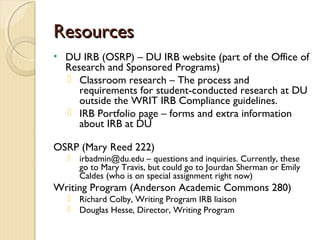
ResourcesResources
• DU IRB (OSRP) – DU IRB website (part of the Office of
Research and Sponsored Programs)
 Classroom research – The process and
requirements for student-conducted research at DU
outside the WRIT IRB Compliance guidelines.
 IRB Portfolio page – forms and extra information
about IRB at DU
OSRP (Mary Reed 222)
 irbadmin@du.edu – questions and inquiries. Currently, these
go to Mary Travis, but could go to Jourdan Sherman or Emily
Caldes (who is on special assignment right now)
Writing Program (Anderson Academic Commons 280)
 Richard Colby, Writing Program IRB liaison
 Douglas Hesse, Director, Writing Program

IRB Compliance

  • 1.
    Writing ProgramWriting Program IRBComplianceIRB Compliance Information for faculty about student-conducted research involving human participants April 2015
  • 2.
    IntroductionIntroduction The Institutional ReviewBoard (IRB) at the University of Denver (DU) is responsible for protecting the rights and safety of individuals participating in research projects that involve human participants. The following PowerPoint is divided into three sections: ◦ Writing Program IRB Compliance ◦ IRB oversight: what’s covered/what’s not ◦ Resources for faculty
  • 3.
  • 4.
    WRIT IRB ComplianceWRITIRB Compliance  The IRB approved the Writing Program’s proposal that student-conducted research projects in WRIT classes involving human subjects be classified Exempt.  This exempt approval means that as long as student- conducted research abides by certain guidelines the following applies: ◦ Students conducting fieldwork research observations, interviews, and surveys in WRIT courses do not have to get separate IRB approval to conduct that research. ◦ You, as instructor, do not have to complete an IRB application nor have your students complete a Class Project Form for each class project involving fieldwork research.
  • 5.
    WRIT IRB GuidelinesWRITIRB Guidelines 3 Parts3 Parts  Part 1:Part 1: Student-conducted research is limited to confidential interviews and observations, and anonymous surveys.  Part 2:Part 2: Student-conducted research cannot specifically target or ask questions about certain participant behaviors or traits.  Part 3:Part 3: Students should be given the IRB Introduction and Research Limitation handout. Surveys must include the pre-approved statement about a participant’s right to refuse to respond to the survey and of his/her right of anonymity. Interviewed participants must sign a pre-approved statement about a participant’s right to refuse to respond and his/her right of confidentiality. The IRB Introduction and Research Limitations along with anonymity and confidentiality statements can be found at the Writing Program’s Portfolio at http://portfolio.du.edu/writing
  • 6.
    WRIT IRB GuidelinesWRITIRB Guidelines Part 1Part 1 Student-conducted research is limited to confidential interviews and observations, and anonymous surveys. Thus, students cannot do experimental/quasi- experimental research that involves the following: ◦ Deception of participants ◦ Shock or other forms of punishment ◦ Handling of money or other valuable commodities ◦ Extraction of blood or other bodily fluids ◦ Purposeful creation of anxiety ◦ Physical exercise or stress ◦ Administration of substances to participants ◦ Compensation to participants ◦ Any procedure that might place subjects at risk
  • 7.
    WRIT IRB GuidelinesWRITIRB Guidelines Part 2Part 2 Student-conducted research cannot specifically target or ask questions about certain participant behaviors or traits. Students cannot do field research specifically targeting any of the following: ◦ Participants under 18 years of age ◦ Physically or mentally disabled participants ◦ Participants unable to provide their own legal informed consent ◦ Pregnant females ◦ Subjects in institutions (e.g., prisons, nursing homes, halfway house) ◦ Sexually explicit materials or questions ◦ Questions about drug use ◦ Questions about illegal behavior ◦ Questions about suicide or suicidal thoughts ◦ Questions about sexual experiences or sexual abuse
  • 8.
    WRIT IRB GuidelinesWRITIRB Guidelines Part 3Part 3 Surveys must include the pre-approved statement about a participant’s right to refuse to respond to the survey and of his/her right of anonymity: By completing the following questions, you are also granting consent for this information to be used as part of a research project that I am completing for a course at the University of Denver. Your participation is completely voluntary. The information you provide may be used in a project and may be published online and/or in print, but your identity will remain anonymous. While profile information you volunteer in this survey may be included in my writing project (i.e. your age, sex, class standing, etc.), your name and identity will NOT be used or reported. If at any time you do not want to answer a question, or do not want to complete the questionnaire, you do not have to. By signing, you are granting consent for this information to be used as part of a research exercise that I am completing for a course at the University of Denver. Your participation is completely voluntary. The information you provide may be used in a class project and/or published in research writing that I am doing, but your identity will only be known by me and my professor. Although profile information may be included in my project, your name and the name of the organization will NOT be used. You may further agree or disagree whether to be recorded via audio/video for research purposes.   _____ I agree to be recorded via audio with the understanding that the recording will be destroyed after the research is completed. _____ I agree to be recorded via video with the understanding that the recording will be destroyed after the research is completed. _____ I do not want to be recorded via audio or video.   _____________________________________ ______________ (signature) (date)   _____________________________________ (phone / email) Interviewed participants must sign a pre-approved statement about the participant’s right to refuse to respond and his/her right of confidentiality:
  • 9.
  • 10.
    DefinitionsDefinitions Research is definedas “a systematic investigation, including development, testing, and evaluation, designed to develop or contribute to generalizable knowledge” ( 45CFR46.102(d)) A human subject is defined as "a living individual about whom an investigator conducting research obtains (1) data through intervention or interaction with the individual, or (2) identifiable private information." (45CFR46.102(f))
  • 11.
    WhatWhat “research” meansfor“research” means for WRIT student-conducted researchWRIT student-conducted research Research leading to “generalizable knowledge” DU IRB defines this as follows: Investigations designed to develop or contribute to generalizable knowledge are those designed to:  draw general conclusions,  test or generate a hypothesis,  inform policy, or generalize findings beyond a single individual or an internal program,  offer benefits that extend beyond immediate population - to society, other researchers, scholars, or practitioners in field contribute to a theoretical framework or body of knowledge,  or lead to publication or presentation to inform the field of study Publication/presentation means anybody external to the study investigator andPublication/presentation means anybody external to the study investigator and participants reading the study, which includes something as obvious asparticipants reading the study, which includes something as obvious as Writ LargeWrit Large and not as obvious as peer review.and not as obvious as peer review.
  • 12.
    WhatWhat “human-subjects” meansfor“human-subjects” means for WRIT student-conducted researchWRIT student-conducted research “a living individual about whom an investigator conducting research obtains (1) data through intervention or interaction with the individual, or (2) identifiable private information”  The key phrase in this definition is “about whom”; it means that “human subjects” specifically applies only to research that asks about participants’ attitudes, beliefs, traits, behaviors, or values.  According to the Collaborative Institutional Training Initiative [IRB training course for students and faculty], “Information-gathering interviews where questions focus on things, products, or policies rather than about people or their thoughts regarding themselves are not human subjects research. Example: canvassing librarians about inter-library loan policies or rising journal costs” (Cho and Rose).  Thus, for formal or informal interviews that students conduct in which they are not asking about or revealing personal information, they are not subject to IRB (although, they should abide by general research ethics).
  • 13.
    What this meansforWhat this means for WRIT coursesWRIT courses  Journalistic assignments such as features or reporting that might involve interviews by named or unnamed sources about things, phenomena or occurrences are not considered research of human subjects.  Journalistic assignments involving interviews or profiles of persons but that are not meant to contribute to generalizable knowledge are not considered research of human subjects.  Observations of public behavior that do not name individuals are not considered research of human subjects.  Surveys or polls in which no personal information is asked for is not considered research of human subjects.  Research activities or lessons (e.g. interviews, observations, surveys) that you or your students conduct in-class and are not reported or conducted outside of the classroom are not considered research of human subjects.  All other research consisting of organized study of human participants’ observable or reported attitudes, beliefs, behaviors, values, traits is subject to IRB oversight. Because each university IRB interprets the federal guidelines differently, only refer to resources from DU’s IRB/ORSP website or the DU’s Writing Program’s IRB Compliance.
  • 14.
    Further OptionsFurther Options Ifyou or your students have a project that would not work under the Writing Program’s IRB compliance, there are three options available:  Option 1:Option 1: If all students are following the same protocol (e.g. interview questions, questionnaire/survey), you can apply for Class Project IRB Approval by completing IRB training and a submitting an IRB application for the assignment. This should be completed before the term begins.  Option 2:Option 2: If students are following different protocols for the same assignment, you can apply for Class Project IRB Approval and each student conducting the research will complete the Class Project Approval Form. Your application should be completed before the term begins; the students can fill the form out before they conduct the project.  Option 3:Option 3: If students are doing independent projects that do not meet the writing program’s IRB compliance guidelines, the student can submit their own application to IRB—the student will have to complete necessary IRB training.
  • 15.
  • 16.
    ResourcesResources • DU IRB(OSRP) – DU IRB website (part of the Office of Research and Sponsored Programs)  Classroom research – The process and requirements for student-conducted research at DU outside the WRIT IRB Compliance guidelines.  IRB Portfolio page – forms and extra information about IRB at DU OSRP (Mary Reed 222)  irbadmin@du.edu – questions and inquiries. Currently, these go to Mary Travis, but could go to Jourdan Sherman or Emily Caldes (who is on special assignment right now) Writing Program (Anderson Academic Commons 280)  Richard Colby, Writing Program IRB liaison  Douglas Hesse, Director, Writing Program