Copyright © 2014 John Wiley & Sons, Inc. All rights reserved.
CHAPTER 26
The Urinary System
Principles of
Anatomy and
Physiology
14th
Edition
Consists of the kidneys, ureters, bladder,
and urethra
Maintains homeostasis by managing the
volume and composition of fluid
reservoirs, primarily blood
The Urinary System
Copyright © 2014 John Wiley & Sons, Inc. All rights reserved.
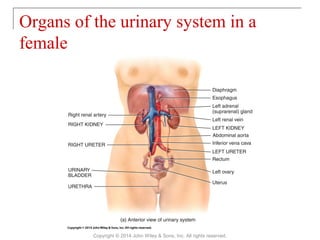
Organs of the urinary system in a
female
Copyright © 2014 John Wiley & Sons, Inc. All rights reserved.
Regulation of blood ionic composition
Na+, K+
, Cl–
Regulation of blood pH
H+
, HCO3
–
Regulation of blood volume
H20
Regulation of blood pressure
Homeostatic Kidney Functions
Copyright © 2014 John Wiley & Sons, Inc. All rights reserved.
Maintenance of blood osmolarity
Production of hormones
Calcitrol and Erythropoietin
Regulation of blood glucose level
Excretion of metabolic wastes and foreign
substances (drugs or toxins)
Homeostatic Kidney Functions
Copyright © 2014 John Wiley & Sons, Inc. All rights reserved.
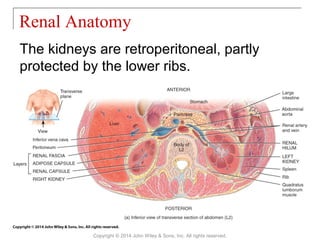
The kidneys are retroperitoneal, partly
protected by the lower ribs.
Renal Anatomy
Copyright © 2014 John Wiley & Sons, Inc. All rights reserved.
Renal Anatomy
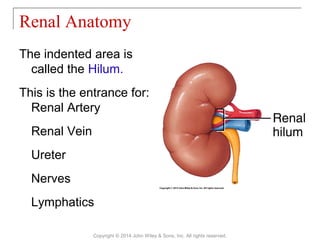
The indented area is
called the Hilum.
This is the entrance for:
Renal Artery
Renal Vein
Ureter
Nerves
Lymphatics
Copyright © 2014 John Wiley & Sons, Inc. All rights reserved.
Connective Tissue, Superficial to Deep
• Renal Fascia - Anchors to other structures
• Adipose Capsule – Protects and anchors
• Renal Capsule – Continuous with Ureter
External Layers
Copyright © 2014 John Wiley & Sons, Inc. All rights reserved.
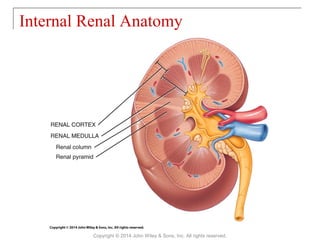
Renal Cortex – Outer layer
Renal Medulla – Inner region
Renal Pyramids – Secreting Apparatus and
Tubules
Renal Columns – Anchor the Cortex
Internal Renal Anatomy
Copyright © 2014 John Wiley & Sons, Inc. All rights reserved.
Internal Renal Anatomy
Copyright © 2014 John Wiley & Sons, Inc. All rights reserved.
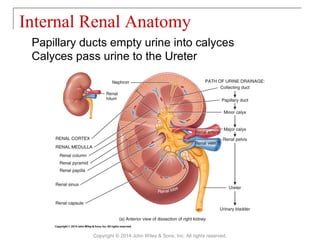
Papillary ducts empty urine into calyces
Calyces pass urine to the Ureter
Internal Renal Anatomy
Copyright © 2014 John Wiley & Sons, Inc. All rights reserved.
Blood supply
Although kidneys constitute less than 0.5% of total
body mass, they receive 20–25% of resting cardiac
output
Nerve Supply
Renal Nerves primarily carry sympathetic outflow
They regulate blood flow through the kidneys
Blood and Nerve supply of the
Kidneys
Copyright © 2014 John Wiley & Sons, Inc. All rights reserved.
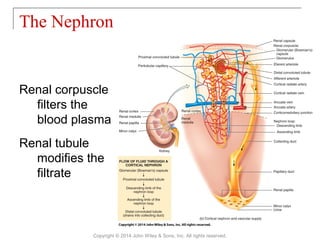
The Nephron
Renal corpuscle
filters the
blood plasma
Renal tubule
modifies the
filtrate
Copyright © 2014 John Wiley & Sons, Inc. All rights reserved.
The Renal Corpuscle consists of two parts:
The Glomerulus is a mass of capillaries.
The Glomerular (Bowman’s) Capsule has a
visceral layer of podocytes which wrap
around the capillaries.
The Renal Corpuscle
Copyright © 2014 John Wiley & Sons, Inc. All rights reserved.
The Glomerulus is a mass of capillaries.
It is fed by the Afferent Arteriole and drains
into the Efferent Arteriole.
Mesangial cells are contractile and help
regulate glomerular filtration.
The Renal Corpuscle
Copyright © 2014 John Wiley & Sons, Inc. All rights reserved.
The Glomerular (Bowman’s) Capsule has a
visceral layer of podocytes which wrap
around the capillaries.
The filtrate is collected between the visceral
and parietal layers.
The Renal Corpuscle
Copyright © 2014 John Wiley & Sons, Inc. All rights reserved.
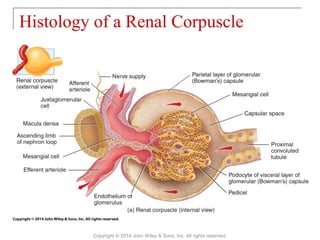
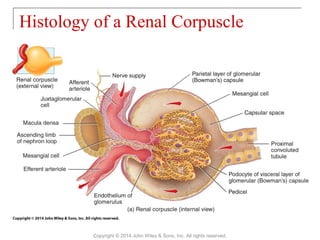
Histology of a Renal Corpuscle
Copyright © 2014 John Wiley & Sons, Inc. All rights reserved.
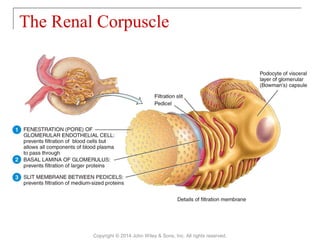
The glomerular endothelial cells have large
pores (fenestrations) and are leaky.
Basal lamina lies between endothelium and
podocytes.
Podocytes form pedicels, between which
are filtration slits.
The Renal Corpuscle
Copyright © 2014 John Wiley & Sons, Inc. All rights reserved.
The Renal Corpuscle
Copyright © 2014 John Wiley & Sons, Inc. All rights reserved.
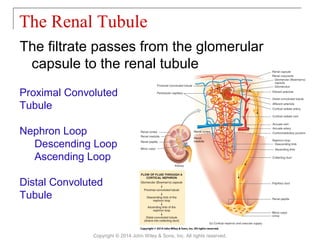
The filtrate passes from the glomerular
capsule to the renal tubule
The Renal Tubule
Copyright © 2014 John Wiley & Sons, Inc. All rights reserved.
Proximal Convoluted
Tubule
Nephron Loop
Descending Loop
Ascending Loop
Distal Convoluted
Tubule
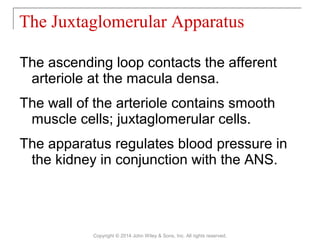
The ascending loop contacts the afferent
arteriole at the macula densa.
The wall of the arteriole contains smooth
muscle cells; juxtaglomerular cells.
The apparatus regulates blood pressure in
the kidney in conjunction with the ANS.
The Juxtaglomerular Apparatus
Copyright © 2014 John Wiley & Sons, Inc. All rights reserved.
Histology of a Renal Corpuscle
Copyright © 2014 John Wiley & Sons, Inc. All rights reserved.
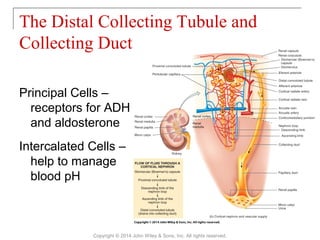
The Distal Collecting Tubule and
Collecting Duct
Principal Cells –
receptors for ADH
and aldosterone
Intercalated Cells –
help to manage
blood pH
Copyright © 2014 John Wiley & Sons, Inc. All rights reserved.
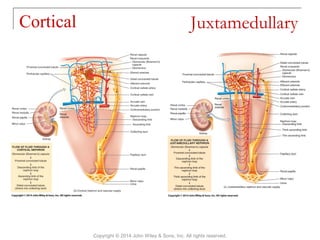
Cortical nephrons – 80-85% of nephrons
Renal corpuscle in outer portion of cortex
Short loops of Henle extend only into outer region
of medulla
Create urine with osmolarity similar to blood
Two Kinds of Nephrons
Copyright © 2014 John Wiley & Sons, Inc. All rights reserved.
Renal corpuscle deep in cortex with long
nephron loops
Receive blood from peritubular capillaries
and vasa recta
Ascending limb has thick and thin regions
Enable kidney to secrete very concentrated
urine
Juxtamedullary Nephrons
Copyright © 2014 John Wiley & Sons, Inc. All rights reserved.
Cortical
Copyright © 2014 John Wiley & Sons, Inc. All rights reserved.
Juxtamedullary
Renal Physiology - Urine Formation
Copyright © 2014 John Wiley & Sons, Inc. All rights reserved.
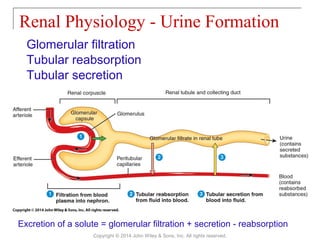
Glomerular filtration
Tubular reabsorption
Tubular secretion
Excretion of a solute = glomerular filtration + secretion - reabsorption
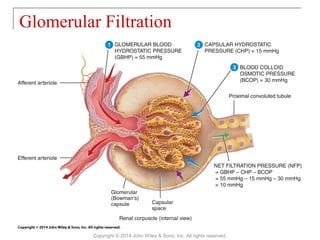
Driven by blood pressure
Opposed by capsular hydrostatic pressure
and blood colloid osmotic pressure
Water and small molecules move out of the
glomerulus.
In one day, 150–180 liters of water pass out
into the glomerular capsule.
Glomerular Filtration
Copyright © 2014 John Wiley & Sons, Inc. All rights reserved.
Glomerular filtration rate – amount of filtrate
formed by both kidneys each minute
Homeostasis requires kidneys to maintain a
relatively constant GFR
Too high – substances pass too quickly and are not
reabsorbed
Too low – nearly all reabsorbed and some waste
products not adequately excreted
Glomerular filtration
Copyright © 2014 John Wiley & Sons, Inc. All rights reserved.
Glomerular Filtration
Copyright © 2014 John Wiley & Sons, Inc. All rights reserved.
Glomerular Filtration
Copyright © 2014 John Wiley & Sons, Inc. All rights reserved.
 Renal Filtration
Interactions Animation:
You must be connected to the Internet and in Slideshow Mode to
run this animation.
GFR averages 125mL/min in males and
105mL/min in females
Controlled by:
Renal Autoregulation
Neural Regulation
Hormonal Regulation
Glomerular Filtration Rate
Copyright © 2014 John Wiley & Sons, Inc. All rights reserved.
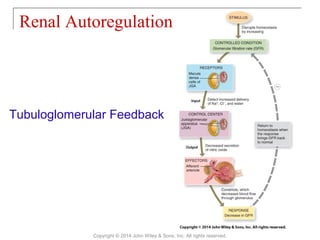
Myogenic Mechanism
Smooth muscle cells in afferent arterioles contract in
response to elevated blood pressure
Tubuloglomerular Feedback
High GFR diminishes reabsorption
Macula Densa inhibits release of nitric oxide
Afferent arterioles constrict
Renal Autoregulation
Copyright © 2014 John Wiley & Sons, Inc. All rights reserved.
Renal Autoregulation
Copyright © 2014 John Wiley & Sons, Inc. All rights reserved.
Tubuloglomerular Feedback
Kidneys are richly supplied by sympathetic
fibers.
Strong stimulation (exercise or
hemorrhage)–afferent arterioles are
constricted.
Urine output is reduced, and more blood is
available for other organs.
Neural Regulation
Copyright © 2014 John Wiley & Sons, Inc. All rights reserved.
Angiotensin II constricts afferents and
efferents, diminishing GFR.
Atrial Natriuretic Peptide relaxes mesangial
cells, increasing capillary surface area and
GFR.
ANP is secreted in response to stretch of
the cardiac atria.
Hormonal Regulation
Copyright © 2014 John Wiley & Sons, Inc. All rights reserved.
Much of the filtrate is reabsorbed
Especially water, glucose, amino acids, and
ions
Secretion helps to mange pH and rid the
body of toxic and foreign substances.
Tubular Reabsorption and Secretion
Copyright © 2014 John Wiley & Sons, Inc. All rights reserved.
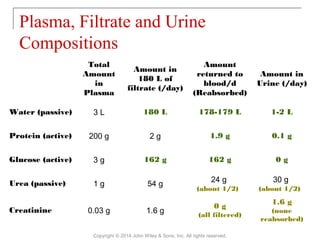
Total
Amount
in
Plasma
Amount in
180 L of
filtrate (/day)
Amount
returned to
blood/d
(Reabsorbed)
Amount in
Urine (/day)
Water (passive) 3 L 180 L 178-179 L 1-2 L
Protein (active) 200 g 2 g 1.9 g 0.1 g
Glucose (active) 3 g 162 g 162 g 0 g
Urea (passive) 1 g 54 g
24 g
(about 1/2)
30 g
(about 1/2)
Creatinine 0.03 g 1.6 g
0 g
(all filtered)
1.6 g
(none
reabsorbed)
Plasma, Filtrate and Urine
Compositions
Copyright © 2014 John Wiley & Sons, Inc. All rights reserved.
Much of the filtrate is reabsorbed by both
active and passive processes.
Especially water, glucose, amino acids, and
ions
Secretion helps to mange pH and rid the
body of toxic and foreign substances.
Tubular Reabsorption and Secretion
Copyright © 2014 John Wiley & Sons, Inc. All rights reserved.
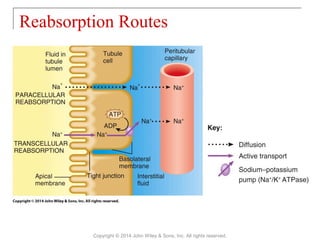
Paracellular Reabsorption
Passive fluid leakage between cells
Transcellular Reabsorption
Directly through the tubule cells
Reabsorption Routes
Copyright © 2014 John Wiley & Sons, Inc. All rights reserved.
Reabsorption Routes
Copyright © 2014 John Wiley & Sons, Inc. All rights reserved.
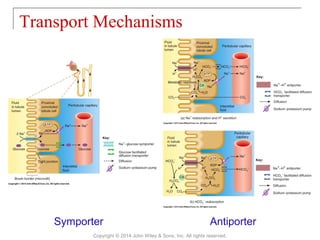
Primary Active Transport
Uses ATP, like Na+
/K+
pumps
At rest, accounts for 6% total body ATP
use
Secondary Active Transport
Driven by ion’s electrochemical gradient
Symporters move substances in same
direction
Antiporters move substances in opposite
directions
Transport Mechanisms
Copyright © 2014 John Wiley & Sons, Inc. All rights reserved.
Obligatory Water Reabsorption – 90%
Water follows the solutes that are
reabsorbed
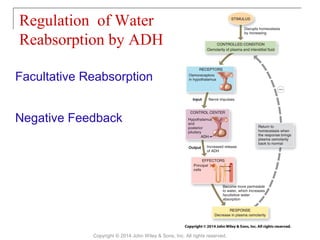
Facultative Water Reabsorption – 10%
Regulated by ADH
Water Reabsorption
Copyright © 2014 John Wiley & Sons, Inc. All rights reserved.
Na+
- Glucose Symporters
Na+
- H+
Antiporters
Aquaporin - 1
Membrane protein permeable to water
Reabsorption and Secretion in PCT
Copyright © 2014 John Wiley & Sons, Inc. All rights reserved.
Transport Mechanisms
Copyright © 2014 John Wiley & Sons, Inc. All rights reserved.
AntiporterSymporter
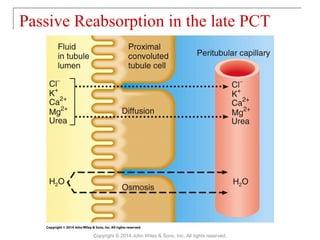
Passive Reabsorption in the late PCT
Copyright © 2014 John Wiley & Sons, Inc. All rights reserved.
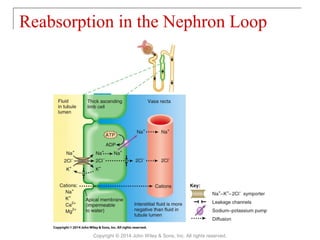
Relatively impermeable to water, especially
the ascending limb
Little obligatory water reabsorption
Na+
- K+
- 2Cl–
symporters
Reabsorption in the Loop of Henle
Copyright © 2014 John Wiley & Sons, Inc. All rights reserved.
Reabsorption in the Nephron Loop
Copyright © 2014 John Wiley & Sons, Inc. All rights reserved.
Na+
- Cl–
symporters reabsorb ions
PTH stimulates reabsorption of Ca2+
It also inhibits phosphate reabsorption in the
PCT, enhancing its excretion
Reabsorption in early DCT
Copyright © 2014 John Wiley & Sons, Inc. All rights reserved.
Principal Cells
Na+
-K+
pumps reabsorb Na+
Aquaporin – 2 reabsorbs water
Stimulated by ADH
Intercalated Cells
Reabsorb K+
+ HCO3
–
, secrete H+
Late DCT and Collecting Duct
Copyright © 2014 John Wiley & Sons, Inc. All rights reserved.
Regulation of Water
Reabsorption by ADH
Copyright © 2014 John Wiley & Sons, Inc. All rights reserved.
Facultative Reabsorption
Negative Feedback
Fluid intake is highly variable.
Homeostasis requires maintenance of fluid
volumes within specific limits.
Urine concentration varies with ADH.
Urine Production
Copyright © 2014 John Wiley & Sons, Inc. All rights reserved.
High intake – Dilute urine of high volume
Low intake – Concentrated urine of low
volume
Urine Production
Copyright © 2014 John Wiley & Sons, Inc. All rights reserved.
Glomerular filtrate and blood have the same
osmolarity – 300mOsm/Liter
Tubular osmolarity changes due to a
concentration gradient in the medulla
Formation of Dilute Urine
Copyright © 2014 John Wiley & Sons, Inc. All rights reserved.
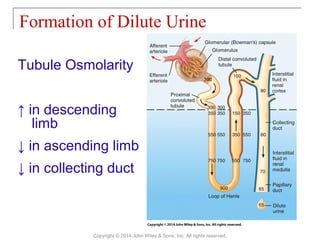
When dilute urine is formed, osmolarity in
the tubule
1. Increases in the descending limb
2. Decreases in the ascending limb
3. Decreases more in the collecting duct
Formation of Dilute Urine
Copyright © 2014 John Wiley & Sons, Inc. All rights reserved.
Formation of Dilute Urine
Copyright © 2014 John Wiley & Sons, Inc. All rights reserved.
Tubule Osmolarity
↑ in descending
limb
↓ in ascending limb
↓ in collecting duct
Thick Ascending Limb
Symporters actively resorb Na+
, K+
, Cl–
Low water permeablility
Solutes leave, water stays in tubule
Collecting Duct
Low water permeability in absence of
ADH
Formation of Dilute Urine
Copyright © 2014 John Wiley & Sons, Inc. All rights reserved.
Formation of Dilute Urine
Copyright © 2014 John Wiley & Sons, Inc. All rights reserved.
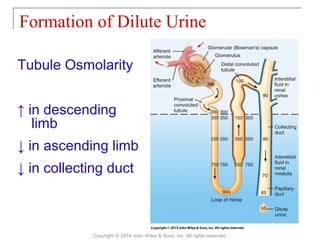
Tubule Osmolarity
↑ in descending
limb
↓ in ascending limb
↓ in collecting duct
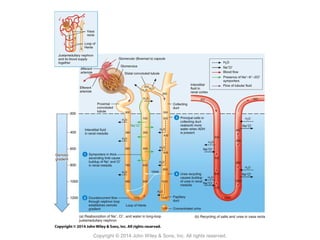
Juxtamedullary Nephrons with long loops
Osmotic gradient is created by the
Countercurrent Multiplier
Solutes pumped out of ascending limb, but
water stays in tubule
Medulla osmolarity is increased
Formation of Concentrated Urine
Copyright © 2014 John Wiley & Sons, Inc. All rights reserved.
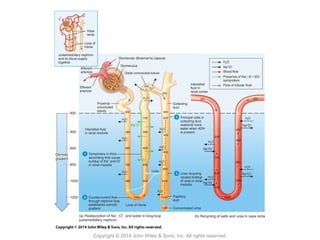
In presence of ADH, collecting ducts
become very permeable to water.
Tubular fluid there becomes very
concentrated.
Movement of water also carries urea into the
medulla, contributing to its osmolarity.
Formation of Concentrated Urine
Copyright © 2014 John Wiley & Sons, Inc. All rights reserved.
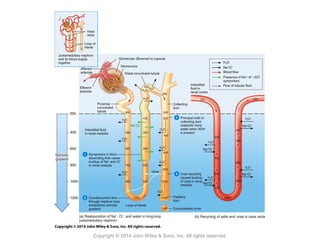
Loop and duct cells require nutrients and
oxygen from blood supply.
Capillaries that feed them (vasa recta) form
loops like those of nephron loops in the
medulla.
Incoming and outgoing blood will have
similar osmolarity.
This maintains medulla concentration
gradient.
Countercurrent Exchange
Copyright © 2014 John Wiley & Sons, Inc. All rights reserved.
Tubular Reabsorption
Copyright © 2014 John Wiley & Sons, Inc. All rights reserved.
Water Homeostasis
Interactions Animation:
You must be connected to the Internet and in Slideshow Mode to
run this animation.
Routine urinalysis primarily evaluates for the
presence of abnormalities in the urine:
Albumin
Glucose
Red blood cells
Ketone bodies
Microbes
Evaluation of Kidney Function
Copyright © 2014 John Wiley & Sons, Inc. All rights reserved.
Each ureter transports urine from a renal pelvis by
peristaltic waves, hydrostatic pressure, and
gravity.
No anatomical valve at the opening of the ureter into
bladder – when bladder fills, it compresses the
opening and prevents backflow.
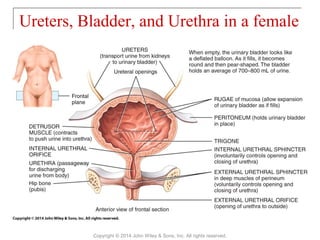
The bladder is a hollow, distensible, muscular organ
with a capacity averaging 700–800 mL.
Urine Transportation and Storage
Copyright © 2014 John Wiley & Sons, Inc. All rights reserved.
Ureters, Bladder, and Urethra in a female
Copyright © 2014 John Wiley & Sons, Inc. All rights reserved.
The discharge of urine involves voluntary
and involuntary muscle contractions.
Stretch receptors trigger a spinal reflex,
which we learn to control in childhood.
The urethra carries urine from the internal
urethral orifice to the exterior of the body.
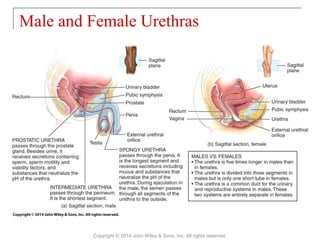
In males, it discharges semen as well as
urine.
Micturition
Copyright © 2014 John Wiley & Sons, Inc. All rights reserved.
Male and Female Urethras
Copyright © 2014 John Wiley & Sons, Inc. All rights reserved.
Copyright 2014 John Wiley & Sons, Inc.
All rights reserved. Reproduction or translation of this
work beyond that permitted in section 117 of the 1976
United States Copyright Act without express
permission of the copyright owner is unlawful. Request
for further information should be addressed to the
Permission Department, John Wiley & Sons, Inc. The
purchaser may make back-up copies for his/her own
use only and not for distribution or resale. The
Publishers assumes no responsibility for errors,
omissions, or damages caused by the use of these
programs or from the use of the information herein.
End of Chapter 26
Copyright © 2014 John Wiley & Sons, Inc. All rights reserved.

26 [chapter 26 the urinary system]

  • 1.
    Copyright © 2014John Wiley & Sons, Inc. All rights reserved. CHAPTER 26 The Urinary System Principles of Anatomy and Physiology 14th Edition
  • 2.
    Consists of thekidneys, ureters, bladder, and urethra Maintains homeostasis by managing the volume and composition of fluid reservoirs, primarily blood The Urinary System Copyright © 2014 John Wiley & Sons, Inc. All rights reserved.
  • 3.
    Organs of theurinary system in a female Copyright © 2014 John Wiley & Sons, Inc. All rights reserved.
  • 4.
    Regulation of bloodionic composition Na+, K+ , Cl– Regulation of blood pH H+ , HCO3 – Regulation of blood volume H20 Regulation of blood pressure Homeostatic Kidney Functions Copyright © 2014 John Wiley & Sons, Inc. All rights reserved.
  • 5.
    Maintenance of bloodosmolarity Production of hormones Calcitrol and Erythropoietin Regulation of blood glucose level Excretion of metabolic wastes and foreign substances (drugs or toxins) Homeostatic Kidney Functions Copyright © 2014 John Wiley & Sons, Inc. All rights reserved.
  • 6.
    The kidneys areretroperitoneal, partly protected by the lower ribs. Renal Anatomy Copyright © 2014 John Wiley & Sons, Inc. All rights reserved.
  • 7.
    Renal Anatomy The indentedarea is called the Hilum. This is the entrance for: Renal Artery Renal Vein Ureter Nerves Lymphatics Copyright © 2014 John Wiley & Sons, Inc. All rights reserved.
  • 8.
    Connective Tissue, Superficialto Deep • Renal Fascia - Anchors to other structures • Adipose Capsule – Protects and anchors • Renal Capsule – Continuous with Ureter External Layers Copyright © 2014 John Wiley & Sons, Inc. All rights reserved.
  • 9.
    Renal Cortex –Outer layer Renal Medulla – Inner region Renal Pyramids – Secreting Apparatus and Tubules Renal Columns – Anchor the Cortex Internal Renal Anatomy Copyright © 2014 John Wiley & Sons, Inc. All rights reserved.
  • 10.
    Internal Renal Anatomy Copyright© 2014 John Wiley & Sons, Inc. All rights reserved.
  • 11.
    Papillary ducts emptyurine into calyces Calyces pass urine to the Ureter Internal Renal Anatomy Copyright © 2014 John Wiley & Sons, Inc. All rights reserved.
  • 12.
    Blood supply Although kidneysconstitute less than 0.5% of total body mass, they receive 20–25% of resting cardiac output Nerve Supply Renal Nerves primarily carry sympathetic outflow They regulate blood flow through the kidneys Blood and Nerve supply of the Kidneys Copyright © 2014 John Wiley & Sons, Inc. All rights reserved.
  • 13.
    The Nephron Renal corpuscle filtersthe blood plasma Renal tubule modifies the filtrate Copyright © 2014 John Wiley & Sons, Inc. All rights reserved.
  • 14.
    The Renal Corpuscleconsists of two parts: The Glomerulus is a mass of capillaries. The Glomerular (Bowman’s) Capsule has a visceral layer of podocytes which wrap around the capillaries. The Renal Corpuscle Copyright © 2014 John Wiley & Sons, Inc. All rights reserved.
  • 15.
    The Glomerulus isa mass of capillaries. It is fed by the Afferent Arteriole and drains into the Efferent Arteriole. Mesangial cells are contractile and help regulate glomerular filtration. The Renal Corpuscle Copyright © 2014 John Wiley & Sons, Inc. All rights reserved.
  • 16.
    The Glomerular (Bowman’s)Capsule has a visceral layer of podocytes which wrap around the capillaries. The filtrate is collected between the visceral and parietal layers. The Renal Corpuscle Copyright © 2014 John Wiley & Sons, Inc. All rights reserved.
  • 17.
    Histology of aRenal Corpuscle Copyright © 2014 John Wiley & Sons, Inc. All rights reserved.
  • 18.
    The glomerular endothelialcells have large pores (fenestrations) and are leaky. Basal lamina lies between endothelium and podocytes. Podocytes form pedicels, between which are filtration slits. The Renal Corpuscle Copyright © 2014 John Wiley & Sons, Inc. All rights reserved.
  • 19.
    The Renal Corpuscle Copyright© 2014 John Wiley & Sons, Inc. All rights reserved.
  • 20.
    The filtrate passesfrom the glomerular capsule to the renal tubule The Renal Tubule Copyright © 2014 John Wiley & Sons, Inc. All rights reserved. Proximal Convoluted Tubule Nephron Loop Descending Loop Ascending Loop Distal Convoluted Tubule
  • 21.
    The ascending loopcontacts the afferent arteriole at the macula densa. The wall of the arteriole contains smooth muscle cells; juxtaglomerular cells. The apparatus regulates blood pressure in the kidney in conjunction with the ANS. The Juxtaglomerular Apparatus Copyright © 2014 John Wiley & Sons, Inc. All rights reserved.
  • 22.
    Histology of aRenal Corpuscle Copyright © 2014 John Wiley & Sons, Inc. All rights reserved.
  • 23.
    The Distal CollectingTubule and Collecting Duct Principal Cells – receptors for ADH and aldosterone Intercalated Cells – help to manage blood pH Copyright © 2014 John Wiley & Sons, Inc. All rights reserved.
  • 24.
    Cortical nephrons –80-85% of nephrons Renal corpuscle in outer portion of cortex Short loops of Henle extend only into outer region of medulla Create urine with osmolarity similar to blood Two Kinds of Nephrons Copyright © 2014 John Wiley & Sons, Inc. All rights reserved.
  • 25.
    Renal corpuscle deepin cortex with long nephron loops Receive blood from peritubular capillaries and vasa recta Ascending limb has thick and thin regions Enable kidney to secrete very concentrated urine Juxtamedullary Nephrons Copyright © 2014 John Wiley & Sons, Inc. All rights reserved.
  • 26.
    Cortical Copyright © 2014John Wiley & Sons, Inc. All rights reserved. Juxtamedullary
  • 27.
    Renal Physiology -Urine Formation Copyright © 2014 John Wiley & Sons, Inc. All rights reserved. Glomerular filtration Tubular reabsorption Tubular secretion Excretion of a solute = glomerular filtration + secretion - reabsorption
  • 28.
    Driven by bloodpressure Opposed by capsular hydrostatic pressure and blood colloid osmotic pressure Water and small molecules move out of the glomerulus. In one day, 150–180 liters of water pass out into the glomerular capsule. Glomerular Filtration Copyright © 2014 John Wiley & Sons, Inc. All rights reserved.
  • 29.
    Glomerular filtration rate– amount of filtrate formed by both kidneys each minute Homeostasis requires kidneys to maintain a relatively constant GFR Too high – substances pass too quickly and are not reabsorbed Too low – nearly all reabsorbed and some waste products not adequately excreted Glomerular filtration Copyright © 2014 John Wiley & Sons, Inc. All rights reserved.
  • 30.
    Glomerular Filtration Copyright ©2014 John Wiley & Sons, Inc. All rights reserved.
  • 31.
    Glomerular Filtration Copyright ©2014 John Wiley & Sons, Inc. All rights reserved.  Renal Filtration Interactions Animation: You must be connected to the Internet and in Slideshow Mode to run this animation.
  • 32.
    GFR averages 125mL/minin males and 105mL/min in females Controlled by: Renal Autoregulation Neural Regulation Hormonal Regulation Glomerular Filtration Rate Copyright © 2014 John Wiley & Sons, Inc. All rights reserved.
  • 33.
    Myogenic Mechanism Smooth musclecells in afferent arterioles contract in response to elevated blood pressure Tubuloglomerular Feedback High GFR diminishes reabsorption Macula Densa inhibits release of nitric oxide Afferent arterioles constrict Renal Autoregulation Copyright © 2014 John Wiley & Sons, Inc. All rights reserved.
  • 34.
    Renal Autoregulation Copyright ©2014 John Wiley & Sons, Inc. All rights reserved. Tubuloglomerular Feedback
  • 35.
    Kidneys are richlysupplied by sympathetic fibers. Strong stimulation (exercise or hemorrhage)–afferent arterioles are constricted. Urine output is reduced, and more blood is available for other organs. Neural Regulation Copyright © 2014 John Wiley & Sons, Inc. All rights reserved.
  • 36.
    Angiotensin II constrictsafferents and efferents, diminishing GFR. Atrial Natriuretic Peptide relaxes mesangial cells, increasing capillary surface area and GFR. ANP is secreted in response to stretch of the cardiac atria. Hormonal Regulation Copyright © 2014 John Wiley & Sons, Inc. All rights reserved.
  • 37.
    Much of thefiltrate is reabsorbed Especially water, glucose, amino acids, and ions Secretion helps to mange pH and rid the body of toxic and foreign substances. Tubular Reabsorption and Secretion Copyright © 2014 John Wiley & Sons, Inc. All rights reserved.
  • 38.
    Total Amount in Plasma Amount in 180 Lof filtrate (/day) Amount returned to blood/d (Reabsorbed) Amount in Urine (/day) Water (passive) 3 L 180 L 178-179 L 1-2 L Protein (active) 200 g 2 g 1.9 g 0.1 g Glucose (active) 3 g 162 g 162 g 0 g Urea (passive) 1 g 54 g 24 g (about 1/2) 30 g (about 1/2) Creatinine 0.03 g 1.6 g 0 g (all filtered) 1.6 g (none reabsorbed) Plasma, Filtrate and Urine Compositions Copyright © 2014 John Wiley & Sons, Inc. All rights reserved.
  • 39.
    Much of thefiltrate is reabsorbed by both active and passive processes. Especially water, glucose, amino acids, and ions Secretion helps to mange pH and rid the body of toxic and foreign substances. Tubular Reabsorption and Secretion Copyright © 2014 John Wiley & Sons, Inc. All rights reserved.
  • 40.
    Paracellular Reabsorption Passive fluidleakage between cells Transcellular Reabsorption Directly through the tubule cells Reabsorption Routes Copyright © 2014 John Wiley & Sons, Inc. All rights reserved.
  • 41.
    Reabsorption Routes Copyright ©2014 John Wiley & Sons, Inc. All rights reserved.
  • 42.
    Primary Active Transport UsesATP, like Na+ /K+ pumps At rest, accounts for 6% total body ATP use Secondary Active Transport Driven by ion’s electrochemical gradient Symporters move substances in same direction Antiporters move substances in opposite directions Transport Mechanisms Copyright © 2014 John Wiley & Sons, Inc. All rights reserved.
  • 43.
    Obligatory Water Reabsorption– 90% Water follows the solutes that are reabsorbed Facultative Water Reabsorption – 10% Regulated by ADH Water Reabsorption Copyright © 2014 John Wiley & Sons, Inc. All rights reserved.
  • 44.
    Na+ - Glucose Symporters Na+ -H+ Antiporters Aquaporin - 1 Membrane protein permeable to water Reabsorption and Secretion in PCT Copyright © 2014 John Wiley & Sons, Inc. All rights reserved.
  • 45.
    Transport Mechanisms Copyright ©2014 John Wiley & Sons, Inc. All rights reserved. AntiporterSymporter
  • 46.
    Passive Reabsorption inthe late PCT Copyright © 2014 John Wiley & Sons, Inc. All rights reserved.
  • 47.
    Relatively impermeable towater, especially the ascending limb Little obligatory water reabsorption Na+ - K+ - 2Cl– symporters Reabsorption in the Loop of Henle Copyright © 2014 John Wiley & Sons, Inc. All rights reserved.
  • 48.
    Reabsorption in theNephron Loop Copyright © 2014 John Wiley & Sons, Inc. All rights reserved.
  • 49.
    Na+ - Cl– symporters reabsorbions PTH stimulates reabsorption of Ca2+ It also inhibits phosphate reabsorption in the PCT, enhancing its excretion Reabsorption in early DCT Copyright © 2014 John Wiley & Sons, Inc. All rights reserved.
  • 50.
    Principal Cells Na+ -K+ pumps reabsorbNa+ Aquaporin – 2 reabsorbs water Stimulated by ADH Intercalated Cells Reabsorb K+ + HCO3 – , secrete H+ Late DCT and Collecting Duct Copyright © 2014 John Wiley & Sons, Inc. All rights reserved.
  • 51.
    Regulation of Water Reabsorptionby ADH Copyright © 2014 John Wiley & Sons, Inc. All rights reserved. Facultative Reabsorption Negative Feedback
  • 52.
    Fluid intake ishighly variable. Homeostasis requires maintenance of fluid volumes within specific limits. Urine concentration varies with ADH. Urine Production Copyright © 2014 John Wiley & Sons, Inc. All rights reserved.
  • 53.
    High intake –Dilute urine of high volume Low intake – Concentrated urine of low volume Urine Production Copyright © 2014 John Wiley & Sons, Inc. All rights reserved.
  • 54.
    Glomerular filtrate andblood have the same osmolarity – 300mOsm/Liter Tubular osmolarity changes due to a concentration gradient in the medulla Formation of Dilute Urine Copyright © 2014 John Wiley & Sons, Inc. All rights reserved.
  • 55.
    When dilute urineis formed, osmolarity in the tubule 1. Increases in the descending limb 2. Decreases in the ascending limb 3. Decreases more in the collecting duct Formation of Dilute Urine Copyright © 2014 John Wiley & Sons, Inc. All rights reserved.
  • 56.
    Formation of DiluteUrine Copyright © 2014 John Wiley & Sons, Inc. All rights reserved. Tubule Osmolarity ↑ in descending limb ↓ in ascending limb ↓ in collecting duct
  • 57.
    Thick Ascending Limb Symportersactively resorb Na+ , K+ , Cl– Low water permeablility Solutes leave, water stays in tubule Collecting Duct Low water permeability in absence of ADH Formation of Dilute Urine Copyright © 2014 John Wiley & Sons, Inc. All rights reserved.
  • 58.
    Formation of DiluteUrine Copyright © 2014 John Wiley & Sons, Inc. All rights reserved. Tubule Osmolarity ↑ in descending limb ↓ in ascending limb ↓ in collecting duct
  • 59.
    Juxtamedullary Nephrons withlong loops Osmotic gradient is created by the Countercurrent Multiplier Solutes pumped out of ascending limb, but water stays in tubule Medulla osmolarity is increased Formation of Concentrated Urine Copyright © 2014 John Wiley & Sons, Inc. All rights reserved.
  • 60.
    Copyright © 2014John Wiley & Sons, Inc. All rights reserved.
  • 61.
    In presence ofADH, collecting ducts become very permeable to water. Tubular fluid there becomes very concentrated. Movement of water also carries urea into the medulla, contributing to its osmolarity. Formation of Concentrated Urine Copyright © 2014 John Wiley & Sons, Inc. All rights reserved.
  • 62.
    Copyright © 2014John Wiley & Sons, Inc. All rights reserved.
  • 63.
    Loop and ductcells require nutrients and oxygen from blood supply. Capillaries that feed them (vasa recta) form loops like those of nephron loops in the medulla. Incoming and outgoing blood will have similar osmolarity. This maintains medulla concentration gradient. Countercurrent Exchange Copyright © 2014 John Wiley & Sons, Inc. All rights reserved.
  • 64.
    Copyright © 2014John Wiley & Sons, Inc. All rights reserved.
  • 65.
    Tubular Reabsorption Copyright ©2014 John Wiley & Sons, Inc. All rights reserved. Water Homeostasis Interactions Animation: You must be connected to the Internet and in Slideshow Mode to run this animation.
  • 66.
    Routine urinalysis primarilyevaluates for the presence of abnormalities in the urine: Albumin Glucose Red blood cells Ketone bodies Microbes Evaluation of Kidney Function Copyright © 2014 John Wiley & Sons, Inc. All rights reserved.
  • 67.
    Each ureter transportsurine from a renal pelvis by peristaltic waves, hydrostatic pressure, and gravity. No anatomical valve at the opening of the ureter into bladder – when bladder fills, it compresses the opening and prevents backflow. The bladder is a hollow, distensible, muscular organ with a capacity averaging 700–800 mL. Urine Transportation and Storage Copyright © 2014 John Wiley & Sons, Inc. All rights reserved.
  • 68.
    Ureters, Bladder, andUrethra in a female Copyright © 2014 John Wiley & Sons, Inc. All rights reserved.
  • 69.
    The discharge ofurine involves voluntary and involuntary muscle contractions. Stretch receptors trigger a spinal reflex, which we learn to control in childhood. The urethra carries urine from the internal urethral orifice to the exterior of the body. In males, it discharges semen as well as urine. Micturition Copyright © 2014 John Wiley & Sons, Inc. All rights reserved.
  • 70.
    Male and FemaleUrethras Copyright © 2014 John Wiley & Sons, Inc. All rights reserved.
  • 71.
    Copyright 2014 JohnWiley & Sons, Inc. All rights reserved. Reproduction or translation of this work beyond that permitted in section 117 of the 1976 United States Copyright Act without express permission of the copyright owner is unlawful. Request for further information should be addressed to the Permission Department, John Wiley & Sons, Inc. The purchaser may make back-up copies for his/her own use only and not for distribution or resale. The Publishers assumes no responsibility for errors, omissions, or damages caused by the use of these programs or from the use of the information herein. End of Chapter 26 Copyright © 2014 John Wiley & Sons, Inc. All rights reserved.

Editor's Notes

  • #8 OK to leave this image
  • #25 No loop of Henle
  • #65 14e – Figure 26.19