Exploring Transitivity

Lala Bumela
The Department of English Education
The University of Kuningan
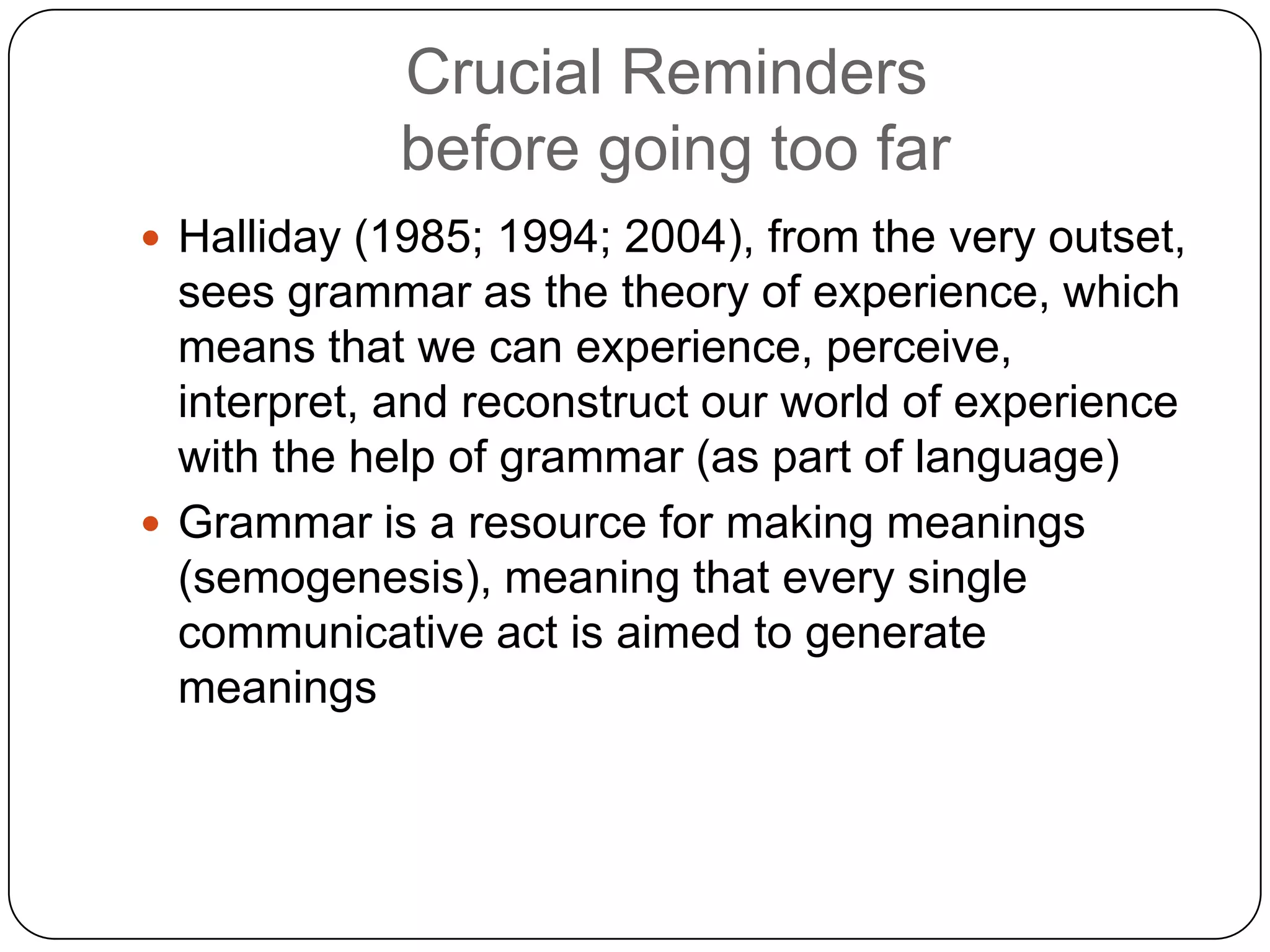
Crucial Reminders
before going too far
 Halliday (1985; 1994; 2004), from the very outset,

sees grammar as the theory of experience, which
means that we can experience, perceive,
interpret, and reconstruct our world of experience
with the help of grammar (as part of language)
 Grammar is a resource for making meanings
(semogenesis), meaning that every single
communicative act is aimed to generate
meanings
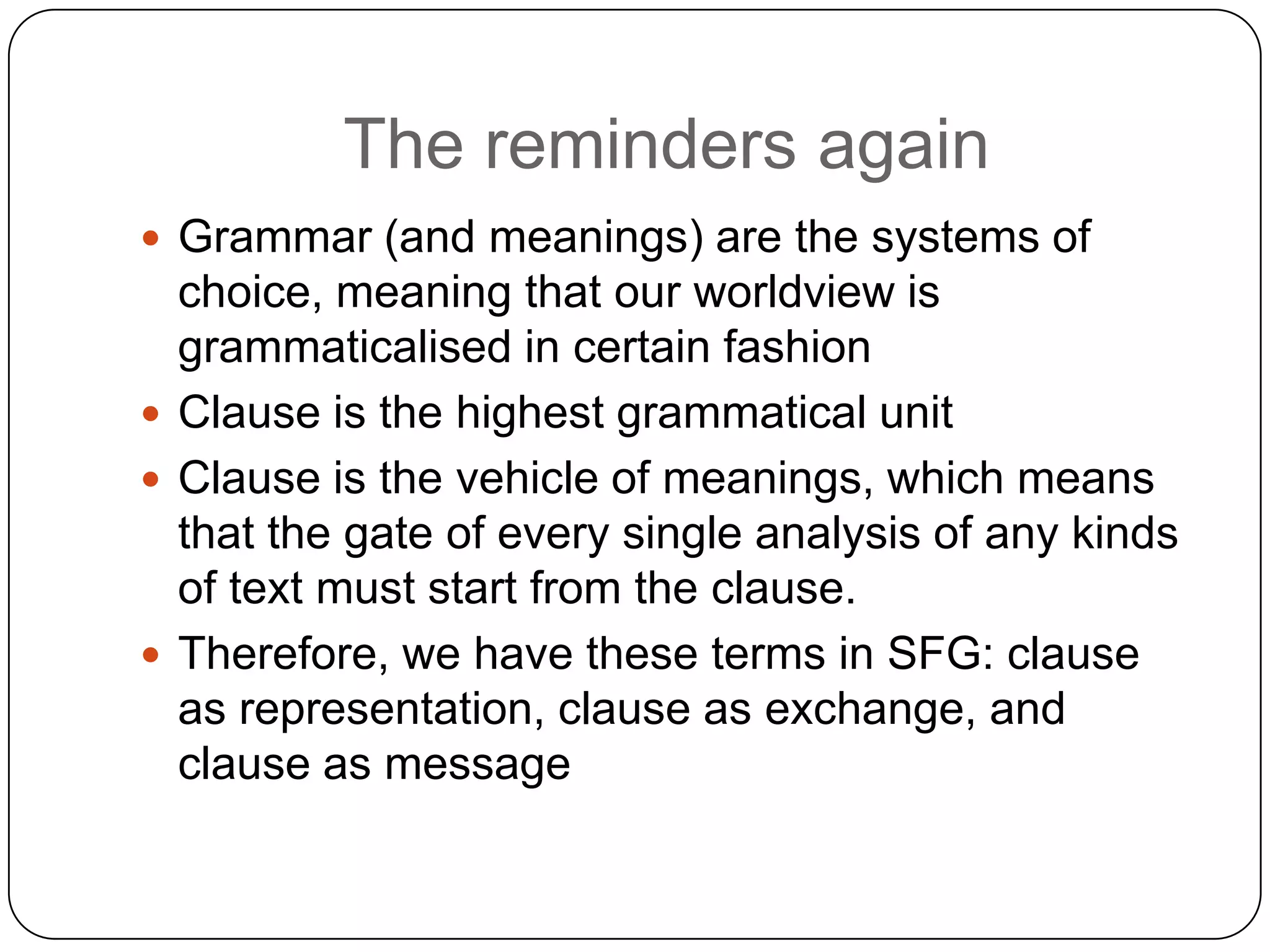
The reminders again
 Grammar (and meanings) are the systems of

choice, meaning that our worldview is
grammaticalised in certain fashion
 Clause is the highest grammatical unit
 Clause is the vehicle of meanings, which means
that the gate of every single analysis of any kinds
of text must start from the clause.
 Therefore, we have these terms in SFG: clause
as representation, clause as exchange, and
clause as message
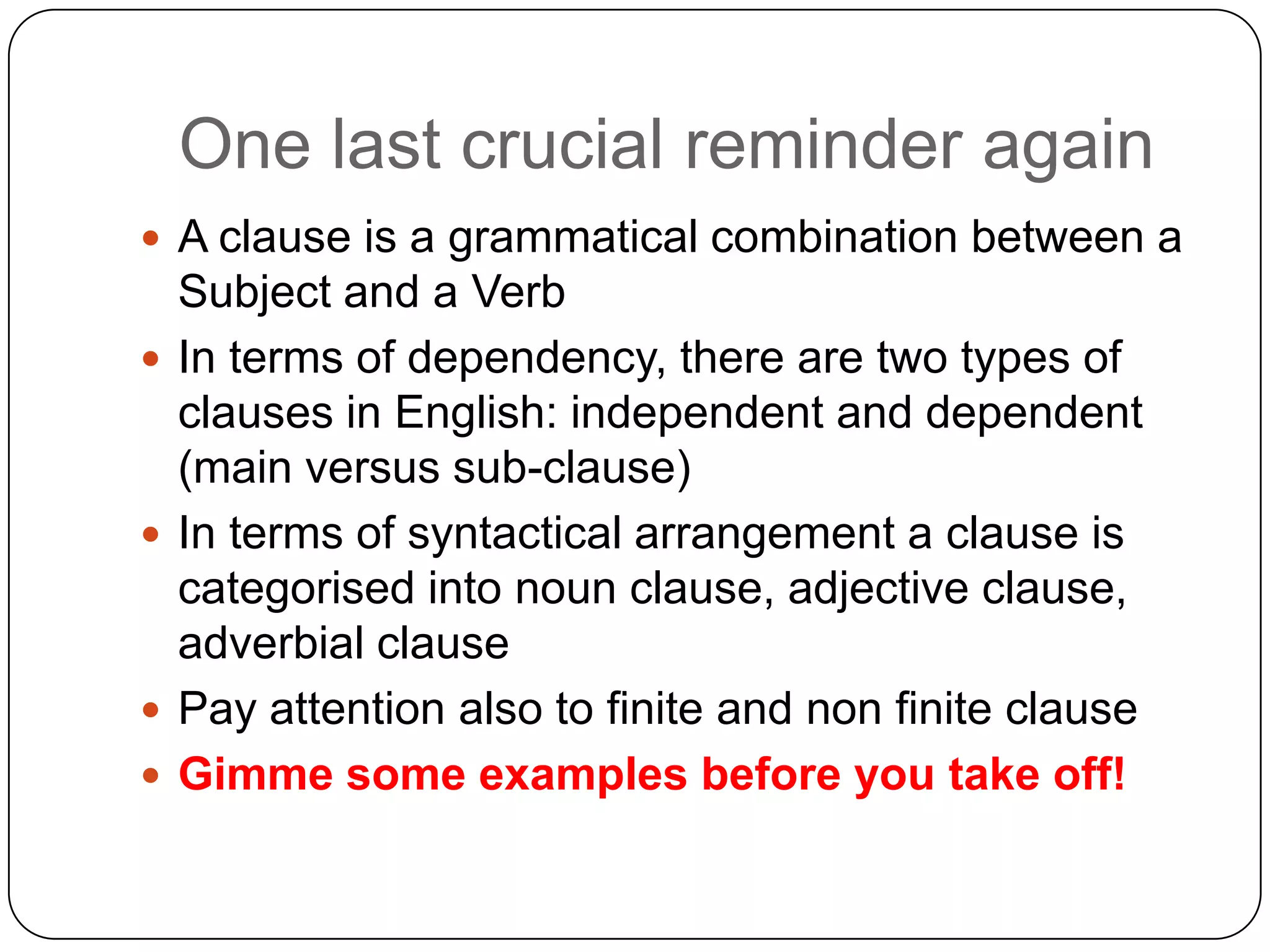
One last crucial reminder again
 A clause is a grammatical combination between a








Subject and a Verb
In terms of dependency, there are two types of
clauses in English: independent and dependent
(main versus sub-clause)
In terms of syntactical arrangement a clause is
categorised into noun clause, adjective clause,
adverbial clause
Pay attention also to finite and non finite clause
Gimme some examples before you take off!
Extra Homewrok
 Please enrich your grammatical reportoire before

you take off into the island called TRANSITIVITY.
 Things you must probably understand well
include:
 parts of speech,
 types of verbs,
 types of sentences,
 types of clauses,
 finiteness
Let us now take off, mates!
 Transitivity the grammatical resource for

ideational metafunctions (experiential and
logical),
 Or it is seen as the resources for construing
human experience of the world around us and
inside us as meaning
 It represents language as ideation: we turn
experience into meanings.
 Gimme some examples, puhhlease!
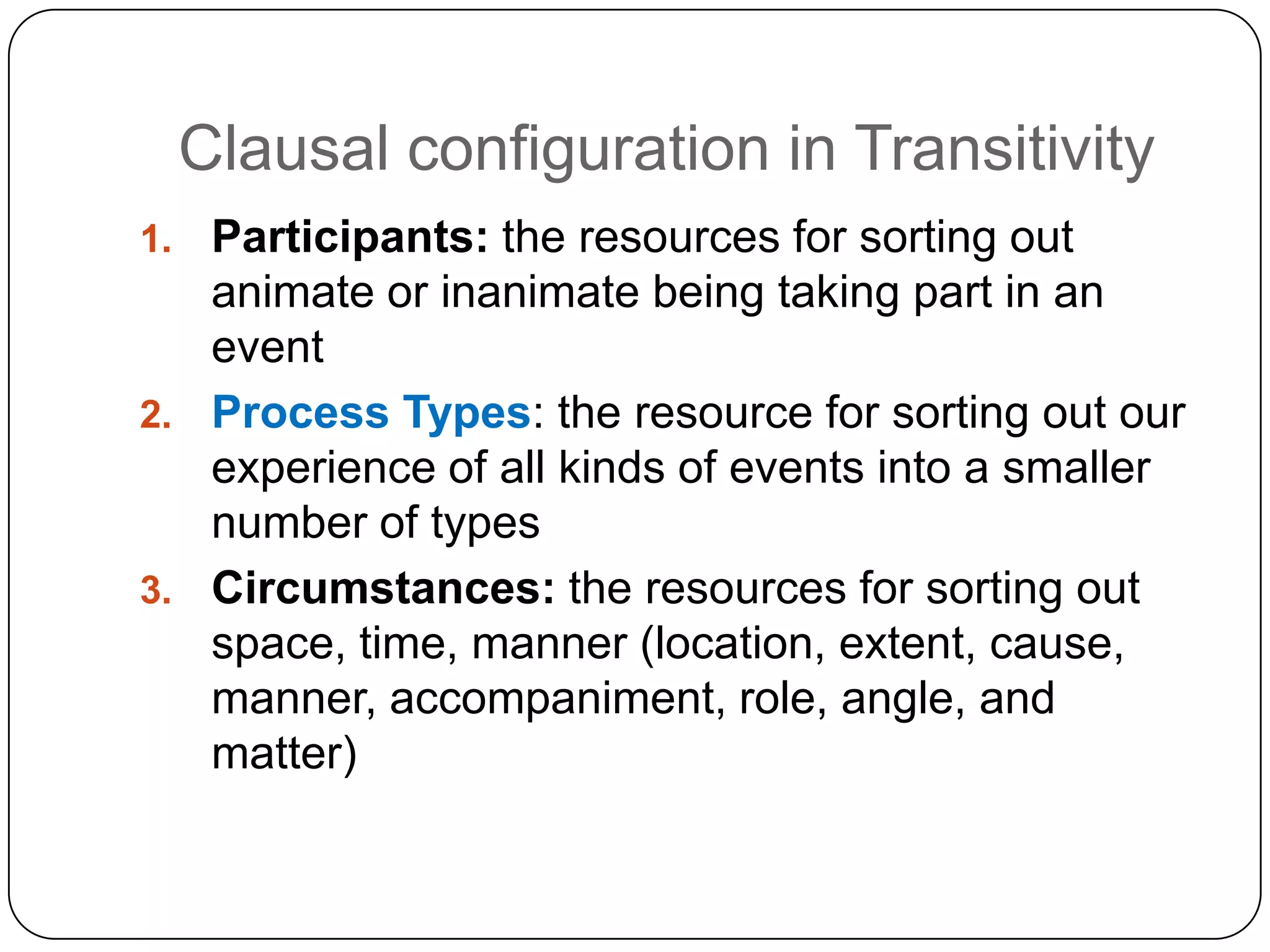
Clausal configuration in Transitivity
Participants: the resources for sorting out
animate or inanimate being taking part in an
event
2. Process Types: the resource for sorting out our
experience of all kinds of events into a smaller
number of types
3. Circumstances: the resources for sorting out
space, time, manner (location, extent, cause,
manner, accompaniment, role, angle, and
matter)
1.
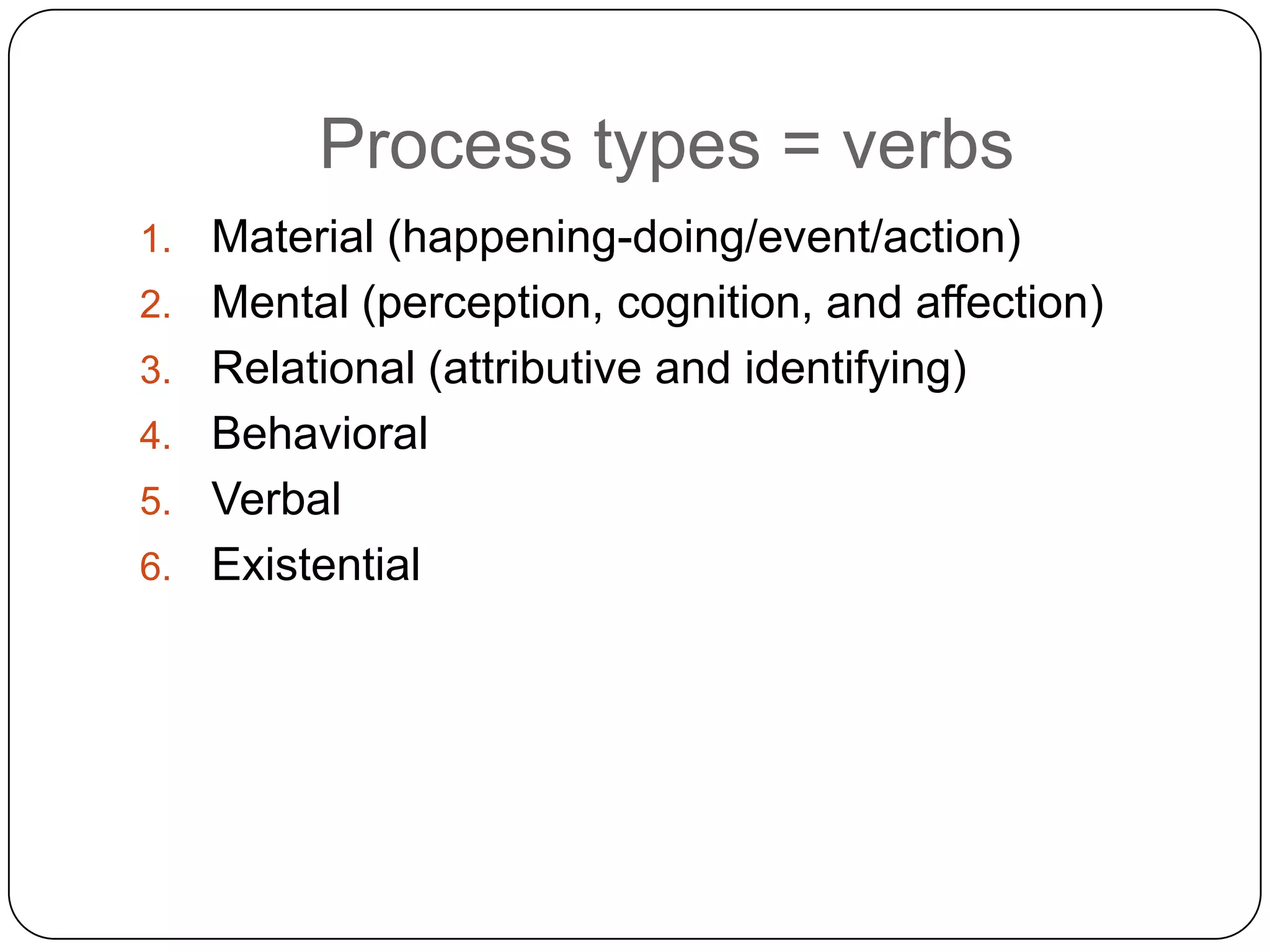
Process types = verbs
1.
2.
3.
4.
5.

6.

Material (happening-doing/event/action)
Mental (perception, cognition, and affection)
Relational (attributive and identifying)
Behavioral
Verbal
Existential
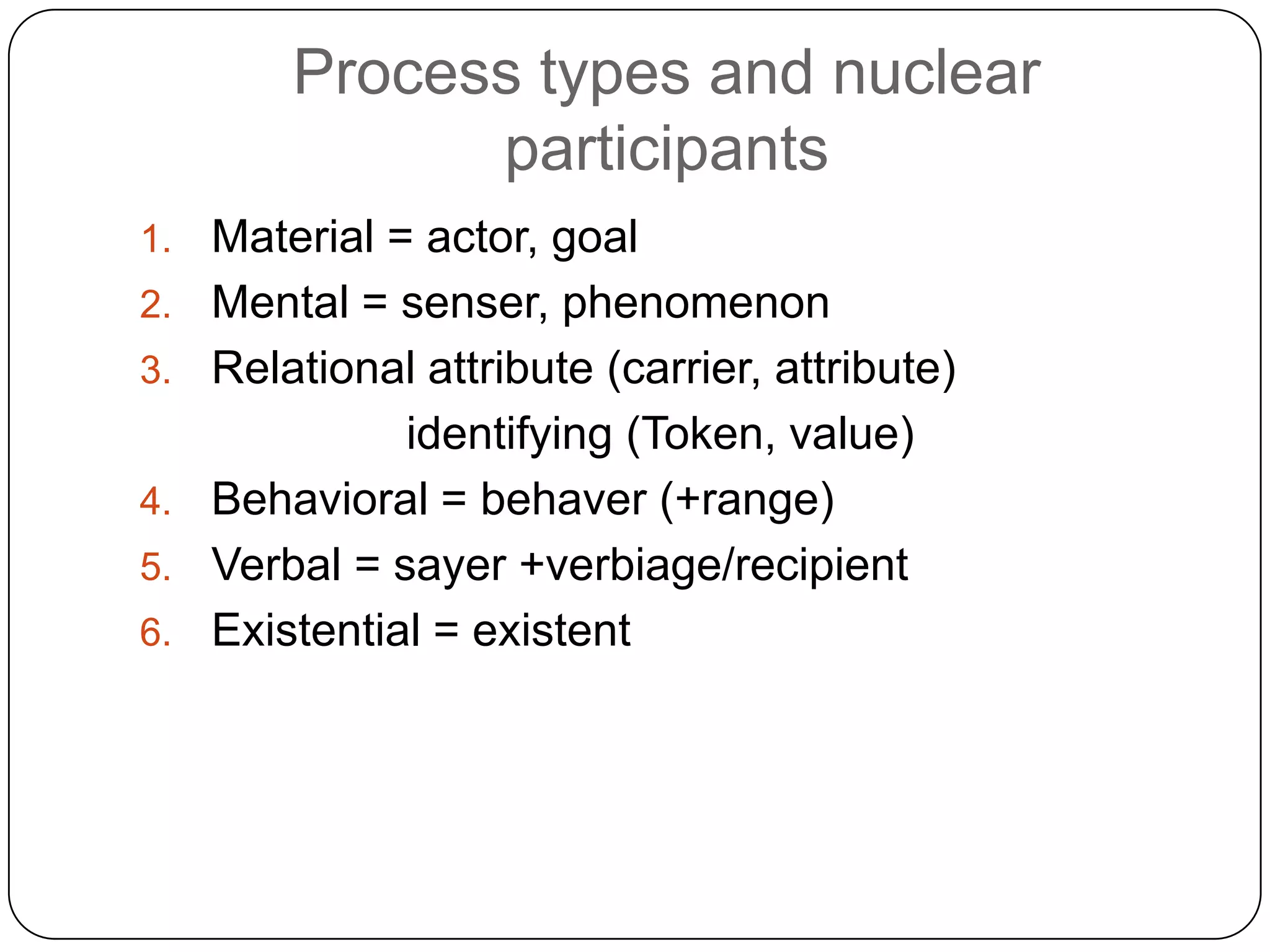
Process types and nuclear
participants
1.
2.
3.
4.

5.
6.

Material = actor, goal
Mental = senser, phenomenon
Relational attribute (carrier, attribute)
identifying (Token, value)
Behavioral = behaver (+range)
Verbal = sayer +verbiage/recipient
Existential = existent
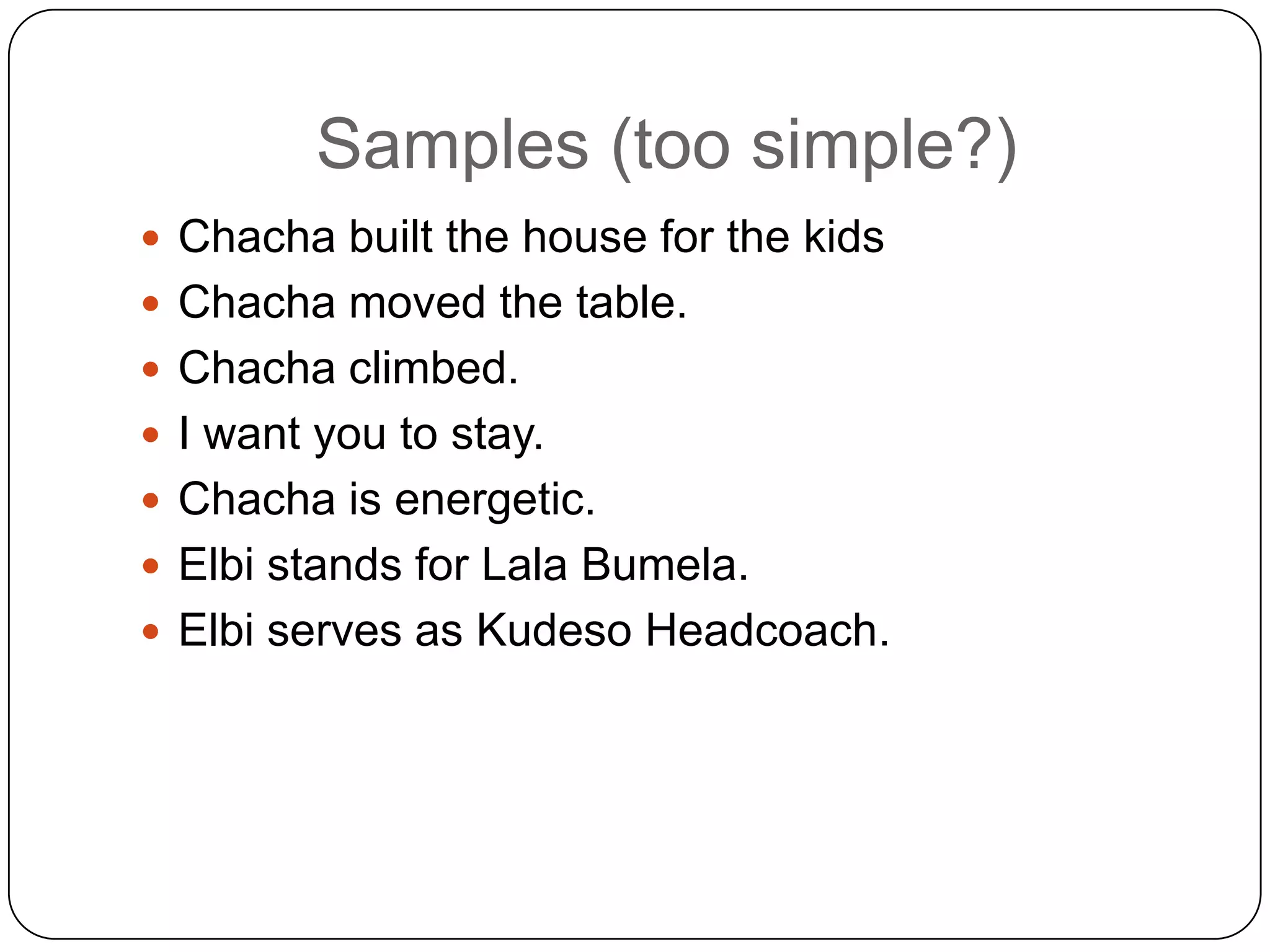
Samples (too simple?)
 Chacha built the house for the kids
 Chacha moved the table.
 Chacha climbed.
 I want you to stay.
 Chacha is energetic.

 Elbi stands for Lala Bumela.
 Elbi serves as Kudeso Headcoach.
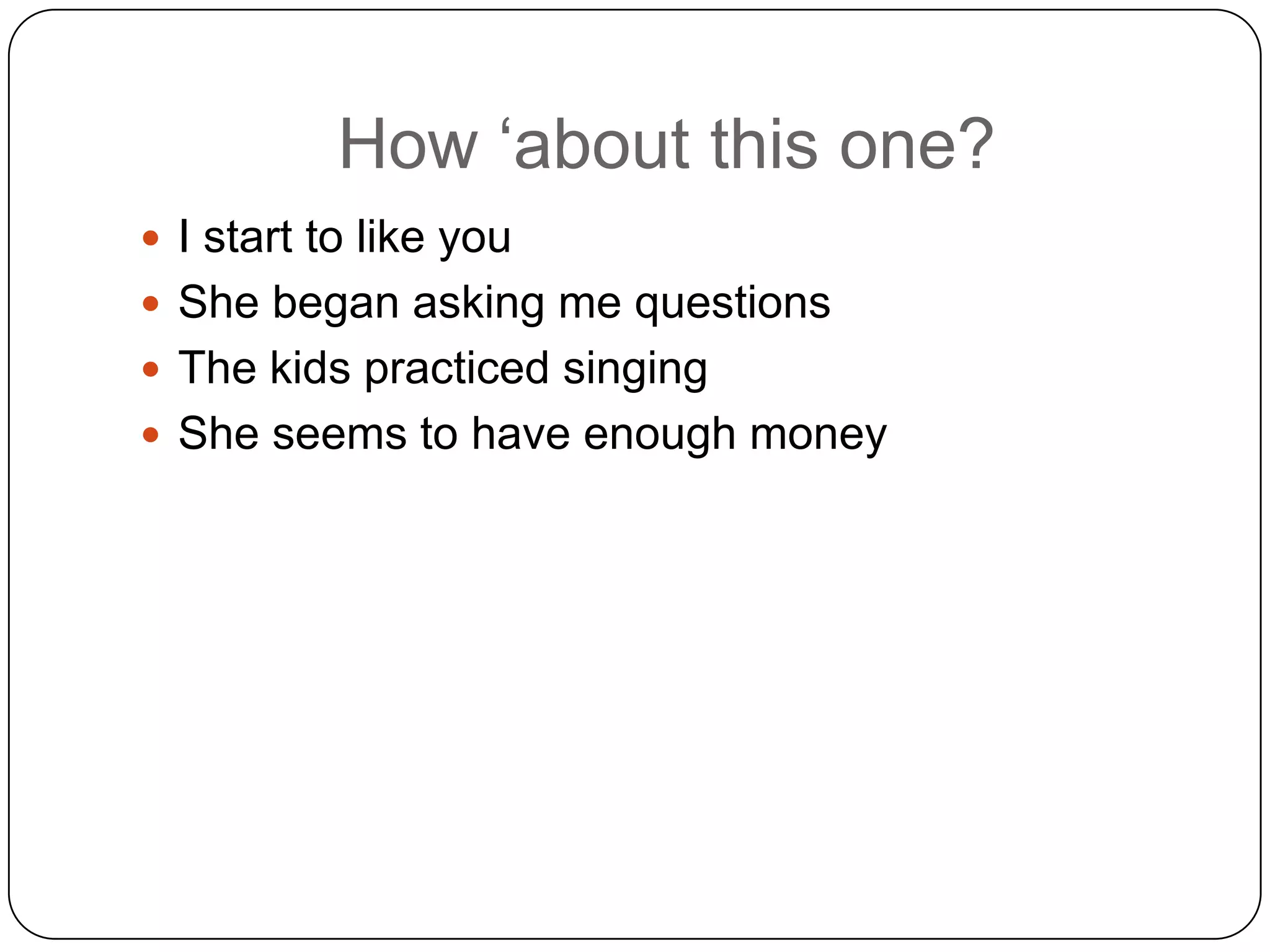
How „about this one?
 I start to like you
 She began asking me questions
 The kids practiced singing
 She seems to have enough money
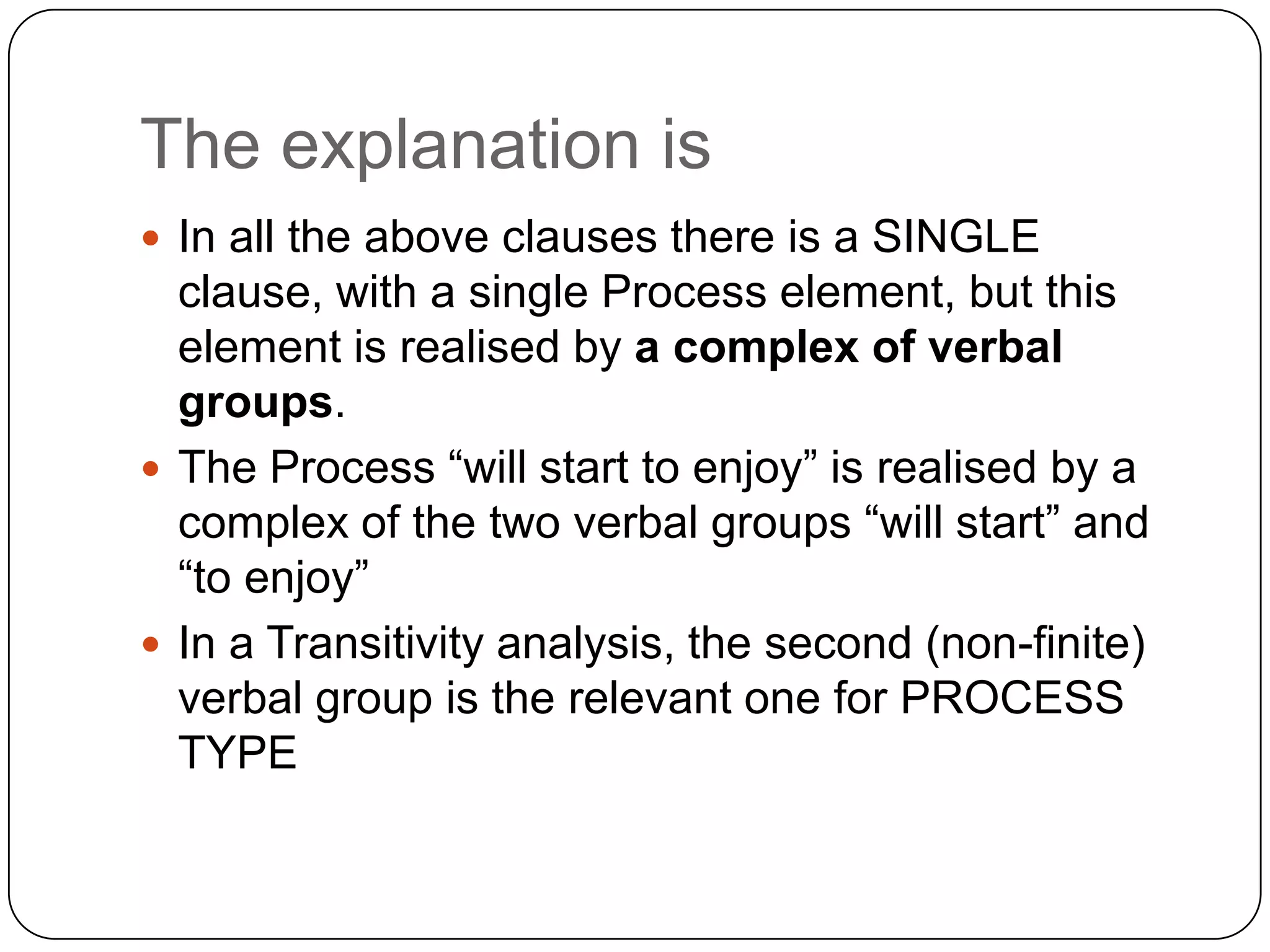
The explanation is
 In all the above clauses there is a SINGLE

clause, with a single Process element, but this
element is realised by a complex of verbal
groups.
 The Process “will start to enjoy” is realised by a
complex of the two verbal groups “will start” and
“to enjoy”
 In a Transitivity analysis, the second (non-finite)
verbal group is the relevant one for PROCESS
TYPE
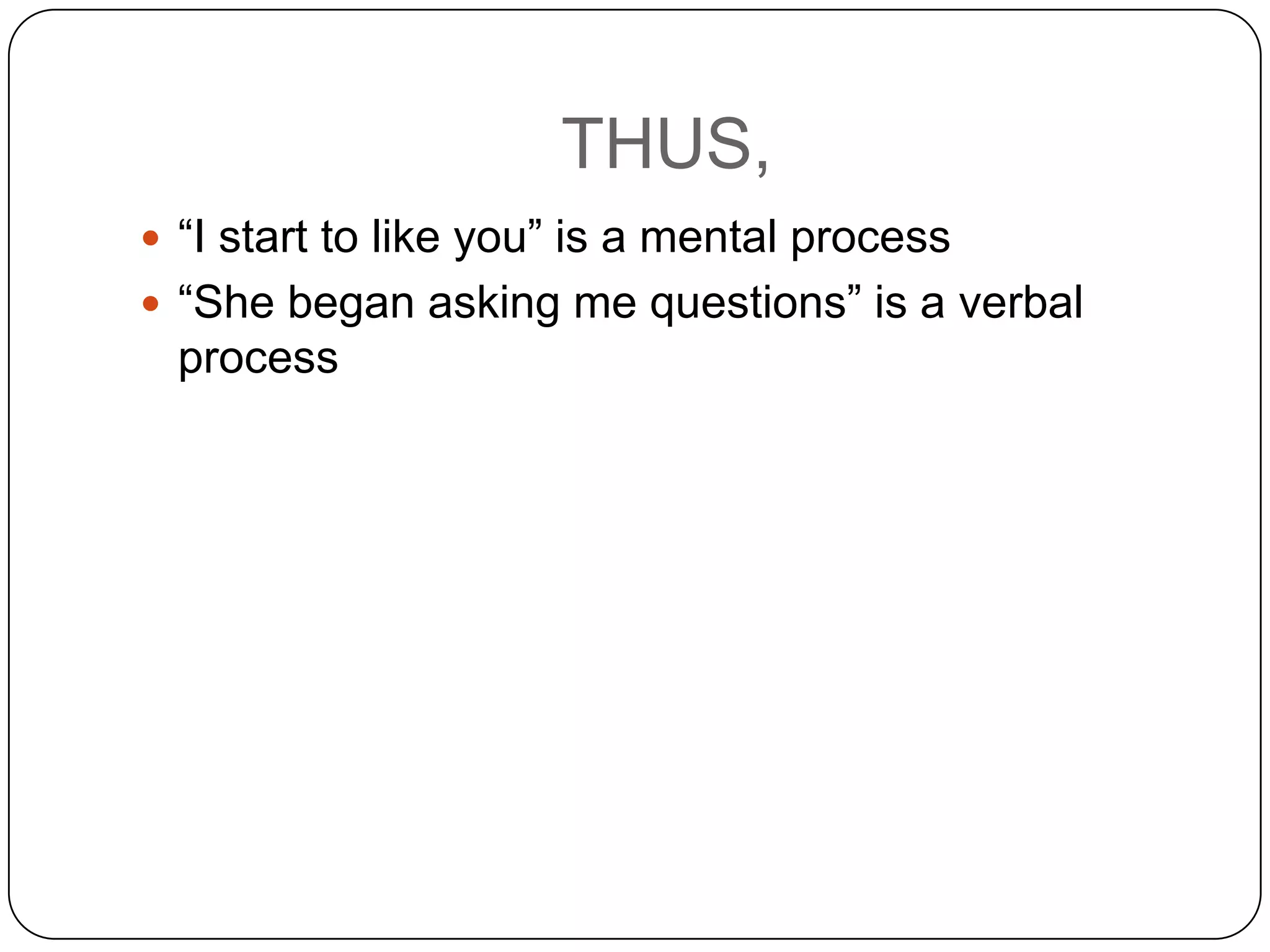
THUS,
 “I start to like you” is a mental process
 “She began asking me questions” is a verbal

process
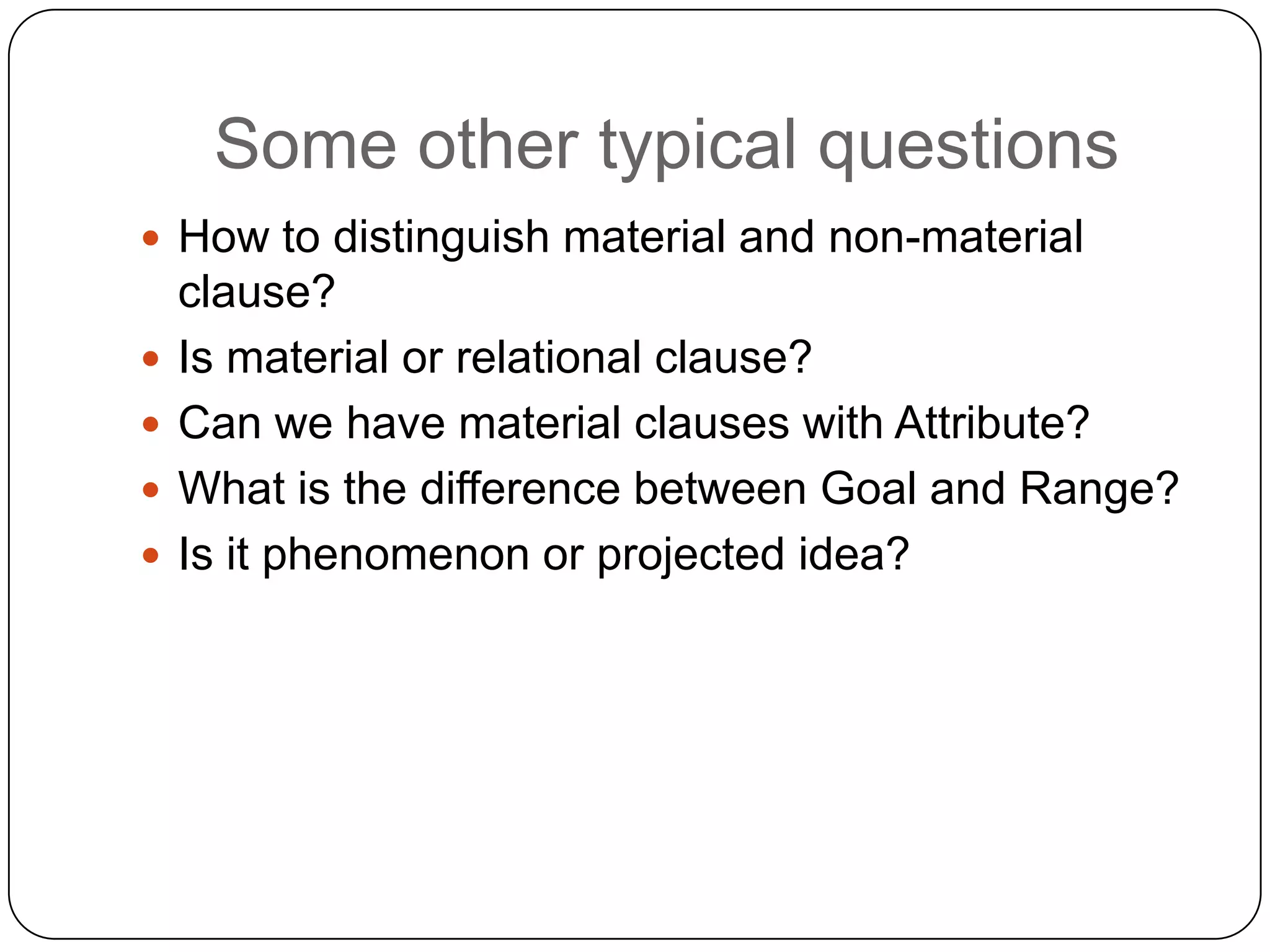
Some other typical questions
 How to distinguish material and non-material






clause?
Is material or relational clause?
Can we have material clauses with Attribute?
What is the difference between Goal and Range?
Is it phenomenon or projected idea?

Exploring transitivity

  • 1.
    Exploring Transitivity Lala Bumela TheDepartment of English Education The University of Kuningan
  • 2.
    Crucial Reminders before goingtoo far  Halliday (1985; 1994; 2004), from the very outset, sees grammar as the theory of experience, which means that we can experience, perceive, interpret, and reconstruct our world of experience with the help of grammar (as part of language)  Grammar is a resource for making meanings (semogenesis), meaning that every single communicative act is aimed to generate meanings
  • 3.
    The reminders again Grammar (and meanings) are the systems of choice, meaning that our worldview is grammaticalised in certain fashion  Clause is the highest grammatical unit  Clause is the vehicle of meanings, which means that the gate of every single analysis of any kinds of text must start from the clause.  Therefore, we have these terms in SFG: clause as representation, clause as exchange, and clause as message
  • 4.
    One last crucialreminder again  A clause is a grammatical combination between a     Subject and a Verb In terms of dependency, there are two types of clauses in English: independent and dependent (main versus sub-clause) In terms of syntactical arrangement a clause is categorised into noun clause, adjective clause, adverbial clause Pay attention also to finite and non finite clause Gimme some examples before you take off!
  • 5.
    Extra Homewrok  Pleaseenrich your grammatical reportoire before you take off into the island called TRANSITIVITY.  Things you must probably understand well include:  parts of speech,  types of verbs,  types of sentences,  types of clauses,  finiteness
  • 6.
    Let us nowtake off, mates!  Transitivity the grammatical resource for ideational metafunctions (experiential and logical),  Or it is seen as the resources for construing human experience of the world around us and inside us as meaning  It represents language as ideation: we turn experience into meanings.  Gimme some examples, puhhlease!
  • 7.
    Clausal configuration inTransitivity Participants: the resources for sorting out animate or inanimate being taking part in an event 2. Process Types: the resource for sorting out our experience of all kinds of events into a smaller number of types 3. Circumstances: the resources for sorting out space, time, manner (location, extent, cause, manner, accompaniment, role, angle, and matter) 1.
  • 8.
    Process types =verbs 1. 2. 3. 4. 5. 6. Material (happening-doing/event/action) Mental (perception, cognition, and affection) Relational (attributive and identifying) Behavioral Verbal Existential
  • 9.
    Process types andnuclear participants 1. 2. 3. 4. 5. 6. Material = actor, goal Mental = senser, phenomenon Relational attribute (carrier, attribute) identifying (Token, value) Behavioral = behaver (+range) Verbal = sayer +verbiage/recipient Existential = existent
  • 10.
    Samples (too simple?) Chacha built the house for the kids  Chacha moved the table.  Chacha climbed.  I want you to stay.  Chacha is energetic.  Elbi stands for Lala Bumela.  Elbi serves as Kudeso Headcoach.
  • 11.
    How „about thisone?  I start to like you  She began asking me questions  The kids practiced singing  She seems to have enough money
  • 12.
    The explanation is In all the above clauses there is a SINGLE clause, with a single Process element, but this element is realised by a complex of verbal groups.  The Process “will start to enjoy” is realised by a complex of the two verbal groups “will start” and “to enjoy”  In a Transitivity analysis, the second (non-finite) verbal group is the relevant one for PROCESS TYPE
  • 13.
    THUS,  “I startto like you” is a mental process  “She began asking me questions” is a verbal process
  • 14.
    Some other typicalquestions  How to distinguish material and non-material     clause? Is material or relational clause? Can we have material clauses with Attribute? What is the difference between Goal and Range? Is it phenomenon or projected idea?