Rural Local Self - Government
A Presentation By:
Name: Shreyash Anand
Class: IX ‘B’
Roll No.: 53
What is Local Self Government
● Local self - government is an institution comprising of locally elected
representatives managing the affair of the locality and providing them with basic
amenities. In rural area such an institution is called as Gram Panchayat and in
urban areas it is known as Municipal Corporation or simply Municipality.
● Panchayati Raj System was first inaugurated by the Prime Minister, Jawaharlal
Nehru, at Nagpur in Rajasthan on October 2,1959. Then it was started in most of
the states, like in Andhra Pradesh. But the real breakthrough came on 24 April,
1993 when the Constitution (73 Amendment) Act, 1992 came into force.
● In November 1957, Balwant G. Mehta recommended the scheme of democratic
decentralisation which ultimately came to be know as Panchayati Raj.
The 73rd Constitutional Amendment Act
● The 73rd Constitutional Amendment Act was Passed by the Parliament in 1992,
that added a new ‘Part - IX’ and a new ‘11th schedule’ to the constitution.
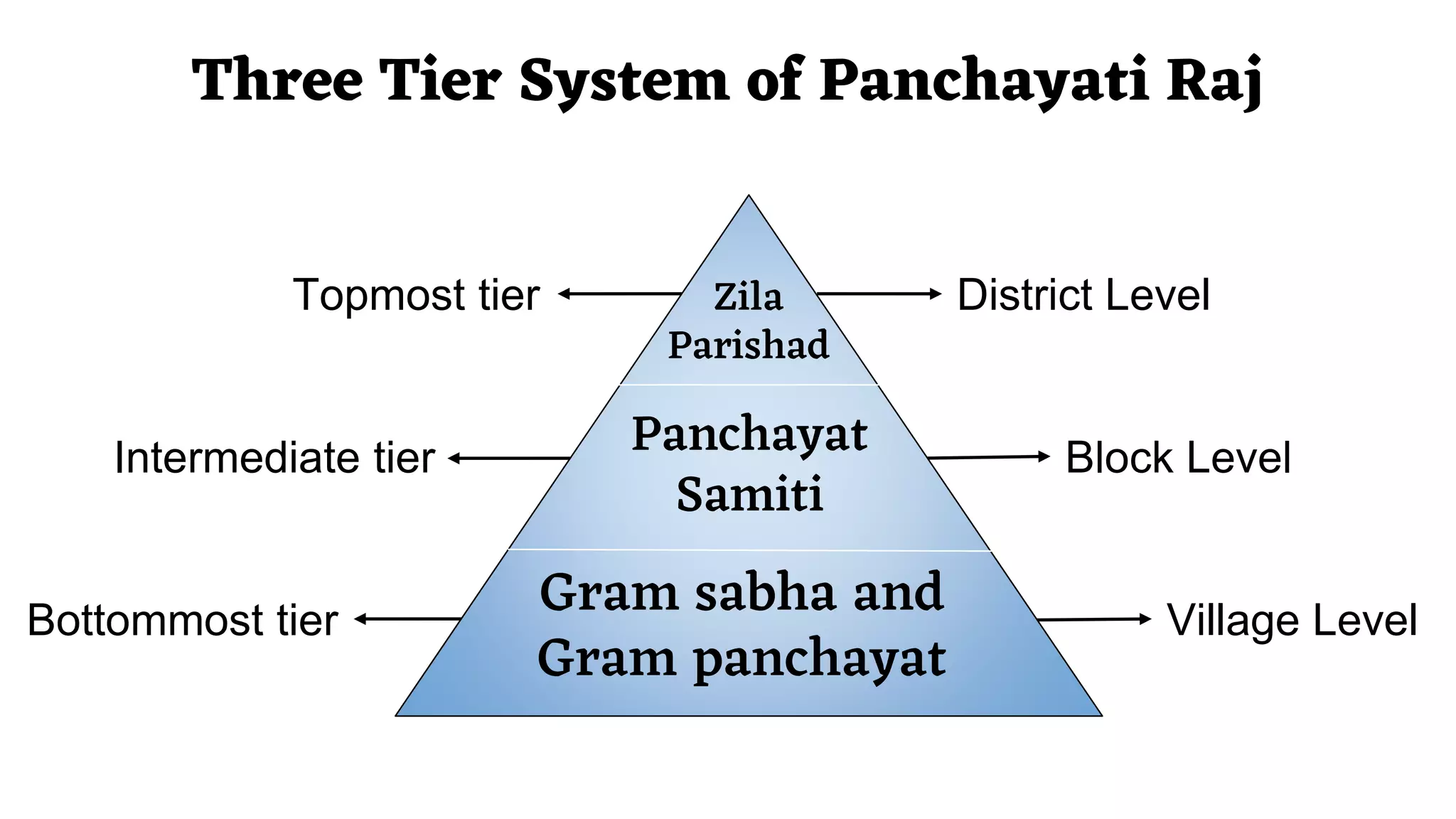
● Panchayati Raj System is a three-tier local self-government system, which
comprises of Gram Panchayat at Village level, Panchayat Samiti at the Block
level, and Zila Parishad at the District level.
● This Amendment Act forecasts the Gram Sabha as the foundation of the
Panchayati Raj System to perform functions and powers entrusted to it by the
State legislatures.
● The Amendment took effect from the 24th April, 1993 and the same provides
basic institutional framework of the Panchayats in the country state.
Importance
of Local Self
Government
Training
ground for
local
leadership
Government
can reach
ordinary
people
Foundation
for
democratic
structure
Lessens
burden of
State &
Central
Government
Training
ground for
local
leadership
Local people
will suggest
better
solutions
Three Tier System of Panchayati Raj
Gram sabha and
Gram panchayat
Panchayat
Samiti
Zila
Parishad
District Level
Block Level
Village Level
Topmost tier
Intermediate tier
Bottommost tier
Gram Panchayat (Village Level):
➤ The ‘Gram Sabha’ is the centre of self - governance at the village level. It ensures direct
& participative Democracy.
➤ And ‘Gram Panchayat’ is the ‘Executive Body’ of the Gram Sabha. It ensures to fulfill
the Constitution makers’ dream of ‘Gram Swaraj’.
Gram Sabha
Gram Panchayat
➤ A Gram Panchayat can be set up in a village with a population more that 600. If the
population of the village is less than 600, two or more villages are joined together to share
a common Gram Panchayat.
➤ There are about 250,000 Gram Panchayats in India.
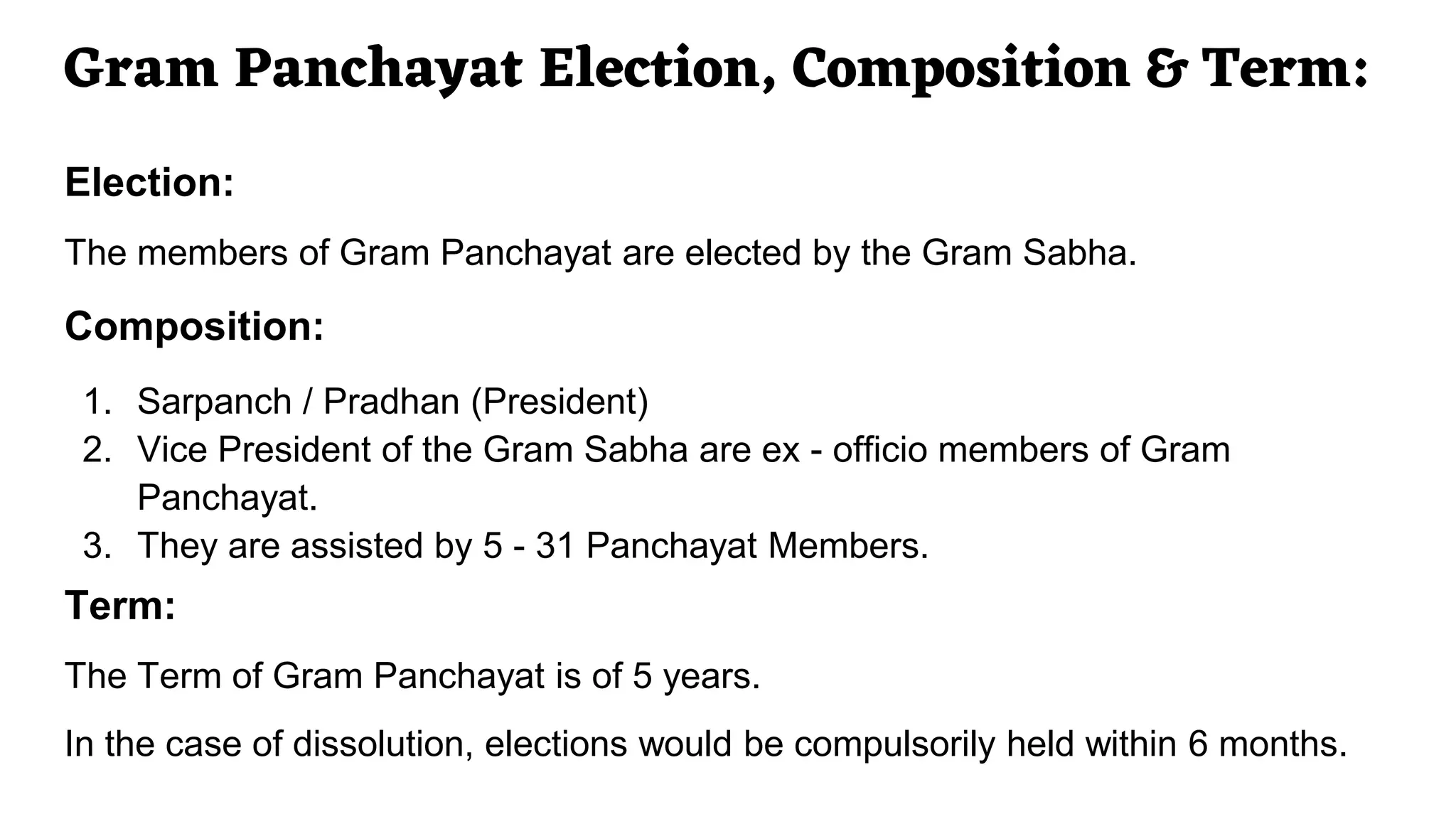
Gram Panchayat Election, Composition & Term:
Election:
The members of Gram Panchayat are elected by the Gram Sabha.
Composition:
1. Sarpanch / Pradhan (President)
2. Vice President of the Gram Sabha are ex - officio members of Gram
Panchayat.
3. They are assisted by 5 - 31 Panchayat Members.
Term:
The Term of Gram Panchayat is of 5 years.
In the case of dissolution, elections would be compulsorily held within 6 months.
Gram Panchayat Qualifications:
1. 21+ years of age.
2. Registered voter of the constituency.
3. Should be Mentally Sound.
4. Should not be a convict / criminal.
5. Should not be disqualified under any law made by State or Union
Legislature.
6. Should not hold any office of profit under Government of India.
Reservations (according to proportion to the
population):
■ Almost ⅓ rd Seats are reserved for SC/ST.
■ ⅓ rd seats are reserved for women.
Which are about 50% in some states.
33%
33%
33%
Women
SC/ST
and
OBC
Elected
Member
Functions Of Gram Panchayat
Civic Facilities
and Welfare
Functions
Judicial
Functions
Developmental
Functions
Regulatory
& General
Administration
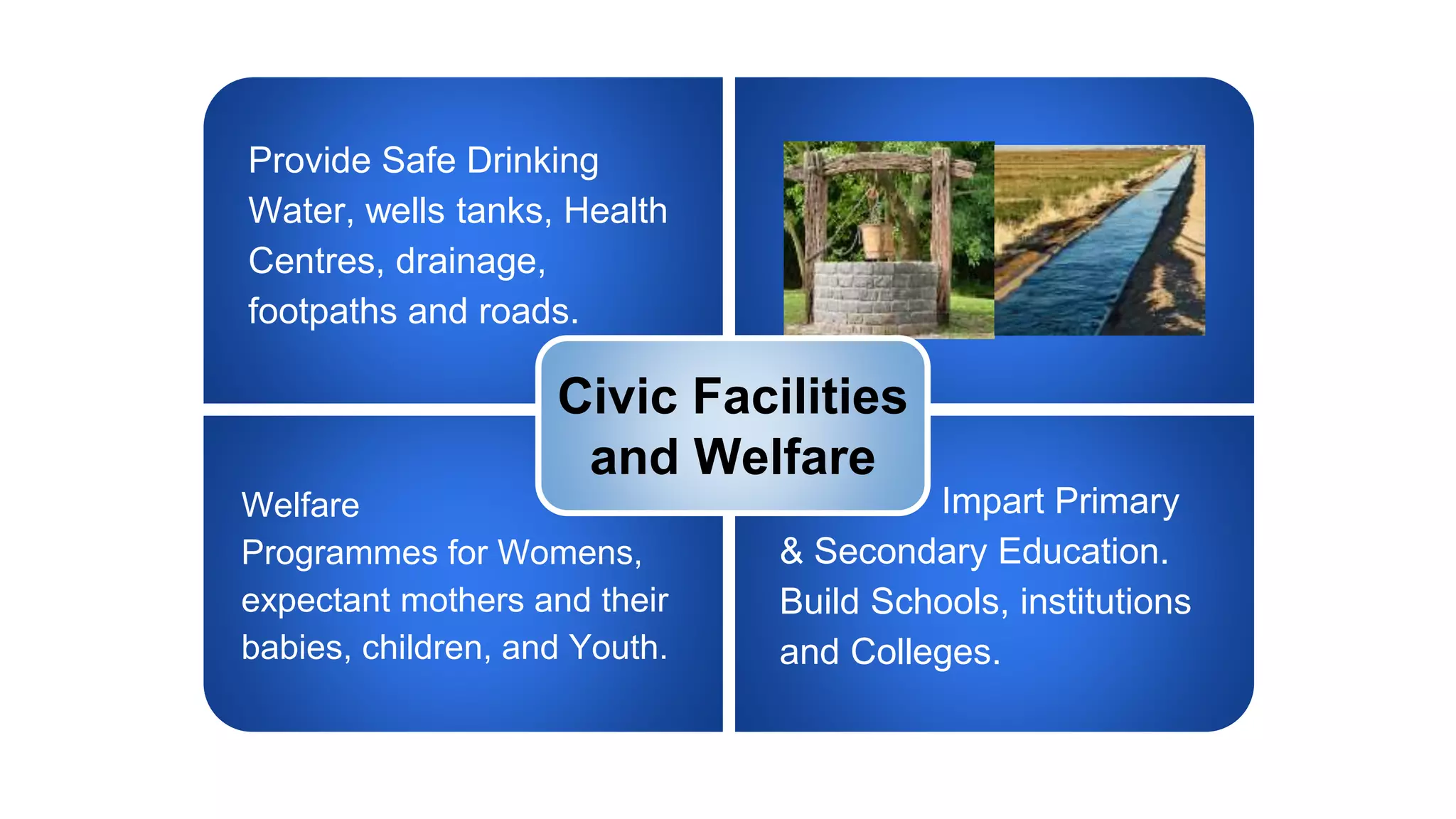
Civic Facilities
and Welfare
Provide Safe Drinking
Water, wells tanks, Health
Centres, drainage,
footpaths and roads.
Impart Primary
& Secondary Education.
Build Schools, institutions
and Colleges.
Welfare
Programmes for Womens,
expectant mothers and their
babies, children, and Youth.
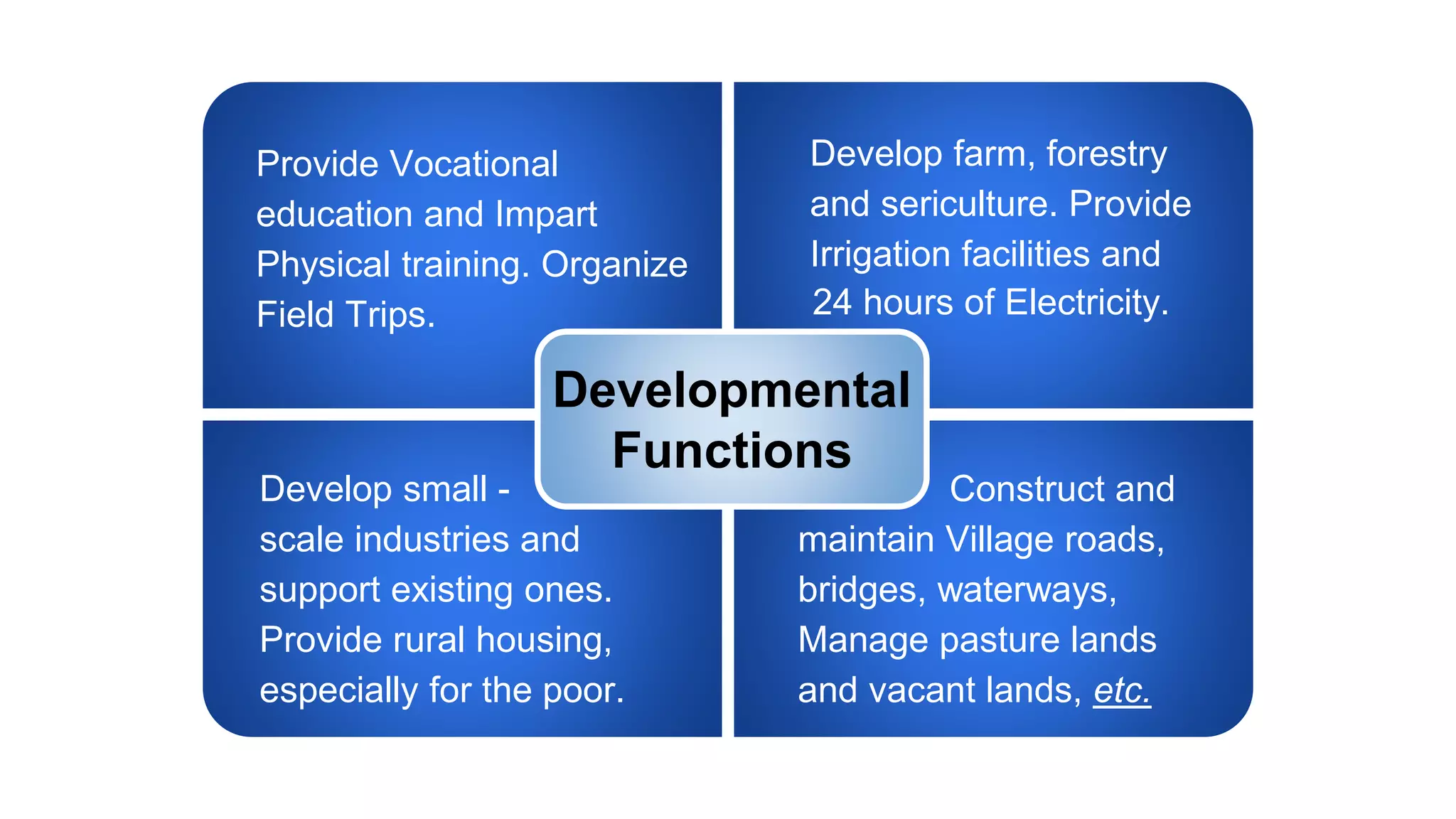
Developmental
Functions
Provide Vocational
education and Impart
Physical training. Organize
Field Trips.
Construct and
maintain Village roads,
bridges, waterways,
Manage pasture lands
and vacant lands, etc.
Develop small -
scale industries and
support existing ones.
Provide rural housing,
especially for the poor.
Develop farm, forestry
and sericulture. Provide
Irrigation facilities and
24 hours of Electricity.
Helping the Government to
maintain Law & Order.
Provision and Maintenance
of lights in public street and
other places.
Regulatory
& General
Administration
Maintenance of
The Village’s Common
Properties, like rivers,
pasture, drainage.
Registration of
Births, Deaths and
marriages.
Judicial
Functions
They have no power to
imprison & can fine only
upto Rs. 1000 and that
also in rare cases.
Provides Speedy and
Inexpensive justice to
villagers, by setting up a
Nyaya Panchayat.
Cases like petty
theft, property, cheating,
assault, trespass, etc. falls
under the jurisdiction of
Nyaya Panchayat.
Panchayat Samiti (Block Level):
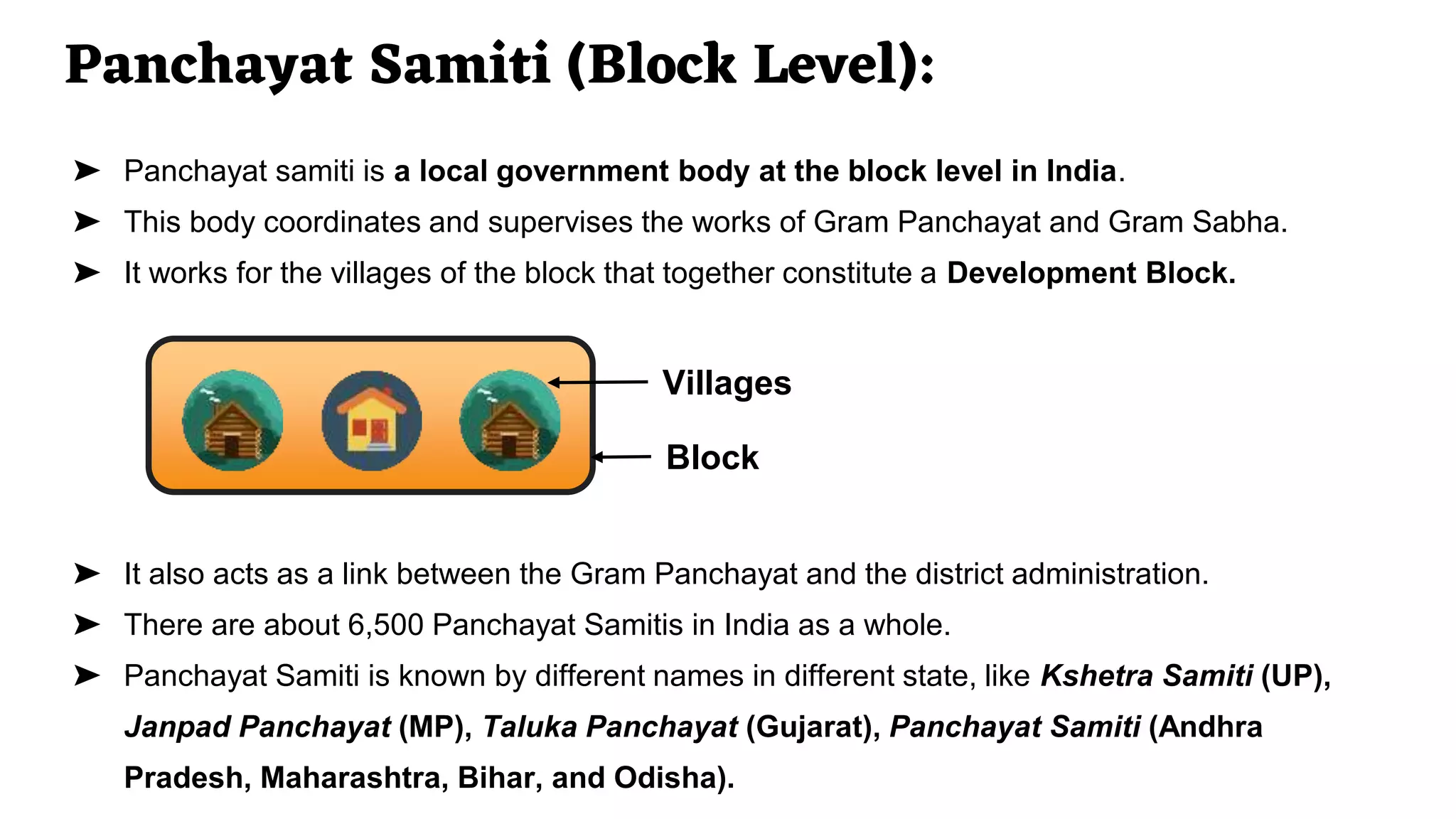
➤ Panchayat samiti is a local government body at the block level in India.
➤ This body coordinates and supervises the works of Gram Panchayat and Gram Sabha.
➤ It works for the villages of the block that together constitute a Development Block.
➤ It also acts as a link between the Gram Panchayat and the district administration.
➤ There are about 6,500 Panchayat Samitis in India as a whole.
➤ Panchayat Samiti is known by different names in different state, like Kshetra Samiti (UP),
Janpad Panchayat (MP), Taluka Panchayat (Gujarat), Panchayat Samiti (Andhra
Pradesh, Maharashtra, Bihar, and Odisha).
Villages
Block
Panchayat Samiti Composition:
1. Elected Members: Sarpanch (president) within the block, and one elected member by each
Gram Panchayat.
2. Associate Members: BDO, MPs, MLAs, MLCs of that area.They can only attend meetings
and express views, do not have the power to vote.
3. Ex-officio Members: The sub divisional magistrate and and block
development officer (BDO).
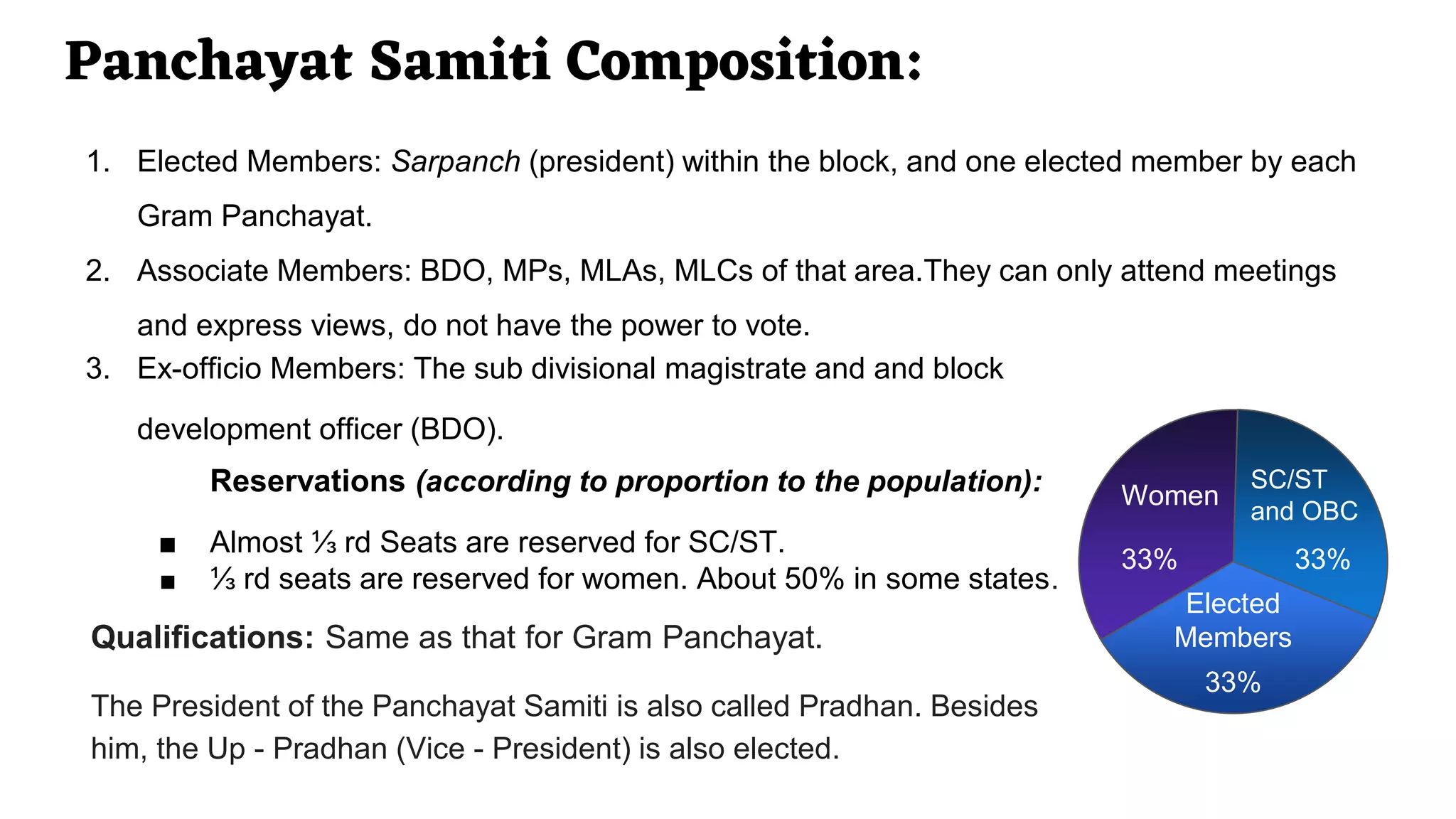
Reservations (according to proportion to the population):
■ Almost ⅓ rd Seats are reserved for SC/ST.
■ ⅓ rd seats are reserved for women. About 50% in some states.
33%
33%
33%
Women
SC/ST
and OBC
Elected
Members
The President of the Panchayat Samiti is also called Pradhan. Besides
him, the Up - Pradhan (Vice - President) is also elected.
Qualifications: Same as that for Gram Panchayat.
Functions Of Panchayat Samiti
Civic Facilities
and Welfare
Delegated
Functions
Supervisory
Functions
Civic Facilities
and Welfare
Develop Cottage,
Handloom, Handicraft,
and Village Industries.
Rural Health Programme
(PHC & CHC).
Rural Water Supply.
Support
Agriculture, Animal
Husbandry & Fisheries.
Social Welfare :
improve status of women,
children, welfare of SC/ST, and
Setting up ‘Anganwadis’. Rural Employment.
Supervisory
Functions
Build Roads, Bridges,
Education, Hospitals,
Drinking Water, etc.
Examines the Budget of
Gram Panchayats under it.
Notes Number of
Deaths and Births. Exercises
Control Over the functioning
of BDOs and his assistants.
Supervises the
Work of Gram
Panchayats
under it.
Delegated
Functions
Serves as a link between
Gram Panchayat and
Zila Parishad.
Improve overall quality of
life in rural areas.
Coordinates a
number of central schemes
on 50:50 basis between the
States and the Centre.
State government
assigns functions to District
agencies and they assign
them to Panchayat Samiti.
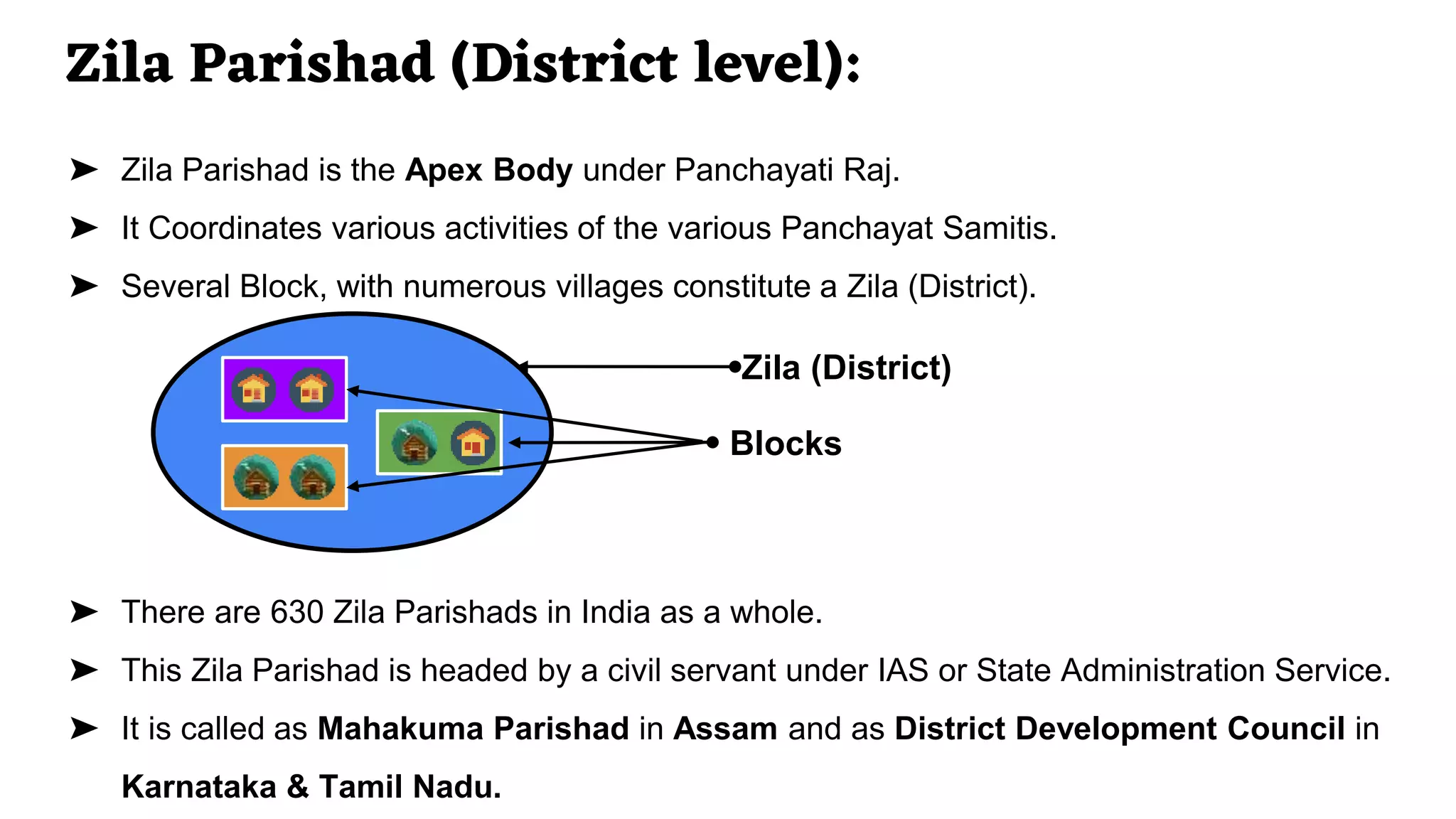
➤ Zila Parishad is the Apex Body under Panchayati Raj.
➤ It Coordinates various activities of the various Panchayat Samitis.
➤ Several Block, with numerous villages constitute a Zila (District).
Zila Parishad (District level):
Zila (District)
Blocks
➤ There are 630 Zila Parishads in India as a whole.
➤ This Zila Parishad is headed by a civil servant under IAS or State Administration Service.
➤ It is called as Mahakuma Parishad in Assam and as District Development Council in
Karnataka & Tamil Nadu.
Zila Parishad Composition:
1. Elected Members: Pradhans / Chairman (president) of Zila Parishad within the district, and
one from each of the co - operative societies of the district.
2. Associate Members: BDO, MPs, MLAs, MLCs of that area. They can only attend meetings
and express views, do not have the power to vote.
3. Ex-officio Members: The sub divisional magistrate and and block
development officer (BDO).
Reservations (according to proportion to the population):
■ Almost ⅓ rd Seats are reserved for SC/ST.
■ ⅓ rd seats are reserved for women. About 50% in some states.
33%
33%
33%
Women
SC/ST
and OBC
Elected
Members
The President of the Panchayat Samiti is also called Pradhan. Besides
him, the Up - Pradhan (Vice - President) is also elected.
Qualifications: Same as that for Gram Panchayat.
Functions Of Zila Parishad
Civic Facilities
and Welfare
Advisory &
Financial
Functions
Coordination &
Supervisory
Functions
Civic Facilities
and Welfare
Construct and Maintain
Roads, Bridges, Public
Houses, etc.
Build libraries, hospitals,
dispensaries, educational
institutions, etc.
Provide relief
during emergencies and
promote welfare of weaker
sections of the society.
Develop land, water
and human resources of that
Area. Improve Irrigation &
Electrification facilities.
Coordination
& Supervision
Supervises the work of the
Panchayat Samitis that
are under it.
Examines the
budget of the Panchayat
Samitis that are under it.
Promotes
E - governance in order to
monitor the functioning of
Panchayat Samitis.
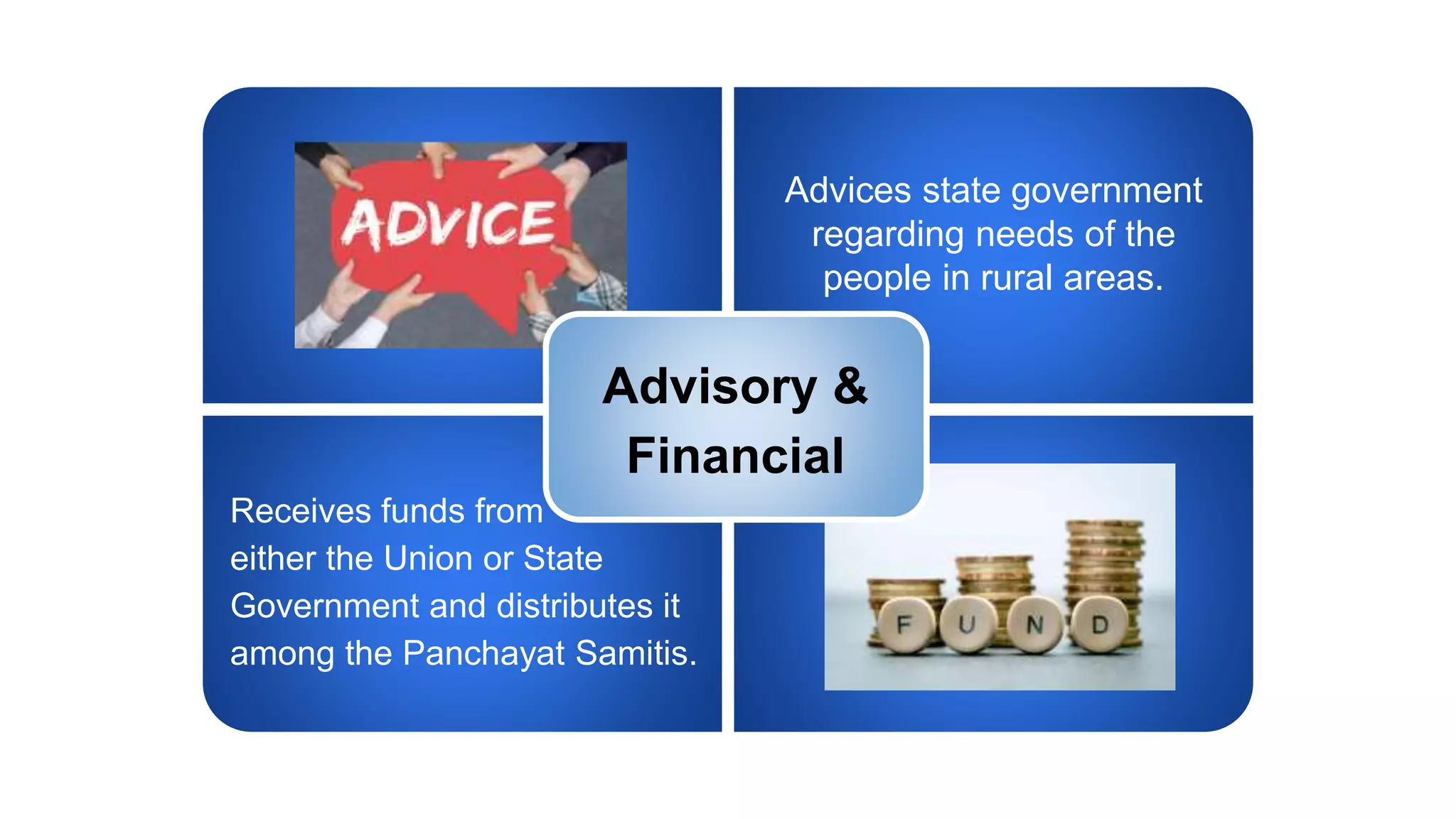
Advices state government
regarding needs of the
people in rural areas.
Receives funds from
either the Union or State
Government and distributes it
among the Panchayat Samitis.
Advisory &
Financial
Conclusion
Panchayati Raj is also known as 'Local self government' because it deals with
the decentralised governance and administration of people at the basic or local
level in village, panchayats and small towns.
Local authorities are able to adapt to local needs and react more quickly to local
problems than Central Government. Councillors and Officers have an
understanding of the local area and can tailor policies to that area. It is likely to be
more efficient to run services locally than manage them from the centre.
Almost all such local government bodies share certain characteristics: a
continuing Organization; the authority to undertake public activities; the ability to
enter into contracts; and the ability to collect taxes and determine a budget.
Acknowledgement
First and Foremost, I would like to express my special thanks and gratitude to
my Civics teacher and our Principal for providing me with the golden
opportunity to do this wonderful project on the topic - “Rural Local Self
Government”, and also for their support, encouragement, enthusiasm, and
guidance throughout the project.
Secondly, I would like to thank my parents and my friends for their continuous
support, help, and encouragement, and also for providing me with enough
content and material for the project.
At last, I would like to thank my Fellow Classmates for numerous helpful
discussions along the way.
Bibliography
Book Referred : -
Ages And Events: ICSE History and Civics, Class 9
Websites Referred : -
1) https://www.slideshare.net
2) https://en.wikipedia.org
3) https://www.quora.com
4) https://in.pinterest.com
5) https://www.india.gov.in

Rural - Local Self Government || Civics Presentation

  • 1.
    Rural Local Self- Government A Presentation By: Name: Shreyash Anand Class: IX ‘B’ Roll No.: 53
  • 2.
    What is LocalSelf Government ● Local self - government is an institution comprising of locally elected representatives managing the affair of the locality and providing them with basic amenities. In rural area such an institution is called as Gram Panchayat and in urban areas it is known as Municipal Corporation or simply Municipality. ● Panchayati Raj System was first inaugurated by the Prime Minister, Jawaharlal Nehru, at Nagpur in Rajasthan on October 2,1959. Then it was started in most of the states, like in Andhra Pradesh. But the real breakthrough came on 24 April, 1993 when the Constitution (73 Amendment) Act, 1992 came into force. ● In November 1957, Balwant G. Mehta recommended the scheme of democratic decentralisation which ultimately came to be know as Panchayati Raj.
  • 3.
    The 73rd ConstitutionalAmendment Act ● The 73rd Constitutional Amendment Act was Passed by the Parliament in 1992, that added a new ‘Part - IX’ and a new ‘11th schedule’ to the constitution. ● Panchayati Raj System is a three-tier local self-government system, which comprises of Gram Panchayat at Village level, Panchayat Samiti at the Block level, and Zila Parishad at the District level. ● This Amendment Act forecasts the Gram Sabha as the foundation of the Panchayati Raj System to perform functions and powers entrusted to it by the State legislatures. ● The Amendment took effect from the 24th April, 1993 and the same provides basic institutional framework of the Panchayats in the country state.
  • 4.
    Importance of Local Self Government Training groundfor local leadership Government can reach ordinary people Foundation for democratic structure Lessens burden of State & Central Government Training ground for local leadership Local people will suggest better solutions
  • 5.
    Three Tier Systemof Panchayati Raj Gram sabha and Gram panchayat Panchayat Samiti Zila Parishad District Level Block Level Village Level Topmost tier Intermediate tier Bottommost tier
  • 6.
    Gram Panchayat (VillageLevel): ➤ The ‘Gram Sabha’ is the centre of self - governance at the village level. It ensures direct & participative Democracy. ➤ And ‘Gram Panchayat’ is the ‘Executive Body’ of the Gram Sabha. It ensures to fulfill the Constitution makers’ dream of ‘Gram Swaraj’. Gram Sabha Gram Panchayat ➤ A Gram Panchayat can be set up in a village with a population more that 600. If the population of the village is less than 600, two or more villages are joined together to share a common Gram Panchayat. ➤ There are about 250,000 Gram Panchayats in India.
  • 7.
    Gram Panchayat Election,Composition & Term: Election: The members of Gram Panchayat are elected by the Gram Sabha. Composition: 1. Sarpanch / Pradhan (President) 2. Vice President of the Gram Sabha are ex - officio members of Gram Panchayat. 3. They are assisted by 5 - 31 Panchayat Members. Term: The Term of Gram Panchayat is of 5 years. In the case of dissolution, elections would be compulsorily held within 6 months.
  • 8.
    Gram Panchayat Qualifications: 1.21+ years of age. 2. Registered voter of the constituency. 3. Should be Mentally Sound. 4. Should not be a convict / criminal. 5. Should not be disqualified under any law made by State or Union Legislature. 6. Should not hold any office of profit under Government of India. Reservations (according to proportion to the population): ■ Almost ⅓ rd Seats are reserved for SC/ST. ■ ⅓ rd seats are reserved for women. Which are about 50% in some states. 33% 33% 33% Women SC/ST and OBC Elected Member
  • 9.
    Functions Of GramPanchayat Civic Facilities and Welfare Functions Judicial Functions Developmental Functions Regulatory & General Administration
  • 10.
    Civic Facilities and Welfare ProvideSafe Drinking Water, wells tanks, Health Centres, drainage, footpaths and roads. Impart Primary & Secondary Education. Build Schools, institutions and Colleges. Welfare Programmes for Womens, expectant mothers and their babies, children, and Youth.
  • 11.
    Developmental Functions Provide Vocational education andImpart Physical training. Organize Field Trips. Construct and maintain Village roads, bridges, waterways, Manage pasture lands and vacant lands, etc. Develop small - scale industries and support existing ones. Provide rural housing, especially for the poor. Develop farm, forestry and sericulture. Provide Irrigation facilities and 24 hours of Electricity.
  • 12.
    Helping the Governmentto maintain Law & Order. Provision and Maintenance of lights in public street and other places. Regulatory & General Administration Maintenance of The Village’s Common Properties, like rivers, pasture, drainage. Registration of Births, Deaths and marriages.
  • 13.
    Judicial Functions They have nopower to imprison & can fine only upto Rs. 1000 and that also in rare cases. Provides Speedy and Inexpensive justice to villagers, by setting up a Nyaya Panchayat. Cases like petty theft, property, cheating, assault, trespass, etc. falls under the jurisdiction of Nyaya Panchayat.
  • 14.
    Panchayat Samiti (BlockLevel): ➤ Panchayat samiti is a local government body at the block level in India. ➤ This body coordinates and supervises the works of Gram Panchayat and Gram Sabha. ➤ It works for the villages of the block that together constitute a Development Block. ➤ It also acts as a link between the Gram Panchayat and the district administration. ➤ There are about 6,500 Panchayat Samitis in India as a whole. ➤ Panchayat Samiti is known by different names in different state, like Kshetra Samiti (UP), Janpad Panchayat (MP), Taluka Panchayat (Gujarat), Panchayat Samiti (Andhra Pradesh, Maharashtra, Bihar, and Odisha). Villages Block
  • 15.
    Panchayat Samiti Composition: 1.Elected Members: Sarpanch (president) within the block, and one elected member by each Gram Panchayat. 2. Associate Members: BDO, MPs, MLAs, MLCs of that area.They can only attend meetings and express views, do not have the power to vote. 3. Ex-officio Members: The sub divisional magistrate and and block development officer (BDO). Reservations (according to proportion to the population): ■ Almost ⅓ rd Seats are reserved for SC/ST. ■ ⅓ rd seats are reserved for women. About 50% in some states. 33% 33% 33% Women SC/ST and OBC Elected Members The President of the Panchayat Samiti is also called Pradhan. Besides him, the Up - Pradhan (Vice - President) is also elected. Qualifications: Same as that for Gram Panchayat.
  • 16.
    Functions Of PanchayatSamiti Civic Facilities and Welfare Delegated Functions Supervisory Functions
  • 17.
    Civic Facilities and Welfare DevelopCottage, Handloom, Handicraft, and Village Industries. Rural Health Programme (PHC & CHC). Rural Water Supply. Support Agriculture, Animal Husbandry & Fisheries. Social Welfare : improve status of women, children, welfare of SC/ST, and Setting up ‘Anganwadis’. Rural Employment.
  • 18.
    Supervisory Functions Build Roads, Bridges, Education,Hospitals, Drinking Water, etc. Examines the Budget of Gram Panchayats under it. Notes Number of Deaths and Births. Exercises Control Over the functioning of BDOs and his assistants. Supervises the Work of Gram Panchayats under it.
  • 19.
    Delegated Functions Serves as alink between Gram Panchayat and Zila Parishad. Improve overall quality of life in rural areas. Coordinates a number of central schemes on 50:50 basis between the States and the Centre. State government assigns functions to District agencies and they assign them to Panchayat Samiti.
  • 20.
    ➤ Zila Parishadis the Apex Body under Panchayati Raj. ➤ It Coordinates various activities of the various Panchayat Samitis. ➤ Several Block, with numerous villages constitute a Zila (District). Zila Parishad (District level): Zila (District) Blocks ➤ There are 630 Zila Parishads in India as a whole. ➤ This Zila Parishad is headed by a civil servant under IAS or State Administration Service. ➤ It is called as Mahakuma Parishad in Assam and as District Development Council in Karnataka & Tamil Nadu.
  • 21.
    Zila Parishad Composition: 1.Elected Members: Pradhans / Chairman (president) of Zila Parishad within the district, and one from each of the co - operative societies of the district. 2. Associate Members: BDO, MPs, MLAs, MLCs of that area. They can only attend meetings and express views, do not have the power to vote. 3. Ex-officio Members: The sub divisional magistrate and and block development officer (BDO). Reservations (according to proportion to the population): ■ Almost ⅓ rd Seats are reserved for SC/ST. ■ ⅓ rd seats are reserved for women. About 50% in some states. 33% 33% 33% Women SC/ST and OBC Elected Members The President of the Panchayat Samiti is also called Pradhan. Besides him, the Up - Pradhan (Vice - President) is also elected. Qualifications: Same as that for Gram Panchayat.
  • 22.
    Functions Of ZilaParishad Civic Facilities and Welfare Advisory & Financial Functions Coordination & Supervisory Functions
  • 23.
    Civic Facilities and Welfare Constructand Maintain Roads, Bridges, Public Houses, etc. Build libraries, hospitals, dispensaries, educational institutions, etc. Provide relief during emergencies and promote welfare of weaker sections of the society. Develop land, water and human resources of that Area. Improve Irrigation & Electrification facilities.
  • 24.
    Coordination & Supervision Supervises thework of the Panchayat Samitis that are under it. Examines the budget of the Panchayat Samitis that are under it. Promotes E - governance in order to monitor the functioning of Panchayat Samitis.
  • 25.
    Advices state government regardingneeds of the people in rural areas. Receives funds from either the Union or State Government and distributes it among the Panchayat Samitis. Advisory & Financial
  • 26.
    Conclusion Panchayati Raj isalso known as 'Local self government' because it deals with the decentralised governance and administration of people at the basic or local level in village, panchayats and small towns. Local authorities are able to adapt to local needs and react more quickly to local problems than Central Government. Councillors and Officers have an understanding of the local area and can tailor policies to that area. It is likely to be more efficient to run services locally than manage them from the centre. Almost all such local government bodies share certain characteristics: a continuing Organization; the authority to undertake public activities; the ability to enter into contracts; and the ability to collect taxes and determine a budget.
  • 27.
    Acknowledgement First and Foremost,I would like to express my special thanks and gratitude to my Civics teacher and our Principal for providing me with the golden opportunity to do this wonderful project on the topic - “Rural Local Self Government”, and also for their support, encouragement, enthusiasm, and guidance throughout the project. Secondly, I would like to thank my parents and my friends for their continuous support, help, and encouragement, and also for providing me with enough content and material for the project. At last, I would like to thank my Fellow Classmates for numerous helpful discussions along the way.
  • 28.
    Bibliography Book Referred :- Ages And Events: ICSE History and Civics, Class 9 Websites Referred : - 1) https://www.slideshare.net 2) https://en.wikipedia.org 3) https://www.quora.com 4) https://in.pinterest.com 5) https://www.india.gov.in