INDIAN HERITAGE
&CULTURE
2
 CONTENTS
 EARLY LIFE
 EDUCATION
 CONTRIBUTIONS
- EDUCATION
*WOMEN
- SOCIAL
- RELIGION
*BRAMHA SAMAJ
- JOURNALS
 DEATH
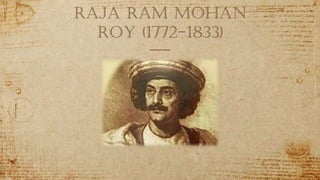
RAJA RAM MOHAN
ROY (1772-1833)
3
4
 Born: August 14, 1772
 Place of Birth: Radhanagar village, Hoogly district, Bengal
Presidency (now West Bengal)
 Parents: Ramakanta Roy (Father) and Tarini Devi (Mother)
 Education: Persian and Urdu in Patna; Sanskrit in Varanasi;
English in Kolkata
 Religious Views: Hinduism (early life) and Brahmoism (later in life)
 Death: September 27, 1833
 Place of death: Bristol, England
 Memorial: Museum at Kolkata
 EARLY LIFE
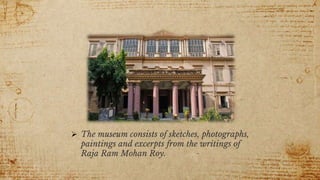
 The museum consists of sketches, photographs,
paintings and excerpts from the writings of
Raja Ram Mohan Roy.
6
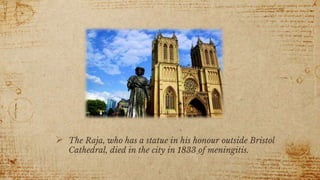
 The Raja, who has a statue in his honour outside Bristol
Cathedral, died in the city in 1833 of meningitis.
7
 EDUCATION
He got Bengali and Sanskrit education from the village
school.
 After that, Ram Mohan was sent to Patna to study Persian
and Arabic in a Madrasa. He began studying scriptures,
including the Vedas and Upanishads.
 He learnt English language at the age of 22. He acquired
the knowledge of Latin, Greek, and Hebrew. He also studied
Christanity.
 Post completion of his education, Ram Mohan entered the
services of the East India Company as a clerk. He was
eventually promoted to be a Dewan.
8
 He advocated the introduction of an
English Education System in the
country teaching scientific subjects
like Mathematics, Physics, Chemistry
and even Botany.
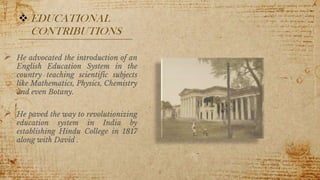
 He paved the way to revolutionizing
education system in India by
establishing Hindu College in 1817
along with David .
 EDUCATIONAL
CONTRIBUTIONS
9
 WOMEN
EDUCATION
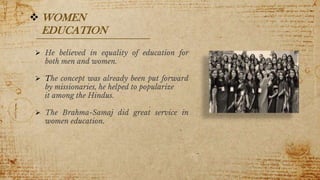
 He believed in equality of education for
both men and women.
 The concept was already been put forward
by missionaries, he helped to popularize
it among the Hindus.
 The Brahma-Samaj did great service in
women education.
 SOCIAL
CONTRIBUTIONS
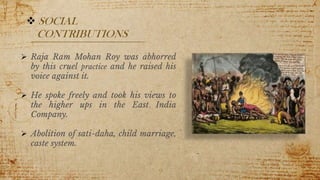
 Raja Ram Mohan Roy was abhorred
by this cruel practice and he raised his
voice against it.
 He spoke freely and took his views to
the higher ups in the East India
Company.
 Abolition of sati-daha, child marriage,
caste system.
9
11
 RELIGION
CONTRIBUTIONS
 He founded the Atmiya Sabha in
1928. The Atmiya Sabha
reorganised itself into the Brahma
Sabha.
 With time, the Brahma Samaj
became a strong progressive force to
drive social reforms in Bengal,
especially women education.
12
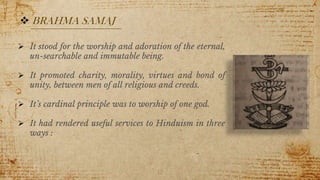
 BRAHMA SAMAJ
 It stood for the worship and adoration of the eternal,
un-searchable and immutable being.
 It promoted charity, morality, virtues and bond of
unity, between men of all religious and creeds.
 It’s cardinal principle was to worship of one god.
 It had rendered useful services to Hinduism in three
ways :
13
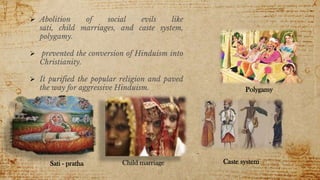
 Abolition of social evils like
sati, child marriages, and caste system,
polygamy.
 prevented the conversion of Hinduism into
Christianity.
 It purified the popular religion and paved
the way for aggressive Hinduism.
Sati - pratha Child marriage Caste system
Polygamy
14
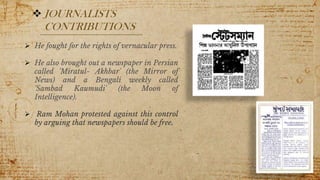
 He fought for the rights of vernacular press.
 He also brought out a newspaper in Persian
called 'Miratul- Akhbar' (the Mirror of
News) and a Bengali weekly called
'Sambad Kaumudi' (the Moon of
Intelligence).
 Ram Mohan protested against this control
by arguing that newspapers should be free.
 JOURNALISTS
CONTRIBUTIONS
15
 DEATH
 Raja Ram Mohan Roy travelled to England
in 1830 to request the Imperial
Government to increase the royalty, and to
ensure that Lord Bentinck's Sati Act would
not be overturned.
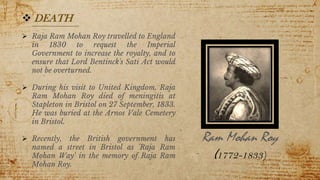
 During his visit to United Kingdom, Raja
Ram Mohan Roy died of meningitis at
Stapleton in Bristol on 27 September, 1833.
He was buried at the Arnos Vale Cemetery
in Bristol.
 Recently, the British government has
named a street in Bristol as 'Raja Ram
Mohan Way' in the memory of Raja Ram
Mohan Roy.
Ram Mohan Roy
(1772-1833)
16
Thank you
B.SHRADHA
121713601009
BBA-A

Raja ram mohan roy

  • 1.
  • 2.
    2  CONTENTS  EARLYLIFE  EDUCATION  CONTRIBUTIONS - EDUCATION *WOMEN - SOCIAL - RELIGION *BRAMHA SAMAJ - JOURNALS  DEATH
  • 3.
    RAJA RAM MOHAN ROY(1772-1833) 3
  • 4.
    4  Born: August14, 1772  Place of Birth: Radhanagar village, Hoogly district, Bengal Presidency (now West Bengal)  Parents: Ramakanta Roy (Father) and Tarini Devi (Mother)  Education: Persian and Urdu in Patna; Sanskrit in Varanasi; English in Kolkata  Religious Views: Hinduism (early life) and Brahmoism (later in life)  Death: September 27, 1833  Place of death: Bristol, England  Memorial: Museum at Kolkata  EARLY LIFE
  • 5.
     The museumconsists of sketches, photographs, paintings and excerpts from the writings of Raja Ram Mohan Roy.
  • 6.
    6  The Raja,who has a statue in his honour outside Bristol Cathedral, died in the city in 1833 of meningitis.
  • 7.
    7  EDUCATION He gotBengali and Sanskrit education from the village school.  After that, Ram Mohan was sent to Patna to study Persian and Arabic in a Madrasa. He began studying scriptures, including the Vedas and Upanishads.  He learnt English language at the age of 22. He acquired the knowledge of Latin, Greek, and Hebrew. He also studied Christanity.  Post completion of his education, Ram Mohan entered the services of the East India Company as a clerk. He was eventually promoted to be a Dewan.
  • 8.
    8  He advocatedthe introduction of an English Education System in the country teaching scientific subjects like Mathematics, Physics, Chemistry and even Botany.  He paved the way to revolutionizing education system in India by establishing Hindu College in 1817 along with David .  EDUCATIONAL CONTRIBUTIONS
  • 9.
    9  WOMEN EDUCATION  Hebelieved in equality of education for both men and women.  The concept was already been put forward by missionaries, he helped to popularize it among the Hindus.  The Brahma-Samaj did great service in women education.
  • 10.
     SOCIAL CONTRIBUTIONS  RajaRam Mohan Roy was abhorred by this cruel practice and he raised his voice against it.  He spoke freely and took his views to the higher ups in the East India Company.  Abolition of sati-daha, child marriage, caste system. 9
  • 11.
    11  RELIGION CONTRIBUTIONS  Hefounded the Atmiya Sabha in 1928. The Atmiya Sabha reorganised itself into the Brahma Sabha.  With time, the Brahma Samaj became a strong progressive force to drive social reforms in Bengal, especially women education.
  • 12.
    12  BRAHMA SAMAJ It stood for the worship and adoration of the eternal, un-searchable and immutable being.  It promoted charity, morality, virtues and bond of unity, between men of all religious and creeds.  It’s cardinal principle was to worship of one god.  It had rendered useful services to Hinduism in three ways :
  • 13.
    13  Abolition ofsocial evils like sati, child marriages, and caste system, polygamy.  prevented the conversion of Hinduism into Christianity.  It purified the popular religion and paved the way for aggressive Hinduism. Sati - pratha Child marriage Caste system Polygamy
  • 14.
    14  He foughtfor the rights of vernacular press.  He also brought out a newspaper in Persian called 'Miratul- Akhbar' (the Mirror of News) and a Bengali weekly called 'Sambad Kaumudi' (the Moon of Intelligence).  Ram Mohan protested against this control by arguing that newspapers should be free.  JOURNALISTS CONTRIBUTIONS
  • 15.
    15  DEATH  RajaRam Mohan Roy travelled to England in 1830 to request the Imperial Government to increase the royalty, and to ensure that Lord Bentinck's Sati Act would not be overturned.  During his visit to United Kingdom, Raja Ram Mohan Roy died of meningitis at Stapleton in Bristol on 27 September, 1833. He was buried at the Arnos Vale Cemetery in Bristol.  Recently, the British government has named a street in Bristol as 'Raja Ram Mohan Way' in the memory of Raja Ram Mohan Roy. Ram Mohan Roy (1772-1833)
  • 16.