PANCHAYATI RAJ
SYSTEM
Presented by
Sounita
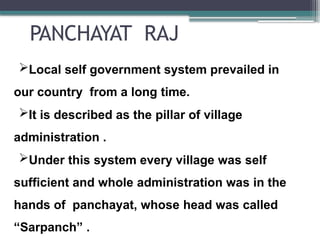
PANCHAYAT RAJ
Local self government system prevailed in
our country from a long time.
It is described as the pillar of village
administration .
Under this system every village was self
sufficient and whole administration was in the
hands of panchayat, whose head was called
“Sarpanch” .
CONT….
If the constitution is a frame work for federal
structure then the power is said between two
sets of government.
One of the center called Union or federal
Government and other State or provincial
Government.
CONT…
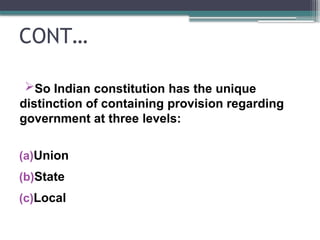
So Indian constitution has the unique
distinction of containing provision regarding
government at three levels:
(a)Union
(b)State
(c)Local
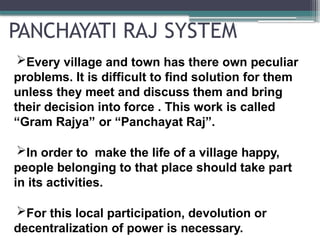
PANCHAYATI RAJ SYSTEM
Every village and town has there own peculiar
problems. It is difficult to find solution for them
unless they meet and discuss them and bring
their decision into force . This work is called
“Gram Rajya” or “Panchayat Raj”.
In order to make the life of a village happy,
people belonging to that place should take part
in its activities.
For this local participation, devolution or
decentralization of power is necessary.
CONT…
Action can be taken only when power is
given to local people. It is for the progress
and development of the villages that both
the central and state government have
implemented the “Panchayat Raj System”
AIMS OF PANCHAYAT RAJ
SYSTEM
(1) To give more power to people in
administration.
(2) Introduce decentralization of power in
administration.
(3)Work for the comprehensive
progress of a village
LOCAL ADMINISTRATION IN
VILLAGE
There are two kinds of village
administration institution:
1) For a village
2) For a town.
On 1st November 1959,i.e. the “Rajyotsava
day” Mysore gram panchayat and local self
CONT…
It consisted of three tier system:
(1)Village panchayat at village level.
(2)Taluk development board at Taluk level.
(3)District development council at District
level.
GRAM PANCHAYAT
Under Panchayat Raj System, the role of
gram panchayat is very important. The
progress and development of village
depends on it.
It is called the pillar of “Grama
Swarajaya” or “Grama Suraj”.
Under this new act, villages with 5,000-
7,000 population and the adjacent small
villages join together to create a Gram
Panchayat.
Cont…
Where as in Malnad and hilly areas, villages
having a population of 2500 are allowed to form a
gram panchayat.
Every 400 residents will have one representative
and they are elected by voters, whose age is
above 18 years the term of office is 5 years.
It is expected to meet at least once in 2 months.
FUNCTIONS OF GRAM
PANCHAYAT
1.Taking care of health and sanitation of the
village.
2.Providing pure water for drinking.
3.Providing drainage and street lights.
4.Housing
5.Establishing khadi and village industries
6.Providing elementary education.
TALUK PANCHAYAT
Every revenue Taluk will have a Taluk
panchayat it consists of the elected
members of the taluk panchayat.
For every thousand person, one
representative is elected from rural
areas.
CONT…
In addition the local member of legislative
assembly, member of legislative council and
member of parliament are also member.
Besides 1/5th of the president of the Gram
Panchayat are appointed on rotation basis for a
period of one year.
FUNCTIONS OF TALUK
PANCHAYAT
1.To prepare the annual plan and budget
as suggested by the government or the
zilla panchayat.
2.Prepare agricultural extension programs
and request for grants.
3.Conservation of soil and land
developments
4.Promoting the use of non conventional
energy resources
5.Promoting primary, higher and technical
ZILLA PANCHAYAT
It is one of the important units of
panchayat raj system at the district level.
A member for every 40,000 people is
elected for zilla panchayat but in case of
Malnad, hilly areas one member is
elected for 30,000 people.
CONT…
 In addition the members of “Lok Sabha” and
“Rajya Sabha” who represent the district and
the member of legislature are the member of
Zilla panchayat.
 Gram panchayat presidents are also its
member.
FUNCTIONS OF ZILLA
PANCHAYAT
1.Extension plans for agriculture and
horticulture.
2.Use of water resources and its maintenance.
3.Use of non conventional energy.
4.Women and child welfare programmes .
5.Social developments of the disables and
mentally retarded.
6.Helping reading room and library
developments.
MUNICIPAL
LOCAL BODIES
These are created to look after the welfare of
cities and towns.
There are three kinds:
1) “town municipality”
2) “city municipality”
3) “corporation”.
CONT…
TOWN AND CITY MUNICIPALITIES:
They are constituted for a population of 10,000-
50,000 in towns or cities.
Such city municipality council will have 15-35
elected members.
In practice they are called councilors. Even there
is reservation for women, SC, ST.
The term of these municipality is five (5) years.
FUNCTIONS OF TOWN AND CITY
MUNICIPALITIES
1.Maintenace of under ground drainage, public
gardens, play grounds, and cleanliness.
2.Taking care of roads, street lights, and
sanitations.
3.Provide relief in case of natural calamities.
4.Maintenance of birth and death reports.
5.Extension and beautification of city.
6.Supply of drinking water.
MUNICIPAL CORPORATION OR
MAHANAGAR PALIKA
 They are created where the population is more
than two lakhs and income is more than one crore
rupees.
 The number of members is decided by the state
governments. The membership may vary from 50-
100.
 The complete city is divided into wards, and from
each ward, one member is elected. The term of
corporation is five years.
CONT…
 To help administration, an administrator is
appointed by the government.
 The administration of the Mahanagar Palika
is carried on by three wings:
1) General body or council
2) Standing committees
3) Commissioner.
FUNCTIONS OF MUNICIPAL
CORPORATION OR MAHANAGAR
PALIKA
1.Construction of roads, maintaining street
lights, water supply, underground
drainage, gardens.
2.Maternity hospitals, family welfare
centers, dispensaries.
CONT…
3. Prevention of epidemics.
4. Free and compulsory education, mid-
day meals, restaurants, library and
registering birth and death.
THE SCHEDULED AND TRIBAL
AREAS
Our constitution contains special
provisions for administration and
controls of certain areas which have been
named as scheduled areas and also for
scheduled tribes.
Even though such areas form part of a
state or union territory. It was also a step
towards preserving there culture and
protecting them from exploitation.

CONT…
As a result of this policy these tribes
are even 68 years after the
commencement of the constitutions
far away from the mainstream and
have developed a vested interest on
separatism.
The president has the power to
declare any area to be scheduled
area.
CONT…
The union may give directions to the
states in regard to the administration of
such area.
Each states has a tribes advisory.
.

panchayatirajsyatemdefinationandinfo.pptx

  • 1.
  • 2.
    PANCHAYAT RAJ Local selfgovernment system prevailed in our country from a long time. It is described as the pillar of village administration . Under this system every village was self sufficient and whole administration was in the hands of panchayat, whose head was called “Sarpanch” .
  • 3.
    CONT…. If the constitutionis a frame work for federal structure then the power is said between two sets of government. One of the center called Union or federal Government and other State or provincial Government.
  • 4.
    CONT… So Indian constitutionhas the unique distinction of containing provision regarding government at three levels: (a)Union (b)State (c)Local
  • 5.
    PANCHAYATI RAJ SYSTEM Everyvillage and town has there own peculiar problems. It is difficult to find solution for them unless they meet and discuss them and bring their decision into force . This work is called “Gram Rajya” or “Panchayat Raj”. In order to make the life of a village happy, people belonging to that place should take part in its activities. For this local participation, devolution or decentralization of power is necessary.
  • 6.
    CONT… Action can betaken only when power is given to local people. It is for the progress and development of the villages that both the central and state government have implemented the “Panchayat Raj System”
  • 7.
    AIMS OF PANCHAYATRAJ SYSTEM (1) To give more power to people in administration. (2) Introduce decentralization of power in administration. (3)Work for the comprehensive progress of a village
  • 8.
    LOCAL ADMINISTRATION IN VILLAGE Thereare two kinds of village administration institution: 1) For a village 2) For a town. On 1st November 1959,i.e. the “Rajyotsava day” Mysore gram panchayat and local self
  • 9.
    CONT… It consisted ofthree tier system: (1)Village panchayat at village level. (2)Taluk development board at Taluk level. (3)District development council at District level.
  • 10.
    GRAM PANCHAYAT Under PanchayatRaj System, the role of gram panchayat is very important. The progress and development of village depends on it. It is called the pillar of “Grama Swarajaya” or “Grama Suraj”. Under this new act, villages with 5,000- 7,000 population and the adjacent small villages join together to create a Gram Panchayat.
  • 11.
    Cont… Where as inMalnad and hilly areas, villages having a population of 2500 are allowed to form a gram panchayat. Every 400 residents will have one representative and they are elected by voters, whose age is above 18 years the term of office is 5 years. It is expected to meet at least once in 2 months.
  • 12.
    FUNCTIONS OF GRAM PANCHAYAT 1.Takingcare of health and sanitation of the village. 2.Providing pure water for drinking. 3.Providing drainage and street lights. 4.Housing 5.Establishing khadi and village industries 6.Providing elementary education.
  • 13.
    TALUK PANCHAYAT Every revenueTaluk will have a Taluk panchayat it consists of the elected members of the taluk panchayat. For every thousand person, one representative is elected from rural areas.
  • 14.
    CONT… In addition thelocal member of legislative assembly, member of legislative council and member of parliament are also member. Besides 1/5th of the president of the Gram Panchayat are appointed on rotation basis for a period of one year.
  • 15.
    FUNCTIONS OF TALUK PANCHAYAT 1.Toprepare the annual plan and budget as suggested by the government or the zilla panchayat. 2.Prepare agricultural extension programs and request for grants. 3.Conservation of soil and land developments 4.Promoting the use of non conventional energy resources 5.Promoting primary, higher and technical
  • 16.
    ZILLA PANCHAYAT It isone of the important units of panchayat raj system at the district level. A member for every 40,000 people is elected for zilla panchayat but in case of Malnad, hilly areas one member is elected for 30,000 people.
  • 17.
    CONT…  In additionthe members of “Lok Sabha” and “Rajya Sabha” who represent the district and the member of legislature are the member of Zilla panchayat.  Gram panchayat presidents are also its member.
  • 18.
    FUNCTIONS OF ZILLA PANCHAYAT 1.Extensionplans for agriculture and horticulture. 2.Use of water resources and its maintenance. 3.Use of non conventional energy. 4.Women and child welfare programmes . 5.Social developments of the disables and mentally retarded. 6.Helping reading room and library developments.
  • 19.
    MUNICIPAL LOCAL BODIES These arecreated to look after the welfare of cities and towns. There are three kinds: 1) “town municipality” 2) “city municipality” 3) “corporation”.
  • 20.
    CONT… TOWN AND CITYMUNICIPALITIES: They are constituted for a population of 10,000- 50,000 in towns or cities. Such city municipality council will have 15-35 elected members. In practice they are called councilors. Even there is reservation for women, SC, ST. The term of these municipality is five (5) years.
  • 21.
    FUNCTIONS OF TOWNAND CITY MUNICIPALITIES 1.Maintenace of under ground drainage, public gardens, play grounds, and cleanliness. 2.Taking care of roads, street lights, and sanitations. 3.Provide relief in case of natural calamities. 4.Maintenance of birth and death reports. 5.Extension and beautification of city. 6.Supply of drinking water.
  • 22.
    MUNICIPAL CORPORATION OR MAHANAGARPALIKA  They are created where the population is more than two lakhs and income is more than one crore rupees.  The number of members is decided by the state governments. The membership may vary from 50- 100.  The complete city is divided into wards, and from each ward, one member is elected. The term of corporation is five years.
  • 23.
    CONT…  To helpadministration, an administrator is appointed by the government.  The administration of the Mahanagar Palika is carried on by three wings: 1) General body or council 2) Standing committees 3) Commissioner.
  • 24.
    FUNCTIONS OF MUNICIPAL CORPORATIONOR MAHANAGAR PALIKA 1.Construction of roads, maintaining street lights, water supply, underground drainage, gardens. 2.Maternity hospitals, family welfare centers, dispensaries.
  • 25.
    CONT… 3. Prevention ofepidemics. 4. Free and compulsory education, mid- day meals, restaurants, library and registering birth and death.
  • 26.
    THE SCHEDULED ANDTRIBAL AREAS Our constitution contains special provisions for administration and controls of certain areas which have been named as scheduled areas and also for scheduled tribes. Even though such areas form part of a state or union territory. It was also a step towards preserving there culture and protecting them from exploitation.
  • 27.
    CONT… As a resultof this policy these tribes are even 68 years after the commencement of the constitutions far away from the mainstream and have developed a vested interest on separatism. The president has the power to declare any area to be scheduled area.
  • 28.
    CONT… The union maygive directions to the states in regard to the administration of such area. Each states has a tribes advisory.
  • 29.