Introduction Brandon & Michelle
• Brandon Carson, Bill.com
   • @brandonwcarson
   • LinkedIn: brandoncarson

• Michelle Lentz, Clarity Consultants
  • @michellelentz
  • LinkedIn: michelleslentz            HELLO
                                        my nam
                                               e is
5, 10, 80
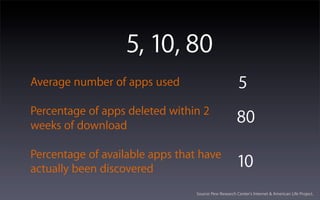
5, 10, 80
Average number of apps used                            5
Percentage of apps deleted within 2
weeks of download
                                                      80
Percentage of available apps that have
actually been discovered                              10
                                 Source: Pew Research Center's Internet & American Life Project.
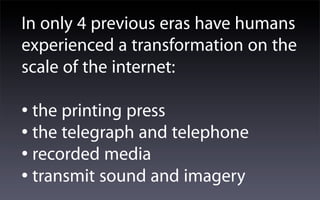
In only 4 previous eras have humans
experienced a transformation on the
scale of the internet:

• the printing press
• the telegraph and telephone
• recorded media
• transmit sound and imagery
a brief history of mobile time
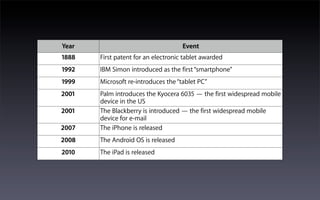
Year                                 Event
1888   First patent for an electronic tablet awarded
1992   IBM Simon introduced as the first “smartphone”
1999   Microsoft re-introduces the “tablet PC”
2001   Palm introduces the Kyocera 6035 — the first widespread mobile
       device in the US
2001   The Blackberry is introduced — the first widespread mobile
       device for e-mail
2007   The iPhone is released
2008   The Android OS is released
2010   The iPad is released
mobile users
Your users now have near real-time
access to information in the palm
of their hand. They expect:

• technical stability
• up-to-date, credible information
The majority of Internet users will
    eventually connect with
     mobile devices first.

    In many Asian countries,
        they already do.
Compared to just last year,
consumers:

• Spend 54% more time with their
  connected devices
• 49% more time talking and texting
• 29% more time watching videos
                              Source: Yahoo! Insights 2011
mobile mindsets
Mobile users engage in short ‘activity bursts’
     with the expectation to continue
 their experience across multiple devices
Fully one in three people multi-task with their devices
Most mobile consumers use their devices between
             8:30 a.m. and 1:00 p.m.


                                         Source: Yahoo! Insights 2011
Almost two-thirds of smartphone owners state “my mobile
device allows me to access information that helps me in real
                    life circumstances”


                                                 Source: Yahoo! Insights 2011
65% of mobile consumers agree that their mobile device
    quickly provides the answer to questions when
          they need an immediate response


                                             Source: Yahoo! Insights 2011
The deeply personal connection that people have with their
 connected devices means that we must keep in mind their
consumption habits, activities and accompanying mindsets
differences between app types
discover > install > click icon > run
native apps

• must be installed on the device
• written specifically for the OS
web apps

• reside on a server
• coded once for multiple OS’s
which app to develop?

• native API or native graphics?
• written specifically for the OS
Characteristic                    Native   Web
Downloaded to the device
Coded in a language specific to the device OS
Objective C, Java)
Runs in a browser

Coded in HTML, JavaScript, and CSS

Distributed via an app store

Full use of device hardware and APIs
Limited access to device hardware and data, as well
as user data
Characteristic                    Native   Web
Downloaded to the device                                X
Coded in a language specific to the device OS
Objective C, Java)                                      X
Runs in a browser                                               X
Coded in HTML, JavaScript, and CSS                              X
Distributed via an app store                            X
Full use of device hardware and APIs                    X
Limited access to device hardware and data, as well
as user data                                                    X
hybrid apps

• written in native languages
• downloaded to the device
• can access APIs
• content comes from the web
Consumers expect participatory
content experiences:

• contextually relevant
• consumable with multiple devices
• trusted and sharable
authoring tools for mobile first
Articulate Storyline > Articulate iPad App


Flash > HTML5 conversion project
 Articulate Presenter
pitfalls
audio and other bugs
creating interactions from scratch
cost
maintenance
conversion:
course length
legacy technology,
   interactions
    and Flash
content
best practices for mobile design
always ask why
know mobile constraints

         small screens
     unreliable networks
people in all kinds of situations
one step at a time
small chunks
orientation
create a default reference design
    for the devices and know
     your device capabilities
become more aware of touch targets,
      gestures, and actions
use technology to your advantage
consider performance optimization
emulation
test
and test again
new opportunity
     reboot
   fresh start
goodbye

Designing Content for Multiple Devices

  • 2.
    Introduction Brandon &Michelle • Brandon Carson, Bill.com • @brandonwcarson • LinkedIn: brandoncarson • Michelle Lentz, Clarity Consultants • @michellelentz • LinkedIn: michelleslentz HELLO my nam e is
  • 3.
  • 4.
    5, 10, 80 Averagenumber of apps used 5 Percentage of apps deleted within 2 weeks of download 80 Percentage of available apps that have actually been discovered 10 Source: Pew Research Center's Internet & American Life Project.
  • 5.
    In only 4previous eras have humans experienced a transformation on the scale of the internet: • the printing press • the telegraph and telephone • recorded media • transmit sound and imagery
  • 6.
    a brief historyof mobile time
  • 7.
    Year Event 1888 First patent for an electronic tablet awarded 1992 IBM Simon introduced as the first “smartphone” 1999 Microsoft re-introduces the “tablet PC” 2001 Palm introduces the Kyocera 6035 — the first widespread mobile device in the US 2001 The Blackberry is introduced — the first widespread mobile device for e-mail 2007 The iPhone is released 2008 The Android OS is released 2010 The iPad is released
  • 8.
  • 9.
    Your users nowhave near real-time access to information in the palm of their hand. They expect: • technical stability • up-to-date, credible information
  • 10.
    The majority ofInternet users will eventually connect with mobile devices first. In many Asian countries, they already do.
  • 11.
    Compared to justlast year, consumers: • Spend 54% more time with their connected devices • 49% more time talking and texting • 29% more time watching videos Source: Yahoo! Insights 2011
  • 12.
  • 13.
    Mobile users engagein short ‘activity bursts’ with the expectation to continue their experience across multiple devices
  • 14.
    Fully one inthree people multi-task with their devices
  • 15.
    Most mobile consumersuse their devices between 8:30 a.m. and 1:00 p.m. Source: Yahoo! Insights 2011
  • 16.
    Almost two-thirds ofsmartphone owners state “my mobile device allows me to access information that helps me in real life circumstances” Source: Yahoo! Insights 2011
  • 17.
    65% of mobileconsumers agree that their mobile device quickly provides the answer to questions when they need an immediate response Source: Yahoo! Insights 2011
  • 18.
    The deeply personalconnection that people have with their connected devices means that we must keep in mind their consumption habits, activities and accompanying mindsets
  • 22.
  • 23.
    discover > install> click icon > run
  • 24.
    native apps • mustbe installed on the device • written specifically for the OS
  • 25.
    web apps • resideon a server • coded once for multiple OS’s
  • 26.
    which app todevelop? • native API or native graphics? • written specifically for the OS
  • 27.
    Characteristic Native Web Downloaded to the device Coded in a language specific to the device OS Objective C, Java) Runs in a browser Coded in HTML, JavaScript, and CSS Distributed via an app store Full use of device hardware and APIs Limited access to device hardware and data, as well as user data
  • 28.
    Characteristic Native Web Downloaded to the device X Coded in a language specific to the device OS Objective C, Java) X Runs in a browser X Coded in HTML, JavaScript, and CSS X Distributed via an app store X Full use of device hardware and APIs X Limited access to device hardware and data, as well as user data X
  • 29.
    hybrid apps • writtenin native languages • downloaded to the device • can access APIs • content comes from the web
  • 31.
    Consumers expect participatory contentexperiences: • contextually relevant • consumable with multiple devices • trusted and sharable
  • 34.
    authoring tools formobile first
  • 35.
    Articulate Storyline >Articulate iPad App Flash > HTML5 conversion project Articulate Presenter
  • 36.
  • 37.
  • 38.
  • 39.
  • 40.
  • 41.
  • 42.
  • 43.
    legacy technology, interactions and Flash
  • 44.
  • 45.
    best practices formobile design
  • 46.
  • 47.
    know mobile constraints small screens unreliable networks people in all kinds of situations
  • 49.
  • 50.
  • 51.
  • 52.
    create a defaultreference design for the devices and know your device capabilities
  • 53.
    become more awareof touch targets, gestures, and actions
  • 54.
    use technology toyour advantage
  • 55.
  • 56.
  • 57.
  • 58.
    new opportunity reboot fresh start
  • 59.

Editor's Notes

  • #4 “ Because the average consumer uses products from multiple platforms, content designers need to adapt to the new multi-platform reality where your consumer might use a Windows device, a smartphone running Android and a tablet running iOS during a normal business day. This is our new reality and it’s critical for us to understand how platforms, products, and services interact as part of an ecosystem that our users are now moving around in.Today, we’re going to discuss four areas of focus for those who need to design and develop content across multiple devices.We will touch on:+ A brief history and current state of the mobile ecosystem+ The mobile user’s mindset+ Best practices for multi-platform content design+ The differences between web, hybrid, and native apps + All in 50 minutes! Let’s go!”
  • #7 “ As a result of the Internet, we are living in the largest increase of expressive capability in human history. In only four previous eras have there been communication transformations on this scale: • + Invention of the printing press and movable type• + Invention of the telegraph and telephone • + Invention of recorded media (photography, sound, and movies)• + Ability to transmit sound and images through the air”
  • #23 “ Sharing is becoming the most powerful social element with smartphones -- people like to not only share their experience, but also contrast their immediate experiences with those of their friends, and construct new shared experiences within the context of the app environment.”
  • #28 [Source: Nielsen Norman, September 2011]
  • #56