OCCUPATIONAL
PERFORMANACE MODEL
Shamima Akter
B. Sc (Honours) in Occupational Therapy
& M. Sc in Rehabilitation Science
Assistant Professor,
Department of Occupational Therapy
Bangladesh Health Professions Institute (BHPI)
Centre for the Rehabilitation of the Paralysed (CRP)
Chapain, Savar
Model in Occupational Therapy
Simply therapeutic model will give you idea
how to design treatment for client as well as
relate theory into practice.
?
Now question is how literature define
MODEL
TS1_OPM_Shamima_2018
Background
• The Occupational Performance Model [OPM] is
one of several models of human occupation and
occupational performance developed around the
world by occupational therapy theorists.
• This model was first conceptualized in 1986 by
Dr. Christine Chapparo and Dr. Judy Ranka at
the University of Sydney, Australia.
TS1_OPM_Shamima_2018
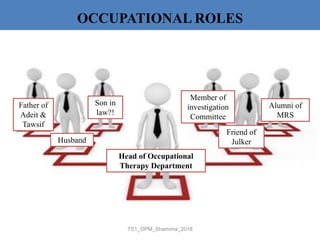
OCCUPATIONAL ROLES
TS1_OPM_Shamima_2018
Head of Occupational
Therapy Department
Husband
Son in
law?!
Father of
Adeit &
Tawsif
Member of
investigation
Committee
Friend of
Julker
Alumni of
MRS
OCCUPATIONAL ROLES
• The different positions in society we have.
• These are patterns of occupational behavior
composed of configurations of self-
maintenance, productivity, leisure and rest
occupations.
• Roles are determined by individual person-
environment-performance relationships.
• They are established through need and/or
choice and are modified with age, ability,
experience, circumstance and time.
TS1_OPM_Shamima_2018
OCCUPATIONAL PERFORMANCE ROLES
According to Radomoski and Latham 2014,
p3, Generally, roles fall into one of the
following three categories:
a) Self-Maintenance Roles
b) Self- Advancement Roles
c) Self- Enhancement Roles
TS1_OPM_Shamima_2018
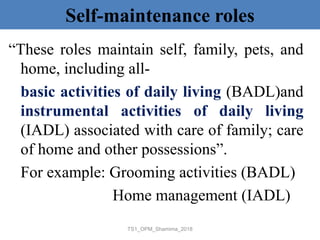
Self-maintenance roles
“These roles maintain self, family, pets, and
home, including all-
basic activities of daily living (BADL)and
instrumental activities of daily living
(IADL) associated with care of family; care
of home and other possessions”.
For example: Grooming activities (BADL)
Home management (IADL)
TS1_OPM_Shamima_2018
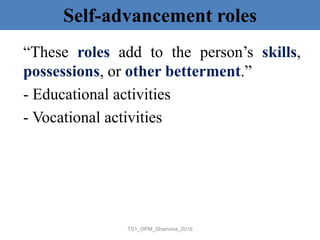
Self-advancement roles
“These roles add to the person’s skills,
possessions, or other betterment.”
- Educational activities
- Vocational activities
TS1_OPM_Shamima_2018
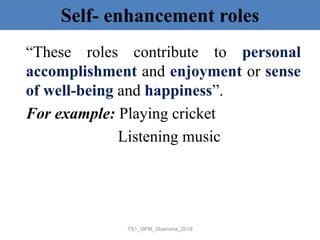
Self- enhancement roles
“These roles contribute to personal
accomplishment and enjoyment or sense
of well-being and happiness”.
For example: Playing cricket
Listening music
TS1_OPM_Shamima_2018
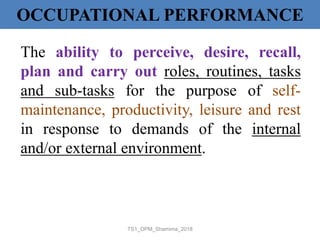
OCCUPATIONAL PERFORMANCE
The ability to perceive, desire, recall,
plan and carry out roles, routines, tasks
and sub-tasks for the purpose of self-
maintenance, productivity, leisure and rest
in response to demands of the internal
and/or external environment.
TS1_OPM_Shamima_2018
OCCUPATIONAL PERFORMANCE AREAS
• These are categories of routines, tasks and
sub-tasks performed by people to fulfil the
requirements of occupational performance
roles.
• These categories include self-maintenance
occupations/ self-care activities,
productivity/ school occupations, leisure/
play occupations and rest occupations.
TS1_OPM_Shamima_2018
Continue…
According to uniform terminology, The
different areas or categories of
occupations/activities that we participate
in:
- Self-care activities/ activities of daily
living/ self-maintenance activities,
- Work/productivity/ self- advancement
activities,
- Leisure/rest/ play/ self- enhancement
activities
TS1_OPM_Shamima_2018
Continue...
• Self- care activities: The typical life task
required for self-care and self- maintenance,
such as grooming, bathing, eating, dressing etc.
• Productivity: It refers to activities (both paid or
unpaid) that provide services or commodities to
others such educational activities and job-
related activities.
• Play: It refers to activities freely undertaken for
their own sake; it includes exploring, pretending,
celebrating, engaging in games or sports, and
pursuing hobbies.
TS1_OPM_Shamima_2018
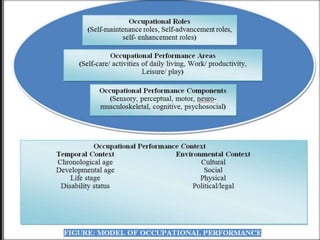
OCCUPATIONAL PERFORMANCE COMPONENT
• These are the component attributes of the
performer as well as the components of
occupational tasks.
• The physical, sensory-motor, cognitive,
and psychosocial dimensions of any task
performed; mirrors and prompts a
person’s various physical, sensory-motor,
cognitive and psychosocial operations that
are used to engage in task performance.
TS1_OPM_Shamima_2018
Continue…
• The different parts/components that help us to
participate in the activities of our daily lives.
These are sometimes called our abilities.
– Sensory component
– Perceptual component
– Neuro-musculoskeletal component
– Motor component
– Cognitive component and
– Psychosocial component
TS1_OPM_Shamima_2018
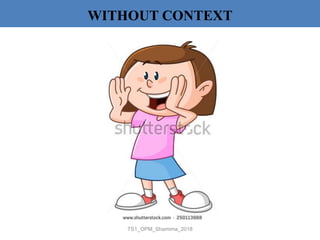
WITHOUT CONTEXT
TS1_OPM_Shamima_2018
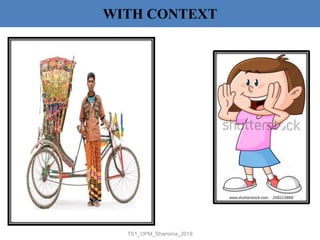
WITH CONTEXT
TS1_OPM_Shamima_2018
OCCUPATIONAL PERFORMANCE CONTEXT
• These are the situations or settings or places
or things that influence where we perform our
activities, how we perform them, why we
perform them, how often we perform them, etc.
• Situations or factors that influence an
individual’s engagement in desired and/or
required performance areas (AOTA, 1994)
• It has been divided into two- Temporal and
Environmental, which have been further
classified.
TS1_OPM_Shamima_2018
TEMPORAL CONTEXT
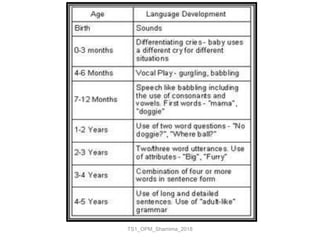
1. Chronological age
2. Developmental stage
3. Life cycle phage
4. Disability status
TS1_OPM_Shamima_2018
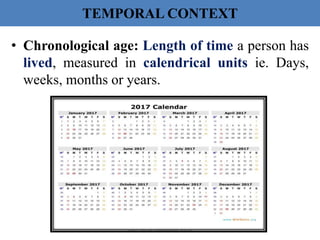
TEMPORAL CONTEXT
• Chronological age: Length of time a person has
lived, measured in calendrical units ie. Days,
weeks, months or years.
TS1_OPM_Shamima_2018
TEMPORAL CONTEXT
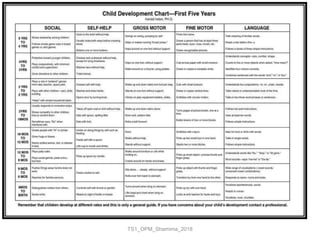
• Developmental stage/ age: Internal
mechanism of the individual organism as
an unfolding biological, cognitive and
psychosocial process.
TS1_OPM_Shamima_2018
TEMPORAL CONTEXT
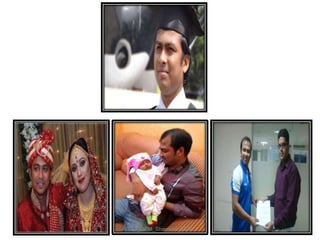
• Life cycle phage: Life cycle phase is defined in
the Uniform Terminology as
“place in important life phases, such as
career style, parenting cycle or educational
process” (AOTA, 1994).
• It refers to the involvement of the person in social
roles and life tasks that are common for persons
of that age and social status in the culture in
which the individual lives.
TS1_OPM_Shamima_2018
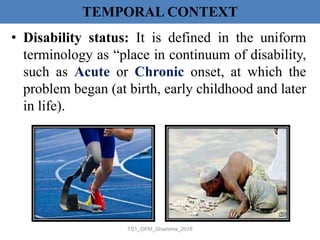
• Disability status: It is defined in the uniform
terminology as “place in continuum of disability,
such as Acute or Chronic onset, at which the
problem began (at birth, early childhood and later
in life).
TS1_OPM_Shamima_2018
TEMPORAL CONTEXT
TS1_OPM_Shamima_2018
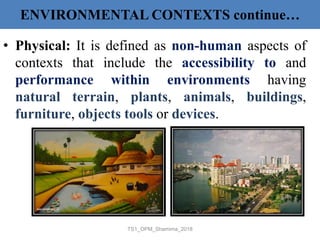
1. Physical environment
2. Social environment
3. Cultural environment
4. Political environment
TS1_OPM_Shamima_2018
ENVIRONMENTAL CONTEXTS
ENVIRONMENTAL CONTEXTS continue…
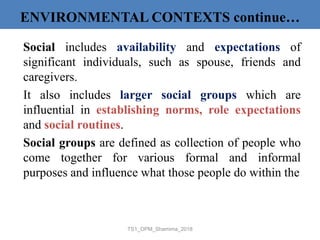
• Physical: It is defined as non-human aspects of
contexts that include the accessibility to and
performance within environments having
natural terrain, plants, animals, buildings,
furniture, objects tools or devices.
TS1_OPM_Shamima_2018
Social includes availability and expectations of
significant individuals, such as spouse, friends and
caregivers.
It also includes larger social groups which are
influential in establishing norms, role expectations
and social routines.
Social groups are defined as collection of people who
come together for various formal and informal
purposes and influence what those people do within the
TS1_OPM_Shamima_2018
ENVIRONMENTAL CONTEXTS continue…
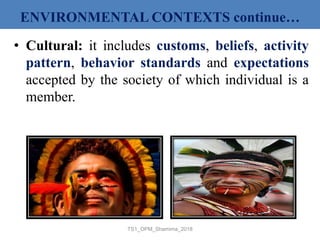
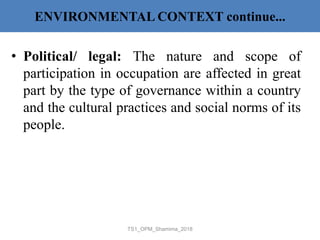
• Cultural: it includes customs, beliefs, activity
pattern, behavior standards and expectations
accepted by the society of which individual is a
member.
TS1_OPM_Shamima_2018
ENVIRONMENTAL CONTEXTS continue…
ENVIRONMENTAL CONTEXT continue...
• Political/ legal: The nature and scope of
participation in occupation are affected in great
part by the type of governance within a country
and the cultural practices and social norms of its
people.
TS1_OPM_Shamima_2018
REFERENCES
• Trombly CA 1996, Occupational Therapy for
Physical Dysfunction, 5th ed, Mosby Company,
Philadelphia
• Radomski and Trombly-Latham 2008,
Occupational Therapy for Physical Dysfunction
(6th Ed). Philadelphia: Lippincott, Williams and
Wilkins.
• Radomski and Trombly-Latham 2014,
Occupational Therapy for Physical Dysfunction
(7th Ed). Philadelphia: Lippincott, Williams and
Wilkins.
TS1_OPM_Shamima_2018
Terminology
• Possessions— the state of having, owning, or
controlling something.
• Configuration— an arrangement of elements in
a particular form, figure, or combination.
• Cultural— relating to the ideas, customs, and
social behavior of a society.
• Temporal- relating to time.
TS1_OPM_Shamima_2018
Social Term in Professionalism
• Etiquette is a code of behavior that delineates
expectations for social behavior according to
contemporary conventional norms within a
society, social class, or group.
• Professional etiquette is an unwritten code of
conduct regarding the interactions among the
members in a business setting. When proper
professional etiquette is used, all involved are
able to feel more comfortable, and things tend to
flow more smoothly.
TS1_OPM_Shamima_2018
Possible questions
• Outline/ Illustrate Occupational Performance
Model.
• Briefly describe Occupational Performance
Model.
• Briefly describe occupational performance
context according to OPM.
• Briefly describe occupational roles according
to OPM.
TS1_OPM_Shamima_2018
ASK AGAIN AND AGAIN
TS1_OPM_Shamima_2018
The more you
ask, the more
you learn

Occupational Performance Model- Old version

  • 2.
    OCCUPATIONAL PERFORMANACE MODEL Shamima Akter B.Sc (Honours) in Occupational Therapy & M. Sc in Rehabilitation Science Assistant Professor, Department of Occupational Therapy Bangladesh Health Professions Institute (BHPI) Centre for the Rehabilitation of the Paralysed (CRP) Chapain, Savar
  • 3.
    Model in OccupationalTherapy Simply therapeutic model will give you idea how to design treatment for client as well as relate theory into practice. ? Now question is how literature define MODEL TS1_OPM_Shamima_2018
  • 4.
    Background • The OccupationalPerformance Model [OPM] is one of several models of human occupation and occupational performance developed around the world by occupational therapy theorists. • This model was first conceptualized in 1986 by Dr. Christine Chapparo and Dr. Judy Ranka at the University of Sydney, Australia. TS1_OPM_Shamima_2018
  • 5.
  • 6.
    OCCUPATIONAL ROLES TS1_OPM_Shamima_2018 Head ofOccupational Therapy Department Husband Son in law?! Father of Adeit & Tawsif Member of investigation Committee Friend of Julker Alumni of MRS
  • 7.
    OCCUPATIONAL ROLES • Thedifferent positions in society we have. • These are patterns of occupational behavior composed of configurations of self- maintenance, productivity, leisure and rest occupations. • Roles are determined by individual person- environment-performance relationships. • They are established through need and/or choice and are modified with age, ability, experience, circumstance and time. TS1_OPM_Shamima_2018
  • 8.
    OCCUPATIONAL PERFORMANCE ROLES Accordingto Radomoski and Latham 2014, p3, Generally, roles fall into one of the following three categories: a) Self-Maintenance Roles b) Self- Advancement Roles c) Self- Enhancement Roles TS1_OPM_Shamima_2018
  • 9.
    Self-maintenance roles “These rolesmaintain self, family, pets, and home, including all- basic activities of daily living (BADL)and instrumental activities of daily living (IADL) associated with care of family; care of home and other possessions”. For example: Grooming activities (BADL) Home management (IADL) TS1_OPM_Shamima_2018
  • 10.
    Self-advancement roles “These rolesadd to the person’s skills, possessions, or other betterment.” - Educational activities - Vocational activities TS1_OPM_Shamima_2018
  • 11.
    Self- enhancement roles “Theseroles contribute to personal accomplishment and enjoyment or sense of well-being and happiness”. For example: Playing cricket Listening music TS1_OPM_Shamima_2018
  • 12.
    OCCUPATIONAL PERFORMANCE The abilityto perceive, desire, recall, plan and carry out roles, routines, tasks and sub-tasks for the purpose of self- maintenance, productivity, leisure and rest in response to demands of the internal and/or external environment. TS1_OPM_Shamima_2018
  • 13.
    OCCUPATIONAL PERFORMANCE AREAS •These are categories of routines, tasks and sub-tasks performed by people to fulfil the requirements of occupational performance roles. • These categories include self-maintenance occupations/ self-care activities, productivity/ school occupations, leisure/ play occupations and rest occupations. TS1_OPM_Shamima_2018
  • 14.
    Continue… According to uniformterminology, The different areas or categories of occupations/activities that we participate in: - Self-care activities/ activities of daily living/ self-maintenance activities, - Work/productivity/ self- advancement activities, - Leisure/rest/ play/ self- enhancement activities TS1_OPM_Shamima_2018
  • 15.
    Continue... • Self- careactivities: The typical life task required for self-care and self- maintenance, such as grooming, bathing, eating, dressing etc. • Productivity: It refers to activities (both paid or unpaid) that provide services or commodities to others such educational activities and job- related activities. • Play: It refers to activities freely undertaken for their own sake; it includes exploring, pretending, celebrating, engaging in games or sports, and pursuing hobbies. TS1_OPM_Shamima_2018
  • 16.
    OCCUPATIONAL PERFORMANCE COMPONENT •These are the component attributes of the performer as well as the components of occupational tasks. • The physical, sensory-motor, cognitive, and psychosocial dimensions of any task performed; mirrors and prompts a person’s various physical, sensory-motor, cognitive and psychosocial operations that are used to engage in task performance. TS1_OPM_Shamima_2018
  • 17.
    Continue… • The differentparts/components that help us to participate in the activities of our daily lives. These are sometimes called our abilities. – Sensory component – Perceptual component – Neuro-musculoskeletal component – Motor component – Cognitive component and – Psychosocial component TS1_OPM_Shamima_2018
  • 18.
  • 19.
  • 20.
    OCCUPATIONAL PERFORMANCE CONTEXT •These are the situations or settings or places or things that influence where we perform our activities, how we perform them, why we perform them, how often we perform them, etc. • Situations or factors that influence an individual’s engagement in desired and/or required performance areas (AOTA, 1994) • It has been divided into two- Temporal and Environmental, which have been further classified. TS1_OPM_Shamima_2018
  • 21.
    TEMPORAL CONTEXT 1. Chronologicalage 2. Developmental stage 3. Life cycle phage 4. Disability status TS1_OPM_Shamima_2018
  • 22.
    TEMPORAL CONTEXT • Chronologicalage: Length of time a person has lived, measured in calendrical units ie. Days, weeks, months or years. TS1_OPM_Shamima_2018
  • 23.
    TEMPORAL CONTEXT • Developmentalstage/ age: Internal mechanism of the individual organism as an unfolding biological, cognitive and psychosocial process. TS1_OPM_Shamima_2018
  • 24.
  • 25.
  • 26.
    TEMPORAL CONTEXT • Lifecycle phage: Life cycle phase is defined in the Uniform Terminology as “place in important life phases, such as career style, parenting cycle or educational process” (AOTA, 1994). • It refers to the involvement of the person in social roles and life tasks that are common for persons of that age and social status in the culture in which the individual lives. TS1_OPM_Shamima_2018
  • 27.
  • 28.
    • Disability status:It is defined in the uniform terminology as “place in continuum of disability, such as Acute or Chronic onset, at which the problem began (at birth, early childhood and later in life). TS1_OPM_Shamima_2018 TEMPORAL CONTEXT
  • 29.
  • 30.
    1. Physical environment 2.Social environment 3. Cultural environment 4. Political environment TS1_OPM_Shamima_2018 ENVIRONMENTAL CONTEXTS
  • 31.
    ENVIRONMENTAL CONTEXTS continue… •Physical: It is defined as non-human aspects of contexts that include the accessibility to and performance within environments having natural terrain, plants, animals, buildings, furniture, objects tools or devices. TS1_OPM_Shamima_2018
  • 32.
    Social includes availabilityand expectations of significant individuals, such as spouse, friends and caregivers. It also includes larger social groups which are influential in establishing norms, role expectations and social routines. Social groups are defined as collection of people who come together for various formal and informal purposes and influence what those people do within the TS1_OPM_Shamima_2018 ENVIRONMENTAL CONTEXTS continue…
  • 33.
    • Cultural: itincludes customs, beliefs, activity pattern, behavior standards and expectations accepted by the society of which individual is a member. TS1_OPM_Shamima_2018 ENVIRONMENTAL CONTEXTS continue…
  • 34.
    ENVIRONMENTAL CONTEXT continue... •Political/ legal: The nature and scope of participation in occupation are affected in great part by the type of governance within a country and the cultural practices and social norms of its people. TS1_OPM_Shamima_2018
  • 35.
    REFERENCES • Trombly CA1996, Occupational Therapy for Physical Dysfunction, 5th ed, Mosby Company, Philadelphia • Radomski and Trombly-Latham 2008, Occupational Therapy for Physical Dysfunction (6th Ed). Philadelphia: Lippincott, Williams and Wilkins. • Radomski and Trombly-Latham 2014, Occupational Therapy for Physical Dysfunction (7th Ed). Philadelphia: Lippincott, Williams and Wilkins. TS1_OPM_Shamima_2018
  • 36.
    Terminology • Possessions— thestate of having, owning, or controlling something. • Configuration— an arrangement of elements in a particular form, figure, or combination. • Cultural— relating to the ideas, customs, and social behavior of a society. • Temporal- relating to time. TS1_OPM_Shamima_2018
  • 37.
    Social Term inProfessionalism • Etiquette is a code of behavior that delineates expectations for social behavior according to contemporary conventional norms within a society, social class, or group. • Professional etiquette is an unwritten code of conduct regarding the interactions among the members in a business setting. When proper professional etiquette is used, all involved are able to feel more comfortable, and things tend to flow more smoothly. TS1_OPM_Shamima_2018
  • 38.
    Possible questions • Outline/Illustrate Occupational Performance Model. • Briefly describe Occupational Performance Model. • Briefly describe occupational performance context according to OPM. • Briefly describe occupational roles according to OPM. TS1_OPM_Shamima_2018
  • 39.
    ASK AGAIN ANDAGAIN TS1_OPM_Shamima_2018 The more you ask, the more you learn