A SEMINAR ON
SPHERIFICATION IN MOLECULAR
GASTRONOMY
PRESENTED BY :
MR. KARAD SANTOSH NAVNATH
ROLL NO : 08
EXAM NO : 62
M TECH 1ST YEAR
FOOD TECHNOLOGY
DEPARTMENT OF TECHNOLOGY SUK
INTRODUCTION
 Molecular gastronomy is the scientific discipline that explores the
phenomena occurring during culinary transformations.
 The objective of molecular gastronomy is the determination of
physical and chemical mechanisms involved in the preparation and
processing of food
 Molecular gastronomy is the study of chemical and physical changes
in food during processing.
 In 1988, Hungarian physicist Nicholas Kurti and French chemist
Hervey dedicated the term “Molecular & physical gastronomy”
SPHERIFICATION
 The spherification technique was introduced by Ferran Adria in
2003.
 It consists of a controlled jellification of a liquid which forms
spheres when submerged in a bath.
 Turn any drink or pureed food into small spheres
 The spheres have a gelatinous outside with a liquid center.
 Caviar -small size.
 Ravioli - larger size.
 Calcium chloride and sodium alginate are the two basic components
used for this technique.
 A slight pressure of the mouth on the sphere makes it burst and
release an amazing explosion of flavor.
TYPES OF SPHERIFICATION
A) Basic/ Direct Spherification.
B) Reverse Spherification.
A) Direct Spherification :
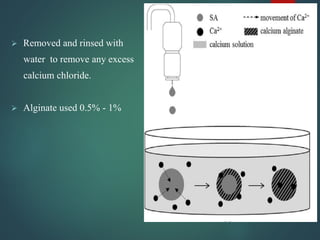
 Flavored liquid containing sodium alginate is dripped into a water
bath that is mixed with calcium (either calcium chloride or calcium
lactate).
 Outer layer is induced by calcium to form a thin gel layer, leaving a
liquid centre.
 In this version, the spheres are easily breakable and should be
consumed immediately.
 Removed and rinsed with
water to remove any excess
calcium chloride.
 Alginate used 0.5% - 1%
B) Reverse spherification
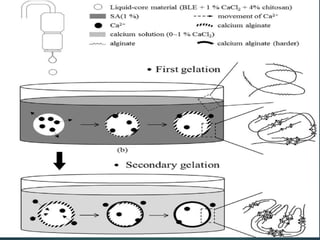
 A flavorful calcium rich solution is dropped into a bath of sodium
alginate.
 The calcium causes the sodium alginate to gel into a thin film
around the flavorful liquid.
 This method is used to produce larger spheres.
 Sodium alginate used 0.5-0.8% .
REACTION OCCURES DURING
SPHERIFICATION
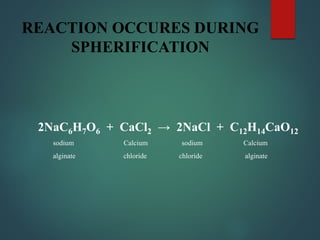
2NaC6H7O6 + CaCl2 → 2NaCl + C12H14CaO12
sodium Calcium sodium Calcium
alginate chloride chloride alginate
Chemicals used in Spherification
1) Sodium Alginate :
Origin - Seaweed
Generally Use - 0.5% - 1%
 Sodium alginate, which is also called algin.
 Natural gelling agent.
 Cell walls of certain Brown seaweed species.
 This salt is obtained by drying the seaweed, followed by cleaning,
boiling, gelling, and pulverizing it.
 A light yellow powder is produced from the process.
 Sodium alginate acts as a thickener, creating a viscous fluid.
 Alginate does not work properly with mixtures which are too acidic
(below 3.5pH).
 Alginate mixtures should be allowed to settle after blending in order to
allow the alginate to fully hydrate and trapped air to escape from the
mixture.
2) Calcium chloride :
 At room temperature it is a solid salt.
 Calcium chloride, (CaCl2), is a compound of chlorine and calcium
that is a by-product of sodium bicarbonate (baking soda)
manufacturing.
3) Calcium lactate :
 Calcium lactate is a calcium salt resulting from the fermentation of
lactic acid and calcium.
 White crystalline powder when solid and is highly soluble in cold
liquids.
 Used as a thickener in reverse spherification
Important factors affecting
Spherification
1) Dispersion and hydration :
 Use of cold water.
 Avoid hot water because it forms gel before powder dispersed.
 Blend dry sodium alginate with dry sugar.
 Use of sphere magic.
2) Getting the pH right :
 Below pH 3.6 SA convert into insoluble alginic acid.
 Use of sodium hexametaphosphate.
3) Avoiding excess calcium :
 Avoid hard water.
 Use of distilled water.
4) Preserving the flavor of spheres :
 Keep sphere in the same liquid.
 Use of oil bath.
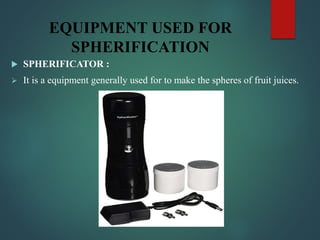
EQUIPMENT USED FOR
SPHERIFICATION
 SPHERIFICATOR :
 It is a equipment generally used for to make the spheres of fruit juices.
How to operate Spherificator
1) Dissolve 2-3g of sodium alginate into 250ml of the liquid ingredient.
2) Keep for 15 minutes as it is.
3) Prepare a calcium chloride bath :by dissolving 5g of calcium
chloride into 500ml of water.
4) Stir with a spoon until dissolved.
5) Select a needle and screw into the bottom opening of the
Spherificator.
6) Strain the sodium alginate mixture through a strainer.
7) Pour the preparation containing alginate into the Spherificator.
8) Drip droplets into the calcium chloride bath by pressing the button.
9) Collect the caviar from the calcium chloride bath using a slotted
spoon or a sieve
10) Rinse the caviar in cold water
APPLICATION
 Caviar making :Strawberry, Cucumber, Ginger, Lemon, Whiskey.
 Ravioli making : fruit juices.
 Seasoning of other food : Cakes.
 Making dishes delicious.
 To decorate alcohol shots.
EXAMPLES
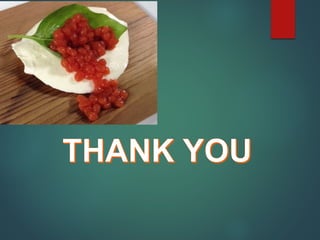
1)Strawberry Caviar :
 Place 150 ml water and strawberry syrup in a blender and blend for 30
seconds.
 Mix sugar with sodium alginate (2-3 gm).
 Sprinkle sodium alginate onto the spinning liquid.
 Mix until the powder is absorbed by the liquid.
 Let rest 15-20 minutes to allow all the air to escape.
 Strain strawberry mixture through a small strainer. Pour into
Spherificator.
 Dissolve the 5gm calcium chloride in 500 ml water by mixing with a
spoon for 30 seconds.
 Press the button on the Spherificator and drop the strawberry solution
into the calcium bath and leave sit for 1 minute.
 Collect the pearls in a strainer, rinse by water, drain and serve.
FUTURE SCOPE
 It is necessary to improve shelf life or stability of the spheres.
 Frozen spherification technique is also useful.
 It can be used in the bakery sector.
Spherification

Spherification

  • 1.
    A SEMINAR ON SPHERIFICATIONIN MOLECULAR GASTRONOMY PRESENTED BY : MR. KARAD SANTOSH NAVNATH ROLL NO : 08 EXAM NO : 62 M TECH 1ST YEAR FOOD TECHNOLOGY DEPARTMENT OF TECHNOLOGY SUK
  • 2.
    INTRODUCTION  Molecular gastronomyis the scientific discipline that explores the phenomena occurring during culinary transformations.  The objective of molecular gastronomy is the determination of physical and chemical mechanisms involved in the preparation and processing of food  Molecular gastronomy is the study of chemical and physical changes in food during processing.  In 1988, Hungarian physicist Nicholas Kurti and French chemist Hervey dedicated the term “Molecular & physical gastronomy”
  • 3.
    SPHERIFICATION  The spherificationtechnique was introduced by Ferran Adria in 2003.  It consists of a controlled jellification of a liquid which forms spheres when submerged in a bath.  Turn any drink or pureed food into small spheres  The spheres have a gelatinous outside with a liquid center.  Caviar -small size.  Ravioli - larger size.
  • 4.
     Calcium chlorideand sodium alginate are the two basic components used for this technique.  A slight pressure of the mouth on the sphere makes it burst and release an amazing explosion of flavor.
  • 5.
    TYPES OF SPHERIFICATION A)Basic/ Direct Spherification. B) Reverse Spherification. A) Direct Spherification :  Flavored liquid containing sodium alginate is dripped into a water bath that is mixed with calcium (either calcium chloride or calcium lactate).  Outer layer is induced by calcium to form a thin gel layer, leaving a liquid centre.  In this version, the spheres are easily breakable and should be consumed immediately.
  • 6.
     Removed andrinsed with water to remove any excess calcium chloride.  Alginate used 0.5% - 1%
  • 7.
    B) Reverse spherification A flavorful calcium rich solution is dropped into a bath of sodium alginate.  The calcium causes the sodium alginate to gel into a thin film around the flavorful liquid.  This method is used to produce larger spheres.  Sodium alginate used 0.5-0.8% .
  • 9.
    REACTION OCCURES DURING SPHERIFICATION 2NaC6H7O6+ CaCl2 → 2NaCl + C12H14CaO12 sodium Calcium sodium Calcium alginate chloride chloride alginate
  • 10.
    Chemicals used inSpherification 1) Sodium Alginate : Origin - Seaweed Generally Use - 0.5% - 1%  Sodium alginate, which is also called algin.  Natural gelling agent.  Cell walls of certain Brown seaweed species.  This salt is obtained by drying the seaweed, followed by cleaning, boiling, gelling, and pulverizing it.  A light yellow powder is produced from the process.
  • 11.
     Sodium alginateacts as a thickener, creating a viscous fluid.  Alginate does not work properly with mixtures which are too acidic (below 3.5pH).  Alginate mixtures should be allowed to settle after blending in order to allow the alginate to fully hydrate and trapped air to escape from the mixture.
  • 12.
    2) Calcium chloride:  At room temperature it is a solid salt.  Calcium chloride, (CaCl2), is a compound of chlorine and calcium that is a by-product of sodium bicarbonate (baking soda) manufacturing. 3) Calcium lactate :  Calcium lactate is a calcium salt resulting from the fermentation of lactic acid and calcium.  White crystalline powder when solid and is highly soluble in cold liquids.  Used as a thickener in reverse spherification
  • 13.
    Important factors affecting Spherification 1)Dispersion and hydration :  Use of cold water.  Avoid hot water because it forms gel before powder dispersed.  Blend dry sodium alginate with dry sugar.  Use of sphere magic. 2) Getting the pH right :  Below pH 3.6 SA convert into insoluble alginic acid.  Use of sodium hexametaphosphate.
  • 14.
    3) Avoiding excesscalcium :  Avoid hard water.  Use of distilled water. 4) Preserving the flavor of spheres :  Keep sphere in the same liquid.  Use of oil bath.
  • 15.
    EQUIPMENT USED FOR SPHERIFICATION SPHERIFICATOR :  It is a equipment generally used for to make the spheres of fruit juices.
  • 16.
    How to operateSpherificator 1) Dissolve 2-3g of sodium alginate into 250ml of the liquid ingredient. 2) Keep for 15 minutes as it is. 3) Prepare a calcium chloride bath :by dissolving 5g of calcium chloride into 500ml of water. 4) Stir with a spoon until dissolved. 5) Select a needle and screw into the bottom opening of the Spherificator.
  • 17.
    6) Strain thesodium alginate mixture through a strainer. 7) Pour the preparation containing alginate into the Spherificator. 8) Drip droplets into the calcium chloride bath by pressing the button. 9) Collect the caviar from the calcium chloride bath using a slotted spoon or a sieve 10) Rinse the caviar in cold water
  • 18.
    APPLICATION  Caviar making:Strawberry, Cucumber, Ginger, Lemon, Whiskey.  Ravioli making : fruit juices.  Seasoning of other food : Cakes.  Making dishes delicious.  To decorate alcohol shots.
  • 19.
    EXAMPLES 1)Strawberry Caviar : Place 150 ml water and strawberry syrup in a blender and blend for 30 seconds.  Mix sugar with sodium alginate (2-3 gm).  Sprinkle sodium alginate onto the spinning liquid.  Mix until the powder is absorbed by the liquid.  Let rest 15-20 minutes to allow all the air to escape.
  • 20.
     Strain strawberrymixture through a small strainer. Pour into Spherificator.  Dissolve the 5gm calcium chloride in 500 ml water by mixing with a spoon for 30 seconds.  Press the button on the Spherificator and drop the strawberry solution into the calcium bath and leave sit for 1 minute.  Collect the pearls in a strainer, rinse by water, drain and serve.
  • 21.
    FUTURE SCOPE  Itis necessary to improve shelf life or stability of the spheres.  Frozen spherification technique is also useful.  It can be used in the bakery sector.