Budget Preparation and
Implementation
Dr. Sangameshwar B. Kanthale
sbkrscp@gmail.com
Rajarshi Shahu College of Pharmacy, Buldana
“A budget is a plan of activities to be carried out in the
future for a specific period in the financial term.”
 The budget is used to project future income and
expenses.
 Budgets are a multi-purpose management tool
supporting planning, control, co-ordination,
communication, performance evaluation, and
motivation.
 Budgets are an important mechanism in the
allocation of decision rights. Budgets are often used
to measure performance. Budgets are also used as
a mechanism for control.
Objectives of Budget:
 It helps to set the benchmark for controlling ongoing
operations.
 Budget brings about efficiency and improvement in
the working of the organization.
 It helps in reducing wastage and losses by revealing
them in time for future corrective actions.
 It is prepared and approved for a definite fixed
period.
Advantages of Planning a Budget/Benefits of Budget:
• All levels of management plan ahead.
• Definite objectives for evaluating performance.
• Early warning system for potential problems.
• Coordination of activities within the business.
• Management awareness of the entity’s overall
operations.
• Motivates personnel throughout the organization to
meet planned objectives.
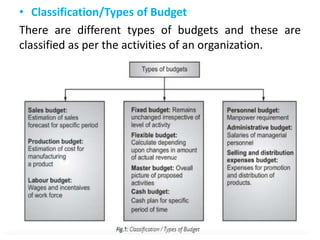
• Classification/Types of Budget
There are different types of budgets and these are
classified as per the activities of an organization.
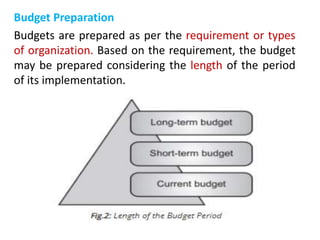
Budget Preparation
Budgets are prepared as per the requirement or types
of organization. Based on the requirement, the budget
may be prepared considering the length of the period
of its implementation.
• Long-term Budget: These budgets are prepared for
the long term. They are prepared for the period of 5
to 10 years. This type of budget is prepared to
depend upon the size of the organization.
• Short-term Budget: This type of budget is prepared
for a duration of 2 to 5 years. These budgets are
prepared under control conditions.
• Current Budget: This type of budget is prepared for a
shorter duration. The duration is usually 1 to 3
months.
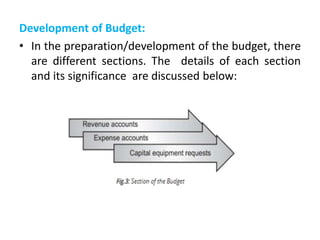
Development of Budget:
• In the preparation/development of the budget, there
are different sections. The details of each section
and its significance are discussed below:
Revenue Accounts:
 Total income must be calculated for the
implementation of the budget.
 The pharmacy department or accounts department
maintains daily, weekly, monthly and annual costs of
the pharmaceuticals issued to the patient services.
 The other statistics include the number of
prescriptions, number of prescriptions dispensed by
each pharmacist, hours of work put in prescription
volume per hour of service, medication cost per
patient, average drug cost per clinic visit, average
salary cost per prescription, and average supply cost
per requisition.
Expense/Expenditure Accounts:
 Expenditure accounts include administrative and
general expenses. Professional care of the patients,
out-patients and emergency expenses, and
miscellaneous expenses.
 The expenditure accounts also include the following
categories of expenses like salaries and wages, in this
expenditure salaries and wages of all employees
need to be taken into consideration.
 In expenses of supplies and materials, the Chief
pharmacist or the responsible person should prepare
the financial statement regarding the requirement of
the amount in rupees for supplies and materials with
the help of the latest financial budget.
 It is necessary to show the actual cost of the
materials. If the budgeted figure and the previous
figure were the same then the previously prepared
budget was well prepared.
 Purchase expense includes the cost of prescriptions
purchased from an outside pharmacy.
 Drugs and pharmaceuticals: Those dispensed by
prescriptions. Those used in the outpatients and
emergency departments.
Capital Equipment Requests:
 The equipment and construction budget includes a
budget for immediate arrangements of new model
equipment.
 The budget is also made for remodeling and
replacement of equipment.
 It also includes the construction of
buildings/infrastructure for future expansion.
Organization for Budgetary Control
 Organizing and administering a budget system is a
very crucial function and requires effective planning.
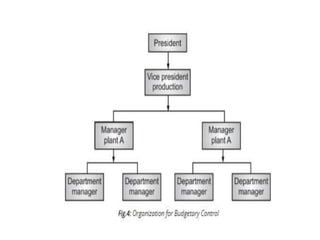
 An organization may have several departments for
the effective functioning of the system. The
budgetary control flow is through defined channels.
 There are departments heads like sales manager,
production manager, finance manager, and personal
manager. They report to the vice president of
respective departments followed by the president.
 Organizations have budget centers, budget
committees, budget officers, and chief executive
officers.
Budgeting Control:
 Effective control of a system or any plan is a very
important aspect of the business.
 To bring efficiency in the working of any business
budgetary control is a useful method.
 Budgeting is closely connected with control.
“The process of control in the organization with the help
of budgets is known as budgetary control.”
Budgetary control involves three steps:
• Preparation of budgets.
• Comparisons of actual results with planned one.
• Revision of plans or budgets in the light of changed
circumstances.
Essentials of Effective Budgeting:
 Sound Organizational Structure: Authority and
responsibility for all phases of operations are clearly
defined.
 Based on Research and Analysis: Realistic goals that
will contribute to the growth and profitability of the
company.
 Top Management: Directly related acceptance by all
levels of management.
Implementation of a Budget
For the Implementation of a budget there is a
requirement of different parameters:
Actual Fund Position:
 Successful implementation of the budget will depend
on the financial position of a firm.
 The master budget will give insight into the plan.
 A cash budget will help to know the cash plan for a
specific period.
 Overall, all types of budgets are studied at the micro
level to implement the planned budget.
Utility of Particular Item:
 This depends upon materials used and expressed in
quantities whereas the materials purchases budget is
expressed in both ways is quantitative and financial.
 This helps in scheduling the purchase of materials to
produce a given volume of output during a particular
period.
Cost of Products:
 Study of the cost required to manufacture/purchase
a particular product is very important in budget
planning.
 Cost includes direct costs and indirect costs. It is the
production and non-production costs required to
manufacture a particular product.
Quantity of products:
 Effective inventory management is needed for the
successful implementation of a budget plan.
 To avoid stock out and over-stock, effective inventory
control is needed, as a huge amount of capital is
invested in inventory.
• Reference:
https://solutionpharmacy.in/budget-
preparation-and-implementation/
Budget Preparation and Implementation.pptx

Budget Preparation and Implementation.pptx

  • 1.
    Budget Preparation and Implementation Dr.Sangameshwar B. Kanthale sbkrscp@gmail.com Rajarshi Shahu College of Pharmacy, Buldana
  • 2.
    “A budget isa plan of activities to be carried out in the future for a specific period in the financial term.”  The budget is used to project future income and expenses.  Budgets are a multi-purpose management tool supporting planning, control, co-ordination, communication, performance evaluation, and motivation.  Budgets are an important mechanism in the allocation of decision rights. Budgets are often used to measure performance. Budgets are also used as a mechanism for control.
  • 3.
    Objectives of Budget: It helps to set the benchmark for controlling ongoing operations.  Budget brings about efficiency and improvement in the working of the organization.  It helps in reducing wastage and losses by revealing them in time for future corrective actions.  It is prepared and approved for a definite fixed period.
  • 4.
    Advantages of Planninga Budget/Benefits of Budget: • All levels of management plan ahead. • Definite objectives for evaluating performance. • Early warning system for potential problems. • Coordination of activities within the business. • Management awareness of the entity’s overall operations. • Motivates personnel throughout the organization to meet planned objectives.
  • 5.
    • Classification/Types ofBudget There are different types of budgets and these are classified as per the activities of an organization.
  • 6.
    Budget Preparation Budgets areprepared as per the requirement or types of organization. Based on the requirement, the budget may be prepared considering the length of the period of its implementation.
  • 7.
    • Long-term Budget:These budgets are prepared for the long term. They are prepared for the period of 5 to 10 years. This type of budget is prepared to depend upon the size of the organization. • Short-term Budget: This type of budget is prepared for a duration of 2 to 5 years. These budgets are prepared under control conditions. • Current Budget: This type of budget is prepared for a shorter duration. The duration is usually 1 to 3 months.
  • 8.
    Development of Budget: •In the preparation/development of the budget, there are different sections. The details of each section and its significance are discussed below:
  • 9.
    Revenue Accounts:  Totalincome must be calculated for the implementation of the budget.  The pharmacy department or accounts department maintains daily, weekly, monthly and annual costs of the pharmaceuticals issued to the patient services.  The other statistics include the number of prescriptions, number of prescriptions dispensed by each pharmacist, hours of work put in prescription volume per hour of service, medication cost per patient, average drug cost per clinic visit, average salary cost per prescription, and average supply cost per requisition.
  • 10.
    Expense/Expenditure Accounts:  Expenditureaccounts include administrative and general expenses. Professional care of the patients, out-patients and emergency expenses, and miscellaneous expenses.  The expenditure accounts also include the following categories of expenses like salaries and wages, in this expenditure salaries and wages of all employees need to be taken into consideration.  In expenses of supplies and materials, the Chief pharmacist or the responsible person should prepare the financial statement regarding the requirement of the amount in rupees for supplies and materials with the help of the latest financial budget.
  • 11.
     It isnecessary to show the actual cost of the materials. If the budgeted figure and the previous figure were the same then the previously prepared budget was well prepared.  Purchase expense includes the cost of prescriptions purchased from an outside pharmacy.  Drugs and pharmaceuticals: Those dispensed by prescriptions. Those used in the outpatients and emergency departments.
  • 12.
    Capital Equipment Requests: The equipment and construction budget includes a budget for immediate arrangements of new model equipment.  The budget is also made for remodeling and replacement of equipment.  It also includes the construction of buildings/infrastructure for future expansion.
  • 13.
    Organization for BudgetaryControl  Organizing and administering a budget system is a very crucial function and requires effective planning.  An organization may have several departments for the effective functioning of the system. The budgetary control flow is through defined channels.  There are departments heads like sales manager, production manager, finance manager, and personal manager. They report to the vice president of respective departments followed by the president.  Organizations have budget centers, budget committees, budget officers, and chief executive officers.
  • 15.
    Budgeting Control:  Effectivecontrol of a system or any plan is a very important aspect of the business.  To bring efficiency in the working of any business budgetary control is a useful method.  Budgeting is closely connected with control. “The process of control in the organization with the help of budgets is known as budgetary control.” Budgetary control involves three steps: • Preparation of budgets. • Comparisons of actual results with planned one. • Revision of plans or budgets in the light of changed circumstances.
  • 16.
    Essentials of EffectiveBudgeting:  Sound Organizational Structure: Authority and responsibility for all phases of operations are clearly defined.  Based on Research and Analysis: Realistic goals that will contribute to the growth and profitability of the company.  Top Management: Directly related acceptance by all levels of management.
  • 17.
    Implementation of aBudget For the Implementation of a budget there is a requirement of different parameters: Actual Fund Position:  Successful implementation of the budget will depend on the financial position of a firm.  The master budget will give insight into the plan.  A cash budget will help to know the cash plan for a specific period.  Overall, all types of budgets are studied at the micro level to implement the planned budget.
  • 18.
    Utility of ParticularItem:  This depends upon materials used and expressed in quantities whereas the materials purchases budget is expressed in both ways is quantitative and financial.  This helps in scheduling the purchase of materials to produce a given volume of output during a particular period. Cost of Products:  Study of the cost required to manufacture/purchase a particular product is very important in budget planning.  Cost includes direct costs and indirect costs. It is the production and non-production costs required to manufacture a particular product.
  • 19.
    Quantity of products: Effective inventory management is needed for the successful implementation of a budget plan.  To avoid stock out and over-stock, effective inventory control is needed, as a huge amount of capital is invested in inventory.
  • 20.