HOSPITALAND COMMUNITY PHARMACY
Present By
M Naveenkumar
M Pharm-1st SEM.
Pharmacy Practice
KMCH College of Pharmacy
BUDGET PREPARATION AND IMPLEMENTATION
BUGDET PREPARATION:
Budget:
Budget is described as an instrumental through which hospital administration, management
at the department levels and the governing bodies can review the hospital services in relationship
to the prepared plan in a comprehensive and integrated from expressed in financial terms.
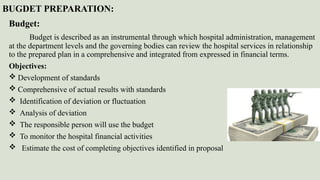
Objectives:
 Development of standards
 Comprehensive of actual results with standards
 Identification of deviation or fluctuation
 Analysis of deviation
 The responsible person will use the budget
 To monitor the hospital financial activities
 Estimate the cost of completing objectives identified in proposal
Functions:
To regulate hospital financial activities
For preparing and filling tenders
Smooth the departmental functions
Estimate to completing objectives
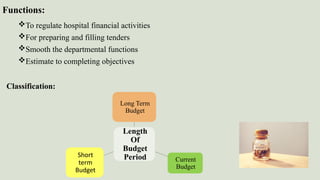
Length
Of
Budget
Period
Long Term
Budget
Current
Budget
Short
term
Budget
Classification:
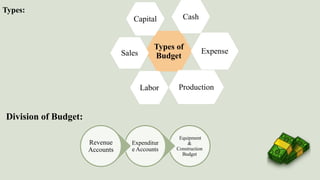
Division of Budget:
Equipment
&
Construction
Budget
Expenditur
e Accounts
Revenue
Accounts
Types:
Types of
Budget
Capital Cash
Expense
Labor Production
Sales
Income Account:
Income is calculated by maintaining daily/weekly/monthly/annual records.
The average total sum up represents income of the department from various sources.
Pharmacy department or accounts department maintains daily, weekly, monthly & annual
cost of the pharmaceutical issued to the patient services.
Hospital Income further depends upon types of patients ;
No of Prescription
No of Prescription dispensed by each pharmacist
Hours of work put in prescription volume per hour of service
Medication cost per patient day
Average drug cost for Physician visit
Average salary cost for prescription
Average supply cost per requisition
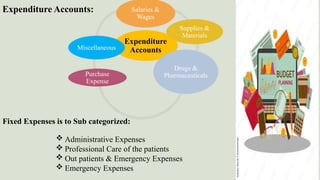
Expenditure Accounts:
Expenditure
Accounts
Salaries &
Wages
Supplies &
Materials
Drugs &
Pharmaceuticals
Purchase
Expense
Miscellaneous
Fixed Expenses is to Sub categorized:
 Administrative Expenses
 Professional Care of the patients
 Out patients & Emergency Expenses
 Emergency Expenses
Salaries & Wages:
Salaries and wages include complete break up of all salaries & wages paid to permanent and
temporary staff(Full time & Part time)
The chart should be prepared in tabular form so as to give an overall view at a glance
The chief Pharmacist/administrator should sub divided the staff into three important categories
like administration, professional and non professional staff.
The total of all three expenses constituents the anticipated salary and wages, expenditure for
next year.
Supplies & Materials:
 Chief Pharmacist or the responsible person should prepare the financial statement regarding
the requirement of amount in rupees for supplies and materials with the help of the latest
financial budget.
 Necessary to show the actual cost of the materials.
Drugs & Pharmaceuticals:
Drugs Dispensed by prescriptions
Drugs used in the outpatients and emergency departments
Charges for the latter are submitted to the respective departments
Purchase Expenses:
 It includes the cost of prescriptions purchased from an outside Pharmacy.
Miscellaneous:
Miscellaneous Supplies and expenses include glassware, labels, stationary, uniform , repair
and maintenance.
In patients, there should be a close liaison between the chief Pharmacist and accounts
department for maintenance of statistical data.
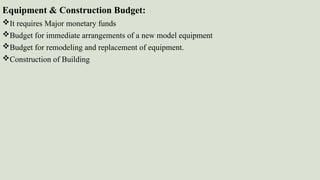
Equipment & Construction Budget:
It requires Major monetary funds
Budget for immediate arrangements of a new model equipment
Budget for remodeling and replacement of equipment.
Construction of Building
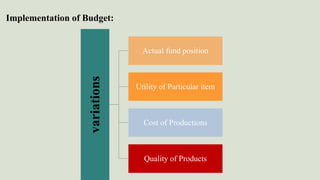
Implementation of Budget:
variations
Actual fund position
Utility of Particular item
Cost of Productions
Quality of Products
Actual Fund Position:
Successful Implementation of the budget will depend on the financial position of
a firm.
The master budget will give insight into the plan.
A cash budget will help to know the cash plan for a specific period.
Overall, all types of budgets are studied at the micro level to implement the
planned budget.
Utility of Particular item:
This depends upon materials used and expressed in qualities where as the materials purchase budget is
expressed in both ways is quantitative and financial.
This helps in scheduling the purchase of materials to produce a given volume of output during a particular
period.
Study of the cost required to manufacture/purchase a particular product is very important in budget planning.
Cost includes direct costs and indirect costs.it is the production and non production costs required to
manufacture a particular product.
Cost of Products:
Quality of products:
Effective inventory management is needed for the successful implementation of a
budget plan.
To avoid stock out and over stock, effective inventory control is needed, as huge
amount of capital is invested in inventory.
Budget Preparation and Implementation  1.pptx

Budget Preparation and Implementation 1.pptx

  • 1.
    HOSPITALAND COMMUNITY PHARMACY PresentBy M Naveenkumar M Pharm-1st SEM. Pharmacy Practice KMCH College of Pharmacy BUDGET PREPARATION AND IMPLEMENTATION
  • 2.
    BUGDET PREPARATION: Budget: Budget isdescribed as an instrumental through which hospital administration, management at the department levels and the governing bodies can review the hospital services in relationship to the prepared plan in a comprehensive and integrated from expressed in financial terms. Objectives:  Development of standards  Comprehensive of actual results with standards  Identification of deviation or fluctuation  Analysis of deviation  The responsible person will use the budget  To monitor the hospital financial activities  Estimate the cost of completing objectives identified in proposal
  • 3.
    Functions: To regulate hospitalfinancial activities For preparing and filling tenders Smooth the departmental functions Estimate to completing objectives Length Of Budget Period Long Term Budget Current Budget Short term Budget Classification:
  • 4.
    Division of Budget: Equipment & Construction Budget Expenditur eAccounts Revenue Accounts Types: Types of Budget Capital Cash Expense Labor Production Sales
  • 5.
    Income Account: Income iscalculated by maintaining daily/weekly/monthly/annual records. The average total sum up represents income of the department from various sources. Pharmacy department or accounts department maintains daily, weekly, monthly & annual cost of the pharmaceutical issued to the patient services. Hospital Income further depends upon types of patients ; No of Prescription No of Prescription dispensed by each pharmacist Hours of work put in prescription volume per hour of service Medication cost per patient day Average drug cost for Physician visit Average salary cost for prescription Average supply cost per requisition
  • 6.
    Expenditure Accounts: Expenditure Accounts Salaries & Wages Supplies& Materials Drugs & Pharmaceuticals Purchase Expense Miscellaneous Fixed Expenses is to Sub categorized:  Administrative Expenses  Professional Care of the patients  Out patients & Emergency Expenses  Emergency Expenses
  • 7.
    Salaries & Wages: Salariesand wages include complete break up of all salaries & wages paid to permanent and temporary staff(Full time & Part time) The chart should be prepared in tabular form so as to give an overall view at a glance The chief Pharmacist/administrator should sub divided the staff into three important categories like administration, professional and non professional staff. The total of all three expenses constituents the anticipated salary and wages, expenditure for next year. Supplies & Materials:  Chief Pharmacist or the responsible person should prepare the financial statement regarding the requirement of amount in rupees for supplies and materials with the help of the latest financial budget.  Necessary to show the actual cost of the materials.
  • 8.
    Drugs & Pharmaceuticals: DrugsDispensed by prescriptions Drugs used in the outpatients and emergency departments Charges for the latter are submitted to the respective departments Purchase Expenses:  It includes the cost of prescriptions purchased from an outside Pharmacy. Miscellaneous: Miscellaneous Supplies and expenses include glassware, labels, stationary, uniform , repair and maintenance. In patients, there should be a close liaison between the chief Pharmacist and accounts department for maintenance of statistical data.
  • 9.
    Equipment & ConstructionBudget: It requires Major monetary funds Budget for immediate arrangements of a new model equipment Budget for remodeling and replacement of equipment. Construction of Building
  • 10.
    Implementation of Budget: variations Actualfund position Utility of Particular item Cost of Productions Quality of Products
  • 11.
    Actual Fund Position: SuccessfulImplementation of the budget will depend on the financial position of a firm. The master budget will give insight into the plan. A cash budget will help to know the cash plan for a specific period. Overall, all types of budgets are studied at the micro level to implement the planned budget.
  • 12.
    Utility of Particularitem: This depends upon materials used and expressed in qualities where as the materials purchase budget is expressed in both ways is quantitative and financial. This helps in scheduling the purchase of materials to produce a given volume of output during a particular period. Study of the cost required to manufacture/purchase a particular product is very important in budget planning. Cost includes direct costs and indirect costs.it is the production and non production costs required to manufacture a particular product. Cost of Products:
  • 13.
    Quality of products: Effectiveinventory management is needed for the successful implementation of a budget plan. To avoid stock out and over stock, effective inventory control is needed, as huge amount of capital is invested in inventory.