Theatre Styles1
ContentsClassicalCommedia dell’ArteTheatre of CrueltySymbolismNaturalismRealismExpressionismAbsurdismModernismPostmodernismPhysicalVerbatim 2
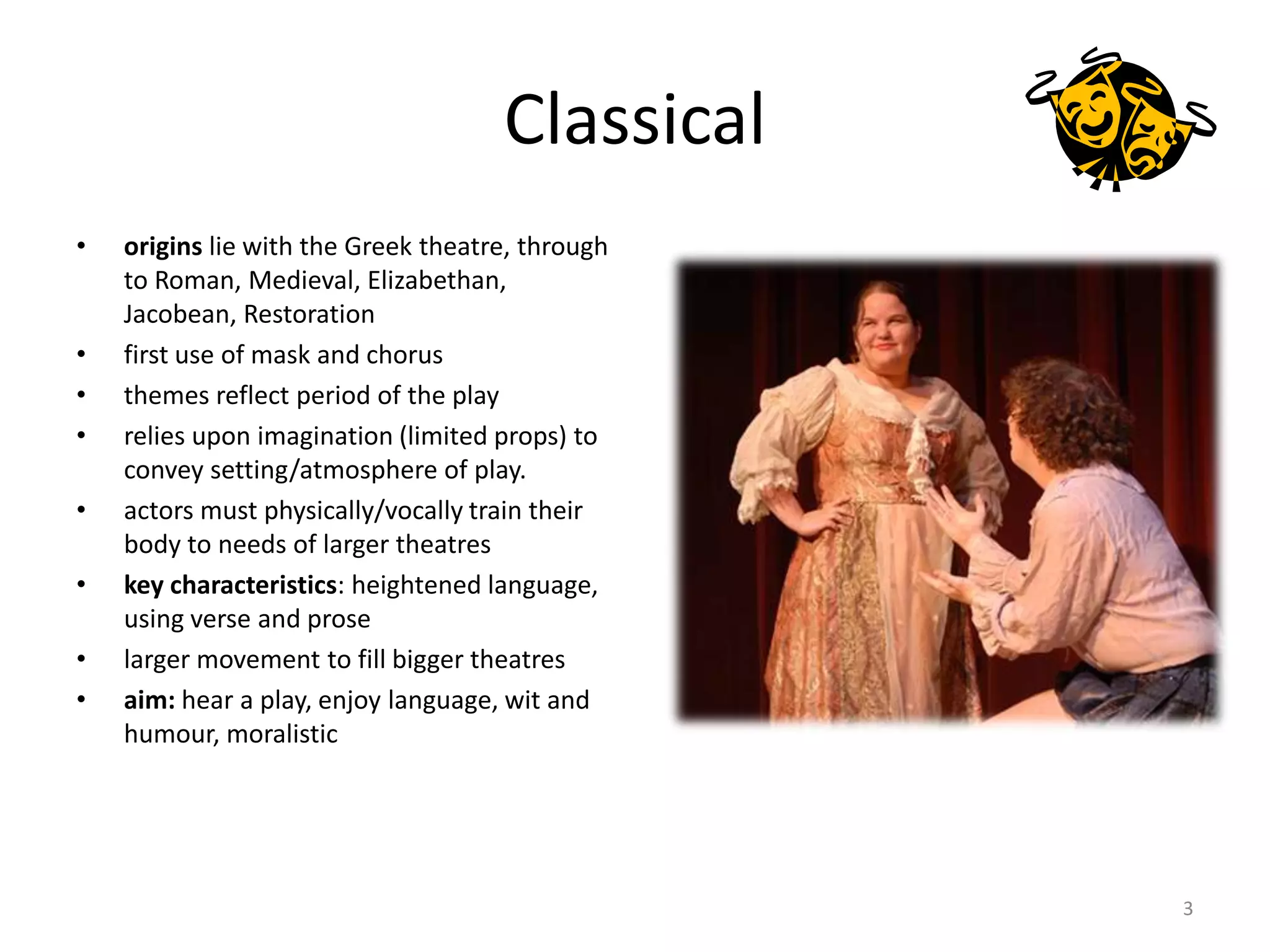
Classicalorigins lie with the Greek theatre, through to Roman, Medieval, Elizabethan, Jacobean, Restorationfirst use of mask and chorusthemes reflect period of the playrelies upon imagination (limited props) to convey setting/atmosphere of play.actors must physically/vocally train their body to needs of larger theatreskey characteristics: heightened language, using verse and proselarger movement to fill bigger theatresaim: hear a play, enjoy language, wit and humour, moralistic3
Commedia dell’Arteoriginated in Italy in the 1560s neither professional nor open to the public. Only required actors, no sets and very few propskey characteristics: plays came from scenariosdialogue and comedic interludes were improvisedbased around stock characters,  the lovers, masters, and servantsno female performerspaid by taking a share of the play's profits equivalent to the size of roleat its peak from 1575–1650aim: entertainment, comedyimprovisation today originates  from Commedia4
Naturalismoriginated: late 1800’s made famous by Stanislvaskiclassic texts performed in realist settings. plays that reflect real lifekey characteristics uses natural forms of speech and physical expressionactor attempts complete identification with the role, understood in terms of its 'given circumstances'aim:  audience as onlooker through the ‘fourth wall’,  see great acting in the re-creation of character5
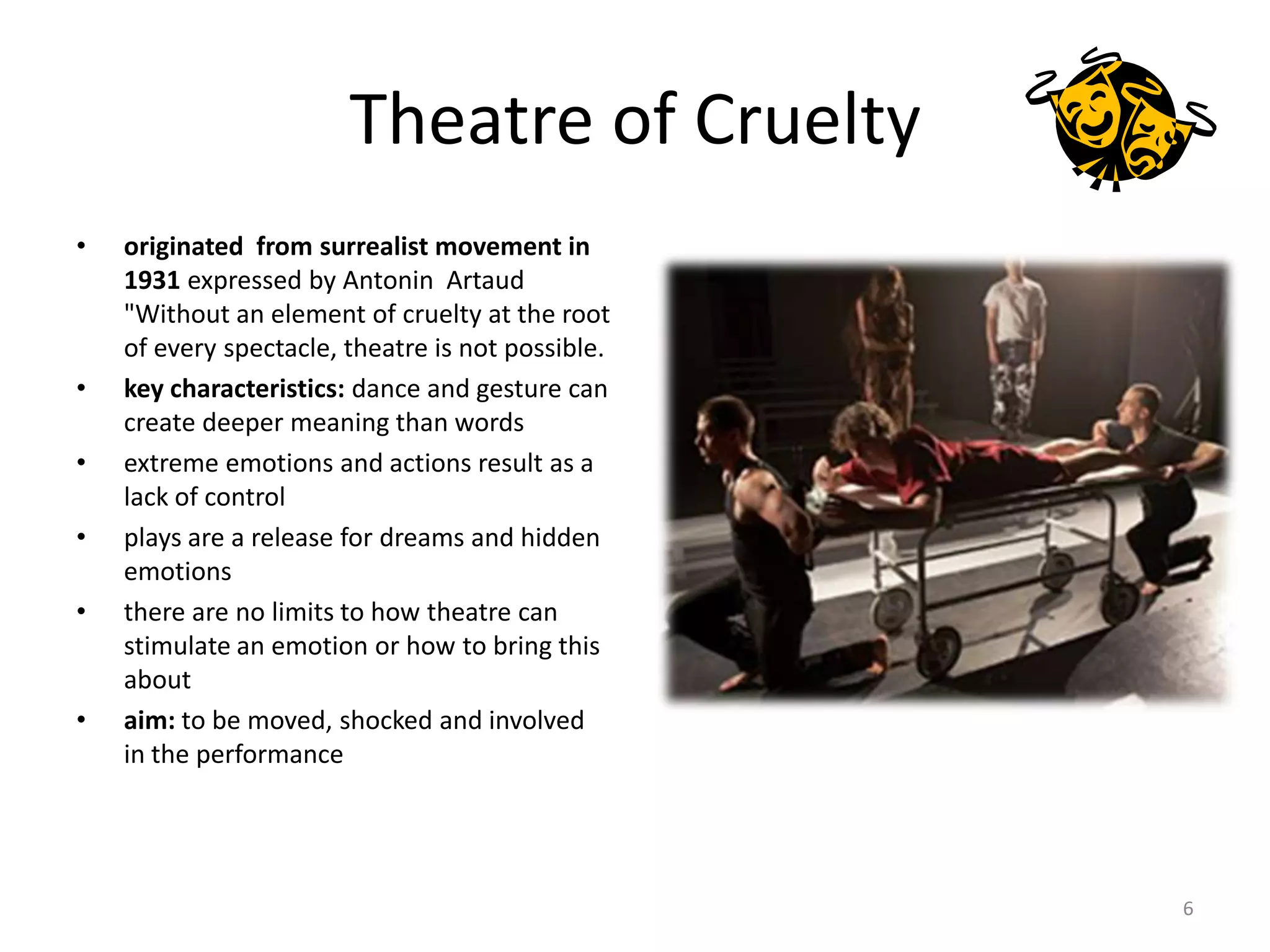
Theatre of Crueltyoriginated  from surrealist movement in 1931 expressed by Antonin  Artaud "Without an element of cruelty at the root of every spectacle, theatre is not possible.key characteristics: dance and gesture can create deeper meaning than wordsextreme emotions and actions result as a lack of controlplays are a release for dreams and hidden emotionsthere are no limits to how theatre can stimulate an emotion or how to bring this aboutaim: to be moved, shocked and involved in the performance 6
Realismoriginated from naturalism and superseded itportrays characters on stage that are close to real life, with realistic settings /stagingdirect attention to the physical and philosophic problems of social and psychological existence key characteristics: victims of forces larger than themselves, individuals confronted with a rapidly accelerating world.playwrights unafraid to present characters as ordinary, impotent and unable to reach answers to their predicaments.aim: identify with plot/situations7
Symbolismlate nineteenth-century art movement of French & Belgian origina backlash to naturalism and realismkey characteristics: emphasis on internal life of dreams/fantasies/spiritualityhighly metaphorical and suggestiveEg: Auguste Villiers de l'Isle-Adam's drama Axël (rev. ed. 1890) is a definitive symbolist play. In it, two aristocrats fall in love while trying to kill each other, only to agree to mutually commit suicide because nothing in life could equal their fantasies Chekhov’s later works identifiedas being influenced by symbolist pessimismaim: audience to interpret imagery and ideas to their original absolute truth8
Expressionisma cultural movement, initially in poetry and painting, originating in Germany at the start of the 20th centuryanti-realistic in seeing truth lying within man. The outward appearance on stage can be distorted and unrealistic to portray an eternal truthdramatises spiritual awakening/sufferings of central character & the struggle against social class values/established authoritykey characteristics: to present the world in an subjective perspective, distorting it for emotional effect, evoke moods/ideasmovement/speech is heightened, expansive, or clipped/telegraphicaim: spectacle, illusion, experience9
Absurdismoriginated in 1940’s – 60’s expresses belief that human existence has no meaning/purpose, therefore all communication breaks downlogical construction and argument gives way to irrational and illogical speech and to its ultimate conclusion: silenceKey characteristics: broad comedy, mixed with horrific/tragic images; characters caught in hopeless situations forced to do repetitive/ meaningless actionsdialogue: clichés/wordplay/nonsenseplots: cyclical or absurdly expansive; either a parody or dismissal of realism and the "well-made play"aim: createsubversive/anarchic view of society10
Modernismoriginated in early 20th century sees art, including theatre, as detached from life in a pure way and able to reflect on life criticallyincludes the activities of those who felt the "traditional" forms of art, architecture, literature, religious faith, social organisation and daily life were becoming outdated in the new economic, social, and political conditions of an emerging fully industrialised worldrejects the lingering certainty of Enlightenment thinking, and also that of the existence of a compassionate, all-powerful Creatoraim: audience to question the axioms of the previous age11
Postmodernismsuperseded modernism: challenges accepted views of the worldincludes use of multiple art /media forms narrative broken, paradoxical and imagistic. characters are fragmented, forming a collection of contrasting / parallel ideas from a central theme or traditional character.each performance is  a spectacle, with no intent on methodical repetitionaudience integral to the shared meaning  & making of the performance processrehearsal process driven by shared improvisation, not scripted textaim : encourages audience to reach own individual understanding.12
Physicalmade prominant in the 20th Century with influences from classical and commediawork often devised, rather than from a pre-existing script (an exception Shared Experience, who focus on making contemporary reinterpretations of highly literary plays including Ibsen’s A Doll's House and  Tolstoy’s War and Peace)has inter-disciplinary origins - crosses between music, dance, visual art as well as theatrechallenges the traditional, proscenium arch, performer/audience relationship.celebrates the non-passive audience.aim: combines the imagination of both the audience and the performer13
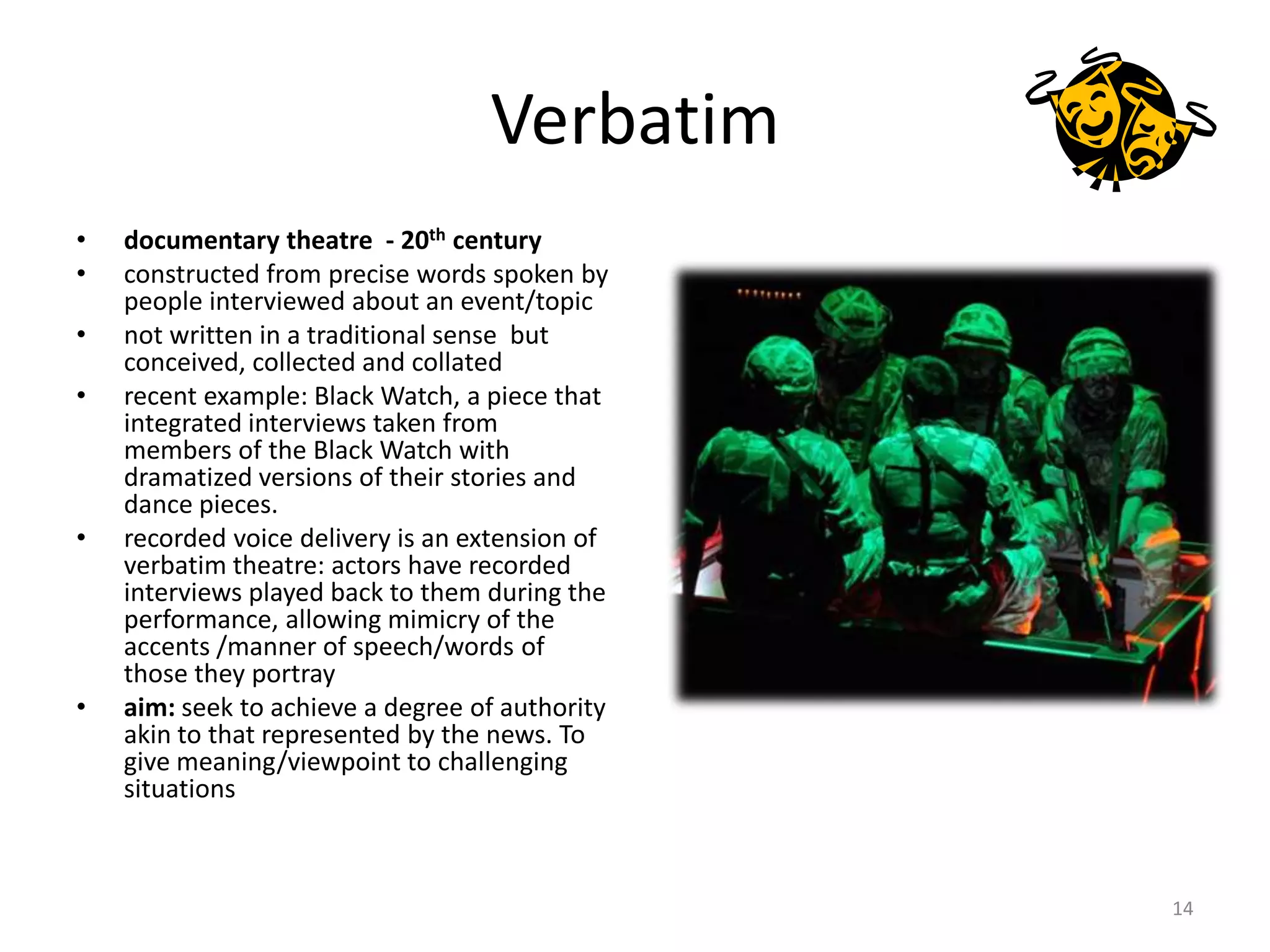
Verbatimdocumentary theatre  - 20th centuryconstructed from precise words spoken by people interviewed about an event/topicnot written in a traditional sense  but conceived, collected and collatedrecent example: Black Watch, a piece that integrated interviews taken from  members of the Black Watch with dramatized versions of their stories and dance pieces.recorded voice delivery is an extension of verbatim theatre: actors have recorded interviews played back to them during the performance, allowing mimicry of the accents /manner of speech/words of those they portrayaim: seek to achieve a degree of authority akin to that represented by the news. To give meaning/viewpoint to challenging situations14
Theatre Styles15
QuotesHarold Clurman The stage is life, music, beautiful girls, legs, breasts, not talk or intellectualism or dried-up  academics.Konstantine Stanislavski Love art in yourself and not yourself in art.Michael ShurtleffAn actor is looking for conflict. Conflict is what creates drama. We are taught to avoid trouble . Actors don't realize they must go looking for it. Plays are written about the extraordinary, the unusual, the climaxes. The more conflict actors find, the more interesting the performance.Sandy's favourite from GoetheI wish the stage were as narrow as a tight rope so that no incompetent would dare walk on it. Sanford MeisnerTransfer the point of concentration to some object outside of yourself – another person, a puzzle, a broken plate that you are gluing.” Actors that had a focus on something other than themselves were completely different in their performance from those that were ‘self’ conscious or  inwardly focused.  If you can do this - you have the most interesting, attention-holding thing of all,  a fascinating human being playing opposite you.  Let them be your focus and you’ll fly.Sanford MeisnerThe seed to the craft of acting is the reality of doing.Sanford MeisnerActing is not talking, it’s living off the other guyActing has nothing to do with talking, little in fact to do with words.  The bit of the ice berg that you CAN see is the words.  The rest of your acting is why lies beneath.Sanford MeisnerAn ounce of behaviour is worth a pound of words.Oscar WildeI regard the theatre as the greatest of all art forms, the most immediate way in which a human being can share with another the sense of what it is to be a human being.Michael ShurtleffWhatever you decide is your motivation in the scene, the opposite of that is also true and should be in the scene.16

Theatre styles

  • 1.
  • 2.
    ContentsClassicalCommedia dell’ArteTheatre ofCrueltySymbolismNaturalismRealismExpressionismAbsurdismModernismPostmodernismPhysicalVerbatim 2
  • 3.
    Classicalorigins lie withthe Greek theatre, through to Roman, Medieval, Elizabethan, Jacobean, Restorationfirst use of mask and chorusthemes reflect period of the playrelies upon imagination (limited props) to convey setting/atmosphere of play.actors must physically/vocally train their body to needs of larger theatreskey characteristics: heightened language, using verse and proselarger movement to fill bigger theatresaim: hear a play, enjoy language, wit and humour, moralistic3
  • 4.
    Commedia dell’Arteoriginated inItaly in the 1560s neither professional nor open to the public. Only required actors, no sets and very few propskey characteristics: plays came from scenariosdialogue and comedic interludes were improvisedbased around stock characters, the lovers, masters, and servantsno female performerspaid by taking a share of the play's profits equivalent to the size of roleat its peak from 1575–1650aim: entertainment, comedyimprovisation today originates from Commedia4
  • 5.
    Naturalismoriginated: late 1800’smade famous by Stanislvaskiclassic texts performed in realist settings. plays that reflect real lifekey characteristics uses natural forms of speech and physical expressionactor attempts complete identification with the role, understood in terms of its 'given circumstances'aim: audience as onlooker through the ‘fourth wall’, see great acting in the re-creation of character5
  • 6.
    Theatre of Crueltyoriginated from surrealist movement in 1931 expressed by Antonin Artaud "Without an element of cruelty at the root of every spectacle, theatre is not possible.key characteristics: dance and gesture can create deeper meaning than wordsextreme emotions and actions result as a lack of controlplays are a release for dreams and hidden emotionsthere are no limits to how theatre can stimulate an emotion or how to bring this aboutaim: to be moved, shocked and involved in the performance 6
  • 7.
    Realismoriginated from naturalismand superseded itportrays characters on stage that are close to real life, with realistic settings /stagingdirect attention to the physical and philosophic problems of social and psychological existence key characteristics: victims of forces larger than themselves, individuals confronted with a rapidly accelerating world.playwrights unafraid to present characters as ordinary, impotent and unable to reach answers to their predicaments.aim: identify with plot/situations7
  • 8.
    Symbolismlate nineteenth-century artmovement of French & Belgian origina backlash to naturalism and realismkey characteristics: emphasis on internal life of dreams/fantasies/spiritualityhighly metaphorical and suggestiveEg: Auguste Villiers de l'Isle-Adam's drama Axël (rev. ed. 1890) is a definitive symbolist play. In it, two aristocrats fall in love while trying to kill each other, only to agree to mutually commit suicide because nothing in life could equal their fantasies Chekhov’s later works identifiedas being influenced by symbolist pessimismaim: audience to interpret imagery and ideas to their original absolute truth8
  • 9.
    Expressionisma cultural movement,initially in poetry and painting, originating in Germany at the start of the 20th centuryanti-realistic in seeing truth lying within man. The outward appearance on stage can be distorted and unrealistic to portray an eternal truthdramatises spiritual awakening/sufferings of central character & the struggle against social class values/established authoritykey characteristics: to present the world in an subjective perspective, distorting it for emotional effect, evoke moods/ideasmovement/speech is heightened, expansive, or clipped/telegraphicaim: spectacle, illusion, experience9
  • 10.
    Absurdismoriginated in 1940’s– 60’s expresses belief that human existence has no meaning/purpose, therefore all communication breaks downlogical construction and argument gives way to irrational and illogical speech and to its ultimate conclusion: silenceKey characteristics: broad comedy, mixed with horrific/tragic images; characters caught in hopeless situations forced to do repetitive/ meaningless actionsdialogue: clichés/wordplay/nonsenseplots: cyclical or absurdly expansive; either a parody or dismissal of realism and the "well-made play"aim: createsubversive/anarchic view of society10
  • 11.
    Modernismoriginated in early20th century sees art, including theatre, as detached from life in a pure way and able to reflect on life criticallyincludes the activities of those who felt the "traditional" forms of art, architecture, literature, religious faith, social organisation and daily life were becoming outdated in the new economic, social, and political conditions of an emerging fully industrialised worldrejects the lingering certainty of Enlightenment thinking, and also that of the existence of a compassionate, all-powerful Creatoraim: audience to question the axioms of the previous age11
  • 12.
    Postmodernismsuperseded modernism: challengesaccepted views of the worldincludes use of multiple art /media forms narrative broken, paradoxical and imagistic. characters are fragmented, forming a collection of contrasting / parallel ideas from a central theme or traditional character.each performance is a spectacle, with no intent on methodical repetitionaudience integral to the shared meaning & making of the performance processrehearsal process driven by shared improvisation, not scripted textaim : encourages audience to reach own individual understanding.12
  • 13.
    Physicalmade prominant inthe 20th Century with influences from classical and commediawork often devised, rather than from a pre-existing script (an exception Shared Experience, who focus on making contemporary reinterpretations of highly literary plays including Ibsen’s A Doll's House and Tolstoy’s War and Peace)has inter-disciplinary origins - crosses between music, dance, visual art as well as theatrechallenges the traditional, proscenium arch, performer/audience relationship.celebrates the non-passive audience.aim: combines the imagination of both the audience and the performer13
  • 14.
    Verbatimdocumentary theatre - 20th centuryconstructed from precise words spoken by people interviewed about an event/topicnot written in a traditional sense but conceived, collected and collatedrecent example: Black Watch, a piece that integrated interviews taken from members of the Black Watch with dramatized versions of their stories and dance pieces.recorded voice delivery is an extension of verbatim theatre: actors have recorded interviews played back to them during the performance, allowing mimicry of the accents /manner of speech/words of those they portrayaim: seek to achieve a degree of authority akin to that represented by the news. To give meaning/viewpoint to challenging situations14
  • 15.
  • 16.
    QuotesHarold Clurman Thestage is life, music, beautiful girls, legs, breasts, not talk or intellectualism or dried-up academics.Konstantine Stanislavski Love art in yourself and not yourself in art.Michael ShurtleffAn actor is looking for conflict. Conflict is what creates drama. We are taught to avoid trouble . Actors don't realize they must go looking for it. Plays are written about the extraordinary, the unusual, the climaxes. The more conflict actors find, the more interesting the performance.Sandy's favourite from GoetheI wish the stage were as narrow as a tight rope so that no incompetent would dare walk on it. Sanford MeisnerTransfer the point of concentration to some object outside of yourself – another person, a puzzle, a broken plate that you are gluing.” Actors that had a focus on something other than themselves were completely different in their performance from those that were ‘self’ conscious or inwardly focused.  If you can do this - you have the most interesting, attention-holding thing of all,  a fascinating human being playing opposite you.  Let them be your focus and you’ll fly.Sanford MeisnerThe seed to the craft of acting is the reality of doing.Sanford MeisnerActing is not talking, it’s living off the other guyActing has nothing to do with talking, little in fact to do with words.  The bit of the ice berg that you CAN see is the words.  The rest of your acting is why lies beneath.Sanford MeisnerAn ounce of behaviour is worth a pound of words.Oscar WildeI regard the theatre as the greatest of all art forms, the most immediate way in which a human being can share with another the sense of what it is to be a human being.Michael ShurtleffWhatever you decide is your motivation in the scene, the opposite of that is also true and should be in the scene.16