RAINA MALIK
A teacher is like a ladder which
remain at it self but helps other to
go higher and higher.
 Drama means “action” in Greek Language. The word is derived
from Greek word “DRAO” meaning “to do”
 Drama is a specific mode of
fiction represented in
performance
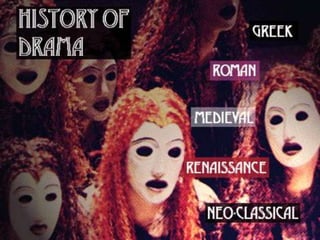
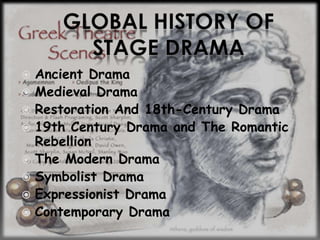
 Ancient Drama
 Medieval Drama
 Restoration And 18th-Century Drama
 19th Century Drama and The Romantic
Rebellion
 The Modern Drama
 Symbolist Drama
 Expressionist Drama
 Contemporary Drama
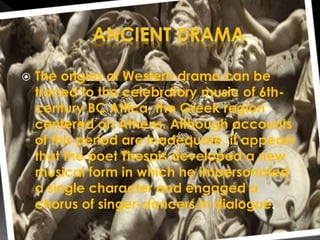
 The origins of Western drama can be
traced to the celebratory music of 6th-
century BC Attica, the Greek region
centered on Athens. Although accounts
of this period are inadequate, it appears
that the poet Thespis developed a new
musical form in which he impersonated
a single character and engaged a
chorus of singer-dancers in dialogue.
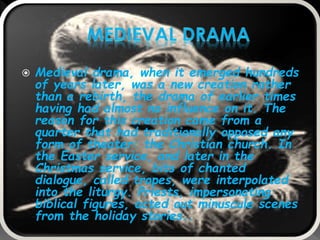
 Medieval drama, when it emerged hundreds
of years later, was a new creation rather
than a rebirth, the drama of earlier times
having had almost no influence on it. The
reason for this creation came from a
quarter that had traditionally opposed any
form of theater: the Christian church. In
the Easter service, and later in the
Christmas service, bits of chanted
dialogue, called tropes, were interpolated
into the liturgy. Priests, impersonating
biblical figures, acted out minuscule scenes
from the holiday stories..
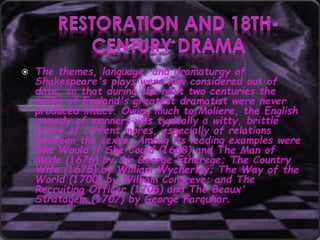
 The themes, language, and dramaturgy of
Shakespeare's plays were now considered out of
date, so that during the next two centuries the
works of England's greatest dramatist were never
produced intact. Owing much to Moliere, the English
comedy of manners was typically a witty, brittle
satire of current mores, especially of relations
between the sexes. Among its leading examples were
She Would if She Could (1668) and The Man of
Mode (1676) by Sir George Etherege; The Country
Wife (1675) by William Wycherley; The Way of the
World (1700) by William Congreve; and The
Recruiting Officer (1706) and The Beaux'
Stratagem (1707) by George Farquhar.
 Romanticism first appeared in Germany, a country with
little native theatre other than rustic farces before the 18th
century. By the 1820s Romanticism dominated the theatre
of most of Europe. Many of the ideas and practices of
Romanticism were evident in the late 18th-century Sturm
und Drang movement of Germany led by Goethe and the
dramatist Friedrich Schiller. These plays had no single style
but were generally strongly emotional, and, in their
experimentation with form, laid the groundwork for the
rejection of Neo-Classicism. The plays of the French
playwright René Charles Gilbert de Pixéré court paved the
way for French Romanticism, which had previously been
known only in the acting of François Joseph Talma in the
first decades of the 19th century. Victor Hugo's Hernani
(1830) is considered the first French Romantic drama.
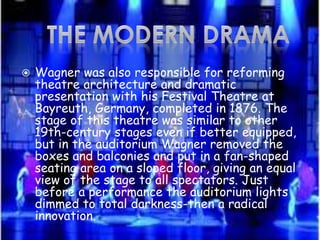
 Wagner was also responsible for reforming
theatre architecture and dramatic
presentation with his Festival Theatre at
Bayreuth, Germany, completed in 1876. The
stage of this theatre was similar to other
19th-century stages even if better equipped,
but in the auditorium Wagner removed the
boxes and balconies and put in a fan-shaped
seating area on a sloped floor, giving an equal
view of the stage to all spectators. Just
before a performance the auditorium lights
dimmed to total darkness-then a radical
innovation.
 The Symbolist movement in France in the 1880s
first adopted Wagner's ideas. The Symbolists
called for "detheatricalizing" the theatre, meaning
stripping away all the technological and scenic
encumbrances of the 19th century and replacing
them with a spirituality that was to come from
the text and the acting. The texts were laden
with symbolic imagery not easily construed-rather
they were suggestive. The general mood of the
plays was slow and dream-like. The intention was
to evoke an unconscious response rather than an
intellectual one and to depict the no rational
aspects of characters and events.
 In Europe in the 1970s, new playwriting was
largely overshadowed by theatricalist
productions, which generally took classical
plays and reinterpreted them, often in bold
new scenographic spectacles, expressing
ideas more through action and the use of
space than through language. In all lands
where the drama flourishes, the only
constant factor today is what has always
been constant: change. The most
significant writers are still those who seek to
redefine the basic premises of the art of
drama.
 The Art and Science of Theater
 The Art and Science of Theater is an
interdisciplinary site that takes you on a
journey through many different aspects of
theater. Theater is an amazing way of
expressing everything from feelings to political
standpoints. It is also something that no matter
what your talent is, you can showcase it in
theater. You don't have to be an actor to show
your talent in theater. If you are talented in
building things or such things as publicity you
can make your talents known in the world of
theater.
 The Art of Theater describes the different artistic aspects
of the theater world. Some of the topics include
Architecture, Stage Craft, Lighting, and Sound.
 Throughout history theater has had a major impact on
literature. Discussed in this section are the historical
effects theater has had on society and also the effects
that theater has had on literature throughout the world.
 Theater has affected many aspects of our social
environment in many ways. This page discusses things such
as the effects theater has had on the economy, also the
way theater has portrayed or influenced our culture.
 The field of health care has opened the door to a field
called psychodrama. This is the use of drama to treat
mental problems, depression, and also for general therapy.
Another topic that is discussed is the role theater has had
in the world of sports.
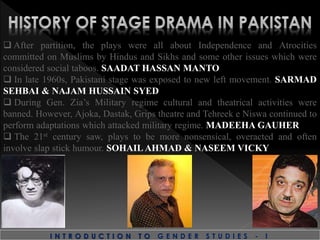
 After partition, the plays were all about Independence and Atrocities
committed on Muslims by Hindus and Sikhs and some other issues which were
considered social taboos. SAADAT HASSAN MANTO
 In late 1960s, Pakistani stage was exposed to new left movement. SARMAD
SEHBAI & NAJAM HUSSAIN SYED
 During Gen. Zia’s Military regime cultural and theatrical activities were
banned. However, Ajoka, Dastak, Grips theatre and Tehreek e Niswa continued to
perform adaptations which attacked military regime. MADEEHA GAUHER
 The 21st century saw, plays to be more nonsensical, overacted and often
involve slap stick humour. SOHAIL AHMAD & NASEEM VICKY
I N T R O D U C T I O N T O G E N D E R S T U D I E S - I
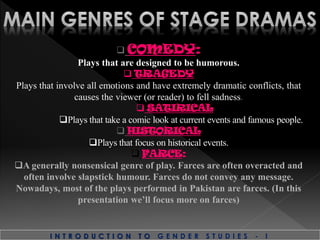
 COMEDY:
Plays that are designed to be humorous.
 TRAGEDY
Plays that involve all emotions and have extremely dramatic conflicts, that
causes the viewer (or reader) to fell sadness.
 SATIRICAL
Plays that take a comic look at current events and famous people.
 HISTORICAL
Plays that focus on historical events.
 FARCE:
A generally nonsensical genre of play. Farces are often overacted and
often involve slapstick humour. Farces do not convey any message.
Nowadays, most of the plays performed in Pakistan are farces. (In this
presentation we’ll focus more on farces)
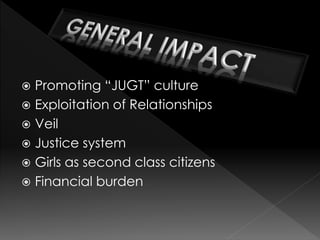
 Promoting “JUGT” culture
 Exploitation of Relationships
 Veil
 Justice system
 Girls as second class citizens
 Financial burden
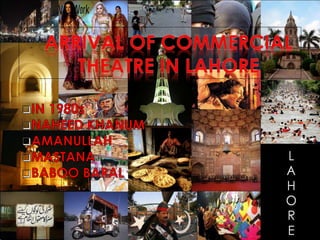
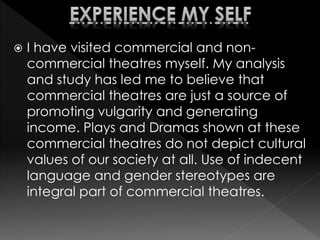
 I have visited commercial and non-
commercial theatres myself. My analysis
and study has led me to believe that
commercial theatres are just a source of
promoting vulgarity and generating
income. Plays and Dramas shown at these
commercial theatres do not depict cultural
values of our society at all. Use of indecent
language and gender stereotypes are
integral part of commercial theatres.
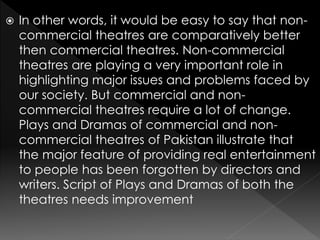
 In other words, it would be easy to say that non-
commercial theatres are comparatively better
then commercial theatres. Non-commercial
theatres are playing a very important role in
highlighting major issues and problems faced by
our society. But commercial and non-
commercial theatres require a lot of change.
Plays and Dramas of commercial and non-
commercial theatres of Pakistan illustrate that
the major feature of providing real entertainment
to people has been forgotten by directors and
writers. Script of Plays and Dramas of both the
theatres needs improvement
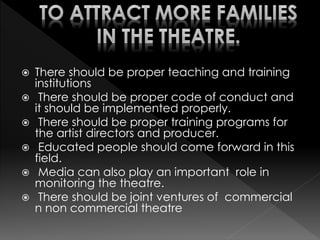
 There should be proper teaching and training
institutions
 There should be proper code of conduct and
it should be implemented properly.
 There should be proper training programs for
the artist directors and producer.
 Educated people should come forward in this
field.
 Media can also play an important role in
monitoring the theatre.
 There should be joint ventures of commercial
n non commercial theatre
 women, children and families are not found in theatre halls
 the impact of greed and commercialism
 Commercial theatre is now a preserve for the
oversexed
 They are killing all forms of decent performers and
replacing them with anything that remotely looks like a
“girl”
 the government doesn’t let Mujras take place freely,
the consumer or the audience has simply found another
channel to satisfy their needs and unfortunately, Lahore’s
commercial theater became the victim of that.
 vulgarity is in demand weather it is English or Punjabi
Culture
 Improve personal insight.
 Heighten self awareness.
 Provide new ways of thinking and
behaving.
 Built self confidence.
 Fasters greater social skills and co-
operate with others.
 Enhancement problem solving skills.
recent Pakistani stage drama's have
many demerits and drawbacks.
Specially the role of male and female
is very shameful and vulgar.
 Some drawbacks according to MAIL
GENDER are:
 passing of vulgar comments and jokes...
 use of abuses...
 forcing female gender for dance
performance...
 dancing of mail gender in female getup...
 IN different stage drama's like "HONT
RSEELE TERE" and "KAJRAR_E_NAINA"
artists are continuously passing vulgar and
bad comments and jokes to their colleges.
In all these drama's the stage artists
have crossed all the limits.
 IN the play "CHALAK TOTAY", artists
are abusing each other even they are
abusing each other's parents...
 IN the recent stage drama "HONT RSEELE
TERE", artist IFTIKHAR THAKUR is saying to
artist DEDAR "TENU SARI RAAT NCHAVAN
SADI FRMAISH TE".
 IN "KJRAR_E_NAINA"male artists are
continuously pushing DEDAR and NURGIS
for dance..these artists are saying , "YOU
ARE HERE JUST FOR DANCING".
 IN the drama "KJRAR_E_NAINA"IFTIKHAR
THAKUR and NASIR CHINIOTI are
performing on the song "KAKRARE", IN a
very vulgar way.
 IN a stage show artist "NASIM
VIKEE“ is performing on the vulgar song,
"KUNDI NA KHRKA SOHNEYA SEDHA
ANDR AA", in fully female getup.
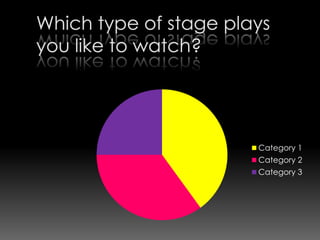
Category 1
Category 2
Category 3
Healthy activity
1st Qtr
2nd Qtr
3rd Qtr
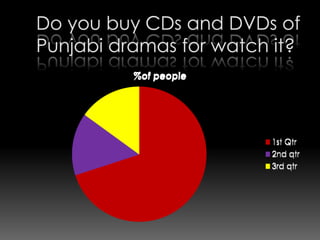
%of people
1st Qtr
2nd qtr
3rd qtr
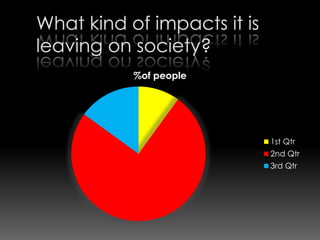
%of people
1st Qtr
2nd qtr
3rd qtr
%of people
1st Qtr
2nd Qtr
3rd Qtr

Gender Portrait in media (Stage Drama)

  • 2.
    RAINA MALIK A teacheris like a ladder which remain at it self but helps other to go higher and higher.
  • 7.
     Drama means“action” in Greek Language. The word is derived from Greek word “DRAO” meaning “to do”  Drama is a specific mode of fiction represented in performance
  • 10.
     Ancient Drama Medieval Drama  Restoration And 18th-Century Drama  19th Century Drama and The Romantic Rebellion  The Modern Drama  Symbolist Drama  Expressionist Drama  Contemporary Drama
  • 11.
     The originsof Western drama can be traced to the celebratory music of 6th- century BC Attica, the Greek region centered on Athens. Although accounts of this period are inadequate, it appears that the poet Thespis developed a new musical form in which he impersonated a single character and engaged a chorus of singer-dancers in dialogue.
  • 12.
     Medieval drama,when it emerged hundreds of years later, was a new creation rather than a rebirth, the drama of earlier times having had almost no influence on it. The reason for this creation came from a quarter that had traditionally opposed any form of theater: the Christian church. In the Easter service, and later in the Christmas service, bits of chanted dialogue, called tropes, were interpolated into the liturgy. Priests, impersonating biblical figures, acted out minuscule scenes from the holiday stories..
  • 13.
     The themes,language, and dramaturgy of Shakespeare's plays were now considered out of date, so that during the next two centuries the works of England's greatest dramatist were never produced intact. Owing much to Moliere, the English comedy of manners was typically a witty, brittle satire of current mores, especially of relations between the sexes. Among its leading examples were She Would if She Could (1668) and The Man of Mode (1676) by Sir George Etherege; The Country Wife (1675) by William Wycherley; The Way of the World (1700) by William Congreve; and The Recruiting Officer (1706) and The Beaux' Stratagem (1707) by George Farquhar.
  • 14.
     Romanticism firstappeared in Germany, a country with little native theatre other than rustic farces before the 18th century. By the 1820s Romanticism dominated the theatre of most of Europe. Many of the ideas and practices of Romanticism were evident in the late 18th-century Sturm und Drang movement of Germany led by Goethe and the dramatist Friedrich Schiller. These plays had no single style but were generally strongly emotional, and, in their experimentation with form, laid the groundwork for the rejection of Neo-Classicism. The plays of the French playwright René Charles Gilbert de Pixéré court paved the way for French Romanticism, which had previously been known only in the acting of François Joseph Talma in the first decades of the 19th century. Victor Hugo's Hernani (1830) is considered the first French Romantic drama.
  • 15.
     Wagner wasalso responsible for reforming theatre architecture and dramatic presentation with his Festival Theatre at Bayreuth, Germany, completed in 1876. The stage of this theatre was similar to other 19th-century stages even if better equipped, but in the auditorium Wagner removed the boxes and balconies and put in a fan-shaped seating area on a sloped floor, giving an equal view of the stage to all spectators. Just before a performance the auditorium lights dimmed to total darkness-then a radical innovation.
  • 16.
     The Symbolistmovement in France in the 1880s first adopted Wagner's ideas. The Symbolists called for "detheatricalizing" the theatre, meaning stripping away all the technological and scenic encumbrances of the 19th century and replacing them with a spirituality that was to come from the text and the acting. The texts were laden with symbolic imagery not easily construed-rather they were suggestive. The general mood of the plays was slow and dream-like. The intention was to evoke an unconscious response rather than an intellectual one and to depict the no rational aspects of characters and events.
  • 18.
     In Europein the 1970s, new playwriting was largely overshadowed by theatricalist productions, which generally took classical plays and reinterpreted them, often in bold new scenographic spectacles, expressing ideas more through action and the use of space than through language. In all lands where the drama flourishes, the only constant factor today is what has always been constant: change. The most significant writers are still those who seek to redefine the basic premises of the art of drama.
  • 19.
     The Artand Science of Theater  The Art and Science of Theater is an interdisciplinary site that takes you on a journey through many different aspects of theater. Theater is an amazing way of expressing everything from feelings to political standpoints. It is also something that no matter what your talent is, you can showcase it in theater. You don't have to be an actor to show your talent in theater. If you are talented in building things or such things as publicity you can make your talents known in the world of theater.
  • 20.
     The Artof Theater describes the different artistic aspects of the theater world. Some of the topics include Architecture, Stage Craft, Lighting, and Sound.  Throughout history theater has had a major impact on literature. Discussed in this section are the historical effects theater has had on society and also the effects that theater has had on literature throughout the world.  Theater has affected many aspects of our social environment in many ways. This page discusses things such as the effects theater has had on the economy, also the way theater has portrayed or influenced our culture.  The field of health care has opened the door to a field called psychodrama. This is the use of drama to treat mental problems, depression, and also for general therapy. Another topic that is discussed is the role theater has had in the world of sports.
  • 21.
     After partition,the plays were all about Independence and Atrocities committed on Muslims by Hindus and Sikhs and some other issues which were considered social taboos. SAADAT HASSAN MANTO  In late 1960s, Pakistani stage was exposed to new left movement. SARMAD SEHBAI & NAJAM HUSSAIN SYED  During Gen. Zia’s Military regime cultural and theatrical activities were banned. However, Ajoka, Dastak, Grips theatre and Tehreek e Niswa continued to perform adaptations which attacked military regime. MADEEHA GAUHER  The 21st century saw, plays to be more nonsensical, overacted and often involve slap stick humour. SOHAIL AHMAD & NASEEM VICKY I N T R O D U C T I O N T O G E N D E R S T U D I E S - I
  • 22.
    I N TR O D U C T I O N T O G E N D E R S T U D I E S - I  COMEDY: Plays that are designed to be humorous.  TRAGEDY Plays that involve all emotions and have extremely dramatic conflicts, that causes the viewer (or reader) to fell sadness.  SATIRICAL Plays that take a comic look at current events and famous people.  HISTORICAL Plays that focus on historical events.  FARCE: A generally nonsensical genre of play. Farces are often overacted and often involve slapstick humour. Farces do not convey any message. Nowadays, most of the plays performed in Pakistan are farces. (In this presentation we’ll focus more on farces)
  • 26.
     Promoting “JUGT”culture  Exploitation of Relationships  Veil  Justice system  Girls as second class citizens  Financial burden
  • 27.
     I havevisited commercial and non- commercial theatres myself. My analysis and study has led me to believe that commercial theatres are just a source of promoting vulgarity and generating income. Plays and Dramas shown at these commercial theatres do not depict cultural values of our society at all. Use of indecent language and gender stereotypes are integral part of commercial theatres.
  • 28.
     In otherwords, it would be easy to say that non- commercial theatres are comparatively better then commercial theatres. Non-commercial theatres are playing a very important role in highlighting major issues and problems faced by our society. But commercial and non- commercial theatres require a lot of change. Plays and Dramas of commercial and non- commercial theatres of Pakistan illustrate that the major feature of providing real entertainment to people has been forgotten by directors and writers. Script of Plays and Dramas of both the theatres needs improvement
  • 29.
     There shouldbe proper teaching and training institutions  There should be proper code of conduct and it should be implemented properly.  There should be proper training programs for the artist directors and producer.  Educated people should come forward in this field.  Media can also play an important role in monitoring the theatre.  There should be joint ventures of commercial n non commercial theatre
  • 30.
     women, childrenand families are not found in theatre halls  the impact of greed and commercialism  Commercial theatre is now a preserve for the oversexed  They are killing all forms of decent performers and replacing them with anything that remotely looks like a “girl”  the government doesn’t let Mujras take place freely, the consumer or the audience has simply found another channel to satisfy their needs and unfortunately, Lahore’s commercial theater became the victim of that.  vulgarity is in demand weather it is English or Punjabi Culture
  • 36.
     Improve personalinsight.  Heighten self awareness.  Provide new ways of thinking and behaving.  Built self confidence.  Fasters greater social skills and co- operate with others.  Enhancement problem solving skills.
  • 38.
    recent Pakistani stagedrama's have many demerits and drawbacks. Specially the role of male and female is very shameful and vulgar.  Some drawbacks according to MAIL GENDER are:  passing of vulgar comments and jokes...  use of abuses...  forcing female gender for dance performance...  dancing of mail gender in female getup...
  • 39.
     IN differentstage drama's like "HONT RSEELE TERE" and "KAJRAR_E_NAINA" artists are continuously passing vulgar and bad comments and jokes to their colleges. In all these drama's the stage artists have crossed all the limits.
  • 40.
     IN theplay "CHALAK TOTAY", artists are abusing each other even they are abusing each other's parents...
  • 41.
     IN therecent stage drama "HONT RSEELE TERE", artist IFTIKHAR THAKUR is saying to artist DEDAR "TENU SARI RAAT NCHAVAN SADI FRMAISH TE".  IN "KJRAR_E_NAINA"male artists are continuously pushing DEDAR and NURGIS for dance..these artists are saying , "YOU ARE HERE JUST FOR DANCING".
  • 42.
     IN thedrama "KJRAR_E_NAINA"IFTIKHAR THAKUR and NASIR CHINIOTI are performing on the song "KAKRARE", IN a very vulgar way.  IN a stage show artist "NASIM VIKEE“ is performing on the vulgar song, "KUNDI NA KHRKA SOHNEYA SEDHA ANDR AA", in fully female getup.
  • 45.
  • 46.
  • 47.
    %of people 1st Qtr 2ndqtr 3rd qtr %of people 1st Qtr 2nd qtr 3rd qtr
  • 48.