Modernism
Modernism is a broad term that refers to the
artistic and cultural movement that emerged in the
late 19th and early 20th centuries, in response to
the social and technological changes brought by
industrialization, urbanization, and globalization.
Modernism challenged the traditional forms and
conventions of art, literature, music, and theatre,
and sought to express the individual and collective
experiences of modern life in new and innovative
ways.
Theatre
of
Absurd
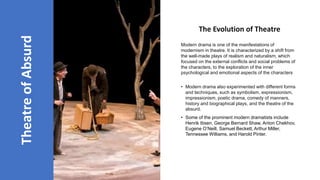
Modern drama is one of the manifestations of
modernism in theatre. It is characterized by a shift from
the well-made plays of realism and naturalism, which
focused on the external conflicts and social problems of
the characters, to the exploration of the inner
psychological and emotional aspects of the characters
• Modern drama also experimented with different forms
and techniques, such as symbolism, expressionism,
impressionism, poetic drama, comedy of manners,
history and biographical plays, and the theatre of the
absurd.
• Some of the prominent modern dramatists include
Henrik Ibsen, George Bernard Shaw, Anton Chekhov,
Eugene O’Neill, Samuel Beckett, Arthur Miller,
Tennessee Williams, and Harold Pinter.
The Evolution of Theatre
Emergence of Modernism Modern Drama in English Literature
The decline of the British Empire and the rise of nationalism and imperialism in
other parts of the world, which challenged the sense of superiority and stability of
the British society.
The two big wars and the Great Depression were really tough times for people. A lot of
suffering happened, and many people felt disappointed and lost hope. It also made clear
that the way politics and society worked had problems and didn't always do what was
right. So, it was a time when people saw that things were not as good as they seemed, and
they questioned how the world was being run.
The scientific and technological advancements, such as the theory of relativity, the
quantum mechanics, the invention of radio, cinema, and automobiles, which
expanded the horizons of knowledge and experience and created new possibilities
and challenges for the artists.
During this time, a bunch of groups and movements, like the Bloomsbury Group, Irish Literary
Revival, Harlem Renaissance, and the Lost Generation, got people excited about trying new
things in culture and thinking. Writers and artists worked together, trying out different ideas
and styles. It was like a creative adventure, where they explored fresh themes and ways of
expressing themselves.
Characteristics of Modern Drama
Realism
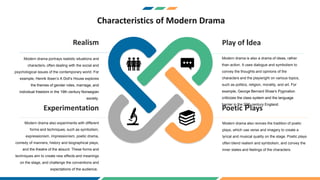
Modern drama portrays realistic situations and
characters, often dealing with the social and
psychological issues of the contemporary world. For
example, Henrik Ibsen’s A Doll’s House explores
the themes of gender roles, marriage, and
individual freedom in the 19th century Norwegian
society.
Play of Idea
Modern drama is also a drama of ideas, rather
than action. It uses dialogue and symbolism to
convey the thoughts and opinions of the
characters and the playwright on various topics,
such as politics, religion, morality, and art. For
example, George Bernard Shaw’s Pygmalion
criticizes the class system and the language
barrier in the 20th century England.
Experimentation
Modern drama also experiments with different
forms and techniques, such as symbolism,
expressionism, impressionism, poetic drama,
comedy of manners, history and biographical plays,
and the theatre of the absurd. These forms and
techniques aim to create new effects and meanings
on the stage, and challenge the conventions and
expectations of the audience.
Poetic Plays
Modern drama also revives the tradition of poetic
plays, which use verse and imagery to create a
lyrical and musical quality on the stage. Poetic plays
often blend realism and symbolism, and convey the
inner states and feelings of the characters.
Conclusion
The significance and impact of modern drama on theatre and
society are:
• It challenged the traditional forms and conventions of theatre,
and introduced new styles and techniques that expanded the
possibilities and meanings of theatrical expression.
• It explored the psychological and emotional aspects of the
characters, and revealed the complexities and contradictions of
human nature and behavior.
• It addressed the social and political issues of the contemporary
world, and provoked the audience to think critically and
question their values and beliefs.
• It influenced the development of other forms of theatre, such
as postmodernism, avant-garde, and experimental theatre, and
inspired many playwrights and directors in the later periods.
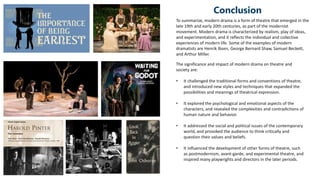
To summarize, modern drama is a form of theatre that emerged in the
late 19th and early 20th centuries, as part of the modernist
movement. Modern drama is characterized by realism, play of ideas,
and experimentation, and it reflects the individual and collective
experiences of modern life. Some of the examples of modern
dramatists are Henrik Ibsen, George Bernard Shaw, Samuel Beckett,
and Arthur Miller.

Modernism and the characteristics.pptx

  • 1.
    Modernism Modernism is abroad term that refers to the artistic and cultural movement that emerged in the late 19th and early 20th centuries, in response to the social and technological changes brought by industrialization, urbanization, and globalization. Modernism challenged the traditional forms and conventions of art, literature, music, and theatre, and sought to express the individual and collective experiences of modern life in new and innovative ways.
  • 2.
    Theatre of Absurd Modern drama isone of the manifestations of modernism in theatre. It is characterized by a shift from the well-made plays of realism and naturalism, which focused on the external conflicts and social problems of the characters, to the exploration of the inner psychological and emotional aspects of the characters • Modern drama also experimented with different forms and techniques, such as symbolism, expressionism, impressionism, poetic drama, comedy of manners, history and biographical plays, and the theatre of the absurd. • Some of the prominent modern dramatists include Henrik Ibsen, George Bernard Shaw, Anton Chekhov, Eugene O’Neill, Samuel Beckett, Arthur Miller, Tennessee Williams, and Harold Pinter. The Evolution of Theatre
  • 3.
    Emergence of ModernismModern Drama in English Literature The decline of the British Empire and the rise of nationalism and imperialism in other parts of the world, which challenged the sense of superiority and stability of the British society. The two big wars and the Great Depression were really tough times for people. A lot of suffering happened, and many people felt disappointed and lost hope. It also made clear that the way politics and society worked had problems and didn't always do what was right. So, it was a time when people saw that things were not as good as they seemed, and they questioned how the world was being run. The scientific and technological advancements, such as the theory of relativity, the quantum mechanics, the invention of radio, cinema, and automobiles, which expanded the horizons of knowledge and experience and created new possibilities and challenges for the artists. During this time, a bunch of groups and movements, like the Bloomsbury Group, Irish Literary Revival, Harlem Renaissance, and the Lost Generation, got people excited about trying new things in culture and thinking. Writers and artists worked together, trying out different ideas and styles. It was like a creative adventure, where they explored fresh themes and ways of expressing themselves.
  • 4.
    Characteristics of ModernDrama Realism Modern drama portrays realistic situations and characters, often dealing with the social and psychological issues of the contemporary world. For example, Henrik Ibsen’s A Doll’s House explores the themes of gender roles, marriage, and individual freedom in the 19th century Norwegian society. Play of Idea Modern drama is also a drama of ideas, rather than action. It uses dialogue and symbolism to convey the thoughts and opinions of the characters and the playwright on various topics, such as politics, religion, morality, and art. For example, George Bernard Shaw’s Pygmalion criticizes the class system and the language barrier in the 20th century England. Experimentation Modern drama also experiments with different forms and techniques, such as symbolism, expressionism, impressionism, poetic drama, comedy of manners, history and biographical plays, and the theatre of the absurd. These forms and techniques aim to create new effects and meanings on the stage, and challenge the conventions and expectations of the audience. Poetic Plays Modern drama also revives the tradition of poetic plays, which use verse and imagery to create a lyrical and musical quality on the stage. Poetic plays often blend realism and symbolism, and convey the inner states and feelings of the characters.
  • 5.
    Conclusion The significance andimpact of modern drama on theatre and society are: • It challenged the traditional forms and conventions of theatre, and introduced new styles and techniques that expanded the possibilities and meanings of theatrical expression. • It explored the psychological and emotional aspects of the characters, and revealed the complexities and contradictions of human nature and behavior. • It addressed the social and political issues of the contemporary world, and provoked the audience to think critically and question their values and beliefs. • It influenced the development of other forms of theatre, such as postmodernism, avant-garde, and experimental theatre, and inspired many playwrights and directors in the later periods. To summarize, modern drama is a form of theatre that emerged in the late 19th and early 20th centuries, as part of the modernist movement. Modern drama is characterized by realism, play of ideas, and experimentation, and it reflects the individual and collective experiences of modern life. Some of the examples of modern dramatists are Henrik Ibsen, George Bernard Shaw, Samuel Beckett, and Arthur Miller.

Editor's Notes

  • #2 Photo by Fezbot2000 on Unsplash