How to be an effective
facilitator
Azim Mirzazadeh, MD, PG Dip. HPE

Associate Professor
School of Medicine,
Tehran University of Medical Sciences (TUMS)
Tehran - Iran
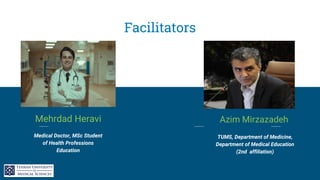
Facilitators
Mehrdad Heravi
Medical Doctor, MSc Student
of Health Professions
Education
Azim Mirzazadeh
TUMS, Department of Medicine,
Department of Medical Education
(2nd affiliation)
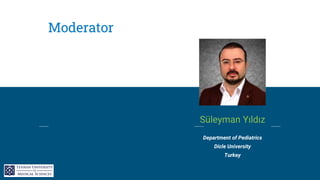
Moderator
Süleyman Yıldız
Department of Pediatrics
Dicle University
Turkey
Workshop goals
● Being familiar with tasks and
attributes of an effective facilitator
● Hands on practice as a facilitator
Facilitation
A new role or a paradigm?
Paradigm shift in medical education
Teaching vs Learning
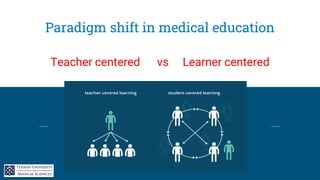
Paradigm shift in medical education
Teacher centered vs Learner centered
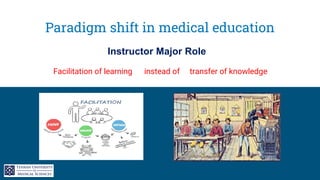
Paradigm shift in medical education
Facilitation of learning instead of transfer of knowledge
Instructor Major Role
Facilitation
1. Compatible with new concepts in Teaching
and Learning (T&L)
2. Needs a paradigm shift in mentality of
teachers and also students about T&L
3. Necessary for small group but not limited to it
4. Could be implemented in a big plenary and
missed in a small group
5. It focuses on deeper and more independent
learning of students
● Providing appropriate learning environments
● Directing the group toward achieving the
session objectives
● Maintaining the group dynamics
● Wrap up and closing the session
● Maintaining the group dynamics
● Achieving the session learning objectives
Tasks of a facilitator
“An important point”
Facilitator role differs based on the
session teaching method:
1. Facilitation in PBL sessions
2. Facilitation in CBL sessions
3. Facilitation in ……
T&L methods in small group
● Tutorial
● Seminar
● Snowballing
● Free Discussion Group
● PBL
● Brainstorming
● Role Play
● Game And Simulation
● Clinical education
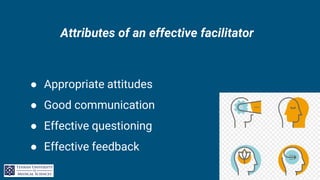
Attributes of an effective facilitator
● Appropriate attitudes
● Good communication
● Effective questioning
● Effective feedback
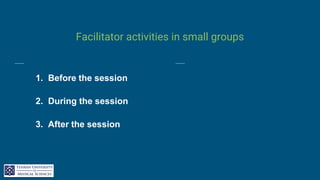
Facilitator activities in small groups
1. Before the session
2. During the session
3. After the session
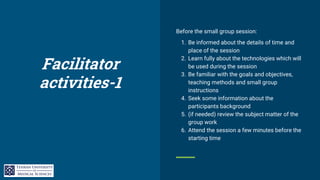
Facilitator
activities-1
Before the small group session:
1. Be informed about the details of time and
place of the session
2. Learn fully about the technologies which will
be used during the session
3. Be familiar with the goals and objectives,
teaching methods and small group
instructions
4. Seek some information about the
participants background
5. (if needed) review the subject matter of the
group work
6. Attend the session a few minutes before the
starting time
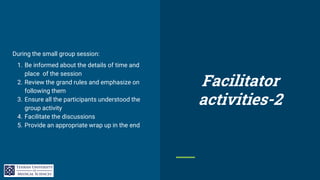
During the small group session:
1. Be informed about the details of time and
place of the session
2. Review the grand rules and emphasize on
following them
3. Ensure all the participants understood the
group activity
4. Facilitate the discussions
5. Provide an appropriate wrap up in the end
Facilitator
activities-2
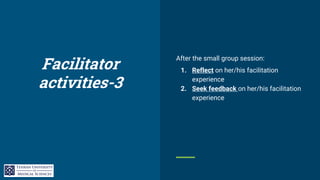
Facilitator
activities-3
After the small group session:
1. Reflect on her/his facilitation
experience
2. Seek feedback on her/his facilitation
experience
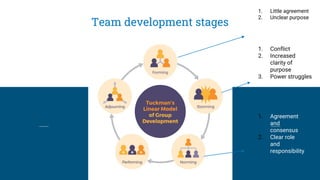
Team development Stages
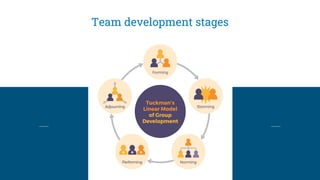
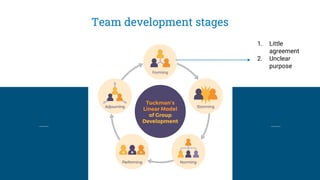
Team development stages
1. Little
agreement
2. Unclear
purpose
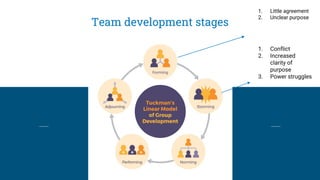
Team development stages
1. Little agreement
2. Unclear purpose
1. Conflict
2. Increased
clarity of
purpose
3. Power struggles
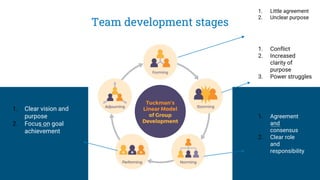
Team development stages
1. Little agreement
2. Unclear purpose
1. Conflict
2. Increased
clarity of
purpose
3. Power struggles
1. Agreement
and
consensus
2. Clear role
and
responsibility
Team development stages
1. Little agreement
2. Unclear purpose
1. Conflict
2. Increased
clarity of
purpose
3. Power struggles
1. Agreement
and
consensus
2. Clear role
and
responsibility
1. Clear vision and
purpose
2. Focus on goal
achievement
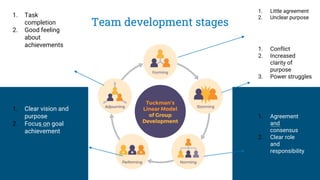
Team development stages
1. Little agreement
2. Unclear purpose
1. Conflict
2. Increased
clarity of
purpose
3. Power struggles
1. Agreement
and
consensus
2. Clear role
and
responsibility
1. Clear vision and
purpose
2. Focus on goal
achievement
1. Task
completion
2. Good feeling
about
achievements
Facilitator challenges during a small group
● Related to curriculum
● Related to physical space and facilities
● Related to facilitators
● Related to participants
Curriculum
challenges
1. Ambiguities regarding the session
objectives and facilitator role
2. Lack/deficiency in group work
materials
3. Lack of clarity in group work guides
4. Inappropriate time for
accomplishment of group work and
achieving its objectives
Curriculum
1. Ambiguities regarding the session objectives and
facilitator role
2. Lack/deficiency in group work materials
3. Lack of clarity in group work guides
4. Inappropriate time for accomplishment of group
work and achieving its objectives
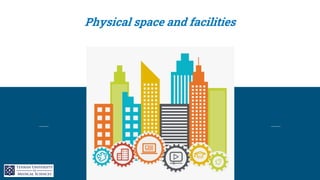
Physical space and facilities
1. Closed doors!!!???
2. Inadequate group work paper for all the participants
3. Physical space deficiencies (light, audio-visual, air
conditioning, chairs)
4. Noisy environments
5. Difficulties in access to audio-visual equipment
(missing computer password, missing files on the
computer)
Facilitators
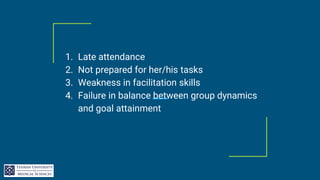
1. Late attendance
2. Not prepared for her/his tasks
3. Weakness in facilitation skills
4. Failure in balance between group dynamics
and goal attainment
Participants
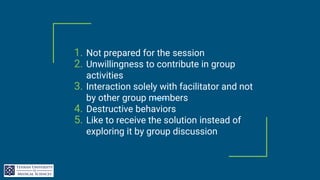
1. Not prepared for the session
2. Unwillingness to contribute in group
activities
3. Interaction solely with facilitator and not
by other group members
4. Destructive behaviors
5. Like to receive the solution instead of
exploring it by group discussion
Destructive
behaviors
1. Silence and abstinence from
participation
2. Dominance by answering all questions
and persistence on her/his ideas
3. Developing sidetrack groups and
distraction
4. Ridiculing others or their comments
5. Obstructing the discussions by bilateral
or multilateral confrontation
6. Engaging in activities not related to
group work (such as Text messaging)
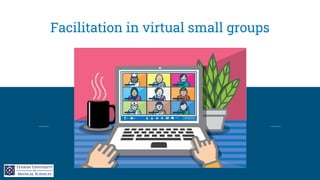
Facilitation in virtual small groups
Challenges:
1. Lack of physical presence and interactions
2. Connection problems (disconnection or low
Bandwidth)
3. Unfamiliarity with platform (for both
facilitator and participants)
4. Difficulty to be focusing on the session
5. Difficulty in motivating the participants to be
involved in group discussions
● Types:
1. Synchronous (in Zoom, Adobe
connect, etc.)
2. Asynchronous (in LMS or social
media groups)
● Facilitator tasks:
1. The same as F2F sessions but more
difficult
Final remarks
1. Facilitation is a new look to the concept of T&L
2. A facilitator should be able to achieve the group dynamics and goal attainment
simultaneously
3. A facilitator should be familiar with team development stages and play
appropriate role in any step
4. A facilitator should do her/his job in all three phases of before, during and after
the session
5. A facilitator should improve her/his communication, questioning and feedback
skills
6. Facilitation in virtual learning is similar to F2F sessions but it needs new skills
and preparedness
Facilitation Skills Workshop Content

Facilitation Skills Workshop Content

  • 1.
    How to bean effective facilitator Azim Mirzazadeh, MD, PG Dip. HPE Associate Professor School of Medicine, Tehran University of Medical Sciences (TUMS) Tehran - Iran
  • 2.
    Facilitators Mehrdad Heravi Medical Doctor,MSc Student of Health Professions Education Azim Mirzazadeh TUMS, Department of Medicine, Department of Medical Education (2nd affiliation)
  • 3.
    Moderator Süleyman Yıldız Department ofPediatrics Dicle University Turkey
  • 4.
    Workshop goals ● Beingfamiliar with tasks and attributes of an effective facilitator ● Hands on practice as a facilitator
  • 5.
  • 6.
    Paradigm shift inmedical education Teaching vs Learning
  • 7.
    Paradigm shift inmedical education Teacher centered vs Learner centered
  • 8.
    Paradigm shift inmedical education Facilitation of learning instead of transfer of knowledge Instructor Major Role
  • 9.
    Facilitation 1. Compatible withnew concepts in Teaching and Learning (T&L) 2. Needs a paradigm shift in mentality of teachers and also students about T&L 3. Necessary for small group but not limited to it 4. Could be implemented in a big plenary and missed in a small group 5. It focuses on deeper and more independent learning of students
  • 10.
    ● Providing appropriatelearning environments ● Directing the group toward achieving the session objectives ● Maintaining the group dynamics ● Wrap up and closing the session ● Maintaining the group dynamics ● Achieving the session learning objectives Tasks of a facilitator
  • 11.
    “An important point” Facilitatorrole differs based on the session teaching method: 1. Facilitation in PBL sessions 2. Facilitation in CBL sessions 3. Facilitation in ……
  • 12.
    T&L methods insmall group ● Tutorial ● Seminar ● Snowballing ● Free Discussion Group ● PBL ● Brainstorming ● Role Play ● Game And Simulation ● Clinical education
  • 13.
    Attributes of aneffective facilitator ● Appropriate attitudes ● Good communication ● Effective questioning ● Effective feedback
  • 14.
    Facilitator activities insmall groups 1. Before the session 2. During the session 3. After the session
  • 15.
    Facilitator activities-1 Before the smallgroup session: 1. Be informed about the details of time and place of the session 2. Learn fully about the technologies which will be used during the session 3. Be familiar with the goals and objectives, teaching methods and small group instructions 4. Seek some information about the participants background 5. (if needed) review the subject matter of the group work 6. Attend the session a few minutes before the starting time
  • 16.
    During the smallgroup session: 1. Be informed about the details of time and place of the session 2. Review the grand rules and emphasize on following them 3. Ensure all the participants understood the group activity 4. Facilitate the discussions 5. Provide an appropriate wrap up in the end Facilitator activities-2
  • 17.
    Facilitator activities-3 After the smallgroup session: 1. Reflect on her/his facilitation experience 2. Seek feedback on her/his facilitation experience
  • 18.
  • 19.
  • 20.
    Team development stages 1.Little agreement 2. Unclear purpose
  • 21.
    Team development stages 1.Little agreement 2. Unclear purpose 1. Conflict 2. Increased clarity of purpose 3. Power struggles
  • 22.
    Team development stages 1.Little agreement 2. Unclear purpose 1. Conflict 2. Increased clarity of purpose 3. Power struggles 1. Agreement and consensus 2. Clear role and responsibility
  • 23.
    Team development stages 1.Little agreement 2. Unclear purpose 1. Conflict 2. Increased clarity of purpose 3. Power struggles 1. Agreement and consensus 2. Clear role and responsibility 1. Clear vision and purpose 2. Focus on goal achievement
  • 24.
    Team development stages 1.Little agreement 2. Unclear purpose 1. Conflict 2. Increased clarity of purpose 3. Power struggles 1. Agreement and consensus 2. Clear role and responsibility 1. Clear vision and purpose 2. Focus on goal achievement 1. Task completion 2. Good feeling about achievements
  • 25.
    Facilitator challenges duringa small group ● Related to curriculum ● Related to physical space and facilities ● Related to facilitators ● Related to participants
  • 26.
    Curriculum challenges 1. Ambiguities regardingthe session objectives and facilitator role 2. Lack/deficiency in group work materials 3. Lack of clarity in group work guides 4. Inappropriate time for accomplishment of group work and achieving its objectives
  • 27.
  • 28.
    1. Ambiguities regardingthe session objectives and facilitator role 2. Lack/deficiency in group work materials 3. Lack of clarity in group work guides 4. Inappropriate time for accomplishment of group work and achieving its objectives
  • 29.
  • 30.
    1. Closed doors!!!??? 2.Inadequate group work paper for all the participants 3. Physical space deficiencies (light, audio-visual, air conditioning, chairs) 4. Noisy environments 5. Difficulties in access to audio-visual equipment (missing computer password, missing files on the computer)
  • 31.
  • 32.
    1. Late attendance 2.Not prepared for her/his tasks 3. Weakness in facilitation skills 4. Failure in balance between group dynamics and goal attainment
  • 33.
  • 34.
    1. Not preparedfor the session 2. Unwillingness to contribute in group activities 3. Interaction solely with facilitator and not by other group members 4. Destructive behaviors 5. Like to receive the solution instead of exploring it by group discussion
  • 35.
    Destructive behaviors 1. Silence andabstinence from participation 2. Dominance by answering all questions and persistence on her/his ideas 3. Developing sidetrack groups and distraction 4. Ridiculing others or their comments 5. Obstructing the discussions by bilateral or multilateral confrontation 6. Engaging in activities not related to group work (such as Text messaging)
  • 36.
  • 37.
    Challenges: 1. Lack ofphysical presence and interactions 2. Connection problems (disconnection or low Bandwidth) 3. Unfamiliarity with platform (for both facilitator and participants) 4. Difficulty to be focusing on the session 5. Difficulty in motivating the participants to be involved in group discussions ● Types: 1. Synchronous (in Zoom, Adobe connect, etc.) 2. Asynchronous (in LMS or social media groups) ● Facilitator tasks: 1. The same as F2F sessions but more difficult
  • 38.
    Final remarks 1. Facilitationis a new look to the concept of T&L 2. A facilitator should be able to achieve the group dynamics and goal attainment simultaneously 3. A facilitator should be familiar with team development stages and play appropriate role in any step 4. A facilitator should do her/his job in all three phases of before, during and after the session 5. A facilitator should improve her/his communication, questioning and feedback skills 6. Facilitation in virtual learning is similar to F2F sessions but it needs new skills and preparedness