1. The document discusses various algorithms and methods for solving optimization problems involving sparse signal recovery from underdetermined linear systems.
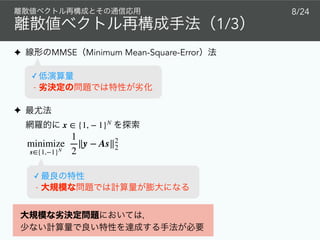
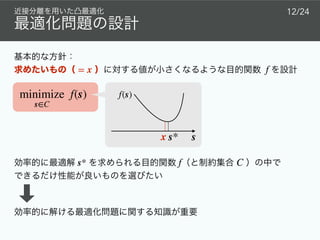
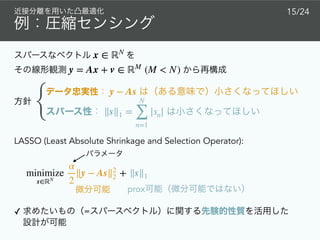
2. Key algorithms mentioned include iterative shrinkage-thresholding algorithms like FISTA, proximal splitting methods like ADMM, and regularization-based methods involving sparse-promoting penalties like l1-norm and sum of absolute values.
3. Applications discussed include compressed sensing, sparse signal recovery from MIMO systems, and discrete signal reconstruction problems.


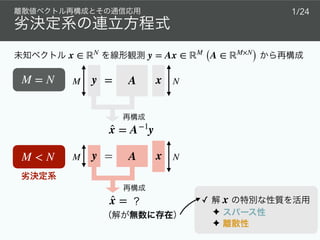
![[1]
✦ MRI [2]
✦ [3]
2/24
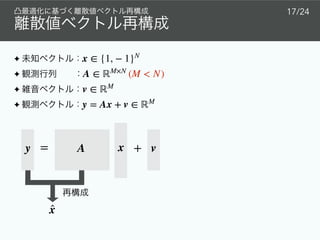
xAy = + v
̂x
x =
0
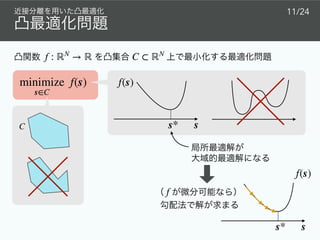
0
0
1.4
0
0
[1] D. L. Donoho, “Compressed sensing,” IEEE Trans. Inf. Theory, vol. 52, no. 4, pp. 1289–1306, Apr. 2006.
[2] M. Lustig, D. L. Donoho, J. M. Santos, and J. M. Pauly, “Compressed sensing MRI,” IEEE Signal Process. Mag.,
vol. 25, no. 2, pp. 72–82, Mar. 2008.
[3] K. Hayashi, M. Nagahara, and T. Tanaka, “A user’s guide to compressed sensing for communications systems,”
IEICE Trans. Commun., vol. E96-B, no. 3, pp. 685–712, Mar. 2013.](https://image.slidesharecdn.com/kjciee2019public-191201135445/85/slide-5-320.jpg)
![✦ MIMO [4]
✦ [5]
✦ FTN Faster-than-Nyquist [6]
[4] K. K. Wong, A. Paulraj, and R. D. Murch, “Efficient high-performance decoding for overloaded MIMO antenna
systems,” IEEE Trans. Wireless Commun., vol. 6, no. 5, pp. 1833–1843, May 2007.
[5] H. Zhu and G. B. Giannakis, ‘’Exploiting sparse user activity in multiuser detection,’’ IEEE Trans. Commun., vol. 59,
no. 2, pp. 454–465, Feb. 2011.
[6] J. E. Mazo, ‘‘Faster-than-Nyquist signaling,’’ Bell Syst. Tech. J., vol. 54, no. 8, pp. 1451–1462, 1975.
3/24
xAy = + v
̂x
x =
1
1
−1
1
−1
−1](https://image.slidesharecdn.com/kjciee2019public-191201135445/85/slide-6-320.jpg)


![MIMO
6/24
˜x1
✦
✦
✦
✦
˜x = [˜x1 ⋯ ˜xNT
] 𝖳
∈ 𝒜NT
˜A =
˜a1,1 ⋯ ˜a1,NT
⋮ ⋱ ⋮
˜aNR,1 ⋯ ˜aNR,NT
∈ ℂNR×NT
˜v = [˜v1 ⋯ ˜vNR
] 𝖳
∈ ℂNR
˜y = [˜y1 ⋯ ˜yNR
] 𝖳
∈ ℂNR
˜xNT
˜a1,1
˜aNR,1
˜a1,NT
˜aNR,NT
˜v1
˜vNR
˜y1
˜yNR
˜y = ˜A˜x + ˜v
QPSK
(Quadrature Phase Shift Keying)
𝒜
Re
Im
𝒜 = {1 + j, − 1 + j,
−1 − j, 1 − j}](https://image.slidesharecdn.com/kjciee2019public-191201135445/85/slide-9-320.jpg)
![MIMO
7/24
MIMO
˜y = ˜A˜x + ˜v ˜x ∈ 𝒜NT
˜y = ˜A˜x + ˜v (˜x ∈ 𝒜NT)
y = Ax + v (x ∈ {1, − 1}2NT)
y =
[
Re{˜y}
Im{˜y}]
∈ ℝ2NR,
(𝒜 = {1 + j, − 1 + j, − 1 − j, 1 − j})
A =
[
Re{ ˜A} −Im{ ˜A}
Im{ ˜A} Re{ ˜A} ]
∈ ℝ2NR×2NT, v =
[
Re{˜v}
Im{˜v}]
∈ ℝ2NR
x =
[
Re{˜x}
Im{˜x}]
∈ {1, − 1}2NT
MIMO =(NR < NT)](https://image.slidesharecdn.com/kjciee2019public-191201135445/85/slide-10-320.jpg)
![2/3
9/24
✦
• AMP (Approximate Message Passing) [7]
• EP (Expectation Propagation) [8]
• OAMP (Orthogonal AMP) [9]
• VAMP (Vector AMP) [10]
[7] D. L. Donoho, A. Maleki, and A. Montanari, “Message-passing algorithms for compressed sensing,” Proc. Nat. Acad.
Sci., vol. 106, no. 45, pp. 18914–18919, Nov. 2009.
[8] J. Céspedes, P. M. Olmos, M. Sánchez-Fernández, and F. Perez-Cruz, ‘‘Expectation propagation detection for
high-order high-dimensional MIMO systems,’’ IEEE Trans. Commun., vol. 62, no. 8, pp. 2840–2849, Aug. 2014.
[9] J. Ma and L. Ping, ‘‘Orthogonal AMP,’’ IEEE Access, vol. 5, pp. 2020–2033, 2017.
[10] S. Rangan, P. Schniter, and A. K. Fletcher, ‘’Vector approximate message passing,’’ in Proc. IEEE ISIT, Jun. 2017.
✓
✓
-
-](https://image.slidesharecdn.com/kjciee2019public-191201135445/85/slide-12-320.jpg)
![3/3
10/24
✦
• Box [11]
• regularization-based method [12]
• transform-based method [12]
• SOAV Sum of Absolute Values [13]
[11] P. H. Tan, L. K. Rasmussen, and T. J. Lim, “Constrained maximum-likelihood detection in CDMA,” IEEE Trans.
Commun., vol. 49, no. 1, pp. 142–153, Jan. 2001.
[12] A. Aïssa-El-Bey, D. Pastor, S. M. A. Sbaï, and Y. Fadlallah, “Sparsity-based recovery of finite alphabet solutions to
underdetermined linear systems,” IEEE Trans. Inf. Theory, vol. 61, no. 4, pp. 2008–2018, Apr. 2015.
[13] M. Nagahara, “Discrete signal reconstruction by sum of absolute values,” IEEE Signal Process. Lett., vol. 22, no. 10,
pp. 1575–1579, Oct. 2015.
✓
✓
-](https://image.slidesharecdn.com/kjciee2019public-191201135445/85/slide-13-320.jpg)
![✦ [16]
✦ FISTA Fast Iterative Shrinkage-Thresholding Algorithm [17]
✦ ADMM Alternating Direction Method of Multipliers [18]
✦ PDS Primal-Dual Splitting [19]
[14] P. L. Combettes and J.-C. Pesquet, “Proximal splitting methods in signal processing,” in Fixed-point algorithms for
inverse problems in science and engineering. Springer, 2011.
[15] , “ ,” ,
vol. 64, no. 6, pp. 316–325, 2019 6 .
[16] P. L. Combettes and V. Wajs, “Signal recovery by proximal forward-backward splitting,” SIAM J. Multi. Model.
Simul., vol. 4, no. 4, pp. 1168–1200, 2005.
[17] A. Beck and M. Teboulle, “A fast iterative shrinkage-thresholding algorithm for linear inverse problems,” SIAM J.
Imag. Sci., vol. 2, no. 1, pp. 183–202, Mar. 2009.
[18] D. Gabay and B. Mercier, “A dual algorithm for the solution of nonlinear variational problems via finite element
approximation,” Comput. Math. Appl., vol. 2, no. 1, pp. 17–40, 1976.
[19] A. Chambolle and T. Pock, “A first-order primal-dual algorithm for convex problems with applications to imaging,”
J. Math. Imaging Vision, vol. 40, no. 1, pp. 120–145, May 2011.
ϕ : ℝN
→ ℝ
proxϕ(s) := arg min
u∈ℝN {
ϕ(u) +
1
2
∥u − s∥2
2}
: ℝN
→ ℝ
13/24](https://image.slidesharecdn.com/kjciee2019public-191201135445/85/slide-17-320.jpg)
![FISTA
prox
proxγϕ2
(z) (γ > 0)
+
FISTA
14/24
✓
→
✓ prox [14]
ϕ2(s)
minimize
s∈ℝN
ϕ1(s) + ϕ2(s)
[14] P. L. Combettes and J.-C. Pesquet, “Proximal splitting methods in signal processing,” in Fixed-point algorithms for
inverse problems in science and engineering. Springer, 2011.](https://image.slidesharecdn.com/kjciee2019public-191201135445/85/slide-18-320.jpg)

![Box [11]
[11] P. H. Tan, L. K. Rasmussen, and T. J. Lim, “Constrained maximum-likelihood detection in CDMA,” IEEE Trans.
Commun., vol. 49, no. 1, pp. 142–153, Jan. 2001.
18/24
Box s ∈ [−1, 1]N
minimize
1−1 s
y − As
s [−1, 1]{
1
2
∥y − As∥2
2
s ∈ [−1, 1]N
x ∈ {1, − 1}N
⊂ [−1, 1]N](https://image.slidesharecdn.com/kjciee2019public-191201135445/85/slide-23-320.jpg)
![SOAV [13]
19/24
[13] M. Nagahara, “Discrete signal reconstruction by sum of absolute values,” IEEE Signal Process. Lett., vol. 22, no. 10,
pp. 1575–1579, Oct. 2015.
x ∈ {1, − 1}N
x − 1, x + 1
y − As
∥s − 1∥1, ∥s + 1∥1{
SOAV Sum of Absolute Values
1
2
∥s − 1∥1 +
1
2
∥s + 1∥1 =
N
∑
n=1
(
1
2
|sn − 1| +
1
2
|sn + 1|
)
prox
minimize
s∈ℝN
α
2
∥y − As∥2
2 +
N
∑
n=1
(
1
2
|sn − 1| +
1
2
|sn + 1|
)](https://image.slidesharecdn.com/kjciee2019public-191201135445/85/slide-24-320.jpg)
![[20]
20/24
minimize
s∈ℝN
α
2
∥y − As∥2
2 +
1
2
∥s − 1∥1 +
1
2
∥s + 1∥1
SOAV
SSR Sum of Sparse Regularizers
✦
✦
ℓp (0 ≤ p < 1)
ℓ1 − ℓ2
[20] R. Hayakawa and K. Hayashi, ”Discrete-valued vector reconstruction by optimization with sum of sparse
regularizers,” in Proc. EUSIPCO, Sept. 2019.
minimize
s∈ℝN
α
2
∥y − As∥2
2 +
1
2
h(s − 1) +
1
2
h(s + 1)
✓ ADMM PDS](https://image.slidesharecdn.com/kjciee2019public-191201135445/85/slide-26-320.jpg)
![[21]
21/24
[21] R. Hayakawa and K. Hayashi, “Reconstruction of complex discrete-valued vector via convex optimization with
sparse regularizers” IEEE Access, vol. 6, pp. 66499–66512, Dec. 2018.
minimize
s∈ℂN
α∥y − As∥2
2 +
L
∑
ℓ=1
qℓhℓ(s − rℓ1)
SCSR Sum of Complex Sparse Regularizers
✦
✦
✦
✦
x ∈ {c1, …, cL}N
⊂ ℂN
A ∈ ℂM×N
(M < N)
v ∈ ℂM
y = Ax + v ∈ ℂM
✓ ADMM
Re
Im
cℓ
Re
Im
cℓ](https://image.slidesharecdn.com/kjciee2019public-191201135445/85/slide-27-320.jpg)
![[22] C. Thrampoulidis, E. Abbasi, and B. Hassibi, “Precise error analysis of regularized M-estimators in high dimensions,”
IEEE Trans. Inf. Theory, vol. 64, no. 8, pp. 5592–5628, Aug. 2018.
[23] C. Thrampoulidis, W. Xu, and B. Hassibi, “Symbol error rate performance of box-relaxation decoders in massive
MIMO,” IEEE Trans. Signal Process., vol. 66, no. 13, pp. 3377–3392, Jul. 2018.
22/24
SER
1
N
∥sign( ̂xBox) − x∥0
CGMT Convex Gaussian Min-max Theorem [22, 23]
Box SER Symbol Error Rate
M, N → ∞ (M/N = Δ)
1 − P
(
1
τ* )
SER
Boxx ∈ {1, − 1}N
✦ 0 i.i.d.
✦ 0 i.i.d.
A
v](https://image.slidesharecdn.com/kjciee2019public-191201135445/85/slide-28-320.jpg)
![[24] K. Gregor, and Y. LeCun, “Learning fast approximations of sparse coding,” in Proc. ICML, 2010.
[25] S. Takabe, M. Imanishi, T. Wadayama, R. Hayakawa, and K. Hayashi, "Trainable projected gradient detector for
massive overloaded MIMO channels: Data-driven tuning approach,” IEEE Access, vol. 7, pp. 93326-93338, Jul.
2019.
23/24
✦ [24]
MIMO [25]
A
B
C
A B C A B C](https://image.slidesharecdn.com/kjciee2019public-191201135445/85/slide-29-320.jpg)



![[Deck] What's New in Spark-Iceberg Integration via DSV2.pptx](https://cdn.slidesharecdn.com/ss_thumbnails/deckwhatsnewinspark-icebergintegrationviadsv2-260210005337-25955b12-thumbnail.jpg?width=640&height=640&fit=bounds)


