Error Recovery with Relaxed MAP Estimation
for Massive MIMO Signal Detection
Graduate School of Informatics, Kyoto University
Ryo Hayakawa and Kazunori Hayashi
The International Symposium on Information Theory and Its Applications (ISITA) 2016

October 30-November 2, 2016

Tu-B-3: Large-Scale MIMO (Organized Session)
Outline
❖ Introduction

❖ Conventional Sparse Error Recovery Method

❖ Proposed Error Recovery Method

❖ Simulation Results

❖ Conclusion
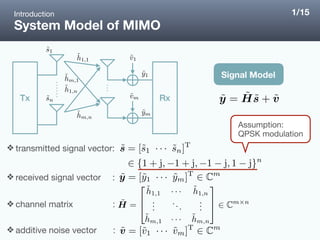
System Model of MIMO
Tx Rx
❖ transmitted signal vector:
❖ received signal vector :
❖ channel matrix :
❖ additive noise vector :
Signal Model
1/15Introduction
Assumption: 

QPSK modulation
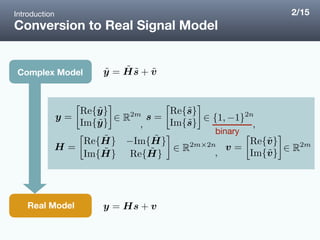
Conversion to Real Signal Model
Complex Model
Real Model
2/15Introduction
binary
Signal Detection Schemes for Massive MIMO
❖ Linear detection schemes

✦ Zero forcing (ZF)

✦ Minimum mean-square-error (MMSE) etc…

❖ Nonlinear detection schemes

✦ Likelihood ascent search (LAS) [1]

✦ Reactive tabu search (RTS) [2]

✦ Gaussian belief propagation (GaBP) [3]

✦ Post-detection sparse error recovery (PDSR) [4] etc…
Introduction
Signal Detection
[1] K. V. Vardhan, et. al., “A low-complexity detector for large MIMO systems and multicarrier CDMA systems,” 

IEEE J. Sel. Areas Commun., vol. 26, no. 4, pp. 473– 485, Apr. 2008.
[2] T. Datta, et. al., “Random- restart reactive tabu search algorithm for detection in large-MIMO systems,” 

IEEE Commun. Lett., vol. 14, no. 12, pp. 1107–1109, Dec. 2010.
[3] T. Wo, et. al., “A simple iterative Gaussian detector for severely delay-spread MIMO channels,”
in Proc. IEEE ICC 2007, pp. 4598–4563, Jun. 2007.
[4] J.Choi, et. al., “New approach for massive MIMO detection using sparse error recovery,” 

in Proc. IEEE GLOBECOM 2014, pp. 3754–3759, Dec. 2014.
3/15
estimate from
Signal Detection Schemes for Massive MIMO
❖ Linear detection schemes

✦ Zero forcing (ZF)

✦ Minimum mean-square-error (MMSE) etc…

❖ Nonlinear detection schemes

✦ Likelihood ascent search (LAS) [1]

✦ Reactive tabu search (RTS) [2]

✦ Gaussian belief propagation (GaBP) [3]

✦ Post-detection sparse error recovery (PDSR) [4] etc…
Introduction
Signal Detection
[1] K. V. Vardhan, et. al., “A low-complexity detector for large MIMO systems and multicarrier CDMA systems,” 

IEEE J. Sel. Areas Commun., vol. 26, no. 4, pp. 473– 485, Apr. 2008.
[2] T. Datta, et. al., “Random- restart reactive tabu search algorithm for detection in large-MIMO systems,” 

IEEE Commun. Lett., vol. 14, no. 12, pp. 1107–1109, Dec. 2010.
[3] T. Wo, et. al., “A simple iterative Gaussian detector for severely delay-spread MIMO channels,”
in Proc. IEEE ICC 2007, pp. 4598–4563, Jun. 2007.
[4] J.Choi, et. al., “New approach for massive MIMO detection using sparse error recovery,” 

in Proc. IEEE GLOBECOM 2014, pp. 3754–3759, Dec. 2014.
improve the tentative estimate 

obtained by some detection schemes 

(e.g. ZF, MMSE)
3/15
estimate from
Outline
❖ Introduction

❖ Conventional Sparse Error Recovery Method

❖ Proposed Error Recovery Method

❖ Simulation Results

❖ Conclusion
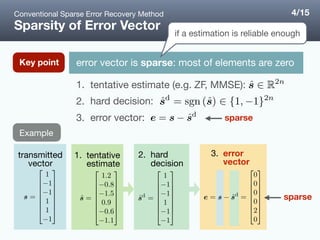
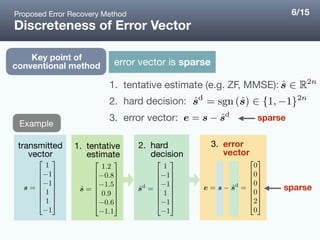
Sparsity of Error Vector
error vector is sparse: most of elements are zero
Example
1. tentative

estimate
3. error

vector
sparse
Conventional Sparse Error Recovery Method
if a estimation is reliable enough
Key point
2. hard

decision
4/15
1. tentative estimate (e.g. ZF, MMSE):

2. hard decision: 

3. error vector: sparse
transmitted

vector
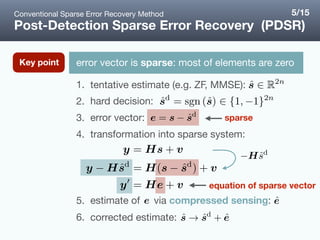
1. tentative estimate (e.g. ZF, MMSE):

2. hard decision: 

3. error vector: 

4. transformation into sparse system: 


5. estimate of via compressed sensing: 

6. corrected estimate:
Post-Detection Sparse Error Recovery (PDSR)
error vector is sparse: most of elements are zeroKey point
sparse
equation of sparse vector
Conventional Sparse Error Recovery Method 5/15
Outline
❖ Introduction

❖ Conventional Sparse Error Recovery Method

❖ Proposed Error Recovery Method

❖ Simulation Results

❖ Conclusion
1. tentative estimate (e.g. ZF, MMSE): 

2. hard decision: 

3. error vector:
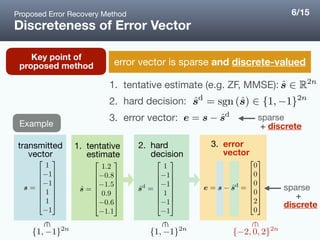
Discreteness of Error Vector
error vector is sparse
sparse
Example
3. error

vector
sparse
2. hard

decision
Proposed Error Recovery Method
Key point of

conventional method
Key point of
conventional method
6/15
1. tentative

estimate
transmitted

vector
1. tentative estimate (e.g. ZF, MMSE): 

2. hard decision: 

3. error vector:
Discreteness of Error Vector
Proposed Error Recovery Method
Example
3. error

vector
sparse
+
discrete
sparse

+ discrete
2. hard

decision
Key point of
proposed method error vector is sparse and discrete-valued
6/15
1. tentative

estimate
transmitted

vector
estimate 

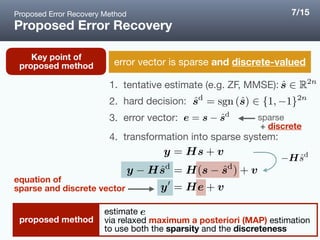
via relaxed maximum a posteriori (MAP) estimation

to use both the sparsity and the discreteness
1. tentative estimate (e.g. ZF, MMSE):

2. hard decision: 

3. error vector: 

4. transformation into sparse system:
Proposed Error Recovery
Proposed Error Recovery Method
equation of
sparse and discrete vector
proposed method
7/15
Key point of
proposed method error vector is sparse and discrete-valued
sparse

+ discrete
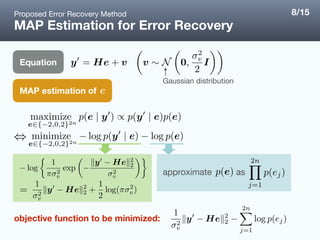
MAP Estimation for Error Recovery
MAP estimation of
Proposed Error Recovery Method
Equation
Gaussian distribution
objective function to be minimized:
approximate as
8/15
objective function:
Proposed Error Recovery Method
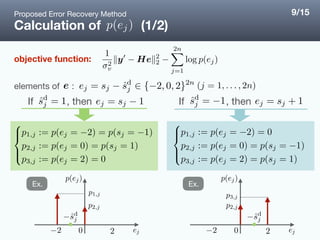
Calculation of (1/2)
Ex. Ex.
If , then If , then
elements of :
9/15
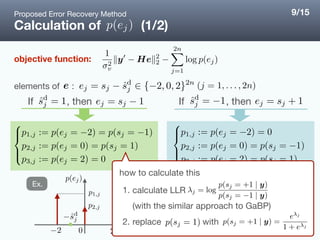
Calculation of (1/2)
If , then If , then
elements of :
objective function:
Proposed Error Recovery Method
Ex. Ex.
1. calculate LLR

(with the similar approach to GaBP)

2. replace with
how to calculate this
9/15
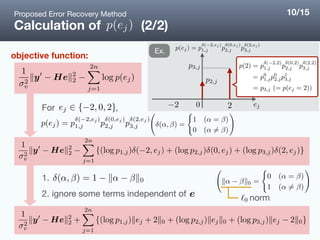
Calculation of (2/2)
objective function:
norm
1. 

2. ignore some terms independent of
Ex.
Proposed Error Recovery Method 10/15
For ,
convex relaxation (similar to [5])
Relaxation into Convex Optimization
Combinational optimization
Convex optimization
❖ is not continuous

❖
Proposed Error Recovery Method
: Sum-of-absolute-value (SOAV) optimization [6]
[5] H. Sasahara, et. al., “Multiuser detection by MAP estimation with sum-of-absolute-values relaxation,” in Proc. IEEE ICC 2016, May 2016.

[6] M. Nagahara,“Discrete signal reconstruction by sum of absolute values,”
IEEE Signal Process. Lett., vol. 22, no. 10, pp. 1575–1579, Oct. 2015.
11/15
convex relaxation (similar to [5])
Relaxation into Convex Optimization
Combinational optimization
Convex optimization
❖ is not continuous

❖
Proposed Error Recovery Method
: Sum-of-absolute-value (SOAV) optimization [6]
[5] H. Sasahara, et. al., “Multiuser detection by MAP estimation with sum-of-absolute-values relaxation,” in Proc. IEEE ICC 2016, May 2016.

[6] M. Nagahara,“Discrete signal reconstruction by sum of absolute values,”
IEEE Signal Process. Lett., vol. 22, no. 10, pp. 1575–1579, Oct. 2015.
11/15
❖ is continuous

❖
If , 

then
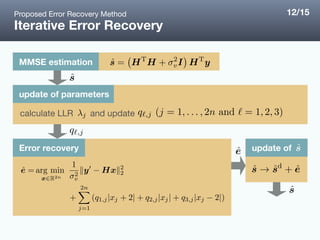
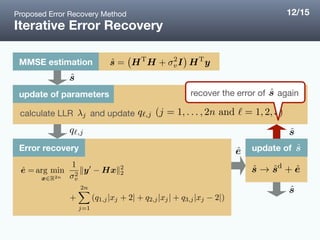
Iterative Error Recovery
MMSE estimation
update of parameters
Error recovery update of
calculate LLR and update
Proposed Error Recovery Method 12/15
Iterative Error Recovery
MMSE estimation
update of parameters
Error recovery update of
calculate LLR and update
Proposed Error Recovery Method 12/15
recover the error of again
Outline
❖ Introduction

❖ Conventional Sparse Error Recovery Method

❖ Proposed Error Recovery Method

❖ Simulation Results

❖ Conclusion
SNR per receive antenna (dB)
0 5 10 15 20 25 30
BER
10
-4
10
-3
10
-2
10
-1
100
MMSE
MMSE+MMP
MMSE+SOAV (T=1)
MMSE+SOAV (T=2)
MMSE+SOAV (T=3)
MMSE+SOAV (T=4)
MMSE+SOAV (T=5)
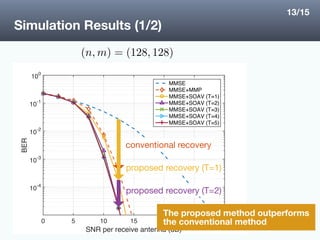
Simulation Results (1/2)
conventional recovery
proposed recovery (T=1)
proposed recovery (T=2)
The proposed method outperforms
the conventional method
13/15
SNR per receive antenna (dB)
0 5 10 15 20 25 30
BER
10
-4
10
-3
10
-2
10
-1
100
MMSE
MMSE+MMP
MMSE+SOAV (T=1)
MMSE+SOAV (T=2)
MMSE+SOAV (T=3)
MMSE+SOAV (T=4)
MMSE+SOAV (T=5)
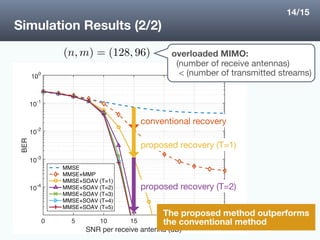
Simulation Results (2/2)
conventional recovery
proposed recovery (T=1)
proposed recovery (T=2)
The proposed method outperforms
the conventional method
overloaded MIMO: 

(number of receive antennas) 

< (number of transmitted streams)
14/15
Outline
❖ Introduction

❖ Conventional Sparse Error Recovery Method

❖ Proposed Error Recovery Method

❖ Simulation Results

❖ Conclusion
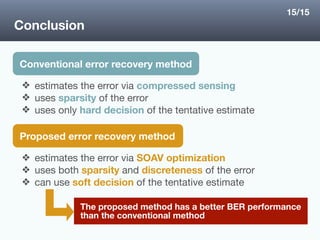
Conclusion
Conventional error recovery method
❖ estimates the error via compressed sensing
❖ uses sparsity of the error 

❖ uses only hard decision of the tentative estimate
The proposed method has a better BER performance
than the conventional method
Proposed error recovery method
❖ estimates the error via SOAV optimization 

❖ uses both sparsity and discreteness of the error

❖ can use soft decision of the tentative estimate
15/15

Error Recovery with Relaxed MAP Estimation for Massive MIMO Signal Detection

  • 1.
    Error Recovery withRelaxed MAP Estimation for Massive MIMO Signal Detection Graduate School of Informatics, Kyoto University Ryo Hayakawa and Kazunori Hayashi The International Symposium on Information Theory and Its Applications (ISITA) 2016 October 30-November 2, 2016 Tu-B-3: Large-Scale MIMO (Organized Session)
  • 2.
    Outline ❖ Introduction ❖ ConventionalSparse Error Recovery Method ❖ Proposed Error Recovery Method ❖ Simulation Results ❖ Conclusion
  • 3.
    System Model ofMIMO Tx Rx ❖ transmitted signal vector: ❖ received signal vector : ❖ channel matrix : ❖ additive noise vector : Signal Model 1/15Introduction Assumption: QPSK modulation
  • 4.
    Conversion to RealSignal Model Complex Model Real Model 2/15Introduction binary
  • 5.
    Signal Detection Schemesfor Massive MIMO ❖ Linear detection schemes ✦ Zero forcing (ZF) ✦ Minimum mean-square-error (MMSE) etc… ❖ Nonlinear detection schemes ✦ Likelihood ascent search (LAS) [1] ✦ Reactive tabu search (RTS) [2] ✦ Gaussian belief propagation (GaBP) [3] ✦ Post-detection sparse error recovery (PDSR) [4] etc… Introduction Signal Detection [1] K. V. Vardhan, et. al., “A low-complexity detector for large MIMO systems and multicarrier CDMA systems,” 
 IEEE J. Sel. Areas Commun., vol. 26, no. 4, pp. 473– 485, Apr. 2008. [2] T. Datta, et. al., “Random- restart reactive tabu search algorithm for detection in large-MIMO systems,” 
 IEEE Commun. Lett., vol. 14, no. 12, pp. 1107–1109, Dec. 2010. [3] T. Wo, et. al., “A simple iterative Gaussian detector for severely delay-spread MIMO channels,” in Proc. IEEE ICC 2007, pp. 4598–4563, Jun. 2007. [4] J.Choi, et. al., “New approach for massive MIMO detection using sparse error recovery,” 
 in Proc. IEEE GLOBECOM 2014, pp. 3754–3759, Dec. 2014. 3/15 estimate from
  • 6.
    Signal Detection Schemesfor Massive MIMO ❖ Linear detection schemes ✦ Zero forcing (ZF) ✦ Minimum mean-square-error (MMSE) etc… ❖ Nonlinear detection schemes ✦ Likelihood ascent search (LAS) [1] ✦ Reactive tabu search (RTS) [2] ✦ Gaussian belief propagation (GaBP) [3] ✦ Post-detection sparse error recovery (PDSR) [4] etc… Introduction Signal Detection [1] K. V. Vardhan, et. al., “A low-complexity detector for large MIMO systems and multicarrier CDMA systems,” 
 IEEE J. Sel. Areas Commun., vol. 26, no. 4, pp. 473– 485, Apr. 2008. [2] T. Datta, et. al., “Random- restart reactive tabu search algorithm for detection in large-MIMO systems,” 
 IEEE Commun. Lett., vol. 14, no. 12, pp. 1107–1109, Dec. 2010. [3] T. Wo, et. al., “A simple iterative Gaussian detector for severely delay-spread MIMO channels,” in Proc. IEEE ICC 2007, pp. 4598–4563, Jun. 2007. [4] J.Choi, et. al., “New approach for massive MIMO detection using sparse error recovery,” 
 in Proc. IEEE GLOBECOM 2014, pp. 3754–3759, Dec. 2014. improve the tentative estimate obtained by some detection schemes (e.g. ZF, MMSE) 3/15 estimate from
  • 7.
    Outline ❖ Introduction ❖ ConventionalSparse Error Recovery Method ❖ Proposed Error Recovery Method ❖ Simulation Results ❖ Conclusion
  • 8.
    Sparsity of ErrorVector error vector is sparse: most of elements are zero Example 1. tentative
 estimate 3. error
 vector sparse Conventional Sparse Error Recovery Method if a estimation is reliable enough Key point 2. hard
 decision 4/15 1. tentative estimate (e.g. ZF, MMSE): 2. hard decision: 3. error vector: sparse transmitted vector
  • 9.
    1. tentative estimate(e.g. ZF, MMSE): 2. hard decision: 3. error vector: 4. transformation into sparse system: 
 
 
 5. estimate of via compressed sensing: 6. corrected estimate: Post-Detection Sparse Error Recovery (PDSR) error vector is sparse: most of elements are zeroKey point sparse equation of sparse vector Conventional Sparse Error Recovery Method 5/15
  • 10.
    Outline ❖ Introduction ❖ ConventionalSparse Error Recovery Method ❖ Proposed Error Recovery Method ❖ Simulation Results ❖ Conclusion
  • 11.
    1. tentative estimate(e.g. ZF, MMSE): 2. hard decision: 3. error vector: Discreteness of Error Vector error vector is sparse sparse Example 3. error
 vector sparse 2. hard
 decision Proposed Error Recovery Method Key point of conventional method Key point of conventional method 6/15 1. tentative
 estimate transmitted vector
  • 12.
    1. tentative estimate(e.g. ZF, MMSE): 2. hard decision: 3. error vector: Discreteness of Error Vector Proposed Error Recovery Method Example 3. error
 vector sparse + discrete sparse + discrete 2. hard
 decision Key point of proposed method error vector is sparse and discrete-valued 6/15 1. tentative
 estimate transmitted vector
  • 13.
    estimate via relaxedmaximum a posteriori (MAP) estimation to use both the sparsity and the discreteness 1. tentative estimate (e.g. ZF, MMSE): 2. hard decision: 3. error vector: 
 4. transformation into sparse system: Proposed Error Recovery Proposed Error Recovery Method equation of sparse and discrete vector proposed method 7/15 Key point of proposed method error vector is sparse and discrete-valued sparse + discrete
  • 14.
    MAP Estimation forError Recovery MAP estimation of Proposed Error Recovery Method Equation Gaussian distribution objective function to be minimized: approximate as 8/15
  • 15.
    objective function: Proposed ErrorRecovery Method Calculation of (1/2) Ex. Ex. If , then If , then elements of : 9/15
  • 16.
    Calculation of (1/2) If, then If , then elements of : objective function: Proposed Error Recovery Method Ex. Ex. 1. calculate LLR
 (with the similar approach to GaBP) 2. replace with how to calculate this 9/15
  • 17.
    Calculation of (2/2) objectivefunction: norm 1. 2. ignore some terms independent of Ex. Proposed Error Recovery Method 10/15 For ,
  • 18.
    convex relaxation (similarto [5]) Relaxation into Convex Optimization Combinational optimization Convex optimization ❖ is not continuous ❖ Proposed Error Recovery Method : Sum-of-absolute-value (SOAV) optimization [6] [5] H. Sasahara, et. al., “Multiuser detection by MAP estimation with sum-of-absolute-values relaxation,” in Proc. IEEE ICC 2016, May 2016.
 [6] M. Nagahara,“Discrete signal reconstruction by sum of absolute values,” IEEE Signal Process. Lett., vol. 22, no. 10, pp. 1575–1579, Oct. 2015. 11/15
  • 19.
    convex relaxation (similarto [5]) Relaxation into Convex Optimization Combinational optimization Convex optimization ❖ is not continuous ❖ Proposed Error Recovery Method : Sum-of-absolute-value (SOAV) optimization [6] [5] H. Sasahara, et. al., “Multiuser detection by MAP estimation with sum-of-absolute-values relaxation,” in Proc. IEEE ICC 2016, May 2016.
 [6] M. Nagahara,“Discrete signal reconstruction by sum of absolute values,” IEEE Signal Process. Lett., vol. 22, no. 10, pp. 1575–1579, Oct. 2015. 11/15 ❖ is continuous ❖ If , then
  • 20.
    Iterative Error Recovery MMSEestimation update of parameters Error recovery update of calculate LLR and update Proposed Error Recovery Method 12/15
  • 21.
    Iterative Error Recovery MMSEestimation update of parameters Error recovery update of calculate LLR and update Proposed Error Recovery Method 12/15 recover the error of again
  • 22.
    Outline ❖ Introduction ❖ ConventionalSparse Error Recovery Method ❖ Proposed Error Recovery Method ❖ Simulation Results ❖ Conclusion
  • 23.
    SNR per receiveantenna (dB) 0 5 10 15 20 25 30 BER 10 -4 10 -3 10 -2 10 -1 100 MMSE MMSE+MMP MMSE+SOAV (T=1) MMSE+SOAV (T=2) MMSE+SOAV (T=3) MMSE+SOAV (T=4) MMSE+SOAV (T=5) Simulation Results (1/2) conventional recovery proposed recovery (T=1) proposed recovery (T=2) The proposed method outperforms the conventional method 13/15
  • 24.
    SNR per receiveantenna (dB) 0 5 10 15 20 25 30 BER 10 -4 10 -3 10 -2 10 -1 100 MMSE MMSE+MMP MMSE+SOAV (T=1) MMSE+SOAV (T=2) MMSE+SOAV (T=3) MMSE+SOAV (T=4) MMSE+SOAV (T=5) Simulation Results (2/2) conventional recovery proposed recovery (T=1) proposed recovery (T=2) The proposed method outperforms the conventional method overloaded MIMO: (number of receive antennas) < (number of transmitted streams) 14/15
  • 25.
    Outline ❖ Introduction ❖ ConventionalSparse Error Recovery Method ❖ Proposed Error Recovery Method ❖ Simulation Results ❖ Conclusion
  • 26.
    Conclusion Conventional error recoverymethod ❖ estimates the error via compressed sensing ❖ uses sparsity of the error ❖ uses only hard decision of the tentative estimate The proposed method has a better BER performance than the conventional method Proposed error recovery method ❖ estimates the error via SOAV optimization ❖ uses both sparsity and discreteness of the error ❖ can use soft decision of the tentative estimate 15/15