Parquet performance tuning:
The missing guide
Ryan Blue
Strata + Hadoop World NY 2016
● Big data at Netflix
● Parquet format background
● Optimization basics
● Stats and dictionary filtering
● Format 2 and compression
● Future work
Contents.
Big data at Netflix.
40+ PB DW Read 3PB Write 300TB600B Events
Strata San Jose results.
Metrics dataset.
Based on Atlas, Netflix’s telemetry platform.
● Performance monitoring backend and UI
● http://techblog.netflix.com/2014/12/introducing-atlas-netflixs-primary.html
Example metrics data.
● Partitioned by day, and cluster
● Columns include metric time, name, value, and host
● Measurements for each minute are stored in a Parquet table
Parquet format background.
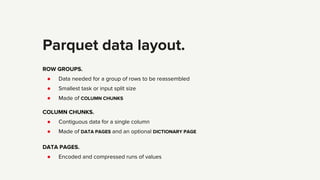
Parquet data layout.
ROW GROUPS.
● Data needed for a group of rows to be reassembled
● Smallest task or input split size
● Made of COLUMN CHUNKS
COLUMN CHUNKS.
● Contiguous data for a single column
● Made of DATA PAGES and an optional DICTIONARY PAGE
DATA PAGES.
● Encoded and compressed runs of values
Row groups.
... F
A B C D
a1 b1 c1 d1
... ... ... ...
aN bN cN dN
... ... ... ...
HDFS block
Column chunks and pages.
... F
dict
Read less data.
Columnar organization.
● Encoding: make the data smaller
● Column projection: read only the columns you need
Row group filtering.
● Use footer stats to eliminate row groups
● Use dictionary pages to eliminate row groups
Page filtering.
● Use page stats to eliminate pages
Basics.
Setup.
Parquet writes:
● Version 1.8.1 or later – includes fix for incorrect statistics, PARQUET-251
● 1.9.0 due in October
Reads:
● Presto: Used 0.139
● Spark: Used version 1.6.1 reading from Hive
● Pig: Used parquet-pig 1.9.0 for predicate push-down
Pig configuration.
-- enable pushdown/filtering
set parquet.pig.predicate.pushdown.enable true;
-- enables stats and dictionary filtering
set parquet.filter.statistics.enabled true;
set parquet.filter.dictionary.enabled true;
Spark configuration.
// turn on Parquet push-down, stats filtering, and dictionary filtering
sqlContext.setConf("parquet.filter.statistics.enabled", "true")
sqlContext.setConf("parquet.filter.dictionary.enabled", "true")
sqlContext.setConf("spark.sql.parquet.filterPushdown", "true")
// use the non-Hive read path
sqlContext.setConf("spark.sql.hive.convertMetastoreParquet", "true")
// turn off schema merging, which turns off push-down
sqlContext.setConf("spark.sql.parquet.mergeSchema", "false")
sqlContext.setConf("spark.sql.hive.convertMetastoreParquet.mergeSchema",
"false")
Writing the data.
Spark:
sqlContext
.table("raw_metrics")
.write.insertInto("metrics")
Pig:
metricsData = LOAD 'raw_metrics'
USING SomeLoader;
STORE metricsData INTO 'metrics'
USING ParquetStorer;
Writing the data.
Spark:
sqlContext
.table("raw_metrics")
.write.insertInto("metrics")
Pig:
metricsData = LOAD 'raw_metrics'
USING SomeLoader;
STORE metricsData INTO 'metrics'
USING ParquetStorer;
OutOfMemoryError
or
ParquetRuntimeException
Writing too many files.
Data doesn’t match partitioning.
● Tasks write a file per partition
Symptoms:
● OutOfMemoryError
● ParquetRuntimeException: New Memory allocation 1047284 bytes is smaller than the
minimum allocation size of 1048576 bytes.
● Successfully write lots of small files, slow split planning
Task 1 part=1/
part=2/
Task 2 part=3/
part=4/
Task 3 part=.../
Account for partitioning.
Spark.
sqlContext
.table("raw_metrics")
.sort("day", "cluster")
.write.insertInto("metrics")
Pig.
metrics = LOAD 'raw_metrics'
USING SomeLoader;
metricsSorted = ORDER metrics
BY day, cluster;
STORE metricsSorted INTO 'metrics'
USING ParquetStorer;
Filter to select partitions.
Spark.
val partition = sqlContext
.table("metrics")
.filter("day = 20160929")
.filter("cluster = 'emr_adhoc'")
Pig.
metricsData = LOAD 'metrics'
USING ParquetLoader;
partition = FILTER metricsData BY
date == 20160929 AND
cluster == 'emr_adhoc'
Stats filters.
Sample query.
Spark.
val low_cpu_count = partition
.filter("name =
'system.cpu.utilization'")
.filter("value < 0.8")
.count()
Pig.
low_cpu = FILTER partition BY
name == 'system.cpu.utilization' AND
value < 0.8;
low_cpu_count = FOREACH
(GROUP low_cpu ALL) GENERATE
COUNT(name);
My job was 5 minutes faster!
Did it work?
● Success metrics: S3 bytes read, CPU time spent
S3N: Number of bytes read: 1,366,228,942,336
CPU time spent (ms): 280,218,780
● Filter didn’t work. Bytes read shows the entire partition was read.
● What happened?
Inspect the file.
● Stats show what happened:
Row group 0: count: 84756 845.42 B records
type encodings count avg size nulls min / max
name BINARY G _ 84756 61.52 B 0 "A..." / "z..."
...
Row group 1: count: 84756 845.42 B records
type encodings count avg size nulls min / max
name BINARY G _ 85579 61.52 B 0 "A..." / "z..."
● Every row group matched the query
Add query columns to the sort.
Spark.
sqlContext
.table("raw_metrics")
.sort("day", "cluster", "name")
.write.insertInto("metrics")
Pig.
metrics = LOAD 'raw_metrics'
USING SomeLoader;
metricsSorted = ORDER metrics
BY day, cluster, name;
STORE metricsSorted INTO 'metrics'
USING ParquetStorer;
Inspect the file, again.
● Stats are fixed:
Row group 0: count: 84756 845.42 B records
type encodings count avg size nulls min / max
name BINARY G _ 84756 61.52 B 0 "A..." / "F..."
...
Row group 1: count: 85579 845.42 B records
type encodings count avg size nulls min / max
name BINARY G _ 85579 61.52 B 0 "F..." / "N..."
...
Row group 2: count: 86712 845.42 B records
type encodings count avg size nulls min / max
name BINARY G _ 86712 61.52 B 0 "N..." / "b..."
Dictionary filters.
Dictionary filtering.
Dictionary is a compact list of all the values.
● Search term missing? Skip the row group
● Like a bloom filter without false positives
When dictionary filtering helps:
● When a column is sorted in each file, not globally sorted – one row group matches
● When filtering an unsorted column
dict dict dict
Dictionary filtering overhead.
Read overhead.
● Extra seeks
● Extra page reads
Not a problem in practice.
● Reading both dictionary and row group resulted in < 1% penalty
● Stats filtering prevents unnecessary dictionary reads
dict dict dict
Works out of the box, right?
Nope.
● Only works when columns are completely dictionary-encoded
● Plain-encoded pages can contain any value, dictionary is no help
● All pages in a chunk must use the dictionary
Dictionary fallback rules:
● If dictionary + references > plain encoding, fall back
● If dictionary size is too large, fall back (default threshold: 1 MB)
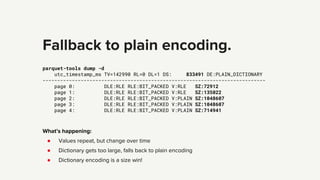
Fallback to plain encoding.
parquet-tools dump -d
utc_timestamp_ms TV=142990 RL=0 DL=1 DS: 833491 DE:PLAIN_DICTIONARY
----------------------------------------------------------------------------
page 0: DLE:RLE RLE:BIT_PACKED V:RLE SZ:72912
page 1: DLE:RLE RLE:BIT_PACKED V:RLE SZ:135022
page 2: DLE:RLE RLE:BIT_PACKED V:PLAIN SZ:1048607
page 3: DLE:RLE RLE:BIT_PACKED V:PLAIN SZ:1048607
page 4: DLE:RLE RLE:BIT_PACKED V:PLAIN SZ:714941
What’s happening:
● Values repeat, but change over time
● Dictionary gets too large, falls back to plain encoding
● Dictionary encoding is a size win!
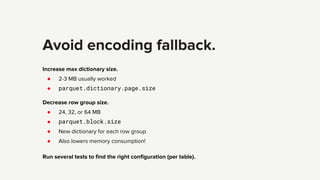
Avoid encoding fallback.
Increase max dictionary size.
● 2-3 MB usually worked
● parquet.dictionary.page.size
Decrease row group size.
● 24, 32, or 64 MB
● parquet.block.size
● New dictionary for each row group
● Also lowers memory consumption!
Run several tests to find the right configuration (per table).
Row group size.
Other reasons to decrease row group size:
● Reduce memory consumption – but not to avoid write-side OOM
● Increase number of tasks / parallelism
Results!
Results (from Pig).
CPU and wall time dropped.
● Initial: CPU Time: 280,218,780 ms Wall Time: 15m 27s
● Filtered: CPU Time: 120,275,590 ms Wall Time: 9m 51s
● Final: CPU Time: 9,593,700 ms Wall Time: 6m 47s
Bytes read is much better.
● Initial: S3 bytes read: 1,366,228,942,336 (1.24 TB)
● Filtered: S3 bytes read: 49,195,996,736 (45.82 GB)
Filtered vs. final time.
Row group filtering is parallel.
● Split planning is independent of stats (or else is a bottleneck)
● Lots of very small tasks: read footer, read dictionary, stop processing
Combine splits in Pig/MR for better time.
● 1 GB splits tend to work well
Other work.
Format version 2.
What’s included:
● New encodings: delta-integer, prefix-binary
● New page format to enable page-level filtering
New encodings didn’t help with Netflix data.
● Delta-integer didn’t help significantly, even with timestamps (high overhead?)
● Not large enough prefixes in URL and JSON data
Page filtering isn’t implemented (yet).
Brotli compression.
● New compression library, from Google
● Based on LZ77, with compatible license
Faster compression, smaller files, or both.
● brotli-5: 19.7% smaller, 2.7% slower – 1 day of data from Kafka
● brotli-4: 14.8% smaller, 12.5% faster – 1 hour, 4 largest Parquet tables
● brotli-1: 8.1% smaller, 28.3% faster – JSON-heavy dataset
Brotli compression. (continued)
Future work.
Future work.
Short term:
● Release Parquet 1.9.0
● Test Zstd compression
● Convert embedded JSON to Avro – good preliminary results
Long-term:
● New encodings: Zig-zag RLE, patching, and floating point decomposition
● Page-level filtering
Thank you!
Questions?
https://jobs.netflix.com/
rblue@netflix.com

Parquet performance tuning: the missing guide

  • 1.
    Parquet performance tuning: Themissing guide Ryan Blue Strata + Hadoop World NY 2016
  • 2.
    ● Big dataat Netflix ● Parquet format background ● Optimization basics ● Stats and dictionary filtering ● Format 2 and compression ● Future work Contents.
  • 3.
    Big data atNetflix.
  • 4.
    Big data atNetflix. 40+ PB DW Read 3PB Write 300TB600B Events
  • 5.
  • 6.
    Metrics dataset. Based onAtlas, Netflix’s telemetry platform. ● Performance monitoring backend and UI ● http://techblog.netflix.com/2014/12/introducing-atlas-netflixs-primary.html Example metrics data. ● Partitioned by day, and cluster ● Columns include metric time, name, value, and host ● Measurements for each minute are stored in a Parquet table
  • 7.
  • 8.
    Parquet data layout. ROWGROUPS. ● Data needed for a group of rows to be reassembled ● Smallest task or input split size ● Made of COLUMN CHUNKS COLUMN CHUNKS. ● Contiguous data for a single column ● Made of DATA PAGES and an optional DICTIONARY PAGE DATA PAGES. ● Encoded and compressed runs of values
  • 9.
    Row groups. ... F AB C D a1 b1 c1 d1 ... ... ... ... aN bN cN dN ... ... ... ... HDFS block
  • 10.
    Column chunks andpages. ... F dict
  • 11.
    Read less data. Columnarorganization. ● Encoding: make the data smaller ● Column projection: read only the columns you need Row group filtering. ● Use footer stats to eliminate row groups ● Use dictionary pages to eliminate row groups Page filtering. ● Use page stats to eliminate pages
  • 12.
  • 13.
    Setup. Parquet writes: ● Version1.8.1 or later – includes fix for incorrect statistics, PARQUET-251 ● 1.9.0 due in October Reads: ● Presto: Used 0.139 ● Spark: Used version 1.6.1 reading from Hive ● Pig: Used parquet-pig 1.9.0 for predicate push-down
  • 14.
    Pig configuration. -- enablepushdown/filtering set parquet.pig.predicate.pushdown.enable true; -- enables stats and dictionary filtering set parquet.filter.statistics.enabled true; set parquet.filter.dictionary.enabled true;
  • 15.
    Spark configuration. // turnon Parquet push-down, stats filtering, and dictionary filtering sqlContext.setConf("parquet.filter.statistics.enabled", "true") sqlContext.setConf("parquet.filter.dictionary.enabled", "true") sqlContext.setConf("spark.sql.parquet.filterPushdown", "true") // use the non-Hive read path sqlContext.setConf("spark.sql.hive.convertMetastoreParquet", "true") // turn off schema merging, which turns off push-down sqlContext.setConf("spark.sql.parquet.mergeSchema", "false") sqlContext.setConf("spark.sql.hive.convertMetastoreParquet.mergeSchema", "false")
  • 16.
    Writing the data. Spark: sqlContext .table("raw_metrics") .write.insertInto("metrics") Pig: metricsData= LOAD 'raw_metrics' USING SomeLoader; STORE metricsData INTO 'metrics' USING ParquetStorer;
  • 17.
    Writing the data. Spark: sqlContext .table("raw_metrics") .write.insertInto("metrics") Pig: metricsData= LOAD 'raw_metrics' USING SomeLoader; STORE metricsData INTO 'metrics' USING ParquetStorer; OutOfMemoryError or ParquetRuntimeException
  • 18.
    Writing too manyfiles. Data doesn’t match partitioning. ● Tasks write a file per partition Symptoms: ● OutOfMemoryError ● ParquetRuntimeException: New Memory allocation 1047284 bytes is smaller than the minimum allocation size of 1048576 bytes. ● Successfully write lots of small files, slow split planning Task 1 part=1/ part=2/ Task 2 part=3/ part=4/ Task 3 part=.../
  • 19.
    Account for partitioning. Spark. sqlContext .table("raw_metrics") .sort("day","cluster") .write.insertInto("metrics") Pig. metrics = LOAD 'raw_metrics' USING SomeLoader; metricsSorted = ORDER metrics BY day, cluster; STORE metricsSorted INTO 'metrics' USING ParquetStorer;
  • 20.
    Filter to selectpartitions. Spark. val partition = sqlContext .table("metrics") .filter("day = 20160929") .filter("cluster = 'emr_adhoc'") Pig. metricsData = LOAD 'metrics' USING ParquetLoader; partition = FILTER metricsData BY date == 20160929 AND cluster == 'emr_adhoc'
  • 21.
  • 22.
    Sample query. Spark. val low_cpu_count= partition .filter("name = 'system.cpu.utilization'") .filter("value < 0.8") .count() Pig. low_cpu = FILTER partition BY name == 'system.cpu.utilization' AND value < 0.8; low_cpu_count = FOREACH (GROUP low_cpu ALL) GENERATE COUNT(name);
  • 23.
    My job was5 minutes faster!
  • 24.
    Did it work? ●Success metrics: S3 bytes read, CPU time spent S3N: Number of bytes read: 1,366,228,942,336 CPU time spent (ms): 280,218,780 ● Filter didn’t work. Bytes read shows the entire partition was read. ● What happened?
  • 25.
    Inspect the file. ●Stats show what happened: Row group 0: count: 84756 845.42 B records type encodings count avg size nulls min / max name BINARY G _ 84756 61.52 B 0 "A..." / "z..." ... Row group 1: count: 84756 845.42 B records type encodings count avg size nulls min / max name BINARY G _ 85579 61.52 B 0 "A..." / "z..." ● Every row group matched the query
  • 26.
    Add query columnsto the sort. Spark. sqlContext .table("raw_metrics") .sort("day", "cluster", "name") .write.insertInto("metrics") Pig. metrics = LOAD 'raw_metrics' USING SomeLoader; metricsSorted = ORDER metrics BY day, cluster, name; STORE metricsSorted INTO 'metrics' USING ParquetStorer;
  • 27.
    Inspect the file,again. ● Stats are fixed: Row group 0: count: 84756 845.42 B records type encodings count avg size nulls min / max name BINARY G _ 84756 61.52 B 0 "A..." / "F..." ... Row group 1: count: 85579 845.42 B records type encodings count avg size nulls min / max name BINARY G _ 85579 61.52 B 0 "F..." / "N..." ... Row group 2: count: 86712 845.42 B records type encodings count avg size nulls min / max name BINARY G _ 86712 61.52 B 0 "N..." / "b..."
  • 28.
  • 29.
    Dictionary filtering. Dictionary isa compact list of all the values. ● Search term missing? Skip the row group ● Like a bloom filter without false positives When dictionary filtering helps: ● When a column is sorted in each file, not globally sorted – one row group matches ● When filtering an unsorted column dict dict dict
  • 30.
    Dictionary filtering overhead. Readoverhead. ● Extra seeks ● Extra page reads Not a problem in practice. ● Reading both dictionary and row group resulted in < 1% penalty ● Stats filtering prevents unnecessary dictionary reads dict dict dict
  • 31.
    Works out ofthe box, right? Nope. ● Only works when columns are completely dictionary-encoded ● Plain-encoded pages can contain any value, dictionary is no help ● All pages in a chunk must use the dictionary Dictionary fallback rules: ● If dictionary + references > plain encoding, fall back ● If dictionary size is too large, fall back (default threshold: 1 MB)
  • 32.
    Fallback to plainencoding. parquet-tools dump -d utc_timestamp_ms TV=142990 RL=0 DL=1 DS: 833491 DE:PLAIN_DICTIONARY ---------------------------------------------------------------------------- page 0: DLE:RLE RLE:BIT_PACKED V:RLE SZ:72912 page 1: DLE:RLE RLE:BIT_PACKED V:RLE SZ:135022 page 2: DLE:RLE RLE:BIT_PACKED V:PLAIN SZ:1048607 page 3: DLE:RLE RLE:BIT_PACKED V:PLAIN SZ:1048607 page 4: DLE:RLE RLE:BIT_PACKED V:PLAIN SZ:714941 What’s happening: ● Values repeat, but change over time ● Dictionary gets too large, falls back to plain encoding ● Dictionary encoding is a size win!
  • 33.
    Avoid encoding fallback. Increasemax dictionary size. ● 2-3 MB usually worked ● parquet.dictionary.page.size Decrease row group size. ● 24, 32, or 64 MB ● parquet.block.size ● New dictionary for each row group ● Also lowers memory consumption! Run several tests to find the right configuration (per table).
  • 34.
    Row group size. Otherreasons to decrease row group size: ● Reduce memory consumption – but not to avoid write-side OOM ● Increase number of tasks / parallelism
  • 35.
  • 36.
    Results (from Pig). CPUand wall time dropped. ● Initial: CPU Time: 280,218,780 ms Wall Time: 15m 27s ● Filtered: CPU Time: 120,275,590 ms Wall Time: 9m 51s ● Final: CPU Time: 9,593,700 ms Wall Time: 6m 47s Bytes read is much better. ● Initial: S3 bytes read: 1,366,228,942,336 (1.24 TB) ● Filtered: S3 bytes read: 49,195,996,736 (45.82 GB)
  • 37.
    Filtered vs. finaltime. Row group filtering is parallel. ● Split planning is independent of stats (or else is a bottleneck) ● Lots of very small tasks: read footer, read dictionary, stop processing Combine splits in Pig/MR for better time. ● 1 GB splits tend to work well
  • 38.
  • 39.
    Format version 2. What’sincluded: ● New encodings: delta-integer, prefix-binary ● New page format to enable page-level filtering New encodings didn’t help with Netflix data. ● Delta-integer didn’t help significantly, even with timestamps (high overhead?) ● Not large enough prefixes in URL and JSON data Page filtering isn’t implemented (yet).
  • 40.
    Brotli compression. ● Newcompression library, from Google ● Based on LZ77, with compatible license Faster compression, smaller files, or both. ● brotli-5: 19.7% smaller, 2.7% slower – 1 day of data from Kafka ● brotli-4: 14.8% smaller, 12.5% faster – 1 hour, 4 largest Parquet tables ● brotli-1: 8.1% smaller, 28.3% faster – JSON-heavy dataset
  • 41.
  • 42.
  • 43.
    Future work. Short term: ●Release Parquet 1.9.0 ● Test Zstd compression ● Convert embedded JSON to Avro – good preliminary results Long-term: ● New encodings: Zig-zag RLE, patching, and floating point decomposition ● Page-level filtering
  • 44.