
How to Write the Methodology Chapter of a Dissertation or Thesis
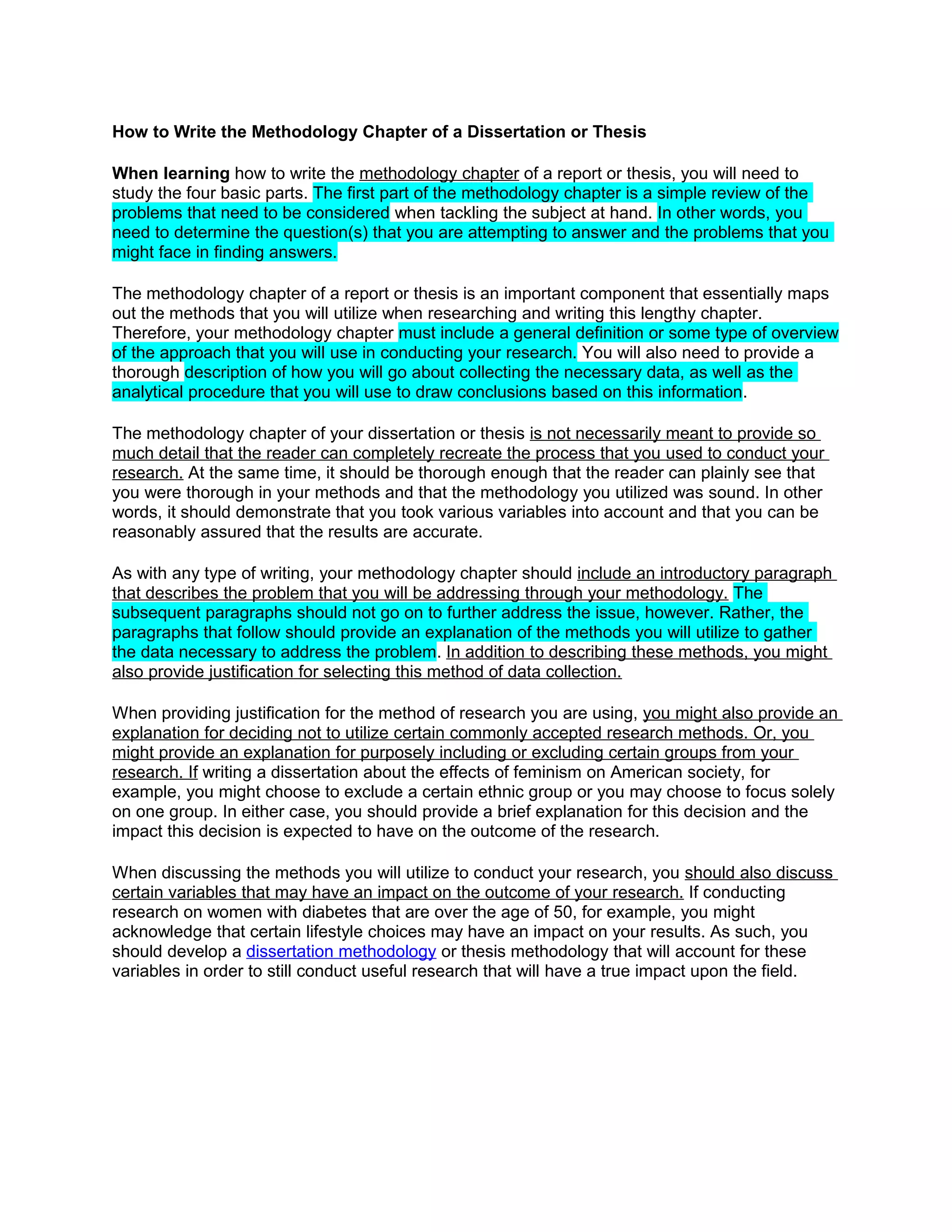
When learning how to write the methodology chapter of a report or thesis, you will need to
study the four basic parts. The first part of the methodology chapter is a simple review of the
problems that need to be considered when tackling the subject at hand. In other words, you
need to determine the question(s) that you are attempting to answer and the problems that you
might face in finding answers.
The methodology chapter of a report or thesis is an important component that essentially maps
out the methods that you will utilize when researching and writing this lengthy chapter.
Therefore, your methodology chapter must include a general definition or some type of overview
of the approach that you will use in conducting your research. You will also need to provide a
thorough description of how you will go about collecting the necessary data, as well as the
analytical procedure that you will use to draw conclusions based on this information.
The methodology chapter of your dissertation or thesis is not necessarily meant to provide so
much detail that the reader can completely recreate the process that you used to conduct your
research. At the same time, it should be thorough enough that the reader can plainly see that
you were thorough in your methods and that the methodology you utilized was sound. In other
words, it should demonstrate that you took various variables into account and that you can be
reasonably assured that the results are accurate.
As with any type of writing, your methodology chapter should include an introductory paragraph
that describes the problem that you will be addressing through your methodology. The
subsequent paragraphs should not go on to further address the issue, however. Rather, the
paragraphs that follow should provide an explanation of the methods you will utilize to gather
the data necessary to address the problem. In addition to describing these methods, you might
also provide justification for selecting this method of data collection.
When providing justification for the method of research you are using, you might also provide an
explanation for deciding not to utilize certain commonly accepted research methods. Or, you
might provide an explanation for purposely including or excluding certain groups from your
research. If writing a dissertation about the effects of feminism on American society, for
example, you might choose to exclude a certain ethnic group or you may choose to focus solely
on one group. In either case, you should provide a brief explanation for this decision and the
impact this decision is expected to have on the outcome of the research.
When discussing the methods you will utilize to conduct your research, you should also discuss
certain variables that may have an impact on the outcome of your research. If conducting
research on women with diabetes that are over the age of 50, for example, you might
acknowledge that certain lifestyle choices may have an impact on your results. As such, you
should develop a dissertation methodology or thesis methodology that will account for these
variables in order to still conduct useful research that will have a true impact upon the field.
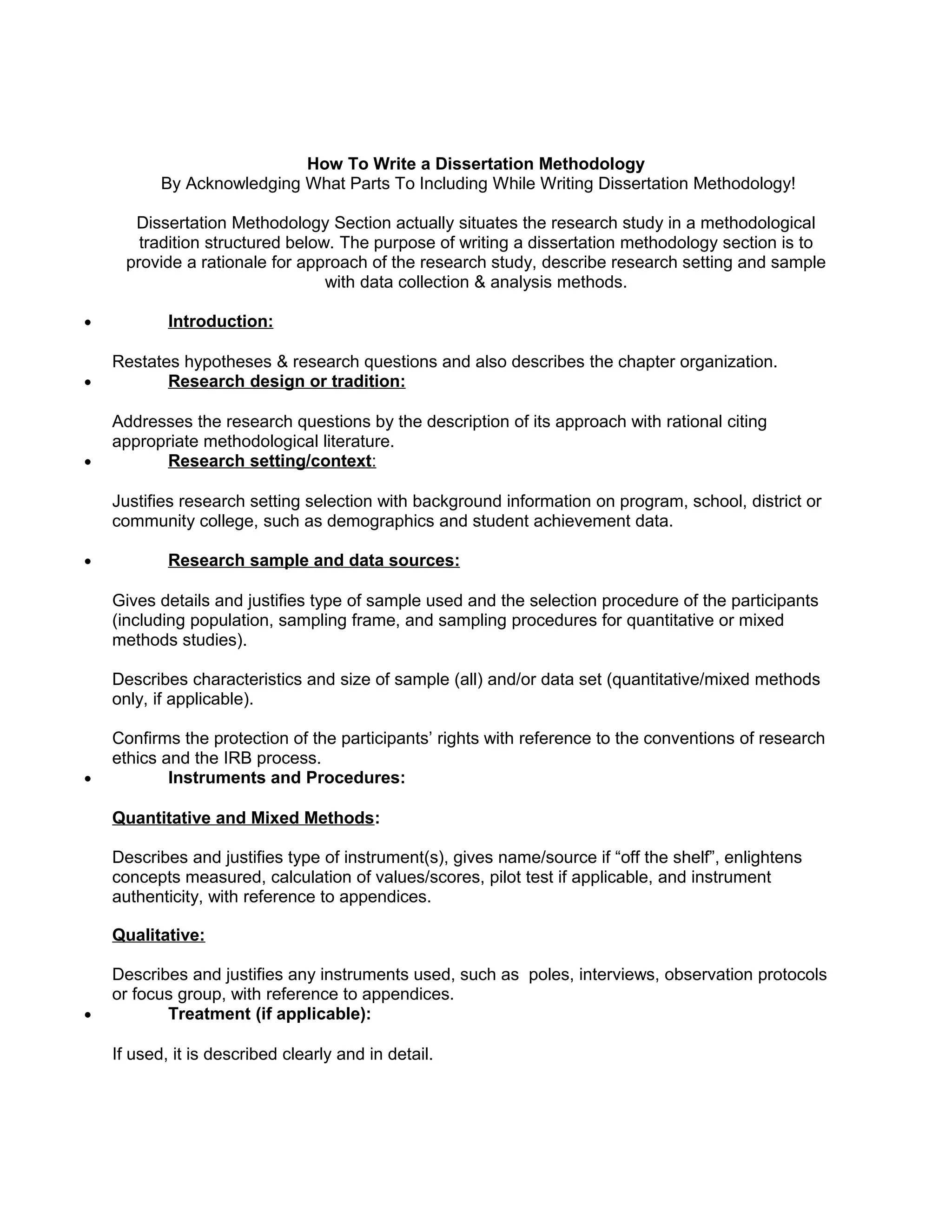
How To Write a Dissertation Methodology
By Acknowledging What Parts To Including While Writing Dissertation Methodology!
Dissertation Methodology Section actually situates the research study in a methodological
tradition structured below. The purpose of writing a dissertation methodology section is to
provide a rationale for approach of the research study, describe research setting and sample
with data collection & analysis methods.
• Introduction:
Restates hypotheses & research questions and also describes the chapter organization.
• Research design or tradition:
Addresses the research questions by the description of its approach with rational citing
appropriate methodological literature.
• Research setting/context:
Justifies research setting selection with background information on program, school, district or
community college, such as demographics and student achievement data.
• Research sample and data sources:
Gives details and justifies type of sample used and the selection procedure of the participants
(including population, sampling frame, and sampling procedures for quantitative or mixed
methods studies).
Describes characteristics and size of sample (all) and/or data set (quantitative/mixed methods
only, if applicable).
Confirms the protection of the participants’ rights with reference to the conventions of research
ethics and the IRB process.
• Instruments and Procedures:
Quantitative and Mixed Methods:
Describes and justifies type of instrument(s), gives name/source if “off the shelf”, enlightens
concepts measured, calculation of values/scores, pilot test if applicable, and instrument
authenticity, with reference to appendices.
Qualitative:
Describes and justifies any instruments used, such as poles, interviews, observation protocols
or focus group, with reference to appendices.
• Treatment (if applicable):
If used, it is described clearly and in detail.
• Data collection:
Explains and justifies the methods and procedures of data collection that includes how, when,
where, and by whom data were collected.
• Data analysis:
Describes and justifies methods and statistical tools (if applicable) used for analysis. Discusses
measures taken to improve study validity. Summarizes outcomes of pilot studies, if applicable.
• Role of the Researcher:
Illustrates the role of researcher in planning and conducting the research study; makes clear,
rational and relevant researcher opinions, assumptions, beliefs, biases (if applicable).
• Summary
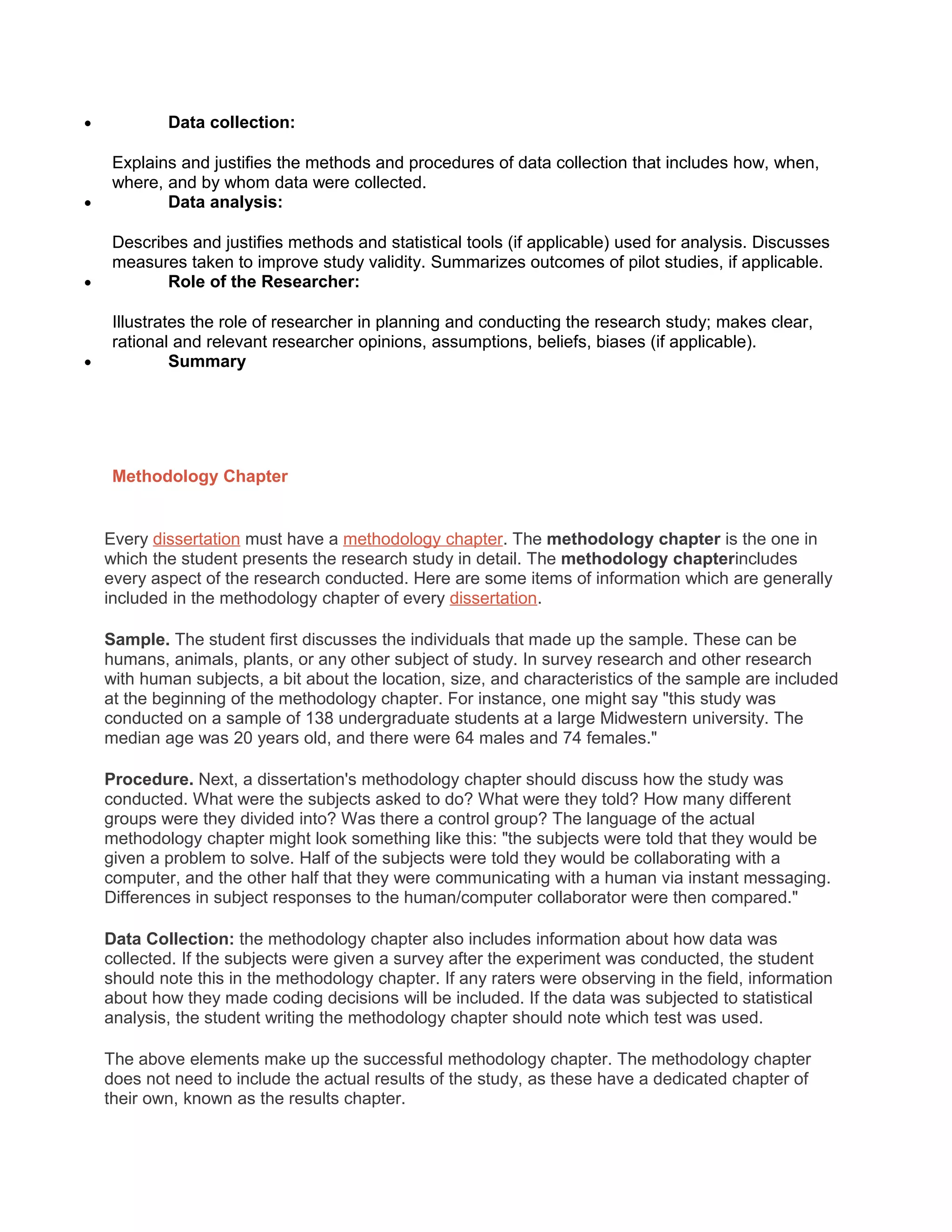
Methodology Chapter
Every dissertation must have a methodology chapter. The methodology chapter is the one in
which the student presents the research study in detail. The methodology chapterincludes
every aspect of the research conducted. Here are some items of information which are generally
included in the methodology chapter of every dissertation.
Sample. The student first discusses the individuals that made up the sample. These can be
humans, animals, plants, or any other subject of study. In survey research and other research
with human subjects, a bit about the location, size, and characteristics of the sample are included
at the beginning of the methodology chapter. For instance, one might say "this study was
conducted on a sample of 138 undergraduate students at a large Midwestern university. The
median age was 20 years old, and there were 64 males and 74 females."
Procedure. Next, a dissertation's methodology chapter should discuss how the study was
conducted. What were the subjects asked to do? What were they told? How many different
groups were they divided into? Was there a control group? The language of the actual
methodology chapter might look something like this: "the subjects were told that they would be
given a problem to solve. Half of the subjects were told they would be collaborating with a
computer, and the other half that they were communicating with a human via instant messaging.
Differences in subject responses to the human/computer collaborator were then compared."
Data Collection: the methodology chapter also includes information about how data was
collected. If the subjects were given a survey after the experiment was conducted, the student
should note this in the methodology chapter. If any raters were observing in the field, information
about how they made coding decisions will be included. If the data was subjected to statistical
analysis, the student writing the methodology chapter should note which test was used.
The above elements make up the successful methodology chapter. The methodology chapter
does not need to include the actual results of the study, as these have a dedicated chapter of
their own, known as the results chapter.
How to write the methodology chapter of a dissertation or thesis

How to write the methodology chapter of a dissertation or thesis

  • 1.
    How to Writethe Methodology Chapter of a Dissertation or Thesis When learning how to write the methodology chapter of a report or thesis, you will need to study the four basic parts. The first part of the methodology chapter is a simple review of the problems that need to be considered when tackling the subject at hand. In other words, you need to determine the question(s) that you are attempting to answer and the problems that you might face in finding answers. The methodology chapter of a report or thesis is an important component that essentially maps out the methods that you will utilize when researching and writing this lengthy chapter. Therefore, your methodology chapter must include a general definition or some type of overview of the approach that you will use in conducting your research. You will also need to provide a thorough description of how you will go about collecting the necessary data, as well as the analytical procedure that you will use to draw conclusions based on this information. The methodology chapter of your dissertation or thesis is not necessarily meant to provide so much detail that the reader can completely recreate the process that you used to conduct your research. At the same time, it should be thorough enough that the reader can plainly see that you were thorough in your methods and that the methodology you utilized was sound. In other words, it should demonstrate that you took various variables into account and that you can be reasonably assured that the results are accurate. As with any type of writing, your methodology chapter should include an introductory paragraph that describes the problem that you will be addressing through your methodology. The subsequent paragraphs should not go on to further address the issue, however. Rather, the paragraphs that follow should provide an explanation of the methods you will utilize to gather the data necessary to address the problem. In addition to describing these methods, you might also provide justification for selecting this method of data collection. When providing justification for the method of research you are using, you might also provide an explanation for deciding not to utilize certain commonly accepted research methods. Or, you might provide an explanation for purposely including or excluding certain groups from your research. If writing a dissertation about the effects of feminism on American society, for example, you might choose to exclude a certain ethnic group or you may choose to focus solely on one group. In either case, you should provide a brief explanation for this decision and the impact this decision is expected to have on the outcome of the research. When discussing the methods you will utilize to conduct your research, you should also discuss certain variables that may have an impact on the outcome of your research. If conducting research on women with diabetes that are over the age of 50, for example, you might acknowledge that certain lifestyle choices may have an impact on your results. As such, you should develop a dissertation methodology or thesis methodology that will account for these variables in order to still conduct useful research that will have a true impact upon the field.
  • 2.
    How To Writea Dissertation Methodology By Acknowledging What Parts To Including While Writing Dissertation Methodology! Dissertation Methodology Section actually situates the research study in a methodological tradition structured below. The purpose of writing a dissertation methodology section is to provide a rationale for approach of the research study, describe research setting and sample with data collection & analysis methods. • Introduction: Restates hypotheses & research questions and also describes the chapter organization. • Research design or tradition: Addresses the research questions by the description of its approach with rational citing appropriate methodological literature. • Research setting/context: Justifies research setting selection with background information on program, school, district or community college, such as demographics and student achievement data. • Research sample and data sources: Gives details and justifies type of sample used and the selection procedure of the participants (including population, sampling frame, and sampling procedures for quantitative or mixed methods studies). Describes characteristics and size of sample (all) and/or data set (quantitative/mixed methods only, if applicable). Confirms the protection of the participants’ rights with reference to the conventions of research ethics and the IRB process. • Instruments and Procedures: Quantitative and Mixed Methods: Describes and justifies type of instrument(s), gives name/source if “off the shelf”, enlightens concepts measured, calculation of values/scores, pilot test if applicable, and instrument authenticity, with reference to appendices. Qualitative: Describes and justifies any instruments used, such as poles, interviews, observation protocols or focus group, with reference to appendices. • Treatment (if applicable): If used, it is described clearly and in detail.
  • 3.
    • Data collection: Explainsand justifies the methods and procedures of data collection that includes how, when, where, and by whom data were collected. • Data analysis: Describes and justifies methods and statistical tools (if applicable) used for analysis. Discusses measures taken to improve study validity. Summarizes outcomes of pilot studies, if applicable. • Role of the Researcher: Illustrates the role of researcher in planning and conducting the research study; makes clear, rational and relevant researcher opinions, assumptions, beliefs, biases (if applicable). • Summary Methodology Chapter Every dissertation must have a methodology chapter. The methodology chapter is the one in which the student presents the research study in detail. The methodology chapterincludes every aspect of the research conducted. Here are some items of information which are generally included in the methodology chapter of every dissertation. Sample. The student first discusses the individuals that made up the sample. These can be humans, animals, plants, or any other subject of study. In survey research and other research with human subjects, a bit about the location, size, and characteristics of the sample are included at the beginning of the methodology chapter. For instance, one might say "this study was conducted on a sample of 138 undergraduate students at a large Midwestern university. The median age was 20 years old, and there were 64 males and 74 females." Procedure. Next, a dissertation's methodology chapter should discuss how the study was conducted. What were the subjects asked to do? What were they told? How many different groups were they divided into? Was there a control group? The language of the actual methodology chapter might look something like this: "the subjects were told that they would be given a problem to solve. Half of the subjects were told they would be collaborating with a computer, and the other half that they were communicating with a human via instant messaging. Differences in subject responses to the human/computer collaborator were then compared." Data Collection: the methodology chapter also includes information about how data was collected. If the subjects were given a survey after the experiment was conducted, the student should note this in the methodology chapter. If any raters were observing in the field, information about how they made coding decisions will be included. If the data was subjected to statistical analysis, the student writing the methodology chapter should note which test was used. The above elements make up the successful methodology chapter. The methodology chapter does not need to include the actual results of the study, as these have a dedicated chapter of their own, known as the results chapter.