11
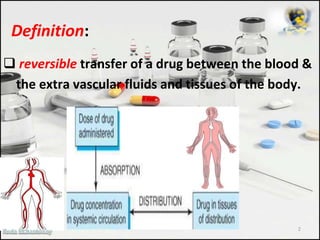
Definition:
 reversible transfer of a drug between the blood &
the extra vascular fluids and tissues of the body.
2
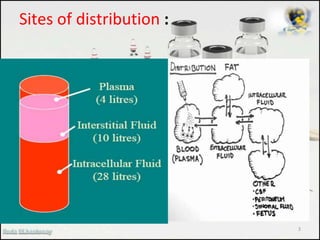
Sites of distribution :
3
volume of distribution (Vd):
Theoretical volume that would have to be
available for drug to disperse
 the amount of fluid in which the administered
drug is distributed
Expressed as: in Liters
4
Volume of distribution (VD)
 It is called as Apparent Volume because all parts
of the body equilibrated with the drug do not have
equal concentration
 Volume distribution of heparin 4L means?
It means heparin distributes about 4 liters of body fluid.
small volume of distribution?
1. Very large molecular weight.
2. Extensive plasma protein binding
5
Volume distribution of Aminoglycosides is 14 liter means?
This drug has a low molecular weight but is hydrophilic.
It distribute into (plasma water + interstitial fluid) =extracellular fluid
(14 liters)
 ethanol has high volume of distribution
Ethanol has a low molecular weight and is hydrophobic
so can it move into the Plasma + Interistitium + cell
6
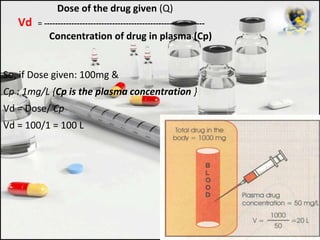
Dose of the drug given (Q)
Vd = -----------------------------------------------------------
Concentration of drug in plasma (Cp)
So, if Dose given: 100mg &
Cp : 1mg/L {Cp is the plasma concentration }
Vd = Dose/ Cp
Vd = 100/1 = 100 L
7
8
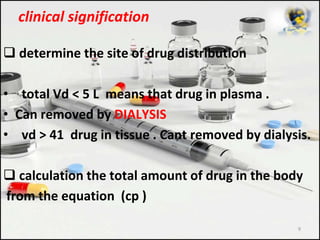
clinical signification
 determine the site of drug distribution
• total Vd < 5 L means that drug in plasma .
• Can removed by DIALYSIS
• vd > 41 drug in tissue . Cant removed by dialysis.
 calculation the total amount of drug in the body
from the equation (cp )
9
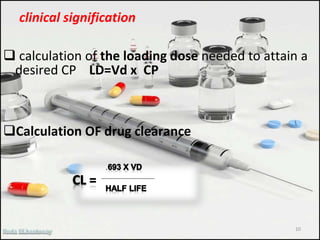
clinical signification
 calculation of the loading dose needed to attain a
desired CP LD=Vd x CP
Calculation OF drug clearance
10
.
THE DISTRIBUTION OF DRUG DEPENDS ON
 blood flow
Capillary permeability (BBB, placental barrier)
Drug factors (lipid solubility ionization _Molecular weight_ pKa of drug)
 Binding of drugs to macromolecules
11
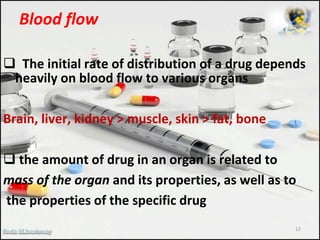
Blood flow
 The initial rate of distribution of a drug depends
heavily on blood flow to various organs
Brain, liver, kidney > muscle, skin > fat, bone
 the amount of drug in an organ is related to
mass of the organ and its properties, as well as to
the properties of the specific drug
12
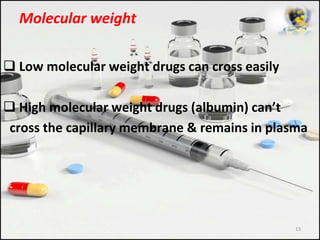
Molecular weight
 Low molecular weight drugs can cross easily
 High molecular weight drugs (albumin) can’t
cross the capillary membrane & remains in plasma
13
pKa of drug & pH of media
 More dissociation….less crossing of membranes
 Blood is slightly alkaline (pH 7.4)
 Acidic low pKa drugs will be ionized more & less
crossing of membranes
Basic low pKa drugs will be ionized less & more
crossing of membranes
14
Brain and CSF Penetration
 BBB is lipoidal and limits the entry of non-lipid soluble drugs
 Only lipid soluble unionized drugs penetrate and have action on the CNS
 inflammation of meanings of brain increases permeability of BBB
15
Placental Transfer
Only lipid soluble Drugs can penetrate
limitation of hydrophillic drugs
Placental P-gp serves as limiting factor But its an
incomplete barrier
some influx transporters operate
 Thalidomide
16
Plasma Protein Binding
 Free drug give the pharmacological effect
 Partially bounded
 Bounded to plasma protein ( ALBUMIN)
17
The clinical significant implications of PPB are:
Highly PPB drugs are largely restricted to the vascular
compartment and have lower Vd.
The PPB fraction is not available for action
 The drugs with high physicochemical affinity for plasma proteins
(e.g. aspirin, sulfonamides) can replace the other drugs( e.g warfarin)
18
Warfarin+ sulfonamide if given together?
If a sulfonamide is administered at same time, it will
displaces warfarin from albumin.
Leading to a rapid increase in the concentration of
free warfarin in plasma
This leads to Toxicity (bleeding)
.
19
The clinical significant implications of PPB are:
High degree of protein binding makes the drug long acting,
because bound fraction is not available for metabolism
.
Generally expressed plasma concentrations of the
drug refer to bound as well as free drug.
 In hypoalbuminemia, binding may be reduced and
high concentration of free drug may be attained
(e.g. phenytoin)
20
21

Drug Distribution

  • 1.
  • 2.
    Definition:  reversible transferof a drug between the blood & the extra vascular fluids and tissues of the body. 2
  • 3.
  • 4.
    volume of distribution(Vd): Theoretical volume that would have to be available for drug to disperse  the amount of fluid in which the administered drug is distributed Expressed as: in Liters 4
  • 5.
    Volume of distribution(VD)  It is called as Apparent Volume because all parts of the body equilibrated with the drug do not have equal concentration  Volume distribution of heparin 4L means? It means heparin distributes about 4 liters of body fluid. small volume of distribution? 1. Very large molecular weight. 2. Extensive plasma protein binding 5
  • 6.
    Volume distribution ofAminoglycosides is 14 liter means? This drug has a low molecular weight but is hydrophilic. It distribute into (plasma water + interstitial fluid) =extracellular fluid (14 liters)  ethanol has high volume of distribution Ethanol has a low molecular weight and is hydrophobic so can it move into the Plasma + Interistitium + cell 6
  • 7.
    Dose of thedrug given (Q) Vd = ----------------------------------------------------------- Concentration of drug in plasma (Cp) So, if Dose given: 100mg & Cp : 1mg/L {Cp is the plasma concentration } Vd = Dose/ Cp Vd = 100/1 = 100 L 7
  • 8.
  • 9.
    clinical signification  determinethe site of drug distribution • total Vd < 5 L means that drug in plasma . • Can removed by DIALYSIS • vd > 41 drug in tissue . Cant removed by dialysis.  calculation the total amount of drug in the body from the equation (cp ) 9
  • 10.
    clinical signification  calculationof the loading dose needed to attain a desired CP LD=Vd x CP Calculation OF drug clearance 10 .
  • 11.
    THE DISTRIBUTION OFDRUG DEPENDS ON  blood flow Capillary permeability (BBB, placental barrier) Drug factors (lipid solubility ionization _Molecular weight_ pKa of drug)  Binding of drugs to macromolecules 11
  • 12.
    Blood flow  Theinitial rate of distribution of a drug depends heavily on blood flow to various organs Brain, liver, kidney > muscle, skin > fat, bone  the amount of drug in an organ is related to mass of the organ and its properties, as well as to the properties of the specific drug 12
  • 13.
    Molecular weight  Lowmolecular weight drugs can cross easily  High molecular weight drugs (albumin) can’t cross the capillary membrane & remains in plasma 13
  • 14.
    pKa of drug& pH of media  More dissociation….less crossing of membranes  Blood is slightly alkaline (pH 7.4)  Acidic low pKa drugs will be ionized more & less crossing of membranes Basic low pKa drugs will be ionized less & more crossing of membranes 14
  • 15.
    Brain and CSFPenetration  BBB is lipoidal and limits the entry of non-lipid soluble drugs  Only lipid soluble unionized drugs penetrate and have action on the CNS  inflammation of meanings of brain increases permeability of BBB 15
  • 16.
    Placental Transfer Only lipidsoluble Drugs can penetrate limitation of hydrophillic drugs Placental P-gp serves as limiting factor But its an incomplete barrier some influx transporters operate  Thalidomide 16
  • 17.
    Plasma Protein Binding Free drug give the pharmacological effect  Partially bounded  Bounded to plasma protein ( ALBUMIN) 17
  • 18.
    The clinical significantimplications of PPB are: Highly PPB drugs are largely restricted to the vascular compartment and have lower Vd. The PPB fraction is not available for action  The drugs with high physicochemical affinity for plasma proteins (e.g. aspirin, sulfonamides) can replace the other drugs( e.g warfarin) 18
  • 19.
    Warfarin+ sulfonamide ifgiven together? If a sulfonamide is administered at same time, it will displaces warfarin from albumin. Leading to a rapid increase in the concentration of free warfarin in plasma This leads to Toxicity (bleeding) . 19
  • 20.
    The clinical significantimplications of PPB are: High degree of protein binding makes the drug long acting, because bound fraction is not available for metabolism . Generally expressed plasma concentrations of the drug refer to bound as well as free drug.  In hypoalbuminemia, binding may be reduced and high concentration of free drug may be attained (e.g. phenytoin) 20
  • 21.