PROCESS RECORDING TEMPLATE
1. COVER PAGE
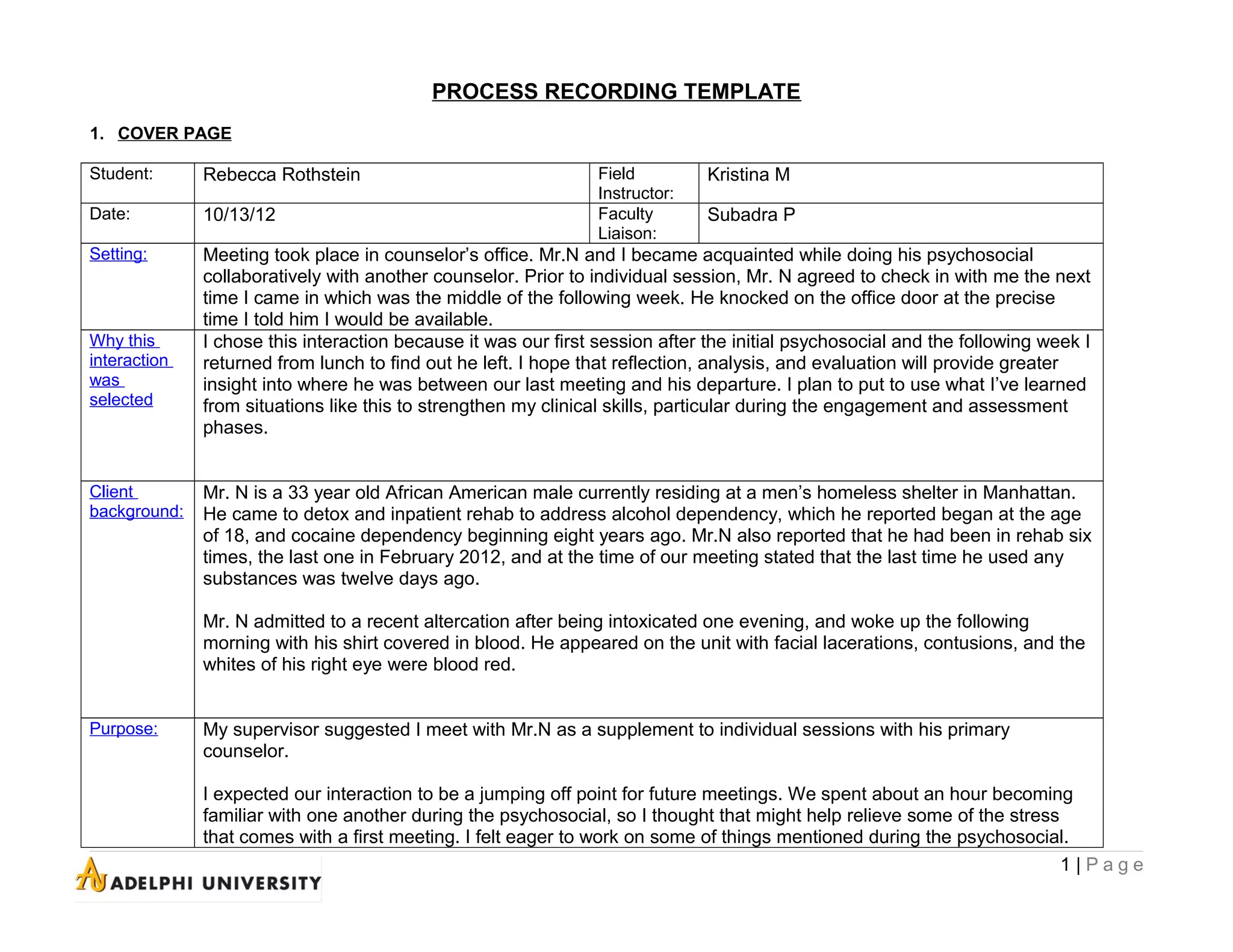
Student: Rebecca Rothstein Field
Instructor:
Kristina M
Date: 10/13/12 Faculty
Liaison:
Subadra P
Setting: Meeting took place in counselor’s office. Mr.N and I became acquainted while doing his psychosocial
collaboratively with another counselor. Prior to individual session, Mr. N agreed to check in with me the next
time I came in which was the middle of the following week. He knocked on the office door at the precise
time I told him I would be available.
Why this
interaction
was
selected
I chose this interaction because it was our first session after the initial psychosocial and the following week I
returned from lunch to find out he left. I hope that reflection, analysis, and evaluation will provide greater
insight into where he was between our last meeting and his departure. I plan to put to use what I’ve learned
from situations like this to strengthen my clinical skills, particular during the engagement and assessment
phases.
Client
background:
Mr. N is a 33 year old African American male currently residing at a men’s homeless shelter in Manhattan.
He came to detox and inpatient rehab to address alcohol dependency, which he reported began at the age
of 18, and cocaine dependency beginning eight years ago. Mr.N also reported that he had been in rehab six
times, the last one in February 2012, and at the time of our meeting stated that the last time he used any
substances was twelve days ago.
Mr. N admitted to a recent altercation after being intoxicated one evening, and woke up the following
morning with his shirt covered in blood. He appeared on the unit with facial lacerations, contusions, and the
whites of his right eye were blood red.
Purpose: My supervisor suggested I meet with Mr.N as a supplement to individual sessions with his primary
counselor.
I expected our interaction to be a jumping off point for future meetings. We spent about an hour becoming
familiar with one another during the psychosocial, so I thought that might help relieve some of the stress
that comes with a first meeting. I felt eager to work on some of things mentioned during the psychosocial.
1 | P a g e
My goal was to introduce myself and give him some background on me and my role in his recovery
process. I wanted to lay the groundwork for future meetings and interactions. In order to do so I needed to
build a repore with Mr.N and begin the process of establishing a therapeutic relationship.
2 | P a g e
2. INTERACTION:
A. Please record your conversation with the client/client group verbatim: (Record the contents of the interaction including verbal and
non-verbal communication between you and the client/client group. Use as much space as necessary).
I started the session by asking Mr. N how he was doing. He stated that he was a little depressed but was hanging in there. I wanted to
acknowledge his feelings by saying that I was sure that this process and what he appeared to be going through must not be easy. He
then nodded while looking at the floor and then at me.
I then went on to discuss the purpose of the meeting and my role at the agency and in his treatment process. I explained that I was a
social work intern and that I was there to learn and get new skills, just like him. I conveyed my desire to help him get the most of his
time on the unit. I told Mr. N that I would give him a safe place to share any thoughts or concerns and we would work together on them.
I then asked if he had anything he wanted to ask me and he said no.
At that point, I laid the groundwork for future meetings. I explained that I would just like to check in with him at least once a week and
told him the hours and days I would be there. I asked if that was okay with him and he appeared to smile a bit and said that it was okay.
I also wanted him to know that given the agency setting, we could connect in-between scheduled activities and he could knock on the
door and either we’d talk then or make arrangements for a better time that day.
He then leaned back in his chair and said he wanted to be honest with me about something. I told him I thought that was great. He
proceeded to tell me that he’s been through detox and other programs many times. Mr. N explained that in that time he’s seen many
social workers, counselors, and doctors. He said he would keep an open mind during any session with me but the truth is that he didn’t
trust people because they come in and out of his life all the time.
I replied by saying that I appreciated where he was coming from and asked him, “So basically for you am I just one of the many people
that have come and gone in your life?” and he just nodded. I explained to him that he was the boss and that I could offer suggestions or
anything else that to help, but what he does is up to him. How he uses his time here is up to him. Mr. N nodded a bit deeper.
I then asked him to tell me why he was on the unit. He said that he knew what would happen to him if he kept drinking. I asked him to
elaborate on that and he said that he knew if he kept drinking he was going to die. He went on to say that when he drinks he gets into
fights and when he’s sober he’s a nice guy. I told him I could I see that. He told me that he spoke to his father earlier in the day and
was warned that there are people in his neighborhood who are waiting for him to get drunk so they beat him or possibly kill him. I said
“Wow! So for you there are very real consequences for your drinking.” He replied that there were and that his father told him that they
were going to beat him with a brick or a pipe. I could see the look of terror and fear in his eyes. I asked him where he was planning on
going after treatment and he said he would be going back to a men’s shelter. I asked him if he would be safe there and he said yes.
He went on to say that he really didn’t like these shelters or three-quarter houses. I inquired about where he would like to be and he
said that ten years ago he had an apartment in Poughkipsie and he really liked it there. He tried to get housing in New York City but
said that when various landlords saw him they turned him down. Mr. N took a deep breath and it was apparent to me that he held on to
these feelings of rejection. I acknowledged how unfortunate it is that there is so much discrimination out there, and that as an African-
3 | P a g e
American man I’m sure that wasn’t the first time he had gone through similar experiences. He added that he was also a black man with
a criminal record. I nodded at him to acknowledge his feelings.
I asked him if he was used to dealing with his feelings on his own. He had mentioned being in contact with his father and siblings but
did not want them to participate in the family program or in his recovery for that matter. He said that he was because his family didn’t
want to hear it any more. I asked him if he ever thought about writing his feelings down in a journal. Mr. N told me that he had a bad
experience in a shelter where someone stole his journal and now he refuses to do it again. The last person he trusted was his foster
mother and she died two years ago. He said he put her through so much and she never gave up on him. Mr. N’s face lit up as he talked
about her smile and how even when she was in hospice on her deathbed she still had that smile.
Mr. N started to look a bit worn out, so I asked him if we could meet again and took some more. I recalled some goals he had
mentioned during the psychosocial such as being a master barber and having a wife and dog. I asked him if we could discuss that as
well as working through some of the feelings he expressed about his alcohol and drug use. Particularly the some of the hardships he
experienced in conjunction with his addiction. He agreed and I asked him how he felt about our discussion and how I stacked up in
relation to the many professionals he had compared me to. He smiled and said the session was good and that it felt good to get things
off his chest. I reminded him that’s what I was there for and he could come to me with anything and we would work through it. We
shook hands and he left.
B. What were your responses? (Thoughts/feelings/reactions):
The more Mr. N filled me in on the details of his life, I felt the pain of his experiences. In his eyes, especially, I saw some joy when he
reflected on some aspects of his life but mostly I saw pain, anger, and fear. I wanted so badly to help him and do something to ease his
burden. I saw a sweet guy who did not know how to feel his emotions. When he told me what he remembered of his recent altercation, it
pulled at my heart strings. He remembered purchasing the alcohol and then he woke up the next morning covered in blood. He had this
look of sheer terror in his face and all I could do was imagine how scary it must be for him. I was also mortified by the situation. As we
talked, I saw a man trying to understand himself and his choices. Mr. N kept repeating that he’s a nice guy when he’s sober and that the
dangerous situations occur when he is under the influence. He just seemed so puzzled and upset and I wanted to help him work through it.
Mr.N also talked about what he wanted, which was a job, a wife, and a dog named “Bobby Brown”. I saw a man who wanted the same
things everyone wants, but it seemed that he did not trust that things could turn out well.
At the end of the session, we planned to meet again and I was ready to help him work through the concerns he expressed to me. I felt
blindsided when he left the following day while I was at lunch. As the details surrounding his departure were brought to my attention it just
4 | P a g e
didn’t sound like the man I had come to know. I still wish I had been there and at least tried to talk to him, but that’s not how things
unfolded. I have to accept the fact that I may never know what happened or what was going on his head.
C. Next steps: (please reflect on what you think would be best in terms of strategies, action steps, etc.)
I think that applying motivational interviewing and starting where he was in the recovery process may have been beneficial. My
eagerness to jump in and get things started might have gotten in the way of utilizing my clinical skills. Had he stayed, I feel the best way to
proceed would have been to really tune into what he was saying and expressing. Mr. N appeared to be at the contemplation stage as he
expressed feelings of defeat and also the desire to change. At this stage in the process, it is advised to try small changes. It’s possible he
was overwhelmed and taking small steps could have made the recovery process more manageable.
3. POST INTERACTION ANALYSIS & INTEGRATION OF CLASSROOM LEARNING WITH FIELD:
Note: Sections A, B, and C may not all be applicable every week. Please choose the one that links best with the interaction
that you had with your client for this week.
A. Identify a theory that you learned in the Human Behavior & Theory courses. Explain how this theory helps you to understand the
client/client’s situation better. Specifically reflect on how this theory helps guide your practice.
Person in environment is theory that is significant across agency settings. The theory allows me to look at and explore the
context of what is being presented to me by a client. People are a product of their environment and experiences. Assessment is done by
gathering information from the individual and looking at environmental systems. It is about getting a more complete picture of what they are
5 | P a g e
presenting to you. Environmental resources and strengths can be an important tool that can be used when formulating goals and treatment
plans.
6 | P a g e
B. Choose specific practice behaviors from the Core Competencies listed below and on the back of the form. Explain how you used
these behaviors. (Use your learning from your Practice courses to reflect on this aspect, review them over a period of time and
discuss in supervision).
Core Competency: Identify as a professional social worker and conduct one-self accordingly:
(Select one or more Practice Behavior from the drop‐down list for the Core Competency).
• practice personal reflection and self-correction to assure continual professional development.
One way I practiced this was by asking for feedback from Mr. N before concluding the session. I wanted to know how he experienced
the session so I could improve as a professional and to recognize him as having an active role in every step of the process.
Core Competency: Engage diversity and difference in practice:
(Select one or more Practice Behavior from the drop‐down list for the Core Competency).
• recognize the extent to which a culture’s structures and values may oppress, marginalize, alienate, or create or enhance privilege
and power.
Mr. N reported that he had difficulties in getting housing and that many landlords rejected him after seeing him in person. I felt it
was important to explore discrimination and how it may have played out in his life. Unfortunately, discrimination and prejudice is a common
experience of marginalized groups. These experiences can be internalized in a variety of ways and everything from thoughts and self-
perceptions to actions and behaviors can be affected. After I brought up racial discrimination, Mr. N added criminal background as another
stigmatizing factor.
7 | P a g e
4. REFLECTIVE PRACTICE AND SELF-CARE:
a) Identify any emotional reactions (physical or affective) that you may have had to this case?
I found myself having increasing emotional reactions as Mr. N revealed more about his life. I was sad as I tried to
process what it must have been like to live through these painful experiences. Mr. N was one of the first patients to really open
my eyes about the bigger picture of addiction. Throughout the session, it became clear to me that his alcohol and cocaine
dependence were merely a symptom of much larger issues.
b) When did they come up? How do you understand them?
They came up when he opened up about his recent altercation. When Mr. N expressed a range of emotions about the
situation from fear to confusion to anger, I felt all of his hurt coming through and I felt awful he had to go through all of that.
Something I’m constantly working on is empathy without taking on a person’s pain. Intellectually, I know that taking on his pain
or allowing my emotions to take over does not help either one of us. It shifts my focus as a clinician and I have to remind myself
to keep the proverbial intern hat on.
c) How do you manage your own reactions?
The way I manage my reactions is through reflective practice. I focus a lot of my attention on how I tuned into the client
and the ways in which I improve in that area. The more I look at an interaction from a variety of ways, the more I am able to find
strengths and areas that need improvement.
8 | P a g e
5. FIELD INSTRUCTOR’S SUMMARY COMMENTS: (in addition to comments on the recording):
Field Instructor Signature _____________________________________________________________Date______________
9 | P a g e
FOR READILY TRACKING THE DEVELOPMENT OF CORE COMPETENCIES IN STUDENTS AS
PROFESSIONAL SOCIAL WORKERS & THE LINK TO DEMONSTRABLE PRACTICE BEHAVIORS
All students must demonstrate that they are competent in the field of social work. In order to measure this, Core
Competencies and Practice Behaviors have been established by the Council on Social Work Education.
Please indicate by circling which Practice Behaviors you utilized during your interaction with you client. These
competencies and associated practice behaviors are based on your knowledge, values, and skills. You may circle
more than one Practice Behavior for each Competency.
Core Competency Practice Behaviors
Identify as a professional social worker and
conduct oneself accordingly: Social workers serve as
representatives of the profession, its mission, and its core
values They know the
profession’s history. Social workers commit themselves to
the profession’s enhancement and to their own professional
conduct and growth.
• advocate for client access to the services of social work;
•practice personal reflection and self-correction to assure continual professional
development;
• attend to professional roles and boundaries;
•demonstrate professional demeanor in behavior, appearance, and communication;
• use supervision and consultation.
Social Work Ethical principles to guide ethical
practice: Social workers have an obligation to conduct
themselves ethically and to engage in ethical decision
making Social workers are knowledgeable about the value
base of the profession, its ethical standards, and relevant
law.
• recognize and manage personal values in a way that allows professional values to
guide practice;
• make ethical decisions by applying standards of the NASW Code of Ethics
• tolerate ambiguity in resolving ethical conflicts; and
• apply strategies of ethical reasoning to arrive at principled decisions.
Apply Critical thinking to inform and
communicate professional judgment. Social
workers are knowledgeable about the principles of logic,
scientific inquiry, and reasoned
discernment. They use critical thinking augmented by
creativity and curiosity. Critical thinking also
requires the synthesis and communication of relevant
• distinguish, appraise, and integrate multiple sources of knowledge, including research-
based knowledge, and practice wisdom;
• analyze models of assessment, prevention, intervention, and evaluation;
• demonstrate effective oral and written communication in working with individuals,
families, groups, organizations, communities, and colleagues.
10 | P a g e
information.
Engage diversity and difference in practice
Social workers understand how diversity characterizes and
shapes the human experience and is critical to the
formation of identity. The dimensions of diversity are
understood as the intersectionality of multiple factors
including age, class, color, culture, disability, ethnicity,
gender, gender identity and expression, immigration status,
political ideology, race, religion, sex, and sexual orientation.
Social workers appreciate that, as a consequence of
difference, a person’s life experiences may include
oppression, poverty, marginalization, and alienation as well
as privilege, power, and acclaim.
• recognize the extent to which a culture’s structures and values may oppress,
marginalize, alienate, or create or enhance privilege and power;
• gain sufficient self-awareness to eliminate the influence of personal biases and values
in working with diverse groups;
• recognize and communicate their understanding of the importance of difference in
shaping life experiences; and
• view themselves as learners and engage those with whom they work as informants.
Apply knowledge of human behavior and the
social environment
Social workers are knowledgeable about human behavior
across the life course; the range of social
systems in which people live; and the ways social systems
promote or deter people in maintaining or
achieving health and well-being. Social workers apply
theories and knowledge from the liberal arts to understand
biological, social, cultural, psychological, and spiritual
development.
• utilize conceptual frameworks to guide the processes of assessment, intervention, and
evaluation;
• critique and apply knowledge to understand person and environment.
Engage, assess, intervene, and evaluate with
individuals, families, groups, organizations, and
communities
Professional practice involves the dynamic and interactive
processes of engagement, assessment,
intervention, and evaluation at multiple levels. Social
workers have the knowledge and skills to practice
with individuals, families, groups, organizations, and
communities. Practice knowledge includes
identifying, analyzing, and implementing evidence-based
interventions designed to achieve client goals;
using research and technological advances; evaluating
program outcomes and practice effectiveness; developing,
analyzing, advocating, and providing leadership for policies
Engagement:
• substantively and affectively prepare for action with individuals, families, groups,
organizations, and communities;
• use empathy and other interpersonal skills;
• develop a mutually agreed-on focus of work and desired outcomes.
Assessment Skills:
• collect, organize, and interpret client data;
• assess client strengths and limitations;
• develop mutually agreed-on intervention goals and objectives;
• select appropriate intervention strategies.
Intervention Skills:
• initiate actions to achieve organizational goals;
• implement prevention interventions that enhance client capacities;
• help clients resolve problems;
11 | P a g e
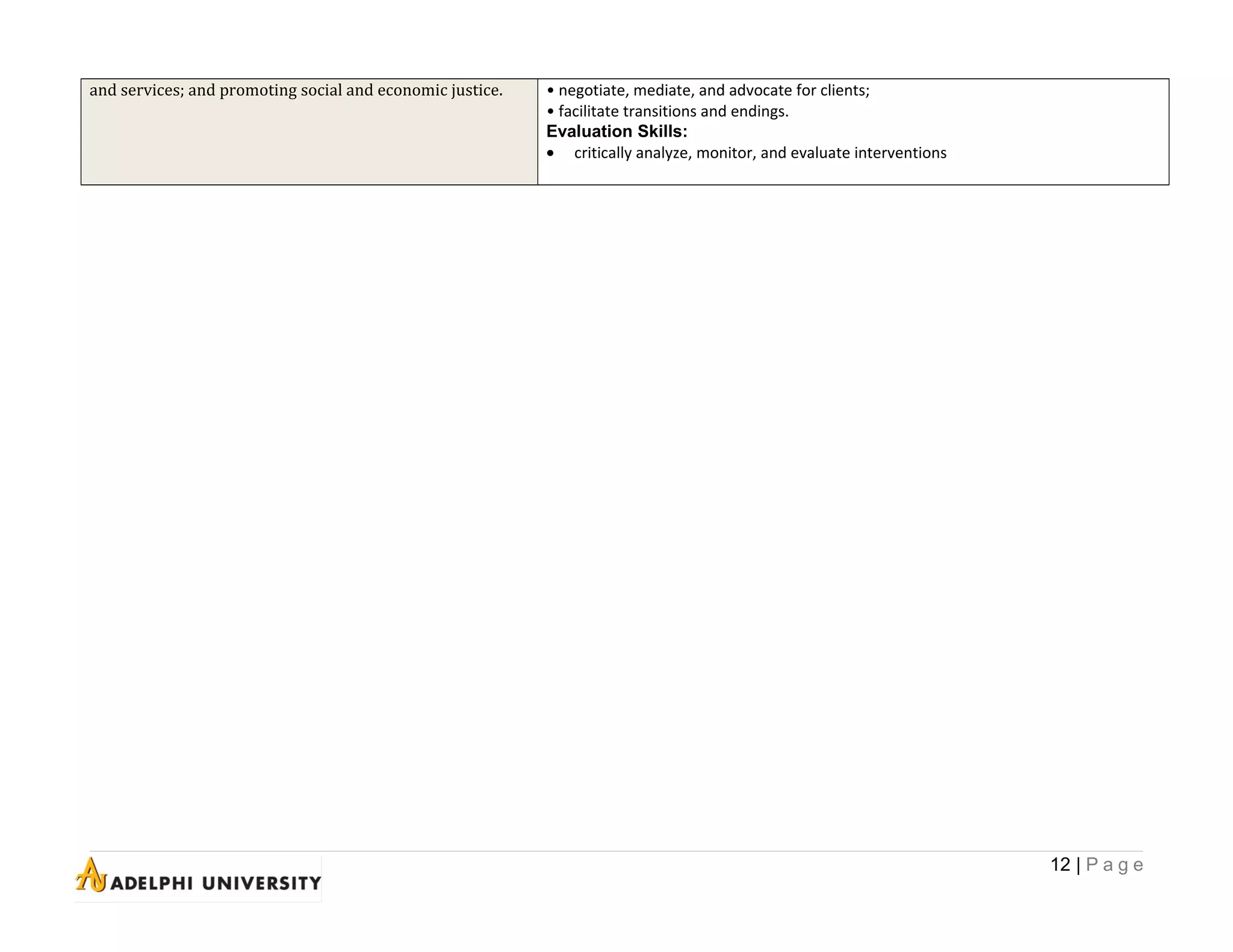
and services; and promoting social and economic justice. • negotiate, mediate, and advocate for clients;
• facilitate transitions and endings.
Evaluation Skills:
• critically analyze, monitor, and evaluate interventions
12 | P a g e

Process Recording #1

  • 1.
    PROCESS RECORDING TEMPLATE 1.COVER PAGE Student: Rebecca Rothstein Field Instructor: Kristina M Date: 10/13/12 Faculty Liaison: Subadra P Setting: Meeting took place in counselor’s office. Mr.N and I became acquainted while doing his psychosocial collaboratively with another counselor. Prior to individual session, Mr. N agreed to check in with me the next time I came in which was the middle of the following week. He knocked on the office door at the precise time I told him I would be available. Why this interaction was selected I chose this interaction because it was our first session after the initial psychosocial and the following week I returned from lunch to find out he left. I hope that reflection, analysis, and evaluation will provide greater insight into where he was between our last meeting and his departure. I plan to put to use what I’ve learned from situations like this to strengthen my clinical skills, particular during the engagement and assessment phases. Client background: Mr. N is a 33 year old African American male currently residing at a men’s homeless shelter in Manhattan. He came to detox and inpatient rehab to address alcohol dependency, which he reported began at the age of 18, and cocaine dependency beginning eight years ago. Mr.N also reported that he had been in rehab six times, the last one in February 2012, and at the time of our meeting stated that the last time he used any substances was twelve days ago. Mr. N admitted to a recent altercation after being intoxicated one evening, and woke up the following morning with his shirt covered in blood. He appeared on the unit with facial lacerations, contusions, and the whites of his right eye were blood red. Purpose: My supervisor suggested I meet with Mr.N as a supplement to individual sessions with his primary counselor. I expected our interaction to be a jumping off point for future meetings. We spent about an hour becoming familiar with one another during the psychosocial, so I thought that might help relieve some of the stress that comes with a first meeting. I felt eager to work on some of things mentioned during the psychosocial. 1 | P a g e
  • 2.
    My goal wasto introduce myself and give him some background on me and my role in his recovery process. I wanted to lay the groundwork for future meetings and interactions. In order to do so I needed to build a repore with Mr.N and begin the process of establishing a therapeutic relationship. 2 | P a g e
  • 3.
    2. INTERACTION: A. Pleaserecord your conversation with the client/client group verbatim: (Record the contents of the interaction including verbal and non-verbal communication between you and the client/client group. Use as much space as necessary). I started the session by asking Mr. N how he was doing. He stated that he was a little depressed but was hanging in there. I wanted to acknowledge his feelings by saying that I was sure that this process and what he appeared to be going through must not be easy. He then nodded while looking at the floor and then at me. I then went on to discuss the purpose of the meeting and my role at the agency and in his treatment process. I explained that I was a social work intern and that I was there to learn and get new skills, just like him. I conveyed my desire to help him get the most of his time on the unit. I told Mr. N that I would give him a safe place to share any thoughts or concerns and we would work together on them. I then asked if he had anything he wanted to ask me and he said no. At that point, I laid the groundwork for future meetings. I explained that I would just like to check in with him at least once a week and told him the hours and days I would be there. I asked if that was okay with him and he appeared to smile a bit and said that it was okay. I also wanted him to know that given the agency setting, we could connect in-between scheduled activities and he could knock on the door and either we’d talk then or make arrangements for a better time that day. He then leaned back in his chair and said he wanted to be honest with me about something. I told him I thought that was great. He proceeded to tell me that he’s been through detox and other programs many times. Mr. N explained that in that time he’s seen many social workers, counselors, and doctors. He said he would keep an open mind during any session with me but the truth is that he didn’t trust people because they come in and out of his life all the time. I replied by saying that I appreciated where he was coming from and asked him, “So basically for you am I just one of the many people that have come and gone in your life?” and he just nodded. I explained to him that he was the boss and that I could offer suggestions or anything else that to help, but what he does is up to him. How he uses his time here is up to him. Mr. N nodded a bit deeper. I then asked him to tell me why he was on the unit. He said that he knew what would happen to him if he kept drinking. I asked him to elaborate on that and he said that he knew if he kept drinking he was going to die. He went on to say that when he drinks he gets into fights and when he’s sober he’s a nice guy. I told him I could I see that. He told me that he spoke to his father earlier in the day and was warned that there are people in his neighborhood who are waiting for him to get drunk so they beat him or possibly kill him. I said “Wow! So for you there are very real consequences for your drinking.” He replied that there were and that his father told him that they were going to beat him with a brick or a pipe. I could see the look of terror and fear in his eyes. I asked him where he was planning on going after treatment and he said he would be going back to a men’s shelter. I asked him if he would be safe there and he said yes. He went on to say that he really didn’t like these shelters or three-quarter houses. I inquired about where he would like to be and he said that ten years ago he had an apartment in Poughkipsie and he really liked it there. He tried to get housing in New York City but said that when various landlords saw him they turned him down. Mr. N took a deep breath and it was apparent to me that he held on to these feelings of rejection. I acknowledged how unfortunate it is that there is so much discrimination out there, and that as an African- 3 | P a g e
  • 4.
    American man I’msure that wasn’t the first time he had gone through similar experiences. He added that he was also a black man with a criminal record. I nodded at him to acknowledge his feelings. I asked him if he was used to dealing with his feelings on his own. He had mentioned being in contact with his father and siblings but did not want them to participate in the family program or in his recovery for that matter. He said that he was because his family didn’t want to hear it any more. I asked him if he ever thought about writing his feelings down in a journal. Mr. N told me that he had a bad experience in a shelter where someone stole his journal and now he refuses to do it again. The last person he trusted was his foster mother and she died two years ago. He said he put her through so much and she never gave up on him. Mr. N’s face lit up as he talked about her smile and how even when she was in hospice on her deathbed she still had that smile. Mr. N started to look a bit worn out, so I asked him if we could meet again and took some more. I recalled some goals he had mentioned during the psychosocial such as being a master barber and having a wife and dog. I asked him if we could discuss that as well as working through some of the feelings he expressed about his alcohol and drug use. Particularly the some of the hardships he experienced in conjunction with his addiction. He agreed and I asked him how he felt about our discussion and how I stacked up in relation to the many professionals he had compared me to. He smiled and said the session was good and that it felt good to get things off his chest. I reminded him that’s what I was there for and he could come to me with anything and we would work through it. We shook hands and he left. B. What were your responses? (Thoughts/feelings/reactions): The more Mr. N filled me in on the details of his life, I felt the pain of his experiences. In his eyes, especially, I saw some joy when he reflected on some aspects of his life but mostly I saw pain, anger, and fear. I wanted so badly to help him and do something to ease his burden. I saw a sweet guy who did not know how to feel his emotions. When he told me what he remembered of his recent altercation, it pulled at my heart strings. He remembered purchasing the alcohol and then he woke up the next morning covered in blood. He had this look of sheer terror in his face and all I could do was imagine how scary it must be for him. I was also mortified by the situation. As we talked, I saw a man trying to understand himself and his choices. Mr. N kept repeating that he’s a nice guy when he’s sober and that the dangerous situations occur when he is under the influence. He just seemed so puzzled and upset and I wanted to help him work through it. Mr.N also talked about what he wanted, which was a job, a wife, and a dog named “Bobby Brown”. I saw a man who wanted the same things everyone wants, but it seemed that he did not trust that things could turn out well. At the end of the session, we planned to meet again and I was ready to help him work through the concerns he expressed to me. I felt blindsided when he left the following day while I was at lunch. As the details surrounding his departure were brought to my attention it just 4 | P a g e
  • 5.
    didn’t sound likethe man I had come to know. I still wish I had been there and at least tried to talk to him, but that’s not how things unfolded. I have to accept the fact that I may never know what happened or what was going on his head. C. Next steps: (please reflect on what you think would be best in terms of strategies, action steps, etc.) I think that applying motivational interviewing and starting where he was in the recovery process may have been beneficial. My eagerness to jump in and get things started might have gotten in the way of utilizing my clinical skills. Had he stayed, I feel the best way to proceed would have been to really tune into what he was saying and expressing. Mr. N appeared to be at the contemplation stage as he expressed feelings of defeat and also the desire to change. At this stage in the process, it is advised to try small changes. It’s possible he was overwhelmed and taking small steps could have made the recovery process more manageable. 3. POST INTERACTION ANALYSIS & INTEGRATION OF CLASSROOM LEARNING WITH FIELD: Note: Sections A, B, and C may not all be applicable every week. Please choose the one that links best with the interaction that you had with your client for this week. A. Identify a theory that you learned in the Human Behavior & Theory courses. Explain how this theory helps you to understand the client/client’s situation better. Specifically reflect on how this theory helps guide your practice. Person in environment is theory that is significant across agency settings. The theory allows me to look at and explore the context of what is being presented to me by a client. People are a product of their environment and experiences. Assessment is done by gathering information from the individual and looking at environmental systems. It is about getting a more complete picture of what they are 5 | P a g e
  • 6.
    presenting to you.Environmental resources and strengths can be an important tool that can be used when formulating goals and treatment plans. 6 | P a g e
  • 7.
    B. Choose specificpractice behaviors from the Core Competencies listed below and on the back of the form. Explain how you used these behaviors. (Use your learning from your Practice courses to reflect on this aspect, review them over a period of time and discuss in supervision). Core Competency: Identify as a professional social worker and conduct one-self accordingly: (Select one or more Practice Behavior from the drop‐down list for the Core Competency). • practice personal reflection and self-correction to assure continual professional development. One way I practiced this was by asking for feedback from Mr. N before concluding the session. I wanted to know how he experienced the session so I could improve as a professional and to recognize him as having an active role in every step of the process. Core Competency: Engage diversity and difference in practice: (Select one or more Practice Behavior from the drop‐down list for the Core Competency). • recognize the extent to which a culture’s structures and values may oppress, marginalize, alienate, or create or enhance privilege and power. Mr. N reported that he had difficulties in getting housing and that many landlords rejected him after seeing him in person. I felt it was important to explore discrimination and how it may have played out in his life. Unfortunately, discrimination and prejudice is a common experience of marginalized groups. These experiences can be internalized in a variety of ways and everything from thoughts and self- perceptions to actions and behaviors can be affected. After I brought up racial discrimination, Mr. N added criminal background as another stigmatizing factor. 7 | P a g e
  • 8.
    4. REFLECTIVE PRACTICEAND SELF-CARE: a) Identify any emotional reactions (physical or affective) that you may have had to this case? I found myself having increasing emotional reactions as Mr. N revealed more about his life. I was sad as I tried to process what it must have been like to live through these painful experiences. Mr. N was one of the first patients to really open my eyes about the bigger picture of addiction. Throughout the session, it became clear to me that his alcohol and cocaine dependence were merely a symptom of much larger issues. b) When did they come up? How do you understand them? They came up when he opened up about his recent altercation. When Mr. N expressed a range of emotions about the situation from fear to confusion to anger, I felt all of his hurt coming through and I felt awful he had to go through all of that. Something I’m constantly working on is empathy without taking on a person’s pain. Intellectually, I know that taking on his pain or allowing my emotions to take over does not help either one of us. It shifts my focus as a clinician and I have to remind myself to keep the proverbial intern hat on. c) How do you manage your own reactions? The way I manage my reactions is through reflective practice. I focus a lot of my attention on how I tuned into the client and the ways in which I improve in that area. The more I look at an interaction from a variety of ways, the more I am able to find strengths and areas that need improvement. 8 | P a g e
  • 9.
    5. FIELD INSTRUCTOR’SSUMMARY COMMENTS: (in addition to comments on the recording): Field Instructor Signature _____________________________________________________________Date______________ 9 | P a g e
  • 10.
    FOR READILY TRACKINGTHE DEVELOPMENT OF CORE COMPETENCIES IN STUDENTS AS PROFESSIONAL SOCIAL WORKERS & THE LINK TO DEMONSTRABLE PRACTICE BEHAVIORS All students must demonstrate that they are competent in the field of social work. In order to measure this, Core Competencies and Practice Behaviors have been established by the Council on Social Work Education. Please indicate by circling which Practice Behaviors you utilized during your interaction with you client. These competencies and associated practice behaviors are based on your knowledge, values, and skills. You may circle more than one Practice Behavior for each Competency. Core Competency Practice Behaviors Identify as a professional social worker and conduct oneself accordingly: Social workers serve as representatives of the profession, its mission, and its core values They know the profession’s history. Social workers commit themselves to the profession’s enhancement and to their own professional conduct and growth. • advocate for client access to the services of social work; •practice personal reflection and self-correction to assure continual professional development; • attend to professional roles and boundaries; •demonstrate professional demeanor in behavior, appearance, and communication; • use supervision and consultation. Social Work Ethical principles to guide ethical practice: Social workers have an obligation to conduct themselves ethically and to engage in ethical decision making Social workers are knowledgeable about the value base of the profession, its ethical standards, and relevant law. • recognize and manage personal values in a way that allows professional values to guide practice; • make ethical decisions by applying standards of the NASW Code of Ethics • tolerate ambiguity in resolving ethical conflicts; and • apply strategies of ethical reasoning to arrive at principled decisions. Apply Critical thinking to inform and communicate professional judgment. Social workers are knowledgeable about the principles of logic, scientific inquiry, and reasoned discernment. They use critical thinking augmented by creativity and curiosity. Critical thinking also requires the synthesis and communication of relevant • distinguish, appraise, and integrate multiple sources of knowledge, including research- based knowledge, and practice wisdom; • analyze models of assessment, prevention, intervention, and evaluation; • demonstrate effective oral and written communication in working with individuals, families, groups, organizations, communities, and colleagues. 10 | P a g e
  • 11.
    information. Engage diversity anddifference in practice Social workers understand how diversity characterizes and shapes the human experience and is critical to the formation of identity. The dimensions of diversity are understood as the intersectionality of multiple factors including age, class, color, culture, disability, ethnicity, gender, gender identity and expression, immigration status, political ideology, race, religion, sex, and sexual orientation. Social workers appreciate that, as a consequence of difference, a person’s life experiences may include oppression, poverty, marginalization, and alienation as well as privilege, power, and acclaim. • recognize the extent to which a culture’s structures and values may oppress, marginalize, alienate, or create or enhance privilege and power; • gain sufficient self-awareness to eliminate the influence of personal biases and values in working with diverse groups; • recognize and communicate their understanding of the importance of difference in shaping life experiences; and • view themselves as learners and engage those with whom they work as informants. Apply knowledge of human behavior and the social environment Social workers are knowledgeable about human behavior across the life course; the range of social systems in which people live; and the ways social systems promote or deter people in maintaining or achieving health and well-being. Social workers apply theories and knowledge from the liberal arts to understand biological, social, cultural, psychological, and spiritual development. • utilize conceptual frameworks to guide the processes of assessment, intervention, and evaluation; • critique and apply knowledge to understand person and environment. Engage, assess, intervene, and evaluate with individuals, families, groups, organizations, and communities Professional practice involves the dynamic and interactive processes of engagement, assessment, intervention, and evaluation at multiple levels. Social workers have the knowledge and skills to practice with individuals, families, groups, organizations, and communities. Practice knowledge includes identifying, analyzing, and implementing evidence-based interventions designed to achieve client goals; using research and technological advances; evaluating program outcomes and practice effectiveness; developing, analyzing, advocating, and providing leadership for policies Engagement: • substantively and affectively prepare for action with individuals, families, groups, organizations, and communities; • use empathy and other interpersonal skills; • develop a mutually agreed-on focus of work and desired outcomes. Assessment Skills: • collect, organize, and interpret client data; • assess client strengths and limitations; • develop mutually agreed-on intervention goals and objectives; • select appropriate intervention strategies. Intervention Skills: • initiate actions to achieve organizational goals; • implement prevention interventions that enhance client capacities; • help clients resolve problems; 11 | P a g e
  • 12.
    and services; andpromoting social and economic justice. • negotiate, mediate, and advocate for clients; • facilitate transitions and endings. Evaluation Skills: • critically analyze, monitor, and evaluate interventions 12 | P a g e