Running Head: Process Recording Template
Process Recording Template
Student Name: Shaneka Ratchford
Date of Contact: 6th Dec 2018
Session number or Contact number:
Location of the client interview: Mrs. Michelle Rowell’s
house
Verbatim dialogue
Assessment of client
Student impression/ feeling / thoughts/ reactions
Identify skills /theory/ conceptual framework
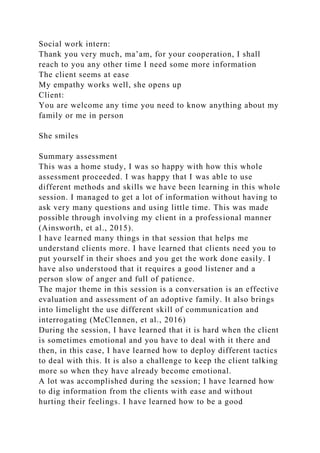
Social work intern:
Hello Madam, I am pleased to meet you
I am a little bit nervous since I have not gained so much
confidence in the field study, but I want to deliver good results
I start with the greetings to start the conversation in and make
my client feel at ease.
Invites her in the conversation
Client:
Hello, am also pleased to meet you. Call me Mrs. Rowell.
She greeted me in a friendly way and seemed to be at ease
Social work intern:
As we had agreed, I have come in your house for a pre-
assessment and see your readiness. Are you ready for this?
I look at the client, she is not looking at me, I take a deep
breath to ease my nervousness
I used closed-ended method requiring a yes or no answer to start
the dialogue
Client:
Yes, I am ready
She is confident and seems very ready and nodded in acceptance
Social work intern:
It must be very difficult accepting that you cannot bear
children biologically? You must have thought about adopting a
child for a long time?
I feel confident now that my client looks like I could now see
she has full confidence with me
I deploy open-ended tactic to kick-start the conversation
Client:
It has been a tough time for me, this is one of the reasons I
ended up being divorced by my husband of many years
Her face changes and she looks very thoughtful
Social work intern:
I am sorry for this ma’am, everything will be fine
I feel sorry for her
I deploy empathy to make her feel more
Client:
Thank you for your concern
Her face brightens again
Social work intern:
You believe that you can be able to take care of the child alone
bearing in mind you seem to ambivalent about a child below the
age of ten? Please tell me more about that?
I try Showing some concern
I try engaging her to get clarifications of what she exactly wants
Client:
As I earlier told you I am working, I would like a child who is
a little bit grown up since I will not be at home at all times
due to work commitment
The client looks uncomfortable at this point since she starts
fidgeting
Social work intern:
How will you handle this alone
She Seems confident
I try digging more from her
Client:
It is a difficult task as I have said, but since I have been
working as a teacher for many years, I have a lot of experience
in parenting
She smiles as she explains her passion with children.
Social work intern:
Now that your mind is set in the adoption of a school going
child, how will you handle the discipline of the child?
I feel she is fit for the task
I want to understand her preparedness in parenting
Client:
I have learned a lot in the field I am in relation to discipline
She points at the wall, showing me her certificate awarded for
counseling
Social work intern:
Have undergone any form of abuse in your life and how did you
handle it?
I can see she is a little bit nervous
I want her to open to me and say it all
Client:
Yes, I have from my ex-husband. After various counseling
sessions I am now okay
She looks down shyly
Social work intern:
I believe this is not all the information you can share on the
extent of the abuse and how it affected you.
I feel she is hiding some information
I confront her in a friendly manner to get it all
Client:
He used to beat and abuse me publicly
tears roll down her cheeks
Social work intern:
All is well ma’am; you are now healed and ready to settle for a
new family?
I sad for her since she seems in an inner pain, she seems sad but
not upset
I was not prepared to handle such like emotions
Client:
Yes, as ready as now
She nods her head
Social work intern:
So you cannot subject your child or a child under your care to
what you went through?
She seems disciplined
I want to dig more about her discipline measures
Client:
What I went through was so bad; I cannot love to see anybody
else go through such
There are other methods that one can employ in case of a
dispute
Social work intern:
Thank you very much, ma’am, for your cooperation, I shall
reach to you any other time I need some more information
The client seems at ease
My empathy works well, she opens up
Client:
You are welcome any time you need to know anything about my
family or me in person
She smiles
Summary assessment
This was a home study, I was so happy with how this whole
assessment proceeded. I was happy that I was able to use
different methods and skills we have been learning in this whole
session. I managed to get a lot of information without having to
ask very many questions and using little time. This was made
possible through involving my client in a professional manner
(Ainsworth, et al., 2015).
I have learned many things in that session that helps me
understand clients more. I have learned that clients need you to
put yourself in their shoes and you get the work done easily. I
have also understood that it requires a good listener and a
person slow of anger and full of patience.
The major theme in this session is a conversation is an effective
evaluation and assessment of an adoptive family. It also brings
into limelight the use different skill of communication and
interrogating (McClennen, et al., 2016)
During the session, I have learned that it is hard when the client
is sometimes emotional and you have to deal with it there and
then, in this case, I have learned how to deploy different tactics
to deal with this. It is also a challenge to keep the client talking
more so when they have already become emotional.
A lot was accomplished during the session; I have learned how
to dig information from the clients with ease and without
hurting their feelings. I have learned how to be a good
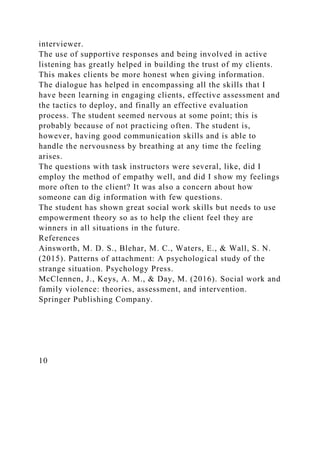
interviewer.
The use of supportive responses and being involved in active
listening has greatly helped in building the trust of my clients.
This makes clients be more honest when giving information.
The dialogue has helped in encompassing all the skills that I
have been learning in engaging clients, effective assessment and
the tactics to deploy, and finally an effective evaluation
process. The student seemed nervous at some point; this is
probably because of not practicing often. The student is,
however, having good communication skills and is able to
handle the nervousness by breathing at any time the feeling
arises.
The questions with task instructors were several, like, did I
employ the method of empathy well, and did I show my feelings
more often to the client? It was also a concern about how
someone can dig information with few questions.
The student has shown great social work skills but needs to use
empowerment theory so as to help the client feel they are
winners in all situations in the future.
References
Ainsworth, M. D. S., Blehar, M. C., Waters, E., & Wall, S. N.
(2015). Patterns of attachment: A psychological study of the
strange situation. Psychology Press.
McClennen, J., Keys, A. M., & Day, M. (2016). Social work and
family violence: theories, assessment, and intervention.
Springer Publishing Company.
10
Running Head Process Recording TemplateProcess Recording Temp.docx

Running Head Process Recording TemplateProcess Recording Temp.docx

  • 1.
    Running Head: ProcessRecording Template Process Recording Template Process Recording Template Student Name: Shaneka Ratchford Date of Contact: 6th Dec 2018 Session number or Contact number: Location of the client interview: Mrs. Michelle Rowell’s house Verbatim dialogue Assessment of client Student impression/ feeling / thoughts/ reactions Identify skills /theory/ conceptual framework Social work intern: Hello Madam, I am pleased to meet you I am a little bit nervous since I have not gained so much confidence in the field study, but I want to deliver good results I start with the greetings to start the conversation in and make my client feel at ease. Invites her in the conversation Client: Hello, am also pleased to meet you. Call me Mrs. Rowell. She greeted me in a friendly way and seemed to be at ease
  • 2.
    Social work intern: Aswe had agreed, I have come in your house for a pre- assessment and see your readiness. Are you ready for this? I look at the client, she is not looking at me, I take a deep breath to ease my nervousness I used closed-ended method requiring a yes or no answer to start the dialogue Client: Yes, I am ready She is confident and seems very ready and nodded in acceptance Social work intern: It must be very difficult accepting that you cannot bear children biologically? You must have thought about adopting a child for a long time? I feel confident now that my client looks like I could now see she has full confidence with me I deploy open-ended tactic to kick-start the conversation Client: It has been a tough time for me, this is one of the reasons I ended up being divorced by my husband of many years Her face changes and she looks very thoughtful Social work intern: I am sorry for this ma’am, everything will be fine I feel sorry for her I deploy empathy to make her feel more Client: Thank you for your concern Her face brightens again Social work intern: You believe that you can be able to take care of the child alone bearing in mind you seem to ambivalent about a child below the
  • 3.
    age of ten?Please tell me more about that? I try Showing some concern I try engaging her to get clarifications of what she exactly wants Client: As I earlier told you I am working, I would like a child who is a little bit grown up since I will not be at home at all times due to work commitment The client looks uncomfortable at this point since she starts fidgeting Social work intern: How will you handle this alone She Seems confident I try digging more from her Client: It is a difficult task as I have said, but since I have been working as a teacher for many years, I have a lot of experience in parenting She smiles as she explains her passion with children. Social work intern: Now that your mind is set in the adoption of a school going child, how will you handle the discipline of the child? I feel she is fit for the task I want to understand her preparedness in parenting Client: I have learned a lot in the field I am in relation to discipline She points at the wall, showing me her certificate awarded for counseling Social work intern: Have undergone any form of abuse in your life and how did you handle it? I can see she is a little bit nervous
  • 4.
    I want herto open to me and say it all Client: Yes, I have from my ex-husband. After various counseling sessions I am now okay She looks down shyly Social work intern: I believe this is not all the information you can share on the extent of the abuse and how it affected you. I feel she is hiding some information I confront her in a friendly manner to get it all Client: He used to beat and abuse me publicly tears roll down her cheeks Social work intern: All is well ma’am; you are now healed and ready to settle for a new family? I sad for her since she seems in an inner pain, she seems sad but not upset I was not prepared to handle such like emotions Client: Yes, as ready as now She nods her head Social work intern: So you cannot subject your child or a child under your care to what you went through? She seems disciplined I want to dig more about her discipline measures Client: What I went through was so bad; I cannot love to see anybody else go through such There are other methods that one can employ in case of a dispute
  • 5.
    Social work intern: Thankyou very much, ma’am, for your cooperation, I shall reach to you any other time I need some more information The client seems at ease My empathy works well, she opens up Client: You are welcome any time you need to know anything about my family or me in person She smiles Summary assessment This was a home study, I was so happy with how this whole assessment proceeded. I was happy that I was able to use different methods and skills we have been learning in this whole session. I managed to get a lot of information without having to ask very many questions and using little time. This was made possible through involving my client in a professional manner (Ainsworth, et al., 2015). I have learned many things in that session that helps me understand clients more. I have learned that clients need you to put yourself in their shoes and you get the work done easily. I have also understood that it requires a good listener and a person slow of anger and full of patience. The major theme in this session is a conversation is an effective evaluation and assessment of an adoptive family. It also brings into limelight the use different skill of communication and interrogating (McClennen, et al., 2016) During the session, I have learned that it is hard when the client is sometimes emotional and you have to deal with it there and then, in this case, I have learned how to deploy different tactics to deal with this. It is also a challenge to keep the client talking more so when they have already become emotional. A lot was accomplished during the session; I have learned how to dig information from the clients with ease and without hurting their feelings. I have learned how to be a good
  • 6.
    interviewer. The use ofsupportive responses and being involved in active listening has greatly helped in building the trust of my clients. This makes clients be more honest when giving information. The dialogue has helped in encompassing all the skills that I have been learning in engaging clients, effective assessment and the tactics to deploy, and finally an effective evaluation process. The student seemed nervous at some point; this is probably because of not practicing often. The student is, however, having good communication skills and is able to handle the nervousness by breathing at any time the feeling arises. The questions with task instructors were several, like, did I employ the method of empathy well, and did I show my feelings more often to the client? It was also a concern about how someone can dig information with few questions. The student has shown great social work skills but needs to use empowerment theory so as to help the client feel they are winners in all situations in the future. References Ainsworth, M. D. S., Blehar, M. C., Waters, E., & Wall, S. N. (2015). Patterns of attachment: A psychological study of the strange situation. Psychology Press. McClennen, J., Keys, A. M., & Day, M. (2016). Social work and family violence: theories, assessment, and intervention. Springer Publishing Company. 10