17-4 PRECIPITATION
HARDENABLE STAINLESS STEEL
INTRODUCTION:
 17-4 PH stainless steel is one of the most common martensitic stainless
steel.
 17-4 PH Stainless steel is precipitation hardening of martensite
stainless steel.
 Precipitation hardening is a special type of heat treatment technique
used to improve the yield strength of the material.
 It is also called age hardening (or) particle hardening.
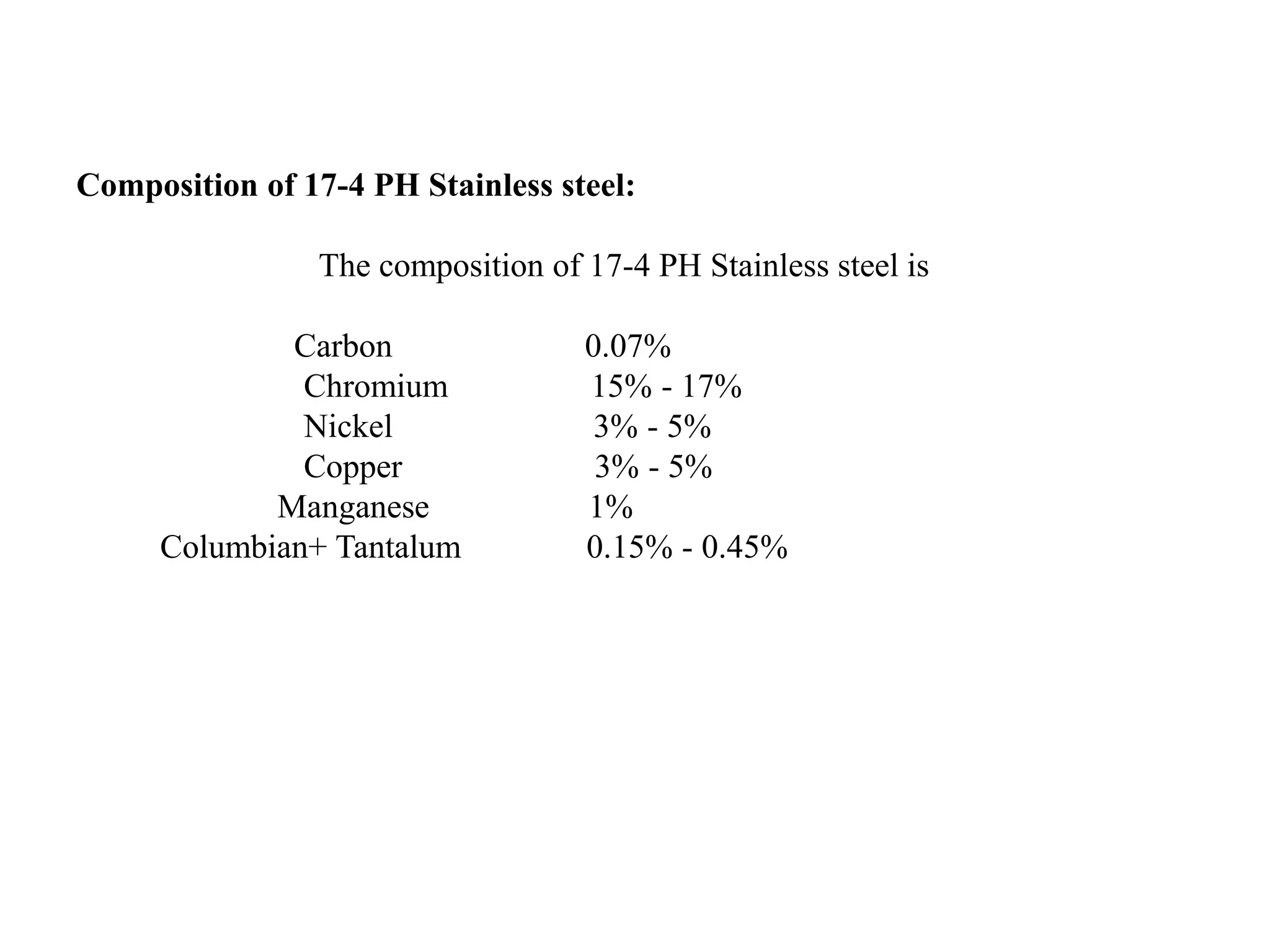
Composition of 17-4 PH Stainless steel:
The composition of 17-4 PH Stainless steel is
Carbon 0.07%
Chromium 15% - 17%
Nickel 3% - 5%
Copper 3% - 5%
Manganese 1%
Columbian+ Tantalum 0.15% - 0.45%
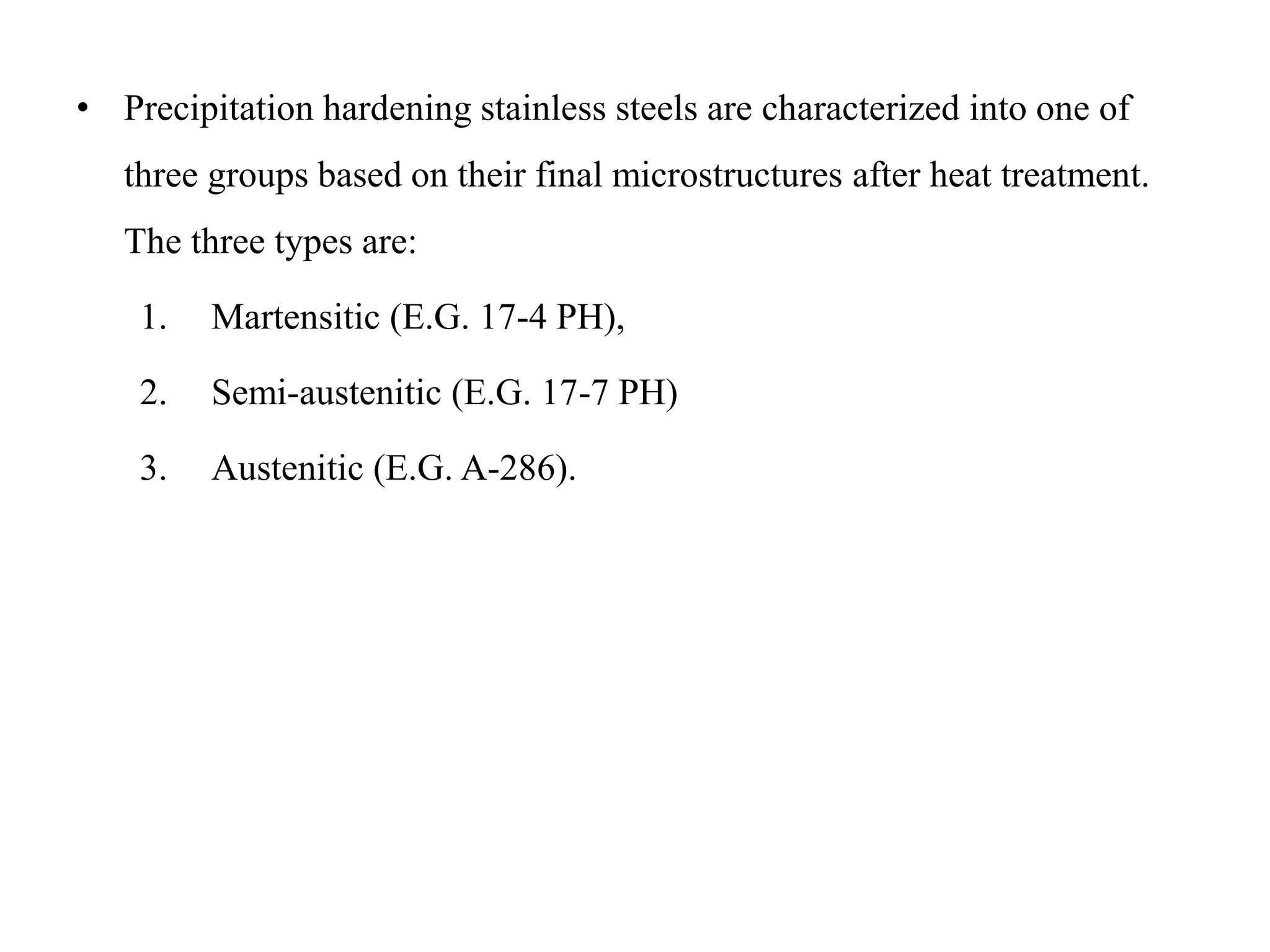
• Precipitation hardening stainless steels are characterized into one of
three groups based on their final microstructures after heat treatment.
The three types are:
1. Martensitic (E.G. 17-4 PH),
2. Semi-austenitic (E.G. 17-7 PH)
3. Austenitic (E.G. A-286).
Martensite stainless steels:
 It is one of the type of PH stainless steels.
 In this they are already martensitic in solution and annealed condition
and only requires precipitation hardening.
 Martensite stainless steels are similar to iron carbon alloys that are
austenitized .
 They are hardened by quenching and tempered for increased ductility
and toughness.
 Their heat treated structure is BCT (Body centred tetragonal).
 These alloys are magnetic.
PRECIPITATION HARDENED HEAT TREATMENT:
 It consists of three stages:
1) Solution Heat treatment
2) Quenching
3) Precipitation or Aging
Solution Heat treatment:
 It consists of high temperature heat treatment that allows any
precipitates and alloying element to dissolve or go in to super saturated
state.
 Temperature is around 980 – 1065C.
Quenching (or) Cooling:
 After the alloys are brought to solution the metal is cooled to room
temperature.
 Cooling can be done in air, water or oil but must be accomplished fast
enough to obtain a super saturated solution.
Precipitation (or) Aging:
 The super saturated solid solution decomposes with time or temperature
as the alloying elements forms small clusters.
Precipitation Treatment for 17-4 PH:
 17-4 PH stainless steel is a martensitic stainless steel containing
approximately 3% copper and is strengthened by precipitation of
copper in the martensite matrix.
 Addition of copper is made to promote its precipitation hardening
capability.
 Precipitation hardened by only holding the steel at 480C for 1 hour.
 Thereby minimizing scaling and distortion and allowing the parts to be
machined to close tolerances , prior to heat treatment.
 These coherent particles are transformed to incoherent FCC – cu after
long term aging at temperature about 400c.
AGING TIME VS YIELD STRENGTH OF 17-4 PH STAINLESS STEEL.
Properties:
• High strength
• High Hardness
• Good corrosion resistance.
• Resistance to atmospheric corrosion
• Good machinability
• Resistance to stress corrosion cracking
• Magnetic
• Coherency
Limitations:
 Dimensional inaccuracy occurs due to heat treatment and should be
carefull.
 stress cracking occurs.
 Scaling and distortion may occur.
Applications:
 Pump shafts
 Pulp and paper industry
 Aerospace ( Turbine blades)
 Food industry
 Off shore (foils, helocopter deck platforms)
 Oil and petroleum refining eqiupment
 Chemical process equipment.
 Gears
 Paper mill equipment
 Air craft parts
References:
1. Journal Microstructural Evolution in a 17-4 PH Stainless
Steelafter Aging at 400 &CM. MURAYAMA, Y. KATAYAMA,
and K. HONO
2. http://www.azom.com/article.aspx?ArticleID=2819
3. https://app.aws.org/wj/1998/11/kotecki/
4. Journal PRECIPITATION HARDENING P/M STAINLESS
STEELS by Chris Schade, Pat Stears Hoeganaes Corporation
Cinnaminson, NJ 08077 Alan Lawley, Roger Doherty ,Drexel
University Philadelphia, PA

17 4 ph stainless steel

  • 1.
  • 2.
    INTRODUCTION:  17-4 PHstainless steel is one of the most common martensitic stainless steel.  17-4 PH Stainless steel is precipitation hardening of martensite stainless steel.  Precipitation hardening is a special type of heat treatment technique used to improve the yield strength of the material.  It is also called age hardening (or) particle hardening.
  • 3.
    Composition of 17-4PH Stainless steel: The composition of 17-4 PH Stainless steel is Carbon 0.07% Chromium 15% - 17% Nickel 3% - 5% Copper 3% - 5% Manganese 1% Columbian+ Tantalum 0.15% - 0.45%
  • 4.
    • Precipitation hardeningstainless steels are characterized into one of three groups based on their final microstructures after heat treatment. The three types are: 1. Martensitic (E.G. 17-4 PH), 2. Semi-austenitic (E.G. 17-7 PH) 3. Austenitic (E.G. A-286).
  • 5.
    Martensite stainless steels: It is one of the type of PH stainless steels.  In this they are already martensitic in solution and annealed condition and only requires precipitation hardening.  Martensite stainless steels are similar to iron carbon alloys that are austenitized .  They are hardened by quenching and tempered for increased ductility and toughness.  Their heat treated structure is BCT (Body centred tetragonal).  These alloys are magnetic.
  • 8.
    PRECIPITATION HARDENED HEATTREATMENT:  It consists of three stages: 1) Solution Heat treatment 2) Quenching 3) Precipitation or Aging Solution Heat treatment:  It consists of high temperature heat treatment that allows any precipitates and alloying element to dissolve or go in to super saturated state.  Temperature is around 980 – 1065C.
  • 9.
    Quenching (or) Cooling: After the alloys are brought to solution the metal is cooled to room temperature.  Cooling can be done in air, water or oil but must be accomplished fast enough to obtain a super saturated solution. Precipitation (or) Aging:  The super saturated solid solution decomposes with time or temperature as the alloying elements forms small clusters.
  • 10.
    Precipitation Treatment for17-4 PH:  17-4 PH stainless steel is a martensitic stainless steel containing approximately 3% copper and is strengthened by precipitation of copper in the martensite matrix.  Addition of copper is made to promote its precipitation hardening capability.  Precipitation hardened by only holding the steel at 480C for 1 hour.  Thereby minimizing scaling and distortion and allowing the parts to be machined to close tolerances , prior to heat treatment.  These coherent particles are transformed to incoherent FCC – cu after long term aging at temperature about 400c.
  • 11.
    AGING TIME VSYIELD STRENGTH OF 17-4 PH STAINLESS STEEL.
  • 12.
    Properties: • High strength •High Hardness • Good corrosion resistance. • Resistance to atmospheric corrosion • Good machinability • Resistance to stress corrosion cracking • Magnetic • Coherency
  • 13.
    Limitations:  Dimensional inaccuracyoccurs due to heat treatment and should be carefull.  stress cracking occurs.  Scaling and distortion may occur.
  • 14.
    Applications:  Pump shafts Pulp and paper industry  Aerospace ( Turbine blades)  Food industry  Off shore (foils, helocopter deck platforms)  Oil and petroleum refining eqiupment  Chemical process equipment.  Gears  Paper mill equipment  Air craft parts
  • 16.
    References: 1. Journal MicrostructuralEvolution in a 17-4 PH Stainless Steelafter Aging at 400 &CM. MURAYAMA, Y. KATAYAMA, and K. HONO 2. http://www.azom.com/article.aspx?ArticleID=2819 3. https://app.aws.org/wj/1998/11/kotecki/ 4. Journal PRECIPITATION HARDENING P/M STAINLESS STEELS by Chris Schade, Pat Stears Hoeganaes Corporation Cinnaminson, NJ 08077 Alan Lawley, Roger Doherty ,Drexel University Philadelphia, PA