Best Practices for Scaling Websites Lessons from eBay Randy Shoup eBay Distinguished Architect QCon Tokyo 2009.04.10
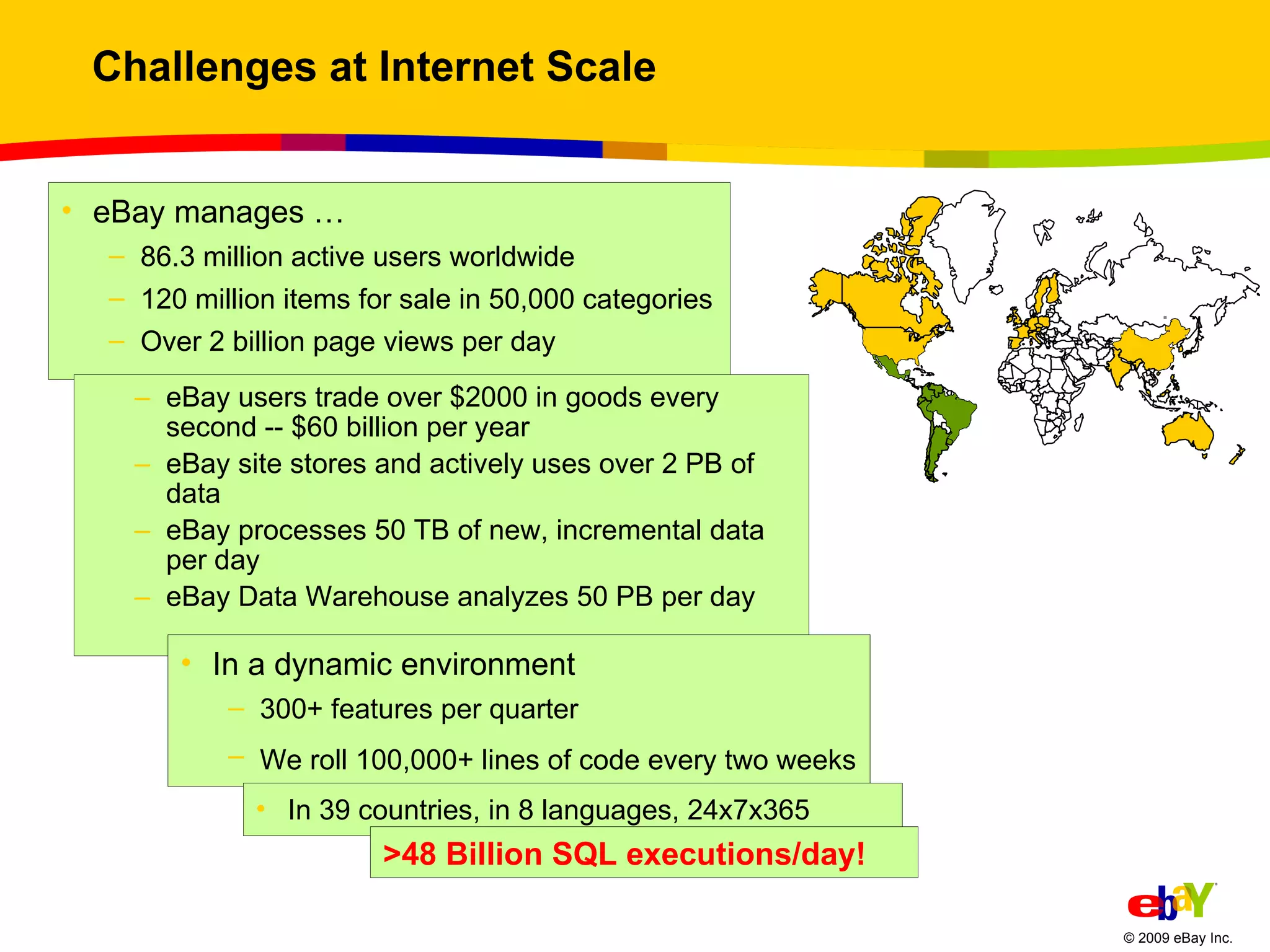
Challenges at Internet Scale eBay users trade over $2000 in goods every second -- $60 billion per year   eBay site stores and actively uses over 2 PB of data  eBay processes 50 TB of new, incremental data per day  eBay Data Warehouse analyzes 50 PB per day eBay manages … 86.3 million active users worldwide 120 million items for sale in 50,000 categories Over 2 billion page views per day In a dynamic environment 300+ features per quarter We roll 100,000+ lines of code every two weeks   In 39 countries, in 8 languages, 24x7x365 >48 Billion SQL executions/day!
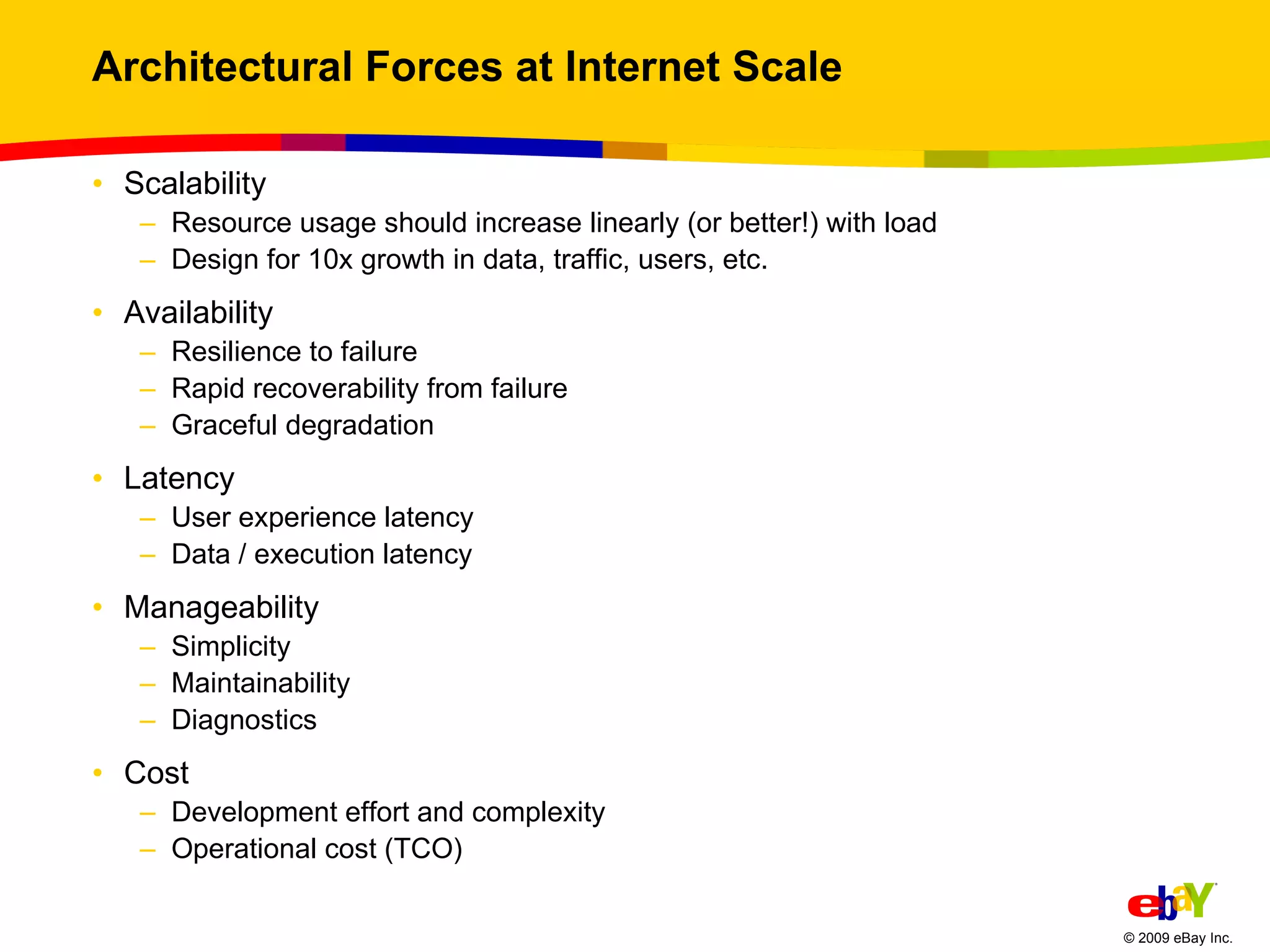
Architectural Forces at Internet Scale Scalability Resource usage should increase linearly (or better!) with load Design for 10x growth in data, traffic, users, etc. Availability Resilience to failure  Rapid recoverability from failure Graceful degradation Latency User experience latency Data / execution latency Manageability Simplicity Maintainability Diagnostics Cost Development effort and complexity Operational cost (TCO)
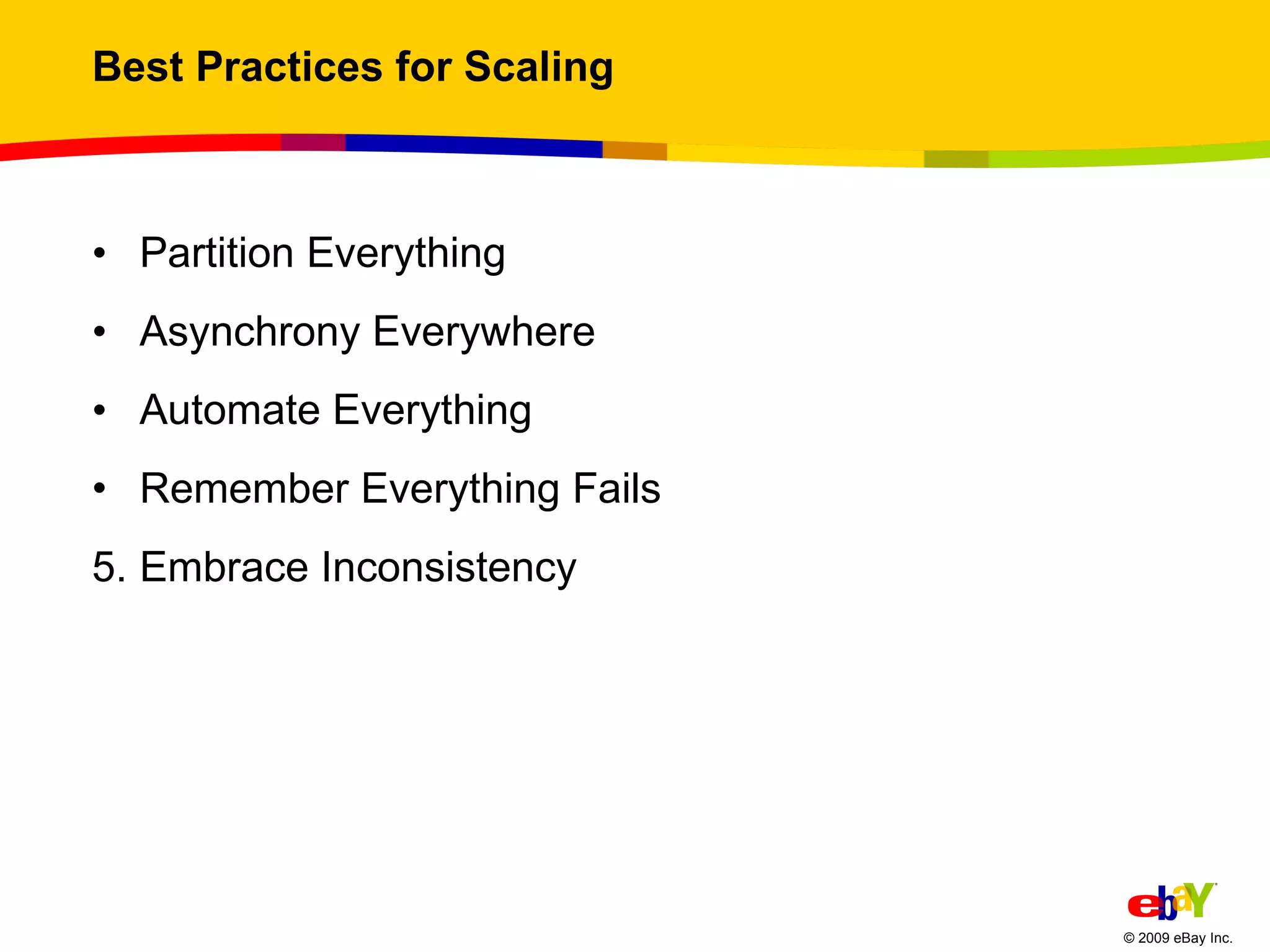
Best Practices for Scaling Partition Everything  Asynchrony Everywhere  Automate Everything Remember Everything Fails  Embrace Inconsistency
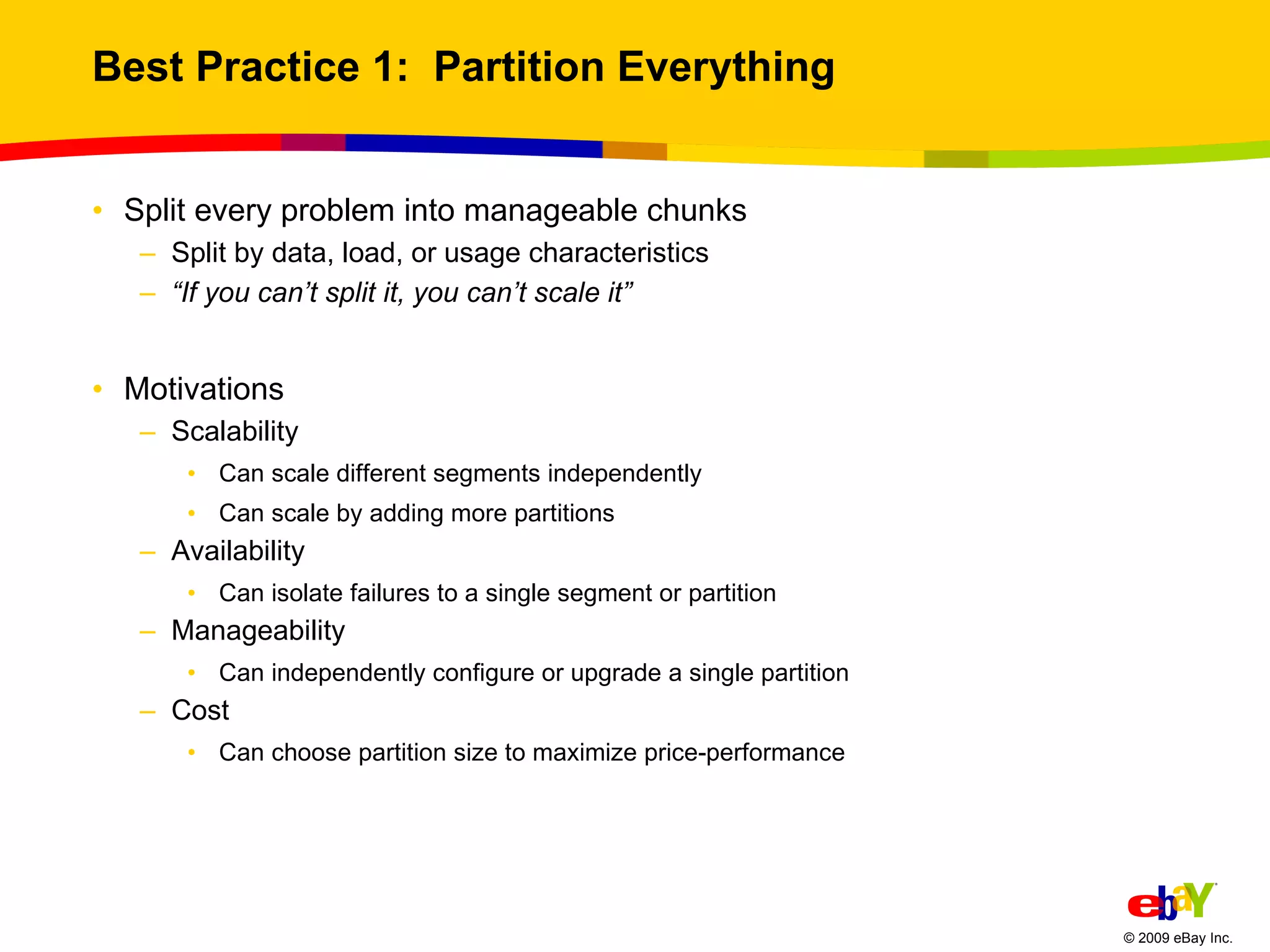
Best Practice 1:  Partition Everything Split every problem into manageable chunks Split by data, load, or usage characteristics “ If you can’t split it, you can’t scale it” Motivations Scalability Can scale different segments independently Can scale by adding more partitions Availability Can isolate failures to a single segment or partition Manageability Can independently configure or upgrade a single partition  Cost Can choose partition size to maximize price-performance
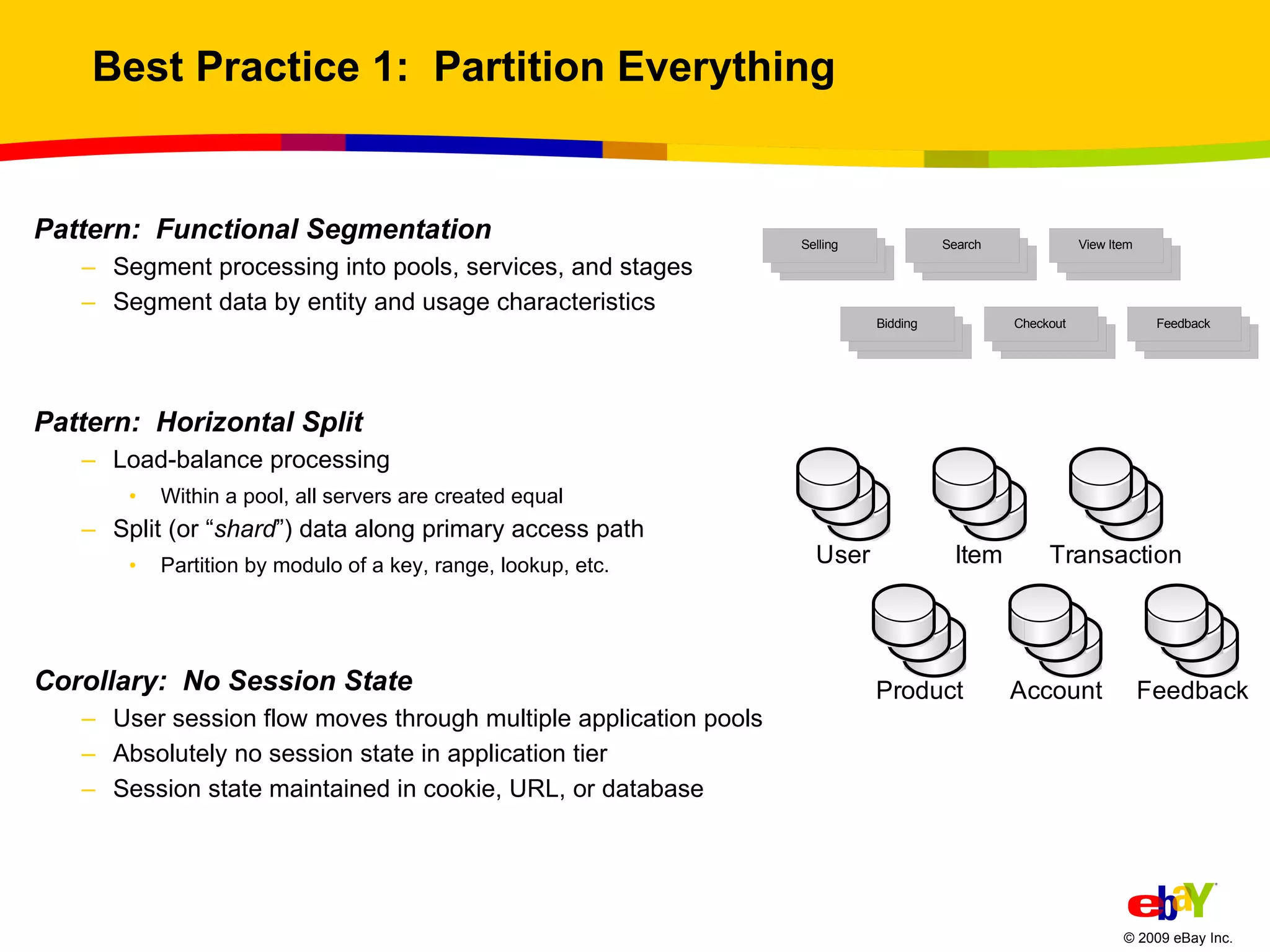
Best Practice 1:  Partition Everything Pattern:  Functional Segmentation Segment processing into pools, services, and stages Segment data by entity and usage characteristics Pattern:  Horizontal Split Load-balance processing Within a pool, all servers are created equal Split (or “ shard ”) data along primary access path Partition by modulo of a key, range, lookup, etc. Corollary:  No Session State User session flow moves through multiple application pools Absolutely no session state in application tier Session state maintained in cookie, URL, or database
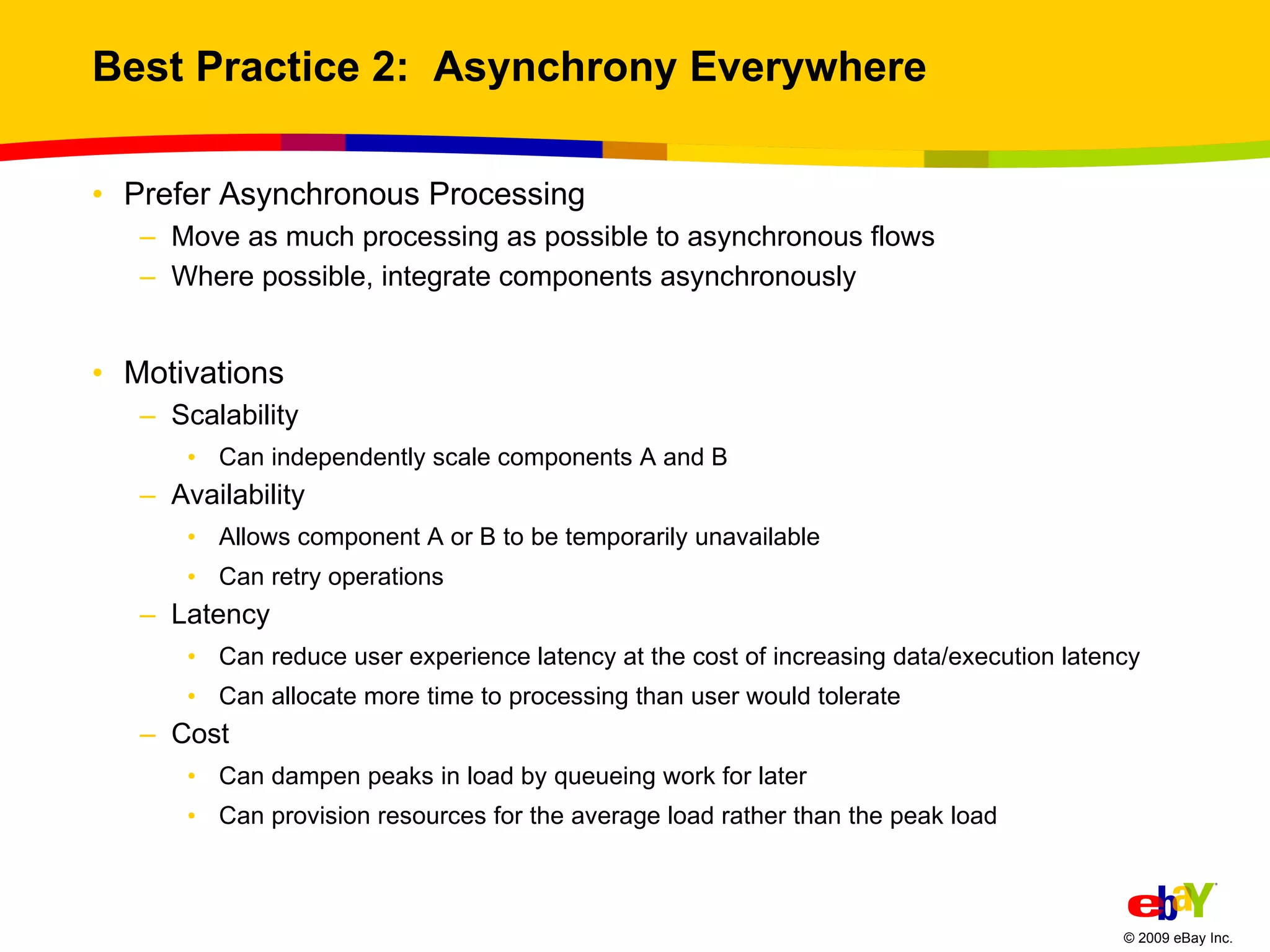
Best Practice 2:  Asynchrony Everywhere Prefer Asynchronous Processing Move as much processing as possible to asynchronous flows Where possible, integrate components asynchronously Motivations Scalability Can independently scale components A and B Availability Allows component A or B to be temporarily unavailable Can retry operations Latency Can reduce user experience latency at the cost of increasing data/execution latency Can allocate more time to processing than user would tolerate Cost Can dampen peaks in load by queueing work for later Can provision resources for the average load rather than the peak load
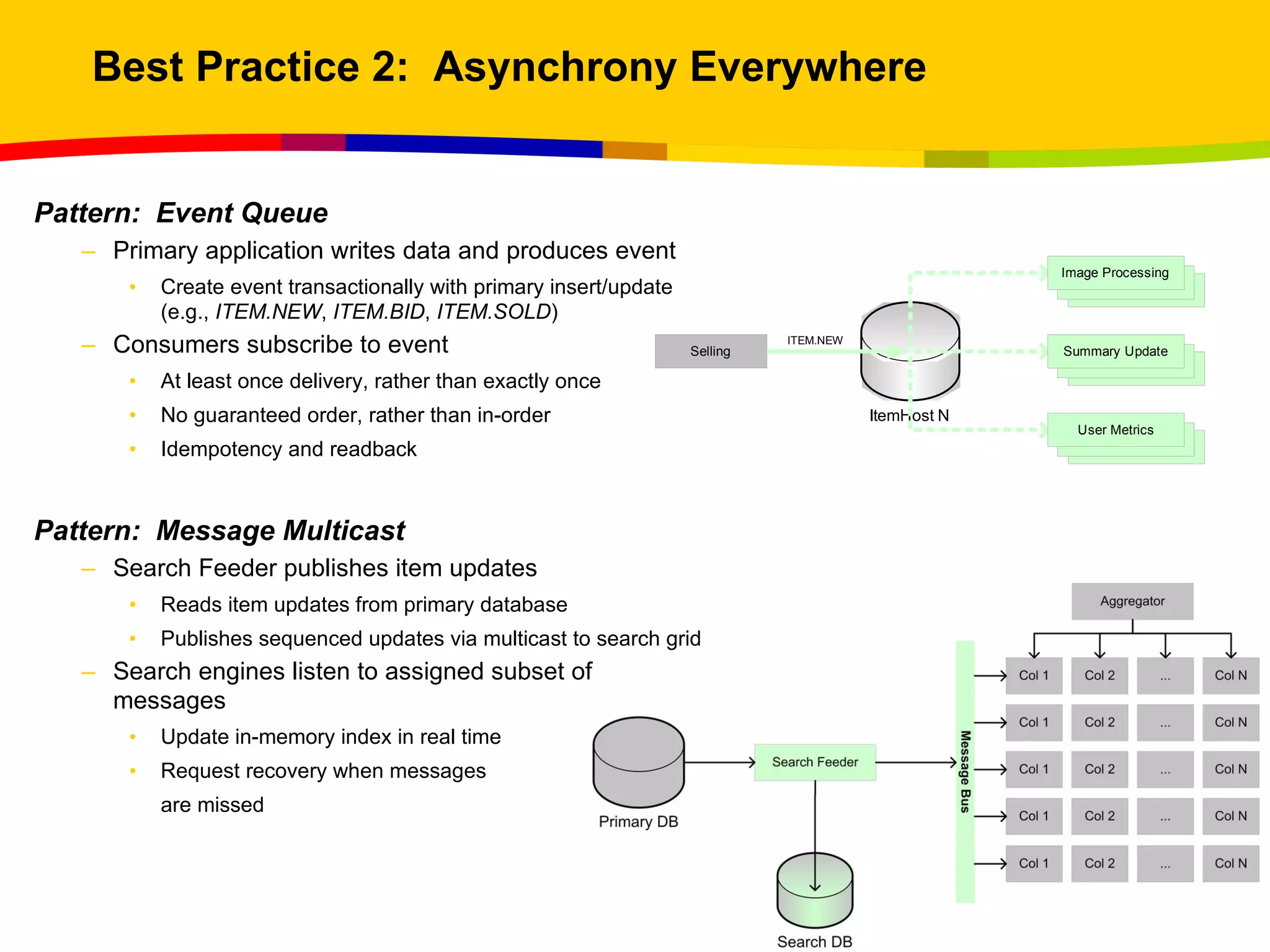
Best Practice 2:  Asynchrony Everywhere Pattern:  Event Queue Primary application writes data and produces event Create event transactionally with primary insert/update (e.g.,  ITEM.NEW ,  ITEM.BID ,  ITEM.SOLD )  Consumers subscribe to event At least once delivery, rather than exactly once No guaranteed order, rather than in-order Idempotency and readback Pattern:  Message Multicast Search Feeder publishes item updates Reads item updates from primary database Publishes sequenced updates via multicast to search grid Search engines listen to assigned subset of messages Update in-memory index in real time Request recovery when messages  are missed
Best Practice 3:  Automate Everything Prefer Adaptive / Automated Systems to Manual Systems Motivations Scalability Can scale with machines, not humans Availability Can adapt to changing environment more rapidly Cost Machines are far less expensive than humans Can adjust themselves over time without manual effort
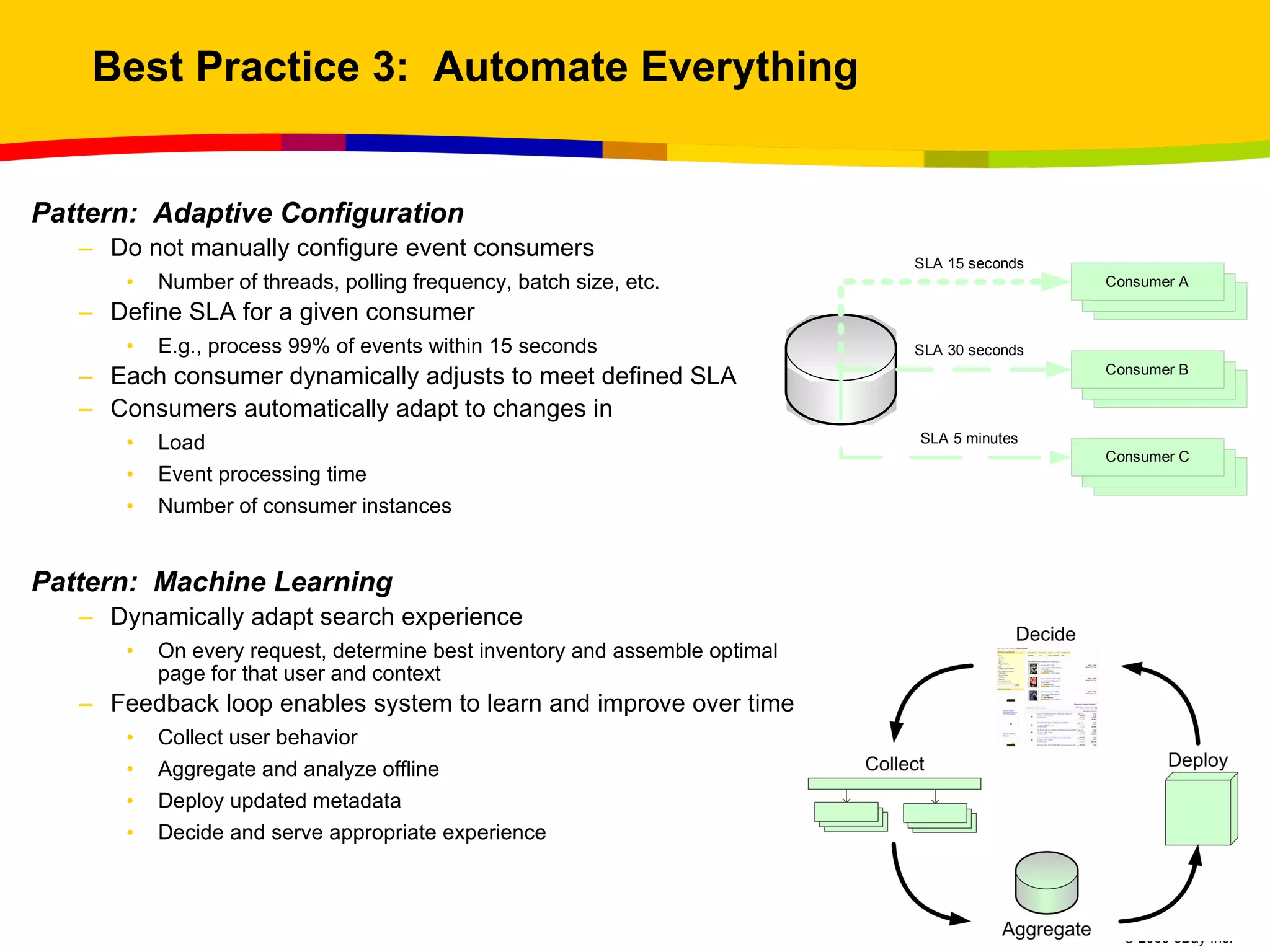
Best Practice 3:  Automate Everything Pattern:  Adaptive Configuration Do not manually configure event consumers Number of threads, polling frequency, batch size, etc. Define SLA for a given consumer E.g., process 99% of events within 15 seconds Each consumer dynamically adjusts to meet defined SLA Consumers automatically adapt to changes in  Load Event processing time Number of consumer instances Pattern:  Machine Learning Dynamically adapt search experience On every request, determine best inventory and assemble optimal page for that user and context Feedback loop enables system to learn and improve over time Collect user behavior Aggregate and analyze offline Deploy updated metadata Decide and serve appropriate experience
Best Practice 4:  Remember Everything Fails Build all systems to be tolerant of failure Assume every operation will fail and every resource will be unavailable Detect failure as rapidly as possible Recover from failure as rapidly as possible Do as much as possible during failure Motivation Availability
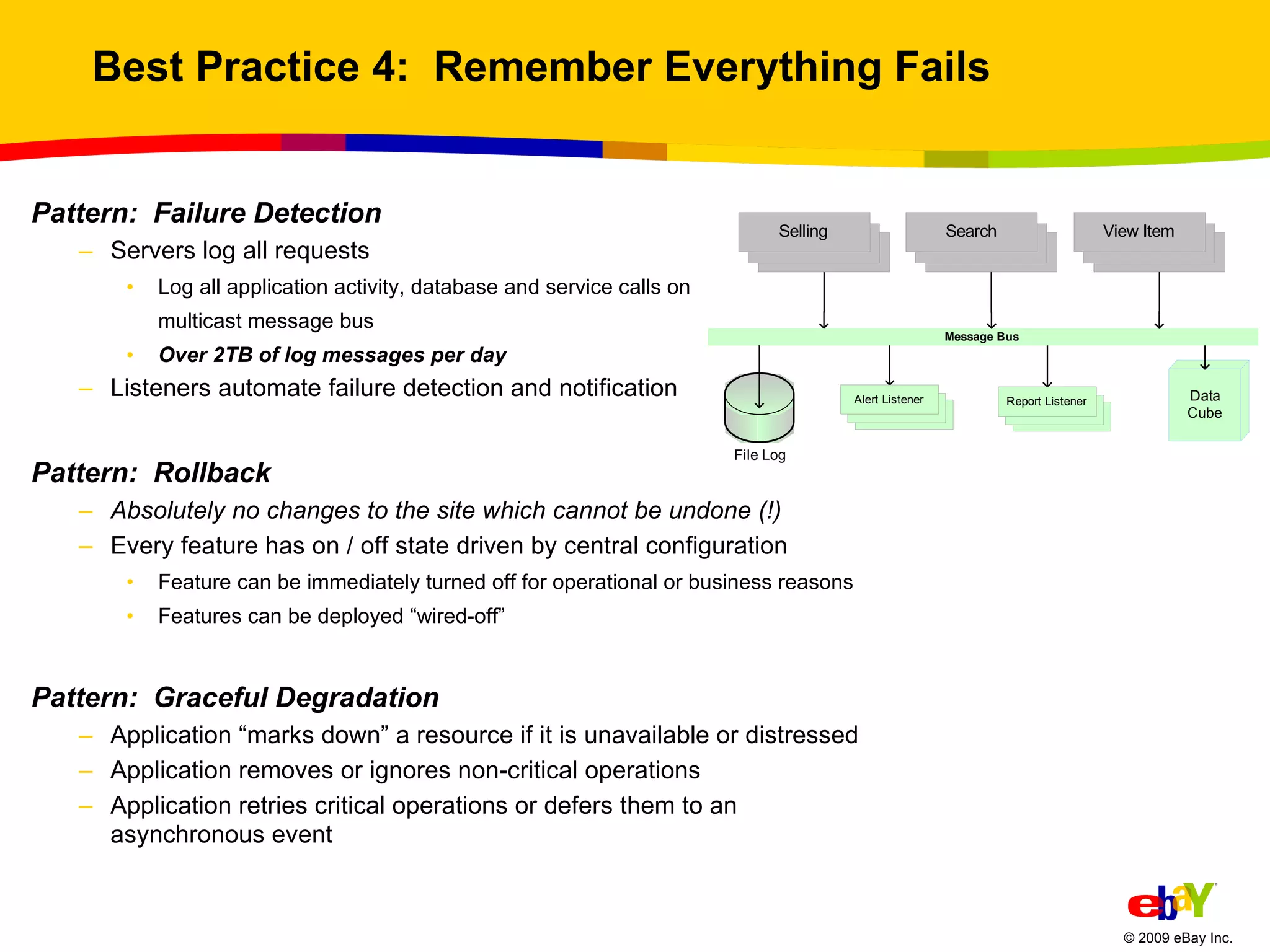
Best Practice 4:  Remember Everything Fails Pattern:  Failure Detection Servers log all requests Log all application activity, database and service calls on  multicast message bus Over 2TB of log messages per day Listeners automate failure detection and notification Pattern:  Rollback Absolutely no changes to the site which cannot be undone (!) Every feature has on / off state driven by central configuration Feature can be immediately turned off for operational or business reasons Features can be deployed “wired-off” Pattern:  Graceful Degradation Application “marks down” a resource if it is unavailable or distressed Application removes or ignores non-critical operations  Application retries critical operations or defers them to an asynchronous event
Best Practice 5:  Embrace Inconsistency Brewer’s CAP Theorem  Any shared-data system can have  at most two  of the following properties: C onsistency:  All clients see the same data, even in the presence of updates A vailability:  All clients will get a response, even in the presence of failures P artition-tolerance:  The system properties hold even when the network is partitioned This trade-off is  fundamental  to all distributed systems
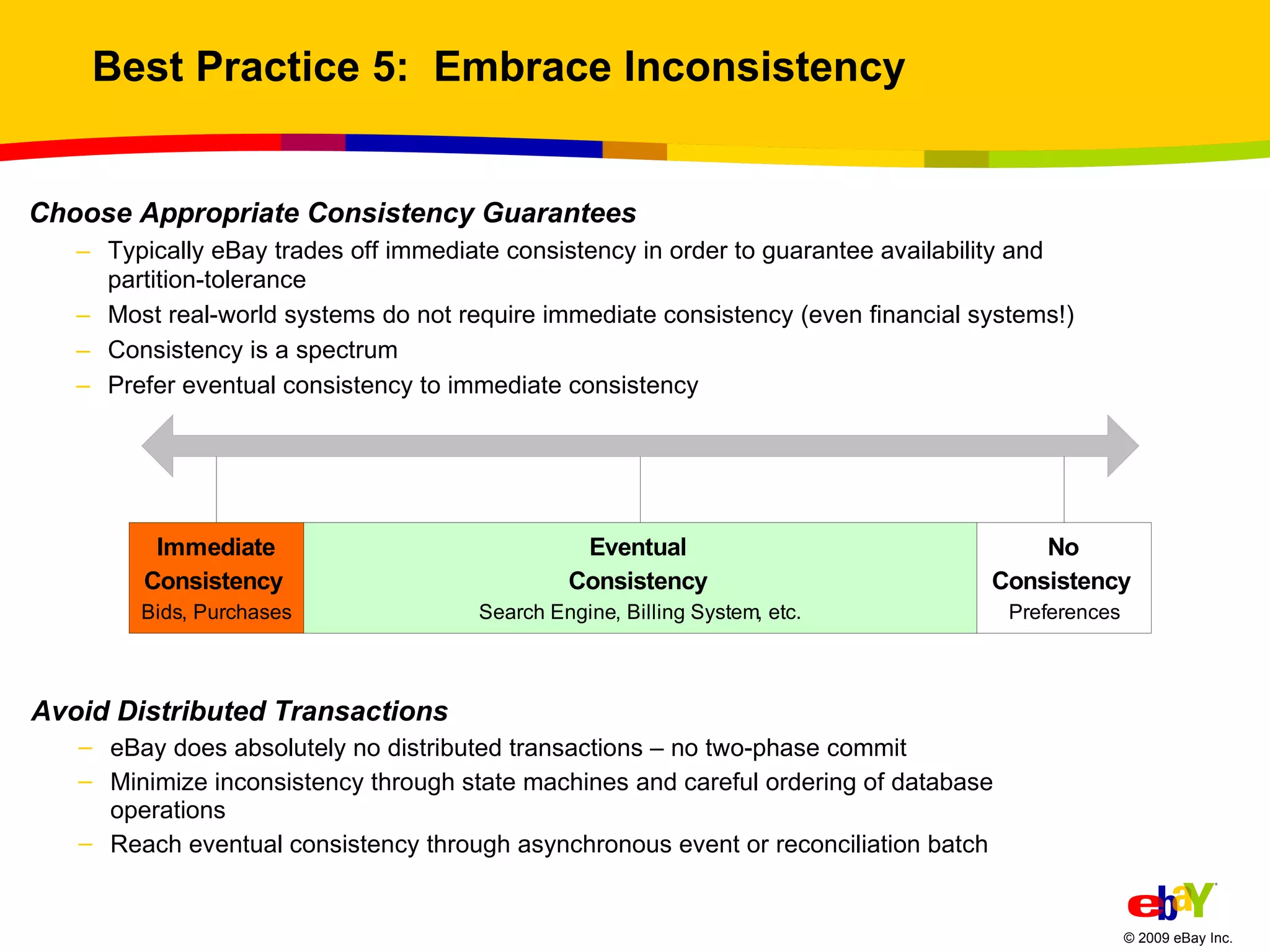
Best Practice 5:  Embrace Inconsistency Choose Appropriate Consistency Guarantees Typically eBay trades off immediate consistency in order to guarantee availability and partition-tolerance Most real-world systems do not require immediate consistency (even financial systems!)  Consistency is a spectrum Prefer eventual consistency to immediate consistency  Avoid Distributed Transactions eBay does absolutely no distributed transactions – no two-phase commit Minimize inconsistency through state machines and careful ordering of database operations Reach eventual consistency through asynchronous event or reconciliation batch
Concluding Messages Message for the Audience:  Best Practices for Scaling Partition Everything  Asynchrony Everywhere  Automate Everything Remember Everything Fails  Embrace Inconsistency  My Dream as an Engineer To build very large distributed systems that are highly efficient, scalable, and resilient
Questions? About the Presenter Randy Shoup  has been the primary architect for eBay's search infrastructure since 2004.  Prior to eBay, Randy was Chief Architect and Technical Fellow at Tumbleweed Communications, and has also held a variety of software development and architecture roles at Oracle and Informatica.  [email_address]

Best Practices for Large-Scale Websites -- Lessons from eBay

  • 1.
    Best Practices forScaling Websites Lessons from eBay Randy Shoup eBay Distinguished Architect QCon Tokyo 2009.04.10
  • 2.
    Challenges at InternetScale eBay users trade over $2000 in goods every second -- $60 billion per year  eBay site stores and actively uses over 2 PB of data eBay processes 50 TB of new, incremental data per day eBay Data Warehouse analyzes 50 PB per day eBay manages … 86.3 million active users worldwide 120 million items for sale in 50,000 categories Over 2 billion page views per day In a dynamic environment 300+ features per quarter We roll 100,000+ lines of code every two weeks In 39 countries, in 8 languages, 24x7x365 >48 Billion SQL executions/day!
  • 3.
    Architectural Forces atInternet Scale Scalability Resource usage should increase linearly (or better!) with load Design for 10x growth in data, traffic, users, etc. Availability Resilience to failure Rapid recoverability from failure Graceful degradation Latency User experience latency Data / execution latency Manageability Simplicity Maintainability Diagnostics Cost Development effort and complexity Operational cost (TCO)
  • 4.
    Best Practices forScaling Partition Everything Asynchrony Everywhere Automate Everything Remember Everything Fails Embrace Inconsistency
  • 5.
    Best Practice 1: Partition Everything Split every problem into manageable chunks Split by data, load, or usage characteristics “ If you can’t split it, you can’t scale it” Motivations Scalability Can scale different segments independently Can scale by adding more partitions Availability Can isolate failures to a single segment or partition Manageability Can independently configure or upgrade a single partition Cost Can choose partition size to maximize price-performance
  • 6.
    Best Practice 1: Partition Everything Pattern: Functional Segmentation Segment processing into pools, services, and stages Segment data by entity and usage characteristics Pattern: Horizontal Split Load-balance processing Within a pool, all servers are created equal Split (or “ shard ”) data along primary access path Partition by modulo of a key, range, lookup, etc. Corollary: No Session State User session flow moves through multiple application pools Absolutely no session state in application tier Session state maintained in cookie, URL, or database
  • 7.
    Best Practice 2: Asynchrony Everywhere Prefer Asynchronous Processing Move as much processing as possible to asynchronous flows Where possible, integrate components asynchronously Motivations Scalability Can independently scale components A and B Availability Allows component A or B to be temporarily unavailable Can retry operations Latency Can reduce user experience latency at the cost of increasing data/execution latency Can allocate more time to processing than user would tolerate Cost Can dampen peaks in load by queueing work for later Can provision resources for the average load rather than the peak load
  • 8.
    Best Practice 2: Asynchrony Everywhere Pattern: Event Queue Primary application writes data and produces event Create event transactionally with primary insert/update (e.g., ITEM.NEW , ITEM.BID , ITEM.SOLD ) Consumers subscribe to event At least once delivery, rather than exactly once No guaranteed order, rather than in-order Idempotency and readback Pattern: Message Multicast Search Feeder publishes item updates Reads item updates from primary database Publishes sequenced updates via multicast to search grid Search engines listen to assigned subset of messages Update in-memory index in real time Request recovery when messages are missed
  • 9.
    Best Practice 3: Automate Everything Prefer Adaptive / Automated Systems to Manual Systems Motivations Scalability Can scale with machines, not humans Availability Can adapt to changing environment more rapidly Cost Machines are far less expensive than humans Can adjust themselves over time without manual effort
  • 10.
    Best Practice 3: Automate Everything Pattern: Adaptive Configuration Do not manually configure event consumers Number of threads, polling frequency, batch size, etc. Define SLA for a given consumer E.g., process 99% of events within 15 seconds Each consumer dynamically adjusts to meet defined SLA Consumers automatically adapt to changes in Load Event processing time Number of consumer instances Pattern: Machine Learning Dynamically adapt search experience On every request, determine best inventory and assemble optimal page for that user and context Feedback loop enables system to learn and improve over time Collect user behavior Aggregate and analyze offline Deploy updated metadata Decide and serve appropriate experience
  • 11.
    Best Practice 4: Remember Everything Fails Build all systems to be tolerant of failure Assume every operation will fail and every resource will be unavailable Detect failure as rapidly as possible Recover from failure as rapidly as possible Do as much as possible during failure Motivation Availability
  • 12.
    Best Practice 4: Remember Everything Fails Pattern: Failure Detection Servers log all requests Log all application activity, database and service calls on multicast message bus Over 2TB of log messages per day Listeners automate failure detection and notification Pattern: Rollback Absolutely no changes to the site which cannot be undone (!) Every feature has on / off state driven by central configuration Feature can be immediately turned off for operational or business reasons Features can be deployed “wired-off” Pattern: Graceful Degradation Application “marks down” a resource if it is unavailable or distressed Application removes or ignores non-critical operations Application retries critical operations or defers them to an asynchronous event
  • 13.
    Best Practice 5: Embrace Inconsistency Brewer’s CAP Theorem Any shared-data system can have at most two of the following properties: C onsistency: All clients see the same data, even in the presence of updates A vailability: All clients will get a response, even in the presence of failures P artition-tolerance: The system properties hold even when the network is partitioned This trade-off is fundamental to all distributed systems
  • 14.
    Best Practice 5: Embrace Inconsistency Choose Appropriate Consistency Guarantees Typically eBay trades off immediate consistency in order to guarantee availability and partition-tolerance Most real-world systems do not require immediate consistency (even financial systems!) Consistency is a spectrum Prefer eventual consistency to immediate consistency Avoid Distributed Transactions eBay does absolutely no distributed transactions – no two-phase commit Minimize inconsistency through state machines and careful ordering of database operations Reach eventual consistency through asynchronous event or reconciliation batch
  • 15.
    Concluding Messages Messagefor the Audience: Best Practices for Scaling Partition Everything Asynchrony Everywhere Automate Everything Remember Everything Fails Embrace Inconsistency My Dream as an Engineer To build very large distributed systems that are highly efficient, scalable, and resilient
  • 16.
    Questions? About thePresenter Randy Shoup has been the primary architect for eBay's search infrastructure since 2004. Prior to eBay, Randy was Chief Architect and Technical Fellow at Tumbleweed Communications, and has also held a variety of software development and architecture roles at Oracle and Informatica. [email_address]