







Architecting for
Massive Scalability
Eric D. Boyd
Director, Chicago + Cloud Practice
Introduction
 Eric D. Boyd
 15 Years in Technology
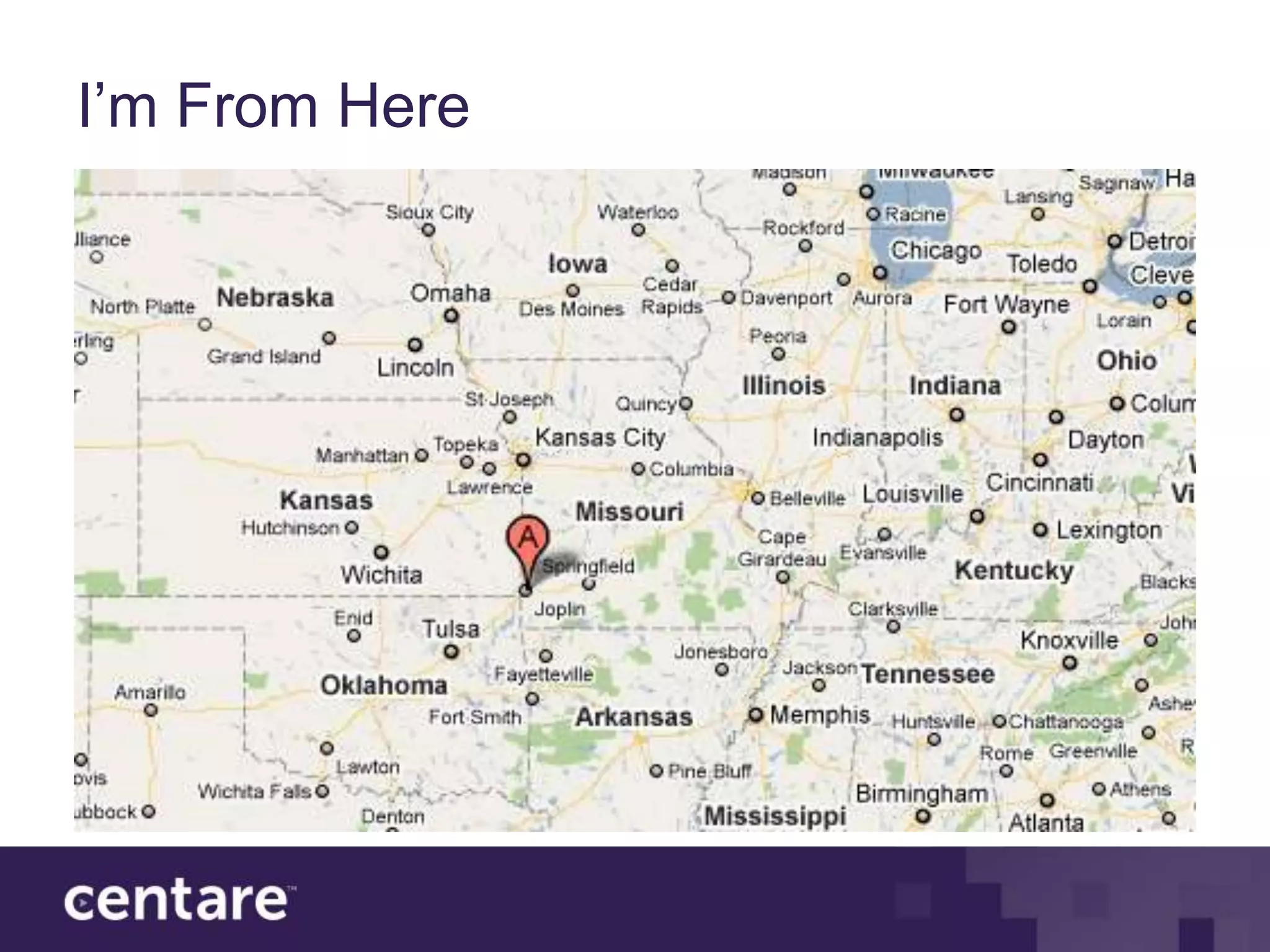
I’m From Here
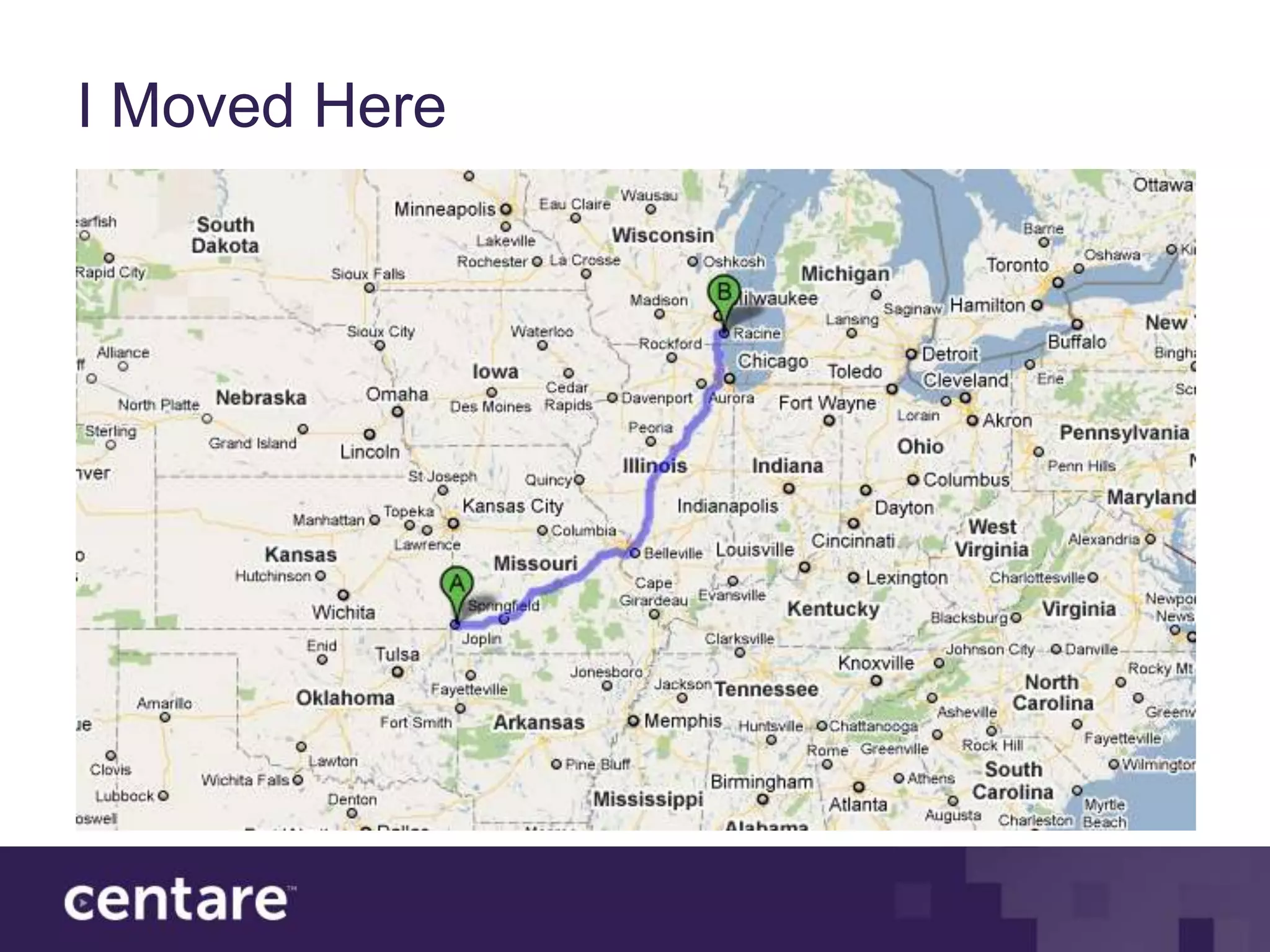
I Moved Here
I Work Here
I Work On
I Blog @ ericdboyd.com
I Tweet @EricDBoyd
Agenda
 What is Scalability?
 ACID, BASE & CAP
 Compute Patterns
 Data Patterns
 Q&A
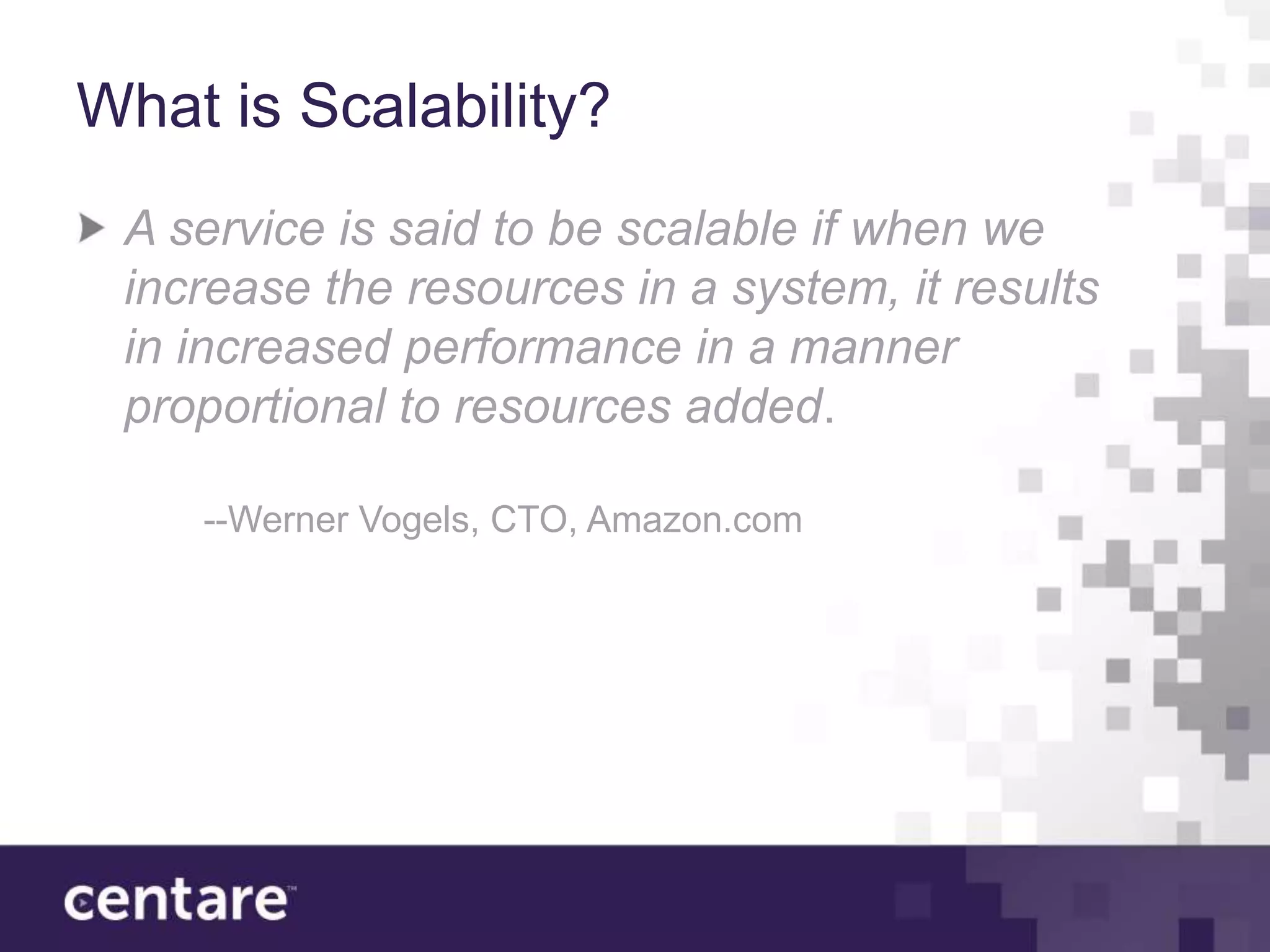
What is Scalability?
 A service is said to be scalable if when we
 increase the resources in a system, it results
 in increased performance in a manner
 proportional to resources added.

    --Werner Vogels, CTO, Amazon.com
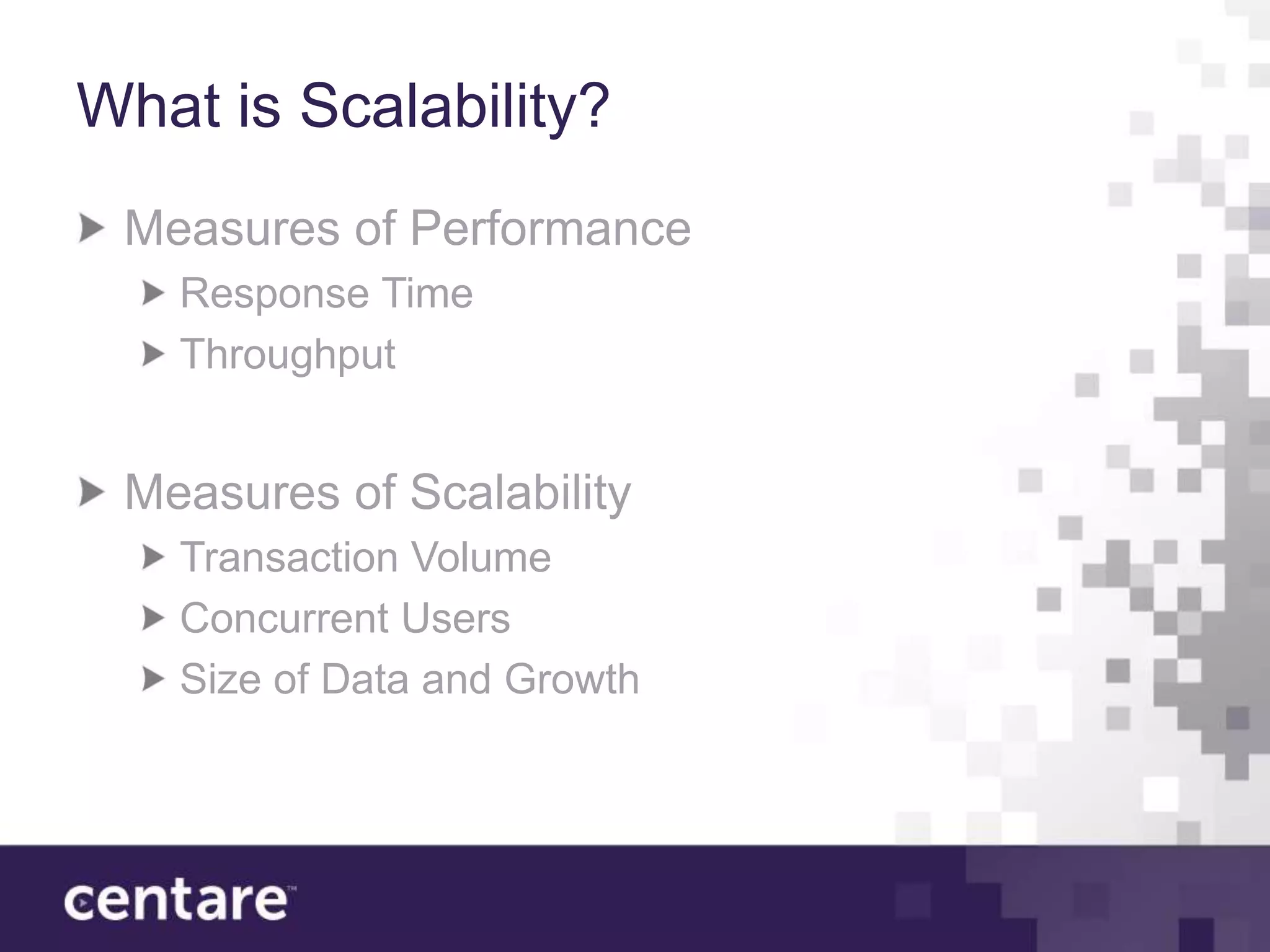
What is Scalability?
 Measures of Performance
   Response Time
   Throughput


 Measures of Scalability
   Transaction Volume
   Concurrent Users
   Size of Data and Growth
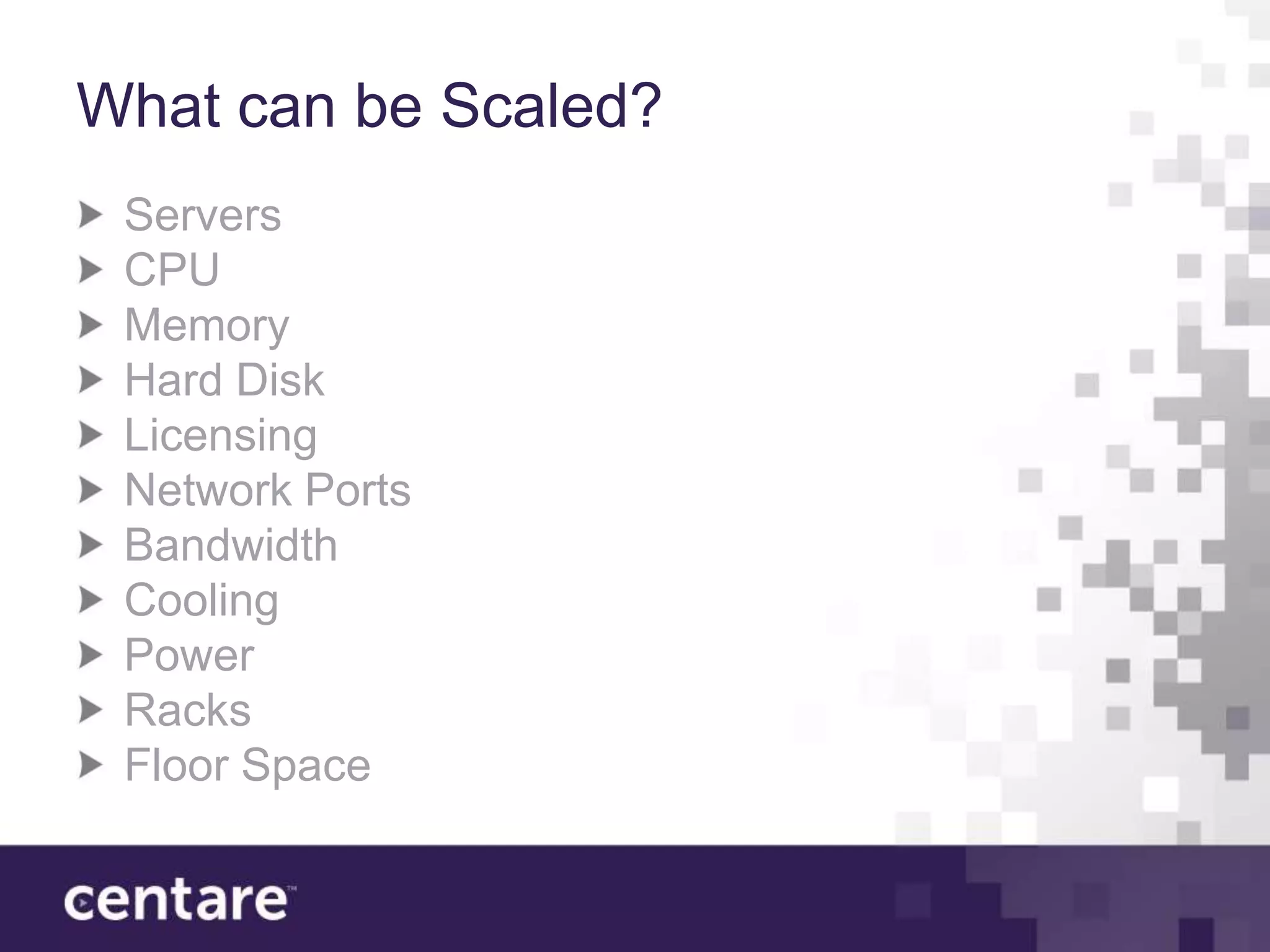
What can be Scaled?
 Servers
 CPU
 Memory
 Hard Disk
 Licensing
 Network Ports
 Bandwidth
 Cooling
 Power
 Racks
 Floor Space
Why is Scalability Important?
 Predictable Growth
 Unpredictable Growth
 Design for Scale

 Benefits of Scalability
   Dynamic Capacity Planning
   Cost is Linear
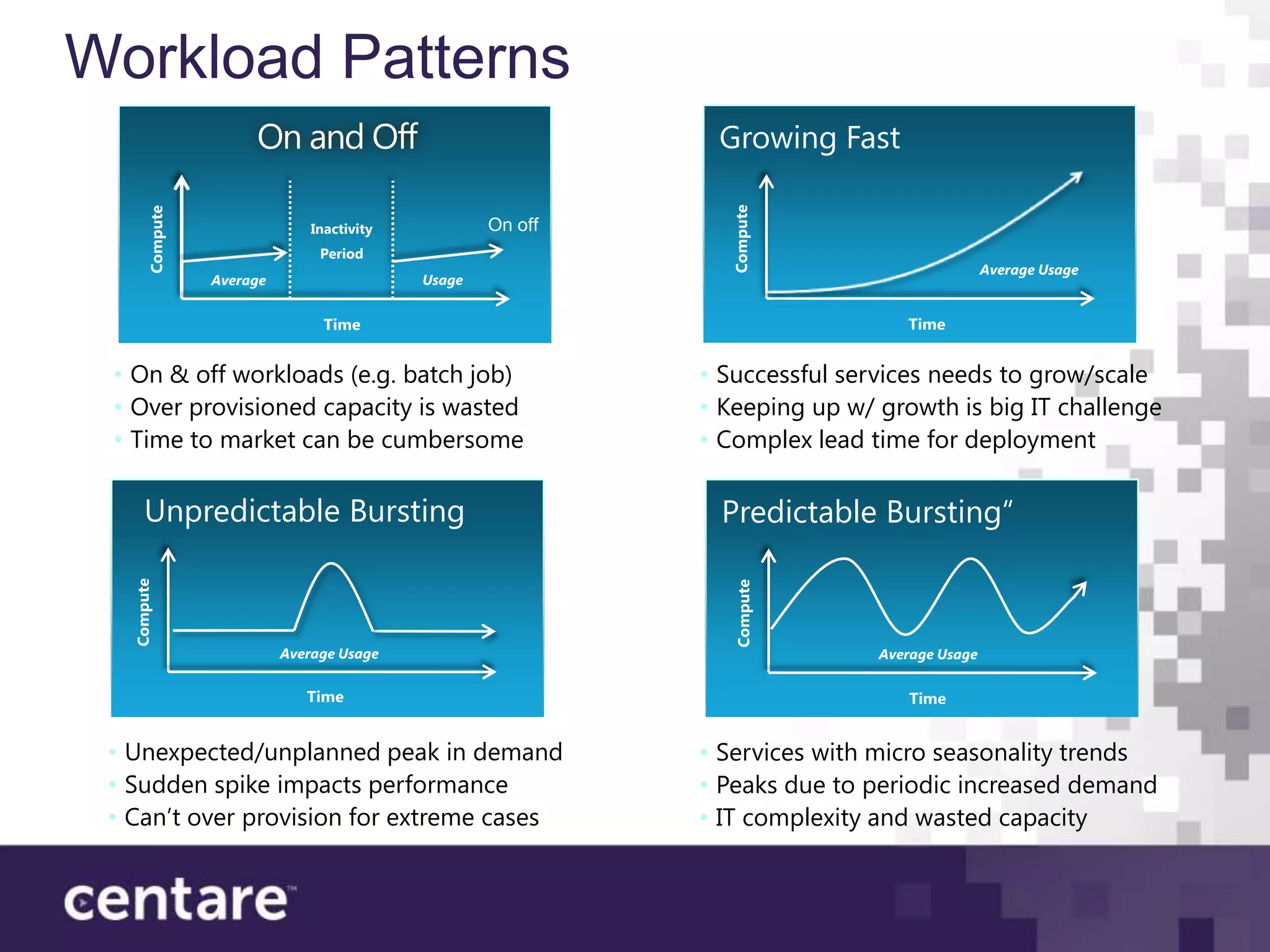
Workload Patterns
                      On and Off                              Growing Fast


                                                               Compute
       Compute


                               Inactivity           On off
                                Period
                                                                                             Average Usage
                 Average                    Usage


                                 Time                                           Time


 • On & off workloads (e.g. batch job)                       • Successful services needs to grow/scale
 • Over provisioned capacity is wasted                       • Keeping up w/ growth is big IT challenge
 • Time to market can be cumbersome                          • Complex lead time for deployment

       Unpredictable Bursting                                 Predictable Bursting“
   Compute


                                                               Compute
                           Average Usage                                     Average Usage


                              Time                                               Time


 • Unexpected/unplanned peak in demand                       • Services with micro seasonality trends
 • Sudden spike impacts performance                          • Peaks due to periodic increased demand
 • Can’t over provision for extreme cases                    • IT complexity and wasted capacity
Traditional Line-of-Business (LOB) Apps
 A - Atomic
 C - Consistent
 I - Isolated
 D - Durable
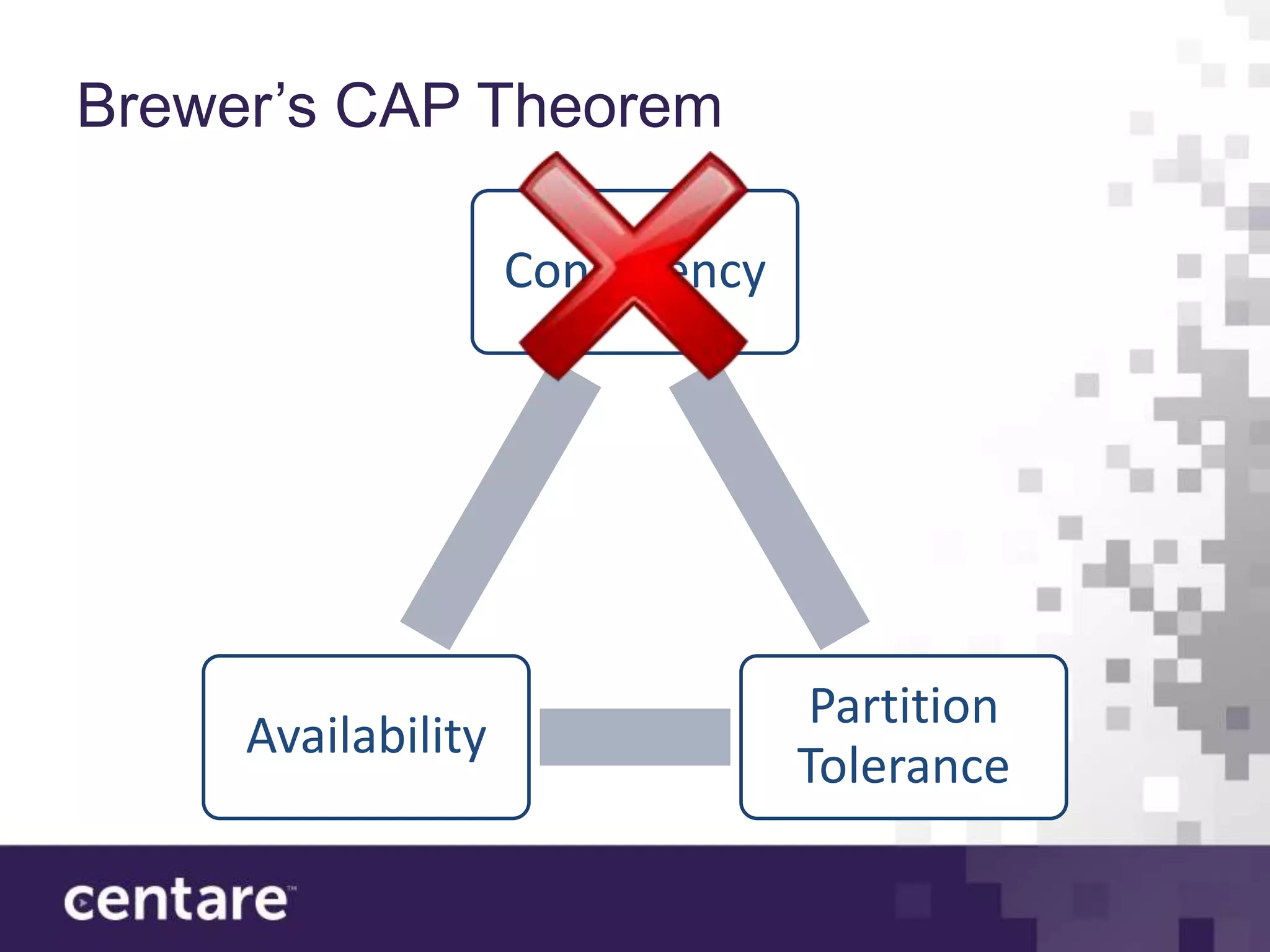
CAP Theorem
 Consistency. The client perceives that a
 set of operations has occurred all at
 once.
 Availability. Every operation must
 terminate in an intended response.
 Partition tolerance. Operations will
 complete, even if individual components
 are unavailable.
Brewer’s CAP Theorem

                    Consistency


                                   Partition
     Availability
                                  Tolerance
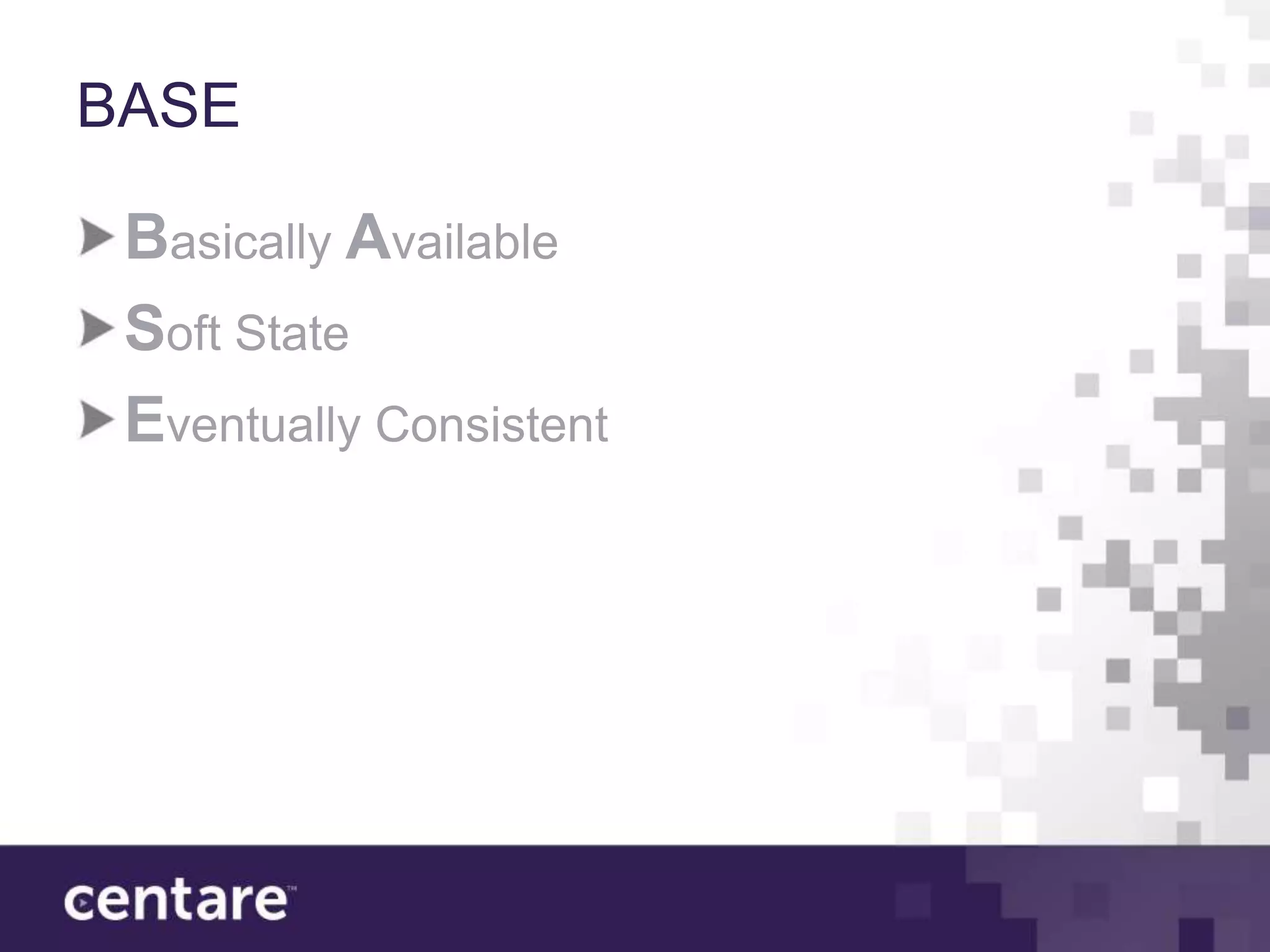
BASE

 Basically Available
 Soft State
 Eventually Consistent
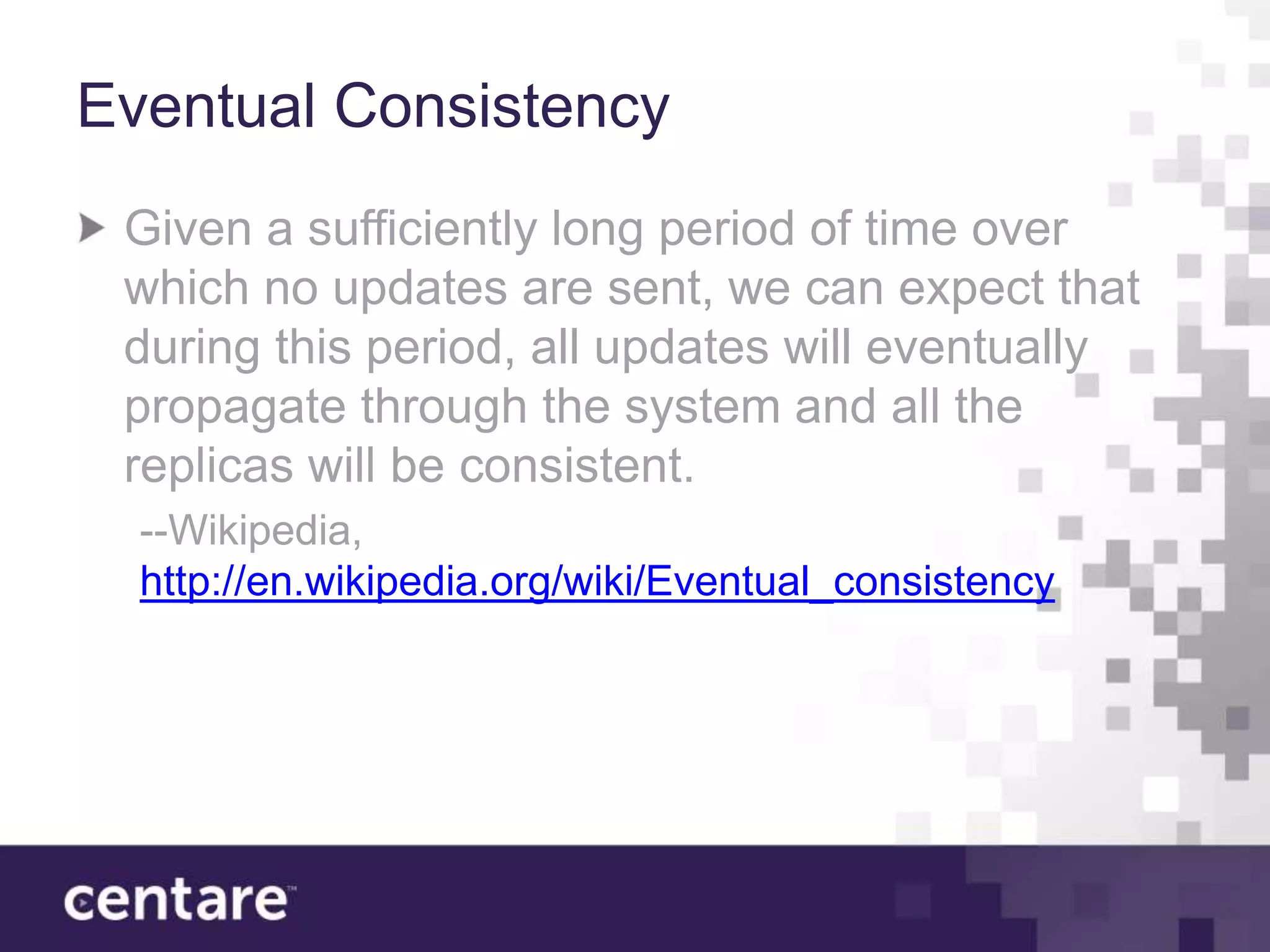
Eventual Consistency
 Given a sufficiently long period of time over
 which no updates are sent, we can expect that
 during this period, all updates will eventually
 propagate through the system and all the
 replicas will be consistent.
  --Wikipedia,
  http://en.wikipedia.org/wiki/Eventual_consistency
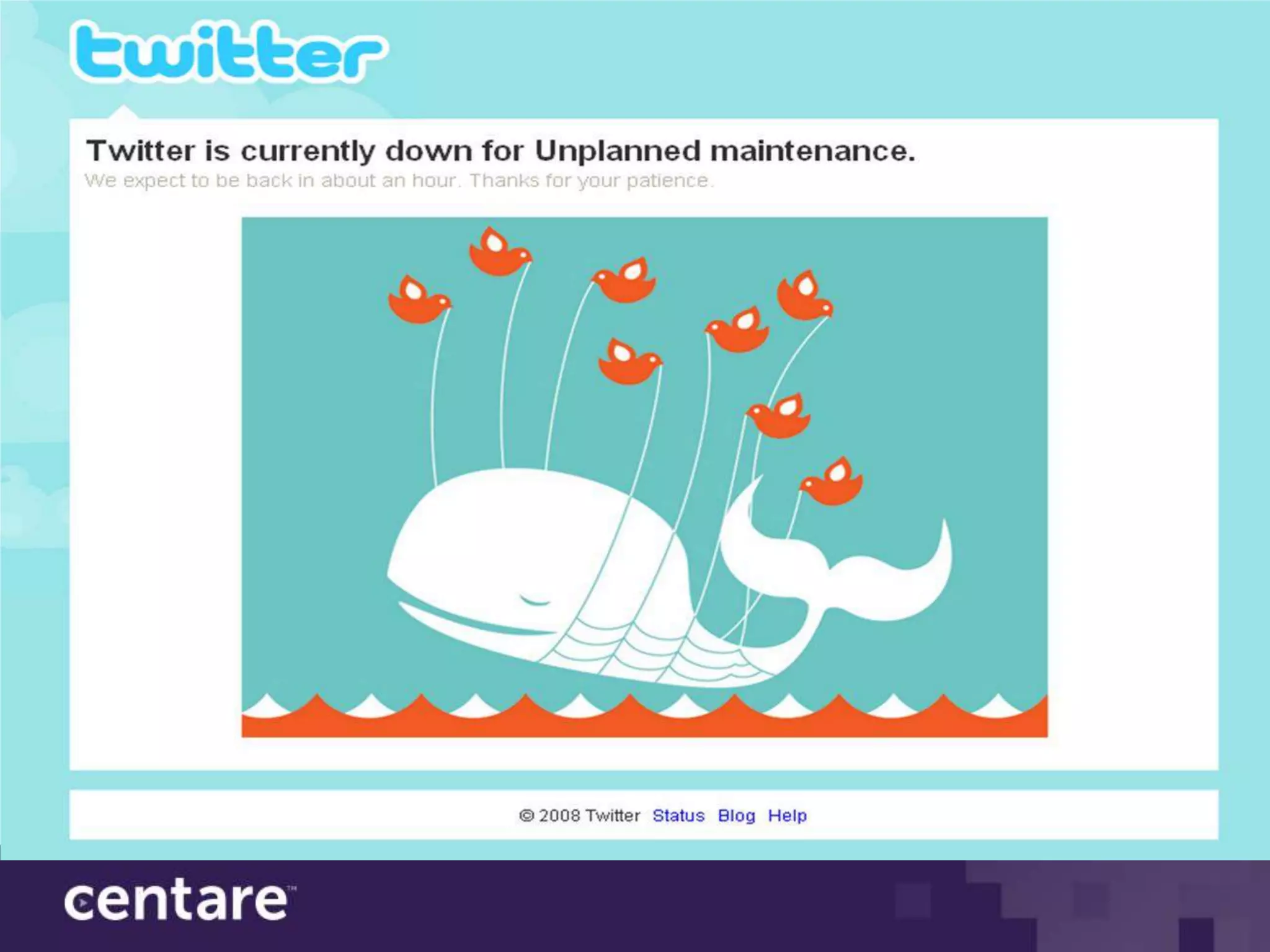
Real-World
 twitter
 Facebook
 eBay
 Amazon
 Foursquare
Compute Patterns
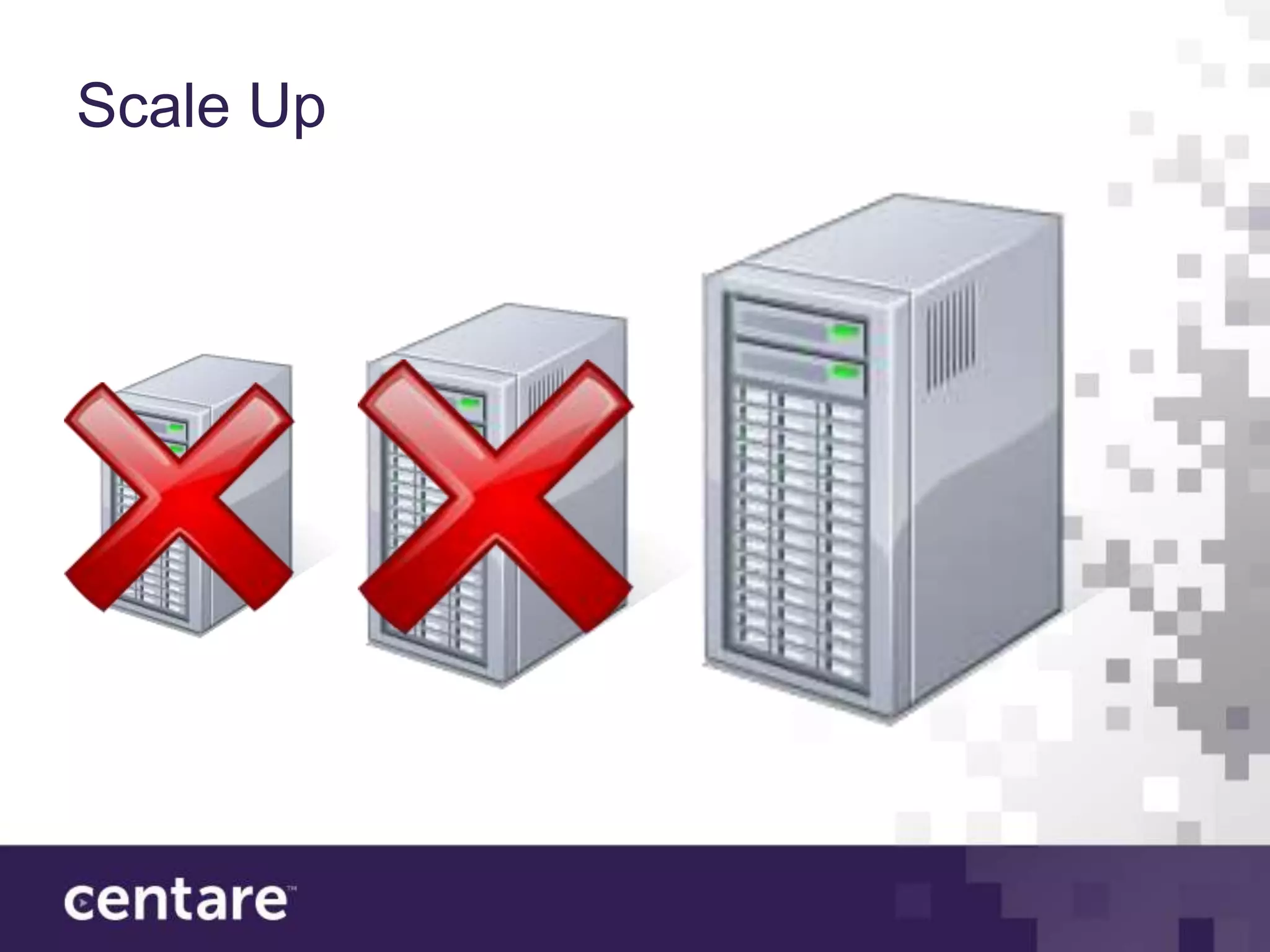
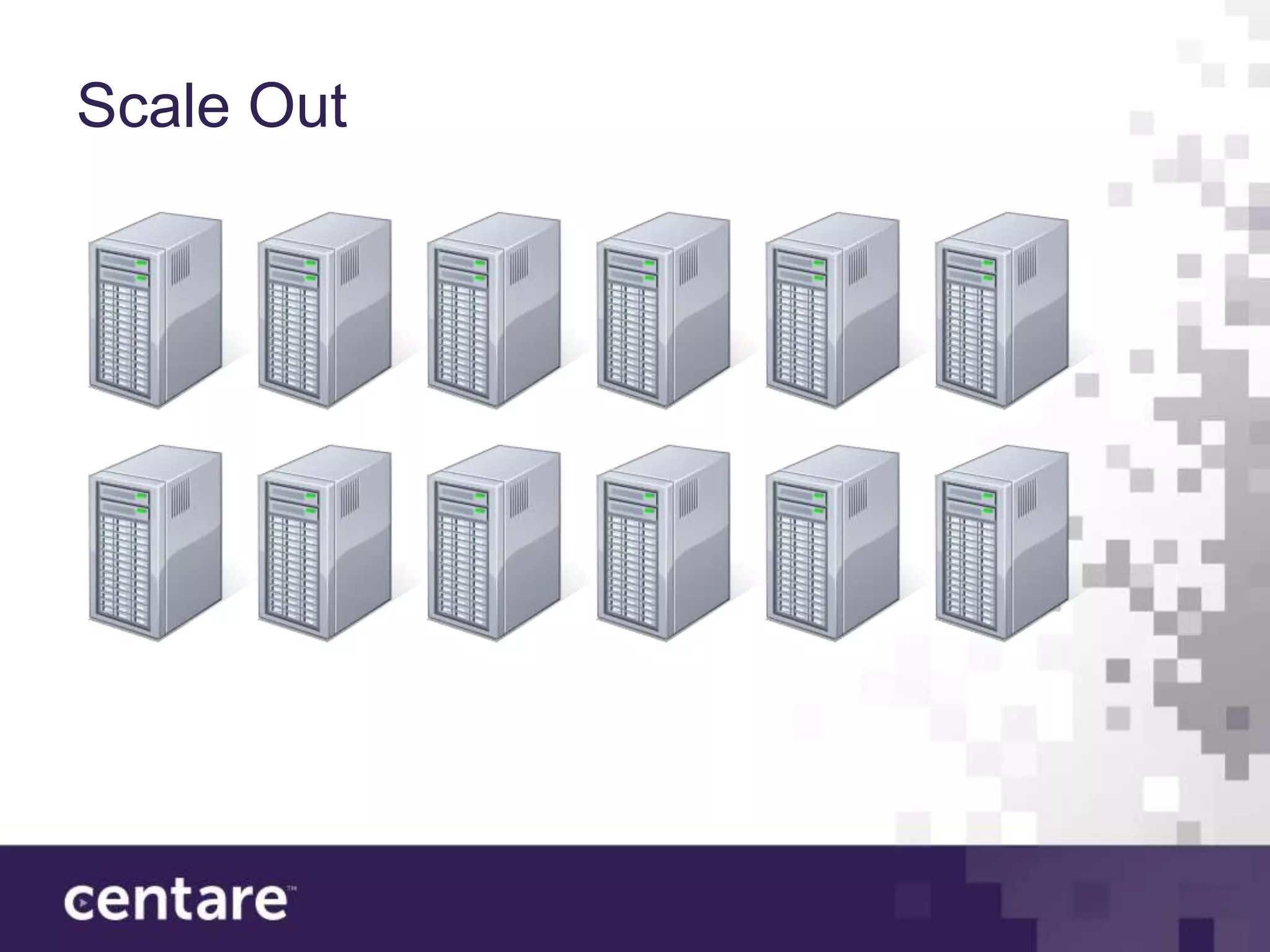
Scale Up
Scale Out
Why Isn’t this the Norm?
 Data is typically Bottleneck
   Designed for and expects ACID
 Not designed for Scale Out
 Load is fixed and constant
 Mind shift and additional work
I Need Scalability
 Loose Coupling
 Stateless
 Messaging & SOA
 Async & Background Processes
 Queuing
 Monitoring and Diagnostics
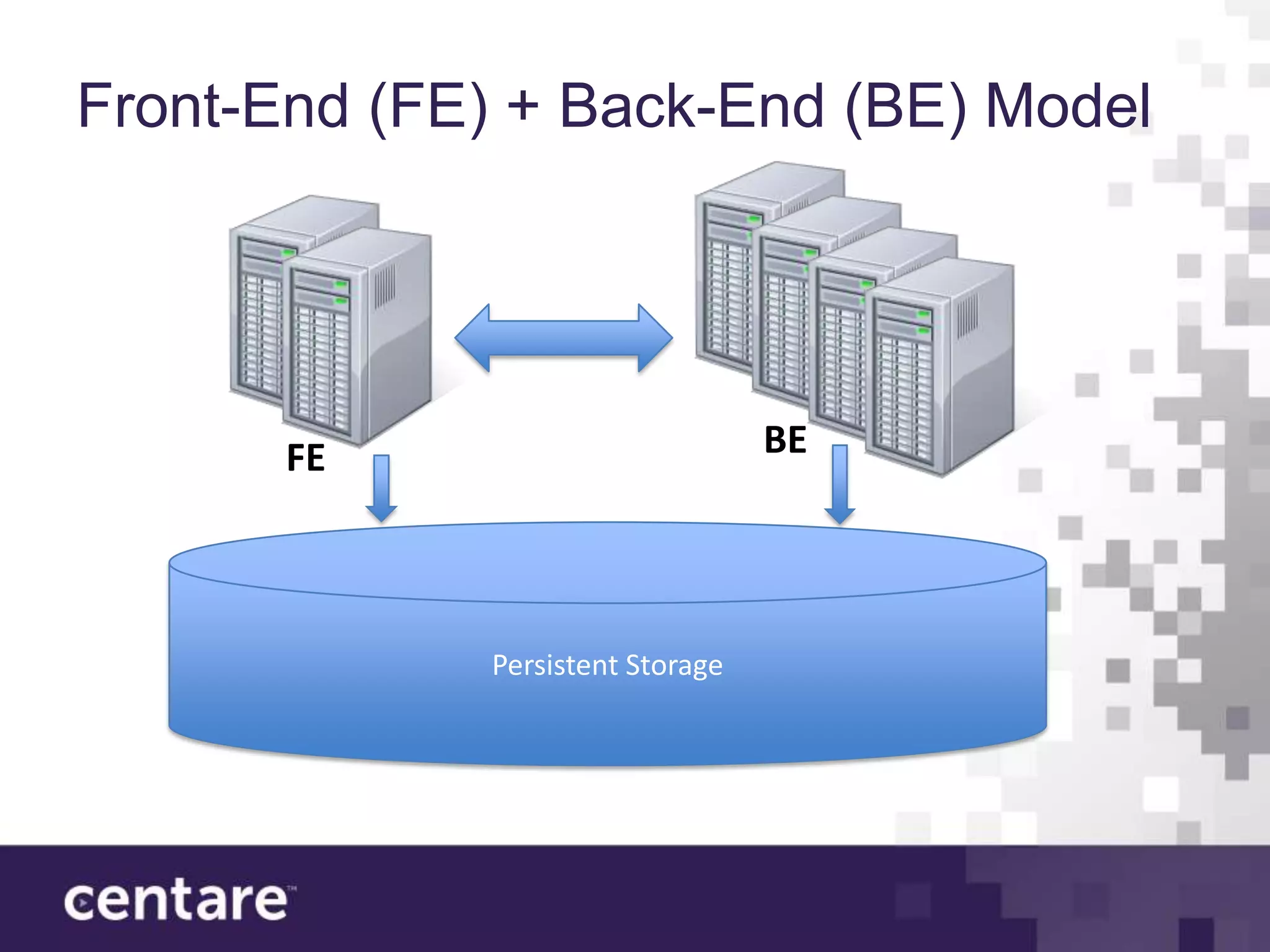
Front-End (FE) + Back-End (BE) Model


       FE                         BE


             Persistent Storage
Front-End (FE) + Back-End (BE) Architecture

 (FE) requests (BE) to perform work
 (BE) completes work
 (BE) reports results back to (FE)
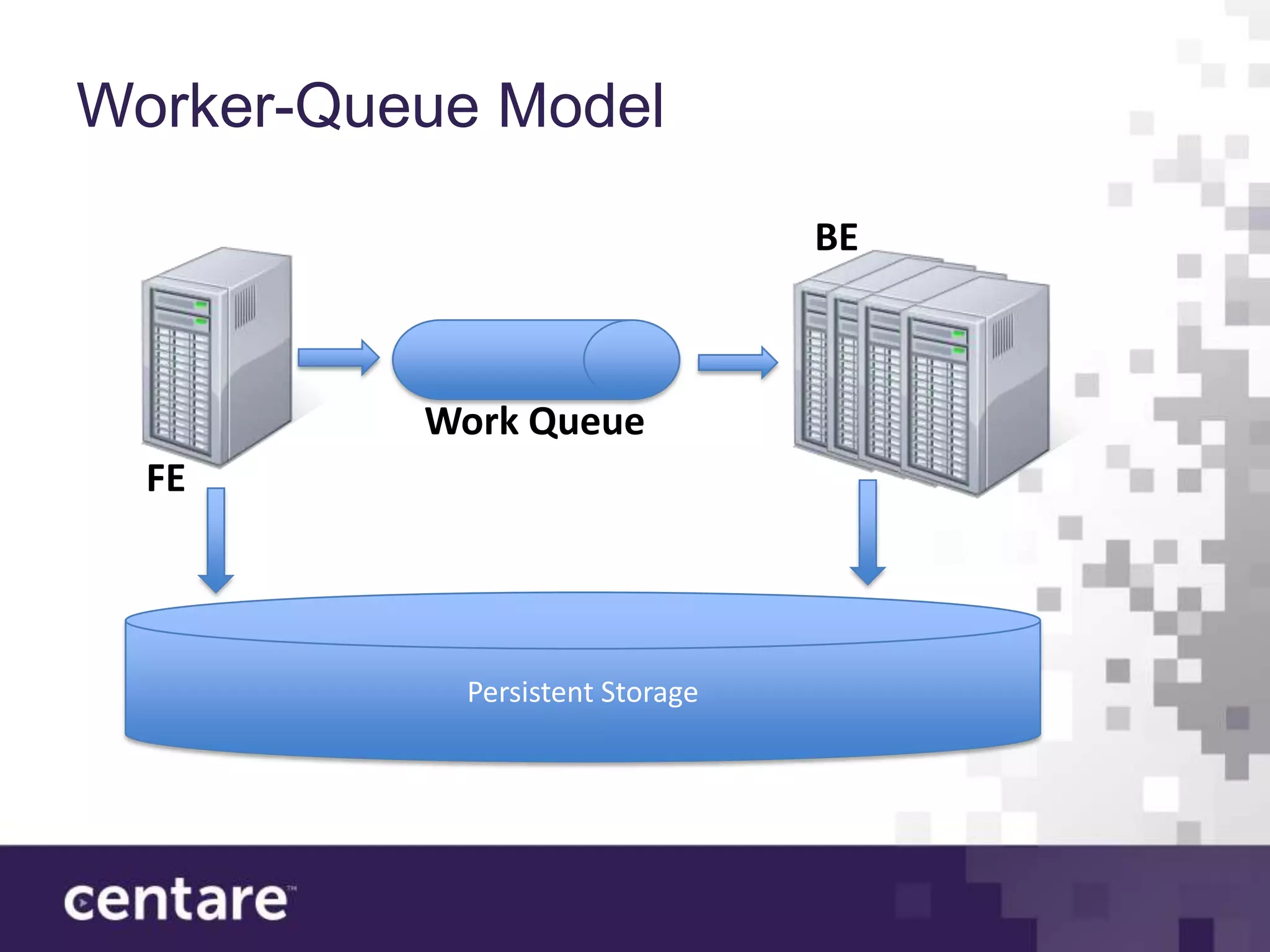
Worker-Queue Model
                                BE


          Work Queue
  FE


           Persistent Storage
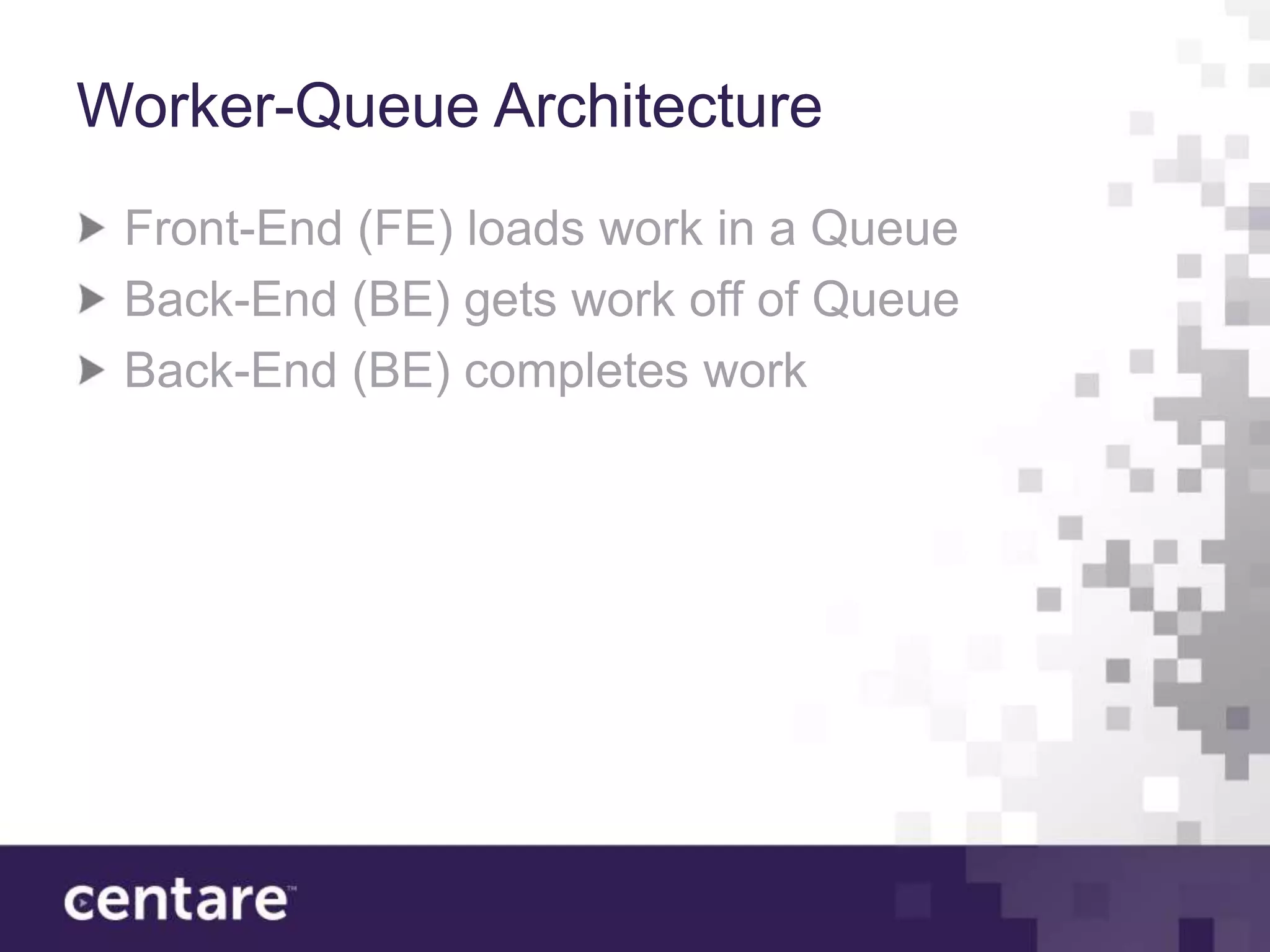
Worker-Queue Architecture
 Front-End (FE) loads work in a Queue
 Back-End (BE) gets work off of Queue
 Back-End (BE) completes work
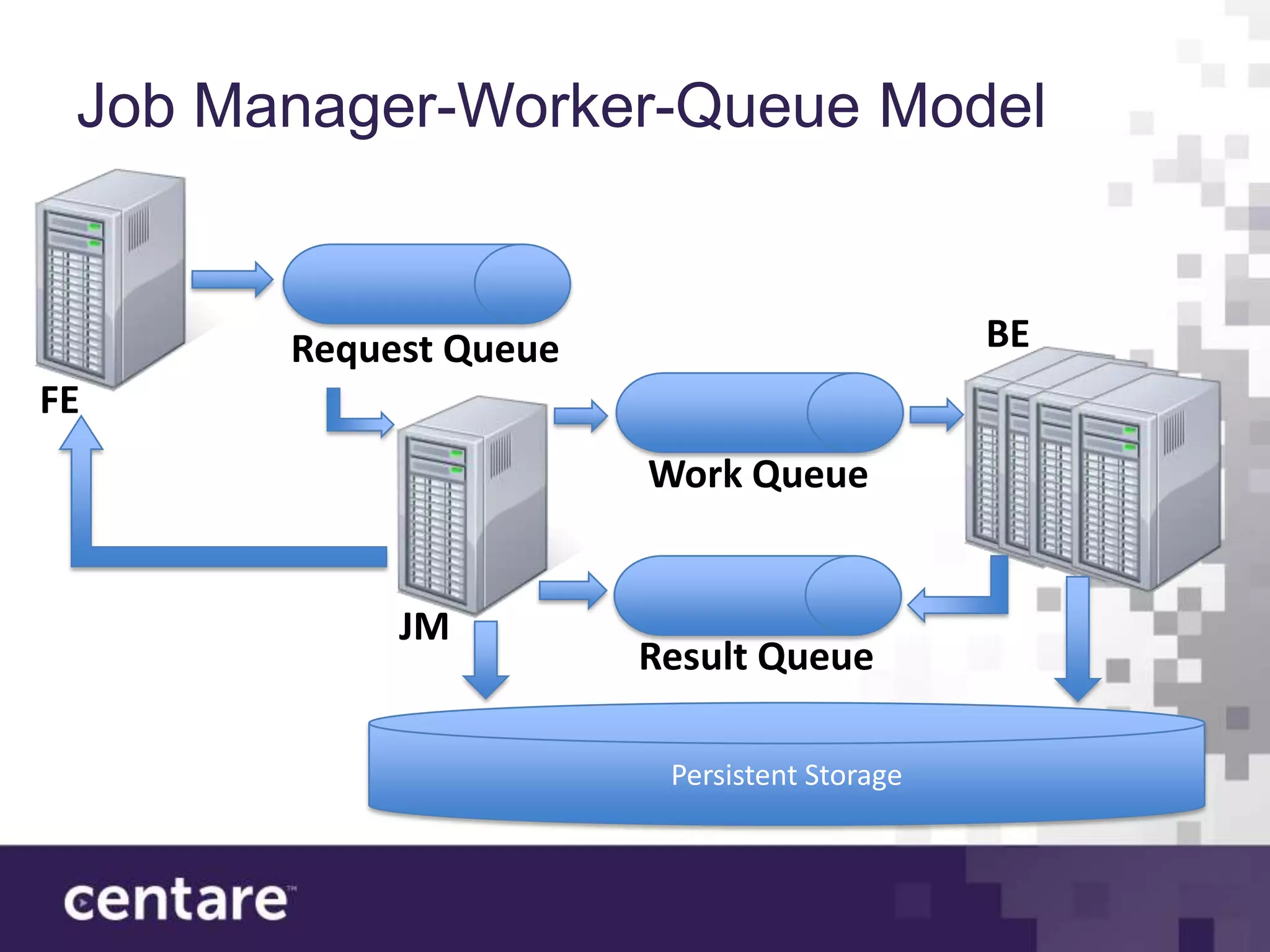
Job Manager-Worker-Queue Model


       Request Queue                         BE
FE
                       Work Queue


            JM
                       Result Queue

                        Persistent Storage
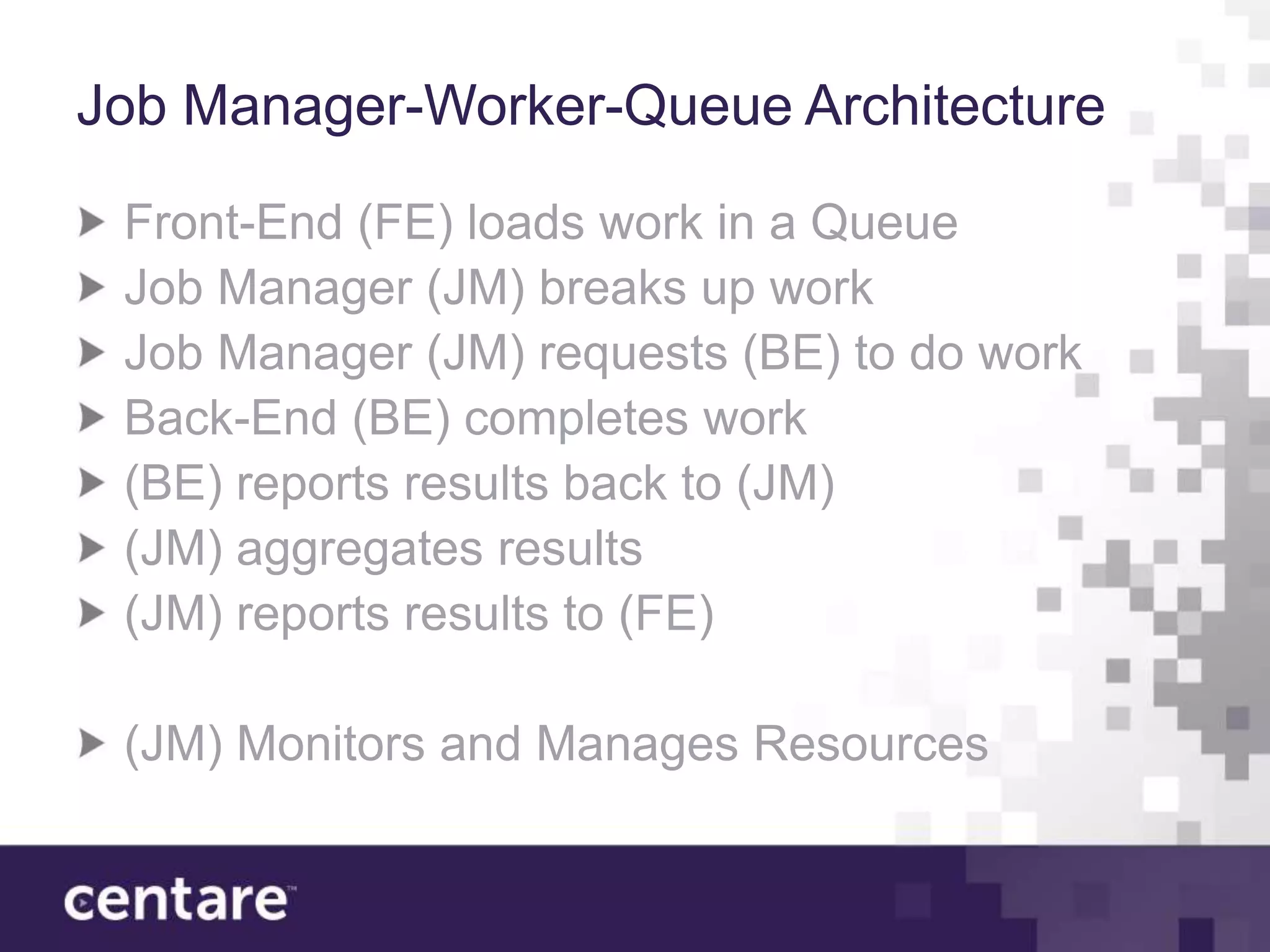
Job Manager-Worker-Queue Architecture

 Front-End (FE) loads work in a Queue
 Job Manager (JM) breaks up work
 Job Manager (JM) requests (BE) to do work
 Back-End (BE) completes work
 (BE) reports results back to (JM)
 (JM) aggregates results
 (JM) reports results to (FE)

 (JM) Monitors and Manages Resources
Data Patterns
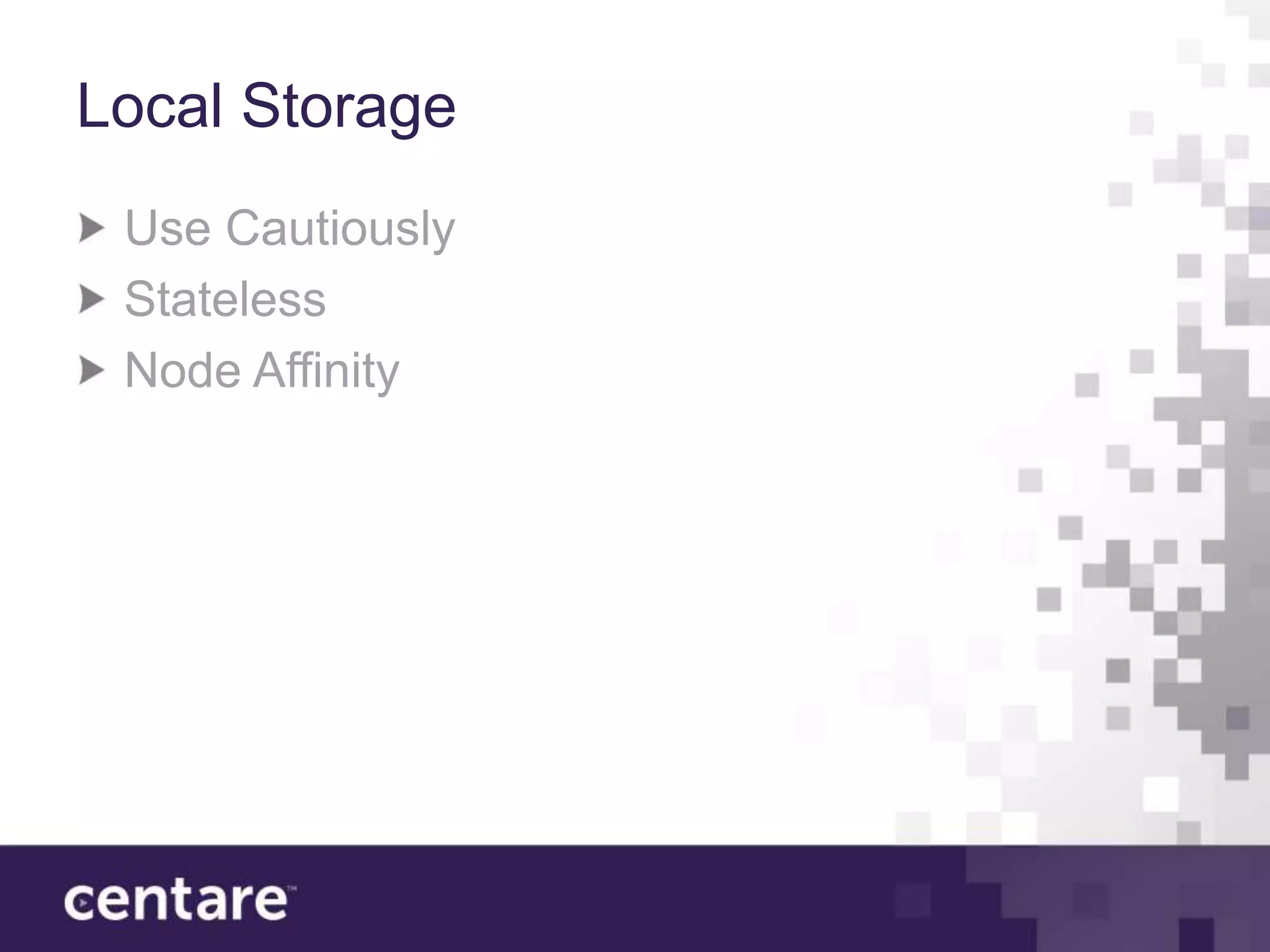
Local Storage
 Use Cautiously
 Stateless
 Node Affinity
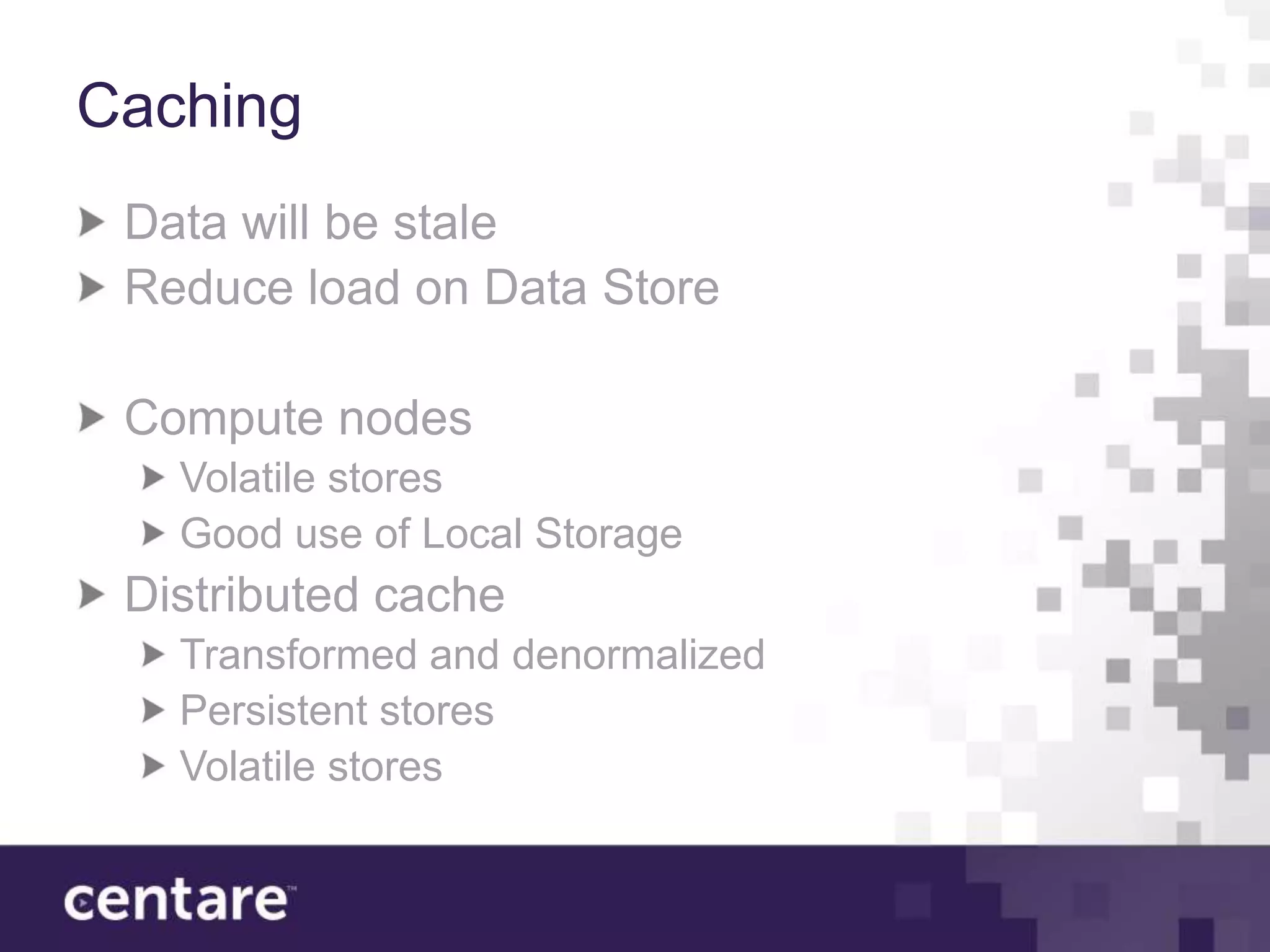
Caching
 Data will be stale
 Reduce load on Data Store

 Compute nodes
   Volatile stores
   Good use of Local Storage
 Distributed cache
   Transformed and denormalized
   Persistent stores
   Volatile stores
Geographic Distribution
 Minimize Travel Costs
 Localize Data Centers
 CDNs
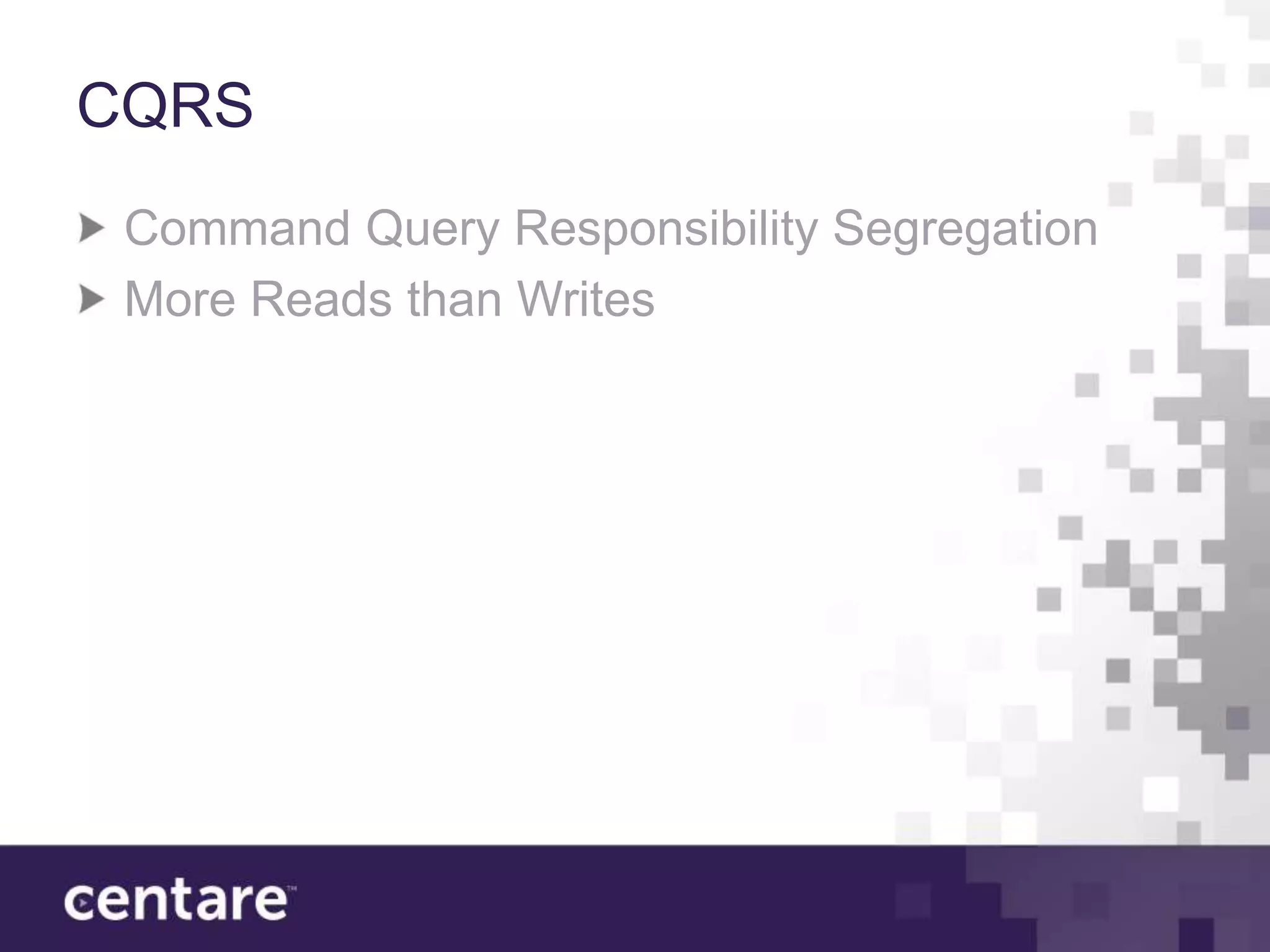
CQRS
 Command Query Responsibility Segregation
 More Reads than Writes
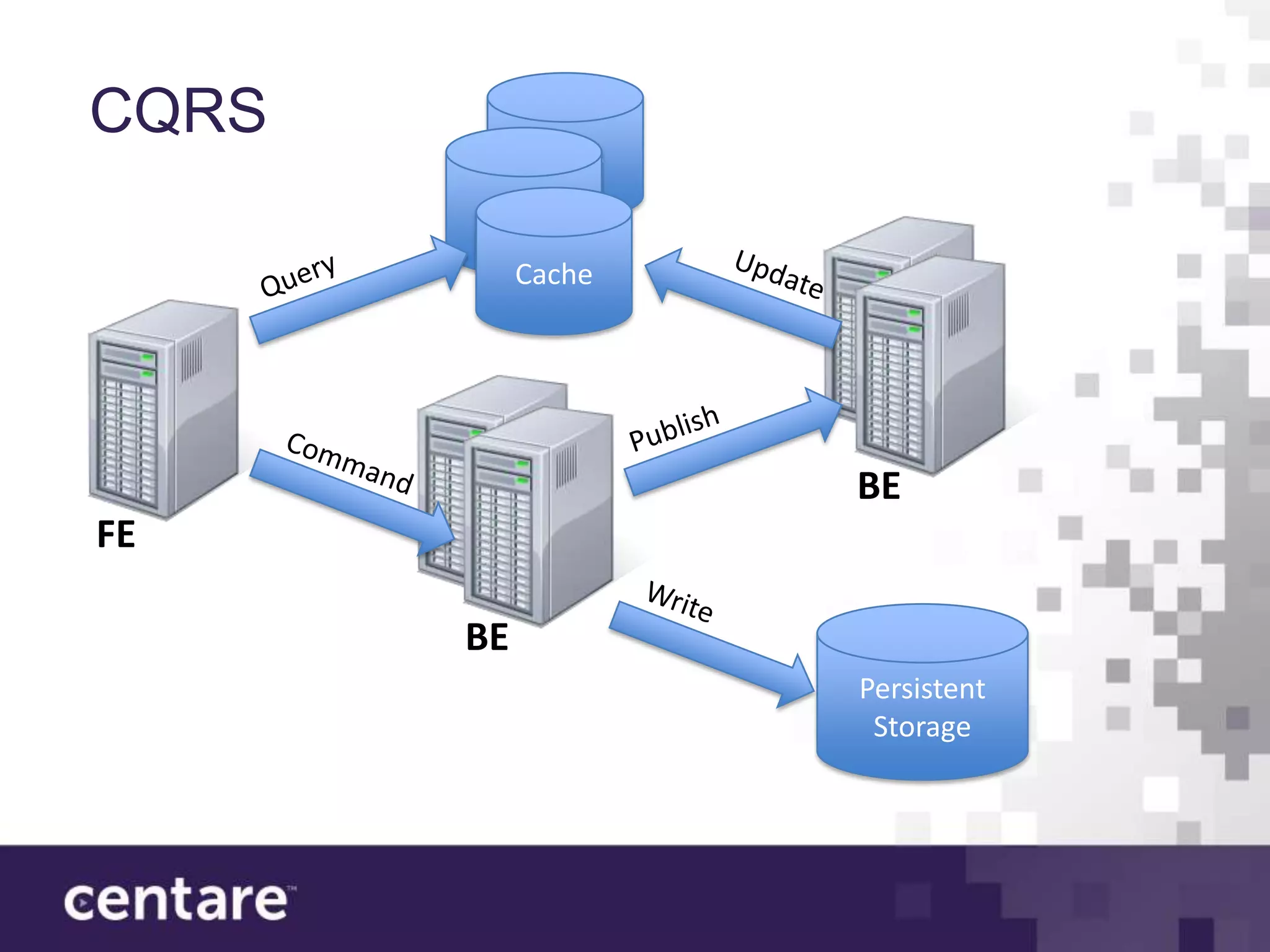
CQRS
            Cache
       Cache
            Cache


                    BE
FE

       BE
                    Persistent
                     Storage
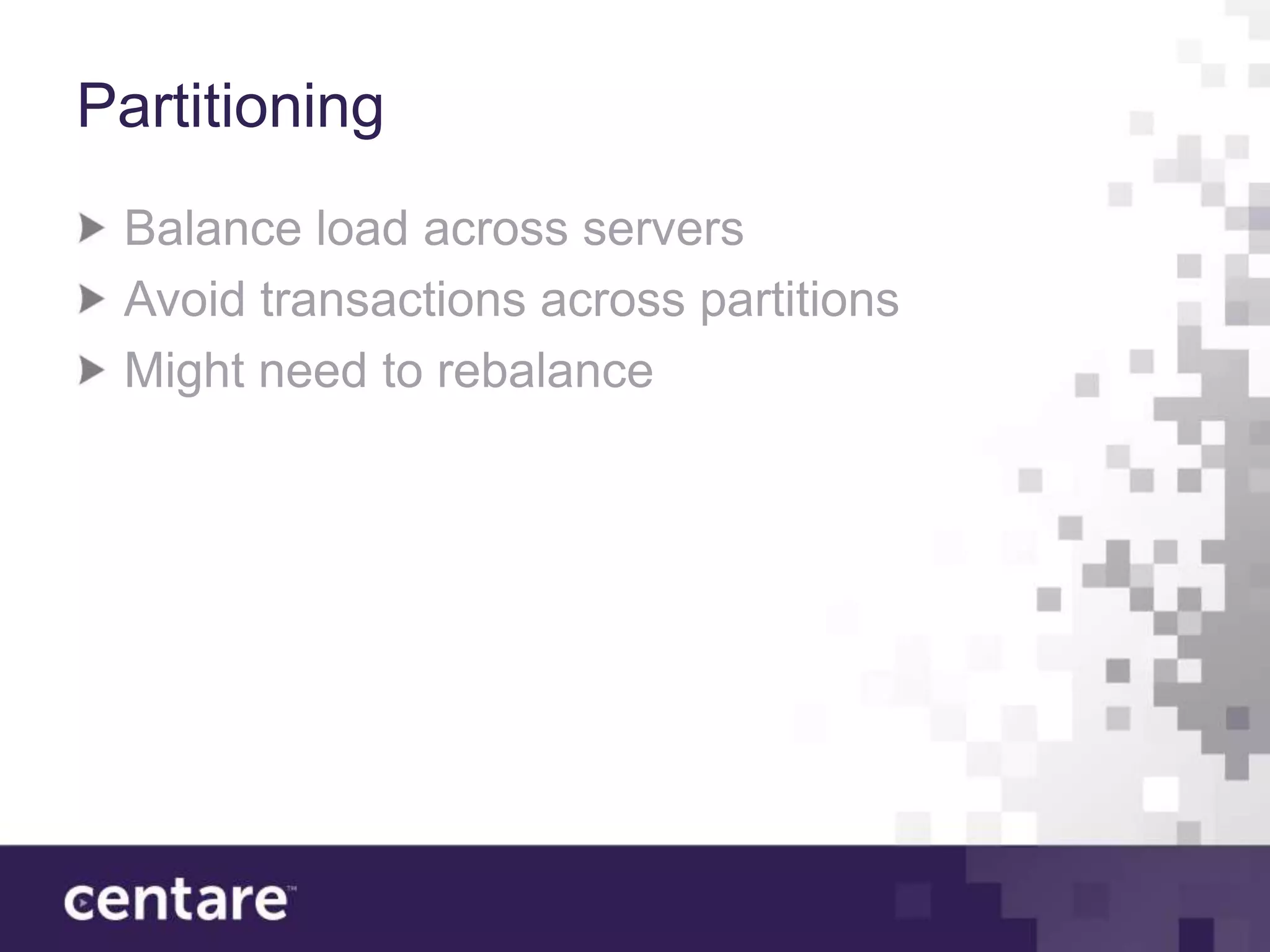
Partitioning
 Balance load across servers
 Avoid transactions across partitions
 Might need to rebalance
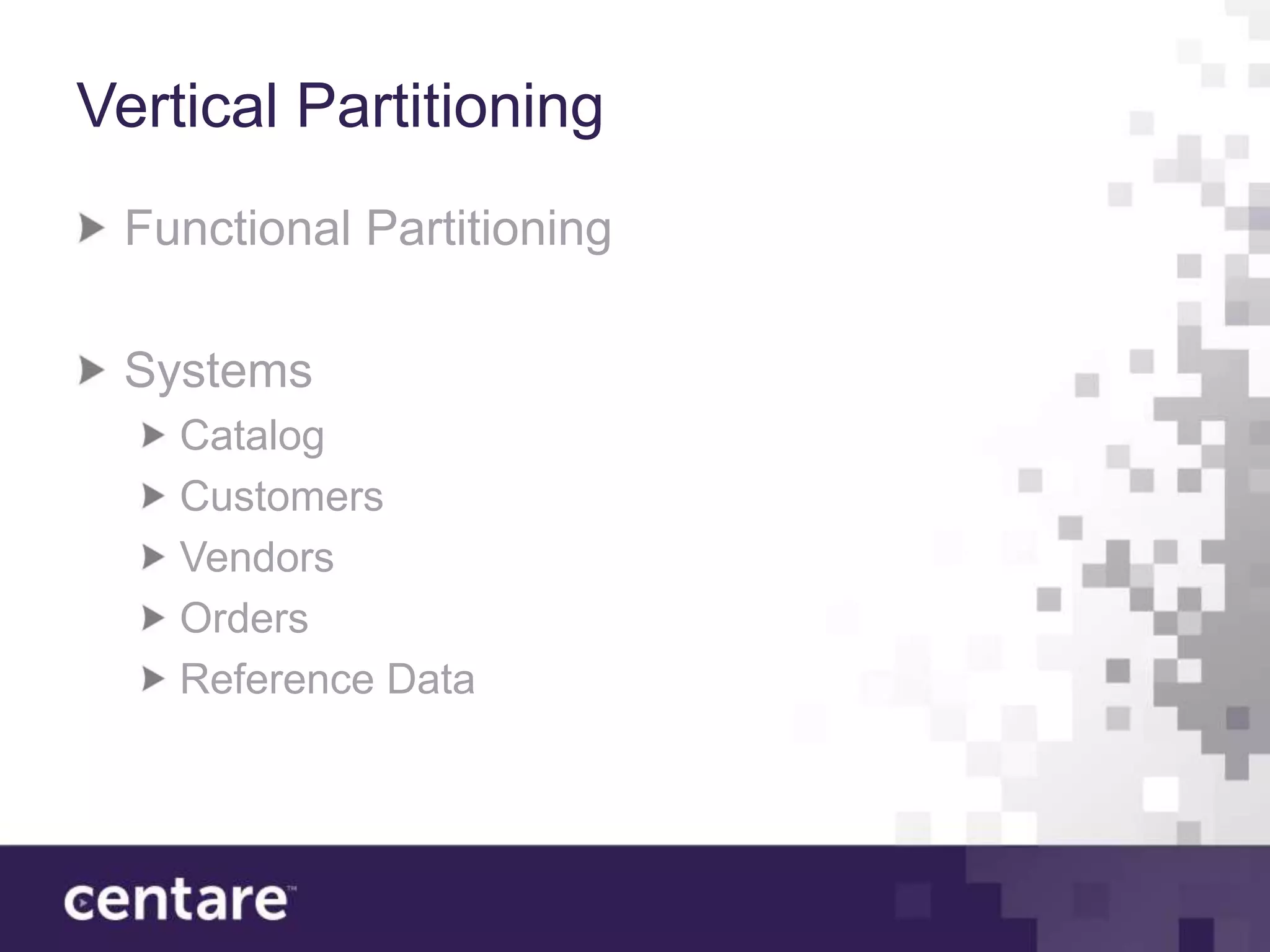
Vertical Partitioning
 Functional Partitioning

 Systems
    Catalog
    Customers
    Vendors
    Orders
    Reference Data
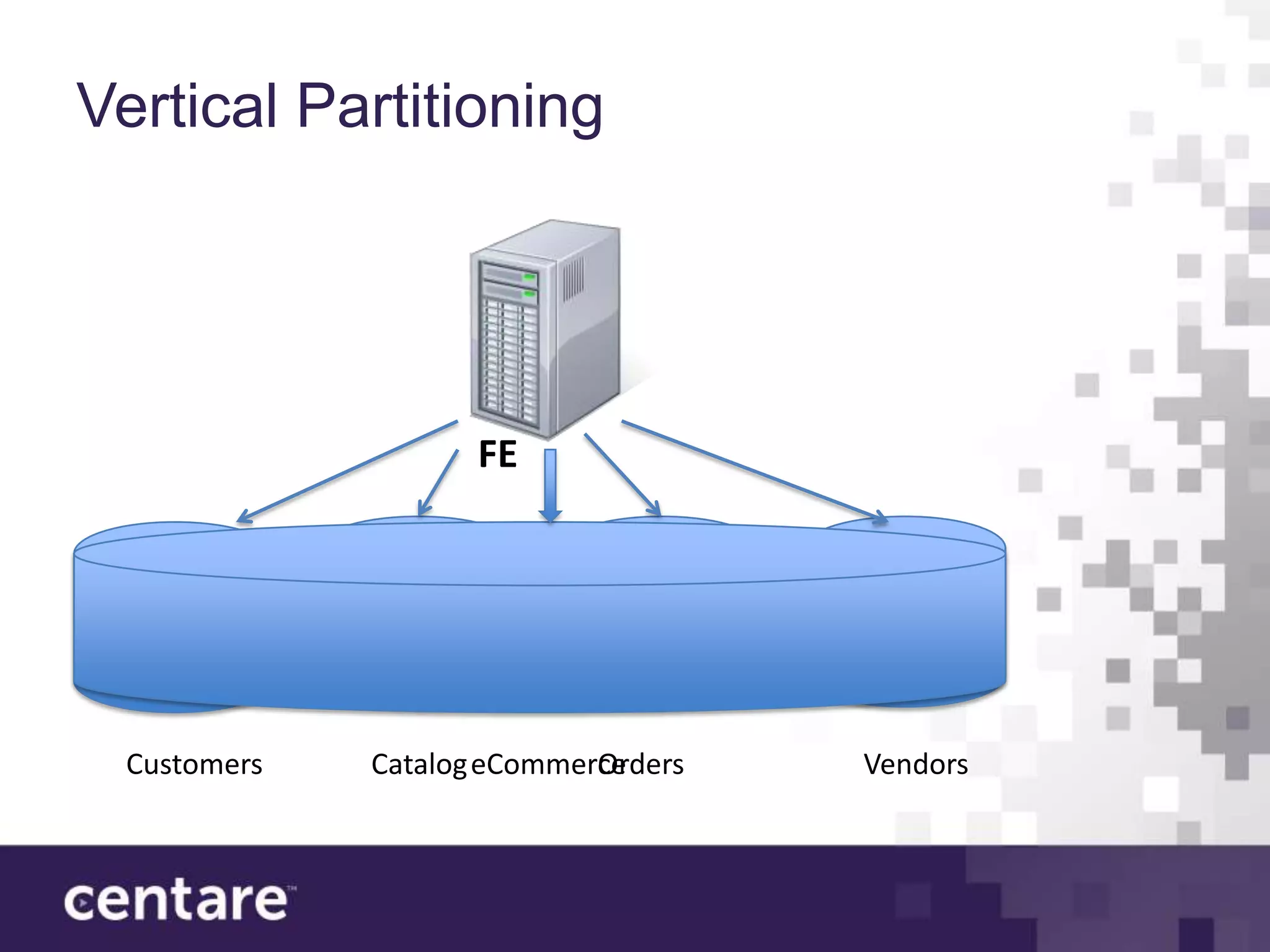
Vertical Partitioning


                    FE


 Customers   Catalog eCommerce
                            Orders   Vendors
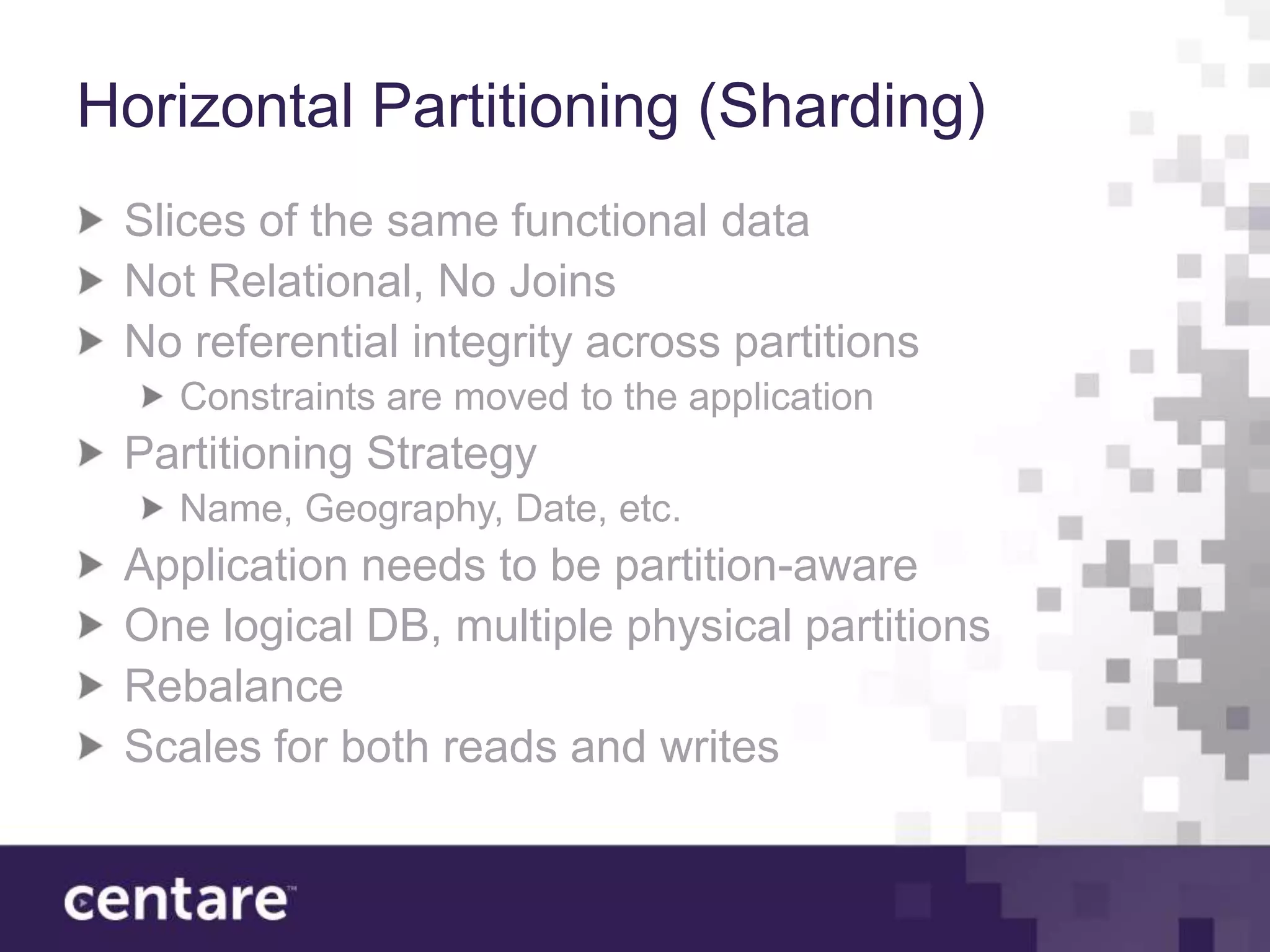
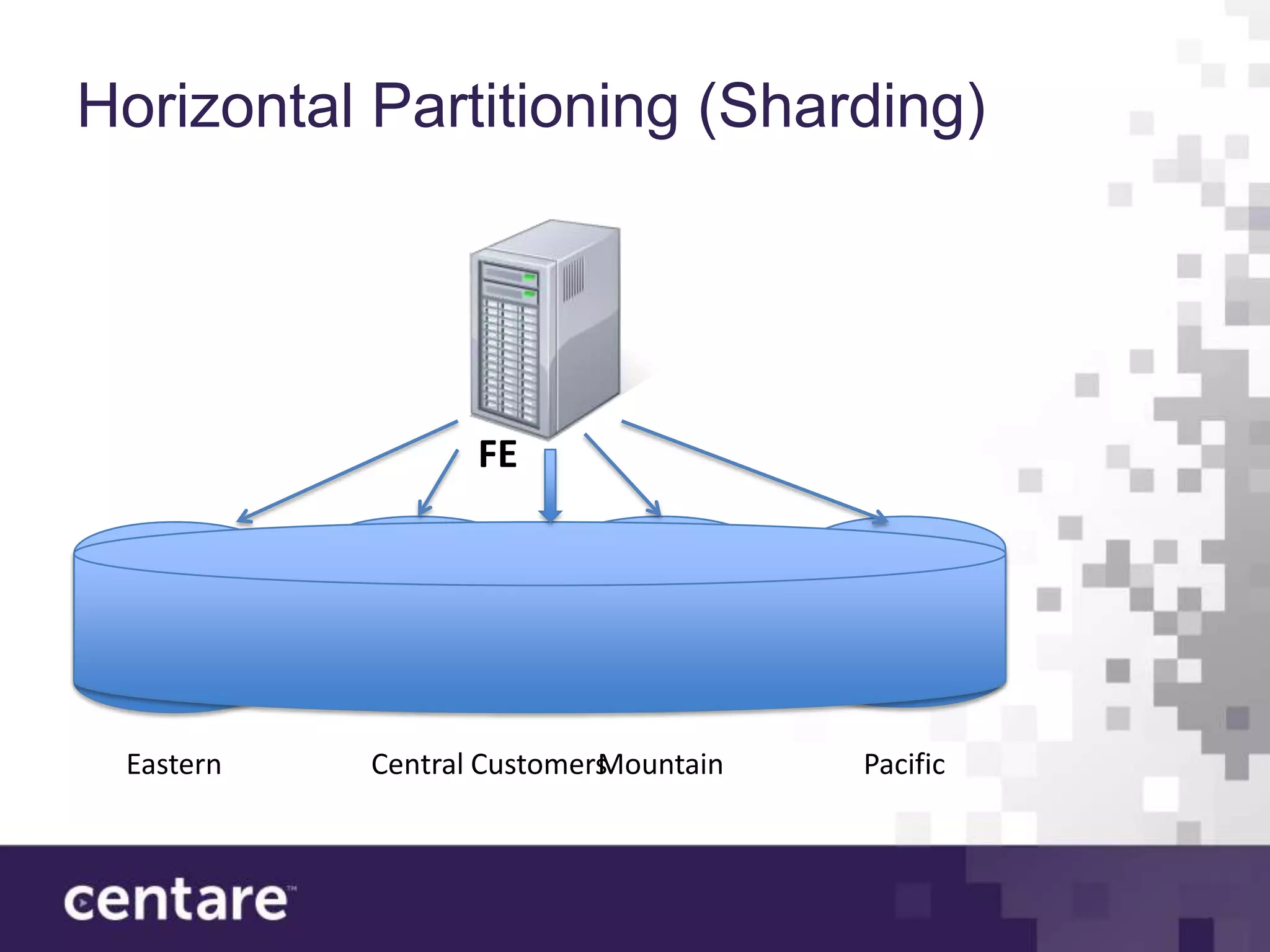
Horizontal Partitioning (Sharding)
 Slices of the same functional data
 Not Relational, No Joins
 No referential integrity across partitions
   Constraints are moved to the application
 Partitioning Strategy
   Name, Geography, Date, etc.
 Application needs to be partition-aware
 One logical DB, multiple physical partitions
 Rebalance
 Scales for both reads and writes
Horizontal Partitioning (Sharding)


                  FE


 Eastern   Central Customers
                           Mountain   Pacific
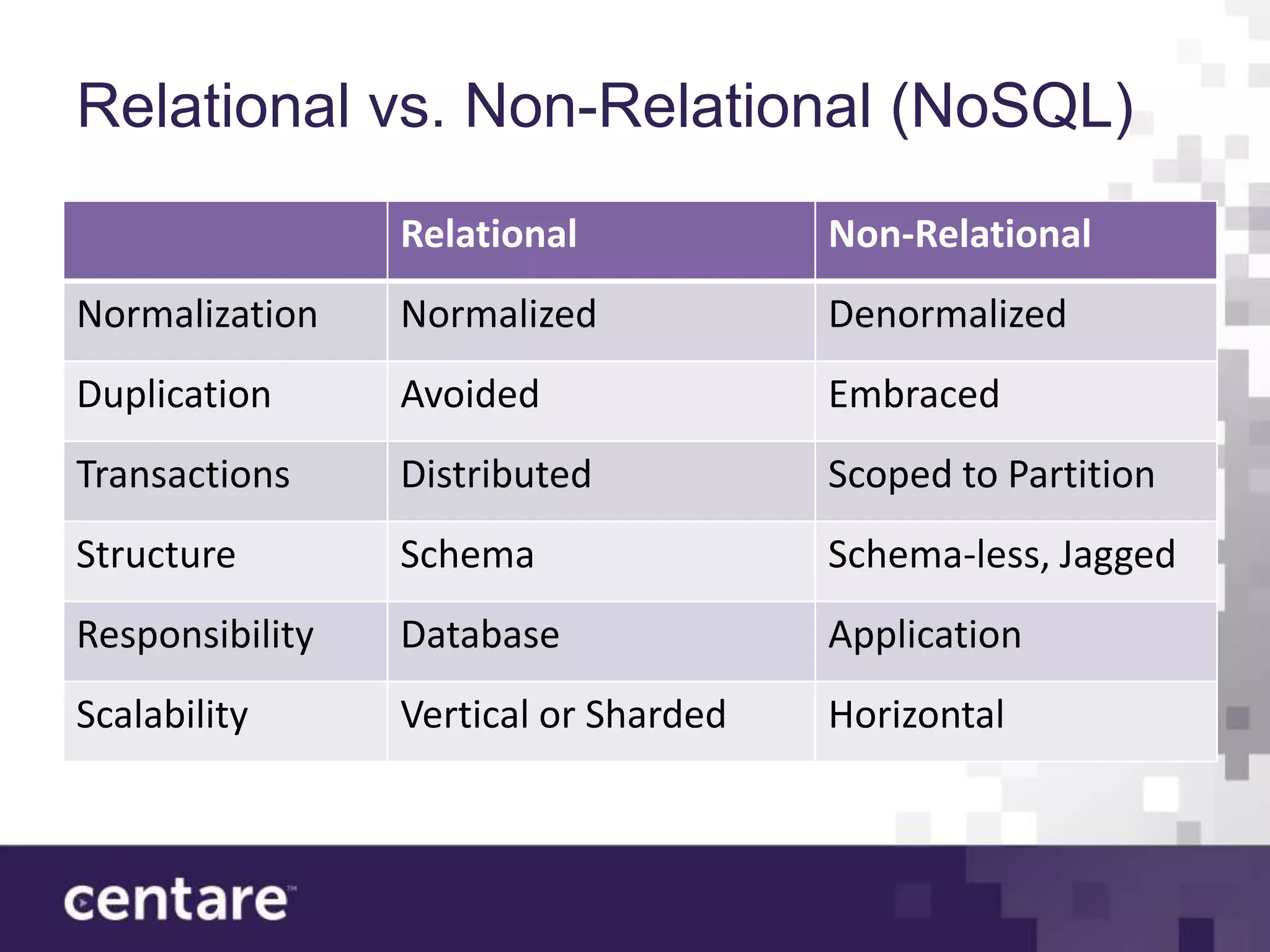
Relational vs. Non-Relational (NoSQL)
                 Relational            Non-Relational
Normalization    Normalized            Denormalized
Duplication      Avoided               Embraced
Transactions     Distributed           Scoped to Partition
Structure        Schema                Schema-less, Jagged
Responsibility   Database              Application
Scalability      Vertical or Sharded   Horizontal
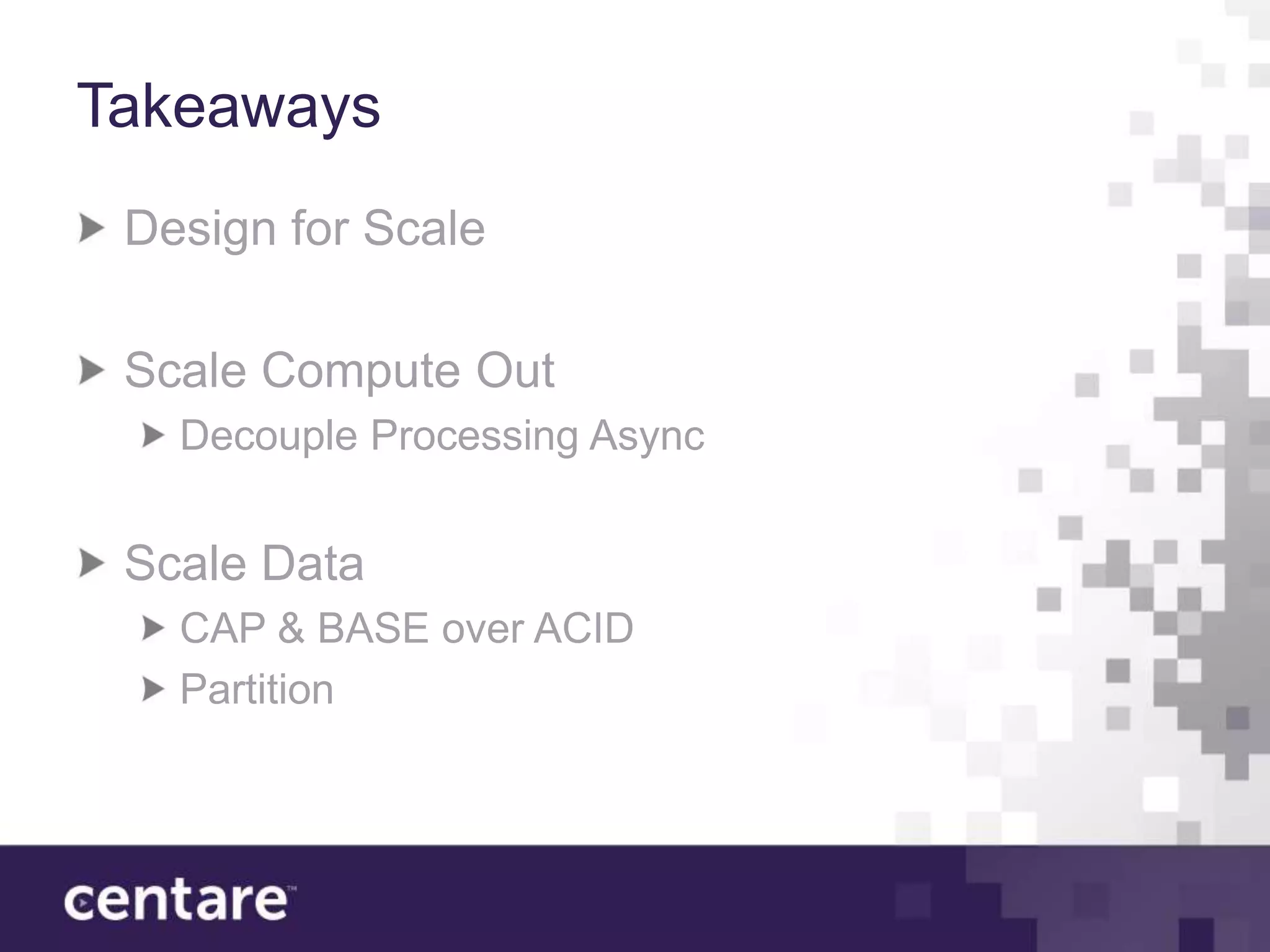
Takeaways
 Design for Scale

 Scale Compute Out
   Decouple Processing Async


 Scale Data
   CAP & BASE over ACID
   Partition
Resources
 Brewer's Keynote on CAP
    http://www.cs.berkeley.edu/~brewer/cs262b-2004/PODC-keynote.pdf

 CAP articles:
    http://www.julianbrowne.com/article/viewer/brewers-cap-theorem
    http://www.allthingsdistributed.com/2008/12/eventually_consistent.html

 BASE Articles
    http://queue.acm.org/detail.cfm?id=1394128

 High Scalability
    http://highscalability.com

 Werner Vogels, CTO of Amazon
    http://www.allthingsdistributed.com/
Other Sessions
 Exploring Scalability and Roles
   Insight, Next Session, Mike Benkovich


 Making $$$ with Windows Phone
   Imagination C/D, 3:00PM-4:00PM
Q&A
http://www.AzureStudyGroup.com
Thank You!


Eric D. Boyd
Director, Chicago + Cloud Practice
Centare

Email: eric.boyd@centare.com
Twitter: www.twitter.com/EricDBoyd
Blog: www.ericdboyd.com
Architecting for Massive Scalability - St. Louis Day of .NET 2011 - Aug 6, 2011

Architecting for Massive Scalability - St. Louis Day of .NET 2011 - Aug 6, 2011

  • 1.
    Architecting for Massive Scalability EricD. Boyd Director, Chicago + Cloud Practice
  • 2.
    Introduction Eric D.Boyd 15 Years in Technology
  • 3.
  • 4.
  • 5.
  • 6.
  • 7.
    I Blog @ericdboyd.com
  • 8.
  • 13.
    Agenda What isScalability? ACID, BASE & CAP Compute Patterns Data Patterns Q&A
  • 14.
    What is Scalability? A service is said to be scalable if when we increase the resources in a system, it results in increased performance in a manner proportional to resources added. --Werner Vogels, CTO, Amazon.com
  • 15.
    What is Scalability? Measures of Performance Response Time Throughput Measures of Scalability Transaction Volume Concurrent Users Size of Data and Growth
  • 16.
    What can beScaled? Servers CPU Memory Hard Disk Licensing Network Ports Bandwidth Cooling Power Racks Floor Space
  • 18.
    Why is ScalabilityImportant? Predictable Growth Unpredictable Growth Design for Scale Benefits of Scalability Dynamic Capacity Planning Cost is Linear
  • 19.
    Workload Patterns On and Off Growing Fast Compute Compute Inactivity On off Period Average Usage Average Usage Time Time • On & off workloads (e.g. batch job) • Successful services needs to grow/scale • Over provisioned capacity is wasted • Keeping up w/ growth is big IT challenge • Time to market can be cumbersome • Complex lead time for deployment Unpredictable Bursting Predictable Bursting“ Compute Compute Average Usage Average Usage Time Time • Unexpected/unplanned peak in demand • Services with micro seasonality trends • Sudden spike impacts performance • Peaks due to periodic increased demand • Can’t over provision for extreme cases • IT complexity and wasted capacity
  • 20.
    Traditional Line-of-Business (LOB)Apps A - Atomic C - Consistent I - Isolated D - Durable
  • 21.
    CAP Theorem Consistency.The client perceives that a set of operations has occurred all at once. Availability. Every operation must terminate in an intended response. Partition tolerance. Operations will complete, even if individual components are unavailable.
  • 22.
    Brewer’s CAP Theorem Consistency Partition Availability Tolerance
  • 23.
    BASE Basically Available Soft State Eventually Consistent
  • 24.
    Eventual Consistency Givena sufficiently long period of time over which no updates are sent, we can expect that during this period, all updates will eventually propagate through the system and all the replicas will be consistent. --Wikipedia, http://en.wikipedia.org/wiki/Eventual_consistency
  • 25.
    Real-World twitter Facebook eBay Amazon Foursquare
  • 26.
  • 27.
  • 28.
  • 29.
    Why Isn’t thisthe Norm? Data is typically Bottleneck Designed for and expects ACID Not designed for Scale Out Load is fixed and constant Mind shift and additional work
  • 30.
    I Need Scalability Loose Coupling Stateless Messaging & SOA Async & Background Processes Queuing Monitoring and Diagnostics
  • 31.
    Front-End (FE) +Back-End (BE) Model FE BE Persistent Storage
  • 32.
    Front-End (FE) +Back-End (BE) Architecture (FE) requests (BE) to perform work (BE) completes work (BE) reports results back to (FE)
  • 33.
    Worker-Queue Model BE Work Queue FE Persistent Storage
  • 34.
    Worker-Queue Architecture Front-End(FE) loads work in a Queue Back-End (BE) gets work off of Queue Back-End (BE) completes work
  • 35.
    Job Manager-Worker-Queue Model Request Queue BE FE Work Queue JM Result Queue Persistent Storage
  • 36.
    Job Manager-Worker-Queue Architecture Front-End (FE) loads work in a Queue Job Manager (JM) breaks up work Job Manager (JM) requests (BE) to do work Back-End (BE) completes work (BE) reports results back to (JM) (JM) aggregates results (JM) reports results to (FE) (JM) Monitors and Manages Resources
  • 37.
  • 38.
    Local Storage UseCautiously Stateless Node Affinity
  • 39.
    Caching Data willbe stale Reduce load on Data Store Compute nodes Volatile stores Good use of Local Storage Distributed cache Transformed and denormalized Persistent stores Volatile stores
  • 40.
    Geographic Distribution MinimizeTravel Costs Localize Data Centers CDNs
  • 41.
    CQRS Command QueryResponsibility Segregation More Reads than Writes
  • 42.
    CQRS Cache Cache Cache BE FE BE Persistent Storage
  • 43.
    Partitioning Balance loadacross servers Avoid transactions across partitions Might need to rebalance
  • 44.
    Vertical Partitioning FunctionalPartitioning Systems Catalog Customers Vendors Orders Reference Data
  • 45.
    Vertical Partitioning FE Customers Catalog eCommerce Orders Vendors
  • 46.
    Horizontal Partitioning (Sharding) Slices of the same functional data Not Relational, No Joins No referential integrity across partitions Constraints are moved to the application Partitioning Strategy Name, Geography, Date, etc. Application needs to be partition-aware One logical DB, multiple physical partitions Rebalance Scales for both reads and writes
  • 47.
    Horizontal Partitioning (Sharding) FE Eastern Central Customers Mountain Pacific
  • 48.
    Relational vs. Non-Relational(NoSQL) Relational Non-Relational Normalization Normalized Denormalized Duplication Avoided Embraced Transactions Distributed Scoped to Partition Structure Schema Schema-less, Jagged Responsibility Database Application Scalability Vertical or Sharded Horizontal
  • 49.
    Takeaways Design forScale Scale Compute Out Decouple Processing Async Scale Data CAP & BASE over ACID Partition
  • 50.
    Resources Brewer's Keynoteon CAP http://www.cs.berkeley.edu/~brewer/cs262b-2004/PODC-keynote.pdf CAP articles: http://www.julianbrowne.com/article/viewer/brewers-cap-theorem http://www.allthingsdistributed.com/2008/12/eventually_consistent.html BASE Articles http://queue.acm.org/detail.cfm?id=1394128 High Scalability http://highscalability.com Werner Vogels, CTO of Amazon http://www.allthingsdistributed.com/
  • 51.
    Other Sessions ExploringScalability and Roles Insight, Next Session, Mike Benkovich Making $$$ with Windows Phone Imagination C/D, 3:00PM-4:00PM
  • 52.
  • 53.
  • 54.
    Thank You! Eric D.Boyd Director, Chicago + Cloud Practice Centare Email: eric.boyd@centare.com Twitter: www.twitter.com/EricDBoyd Blog: www.ericdboyd.com