Scalable Web Design – Principles and
Patterns
Speaker : Sachin Prakash Sancheti
Principal Architect – Cloud (Windows Azure)
1
Context
2
3
Server
Busy!!
Your Request can
not be processed,
please try after
some time
I am trying
to book a
ticket for 1
hour now 
Please
wait!
Any Real life Examples?
4
Survey
What is Scalability?
• It is NOT
– Only Performance
– High Availability
– Business Continuity Planning
• It Is
– Traffic, User Growth
– Dataset, Database Size Growth
5
What is Scalability?
• Scalability
– “The Scalability is measure of number of users it can effectively
support at the same time without degrading the defined
performance”
– Has limits – E.g. “With two load balanced capacity it should support
1000 concurrent users with average response time of 3 seconds”
• “Performance is what an individual user experiences;
Scalability is how many users get to experience it TOGETHER”
6
What is the Concern?
• Scalability is a business concern
– Google observed 500-milisecond delay to page response caused 20%
decrease in traffic
– Amazon.com observed 100-milisecond delay caused a 1% decrease in
retail revenue
– Remember “Performance is what an individual user experiences;
Scalability is how many users get to experience it TOGETHER”
7
Handling Scalability – Degraded Application
• Degraded Application
– Doing nothing  and loosing business
8
Handling Scalability - Throttling
• Throttling
– Throttling the requests to temporarily stop accepting new requests
and serve better to existing or important users
9
Handling Scalability – Adding Resources
• Adding Resources
– Scaling up – Vertical Scaling
• Get Bigger
• Widening the roads
– Scaling out – Horizontal Scaling
• Get More
• Routing the traffic (Partitioning)
10
Typical Web Application Resources
• Web Server, Application Server (Middle Tier) and Database
Tier
11
Web
Server
Database
Server
Application
Server
Scaling Solutions
• Vertical Scaling OR Scaling Up
– Increasing resource power
– Remember widening the roads!!
• Horizontal Scaling OR Scaling Out
– Adding additional machines/nodes
– Remember routing the traffic
12
Vertical Vs. Horizontal Scaling
13
Vertical Scaling Horizontal Scaling
Higher Capital Investment On Demand Investment
Utilization concerns Utilization can be optimized
Relatively Quicker and works with the
current design
Relatively more time consuming and
needs redesigning
Limiting Scale Internet Scale
Not Cloud Native Design Cloud Native Design
Web/Application Server Scalability
14
Scaling Out Web Server – Load Balancing
15
Web
Server
Web
Server
Web
Server
• Design for Fault Tolerance
– Intent : Enables system to continue its
intended operation, possibly at a
reduced level, rather than failing
completely, when some part of the
system fails
– Drivers: Degraded services are better
than no service at all. Compare cost
effectiveness
– Solution:
• Load Balancing
• Monitoring, Self Healing, Restart
Pattern - Bi-directional Scaling
• Design for Scaling Out (Bidirectional)
– Intent: Deployment built using commodity of hardware working
together for economies of scale. Optimization is easier with scaling out
and in, rather than scaling up and down. Driven for Elasticity
– Driver: Optimized utilization, cost saving
– Solution:
• Stateless Application Design
• Nothing is shared except Database
• Scaling every tier is possible – Web/Service/Database etc.
16
Scaling Out / Horizontally: Adding Removing Boxes
Design Principle - Stateless Design
• Stateless designs increases scalability
– Don’t store anything locally on Web Server
• Session State
– Local Sessions – Avoid – Not Scalable
• Load Balancer Sticky sessions can create hot spot load
– Central Session – Good – Distributed Cache, Database
– Client Session – Better – Client Cookie
– No Session – Awesome
18
Design Principle – Loosely Coupled
• Components and layers should be loosely coupled to be able to scale each
layer separately
19
Database
Server
Web Servers
Application
Servers
Caching in Scalability
• Caching helps in avoiding scale
• In-memory distributed cache offers an excellent solution to
data storage bottlenecks
• Distributed caching clusters can keep growing horizontally,
just like the application servers. This reduces pressure on data
storage so that it is no longer a scalability bottleneck.
20
Design Pattern - Cache Aside Pattern
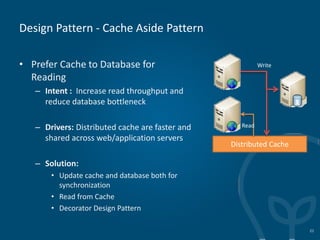
• Prefer Cache to Database for
Reading
– Intent : Increase read throughput and
reduce database bottleneck
– Drivers: Distributed cache are faster and
shared across web/application servers
– Solution:
• Update cache and database both for
synchronization
• Read from Cache
• Decorator Design Pattern
21
Distributed Cache
Write
Read
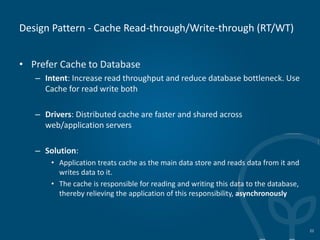
Design Pattern - Cache Read-through/Write-through (RT/WT)
• Prefer Cache to Database
– Intent: Increase read throughput and reduce database bottleneck. Use
Cache for read write both
– Drivers: Distributed cache are faster and shared across
web/application servers
– Solution:
• Application treats cache as the main data store and reads data from it and
writes data to it.
• The cache is responsible for reading and writing this data to the database,
thereby relieving the application of this responsibility, asynchronously
22
23
Design Pattern - Cache Read-through/Write-through (RT/WT)
Database Scalability
24
CAP Theorem
• CAP theorem, also known as Brewer's theorem, states that
it is impossible for a distributed computer system to
simultaneously provide all three of the following
guarantees: Consistency, Availability and Partition
tolerance.
• Consistency: All clients always have the same view of the
data
• Availability: Each client can always read and write
• Partition Tolerance: The system works well despite physical
network partition
25
CAP Theorem – Database Placements
26
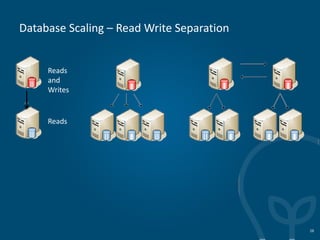
Database Scaling – Replication - Read Mostly Pattern
• Intent: Increase database scalability by separating write and
read operations
– Generally most of the applications have around 80% read and 20%
write
• Drivers: Separate read write responsibilities, High availability
benefits
• Solution:
– Read Write Separation
– Master Slave Pattern
27
Database Scaling – Read Write Separation
28
Reads
and
Writes
Reads
Design Pattern – Partitioning / Sharding
• Design for Database Sharding
– Intent: Increasing data size might rise throttling. Database scale and
performance is more important than reliability. CAP Theorem
– Drivers: Scaling database layer, increasing database throughput
– Solution:
• Database Sharding / Horizontal Partitioning
• Database Federation
29
Shard Resolver
Shard = User ID % 4
Database Sharding Example
30
Shard 0
25%
Shard 1
25%
Shard 2
25%
User ID=3
Shard 3
25%
Design Principles – Eventually Consistent
• BASE Opposite to ACID
– Intent: Real internet scale model. Postpone the consistency.
• Basically Available, Soft state, Eventual consistency
– Solution:
• Queue Based processing Model
• Change in behavior
– Order Placed successfully TO Order Received Successfully
31
Design Principles – Asynchronous Processing
• Blocking is bane for Scalability
– Intent:
• Avoid blocking calls, reduce contention
– Solution:
• Queue Based processing Model
• Fire and Forget Calls
• 1000 users blocked for 5 seconds = 5000 users per second
32
Design Principles – Parallel Design
• Design for Parallel and Reliable Work
– Intent: Increasing resources should results in a proportional increase
in performance. Dependent services might not be available. Blocking
is bane of scalability
– Drivers: Higher reliability, Proportional distribution
– Solution:
• Concern Independent Scaling
• Reliability through Queue
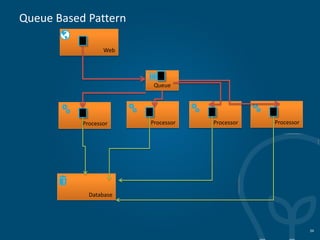
• Queue driven worker tasks - more messages more workers faster work
33
Queue Based Pattern
34
Queue - Load Leveling, Load Balancing, Loose Coupling
35
Design Principles – Queue Based Pattern
• Idempotent
– Design the operation to be idempotent; that is, if it's carried out more
than once, it's as if it was carried out just once
– Implement the receiver in such a way that it can receive a message
multiple times safely, either through a filter that removes already
received messages or by adjustment of message semantics
36
Design Principles – Capacity Planning
• Everything has a limit: Compose a Scale
– Intent: Design Around Provider SLAs and Capacity
– Solution:
• Know the limits, measure the scalability and increase the scale
• E.g. Storage supports up to 10000 transactions/sec
– Add storage for higher scale
• E.g. Queue supports 5000 messages per seconds
– Add additional Queues (Partitioning) for additional scale
37
Design Pattern – Multi Site Deployment Pattern
38
Database
Server
Web Servers
Application
Servers
Database
Server
Web Servers
Application
Servers
Sync
Routing
• Performance Based
• Round Robin
• Failover
Asia United States
Summary
39
Scalability Principles
40
Scalability
Stateless
Parallelization
Asynchronous
Partitioning
Idempotent
Fault Tolerance
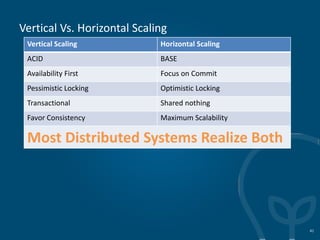
Vertical Vs. Horizontal Scaling
41
Vertical Scaling Horizontal Scaling
ACID BASE
Availability First Focus on Commit
Pessimistic Locking Optimistic Locking
Transactional Shared nothing
Favor Consistency Maximum Scalability
Most Distributed Systems Realize Both
Thank You !
42
43
44
Some of the images are taken by utilizing Google
search and due credit to the source.
Author do not claim any creation or originality of the contents. It is used only for
learning purposes

Scalability Design Principles - Internal Session

  • 1.
    Scalable Web Design– Principles and Patterns Speaker : Sachin Prakash Sancheti Principal Architect – Cloud (Windows Azure) 1
  • 2.
  • 3.
    3 Server Busy!! Your Request can notbe processed, please try after some time I am trying to book a ticket for 1 hour now  Please wait!
  • 4.
    Any Real lifeExamples? 4 Survey
  • 5.
    What is Scalability? •It is NOT – Only Performance – High Availability – Business Continuity Planning • It Is – Traffic, User Growth – Dataset, Database Size Growth 5
  • 6.
    What is Scalability? •Scalability – “The Scalability is measure of number of users it can effectively support at the same time without degrading the defined performance” – Has limits – E.g. “With two load balanced capacity it should support 1000 concurrent users with average response time of 3 seconds” • “Performance is what an individual user experiences; Scalability is how many users get to experience it TOGETHER” 6
  • 7.
    What is theConcern? • Scalability is a business concern – Google observed 500-milisecond delay to page response caused 20% decrease in traffic – Amazon.com observed 100-milisecond delay caused a 1% decrease in retail revenue – Remember “Performance is what an individual user experiences; Scalability is how many users get to experience it TOGETHER” 7
  • 8.
    Handling Scalability –Degraded Application • Degraded Application – Doing nothing  and loosing business 8
  • 9.
    Handling Scalability -Throttling • Throttling – Throttling the requests to temporarily stop accepting new requests and serve better to existing or important users 9
  • 10.
    Handling Scalability –Adding Resources • Adding Resources – Scaling up – Vertical Scaling • Get Bigger • Widening the roads – Scaling out – Horizontal Scaling • Get More • Routing the traffic (Partitioning) 10
  • 11.
    Typical Web ApplicationResources • Web Server, Application Server (Middle Tier) and Database Tier 11 Web Server Database Server Application Server
  • 12.
    Scaling Solutions • VerticalScaling OR Scaling Up – Increasing resource power – Remember widening the roads!! • Horizontal Scaling OR Scaling Out – Adding additional machines/nodes – Remember routing the traffic 12
  • 13.
    Vertical Vs. HorizontalScaling 13 Vertical Scaling Horizontal Scaling Higher Capital Investment On Demand Investment Utilization concerns Utilization can be optimized Relatively Quicker and works with the current design Relatively more time consuming and needs redesigning Limiting Scale Internet Scale Not Cloud Native Design Cloud Native Design
  • 14.
  • 15.
    Scaling Out WebServer – Load Balancing 15 Web Server Web Server Web Server • Design for Fault Tolerance – Intent : Enables system to continue its intended operation, possibly at a reduced level, rather than failing completely, when some part of the system fails – Drivers: Degraded services are better than no service at all. Compare cost effectiveness – Solution: • Load Balancing • Monitoring, Self Healing, Restart
  • 16.
    Pattern - Bi-directionalScaling • Design for Scaling Out (Bidirectional) – Intent: Deployment built using commodity of hardware working together for economies of scale. Optimization is easier with scaling out and in, rather than scaling up and down. Driven for Elasticity – Driver: Optimized utilization, cost saving – Solution: • Stateless Application Design • Nothing is shared except Database • Scaling every tier is possible – Web/Service/Database etc. 16
  • 17.
    Scaling Out /Horizontally: Adding Removing Boxes
  • 18.
    Design Principle -Stateless Design • Stateless designs increases scalability – Don’t store anything locally on Web Server • Session State – Local Sessions – Avoid – Not Scalable • Load Balancer Sticky sessions can create hot spot load – Central Session – Good – Distributed Cache, Database – Client Session – Better – Client Cookie – No Session – Awesome 18
  • 19.
    Design Principle –Loosely Coupled • Components and layers should be loosely coupled to be able to scale each layer separately 19 Database Server Web Servers Application Servers
  • 20.
    Caching in Scalability •Caching helps in avoiding scale • In-memory distributed cache offers an excellent solution to data storage bottlenecks • Distributed caching clusters can keep growing horizontally, just like the application servers. This reduces pressure on data storage so that it is no longer a scalability bottleneck. 20
  • 21.
    Design Pattern -Cache Aside Pattern • Prefer Cache to Database for Reading – Intent : Increase read throughput and reduce database bottleneck – Drivers: Distributed cache are faster and shared across web/application servers – Solution: • Update cache and database both for synchronization • Read from Cache • Decorator Design Pattern 21 Distributed Cache Write Read
  • 22.
    Design Pattern -Cache Read-through/Write-through (RT/WT) • Prefer Cache to Database – Intent: Increase read throughput and reduce database bottleneck. Use Cache for read write both – Drivers: Distributed cache are faster and shared across web/application servers – Solution: • Application treats cache as the main data store and reads data from it and writes data to it. • The cache is responsible for reading and writing this data to the database, thereby relieving the application of this responsibility, asynchronously 22
  • 23.
    23 Design Pattern -Cache Read-through/Write-through (RT/WT)
  • 24.
  • 25.
    CAP Theorem • CAPtheorem, also known as Brewer's theorem, states that it is impossible for a distributed computer system to simultaneously provide all three of the following guarantees: Consistency, Availability and Partition tolerance. • Consistency: All clients always have the same view of the data • Availability: Each client can always read and write • Partition Tolerance: The system works well despite physical network partition 25
  • 26.
    CAP Theorem –Database Placements 26
  • 27.
    Database Scaling –Replication - Read Mostly Pattern • Intent: Increase database scalability by separating write and read operations – Generally most of the applications have around 80% read and 20% write • Drivers: Separate read write responsibilities, High availability benefits • Solution: – Read Write Separation – Master Slave Pattern 27
  • 28.
    Database Scaling –Read Write Separation 28 Reads and Writes Reads
  • 29.
    Design Pattern –Partitioning / Sharding • Design for Database Sharding – Intent: Increasing data size might rise throttling. Database scale and performance is more important than reliability. CAP Theorem – Drivers: Scaling database layer, increasing database throughput – Solution: • Database Sharding / Horizontal Partitioning • Database Federation 29
  • 30.
    Shard Resolver Shard =User ID % 4 Database Sharding Example 30 Shard 0 25% Shard 1 25% Shard 2 25% User ID=3 Shard 3 25%
  • 31.
    Design Principles –Eventually Consistent • BASE Opposite to ACID – Intent: Real internet scale model. Postpone the consistency. • Basically Available, Soft state, Eventual consistency – Solution: • Queue Based processing Model • Change in behavior – Order Placed successfully TO Order Received Successfully 31
  • 32.
    Design Principles –Asynchronous Processing • Blocking is bane for Scalability – Intent: • Avoid blocking calls, reduce contention – Solution: • Queue Based processing Model • Fire and Forget Calls • 1000 users blocked for 5 seconds = 5000 users per second 32
  • 33.
    Design Principles –Parallel Design • Design for Parallel and Reliable Work – Intent: Increasing resources should results in a proportional increase in performance. Dependent services might not be available. Blocking is bane of scalability – Drivers: Higher reliability, Proportional distribution – Solution: • Concern Independent Scaling • Reliability through Queue • Queue driven worker tasks - more messages more workers faster work 33
  • 34.
  • 35.
    Queue - LoadLeveling, Load Balancing, Loose Coupling 35
  • 36.
    Design Principles –Queue Based Pattern • Idempotent – Design the operation to be idempotent; that is, if it's carried out more than once, it's as if it was carried out just once – Implement the receiver in such a way that it can receive a message multiple times safely, either through a filter that removes already received messages or by adjustment of message semantics 36
  • 37.
    Design Principles –Capacity Planning • Everything has a limit: Compose a Scale – Intent: Design Around Provider SLAs and Capacity – Solution: • Know the limits, measure the scalability and increase the scale • E.g. Storage supports up to 10000 transactions/sec – Add storage for higher scale • E.g. Queue supports 5000 messages per seconds – Add additional Queues (Partitioning) for additional scale 37
  • 38.
    Design Pattern –Multi Site Deployment Pattern 38 Database Server Web Servers Application Servers Database Server Web Servers Application Servers Sync Routing • Performance Based • Round Robin • Failover Asia United States
  • 39.
  • 40.
  • 41.
    Vertical Vs. HorizontalScaling 41 Vertical Scaling Horizontal Scaling ACID BASE Availability First Focus on Commit Pessimistic Locking Optimistic Locking Transactional Shared nothing Favor Consistency Maximum Scalability Most Distributed Systems Realize Both
  • 42.
  • 43.
  • 44.
    44 Some of theimages are taken by utilizing Google search and due credit to the source. Author do not claim any creation or originality of the contents. It is used only for learning purposes