● Name: Rajeshvariba Rana
● Roll No. : 20
● Enrollment No. : 4069206420220023
● Semester: 1st
● Paper No. : 105(A)
● Paper Code: 22396
● Paper Name: History of English Literature
● Topic: Literary Characteristics of Neo-Classical Age
● Submitted to: Smt. S.B.Gardi, Department of English, MKBU
● E-mail: rhrana148@gmail.com
Literary Characteristics of Neo-Classical Age
Overview:
● Introduction
● Characteristics
● Imitation of Ancient/French/Classics
● Concept of Man /Nature
● Development of Science
● Satire
● Example
● Conclusion
● Works Cited
Introduction:
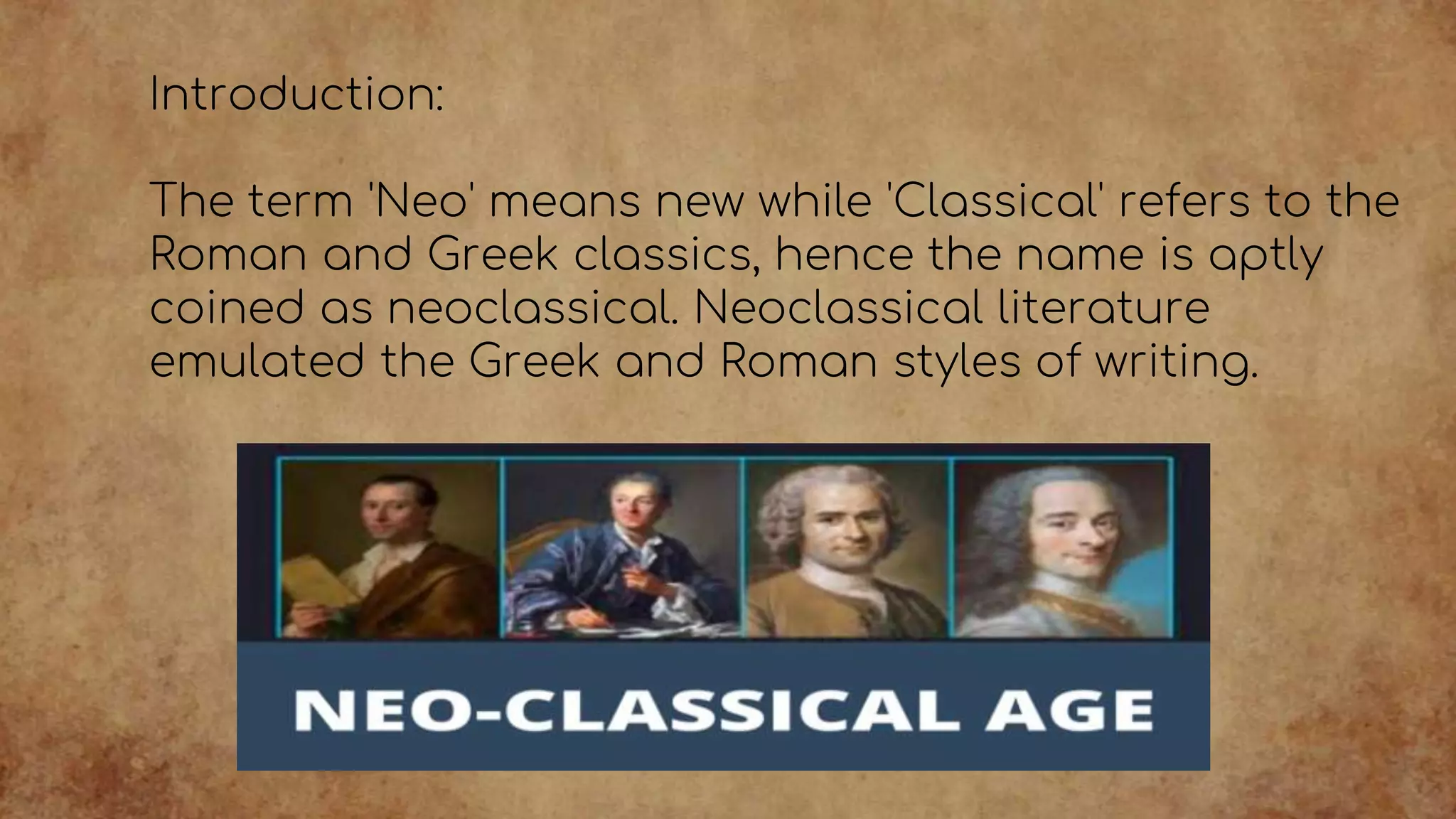
The term 'Neo' means new while 'Classical' refers to the
Roman and Greek classics, hence the name is aptly
coined as neoclassical. Neoclassical literature
emulated the Greek and Roman styles of writing.
Divided into three parts:
Restoration Age (1660-1700)
Known as a Dryden Age
Augustan Age (1700-1750)
Known as a Age of Pope
Age of Sensibility (1750-1798)
Known as a Johnson
Characteristics:
Imitation of the Ancients:
Lacking the genius of the Elizabethans, the authors of
the time turned to the great classical writers, in
particular to the Latin writers, for guidance and
inspiration. This habit, quite noticeable during the time
of Dryden, deepened and hardened during the
succeeding era of the Pope so much so that the latter
laid down as a final test of excellence.(Edward)
Imitation of the French:
Charles II had spent most of his years of exile in France, and when he
returned to England he brought with him a new admiration for French
literature.(Edward)
Imitation of Classics:
One of the most important features of the Neoclassical. literature is
the imitation of the classics of ancient Greek and Roman literature.
The writers of this age imitated the style of the ancient Greek and
Roman writers. The Neoclassical writers like Dryden, Pope, Swift, and
Johnson were convinced that excellence and perfection in the literary
art have been attained by the Roman writers of antiquity, thus they
can only copy the models of perfection and excellence.
Concept of Man :
The Neoclassical literature considers man
as a limited being, having limited power. A
large number of satires and works of the
period attack the man for his pride and
advise him to remain content with his
limited power of knowledge. Thus, man in
Neoclassical literature remains a being of
limited means and power.
Throughout the criticism of this age one finds
frequent allusions to the scientific movement and
arguments drawn from it. (Jones)
There is another way of interpreting scientific history ,
which con siders science primarily as a movement of
ideas.(Jones)
Development of Science :
Concept of Nature :
The concept of nature was an important characteristic of
the Neoclassical age . By nature , they never meant the
forest . nature , but for them , nature meant the general
human nature . The general human nature was not what the
ordinary men and women felt and thought , but the
standard view of human nature as held by Homer and
Horace . Thus , their view of nature as well as of man , world
,and genre was static and standard.
Pseudo Classicism:
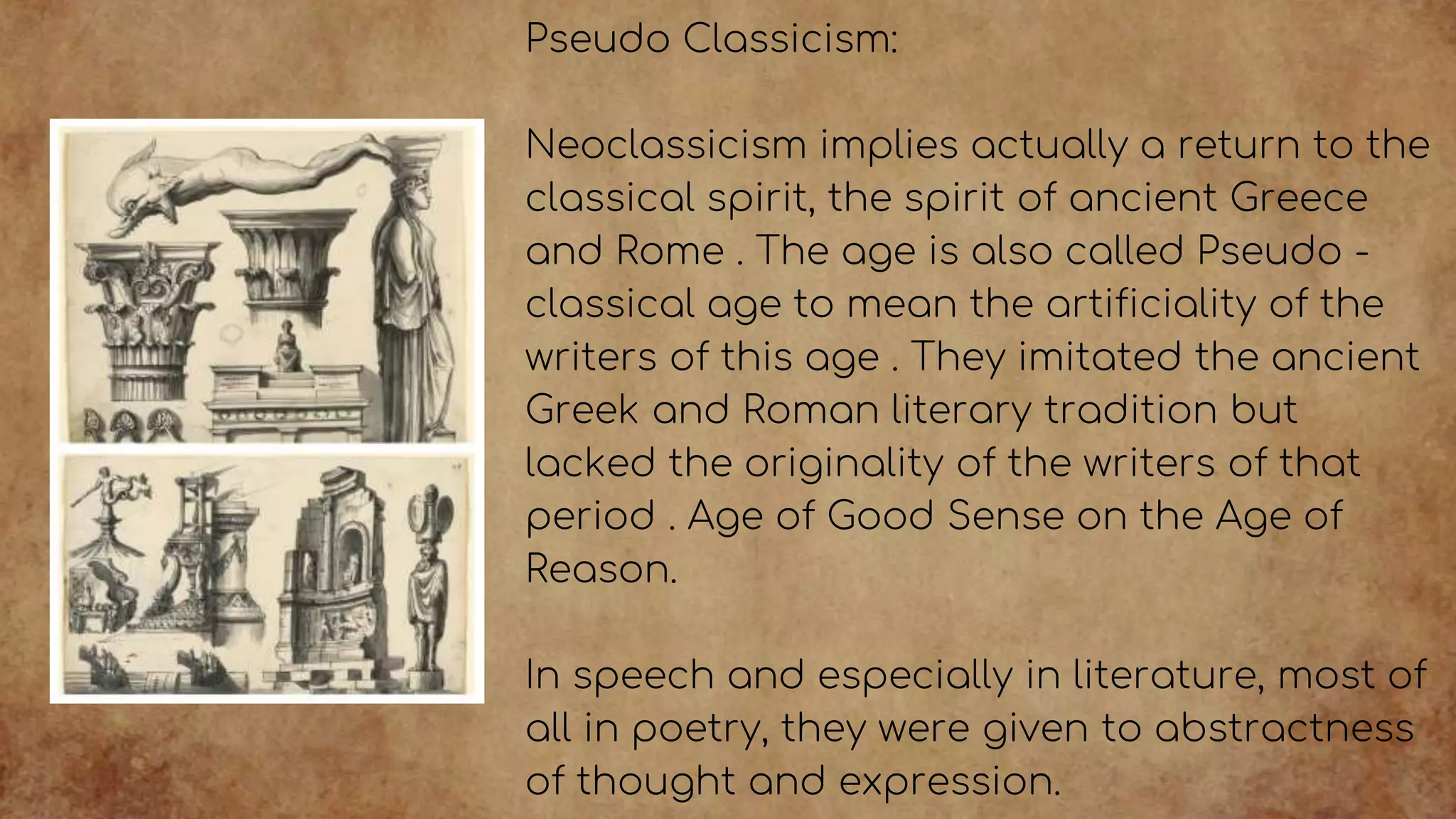
Neoclassicism implies actually a return to the
classical spirit, the spirit of ancient Greece
and Rome . The age is also called Pseudo -
classical age to mean the artificiality of the
writers of this age . They imitated the ancient
Greek and Roman literary tradition but
lacked the originality of the writers of that
period . Age of Good Sense on the Age of
Reason.
In speech and especially in literature, most of
all in poetry, they were given to abstractness
of thought and expression.
Satire:
The weaknesses of the Heroic Plays as drama grow
the merits of political satire . The set speeches of the
temptation are intentionally used like a public
argument to uncover the motives and policies of the
Whigs.(Kitab)
Nearly every writer of the first half of the century was
used and rewarded by Whigs or Tories for satirising
their enemies and for advancing their special
political interests.
“Satire is a sort of glass, wherein beholders do generally
discover everybody's face but their own, which is the
chief reason for that kind of reception it meets in the
world, and that so very few are offended with it."
[Jonathan Swift, preface to The Battle of the Books, 1704]
(SWIFT)
(Tharoor)
In this award-winning novel,
Tharoor has masterfully recast
the two-thousand-year-old
epic, The Mahabharata, with
fictional but highly
recognizable events and
characters from twentieth-
century Indian politics.
"Shav Vahini Ganga" or "Shab-
Vahini Ganga" (English: "Ganges,
the Hearse of Corpses") is a 2021
Gujarati-language poem that was
written by Indian poet Parul
Khakhar. The poem criticises the
Indian government's handling of
the COVID-19 pandemic.
Stirred by what she saw and read,
Parul Khakhar quickly wrote a
poem. She posted the mournful 14-
line dirge called Shabvahini Ganga
(A hearse called Ganga - the Indian
name for river Ganges) on her
Facebook page.(Biswas)
The Romantic Movement :
The reaction which was bound to
accompany the triumph of Pseudo-
classicism, as a reassertion of those
instincts in human nature which
Pseudo-classicism disregarded.
Conclusion:
The neoclassical era was closely preceded by the
renaissance period. Before the renaissance period, life
and literature was mainly dictated by the Church.
However, during the renaissance, science and
innovation was given the main emphasis.
Thus, in the neoclassical era, a vast difference between
the two ideologies can be witnessed. Therefore, you will
find confusion and contrary depictions in neoclassical
literature.
Biswas, Soutik. “Parul Khakhar: The Indian Stay-at-Home Mum Trolled for Poem on Covid
Dead.” BBC News, BBC, 20 June 2021, https://www.bbc.com/news/world-asia-india-
57499775.
Edward, Albert. OUP India . Oxford University Press , 2017.
Jones, Richard F. “Science and Criticism in the Neo-Classical Age of English Literature.”
Journal of the History of Ideas, vol. 1, no. 4, 1940, pp. 381–412. JSTOR,
https://doi.org/10.2307/2707122. Accessed 19 Oct. 2022.
Kitab, Athraa. (PDF) Political Satire in Neo Classical Age - Researchgate. Dec. 2019,
https://www.researchgate.net
/publication/337951932_Political_Satire_in_Neo_Classical_Age.
SWIFT, JONATHAN. Battle of the Books. ALMA CLASSICS, 2016.
Tharoor, Shashi. The Great Indian Novel. Penguin Books, 1998.
Works Cited :
Literary Characteristics of the NeoClassical Age

Literary Characteristics of the NeoClassical Age

  • 1.
    ● Name: RajeshvaribaRana ● Roll No. : 20 ● Enrollment No. : 4069206420220023 ● Semester: 1st ● Paper No. : 105(A) ● Paper Code: 22396 ● Paper Name: History of English Literature ● Topic: Literary Characteristics of Neo-Classical Age ● Submitted to: Smt. S.B.Gardi, Department of English, MKBU ● E-mail: rhrana148@gmail.com
  • 2.
    Literary Characteristics ofNeo-Classical Age Overview: ● Introduction ● Characteristics ● Imitation of Ancient/French/Classics ● Concept of Man /Nature ● Development of Science ● Satire ● Example ● Conclusion ● Works Cited
  • 3.
    Introduction: The term 'Neo'means new while 'Classical' refers to the Roman and Greek classics, hence the name is aptly coined as neoclassical. Neoclassical literature emulated the Greek and Roman styles of writing.
  • 4.
    Divided into threeparts: Restoration Age (1660-1700) Known as a Dryden Age Augustan Age (1700-1750) Known as a Age of Pope Age of Sensibility (1750-1798) Known as a Johnson
  • 5.
    Characteristics: Imitation of theAncients: Lacking the genius of the Elizabethans, the authors of the time turned to the great classical writers, in particular to the Latin writers, for guidance and inspiration. This habit, quite noticeable during the time of Dryden, deepened and hardened during the succeeding era of the Pope so much so that the latter laid down as a final test of excellence.(Edward)
  • 6.
    Imitation of theFrench: Charles II had spent most of his years of exile in France, and when he returned to England he brought with him a new admiration for French literature.(Edward) Imitation of Classics: One of the most important features of the Neoclassical. literature is the imitation of the classics of ancient Greek and Roman literature. The writers of this age imitated the style of the ancient Greek and Roman writers. The Neoclassical writers like Dryden, Pope, Swift, and Johnson were convinced that excellence and perfection in the literary art have been attained by the Roman writers of antiquity, thus they can only copy the models of perfection and excellence.
  • 7.
    Concept of Man: The Neoclassical literature considers man as a limited being, having limited power. A large number of satires and works of the period attack the man for his pride and advise him to remain content with his limited power of knowledge. Thus, man in Neoclassical literature remains a being of limited means and power.
  • 8.
    Throughout the criticismof this age one finds frequent allusions to the scientific movement and arguments drawn from it. (Jones) There is another way of interpreting scientific history , which con siders science primarily as a movement of ideas.(Jones) Development of Science :
  • 9.
    Concept of Nature: The concept of nature was an important characteristic of the Neoclassical age . By nature , they never meant the forest . nature , but for them , nature meant the general human nature . The general human nature was not what the ordinary men and women felt and thought , but the standard view of human nature as held by Homer and Horace . Thus , their view of nature as well as of man , world ,and genre was static and standard.
  • 10.
    Pseudo Classicism: Neoclassicism impliesactually a return to the classical spirit, the spirit of ancient Greece and Rome . The age is also called Pseudo - classical age to mean the artificiality of the writers of this age . They imitated the ancient Greek and Roman literary tradition but lacked the originality of the writers of that period . Age of Good Sense on the Age of Reason. In speech and especially in literature, most of all in poetry, they were given to abstractness of thought and expression.
  • 11.
    Satire: The weaknesses ofthe Heroic Plays as drama grow the merits of political satire . The set speeches of the temptation are intentionally used like a public argument to uncover the motives and policies of the Whigs.(Kitab) Nearly every writer of the first half of the century was used and rewarded by Whigs or Tories for satirising their enemies and for advancing their special political interests.
  • 12.
    “Satire is asort of glass, wherein beholders do generally discover everybody's face but their own, which is the chief reason for that kind of reception it meets in the world, and that so very few are offended with it." [Jonathan Swift, preface to The Battle of the Books, 1704] (SWIFT)
  • 13.
    (Tharoor) In this award-winningnovel, Tharoor has masterfully recast the two-thousand-year-old epic, The Mahabharata, with fictional but highly recognizable events and characters from twentieth- century Indian politics.
  • 14.
    "Shav Vahini Ganga"or "Shab- Vahini Ganga" (English: "Ganges, the Hearse of Corpses") is a 2021 Gujarati-language poem that was written by Indian poet Parul Khakhar. The poem criticises the Indian government's handling of the COVID-19 pandemic. Stirred by what she saw and read, Parul Khakhar quickly wrote a poem. She posted the mournful 14- line dirge called Shabvahini Ganga (A hearse called Ganga - the Indian name for river Ganges) on her Facebook page.(Biswas)
  • 15.
    The Romantic Movement: The reaction which was bound to accompany the triumph of Pseudo- classicism, as a reassertion of those instincts in human nature which Pseudo-classicism disregarded.
  • 16.
    Conclusion: The neoclassical erawas closely preceded by the renaissance period. Before the renaissance period, life and literature was mainly dictated by the Church. However, during the renaissance, science and innovation was given the main emphasis. Thus, in the neoclassical era, a vast difference between the two ideologies can be witnessed. Therefore, you will find confusion and contrary depictions in neoclassical literature.
  • 17.
    Biswas, Soutik. “ParulKhakhar: The Indian Stay-at-Home Mum Trolled for Poem on Covid Dead.” BBC News, BBC, 20 June 2021, https://www.bbc.com/news/world-asia-india- 57499775. Edward, Albert. OUP India . Oxford University Press , 2017. Jones, Richard F. “Science and Criticism in the Neo-Classical Age of English Literature.” Journal of the History of Ideas, vol. 1, no. 4, 1940, pp. 381–412. JSTOR, https://doi.org/10.2307/2707122. Accessed 19 Oct. 2022. Kitab, Athraa. (PDF) Political Satire in Neo Classical Age - Researchgate. Dec. 2019, https://www.researchgate.net /publication/337951932_Political_Satire_in_Neo_Classical_Age. SWIFT, JONATHAN. Battle of the Books. ALMA CLASSICS, 2016. Tharoor, Shashi. The Great Indian Novel. Penguin Books, 1998. Works Cited :