B Y : R A A N A K A R I M P O U R
LASER APPLICATIONS
TO MEDICINE
Bachelor, Department of cellular and molecular
biology, Faculty of advanced science and
technology, Tehran Medical Sciences, Islamic
Azad University, Tehran, Iran
INTRODUCTION
• This presentation gives a brief introduction to the
characteristics of laser devices.
• Absorption, tissue penetration and physiological
mechanisms of laser irradiation are discussed.
• The biological effects of low power laser light are
reviewed in the areas of collagen metabolism,
wound healing, inflammation and pain control.
Contraindications, precautions and side effects of
low power laser irradiation are discussed.
2Raana Karimpour
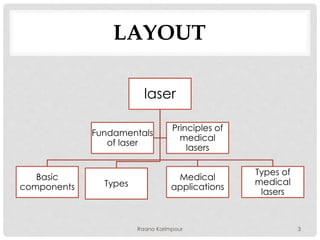
LAYOUT
laser
Basic
components Types
Medical
applications
Types of
medical
lasers
Fundamentals
of laser
Principles of
medical
lasers
3Raana Karimpour
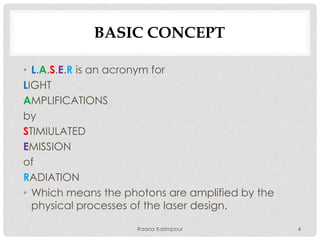
BASIC CONCEPT
• L.A.S.E.R is an acronym for
LIGHT
AMPLIFICATIONS
by
STIMIULATED
EMISSION
of
RADIATION
• Which means the photons are amplified by the
physical processes of the laser design.
4Raana Karimpour
BASIC CONCEPT
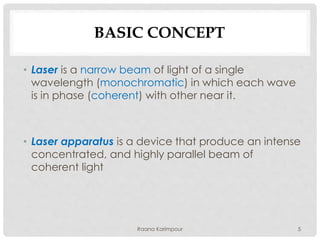
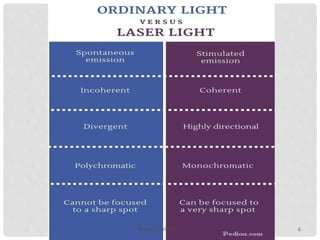
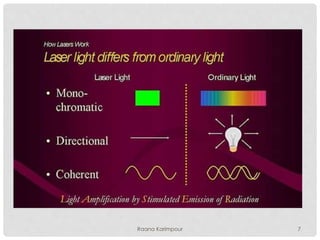
• Laser is a narrow beam of light of a single
wavelength (monochromatic) in which each wave
is in phase (coherent) with other near it.
• Laser apparatus is a device that produce an intense
concentrated, and highly parallel beam of
coherent light
5Raana Karimpour
6Raana Karimpour
7Raana Karimpour
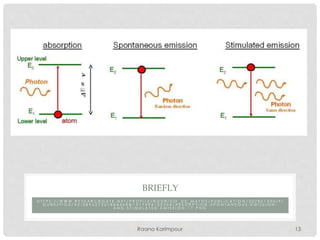
BASIC THEORY FOR LASER
• Atom composed of a nucleus and electron
cloud
• If an incident photon is energetic enough, it
may be absorbed by an atom, raising the
latter to an excited state.
• It was pointed out by Einstein in 1917 that an
excited atom can be revert to a lowest
state via two distinctive mechanisms:
1. spontaneous emission
2. stimulated emission
8Raana Karimpour
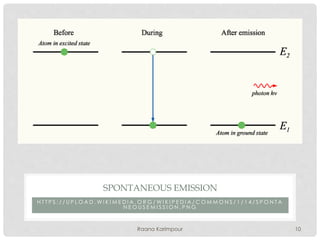
SPONTANEOUS EMISSION
• Each electron can drop back
spontaneously to the ground state emitting
photons.
• Emitted photons bear no incoherent. It
varies in phase from point to point and
from moment to moment.
• e.g. emission from tungsten lamp.
9Raana Karimpour
H T T P S : / / U P L O A D . W I K I M E D I A . O R G / W I K I P E D I A / C O M M O N S / 1 / 1 4 / S P O N T A
N E O U S E M I S S I O N . P N G
SPONTANEOUS EMISSION
10Raana Karimpour
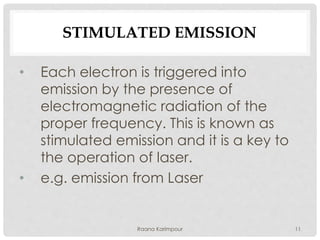
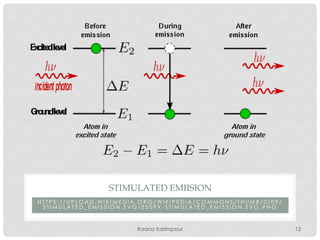
STIMULATED EMISSION
• Each electron is triggered into
emission by the presence of
electromagnetic radiation of the
proper frequency. This is known as
stimulated emission and it is a key to
the operation of laser.
• e.g. emission from Laser
11Raana Karimpour
H T T P S : / / U P L O A D . W I K I M E D I A . O R G / W I K I P E D I A / C O M M O N S / T H U M B / 0 / 0 9 /
S T I M U L A T E D _ E M I S S I O N . S V G / 5 5 0 P X - S T I M U L A T E D _ E M I S S I O N . S V G . P N G
STIMULATED EMIISION
12Raana Karimpour
H T T P S : / / W W W . R E S E A R C H G A T E . N E T / P R O F I L E / R O D R I G O _ D E _ M A T O S / P U B L I C A T I O N / 3 2 2 8 6 1 3 0 5 / F I
G U R E / F I G 2 / A S : 5 8 9 2 2 7 2 2 1 8 6 4 4 4 8 @ 1 5 1 7 4 9 4 1 2 5 3 0 4 / A B S O R P T I O N - S P O N T A N E O U S - E M I S S I O N -
A N D - S T I M U L A T E D - E M I S S I O N - 1 7 . P N G
BRIEFLY
13Raana Karimpour
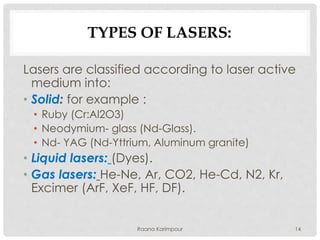
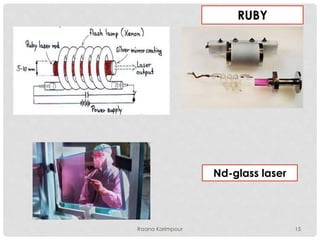
TYPES OF LASERS:
Lasers are classified according to laser active
medium into:
• Solid: for example :
• Ruby (Cr:Al2O3)
• Neodymium- glass (Nd-Glass).
• Nd- YAG (Nd-Yttrium, Aluminum granite)
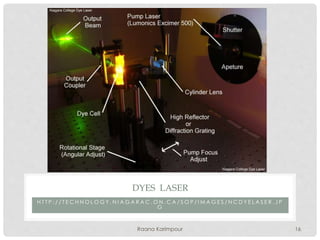
• Liquid lasers: (Dyes).
• Gas lasers: He-Ne, Ar, CO2, He-Cd, N2, Kr,
Excimer (ArF, XeF, HF, DF).
14Raana Karimpour
RUBY
Nd-glass laser
15Raana Karimpour
DYES LASER
H T T P : / / T E C H N O L O G Y . N I A G A R A C . O N . C A / S O P / I M A G E S / N C D Y E L A S E R . J P
G
16Raana Karimpour
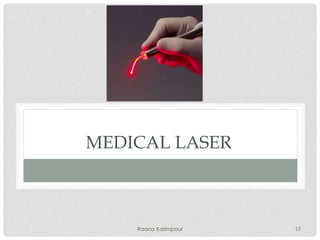
MEDICAL LASER
17Raana Karimpour
MEDICAL LASER
• In the medical field, dermatology, opthalmology
and endoscopicsurgery had been the main areas
employing the useof lasers so far. This has been
especially true for the high power or hot lasers.
• The use of the low power, cold or softlasers is
gaining increasing popularity within physical
therapy.
• The clinical application of the low output laser
encompasses areas concerned with acute and
chronic pain reduction, enhanced tissue healing
and regeneration, and acupuncture therapy
18Raana Karimpour
HISTORY
• Goldman (1962)
• McGuff (1963)
• Endre Mester (1967)
• Choy and Ginsburg (1983)
19Raana Karimpour
PRINCIPLE OF MEDICAL LASERS
• THE RIGHT WAVELENGTH
• THE RIGHT AMOUNT OF LASER ENERGY
• GETTING THE LASER ENERGY THERE:
20Raana Karimpour
CLASSIFICATION
• Laser in medicine can be classified into two general
groups:
1. High power (hot) laser
2. Low power( cold, soft) laser
The difference is based on the optical energy of the
laser.
Low power lasers carry 1-4 J energy and they are
known as :
-LPLT
-LILT
-LLLI
-cold laset therapy
21Raana Karimpour
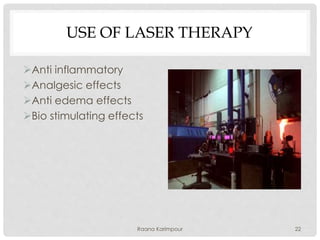
USE OF LASER THERAPY
Anti inflammatory
Analgesic effects
Anti edema effects
Bio stimulating effects
22Raana Karimpour
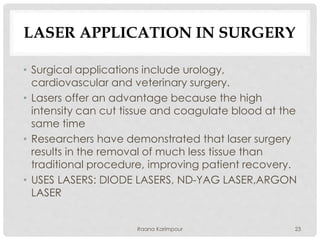
LASER APPLICATION IN SURGERY
• Surgical applications include urology,
cardiovascular and veterinary surgery.
• Lasers offer an advantage because the high
intensity can cut tissue and coagulate blood at the
same time
• Researchers have demonstrated that laser surgery
results in the removal of much less tissue than
traditional procedure, improving patient recovery.
• USES LASERS: DIODE LASERS, ND-YAG LASER,ARGON
LASER
23Raana Karimpour
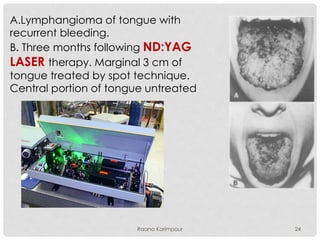
A.Lymphangioma of tongue with
recurrent bleeding.
B. Three months following ND:YAG
LASER therapy. Marginal 3 cm of
tongue treated by spot technique.
Central portion of tongue untreated
24Raana Karimpour
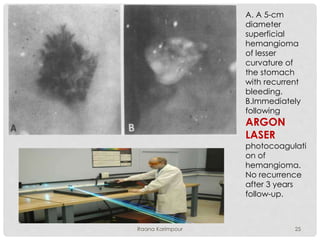
A. A 5-cm
diameter
superficial
hemangioma
of lesser
curvature of
the stomach
with recurrent
bleeding.
B.Immediately
following
ARGON
LASER
photocoagulati
on of
hemangioma.
No recurrence
after 3 years
follow-up.
25Raana Karimpour
LASER APPLICATION IN DENTISTRY
• Lasers have been used in dentistry since 1990s to
treat a number of conditions. The acceptance of
the laser technology has been growing, although it
is still a subject of active research.
• Lasers have been demonstrated in treatment of
tooth decay, gum disease, biopsies, removing of
lesions, activating a bleaching solution for whitening
teeth and curing of dental composites.
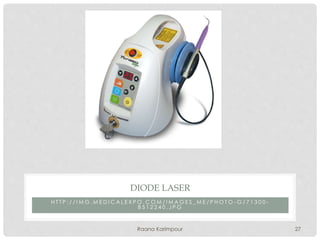
• USES LASERS: DIODE LASER MODULES, Cold
laser,CO2 laser
26Raana Karimpour
H T T P : / / I M G . M E D I C A L E X P O . C O M / I M A G E S _ M E / P H O T O - G / 7 1 3 0 0 -
8 5 1 2 2 4 0 . J P G
DIODE LASER
27Raana Karimpour
LASER APPLICATION IN
DERMATOLOGY
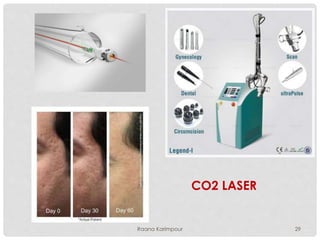
• Skin resurfacing and rejuvenation techniques work
by targeting water absorption in the mid-IR to heat
and ablate tissue or by subtle thermal effects,
stimulating a wound healing response.
• These applications cover a variety of conditions,
including wrinkle removal, sun damaged skin, age
spots and acne spots
• While both ablative and ablative techniques are
uses, the latter are growing in popularity.
28Raana Karimpour
CO2 LASER
29Raana Karimpour
LASER APPLICATION IN UROLOGY
Benign prostatic hyperplasia is a urological
condition that is caused by an enlarged
prostate gland. Surgeons use a laser to
remove the prostate tissue and improve
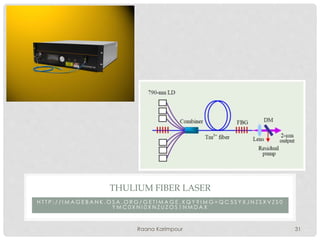
flow into the urethra. IPG’s Thulium fiber
laser has demonstrated positive outcomes
for this application.
Another widespread urological application is lithotripsy. Ho:YAG
laser is de facto standard of care for this procedure, whereas
potential of QCW thulium fiber laser is currently being explored.
30Raana Karimpour
H T T P : / / I M A G E B A N K . O S A . O R G / G E T I M A G E . X Q Y ? I M G = Q C 5 S Y X J N Z S X V Z S 0
Y M C 0 X N I 0 X N Z U Z O S 1 N M D A X
THULIUM FIBER LASER
31Raana Karimpour
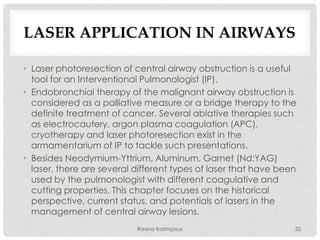
LASER APPLICATION IN AIRWAYS
• Laser photoresection of central airway obstruction is a useful
tool for an Interventional Pulmonologist (IP).
• Endobronchial therapy of the malignant airway obstruction is
considered as a palliative measure or a bridge therapy to the
definite treatment of cancer. Several ablative therapies such
as electrocautery, argon plasma coagulation (APC),
cryotherapy and laser photoresection exist in the
armamentarium of IP to tackle such presentations.
• Besides Neodymium-Yttrium, Aluminum, Garnet (Nd:YAG)
laser, there are several different types of laser that have been
used by the pulmonologist with different coagulative and
cutting properties. This chapter focuses on the historical
perspective, current status, and potentials of lasers in the
management of central airway lesions.
32Raana Karimpour
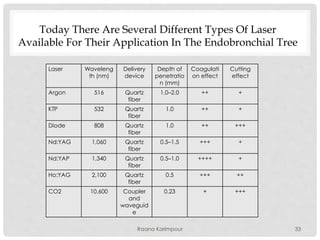
Today There Are Several Different Types Of Laser
Available For Their Application In The Endobronchial Tree
Laser Waveleng
th (nm)
Delivery
device
Depth of
penetratio
n (mm)
Coagulati
on effect
Cutting
effect
Argon 516 Quartz
fiber
1.0–2.0 ++ +
KTP 532 Quartz
fiber
1.0 ++ +
Diode 808 Quartz
fiber
1.0 ++ +++
Nd:YAG 1,060 Quartz
fiber
0.5–1.5 +++ +
Nd:YAP 1,340 Quartz
fiber
0.5–1.0 ++++ +
Ho:YAG 2,100 Quartz
fiber
0.5 +++ ++
CO2 10,600 Coupler
and
waveguid
e
0.23 + +++
33Raana Karimpour
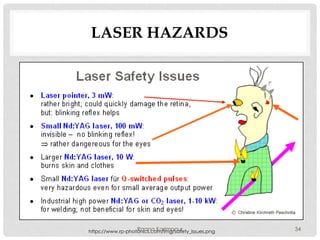
LASER HAZARDS
https://www.rp-photonics.com/img/safety_issues.png 34Raana Karimpour
CONCLUSION
• The biomedical effects of low power laser
irradiation have been investigated in various other
areas. Some of the more interesting settings include
immunosupression-immunostimulation, autoimmune
disease, and nerve regeneration.
• However, little published work exists with respect to
these and greater efforts have to be made to insure
their validity and further development.
35Raana Karimpour
REFERENCES
• Papers:
 Thiel, Haymo. "Low power laser therapy—an introduction and a
review of some biological effects." The Journal of the Canadian
Chiropractic Association 30.3 (1986): 133.
 Dixon, John A. "Current laser applications in general
surgery." Annals of surgery 207.4 (1988): 355.
 https://www.ncbi.nlm.nih.gov/pmc/articles/PMC5220034/
 Choy, D. S. J. "History of lasers in medicine." The Thoracic and
cardiovascular surgeon 36.S 2 (1988): 114-117.
• Books:
 Journal of Lasers in Medical Sciences
Sites:
https://www.ipgphotonics.com/en/applications/medical/surgery
http://sbmu.ac.ir/index.jsp?fkeyid=&siteid=150&pageid=274
36Raana Karimpour
THANK YOU
37Raana Karimpour

Laser application in medicine

  • 1.
    B Y :R A A N A K A R I M P O U R LASER APPLICATIONS TO MEDICINE Bachelor, Department of cellular and molecular biology, Faculty of advanced science and technology, Tehran Medical Sciences, Islamic Azad University, Tehran, Iran
  • 2.
    INTRODUCTION • This presentationgives a brief introduction to the characteristics of laser devices. • Absorption, tissue penetration and physiological mechanisms of laser irradiation are discussed. • The biological effects of low power laser light are reviewed in the areas of collagen metabolism, wound healing, inflammation and pain control. Contraindications, precautions and side effects of low power laser irradiation are discussed. 2Raana Karimpour
  • 3.
  • 4.
    BASIC CONCEPT • L.A.S.E.Ris an acronym for LIGHT AMPLIFICATIONS by STIMIULATED EMISSION of RADIATION • Which means the photons are amplified by the physical processes of the laser design. 4Raana Karimpour
  • 5.
    BASIC CONCEPT • Laseris a narrow beam of light of a single wavelength (monochromatic) in which each wave is in phase (coherent) with other near it. • Laser apparatus is a device that produce an intense concentrated, and highly parallel beam of coherent light 5Raana Karimpour
  • 6.
  • 7.
  • 8.
    BASIC THEORY FORLASER • Atom composed of a nucleus and electron cloud • If an incident photon is energetic enough, it may be absorbed by an atom, raising the latter to an excited state. • It was pointed out by Einstein in 1917 that an excited atom can be revert to a lowest state via two distinctive mechanisms: 1. spontaneous emission 2. stimulated emission 8Raana Karimpour
  • 9.
    SPONTANEOUS EMISSION • Eachelectron can drop back spontaneously to the ground state emitting photons. • Emitted photons bear no incoherent. It varies in phase from point to point and from moment to moment. • e.g. emission from tungsten lamp. 9Raana Karimpour
  • 10.
    H T TP S : / / U P L O A D . W I K I M E D I A . O R G / W I K I P E D I A / C O M M O N S / 1 / 1 4 / S P O N T A N E O U S E M I S S I O N . P N G SPONTANEOUS EMISSION 10Raana Karimpour
  • 11.
    STIMULATED EMISSION • Eachelectron is triggered into emission by the presence of electromagnetic radiation of the proper frequency. This is known as stimulated emission and it is a key to the operation of laser. • e.g. emission from Laser 11Raana Karimpour
  • 12.
    H T TP S : / / U P L O A D . W I K I M E D I A . O R G / W I K I P E D I A / C O M M O N S / T H U M B / 0 / 0 9 / S T I M U L A T E D _ E M I S S I O N . S V G / 5 5 0 P X - S T I M U L A T E D _ E M I S S I O N . S V G . P N G STIMULATED EMIISION 12Raana Karimpour
  • 13.
    H T TP S : / / W W W . R E S E A R C H G A T E . N E T / P R O F I L E / R O D R I G O _ D E _ M A T O S / P U B L I C A T I O N / 3 2 2 8 6 1 3 0 5 / F I G U R E / F I G 2 / A S : 5 8 9 2 2 7 2 2 1 8 6 4 4 4 8 @ 1 5 1 7 4 9 4 1 2 5 3 0 4 / A B S O R P T I O N - S P O N T A N E O U S - E M I S S I O N - A N D - S T I M U L A T E D - E M I S S I O N - 1 7 . P N G BRIEFLY 13Raana Karimpour
  • 14.
    TYPES OF LASERS: Lasersare classified according to laser active medium into: • Solid: for example : • Ruby (Cr:Al2O3) • Neodymium- glass (Nd-Glass). • Nd- YAG (Nd-Yttrium, Aluminum granite) • Liquid lasers: (Dyes). • Gas lasers: He-Ne, Ar, CO2, He-Cd, N2, Kr, Excimer (ArF, XeF, HF, DF). 14Raana Karimpour
  • 15.
  • 16.
    DYES LASER H TT P : / / T E C H N O L O G Y . N I A G A R A C . O N . C A / S O P / I M A G E S / N C D Y E L A S E R . J P G 16Raana Karimpour
  • 17.
  • 18.
    MEDICAL LASER • Inthe medical field, dermatology, opthalmology and endoscopicsurgery had been the main areas employing the useof lasers so far. This has been especially true for the high power or hot lasers. • The use of the low power, cold or softlasers is gaining increasing popularity within physical therapy. • The clinical application of the low output laser encompasses areas concerned with acute and chronic pain reduction, enhanced tissue healing and regeneration, and acupuncture therapy 18Raana Karimpour
  • 19.
    HISTORY • Goldman (1962) •McGuff (1963) • Endre Mester (1967) • Choy and Ginsburg (1983) 19Raana Karimpour
  • 20.
    PRINCIPLE OF MEDICALLASERS • THE RIGHT WAVELENGTH • THE RIGHT AMOUNT OF LASER ENERGY • GETTING THE LASER ENERGY THERE: 20Raana Karimpour
  • 21.
    CLASSIFICATION • Laser inmedicine can be classified into two general groups: 1. High power (hot) laser 2. Low power( cold, soft) laser The difference is based on the optical energy of the laser. Low power lasers carry 1-4 J energy and they are known as : -LPLT -LILT -LLLI -cold laset therapy 21Raana Karimpour
  • 22.
    USE OF LASERTHERAPY Anti inflammatory Analgesic effects Anti edema effects Bio stimulating effects 22Raana Karimpour
  • 23.
    LASER APPLICATION INSURGERY • Surgical applications include urology, cardiovascular and veterinary surgery. • Lasers offer an advantage because the high intensity can cut tissue and coagulate blood at the same time • Researchers have demonstrated that laser surgery results in the removal of much less tissue than traditional procedure, improving patient recovery. • USES LASERS: DIODE LASERS, ND-YAG LASER,ARGON LASER 23Raana Karimpour
  • 24.
    A.Lymphangioma of tonguewith recurrent bleeding. B. Three months following ND:YAG LASER therapy. Marginal 3 cm of tongue treated by spot technique. Central portion of tongue untreated 24Raana Karimpour
  • 25.
    A. A 5-cm diameter superficial hemangioma oflesser curvature of the stomach with recurrent bleeding. B.Immediately following ARGON LASER photocoagulati on of hemangioma. No recurrence after 3 years follow-up. 25Raana Karimpour
  • 26.
    LASER APPLICATION INDENTISTRY • Lasers have been used in dentistry since 1990s to treat a number of conditions. The acceptance of the laser technology has been growing, although it is still a subject of active research. • Lasers have been demonstrated in treatment of tooth decay, gum disease, biopsies, removing of lesions, activating a bleaching solution for whitening teeth and curing of dental composites. • USES LASERS: DIODE LASER MODULES, Cold laser,CO2 laser 26Raana Karimpour
  • 27.
    H T TP : / / I M G . M E D I C A L E X P O . C O M / I M A G E S _ M E / P H O T O - G / 7 1 3 0 0 - 8 5 1 2 2 4 0 . J P G DIODE LASER 27Raana Karimpour
  • 28.
    LASER APPLICATION IN DERMATOLOGY •Skin resurfacing and rejuvenation techniques work by targeting water absorption in the mid-IR to heat and ablate tissue or by subtle thermal effects, stimulating a wound healing response. • These applications cover a variety of conditions, including wrinkle removal, sun damaged skin, age spots and acne spots • While both ablative and ablative techniques are uses, the latter are growing in popularity. 28Raana Karimpour
  • 29.
  • 30.
    LASER APPLICATION INUROLOGY Benign prostatic hyperplasia is a urological condition that is caused by an enlarged prostate gland. Surgeons use a laser to remove the prostate tissue and improve flow into the urethra. IPG’s Thulium fiber laser has demonstrated positive outcomes for this application. Another widespread urological application is lithotripsy. Ho:YAG laser is de facto standard of care for this procedure, whereas potential of QCW thulium fiber laser is currently being explored. 30Raana Karimpour
  • 31.
    H T TP : / / I M A G E B A N K . O S A . O R G / G E T I M A G E . X Q Y ? I M G = Q C 5 S Y X J N Z S X V Z S 0 Y M C 0 X N I 0 X N Z U Z O S 1 N M D A X THULIUM FIBER LASER 31Raana Karimpour
  • 32.
    LASER APPLICATION INAIRWAYS • Laser photoresection of central airway obstruction is a useful tool for an Interventional Pulmonologist (IP). • Endobronchial therapy of the malignant airway obstruction is considered as a palliative measure or a bridge therapy to the definite treatment of cancer. Several ablative therapies such as electrocautery, argon plasma coagulation (APC), cryotherapy and laser photoresection exist in the armamentarium of IP to tackle such presentations. • Besides Neodymium-Yttrium, Aluminum, Garnet (Nd:YAG) laser, there are several different types of laser that have been used by the pulmonologist with different coagulative and cutting properties. This chapter focuses on the historical perspective, current status, and potentials of lasers in the management of central airway lesions. 32Raana Karimpour
  • 33.
    Today There AreSeveral Different Types Of Laser Available For Their Application In The Endobronchial Tree Laser Waveleng th (nm) Delivery device Depth of penetratio n (mm) Coagulati on effect Cutting effect Argon 516 Quartz fiber 1.0–2.0 ++ + KTP 532 Quartz fiber 1.0 ++ + Diode 808 Quartz fiber 1.0 ++ +++ Nd:YAG 1,060 Quartz fiber 0.5–1.5 +++ + Nd:YAP 1,340 Quartz fiber 0.5–1.0 ++++ + Ho:YAG 2,100 Quartz fiber 0.5 +++ ++ CO2 10,600 Coupler and waveguid e 0.23 + +++ 33Raana Karimpour
  • 34.
  • 35.
    CONCLUSION • The biomedicaleffects of low power laser irradiation have been investigated in various other areas. Some of the more interesting settings include immunosupression-immunostimulation, autoimmune disease, and nerve regeneration. • However, little published work exists with respect to these and greater efforts have to be made to insure their validity and further development. 35Raana Karimpour
  • 36.
    REFERENCES • Papers:  Thiel,Haymo. "Low power laser therapy—an introduction and a review of some biological effects." The Journal of the Canadian Chiropractic Association 30.3 (1986): 133.  Dixon, John A. "Current laser applications in general surgery." Annals of surgery 207.4 (1988): 355.  https://www.ncbi.nlm.nih.gov/pmc/articles/PMC5220034/  Choy, D. S. J. "History of lasers in medicine." The Thoracic and cardiovascular surgeon 36.S 2 (1988): 114-117. • Books:  Journal of Lasers in Medical Sciences Sites: https://www.ipgphotonics.com/en/applications/medical/surgery http://sbmu.ac.ir/index.jsp?fkeyid=&siteid=150&pageid=274 36Raana Karimpour
  • 37.