Page 1
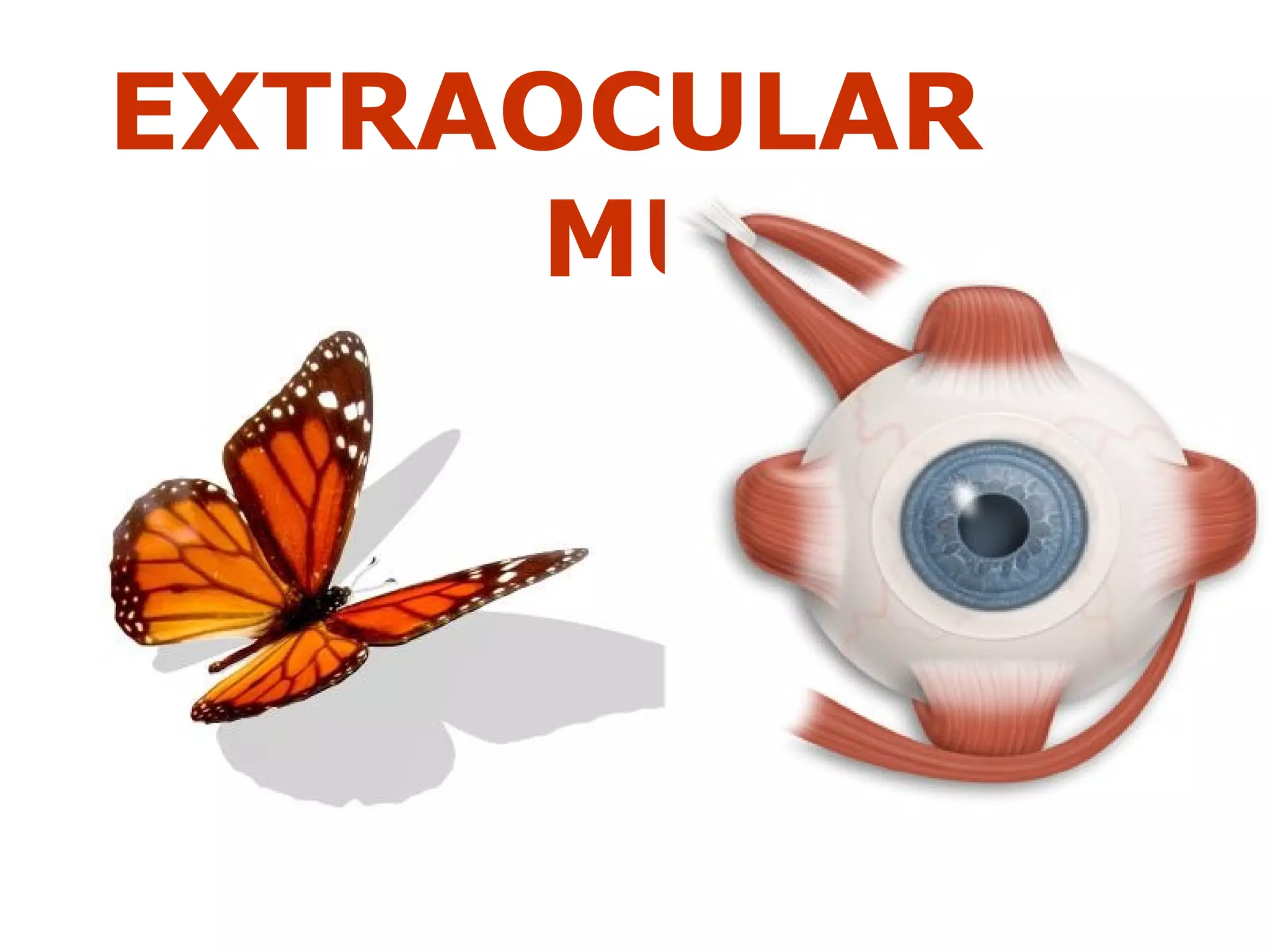
EXTRAOCULAR
MUSCLES
Page 2
-INTRODUCTION
-ANATOMY
-NAME, ORIGIN, INSERTION AND NERVE SUPPLY
-BLOOD SUPPLY
-ACTIONS
-PHYSIOLOGY OF OCULAR MOTILITY
-OCULAR MOVEMENTS
-EXTRAOCULAR ANOMALIES
Page 3
INTRODUCTION
-Muscles that helps and control the eye
mouvements
-Located within the orbit
-They are extrinsic (comming from
outside) and seperated from the eyeball
itself.
-They are six in numbers
Four rectus: SR, IR, MR and LR
Two oblique: SO and IO
Rectus: straight
Oblique: slanting (non-straight)
Page 4
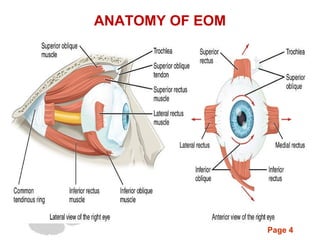
ANATOMY OF EOM
Page 5
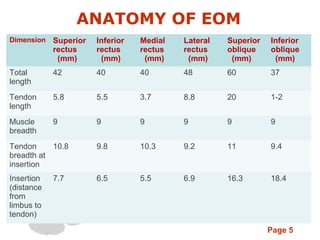
ANATOMY OF EOM
Dimension Superior
rectus
(mm)
Inferior
rectus
(mm)
Medial
rectus
(mm)
Lateral
rectus
(mm)
Superior
oblique
(mm)
Inferior
oblique
(mm)
Total
length
42 40 40 48 60 37
Tendon
length
5.8 5.5 3.7 8.8 20 1-2
Muscle
breadth
9 9 9 9 9 9
Tendon
breadth at
insertion
10.8 9.8 10.3 9.2 11 9.4
Insertion
(distance
from
limbus to
tendon)
7.7 6.5 5.5 6.9 16.3 18.4
Page 6
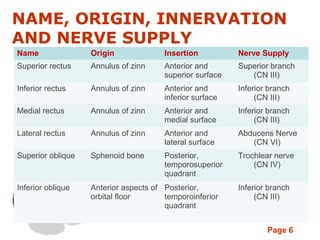
NAME, ORIGIN, INNERVATION
AND NERVE SUPPLY
Name Origin Insertion Nerve Supply
Superior rectus Annulus of zinn Anterior and
superior surface
Superior branch
(CN III)
Inferior rectus Annulus of zinn Anterior and
inferior surface
Inferior branch
(CN III)
Medial rectus Annulus of zinn Anterior and
medial surface
Inferior branch
(CN III)
Lateral rectus Annulus of zinn Anterior and
lateral surface
Abducens Nerve
(CN VI)
Superior oblique Sphenoid bone Posterior,
temporosuperior
quadrant
Trochlear nerve
(CN IV)
Inferior oblique Anterior aspects of
orbital floor
Posterior,
temporoinferior
quadrant
Inferior branch
(CN III)
Page 7
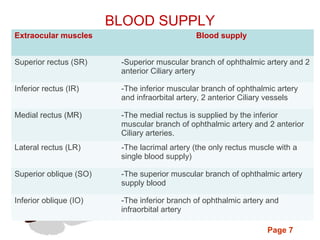
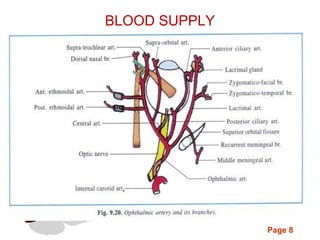
BLOOD SUPPLY
Extraocular muscles Blood supply
Superior rectus (SR) -Superior muscular branch of ophthalmic artery and 2
anterior Ciliary artery
Inferior rectus (IR) -The inferior muscular branch of ophthalmic artery
and infraorbital artery, 2 anterior Ciliary vessels
Medial rectus (MR) -The medial rectus is supplied by the inferior
muscular branch of ophthalmic artery and 2 anterior
Ciliary arteries.
Lateral rectus (LR) -The lacrimal artery (the only rectus muscle with a
single blood supply)
Superior oblique (SO) -The superior muscular branch of ophthalmic artery
supply blood
Inferior oblique (IO) -The inferior branch of ophthalmic artery and
infraorbital artery
Page 8
BLOOD SUPPLY
Page 9
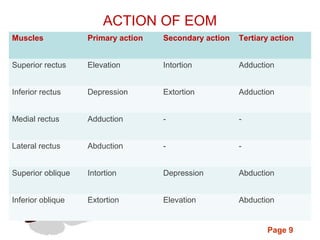
ACTION OF EOM
Muscles Primary action Secondary action Tertiary action
Superior rectus Elevation Intortion Adduction
Inferior rectus Depression Extortion Adduction
Medial rectus Adduction - -
Lateral rectus Abduction - -
Superior oblique Intortion Depression Abduction
Inferior oblique Extortion Elevation Abduction
Page 10
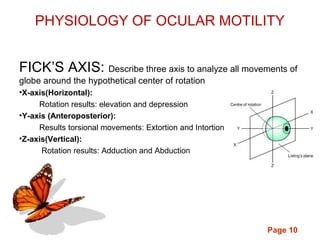
PHYSIOLOGY OF OCULAR MOTILITY
FICK’S AXIS: Describe three axis to analyze all movements of
globe around the hypothetical center of rotation
•X-axis(Horizontal):
Rotation results: elevation and depression
•Y-axis (Anteroposterior):
Results torsional movements: Extortion and Intortion
•Z-axis(Vertical):
Rotation results: Adduction and Abduction
Page 11
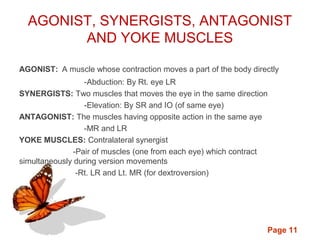
AGONIST, SYNERGISTS, ANTAGONIST
AND YOKE MUSCLES
AGONIST: A muscle whose contraction moves a part of the body directly
-Abduction: By Rt. eye LR
SYNERGISTS: Two muscles that moves the eye in the same direction
-Elevation: By SR and IO (of same eye)
ANTAGONIST: The muscles having opposite action in the same aye
-MR and LR
YOKE MUSCLES: Contralateral synergist
-Pair of muscles (one from each eye) which contract
simultaneously during version movements
-Rt. LR and Lt. MR (for dextroversion)
Page 12
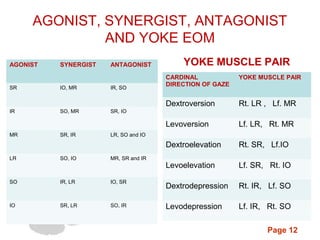
AGONIST, SYNERGIST, ANTAGONIST
AND YOKE EOM
AGONIST SYNERGIST ANTAGONIST
SR IO, MR IR, SO
IR SO, MR SR, IO
MR SR, IR LR, SO and IO
LR SO, IO MR, SR and IR
SO IR, LR IO, SR
IO SR, LR SO, IR
YOKE MUSCLE PAIR
CARDINAL
DIRECTION OF GAZE
YOKE MUSCLE PAIR
Dextroversion Rt. LR , Lf. MR
Levoversion Lf. LR, Rt. MR
Dextroelevation Rt. SR, Lf.IO
Levoelevation Lf. SR, Rt. IO
Dextrodepression Rt. IR, Lf. SO
Levodepression Lf. IR, Rt. SO
Page 13
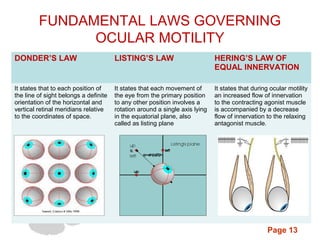
FUNDAMENTAL LAWS GOVERNING
OCULAR MOTILITY
DONDER’S LAW LISTING’S LAW HERING’S LAW OF
EQUAL INNERVATION
It states that to each position of
the line of sight belongs a definite
orientation of the horizontal and
vertical retinal meridians relative
to the coordinates of space.
It states that each movement of
the eye from the primary position
to any other position involves a
rotation around a single axis lying
in the equatorial plane, also
called as listing plane
It states that during ocular motility
an increased flow of innervation
to the contracting agonist muscle
is accompanied by a decrease
flow of innervation to the relaxing
antagonist muscle.
Page 14
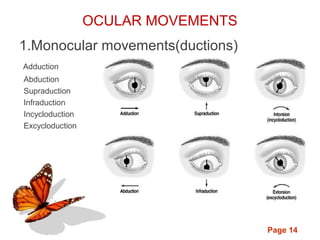
OCULAR MOVEMENTS
1.Monocular movements(ductions)
Adduction
Abduction
Supraduction
Infraduction
Incycloduction
Excycloduction
Page 15
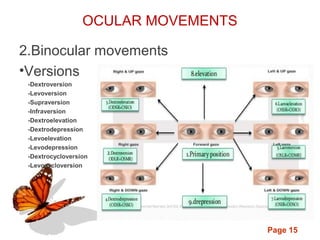
OCULAR MOVEMENTS
2.Binocular movements
•Versions
-Dextroversion
-Levoversion
-Supraversion
-Infraversion
-Dextroelevation
-Dextrodepression
-Levoelevation
-Levodepression
-Dextrocycloversion
-Levocycloversion
Page 16
OCULAR MOVEMENTS
• Vergence:
-Disjugate, synchronous and symmetric movements of the two eyes in opposite
direction
Disjugate: Rotation of the two eye in opposite direction (eg; convergence and
divergence)
Synchronous: Occurs at a same time
Symmetric: Exactly like another
-Are tonic movements and much slower then versions (Velocity of 80-250 per sec)
-Avergence may be voluntary movements or an optomotor reflex.
Optomotor reflex: A reflex turning of the eyes or head in response to the horizontal
movement of environmental objects.
Page 17
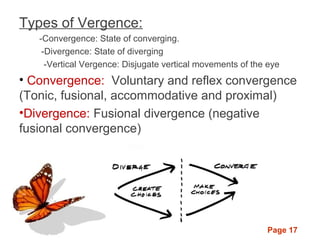
Types of Vergence:
-Convergence: State of converging.
-Divergence: State of diverging
-Vertical Vergence: Disjugate vertical movements of the eye
• Convergence: Voluntary and reflex convergence
(Tonic, fusional, accommodative and proximal)
•Divergence: Fusional divergence (negative
fusional convergence)
Page 18
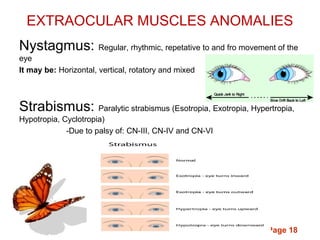
EXTRAOCULAR MUSCLES ANOMALIES
Nystagmus: Regular, rhythmic, repetative to and fro movement of the
eye
It may be: Horizontal, vertical, rotatory and mixed
Strabismus: Paralytic strabismus (Esotropia, Exotropia, Hypertropia,
Hypotropia, Cyclotropia)
-Due to palsy of: CN-III, CN-IV and CN-VI
Page 19
MANAGEMENT
Surgical management:
BY:
Resection: a surgical procedure to remove part of an organ
Recession: Retroplacement of the muscle from its original insertion.
Non-surgical management
Optical (glass, CL, prism)
Medical
Orthoptic exercise
Page 20
PRESENTED BY:
PURUSHOTAM KUMAR SAHANI
“Vasan Institute Of Ophthalmology And Research”
(Thanks for the look of appreciation)

Extraocular muscles

  • 1.
  • 2.
    Page 2 -INTRODUCTION -ANATOMY -NAME, ORIGIN,INSERTION AND NERVE SUPPLY -BLOOD SUPPLY -ACTIONS -PHYSIOLOGY OF OCULAR MOTILITY -OCULAR MOVEMENTS -EXTRAOCULAR ANOMALIES
  • 3.
    Page 3 INTRODUCTION -Muscles thathelps and control the eye mouvements -Located within the orbit -They are extrinsic (comming from outside) and seperated from the eyeball itself. -They are six in numbers Four rectus: SR, IR, MR and LR Two oblique: SO and IO Rectus: straight Oblique: slanting (non-straight)
  • 4.
  • 5.
    Page 5 ANATOMY OFEOM Dimension Superior rectus (mm) Inferior rectus (mm) Medial rectus (mm) Lateral rectus (mm) Superior oblique (mm) Inferior oblique (mm) Total length 42 40 40 48 60 37 Tendon length 5.8 5.5 3.7 8.8 20 1-2 Muscle breadth 9 9 9 9 9 9 Tendon breadth at insertion 10.8 9.8 10.3 9.2 11 9.4 Insertion (distance from limbus to tendon) 7.7 6.5 5.5 6.9 16.3 18.4
  • 6.
    Page 6 NAME, ORIGIN,INNERVATION AND NERVE SUPPLY Name Origin Insertion Nerve Supply Superior rectus Annulus of zinn Anterior and superior surface Superior branch (CN III) Inferior rectus Annulus of zinn Anterior and inferior surface Inferior branch (CN III) Medial rectus Annulus of zinn Anterior and medial surface Inferior branch (CN III) Lateral rectus Annulus of zinn Anterior and lateral surface Abducens Nerve (CN VI) Superior oblique Sphenoid bone Posterior, temporosuperior quadrant Trochlear nerve (CN IV) Inferior oblique Anterior aspects of orbital floor Posterior, temporoinferior quadrant Inferior branch (CN III)
  • 7.
    Page 7 BLOOD SUPPLY Extraocularmuscles Blood supply Superior rectus (SR) -Superior muscular branch of ophthalmic artery and 2 anterior Ciliary artery Inferior rectus (IR) -The inferior muscular branch of ophthalmic artery and infraorbital artery, 2 anterior Ciliary vessels Medial rectus (MR) -The medial rectus is supplied by the inferior muscular branch of ophthalmic artery and 2 anterior Ciliary arteries. Lateral rectus (LR) -The lacrimal artery (the only rectus muscle with a single blood supply) Superior oblique (SO) -The superior muscular branch of ophthalmic artery supply blood Inferior oblique (IO) -The inferior branch of ophthalmic artery and infraorbital artery
  • 8.
  • 9.
    Page 9 ACTION OFEOM Muscles Primary action Secondary action Tertiary action Superior rectus Elevation Intortion Adduction Inferior rectus Depression Extortion Adduction Medial rectus Adduction - - Lateral rectus Abduction - - Superior oblique Intortion Depression Abduction Inferior oblique Extortion Elevation Abduction
  • 10.
    Page 10 PHYSIOLOGY OFOCULAR MOTILITY FICK’S AXIS: Describe three axis to analyze all movements of globe around the hypothetical center of rotation •X-axis(Horizontal): Rotation results: elevation and depression •Y-axis (Anteroposterior): Results torsional movements: Extortion and Intortion •Z-axis(Vertical): Rotation results: Adduction and Abduction
  • 11.
    Page 11 AGONIST, SYNERGISTS,ANTAGONIST AND YOKE MUSCLES AGONIST: A muscle whose contraction moves a part of the body directly -Abduction: By Rt. eye LR SYNERGISTS: Two muscles that moves the eye in the same direction -Elevation: By SR and IO (of same eye) ANTAGONIST: The muscles having opposite action in the same aye -MR and LR YOKE MUSCLES: Contralateral synergist -Pair of muscles (one from each eye) which contract simultaneously during version movements -Rt. LR and Lt. MR (for dextroversion)
  • 12.
    Page 12 AGONIST, SYNERGIST,ANTAGONIST AND YOKE EOM AGONIST SYNERGIST ANTAGONIST SR IO, MR IR, SO IR SO, MR SR, IO MR SR, IR LR, SO and IO LR SO, IO MR, SR and IR SO IR, LR IO, SR IO SR, LR SO, IR YOKE MUSCLE PAIR CARDINAL DIRECTION OF GAZE YOKE MUSCLE PAIR Dextroversion Rt. LR , Lf. MR Levoversion Lf. LR, Rt. MR Dextroelevation Rt. SR, Lf.IO Levoelevation Lf. SR, Rt. IO Dextrodepression Rt. IR, Lf. SO Levodepression Lf. IR, Rt. SO
  • 13.
    Page 13 FUNDAMENTAL LAWSGOVERNING OCULAR MOTILITY DONDER’S LAW LISTING’S LAW HERING’S LAW OF EQUAL INNERVATION It states that to each position of the line of sight belongs a definite orientation of the horizontal and vertical retinal meridians relative to the coordinates of space. It states that each movement of the eye from the primary position to any other position involves a rotation around a single axis lying in the equatorial plane, also called as listing plane It states that during ocular motility an increased flow of innervation to the contracting agonist muscle is accompanied by a decrease flow of innervation to the relaxing antagonist muscle.
  • 14.
    Page 14 OCULAR MOVEMENTS 1.Monocularmovements(ductions) Adduction Abduction Supraduction Infraduction Incycloduction Excycloduction
  • 15.
    Page 15 OCULAR MOVEMENTS 2.Binocularmovements •Versions -Dextroversion -Levoversion -Supraversion -Infraversion -Dextroelevation -Dextrodepression -Levoelevation -Levodepression -Dextrocycloversion -Levocycloversion
  • 16.
    Page 16 OCULAR MOVEMENTS •Vergence: -Disjugate, synchronous and symmetric movements of the two eyes in opposite direction Disjugate: Rotation of the two eye in opposite direction (eg; convergence and divergence) Synchronous: Occurs at a same time Symmetric: Exactly like another -Are tonic movements and much slower then versions (Velocity of 80-250 per sec) -Avergence may be voluntary movements or an optomotor reflex. Optomotor reflex: A reflex turning of the eyes or head in response to the horizontal movement of environmental objects.
  • 17.
    Page 17 Types ofVergence: -Convergence: State of converging. -Divergence: State of diverging -Vertical Vergence: Disjugate vertical movements of the eye • Convergence: Voluntary and reflex convergence (Tonic, fusional, accommodative and proximal) •Divergence: Fusional divergence (negative fusional convergence)
  • 18.
    Page 18 EXTRAOCULAR MUSCLESANOMALIES Nystagmus: Regular, rhythmic, repetative to and fro movement of the eye It may be: Horizontal, vertical, rotatory and mixed Strabismus: Paralytic strabismus (Esotropia, Exotropia, Hypertropia, Hypotropia, Cyclotropia) -Due to palsy of: CN-III, CN-IV and CN-VI
  • 19.
    Page 19 MANAGEMENT Surgical management: BY: Resection:a surgical procedure to remove part of an organ Recession: Retroplacement of the muscle from its original insertion. Non-surgical management Optical (glass, CL, prism) Medical Orthoptic exercise
  • 20.
    Page 20 PRESENTED BY: PURUSHOTAMKUMAR SAHANI “Vasan Institute Of Ophthalmology And Research” (Thanks for the look of appreciation)