1Immunohistochemistry
www.ptglab.com
IMMUNOHISTOCHEMISTRY
EXPERIMENT
How To Optimize Your
Technical Tips and Troubleshooting
www.ptglab.com
2Immunohistochemistry
www.ptglab.com
CONTENTS
Introduction
Applications
IHC Protocol
Antigen Retrieval
Blocking
Selection And Optimization Of Antibodies
For IHC
Detection And Visualization
IHC Controls
Troubleshooting
Contact Us
3
4
5–10
11–14
15
16–18
19–22
23
24–26
27
3Immunohistochemistry
www.ptglab.com
INTRODUCTION
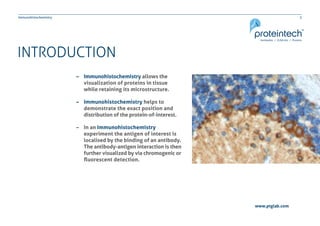
–– Immunohistochemistry allows the 		
	 visualization of proteins in tissue 		
	 while retaining its microstructure.
–– Immunohistochemistry helps to 		
	 demonstrate the exact position and 	
	 distribution of the protein-of-interest.
–– In an Immunohistochemistry 		
	 experiment the antigen of interest is 	
	 localised by the binding of an antibody. 	
	 The antibody-antigen interaction is then 	
	 further visualized by via chromogenic or 	
	 fluorescent detection.
4Immunohistochemistry
www.ptglab.com
APPLICATIONS
–– Prognostic markers in cancer
–– Tumours of uncertain histogenesis
–– Metastasis
–– Responses to treatments
–– Infections
–– Neurodegenerative diseases
–– Muscle diseases
–– Brain trauma
IHC is a crucial technique
widely used in different
medical research laboratories
and clinical diagnostics.
5Immunohistochemistry
www.ptglab.com
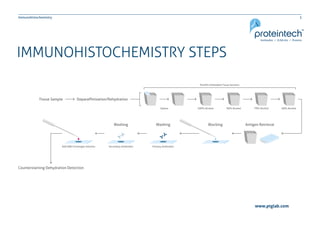
IMMUNOHISTOCHEMISTRY STEPS
6Immunohistochemistry
www.ptglab.com
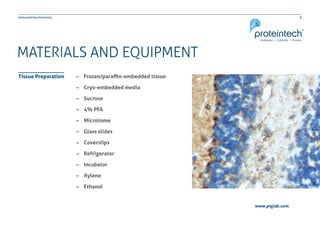
MATERIALS AND EQUIPMENT
–– Frozen/paraffin-embedded tissue
–– Cryo-embedded media
–– Sucrose
–– 4% PFA
–– Microtome
–– Glass slides
–– Coverslips
–– Refrigerator
–– Incubator
–– Xylene
–– Ethanol
Tissue Preparation
7Immunohistochemistry
www.ptglab.com
MATERIALS AND EQUIPMENT
–– Serum, BSA
–– Citrate buffer
–– Tris-EDTA buffer
–– Boiling source
–– Primary and secondary antibodies
–– Hematoxyline
–– Citrate/Tris-EDTA buffer
–– DAB solution
–– Microscope
Tissue Treatment
Detection/
Visualization
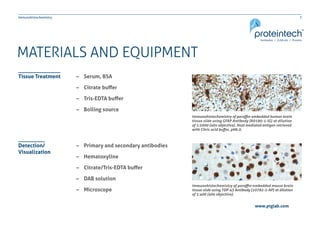
Immunohistochemistry of paraffin-embedded human brain
tissue slide using GFAP Antibody (60190-1-IG) at dilution
of 1:5000 (40x objective). Heat mediated antigen retrieved
with Citric acid buffer, pH6.0.
Immunohistochemistry of paraffin-embedded mouse brain
tissue slide using TDP-43 Antibody (10782-2-AP) at dilution
of 1:400 (40x objective).
8Immunohistochemistry
www.ptglab.com
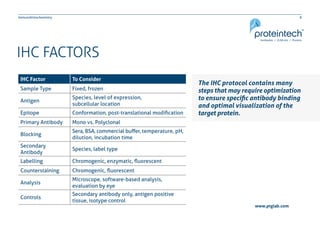
IHC FACTORS
IHC Factor To Consider
Sample Type Fixed, frozen
Antigen
Species, level of expression,
subcellular location
Epitope Conformation, post-translational modification
Primary Antibody Mono vs. Polyclonal
Blocking
Sera, BSA, commercial buffer, temperature, pH,
dilution, incubation time
Secondary
Antibody
Species, label type
Labelling Chromogenic, enzymatic, fluorescent
Counterstaining Chromogenic, fluorescent
Analysis
Microscope, software-based analysis,
evaluation by eye
Controls
Secondary antibody only, antigen positive
tissue, isotype control
The IHC protocol contains many
steps that may require optimization
to ensure specific antibody binding
and optimal visualization of the
target protein.
9Immunohistochemistry
www.ptglab.com
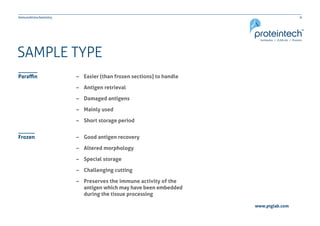
SAMPLE TYPE
–– Easier (than frozen sections) to handle
–– Antigen retrieval
–– Damaged antigens
–– Mainly used
–– Short storage period
–– Good antigen recovery
–– Altered morphology
–– Special storage
–– Challenging cutting
–– Preserves the immune activity of the 	
	 antigen which may have been embedded 	
	 during the tissue processing
Paraffin
Frozen
10Immunohistochemistry
www.ptglab.com
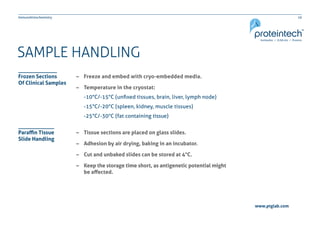
SAMPLE HANDLING
–– Freeze and embed with cryo-embedded media.
–– Temperature in the cryostat:
-10°C/-15°C (unfixed tissues, brain, liver, lymph node)
-15°C/-20°C (spleen, kidney, muscle tissues)
-25°C/-30°C (fat containing tissue)
–– Tissue sections are placed on glass slides.
–– Adhesion by air drying, baking in an incubator.
–– Cut and unbaked slides can be stored at 4°C.
–– Keep the storage time short, as antigenetic potential might
	 be affected.
Frozen Sections
Of Clinical Samples
Paraffin Tissue
Slide Handling
11Immunohistochemistry
www.ptglab.com
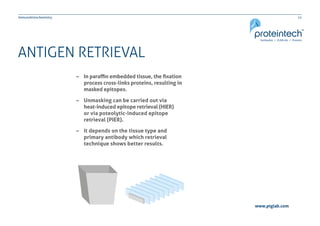
ANTIGEN RETRIEVAL
–– In paraffin embedded tissue, the fixation 	
	 process cross-links proteins, resulting in 	
	 masked epitopes.
–– Unmasking can be carried out via
	 heat-induced epitope retrieval (HIER) 	
	 or via poteolytic-induced epitope 		
	 retrieval (PIER).
–– It depends on the tissue type and
	 primary antibody which retrieval 		
	 technique shows better results.
12Immunohistochemistry
www.ptglab.com
SAMPLE HANDLING
–– Heat up for a certain time in a specific buffer.
–– Microwave, pressure cooker, water bath, steamer, etc.
–– Citrate buffer/Tris-EDTA buffer.
–– EDTA buffer for antibodies against phospho-tyrosines.
–– Used enzymes are trypsin, proteinase k, pepsin, protease
	 or pronase.
–– Trypsin digestion:
1. Prepare the trypsin and pre-heat to 37ºC. Pipette the
                           enzyme solution onto the section.
2. Place the slides in a humidified container and then into
                          37ºC incubator.
3. After 15 min, remove the slides from the incubator and
                          transfer to a rack in a container with tap water. Rinse with
                          running water for 3 min.
Heat-induced
Epitope Retrieval
(HIER)
Proteolytic-induced
Epitope Retrieval
(PIER)
13Immunohistochemistry
www.ptglab.com
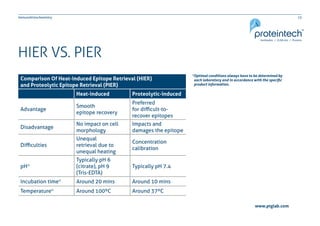
HIER VS. PIER
Comparison Of Heat-induced Epitope Retrieval (HIER)
and Proteolytic Epitope Retrieval (PIER)
Heat-induced Proteolytic-induced
Advantage
Smooth
epitope recovery
Preferred
for difficult-to-
recover epitopes
Disadvantage
No impact on cell
morphology
Impacts and
damages the epitope
Difficulties
Unequal
retrieval due to
unequal heating
Concentration
calibration
pH*
Typically pH 6
(citrate), pH 9
(Tris-EDTA)
Typically pH 7.4
Incubation time* Around 20 mins Around 10 mins
Temperature* Around 100ºC Around 37ºC
*Optimal conditions always have to be determined by
              each laboratory and in accordance with the specific
              product information.
14Immunohistochemistry
www.ptglab.com
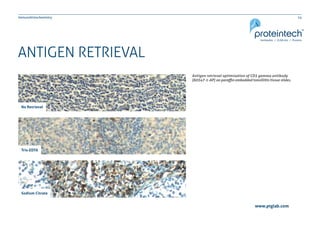
ANTIGEN RETRIEVAL
Antigen retrieval optimization of CD3 gamma antibody
(60347-1-AP) on paraffin embedded tonsillitis tissue slides.
Tris-EDTA
Sodium Citrate
No Retrieval
15Immunohistochemistry
www.ptglab.com
BLOCKING
–– Serum or bovine serum albumin (BSA).
–– Prevents unspecific binding to hydrophobic side chains of 	 	
	 proteins present in tissue.
–– Serum in multi-stainings, blocking serum against all used 		
	 secondary antibodies is needed.
–– If BSA is used, add 0.1–0.5% Trition-X or Tween.
–– Non-specific ionic bindings due to e.g. Van der Waals
	 interactions, dipole-dipole interactions or net charges
	 of specific amino acid groups.
–– Alter the ionic strength of the antibody dilution.
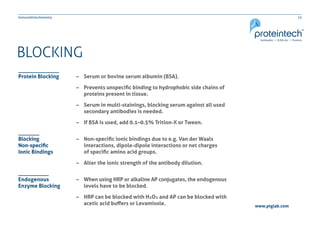
–– When using HRP or alkaline AP conjugates, the endogenous 	 	
	 levels have to be blocked.
–– HRP can be blocked with H₂O₂ and AP can be blocked with
	 acetic acid buffers or Levamisole.
Protein Blocking
Blocking
Non-specific
Ionic Bindings
Endogenous
Enzyme Blocking
16Immunohistochemistry
www.ptglab.com
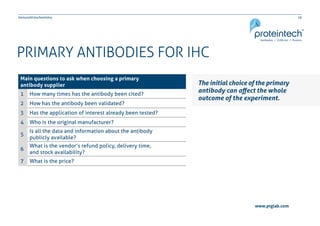
PRIMARY ANTIBODIES FOR IHC
Main questions to ask when choosing a primary
antibody supplier
1 How many times has the antibody been cited?
2 How has the antibody been validated?
3 Has the application of interest already been tested?
4 Who is the original manufacturer?
5
Is all the data and information about the antibody
publicly available?
6
What is the vendor’s refund policy, delivery time,
and stock availability?
7 What is the price?
The initial choice of the primary
antibody can affect the whole
outcome of the experiment.
17Immunohistochemistry
www.ptglab.com
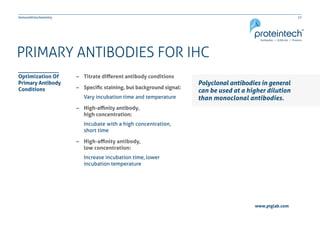
PRIMARY ANTIBODIES FOR IHC
Polyclonal antibodies in general
can be used at a higher dilution
than monoclonal antibodies.
–– Titrate different antibody conditions
–– Specific staining, but background signal:
Vary incubation time and temperature
–– High-affinity antibody,
	 high concentration:
Incubate with a high concentration,
short time
–– High-affinity antibody,
	 low concentration:
Increase incubation time, lower
incubation temperature
Optimization Of
Primary Antibody
Conditions
18Immunohistochemistry
www.ptglab.com
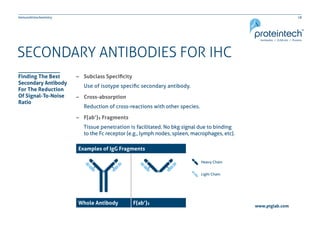
SECONDARY ANTIBODIES FOR IHC
Examples of IgG Fragments
Whole Antibody F(ab’)₂
Heavy Chain
Light Chain
–– Subclass Specificity
Use of isotype specific secondary antibody.
–– Cross-absorption
Reduction of cross-reactions with other species.
–– F(ab’)₂ Fragments
Tissue penetration is facilitated. No bkg signal due to binding
to the Fc receptor (e.g., lymph nodes, spleen, macrophages, etc).
Finding The Best
Secondary Antibody
For The Reduction
Of Signal-To-Noise
Ratio
19Immunohistochemistry
www.ptglab.com
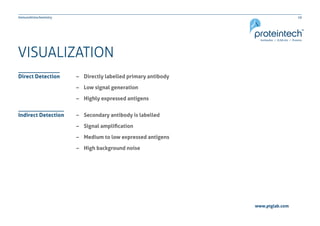
VISUALIZATION
–– Directly labelled primary antibody
–– Low signal generation
–– Highly expressed antigens
–– Secondary antibody is labelled
–– Signal amplification
–– Medium to low expressed antigens
–– High background noise
Direct Detection
Indirect Detection
20Immunohistochemistry
www.ptglab.com
VISUALIZATION
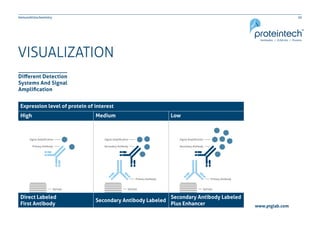
Different Detection
Systems And Signal
Amplification
Expression level of protein of interest
High Medium Low
Direct Labeled
First Antibody
Secondary Antibody Labeled
Plus Enhancer
21Immunohistochemistry
www.ptglab.com
VISUALIZATION
–– Enzyme attached to primary or secondary antibody
–– Forms insoluble coloured product, when an organic substrate
	 is added
–– Horseradish Peroxidase (HRP) and Alkaline Phosphatase react 	
	 with e.g., 3,3’ Diaminobenzidine (DAB)
–– Fluorochrome attached to primary or secondary antibody
–– Beneficial for multi-colour staining experiments
–– Limited by the short lifetime of fluorescent labelled probes
Chromogenic
Signal Generation
Fluorescent
Signal Generation
22Immunohistochemistry
www.ptglab.com
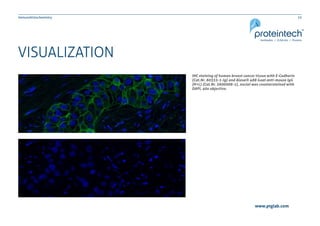
IHC staining of human breast cancer tissue with E-Cadherin
(Cat.Nr. 60335-1-Ig) and Alexa® 488 Goat anti-mouse IgG
(H+L) (Cat.Nr. SA00006-1), nuclei was counterstained with
DAPI, 40x objective.
VISUALIZATION
23Immunohistochemistry
www.ptglab.com
CONTROLS
–– Control tissue that is known to express the protein of interest.
–– Detection of false negative results.
–– Helps to validate the protocol.
–– Control tissue that is known not to express the protein
	 of interest.
–– Incubation just with the secondary antibody.
–– Observation of unstained tissue in brightfield/
	 fluorescence channel gives an idea about biological
	 background signal/autofluorescence.
–– Incubation with a non-immune immunoglobulin of the
	 same isotype.
Positive Control
Negative Control
24Immunohistochemistry
www.ptglab.com
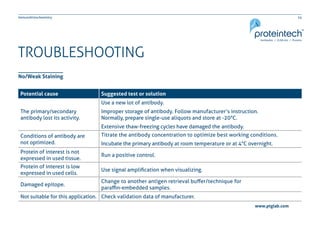
TROUBLESHOOTING
No/Weak Staining
Potential cause Suggested test or solution
The primary/secondary
antibody lost its activity.
Use a new lot of antibody.
Improper storage of antibody. Follow manufacturer’s instruction.
Normally, prepare single-use aliquots and store at -20°C.
Extensive thaw-freezing cycles have damaged the antibody.
Conditions of antibody are
not optimized.
Titrate the antibody concentration to optimize best working conditions.
Incubate the primary antibody at room temperature or at 4°C overnight.
Protein of interest is not
expressed in used tissue.
Run a positive control.
Protein of interest is low
expressed in used cells.
Use signal amplification when visualizing.
Damaged epitope.
Change to another antigen retrieval buffer/technique for
paraffin-embedded samples.
Not suitable for this application. Check validation data of manufacturer.
25Immunohistochemistry
www.ptglab.com
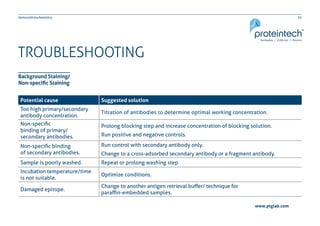
TROUBLESHOOTING
Background Staining/
Non-specific Staining
Potential cause Suggested solution
Too high primary/secondary
antibody concentration.
Titration of antibodies to determine optimal working concentration.
Non-specific
binding of primary/
secondary antibodies.
Prolong blocking step and increase concentration of blocking solution.
Run positive and negative controls.
Non-specific binding
of secondary antibodies.
Run control with secondary antibody only.
Change to a cross-adsorbed secondary antibody or a fragment antibody.
Sample is poorly washed. Repeat or prolong washing step.
Incubation temperature/time
is not suitable.
Optimize conditions.
Damaged epitope.
Change to another antigen retrieval buffer/ technique for
paraffin-embedded samples.
26Immunohistochemistry
www.ptglab.com
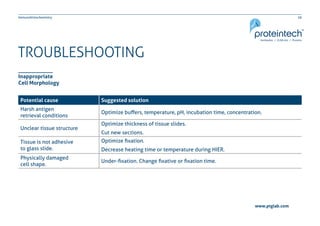
TROUBLESHOOTING
Inappropriate
Cell Morphology
Potential cause Suggested solution
Harsh antigen
retrieval conditions
Optimize buffers, temperature, pH, incubation time, concentration.
Unclear tissue structure
Optimize thickness of tissue slides.
Cut new sections.
Tissue is not adhesive
to glass slide.
Optimize fixation.
Decrease heating time or temperature during HIER.
Physically damaged
cell shape.
Under-fixation. Change fixative or fixation time.
27Immunohistochemistry
www.ptglab.com
CONTACT US
proteintech@ptglab.com
europe@ptglab.com
service@ptglab.com
Available 24 hours via Live Chat and 9–5
(CDT) via phone.
Proteintech Group
Proteintech Europe
Proteintech
Support
US Head Office
United Kingdom
China Office
Please visit us at www.ptglab.com for
more information about our antibodies
and technical tips.

How To Optimize Your Immunohistochemistry Experiment

  • 1.
  • 2.
    2Immunohistochemistry www.ptglab.com CONTENTS Introduction Applications IHC Protocol Antigen Retrieval Blocking SelectionAnd Optimization Of Antibodies For IHC Detection And Visualization IHC Controls Troubleshooting Contact Us 3 4 5–10 11–14 15 16–18 19–22 23 24–26 27
  • 3.
    3Immunohistochemistry www.ptglab.com INTRODUCTION –– Immunohistochemistry allowsthe visualization of proteins in tissue while retaining its microstructure. –– Immunohistochemistry helps to demonstrate the exact position and distribution of the protein-of-interest. –– In an Immunohistochemistry experiment the antigen of interest is localised by the binding of an antibody. The antibody-antigen interaction is then further visualized by via chromogenic or fluorescent detection.
  • 4.
    4Immunohistochemistry www.ptglab.com APPLICATIONS –– Prognostic markersin cancer –– Tumours of uncertain histogenesis –– Metastasis –– Responses to treatments –– Infections –– Neurodegenerative diseases –– Muscle diseases –– Brain trauma IHC is a crucial technique widely used in different medical research laboratories and clinical diagnostics.
  • 5.
  • 6.
    6Immunohistochemistry www.ptglab.com MATERIALS AND EQUIPMENT ––Frozen/paraffin-embedded tissue –– Cryo-embedded media –– Sucrose –– 4% PFA –– Microtome –– Glass slides –– Coverslips –– Refrigerator –– Incubator –– Xylene –– Ethanol Tissue Preparation
  • 7.
    7Immunohistochemistry www.ptglab.com MATERIALS AND EQUIPMENT ––Serum, BSA –– Citrate buffer –– Tris-EDTA buffer –– Boiling source –– Primary and secondary antibodies –– Hematoxyline –– Citrate/Tris-EDTA buffer –– DAB solution –– Microscope Tissue Treatment Detection/ Visualization Immunohistochemistry of paraffin-embedded human brain tissue slide using GFAP Antibody (60190-1-IG) at dilution of 1:5000 (40x objective). Heat mediated antigen retrieved with Citric acid buffer, pH6.0. Immunohistochemistry of paraffin-embedded mouse brain tissue slide using TDP-43 Antibody (10782-2-AP) at dilution of 1:400 (40x objective).
  • 8.
    8Immunohistochemistry www.ptglab.com IHC FACTORS IHC FactorTo Consider Sample Type Fixed, frozen Antigen Species, level of expression, subcellular location Epitope Conformation, post-translational modification Primary Antibody Mono vs. Polyclonal Blocking Sera, BSA, commercial buffer, temperature, pH, dilution, incubation time Secondary Antibody Species, label type Labelling Chromogenic, enzymatic, fluorescent Counterstaining Chromogenic, fluorescent Analysis Microscope, software-based analysis, evaluation by eye Controls Secondary antibody only, antigen positive tissue, isotype control The IHC protocol contains many steps that may require optimization to ensure specific antibody binding and optimal visualization of the target protein.
  • 9.
    9Immunohistochemistry www.ptglab.com SAMPLE TYPE –– Easier(than frozen sections) to handle –– Antigen retrieval –– Damaged antigens –– Mainly used –– Short storage period –– Good antigen recovery –– Altered morphology –– Special storage –– Challenging cutting –– Preserves the immune activity of the antigen which may have been embedded during the tissue processing Paraffin Frozen
  • 10.
    10Immunohistochemistry www.ptglab.com SAMPLE HANDLING –– Freezeand embed with cryo-embedded media. –– Temperature in the cryostat: -10°C/-15°C (unfixed tissues, brain, liver, lymph node) -15°C/-20°C (spleen, kidney, muscle tissues) -25°C/-30°C (fat containing tissue) –– Tissue sections are placed on glass slides. –– Adhesion by air drying, baking in an incubator. –– Cut and unbaked slides can be stored at 4°C. –– Keep the storage time short, as antigenetic potential might be affected. Frozen Sections Of Clinical Samples Paraffin Tissue Slide Handling
  • 11.
    11Immunohistochemistry www.ptglab.com ANTIGEN RETRIEVAL –– Inparaffin embedded tissue, the fixation process cross-links proteins, resulting in masked epitopes. –– Unmasking can be carried out via heat-induced epitope retrieval (HIER) or via poteolytic-induced epitope retrieval (PIER). –– It depends on the tissue type and primary antibody which retrieval technique shows better results.
  • 12.
    12Immunohistochemistry www.ptglab.com SAMPLE HANDLING –– Heatup for a certain time in a specific buffer. –– Microwave, pressure cooker, water bath, steamer, etc. –– Citrate buffer/Tris-EDTA buffer. –– EDTA buffer for antibodies against phospho-tyrosines. –– Used enzymes are trypsin, proteinase k, pepsin, protease or pronase. –– Trypsin digestion: 1. Prepare the trypsin and pre-heat to 37ºC. Pipette the                            enzyme solution onto the section. 2. Place the slides in a humidified container and then into                           37ºC incubator. 3. After 15 min, remove the slides from the incubator and                           transfer to a rack in a container with tap water. Rinse with                           running water for 3 min. Heat-induced Epitope Retrieval (HIER) Proteolytic-induced Epitope Retrieval (PIER)
  • 13.
    13Immunohistochemistry www.ptglab.com HIER VS. PIER ComparisonOf Heat-induced Epitope Retrieval (HIER) and Proteolytic Epitope Retrieval (PIER) Heat-induced Proteolytic-induced Advantage Smooth epitope recovery Preferred for difficult-to- recover epitopes Disadvantage No impact on cell morphology Impacts and damages the epitope Difficulties Unequal retrieval due to unequal heating Concentration calibration pH* Typically pH 6 (citrate), pH 9 (Tris-EDTA) Typically pH 7.4 Incubation time* Around 20 mins Around 10 mins Temperature* Around 100ºC Around 37ºC *Optimal conditions always have to be determined by               each laboratory and in accordance with the specific               product information.
  • 14.
    14Immunohistochemistry www.ptglab.com ANTIGEN RETRIEVAL Antigen retrievaloptimization of CD3 gamma antibody (60347-1-AP) on paraffin embedded tonsillitis tissue slides. Tris-EDTA Sodium Citrate No Retrieval
  • 15.
    15Immunohistochemistry www.ptglab.com BLOCKING –– Serum orbovine serum albumin (BSA). –– Prevents unspecific binding to hydrophobic side chains of proteins present in tissue. –– Serum in multi-stainings, blocking serum against all used secondary antibodies is needed. –– If BSA is used, add 0.1–0.5% Trition-X or Tween. –– Non-specific ionic bindings due to e.g. Van der Waals interactions, dipole-dipole interactions or net charges of specific amino acid groups. –– Alter the ionic strength of the antibody dilution. –– When using HRP or alkaline AP conjugates, the endogenous levels have to be blocked. –– HRP can be blocked with H₂O₂ and AP can be blocked with acetic acid buffers or Levamisole. Protein Blocking Blocking Non-specific Ionic Bindings Endogenous Enzyme Blocking
  • 16.
    16Immunohistochemistry www.ptglab.com PRIMARY ANTIBODIES FORIHC Main questions to ask when choosing a primary antibody supplier 1 How many times has the antibody been cited? 2 How has the antibody been validated? 3 Has the application of interest already been tested? 4 Who is the original manufacturer? 5 Is all the data and information about the antibody publicly available? 6 What is the vendor’s refund policy, delivery time, and stock availability? 7 What is the price? The initial choice of the primary antibody can affect the whole outcome of the experiment.
  • 17.
    17Immunohistochemistry www.ptglab.com PRIMARY ANTIBODIES FORIHC Polyclonal antibodies in general can be used at a higher dilution than monoclonal antibodies. –– Titrate different antibody conditions –– Specific staining, but background signal: Vary incubation time and temperature –– High-affinity antibody, high concentration: Incubate with a high concentration, short time –– High-affinity antibody, low concentration: Increase incubation time, lower incubation temperature Optimization Of Primary Antibody Conditions
  • 18.
    18Immunohistochemistry www.ptglab.com SECONDARY ANTIBODIES FORIHC Examples of IgG Fragments Whole Antibody F(ab’)₂ Heavy Chain Light Chain –– Subclass Specificity Use of isotype specific secondary antibody. –– Cross-absorption Reduction of cross-reactions with other species. –– F(ab’)₂ Fragments Tissue penetration is facilitated. No bkg signal due to binding to the Fc receptor (e.g., lymph nodes, spleen, macrophages, etc). Finding The Best Secondary Antibody For The Reduction Of Signal-To-Noise Ratio
  • 19.
    19Immunohistochemistry www.ptglab.com VISUALIZATION –– Directly labelledprimary antibody –– Low signal generation –– Highly expressed antigens –– Secondary antibody is labelled –– Signal amplification –– Medium to low expressed antigens –– High background noise Direct Detection Indirect Detection
  • 20.
    20Immunohistochemistry www.ptglab.com VISUALIZATION Different Detection Systems AndSignal Amplification Expression level of protein of interest High Medium Low Direct Labeled First Antibody Secondary Antibody Labeled Secondary Antibody Labeled Plus Enhancer
  • 21.
    21Immunohistochemistry www.ptglab.com VISUALIZATION –– Enzyme attachedto primary or secondary antibody –– Forms insoluble coloured product, when an organic substrate is added –– Horseradish Peroxidase (HRP) and Alkaline Phosphatase react with e.g., 3,3’ Diaminobenzidine (DAB) –– Fluorochrome attached to primary or secondary antibody –– Beneficial for multi-colour staining experiments –– Limited by the short lifetime of fluorescent labelled probes Chromogenic Signal Generation Fluorescent Signal Generation
  • 22.
    22Immunohistochemistry www.ptglab.com IHC staining ofhuman breast cancer tissue with E-Cadherin (Cat.Nr. 60335-1-Ig) and Alexa® 488 Goat anti-mouse IgG (H+L) (Cat.Nr. SA00006-1), nuclei was counterstained with DAPI, 40x objective. VISUALIZATION
  • 23.
    23Immunohistochemistry www.ptglab.com CONTROLS –– Control tissuethat is known to express the protein of interest. –– Detection of false negative results. –– Helps to validate the protocol. –– Control tissue that is known not to express the protein of interest. –– Incubation just with the secondary antibody. –– Observation of unstained tissue in brightfield/ fluorescence channel gives an idea about biological background signal/autofluorescence. –– Incubation with a non-immune immunoglobulin of the same isotype. Positive Control Negative Control
  • 24.
    24Immunohistochemistry www.ptglab.com TROUBLESHOOTING No/Weak Staining Potential causeSuggested test or solution The primary/secondary antibody lost its activity. Use a new lot of antibody. Improper storage of antibody. Follow manufacturer’s instruction. Normally, prepare single-use aliquots and store at -20°C. Extensive thaw-freezing cycles have damaged the antibody. Conditions of antibody are not optimized. Titrate the antibody concentration to optimize best working conditions. Incubate the primary antibody at room temperature or at 4°C overnight. Protein of interest is not expressed in used tissue. Run a positive control. Protein of interest is low expressed in used cells. Use signal amplification when visualizing. Damaged epitope. Change to another antigen retrieval buffer/technique for paraffin-embedded samples. Not suitable for this application. Check validation data of manufacturer.
  • 25.
    25Immunohistochemistry www.ptglab.com TROUBLESHOOTING Background Staining/ Non-specific Staining Potentialcause Suggested solution Too high primary/secondary antibody concentration. Titration of antibodies to determine optimal working concentration. Non-specific binding of primary/ secondary antibodies. Prolong blocking step and increase concentration of blocking solution. Run positive and negative controls. Non-specific binding of secondary antibodies. Run control with secondary antibody only. Change to a cross-adsorbed secondary antibody or a fragment antibody. Sample is poorly washed. Repeat or prolong washing step. Incubation temperature/time is not suitable. Optimize conditions. Damaged epitope. Change to another antigen retrieval buffer/ technique for paraffin-embedded samples.
  • 26.
    26Immunohistochemistry www.ptglab.com TROUBLESHOOTING Inappropriate Cell Morphology Potential causeSuggested solution Harsh antigen retrieval conditions Optimize buffers, temperature, pH, incubation time, concentration. Unclear tissue structure Optimize thickness of tissue slides. Cut new sections. Tissue is not adhesive to glass slide. Optimize fixation. Decrease heating time or temperature during HIER. Physically damaged cell shape. Under-fixation. Change fixative or fixation time.
  • 27.
    27Immunohistochemistry www.ptglab.com CONTACT US proteintech@ptglab.com europe@ptglab.com service@ptglab.com Available 24hours via Live Chat and 9–5 (CDT) via phone. Proteintech Group Proteintech Europe Proteintech Support US Head Office United Kingdom China Office Please visit us at www.ptglab.com for more information about our antibodies and technical tips.